
A jet-driven strike leveled a Kharkiv preschool as 400+ drones battered cities, U.S. sanctions finally hit Rosneft and Lukoil, and Moscow answered diplomacy with a nuclear show.
The Day’s Reckoning
October 22, 2025—the 1,337th day of Russia’s full-scale invasion—began before dawn with the sound of sirens rolling across Kyiv’s empty streets. Within minutes, the sky filled with the whine of engines as Russia unleashed one of the largest air assaults of the war—hundreds of drones and missiles fired in waves meant to overwhelm every layer of Ukraine’s defenses. By sunrise, the smoke of burning substations and apartment blocks rose from Kyiv to Odesa. Six civilians were dead, among them a six-month-old baby and a twelve-year-old girl.
But the destruction from the sky was only half the story. In Washington, after months of hesitation, President Donald Trump finally imposed sweeping sanctions on Rosneft and Lukoil—the twin engines of Russia’s oil empire. In the same breath, his long-planned peace summit with Vladimir Putin collapsed, undone by the Kremlin’s refusal to yield an inch from its maximalist demands. Moscow’s answer was theatrical: a full nuclear-forces exercise featuring intercontinental launches and submarine tests, staged to remind the world that it still had levers of fear.
And then, amid all the geopolitics and spectacle, came the image that froze the day in moral clarity: a kindergarten in Kharkiv struck by drones in broad daylight. Forty-eight children and their teachers crouched in a basement as the building above them disintegrated. One man was killed nearby. The children lived. Russia’s war for “de-Nazification” had found its newest target—a preschool.
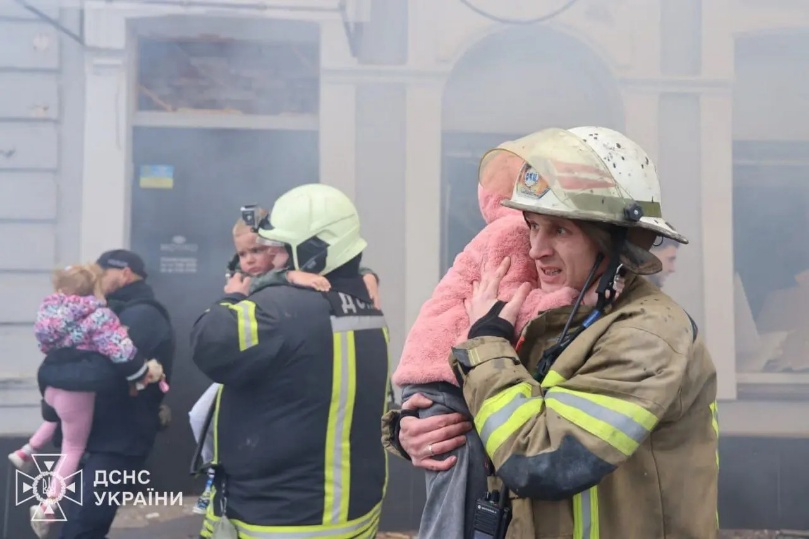
Children’s backpacks and toys lie scattered in the rubble after a Russian drone strike leveled a kindergarten in Kharkiv — a grim reminder that even classrooms have become frontlines in this war. (State Emergency Service of Ukraine / Telegram)
The Night of 400 Drones
The first hums came low and far off, like distant generators. Then the sky erupted. Kyiv’s night turned to chaos as hundreds of drones poured in from every direction, their engines screaming through the wind. The air defenses answered in flashes of white light and thunderclaps that rolled through the city’s concrete valleys.
In an apartment corridor, Halyna Sharii sat clutching her blanket as dust rained from the ceiling. “I thought our building was falling,” she said later. “But it was the one next door.” A few blocks away, Ira Lukiants stepped into the hallway of her ninth-floor flat, barefoot and trembling, the air thick with plaster dust. “You don’t think, you just wait,” she said. “Then you’re still alive—and the fear catches up after.”
By dawn, the sky was gray with smoke. Two people dead in Kyiv, twenty-nine wounded, five of them children. East of the city, firefighters pulled the remains of a young family from the wreckage of their home—a mother, father, baby, and twelve-year-old girl who had tried to hide together.
Emergency crews worked through the morning restoring power as air-raid sirens faded. “Another night proving that Russia is not feeling enough pressure,” Zelensky said, as engineers fought to bring electricity back to the capital. Above the Danube, NATO jets lifted off to track what was left of the swarm. The war’s edges had widened again, and the sound of those engines carried farther than ever before.
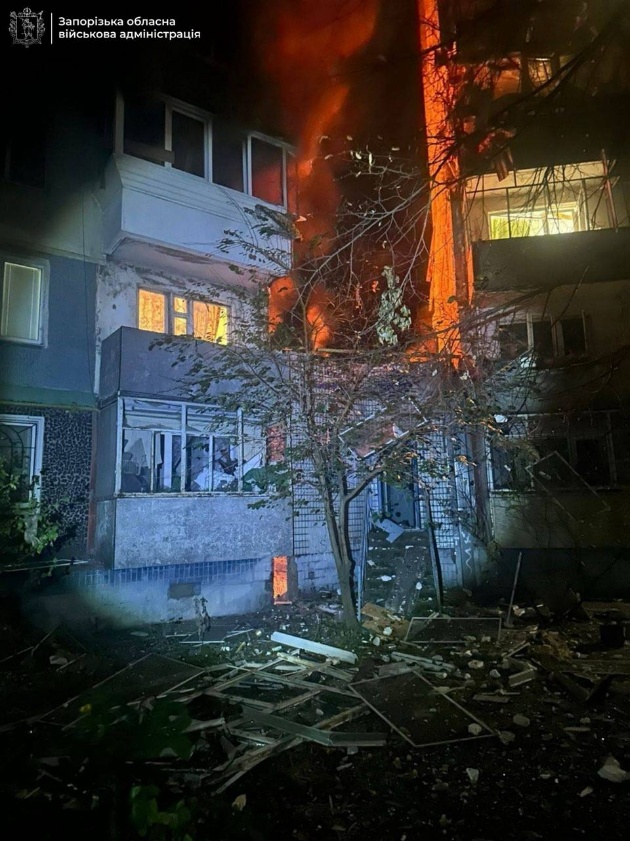
Fire consumes a residential building after one of the heaviest overnight barrages of the war, as rescue crews battle flames through the night in a Kyiv neighborhood scarred by debris and falling drones. (Ivan Fedorov / Telegram)
The Kindergarten Strike: When Russia Attacked Childhood Itself
The morning had been calm until the sound came—too sharp, too fast to be the usual Shahed. Teachers in the Kharkiv kindergarten froze for a split second, then moved as one. “Basement, now!” someone shouted. Tiny shoes slapped against linoleum, teachers guiding trembling hands toward the shelter just as the windows turned white.
The explosion lifted the air itself. Glass, crayons, and storybooks vanished in the flash. When it was over, the playground was gone, the roof torn apart, sunlight pouring through the smoke. Down below, forty-eight children sat pressed together in the dim shelter, whispering prayers they didn’t yet understand.
Above them, rescuers picked through burning wreckage. A man who’d been walking nearby lay dead. Nine others were wounded. It was later confirmed that this had been no ordinary drone strike—the attackers had used new jet-powered Geran-2s, faster and quieter than the buzzing Shaheds that once gave warning. These came almost silent, almost invisible, and struck before anyone could reach cover.
When firefighters finally opened the shelter door, the children blinked up through the haze as if waking from a nightmare. Some clutched their stuffed animals; others simply stared. “There is no justification for a drone strike on a kindergarten,” Zelensky said that afternoon. “None. Ever.”
The strike landed the same morning the White House hosted NATO’s secretary general, and just hours after Trump’s meeting with Putin collapsed. Moscow’s answer to diplomacy was not words—it was the ruin of a preschool, a clear signal that nothing, not even peace talks, would restrain its cruelty.
Trump’s Tardy Pressure: Sanctions That Came in the Smoke
The statement from Washington landed midmorning, long after the smoke over Kyiv had already turned the sky gray. The U.S. Treasury’s Office of Foreign Assets Control announced sweeping sanctions against Rosneft and Lukoil—Russia’s twin oil giants and lifelines of its war economy. The language tried for firmness, promising to “cut off the Kremlin’s war machine.” But to Ukrainians digging children out of rubble, it sounded like justice delayed.
Treasury Secretary Scott Bessent said the move was meant to push Putin toward peace: “Now is the time to stop the killing.” The sanctions froze all entities tied to Rosneft and Lukoil, warning foreign banks that any deal with Russia’s arms industry could now sever their access to the dollar system. It was the first true economic strike by the Trump administration since the war began—measured, comprehensive, and months overdue.
At the White House, Trump called it “a very big day,” telling NATO Secretary General Mark Rutte that he hoped the sanctions “won’t be on for long.” Rutte was more candid: “This has to change Putin’s calculus.” Ukraine’s ambassador in Washington, Olha Stefanishyna, chose her words carefully—“for the first time in office”—a polite reminder that Kyiv had begged for this step since January.
But as officials spoke of leverage and pressure, the timing mocked the logic. The sanctions arrived the same day Russian drones turned kindergartens to ash. Whatever pain the measures might one day cause in Moscow, they could not undo the horror already written into this morning.
The Storm Shadow Confusion: When Words and Weapons Diverged
It began with a headline that rippled through Washington like an aftershock. The Wall Street Journal reported that the Trump administration had quietly lifted restrictions on Ukraine’s use of British Storm Shadow missiles—long-range weapons capable of striking deep inside Russia. For Kyiv’s military, it meant a green light to reach the war’s industrial heart. For diplomats, it meant a problem no one wanted to admit existed.
The decision, according to unnamed U.S. officials, had been made before Zelensky’s recent White House meeting. The authority had shifted from Defense Secretary Pete Hegseth—known to oppose cross-border strikes—to General Alexus Grynkewich, NATO’s supreme commander in Europe, who had testified that Ukraine could win the war. Soon after, explosions tore through the Bryansk Chemical Plant, which produced propellants and rocket fuel. Ukraine’s General Staff confirmed the strike, describing it as a multi-service operation using Air Force, Ground, and Navy coordination—something that only worked with American satellite intelligence.
Then Trump posted. “FAKE NEWS,” he wrote. “The U.S. has nothing to do with those missiles.” In a few sentences, he cast doubt on the Journal’s story, his own Pentagon, and the broader policy line of his administration.
The truth likely sat in the gray space between words. Britain had supplied the Storm Shadows, but they flew with U.S. GPS and targeting data. America could stop their use at any time by closing the data feed—no order, no press release, just silence on a satellite link. For Ukraine, that distinction was academic. The missiles were flying, Russian factories were burning, and Washington’s denials were as calibrated as its cooperation.
The Summit That Wasn’t: When Diplomacy Met Russian Reality
The collapse came quietly, like a door closing in another room. Trump’s much-promoted Budapest summit with Putin was suddenly off, canceled with a single phrase—he didn’t want a “wasted meeting.” Behind that understatement was a week of diplomatic friction that stripped away what little hope remained for compromise.
In Washington, aides confirmed what insiders already knew: Moscow had refused every U.S. overture for a ceasefire along the existing front. Secretary of State Marco Rubio’s call with Sergei Lavrov had gone nowhere. Russia still demanded full control of Donetsk and Luhansk, still insisted that NATO be banned from Ukrainian soil, still offered nothing but the promise to “stop attacking” once its terms were met.
Then came the non-paper—a deliberately informal document sent from Moscow to Washington that spelled out the Kremlin’s true position in cold language. Russia wanted land it didn’t yet hold, veto rights over Ukraine’s security, and Western recognition of its occupation. It was not a proposal; it was a blueprint for surrender.
Trump, sensing the trap, walked away. Calling off the summit allowed him to blame Putin’s obstinacy while preserving his self-image as a dealmaker above the fray. For Zelensky and Europe, the cancellation brought a strange kind of relief. A frozen conflict on Russia’s terms would have been no peace at all—just a pause before the next invasion. Better no summit than one that rewarded aggression.
The Kremlin’s Blame Game: Rewriting the Failure
When the summit collapsed, Moscow already had its scapegoats prepared. Within hours, Kremlin spokesmen flooded the airwaves with claims that “Western gossip” and “European interference” had sabotaged the talks. Dmitry Peskov said there had never been a date for a Trump–Putin meeting anyway—an easy way to deny what had just fallen apart.
Others joined the chorus. Kirill Dmitriev, Moscow’s investment chief, accused Western media of “distorting the truth to destroy peace.” Lawmakers insisted the summit was still being arranged, even as diplomats knew it was dead. Deputy Foreign Minister Sergei Ryabkov went further, suggesting unnamed “actors opposed to peace” were rewriting the narrative to make Russia look obstinate. The irony was staggering: while Russia’s missiles struck kindergartens and power plants, its officials were performing the theater of victimhood.
This was the same choreography Russia had used since the war’s first days—pretend to seek peace, refuse every compromise, then blame others for the failure. It was propaganda posing as diplomacy, designed to keep domestic audiences docile and to fracture Western unity. The truth was simpler and darker. Russia wasn’t negotiating peace. It was staging innocence.
Nuclear Theater: Putin’s Choreographed Display of Power
It began with light against the northern sky—a Yars intercontinental missile streaking upward from Plesetsk, followed by the muffled roar of a Sineva launch from a submarine beneath the Barents Sea. Moments later, Tu-95 bombers released their payloads, tracing thin white arcs across the stratosphere. The spectacle was deliberate, synchronized, and unmistakably timed.
On the same day Washington imposed oil sanctions and the long-planned summit collapsed, Putin ordered a full demonstration of Russia’s nuclear triad. Officially, it was a “readiness test.” Unofficially, it was theater: a reminder that Moscow could still command the world’s attention with fire.
Deputy Foreign Minister Sergei Ryabkov turned the launches into a podium, declaring that NATO’s “aggressive policies” had forced Russia’s hand. He spoke of treaties and arms control, blaming the West for every suspension and withdrawal—from the INF to the Comprehensive Test-Ban—while offering to extend New START for a single year, as if to appear reasonable amid the saber-rattling.
It was the oldest Kremlin trick: create a crisis, then offer to end it—for a price. The message beneath the spectacle was clear enough. Talk to us about arms control, not Ukraine. By staging apocalypse to win attention, Russia wasn’t signaling readiness for peace—it was reminding the world that even its bluffs come armed.
The European Peace Plan: Twelve Points to Nowhere
As the Trump-Putin summit crumbled, Europe tried to fill the vacuum. In quiet back channels between Brussels, The Hague, and Kyiv, diplomats shaped what they called a “twelve-point peace framework.” NATO Secretary General Mark Rutte carried the draft to Washington, hoping to convince Trump that Europe had a plan both moral and pragmatic—something that could end the war without rewarding invasion.
The proposal froze the frontlines where they stood and demanded the return of all deported Ukrainian children—an attempt to tie peace to justice. Sanctions would lift in phases if Russia complied; $300 billion in frozen Russian assets would remain hostage until Moscow helped rebuild what it had destroyed. To flatter Trump’s dealmaker instincts, the plan even offered him a chairmanship over a “peace board” that would supervise implementation.
On paper, it balanced sticks and incentives with rare sophistication. In reality, it was dead before arrival. The Kremlin’s own non-paper had already made rejection certain: full control of Donetsk and Luhansk, NATO barred from Ukraine, and recognition of every occupation line. The plan’s architects knew it would fail—but failure was part of the strategy.
By proposing something detailed, humane, and enforceable, Europe shifted the burden of rejection back to Moscow. If Russia dismissed it—and it would—the world would see where the obstacle to peace truly lay. The twelve-point plan wasn’t a door to reconciliation; it was a mirror held up to Russia’s face.
The Reservist Gambit: Mobilization by Another Name
The announcement came quietly from the Russian Ministry of Defense, framed as routine. Active reservists, officials said, would now help defend “critical infrastructure” from Ukrainian drone attacks—oil refineries, rail lines, and power facilities spread across the Russian interior. Vice Admiral Vladimir Tsimlyansky explained that these men would form “mobile fire teams,” drawn from the same factories and energy plants they were assigned to protect. They would, in effect, guard their own workplaces.
It sounded practical, even logical. Who better to know a facility’s weak points than those who work there? But the move had a second, unstated purpose. The Kremlin was experimenting with a new kind of mobilization—one that could expand manpower without ever declaring it.
Tsimlyansky denied that these reservists would fight in Ukraine. “There is no mention of mobilization,” he said. Yet the draft law that accompanied his statement told a different story. It would allow the Defense Ministry to deploy members of the “human mobilization reserve” abroad, bypassing the need for a formal declaration of war. The measure created a legal gray zone—an army without an announcement.
Even pro-war bloggers sensed the ploy. “Fire groups without radar or air defense are just targets,” one wrote. The criticism was apt. Ukraine’s own mobile defense relied on a layered system of radar, jamming, and interceptors. Russia’s new plan looked like theater—cheap optics in place of strategy.
Behind the technical language lay the real motive: control the narrative at home. The Kremlin needed to look proactive without admitting weakness. It needed more men without calling them soldiers. And it needed to buy time, drafting civilians one policy at a time while pretending nothing had changed.
Ukraine Strikes Back: Fire in the Russian Heartland
The explosion came just after dawn—an orange bloom rising above the gray skyline of Makhachkala, hundreds of kilometers from the front. For a moment it looked like sunrise. Then the smoke thickened, and sirens began to wail. The target was the Makhachkala Oil Refinery in Dagestan, a key supplier for Russia’s Caspian naval base. Ukrainian drones had reached it after flying fifteen hundred kilometers through Russian airspace, slipping past layer after layer of defenses to strike the refinery’s Sargas unit and ignite a roaring fire.
Almost simultaneously, another blast rocked the Saransk Mechanical Plant in Mordovia, an industrial complex that produced detonators, mining kits, and components for Russia’s artillery. Hours later, the Ministry of Defense grudgingly confirmed “damage at an unspecified enterprise.” It was the same phrase Moscow had used dozens of times before—denial through vagueness.
The scale of the operation revealed how far Ukraine’s reach had grown. These were not symbolic strikes on empty fields; they hit the machinery that powered Russia’s war—fuel, ammunition, logistics. A separate explosion along the Pskov–St. Petersburg rail line disrupted a key supply corridor, forcing Russian forces to reroute equipment bound for the front.
Russian officials boasted that air defenses had downed forty-four drones that night. What they didn’t mention was that several dozen had still made it through. In Makhachkala, refinery workers evacuated under falling debris; in Saransk, windows shattered miles away. For the first time, many Russians saw the war not on television but in the glow on their own horizon.
The message was unmistakable: the front had moved. Distance was no longer protection.
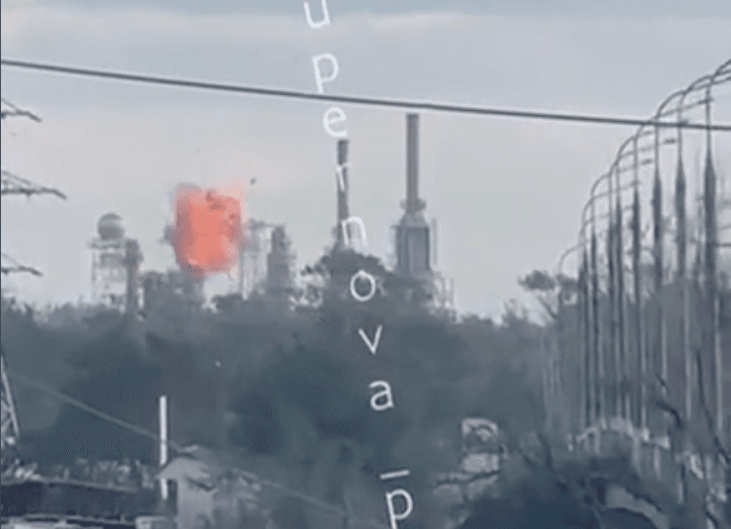
A Ukrainian drone strike ignites a massive fire at an oil refinery deep inside Russia, sending plumes of smoke over the facility and marking another blow to Moscow’s war-sustaining fuel network. (Telegram)
Explosions in the Rear: Stavropol and Kopeysk
Even as fires burned in Dagestan and Mordovia, two more blasts deep inside Russia shattered the illusion of safety.
In Stavropol, the sound came first—a sharp crack that echoed across the street from the 247th Guards Airborne Regiment base. When smoke cleared, rescuers found a baby stroller overturned at the bus stop, its metal frame twisted from the blast. One woman was dead, several others wounded. The bomb had been hidden inside the stroller, placed with care and precision. Whoever planted it knew the rhythm of the soldiers’ shifts, the flow of people, the blind spots in surveillance. This was not a protest—it was a message.
Hours later and a thousand kilometers east, another explosion tore through the Plastmass ammunition factory in Kopeysk. Flames shot through the roof, followed by a chain of secondary detonations that rattled windows miles away. Governor Alexei Teksler confirmed nine dead, five injured. The plant produced shells and detonators for the front, and by nightfall it was little more than twisted steel and blackened earth.
For Russian planners, these strikes were more than sabotage—they were arithmetic. Every soldier pulled from the front to guard a depot or base was one less available for combat. Yet without those guards, the next explosion was inevitable. Across eleven time zones, Russia was discovering the cost of fighting a war it could no longer contain: no city was beyond reach, no civilian beyond danger.
Frontline Grinds Forward: The War That No Longer Pauses
The war along the frontlines no longer roars—it grinds. Every day begins the same: the thud of artillery, the hum of drones, the gray horizon of the Donbas swallowing men and machines alike. October’s rain has turned roads into mud, and yet the fighting goes on, measured not in kilometers but in meters, in lives traded for a treeline or a trench.
Near Dobropillya, Ukrainian assault troops broke through in Kucheriv Yar—a small name on the map, but a rare moment of movement in a landscape long defined by stalemate. Footage showed captured Russians lying face down in the mud, fifty of them taken alive. For once, the blue-and-yellow flag advanced rather than held.
Further south near Pokrovsk, Russia clawed forward by inches. Armored vehicles pushed through the ruins of Myrnohrad, only to be destroyed in a counterstrike by the 7th Air Assault Corps. The same ground changed hands twice in a single morning. Drone footage from nearby Pokrovsk revealed what the reports could not—bodies sprawled on the pavement, civilians caught between the armies, the city itself serving as executioner.
In the forests near Lyman, Russian infantry crept forward in small groups, hiding in basements and dugouts, avoiding direct fire until reinforcements arrived. Ukrainian electronic warfare teams jammed twelve hundred Russian FPV drones in a single month, yet new ones kept coming, as if assembled faster than they could be shot down.
Across the fields near Velykyi Burluk and Oleksandrivka, light vehicles—buggies, motorcycles, anything that moved—carried Russian troops through the mud. It was a battlefield out of a different century, patched with 21st-century drones and 20th-century desperation.
In Kherson, the riverfront burned again. A drone struck a civilian car near the Antonivskyi Bridge, injuring an elderly man who had thought the day calm enough to drive.
Everywhere, the pattern repeated: Russian assaults without breakthrough, Ukrainian defenses without rest. Gains were counted in meters; losses in blood. No front collapsed, no army retreated. The war simply pressed forward, relentless and mechanical, as if powered not by strategy or victory but by the grim inertia of men too deep in to stop.
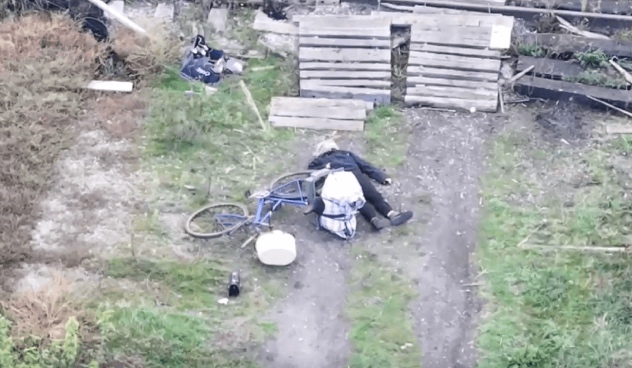
Bodies lie motionless on a street in central Pokrovsk after a Russian strike, as captured in drone footage filmed by a Ukrainian soldier — a stark record of civilians caught in the crossfire of the Donetsk front. (Denys Khrystov)
Kyiv Struck Again: When Night Brought No Relief
By evening, Kyiv’s skies glowed again—the color of fire seen through smoke. The first wave of drones had barely ceased when new explosions echoed across the city at eleven o’clock. After twenty hours of defense, the gunners and radar crews had no strength left to celebrate the day’s survival. Now, they braced for another.
In the old Podil neighborhood, shards of glass glittered beneath the lamps outside the Great Choral Synagogue. Across the street, a residential building lay torn open. “It’s not a non-zero risk that any one of us could have died,” said resident Paul Niland, standing in the debris. “It’s a peaceful area. There are no military objects here. If you want to talk about Putin’s de-Nazification campaign—he just targeted a synagogue.”
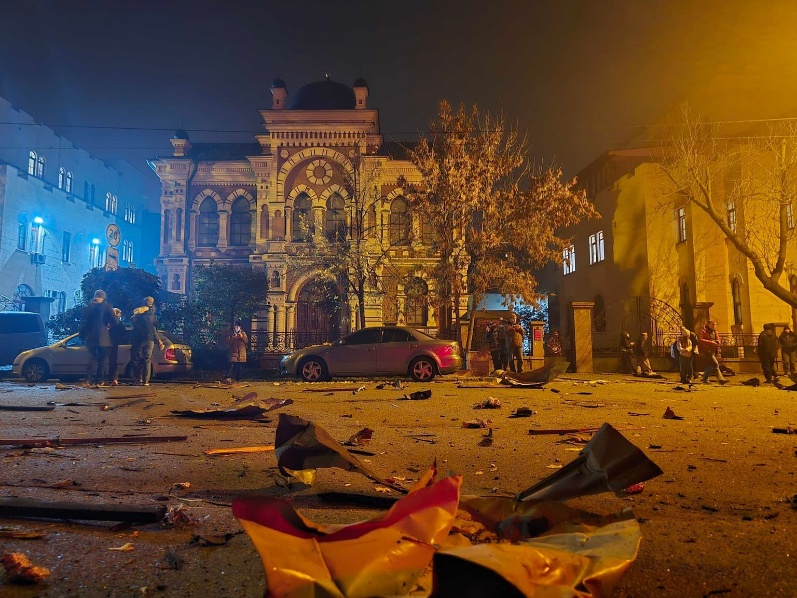
Firefighters and residents stand amid shattered glass and wreckage after a late-night Russian drone strike tore through Kyiv’s historic Podil district, leaving homes scorched and streets littered with debris. (Jared Goyette / The Kyiv Independent)
The irony hung heavy in the cold air. Russia’s missiles had struck beside a Jewish house of worship while its leader ranted about fighting fascism. Seven people were injured, five hospitalized, and the rest treated in the street as paramedics moved between flames. Nearby, another kindergarten had taken a hit—the second that day.
Sirens mixed with the crackle of burning cars. The roof of one apartment block had collapsed; in another district, windows shattered outward like shrapnel. Mayor Klitschko moved through the wreckage with emergency crews, his voice hoarse but steady. “We will not break,” he told reporters, though the exhaustion in his face said otherwise.
The night’s attack carried its own cruel symbolism. The morning barrage could be dismissed as part of a massive onslaught—an industrial wave of four hundred drones. But this strike came after all that, after a full day of chaos, proving that Russia still had strength to strike again. The message was unmistakable: no lull, no mercy, no pause between assaults. In Kyiv, even silence had become a countdown.
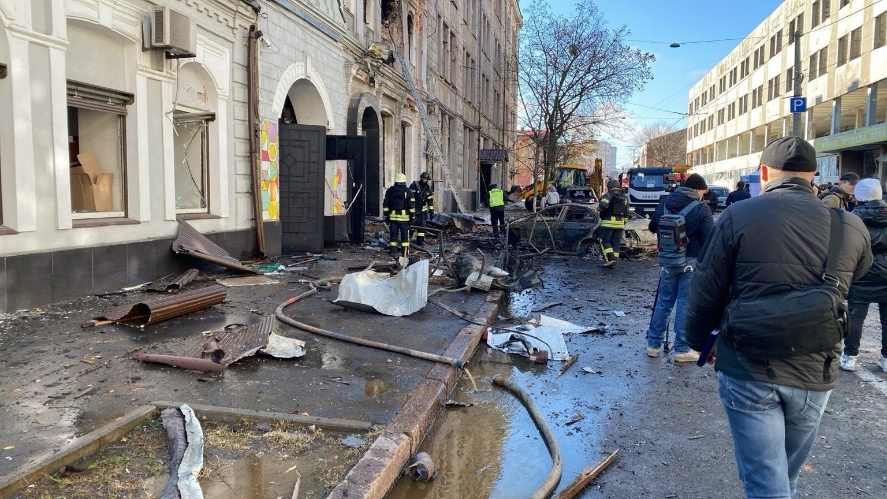
Smoke rises from a damaged power facility after another night of missile and drone attacks targeting Ukraine’s energy grid — a campaign meant to freeze the country into submission as winter draws near.
The Gripen Deal: Sweden and Ukraine Plan for the Future
While explosions echoed across Ukraine, President Volodymyr Zelensky stood in a quiet hangar in Linköping, Sweden, shaking hands with Prime Minister Ulf Kristersson before the sleek gray nose of a Gripen fighter jet. Behind them, the flags of both nations hung side by side—symbols of faith not just in survival, but in a future that could still be built from the ruins of war.
The two leaders signed a letter of intent for Ukraine’s eventual purchase of up to 150 Gripen E aircraft, the newest generation of Sweden’s agile multi-role fighter. For Ukraine, still absorbing the first shipments of F-16s, the agreement marked the next step—a long-term vision of an air force built to match Russia’s.
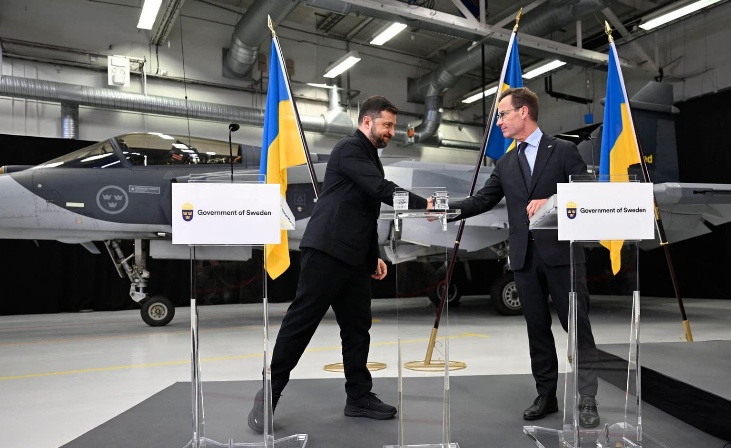
President Volodymyr Zelensky and Swedish Prime Minister Ulf Kristersson shake hands in Linköping after signing a defense cooperation agreement — a step toward Ukraine’s future acquisition of Swedish Gripen fighter jets. (Fredrik Sandberg / TT News Agency / AFP via Getty Images)
Kristersson cautioned that it was the beginning of “a long journey of ten to fifteen years.” Production capacity was limited; the first deliveries might not begin for several years. Zelensky, in contrast, spoke with urgency. “We need these jets as soon as possible,” he said, projecting the same defiant optimism that had kept Ukraine fighting through darker days.
The Gripen E’s advanced radar, powerful engine, and adaptability to short runways made it ideal for Ukraine’s battered airfields. Training for Ukrainian pilots was already underway—a clear sign that both sides viewed the project not as a distant aspiration, but an eventual certainty.
Sweden had stood by Ukraine since 2022 with tanks, artillery, and reconnaissance aircraft. Now it was offering partnership—a shared defense industry, not just aid. From Linköping, Zelensky traveled north to Oslo, securing Norwegian funding for winter gas supplies as Russian strikes deepened the energy crisis. The Scandinavian leg of his tour carried an unmistakable message to Washington: even if America hesitated, Europe would not.
In that hangar, with the Gripen’s cockpit lights glowing behind him, Zelensky looked less like a wartime president than the architect of a new era—one where Ukraine’s defense would depend not on borrowed protection, but on its own wings.
Warsaw and Budapest Trade Barbs: The Druzhba Pipeline Dispute
Europe’s diplomatic front cracked again—not under pressure from Moscow, but from within. A single post from Polish Foreign Minister Radosław Sikorski lit the fuse: “I hope your brave compatriot, Major Magyar, finally succeeds in knocking out the oil pipeline that feeds Putin’s war machine and you get your oil via Croatia.”
The target of his jab was Hungary’s Peter Szijjártó, who had once again defended his country’s continued reliance on Russian oil through the Druzhba pipeline. Sikorski’s reference to “Major Magyar” pointed to Robert Brovdi, a Ukrainian drone commander of Hungarian descent whose units had struck Russian energy facilities tied to the pipeline. Hungary’s response had been to ban Brovdi from entering the country—a decision that enraged Kyiv and embarrassed Brussels.
The exchange captured Europe’s widening fault lines. While most EU members had cut off Russian oil, Hungary and Slovakia still clung to Druzhba’s flow, citing economic survival. To Poland and the Baltics, that meant financing the very war they condemned. The pipeline had become more than infrastructure—it was a symbol of Europe’s moral divide.
Szijjártó retaliated online, branding a Ukrainian accused of Nord Stream sabotage a “terrorist.” Sikorski fired back: “Sabotaging an invader is no crime.” Each post added to the diplomatic theater, but beneath the sarcasm ran a hard truth: the European Union’s unity on Russia was fraying.
For Ukraine, the argument wasn’t abstract. Every drop of oil flowing through Druzhba funded the missiles raining on its cities. For Poland, supporting Ukrainian strikes on those supply lines was both principle and strategy. For Hungary, still talking of sovereignty while importing Russian crude, it was self-interest dressed as neutrality. In the end, the fight over a pipeline laid bare a deeper question—who in Europe still believed that appeasing Moscow could buy peace.
The Day’s Meaning: When Everything Changed and Nothing Changed
October 22, 2025, exposed a war that has evolved in reach but not in nature. Russia launched four hundred drones while Ukraine struck fifteen hundred kilometers into Russian territory. Trump sanctioned Russian oil giants even as peace talks collapsed. The Kremlin fired missiles beside kindergartens while preaching “denazification.” Beneath the politics and firestorms, one image defined the day—a Kharkiv basement where forty-eight children survived while a man above them died.
The day showed how far Ukraine has come and how far peace remains. Sweden prepared to supply Gripen fighters, Europe drafted its own peace framework, and Polish support for Ukrainian sabotage collided with Hungary’s dependence on Russian oil. Yet no summit, sanction, or treaty altered the core truth: Russia still kills civilians; Ukraine still refuses to yield.
When the sirens finally faded, nothing fundamental had changed—only the proof that Ukraine endures. In a world of shifting alliances and fading illusions, the country’s simple act of survival remained its clearest victory.