
September 2, 2026
Prepared by Diana Bozhyk
Ukrainian intelligence and security service officers exchanged gunfire in central Kyiv, wounding three, after a disputed operation involving the deputy commander of a Russian volunteer unit fighting for Ukraine, prompting Zelensky to dismiss a senior SBU official and demand an investigation. Independent researchers debunked a string of exaggerated territorial claims Vladimir Putin made at a press conference, including a fabricated encirclement of 5,000 Ukrainian troops and a Kharkiv Oblast village Ukraine still fully controls. Estonia’s defense minister resigned after auditors found the country paid a company with no prior artillery experience 70 million euros for Ukrainian-bound shells that turned out defective, and Kyiv entered its seventh consecutive day under Russian drone attack, prompting officials to introduce a new two-tier air alert system.
THE DAY’S RECKONING
Two branches of Ukraine’s own security services opened fire on each other in Kyiv today. Not near the front, not against Russians — against each other, over a disputed operation involving a man who fights Russia for a living. Three officers wounded. A dismissal. A president publicly furious. In a war this exhausting, even the institutions meant to hold the line can turn on themselves.
Everywhere else, the day ran on its usual dual track. Vladimir Putin stood in front of cameras and described a battlefield that simply doesn’t exist — a village Ukraine still holds, five thousand soldiers supposedly trapped who were never actually surrounded. Independent researchers took his claims apart within hours. Estonia’s defense minister resigned over a fake artillery contract. Kyiv marked its seventh straight day under drone fire, tired enough that officials finally redesigned how they warn people at all. Somewhere in the middle of it, a volunteer who’d flown into Russia to save his son made it home alive. Small mercies, on a day mostly defined by their absence.
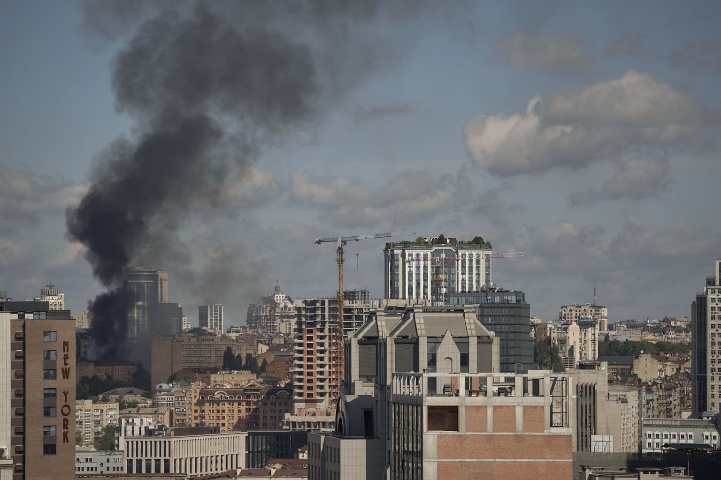
Destruction at a university building in the city center following a Russian attack in Kyiv, Ukraine. (Photo by Vlada Liberova/Libkos/Getty Images)
PUTIN’S BATTLEFIELD CLAIMS, DEBUNKED ONE BY ONE
Vladimir Putin used a press conference to claim Russian forces are accelerating their advance across Ukraine and that Donetsk Oblast’s capture is proceeding exactly as planned — assertions independent researchers dismantled point by point within a day. Putin claimed Russian troops seized 270 square kilometers across 15 settlements in Donetsk Oblast in August; open-source tracking puts the real figure at 73.14 square kilometers seized, with total advances and infiltrations reaching 104.44 square kilometers. He claimed Russian forces sit just 1.5 to four kilometers from Slovyansk, Kramatorsk, and southern Druzhkivka — distances that don’t match available evidence from the ground.
The more striking claims were outright fabrications. Putin said Russian forces seized Svyatohirsk, north of Slovyansk; researchers assess Russian troops have never come closer than 13 kilometers to the town, and likely sit even farther away now given ongoing Ukrainian counterattacks nearby. He claimed Russian forces captured Kozacha Lopan in Kharkiv Oblast; Ukraine’s 14th Army Corps flatly refuted it the same day, noting Russian forces control barely 13 percent of the settlement and have been falsely reporting its capture to their own leadership since July. Most dramatically, Putin claimed Russian forces encircled 13 Ukrainian battalions — roughly 5,000 troops — near the Oskil Reservoir; researchers found no evidence Russian forces even have a presence in the claimed area. It echoes an identical false claim Russia’s own chief of staff made about Kupyansk last October, later disproven when Zelensky visited the city in person.
A SHOOTOUT BETWEEN UKRAINE’S OWN SECURITY SERVICES
Officers from Ukraine’s military intelligence agency and its domestic security service exchanged gunfire in Kyiv this morning, wounding three intelligence officers, two of them seriously, in a clash that erupted during what the SBU described as an investigation into an alleged Russian assassination plot.
The dispute centers on Stepan Kaplunov, deputy commander of the Russian Volunteer Corps, a paramilitary unit made up of Russian nationals fighting for Ukraine and subordinate to Ukraine’s military intelligence directorate. The SBU said it was investigating an FSB-linked plot targeting Kaplunov when the shooting began; Kaplunov’s own unit commander told a very different story, saying SBU officers had “kidnapped” Kaplunov in broad daylight days earlier and held him without charges, and that the shooting started only after SBU officers began detaining intelligence personnel who arrived to intervene. Kaplunov’s lawyer said officers conducted a warrantless nighttime search of his client’s apartment and rejected the SBU’s assassination-plot explanation outright, calling it “a PR move” to justify what he described as an extrajudicial detention.
President Zelensky called the incident “an absolutely disgraceful situation,” ordered Ukraine’s Prosecutor General and State Bureau of Investigation to determine what actually happened, and signed a decree dismissing the SBU’s head of state-secrets protection. “Here in Ukraine, one can shoot only at the Russian occupiers in defense of Ukraine,” Zelensky said. “No other shootout will ever be perceived by our state as something that anyone is allowed to do.” Kaplunov has reportedly been released, though his current whereabouts remain unknown.
DRAPATYI LAYS OUT HIS PRINCIPLES AS ZELENSKY RESHUFFLES GROUND FORCES COMMAND
Commander-in-Chief Mykhailo Drapatyi published a formal statement of leadership principles today, laying out how he intends to run Ukraine’s armed forces roughly six weeks into the job. The document emphasizes delegating authority rather than directing individual battles, demanding accountability at every level, and preserving soldiers’ lives — writing bluntly that war “demands resolve but never recklessness” and that every unjustified loss weakens the military as a whole. Drapatyi also said he wants to overhaul recruitment, training, and rotation policies to make service fairer and more predictable, though the document offers no specific mechanism or timeline for doing so.
The same day, Zelensky dismissed Ground Forces Commander Major General Hennadii Shapovalov, who’d held the post just over a year, replacing him with Brigadier General Svyatoslav Zaitsya. Zaitsya has a distinctive origin story: as a young officer training in Crimea when Russia occupied the peninsula in 2014, he refused to accept Russian terms and managed to withdraw his entire unit to mainland Ukraine intact. Colleagues describe him as unusually attuned to the digitalization and robotization increasingly shaping the war. Zelensky’s decree gave no public reason for Shapovalov’s removal, but the change fits Drapatyi’s broader pattern this summer of replacing senior commanders with officers whose reputations were built entirely inside the current war.
ESTONIA’S DEFENSE MINISTER RESIGNS OVER A €70 MILLION MISTAKE
Estonian Defense Minister Hanno Pevkur resigned today after a national audit exposed a procurement disaster: Estonia paid €70 million to an Italian-registered company for artillery shells destined for Ukraine, despite the company having never sold a single shell before the contract was signed. “A leader must have strength and courage to take responsibility,” Pevkur wrote, acknowledging he wasn’t personally aware of the deal’s problems but accepting political responsibility anyway.
The 2024 deal, financed through the EU’s European Peace Facility, was meant to help address a severe artillery shortage Ukrainian troops faced at the time. Instead, the contracted supplier — ultimately owned by an Indian defense firm — repeatedly missed delivery deadlines, and when shells finally arrived in 2025, they turned out to be defective and unusable. The agency’s current director, who inherited rather than signed the original contract, was blunt in his assessment: “If I start building a house and hire a company that has never built houses before, there is a doubt that the house will not be finished.” Estonia’s prosecutor’s office has opened a criminal investigation, and the country’s prime minister called an emergency cabinet meeting to address the fallout — an uncomfortable episode for a nation that’s otherwise sharply increased defense spending, from 2 percent of GDP in 2022 toward a planned 5.4 percent this year.
NORWAY SEIZES A RUSSIAN SHIP IN THE ARCTIC
Norwegian authorities seized a Russian state vessel, the Professor Molchanov, at the port of Barentsburg in Svalbard today, acting on a request from Ukraine’s state oil and gas company as part of a broader effort to recover $4.22 billion plus interest that a Hague tribunal ordered Russia to pay Naftogaz over its illegal seizure of company assets in occupied Crimea.
A district court cleared the way for the seizure on August 31, and Svalbard’s governor confirmed the ship — normally used for commercial expedition cruises around the Arctic archipelago — will remain in port until further court order. “This is another important step towards restoring justice for Russia’s unlawful seizure of Naftogaz assets in Crimea,” Naftogaz’s acting CEO said, vowing to keep pursuing Russian assets globally until the compensation is paid. The seizure adds to a growing pattern of European countries intercepting Russian-linked vessels: Sweden ordered a seized grain ship handed to Ukraine in June, the UK detained a sanctioned tanker in the English Channel the same month, and France seized an illegal Russian oil tanker in the Mediterranean shortly after — a pattern Putin himself threatened to answer “in kind” back in August, though Russia has yet to follow through on any retaliatory seizure of its own.
UKRAINE SPLITS ITS AIR ALERTS INTO YELLOW AND RED
President Zelensky announced Ukraine will introduce a two-tier air alert system, replacing the single blanket warning currently used for every kind of aerial threat. Yellow alerts will signal drone raids; red alerts will indicate missile threats, including ballistic strikes and large-scale combined attacks. Each level will use a distinct siren sound, and warnings will become more geographically precise so restrictions apply only to areas facing an actual threat rather than blanketing entire regions.
The change directly responds to Russia’s shift toward near-continuous daytime drone strikes, which has left cities under disruptive alerts for hours at a stretch even when the actual threat level varies significantly moment to moment. Under the new system, certain businesses, public transit, and social services will be allowed to keep operating during yellow alerts rather than shutting down entirely; Kyiv’s Green metro line will run in full during yellow alerts, with additional surface transport compensating for reduced service on the Red line. School and kindergarten rules will remain unchanged. “People must understand absolutely clearly what exactly they need to respond to and how,” Zelensky said, noting the government will also expand and update shelter requirements, including mobile shelters, and revise curfew hours in Kyiv and other cities based on local conditions.
KYIV’S SEVENTH DAY: “WE’RE TIRED”
Kyiv entered its seventh consecutive day under Russian drone attack today, with a strike partially destroying a six-story residential building in the Shevchenkivskyi district and injuring seven people, five of them hospitalized. A university was struck while classes were in session, though the roughly 160 students sheltering at the time escaped injury. A medical facility in the same district had its windows blown out; a nearby three-story building caught fire; a private house burned in Solomianskyi district.
“We’re tired. We’re very, very tired,” university student Diana To Hang told reporters, a sentiment echoing across a capital that’s now spent a week absorbing strikes timed specifically to prevent any real recovery between them. Two more people were wounded in a separate morning attack on Kyiv Oblast.
Ukrzaliznytsia confirmed no railway infrastructure was hit in central Kyiv specifically, despite unconfirmed social media reports suggesting otherwise near the main train station — a small but telling detail in a city where residents have learned to distrust the first version of any story until officials confirm it. The pattern of overlapping strikes across multiple districts in a single day has become its own kind of exhausting routine: a fire here, a damaged façade there, injuries scattered across neighborhoods that have absorbed this same disruption day after day without a genuine pause to recover from any single incident before the next one arrives.
MEANWHILE, AT THE FRONT
Ukrainian forces raised a flag over Mohrytsya, northeast of Sumy City, confirming Ukrainian control despite Russian claims otherwise, while separately defeating a Russian infiltration mission near Mykolaivka east of Slovyansk and capturing servicemembers during the clearing operation. Near Kupyansk, Russian forces continued struggling to consolidate a bridgehead on the Oskil River’s right bank, with Ukrainian forces disrupting Russian supply drops enough to degrade infiltrators’ ability to retrieve them.
Russian forces advanced in northwestern Kostyantynivka, while near Dobropillya, a Ukrainian staff officer described a grim Russian tactic: sending columns of 10 to 15 armored vehicles toward the town periodically, aware that only one might actually survive to reach its objective. The officer said Russia is prioritizing Dobropillya specifically for its symbolic value in encircling the Fortress Belt from the southwest, cost be damned.
Ukrainian forces counterattacked west of Orikhiv in Zaporizhzhia Oblast without confirmed Russian advance, while a Russian drone separately struck a civilian evacuation vehicle near Novotroitske, injuring two volunteers doing the dangerous work of moving people out of contested areas. In Kherson City, Russian forces continued their “human safari” campaign, striking a civilian in plain clothes with a first-person-view drone. In the Black Sea near Snake Island, Ukraine’s navy destroyed a Russian unmanned surface vehicle, adding to a string of naval drone losses that have kept Russia’s remaining Black Sea assets increasingly confined to port.
TWO LEIPZIG SUSPECTS NAMED AS MEDVEDEV THREATENS GERMANY
German and EU investigators identified two suspects in last month’s drone attack attempt at Leipzig-Halle Airport: a Belarusian national holding a Russian passport who allegedly entered Europe on an Italian tourist visa issued in Minsk, and a Russian-born man with Latvian citizenship who allegedly coordinated logistics before leaving Germany two days before the planned attack. Both were identified partly through DNA traces recovered from the drone and its explosive payload. The EU said it would summon Russian embassy officials over the incident and pursue further sanctions.
Russia’s response was defiant rather than conciliatory. Its Foreign Ministry summoned Germany’s charge d’affaires in Moscow, calling Berlin’s accusations “entirely fabricated” and promising a “firm response.” Former President Dmitry Medvedev went further, threatening a “direct strike” against German military production facilities and suggesting Berlin itself could be targeted, while separately dismissing Zelensky’s warning about dangerous Russian airspace as “a declaration by the Banderite regime of state terrorism.” NATO Secretary General Mark Rutte pushed back firmly: “If Russia thinks we will be divided by the threat, or if they think we will be deterred from supporting Ukraine, they are mistaken.” European Commission President Ursula von der Leyen promised the pressure on Moscow would only increase “until Russia stops bombing and killing innocent children, men and women.”
RUSSIA HELPS IRAN BUILD SUPERSONIC MISSILES
The Financial Times reported today that Russian missile specialists have spent three years secretly helping Iran develop supersonic cruise missile technology, under a covert program codenamed C430L that began in 2023 and centers on ramjet propulsion — engines capable of sustaining flight at several times the speed of sound, making resulting missiles far harder for air defenses to detect and intercept.
Leaked correspondence, travel records, and patent analysis show Russia’s state arms exporter coordinating with a sanctioned Russian missile manufacturer, whose engineers reviewed Iranian flight-test data and advised on fuel systems, combustion stability, and engine design following Iran’s own successful ramjet test. The cooperation reportedly continued into 2026, well after the US and Israel went to war with Iran, with Russian engineers preparing technical reports for Tehran as recently as June.
Such missiles, if fielded, would pose a genuine new threat to American naval vessels in the Middle East, given how little warning time their speed and low-altitude flight paths would leave for defenders. Neither the Kremlin nor Iran’s government responded to requests for comment on the reporting. The disclosure adds another concrete data point to a partnership that already includes Iranian-designed Shahed drones now built domestically inside Russia and used nightly against Ukrainian cities — a reminder that the technology transfer between the two countries runs in both directions, not simply from Tehran’s drones to Moscow’s battlefield.
BESSENT BLAMES UKRAINE’S REFINERY STRIKES FOR GLOBAL ENERGY PRICES
US Treasury Secretary Scott Bessent told Fox News today that Ukraine’s long-range strikes on Russian oil refineries are contributing directly to rising energy prices worldwide, framing Kyiv’s own defensive campaign as a factor in a broader “energy shock” alongside disruptions from the US-Iran war. “Ukraine has decided that they want to blow up Russian energy assets and refined products, so that is creating upward price pressure on the global basis,” Bessent said.
The comment lands awkwardly given the campaign’s actual purpose: degrading Russia’s ability to fund its own invasion. Ukraine carried out at least 30 strikes against Russian refineries and oil tankers in July alone, part of a campaign analysts estimate has pushed Russian crude processing down to roughly 3.6 million barrels a day — the lowest level since 2002 — triggering fuel shortages, gas station lines, and an export ban across Russia itself.
Bessent’s remarks came days after he met Russian Finance Minister Anton Siluanov at the G20, where he reportedly pressed Moscow on ending the war, a contrast that left some Ukrainian officials privately questioning whether Washington fully credits the strategic logic behind a campaign it’s otherwise rhetorically supported. The framing also sidesteps a separate, larger driver of global energy volatility: the ongoing US-Iran conflict, which closed the Strait of Hormuz and has done far more to unsettle oil markets worldwide than a Ukrainian drone campaign aimed squarely at funding streams for an active invasion.
EUROPE’S SLOW MACHINERY
Two separate European processes crawled forward today, each illustrating how much bureaucratic friction still stands between Ukraine and the support it’s requesting. EU ambassadors failed to agree on extending individual sanctions against more than 3,000 Russian individuals and companies, postponing the decision to September 9 — just six days before the current measures expire — after Slovakia refused to support a full one-year renewal and instead pushed for the traditional six-month cycle plus removing several unnamed individuals from the list entirely.
Separately, European Commission President Ursula von der Leyen confirmed the EU received a Ukrainian payment request, originally submitted by Mykhailo Fedorov shortly before his July dismissal, covering several billion euros in air-defense equipment including PAC-3 interceptors for Patriot systems. Because PAC-3 technology is sourced more than 35 percent from outside the EU and Ukraine, the request requires a formal exemption under the terms of the EU’s €90 billion loan — though approval needs only a qualified majority to pass, not unanimity, and EU diplomats expect it to clear a scheduled September 7 vote. Germany separately pledged new air-defense packages this month, with Zelensky confirming a call with Chancellor Merz in which Berlin also briefed Kyiv on its Leipzig response and discussed finalizing a bilateral drone-development deal.
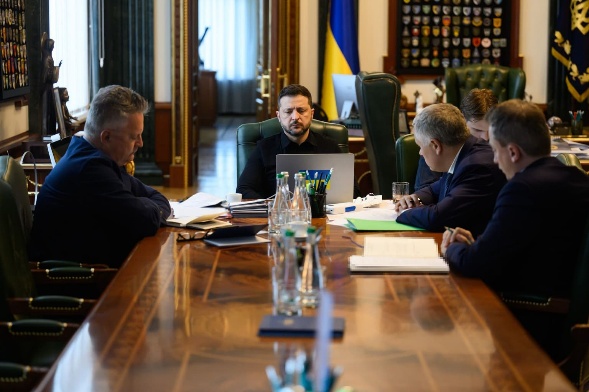
President Volodymyr Zelensky (center) during a call with German Chancellor Friedrich Merz. (President Volodymyr Zelensky/X)
A VOLUNTEER COMES HOME, ALABUGA EXPANDS
Mykhailo Puryshev, the Mariupol volunteer who flew into Russia last month after saying the FSB blackmailed him with threats against his son, confirmed today he’s made it back to Ukraine safely. “I am in Ukraine. I am home,” he wrote, thanking supporters for messages and calls that helped sustain him through an ordeal he said he still can’t fully discuss. “With your support, you can return even from a place that seems impossible to return from.” He said he intends to eventually resume his volunteer work, though he offered no details yet about what happened to his son or the full circumstances of his return.
Separately, satellite imagery revealed Russia is significantly expanding its primary Geran-type drone production complex at the Alabuga Special Economic Zone in Tatarstan, with construction of at least ten new workshops underway across more than 500 hectares since April, alongside new roads, warehouses, and a defensive perimeter of lattice towers designed to intercept incoming strikes. The expansion underscores a stark asymmetry Ukrainian officials have flagged repeatedly: even as Russia’s frontline advances slow to a crawl and its economy strains under sanctions and fuel shortages, its capacity to mass-produce the drones terrorizing Ukrainian cities keeps growing largely unimpeded.
A STRIKE ON DNIPRO, A CORRUPTION CASE, AND A CENSORSHIP FINE
Russian forces struck the city of Dnipro today, killing two people and injuring eight, according to regional military administration head Oleksandr Hanzha. A man died when rescuers pulled his body from rubble; a woman who’d been critically injured died in the hospital shortly after despite medics’ efforts to save her. The strike hit food warehouses belonging to a retail chain and sparked fires that required 17 rescuers and five pieces of equipment to extinguish, damaging educational institutions and apartment buildings along with two burned-out cars.
Separately, Ukraine’s anti-corruption bureau sent a case to court today against a former head of the SBU’s Cybersecurity Department — widely reported to be Illia Vitiuk — accusing him of illicit enrichment and filing false information in an asset declaration. Investigators allege Vitiuk understated the true purchase price of a $522,000 Kyiv apartment by roughly $212,000 in official paperwork, funded partly through fictitious consulting payments traced back to a person NABU separately accuses of embezzling from Ukraine’s state railway company. Vitiuk was dismissed from his post and sent to the front in 2024 after journalists first exposed the property; the SBU has called the case retaliatory, tied to its own earlier detention of NABU employees.
And in Moscow, a court fined Google, Telegram, and Pinterest for refusing to remove content the Kremlin deems undesirable, including war-related material and content related to Russia’s officially banned “international LGBT movement” — a small but telling reminder that Russia’s domestic censorship campaign continues running in parallel with the war itself, entirely unaffected by anything happening on the battlefield.
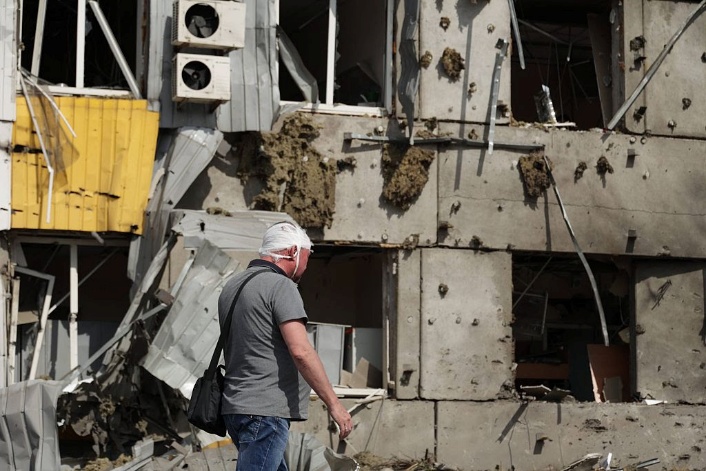
A view of destruction as the emergency services and residents gather at the site of a Russian drone attack on apartment buildings, educational institutions, and a food warehouse in Dnipro. (Dnipropetrovsk Regional Military Administration / Handout / Anadolu via Getty Images)
A GUNFIGHT AT HOME, A LIE UNRAVELING ABROAD
By nightfall, the day’s strangest juxtaposition was hard to shake: Ukraine’s own security services drew guns on each other in Kyiv, while Vladimir Putin stood before cameras describing a war he’s plainly losing as one he’s winning. Neither story reflects particularly well on the institution behind it. Both, in their own way, describe systems under genuine strain.
A defense minister in Tallinn resigned for a mistake he didn’t make personally but owned anyway. A ship in the Arctic changed hands over a debt from a war years in the making. And in Kyiv, a tired student said out loud what an entire city has been feeling for a week: exhausted, but still there. Nothing today resolved cleanly. Everything today added one more thread to a war that keeps testing every institution it touches, on both sides of the front line.
A PRAYER FOR UKRAINE
1. For the Wounded Officers in Kyiv
Lord, three of Ukraine’s own intelligence officers were shot today by fellow Ukrainians, in a country already carrying more violence than any should have to bear. We grieve confusion turning to gunfire between people meant to serve the same cause. Heal the wounded fully, comfort their families, and give Ukraine’s leaders wisdom to find truth in the chaos and to prevent whatever fractured trust made this possible from fracturing further.
2. For a City Marking Its Seventh Exhausted Day
Father, we lift up Kyiv, worn thin by a week of sirens that won’t fully stop. Grant its people the rest they cannot currently find, and grace for each other as patience wears thinner with every passing alert. Protect them through whatever the coming days still bring, and let exhaustion never be mistaken, by them or anyone else, for a readiness to give up.
3. For Honesty to Outlast Every Convenient Lie
Lord of truth, we pray for clarity in a war increasingly cluttered with false claims — fabricated victories, denied incidents, convenient stories told by people in power on every side. Give journalists and researchers the persistence to keep checking the record, no matter how quickly one lie gets replaced by the next. And give ordinary people discernment to recognize truth even when it’s harder to find than the comfortable lie everyone would rather believe.
4. For Every Soldier Sent Toward Almost Certain Loss
God of the fallen, we pray for the soldiers, on both sides, sent forward in columns their own commanders expect will mostly be destroyed. Grieve with us the waste of lives spent for ground measured in meters. Give commanders everywhere the conscience to value soldiers as more than expendable numbers, and give grieving families comfort that outlasts whatever cause was used to justify their loss.
5. For a Volunteer Home Safe, and Others Still Far From It
Lord of deliverance, we give thanks for Mykhailo Puryshev’s safe return, a genuine mercy after real fear. We hold in prayer everyone still caught in danger far from home tonight, whether captured, coerced, or simply trapped by circumstance. Let his homecoming be a sign of hope for every family still waiting, and grant them, too, an ending worth thanking you for.
In Your mercy, in Your justice, in Your time — bring this war to its end, and let the ending be worthy of what Ukraine has endured.