
Ukraine’s lights went out without a single new Russian strike, exposing how months of damage outlasted the ceasefire while peace talks moved forward without Ukraine in the room.
The Day’s Reckoning
The first alarm came quietly.
On the morning of January 31, Ukraine’s grid operators watched the 400-kilovolt line linking Romania and Moldova disconnect. Minutes later, the 750-kilovolt artery between western and central Ukraine failed. Substations tripped into emergency mode. Nuclear plants began rapid unloading to protect their reactors. Power drained across the country.
No missiles. No drones.
The grid collapsed anyway.
Energy Minister Denys Shmyhal would later confirm the cause as “technological disruption.” The Finance Ministry ruled out cyberattack. Moldova’s Energy Ministry spoke of “serious problems” inside Ukraine’s system. Translation: months of Russian strikes had degraded the network so badly that it could no longer withstand normal operating stress—even during a ceasefire.
Emergency shutdowns swept through Kyiv City and Kyiv, Zhytomyr, and Kharkiv oblasts. By early afternoon, crews had restored electricity to critical infrastructure in Kyiv and Dnipropetrovsk. Hospitals came back online. Water pumps resumed. But large civilian areas in Kharkiv, Zhytomyr, and Odesa remained dark as engineers raced against cascading failures.
Three thousand kilometers away in Miami, U.S. Special Envoy Steve Witkoff sat across from Russian negotiator Kirill Dmitriev. The meetings were later described as “productive and constructive.” Treasury Secretary Scott Bessent was there. Jared Kushner. Josh Gruenbaum. Ukraine was not.
While diplomats talked, the war ignored the script. Belarusian balloons violated Polish airspace for the second time in 72 hours. Russian forces pushed near Pokrovsk. Ukrainian units counter advanced elsewhere. A Russian ballistic missile struck a Philip Morris warehouse in Kharkiv Oblast, igniting fires that took eighty firefighters to control—during a pause that supposedly protected cities.
Five civilians died. Nineteen were wounded. Sixty-four drones were shot down. Twenty-one still got through.
Day 1,438 revealed the truth beneath the theater: Russia no longer needed to strike to cause damage. The damage was already doing the work.
When the Lights Failed Without a Single Strike
The alert didn’t come with an explosion.
Inside Ukraine’s grid control rooms, screens flickered as the 400-kilovolt line linking the Romanian–Moldovan system to Ukraine dropped offline. Moments later, the 750-kilovolt artery carrying power between western and central Ukraine failed. Two backbone lines gone almost at once.
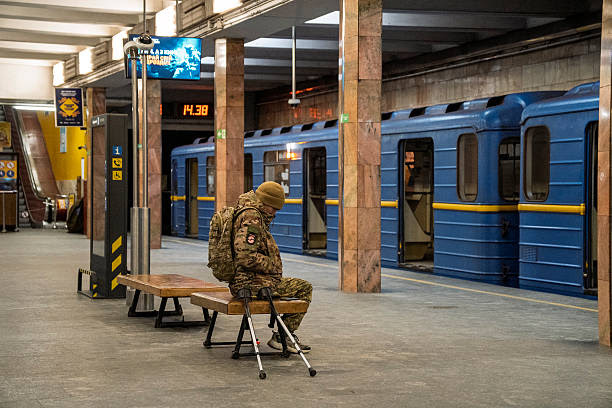
A disabled Ukrainian army veteran sits on a bench at a metro station in front of empty metro carriages during mass power outages in Kyiv. Kyiv’s metro system temporarily suspended operations amid the blackouts. (Serhii Okunev / AFP via Getty Images)
No missiles. No drones.
Just the sudden absence of electricity.
Energy Minister Denys Shmyhal later described the cause with clinical precision: “technological disruption.” Everyone working the system knew what that meant. Since the full-scale invasion began, Russian strikes had damaged every major power plant in the country. Engineers patched transformers, rerouted flows, balanced loads across infrastructure already scarred beyond design limits. What collapsed wasn’t software or cyber defenses—it was endurance.
Moldova’s Energy Ministry spoke of “serious problems” in Ukraine’s grid. Oleksandr Kharchenko of the Energy Research Center called the situation “complicated.” Translation: the system had been beaten so badly that normal operational stress now triggered cascading failure.
Substations snapped into emergency isolation, sacrificing sections of the network to save the whole. Nuclear power plants began rapid unloading, cutting output to avoid reactor damage as demand lurched. The response was fast enough to avert catastrophe—but not fast enough to keep the country lit.
Kyiv City, Kyiv Oblast, Zhytomyr, and Kharkiv slid into darkness. Hospitals, water pumping stations, and emergency services lost power alongside apartment blocks. Crews restored electricity to critical infrastructure in Kyiv and Dnipropetrovsk within hours. Civilian neighborhoods in Kharkiv, Zhytomyr, and Odesa waited much longer, counting time by cold rooms and dead phone batteries.
That was the point.
Moscow’s pause on energy strikes came only after the damage was done. The blackout showed why the Kremlin could afford restraint: Ukraine’s grid no longer needed to be hit to fail.
For months, energy workers had performed near miracles to keep the lights on under fire. This time, heroics weren’t enough. The grid that survived thousands of strikes could not survive what those strikes had already done.
Peace Talked in Miami as Ukraine Went Dark
The room in Miami was brightly lit.
Steve Witkoff sat across from Kirill Dmitriev and later described the meetings as “productive and constructive.” No details followed—only the reassurance that something important had happened.
Around the table were Treasury Secretary Scott Bessent, Jared Kushner, and White House Senior Advisor Josh Gruenbaum. Across from them sat Russia’s lead economic negotiator, flown in for the occasion. It was a bilateral meeting about Ukraine’s war. Ukraine was not present.
Witkoff framed the talks as part of a U.S. mediation effort toward peace. The language mattered. It suggested American initiative shaping outcomes rather than Ukrainian agency defining its own future. Dmitriev’s arrival came just ahead of broader talks scheduled elsewhere, a sequencing that allowed Washington and Moscow to align positions before Kyiv ever entered the room.
While frameworks were discussed in Florida, Ukraine’s reality unfolded very differently. Energy workers rushed to restore electricity across Kyiv, Zhytomyr, and Kharkiv as cascading blackouts spread from damage already inflicted. Control rooms were dark. Phones rang without pause. Engineers worked by headlamp while diplomats spoke of progress.
The contrast was brutal.
Bessent’s presence hinted at sanctions, frozen assets, and reconstruction financing. Kushner’s role suggested influence extending beyond formal channels. Gruenbaum’s attendance signaled presidential oversight. The architecture of a deal was being sketched—economic, political, strategic—without the country that would live with its consequences.
Ukraine would join later talks, after the outlines had already been drawn. The distinction mattered. Frameworks presented are not frameworks negotiated.
The opacity helped Russia. Without details, Ukraine could not prepare its public or pressure its partners. Meanwhile, Russian forces advanced near Pokrovsk. Ballistic missiles struck targets in Kharkiv. Drones killed civilians despite talk of restraint.
The meetings continued anyway.
By the time Kyiv’s lights flickered back on, Miami had already moved on—peace discussed far from the darkness it was meant to resolve.
The Sky Was Breached on Purpose
The alert began as a blip on Polish radar—slow, drifting, easy to dismiss if you wanted to. Objects had crossed into Polish airspace from Belarus. Again. Air defense officers tracked their movement as confirmation came down the chain: these were almost certainly balloons. It was the second violation in three days.
Airspace over Podlaskie Voivodeship closed. Civilian flights were grounded. Fighters stayed on standby as the objects floated through Polish skies and eventually exited, unchallenged. No explosions. No intercepts. Just another quiet breach treated as routine.
It had become routine because it kept happening.
Since late 2025, Belarusian balloons had crossed repeatedly into Polish and Lithuanian airspace. Lithuanian authorities had already declared a state of emergency, officially blaming cigarette smuggling. The explanation never quite fit. Smugglers don’t fly on patterns that test radar coverage. They don’t escalate frequency after Belarus deepens military integration with Russia.
Polish commanders understood that. Their statement called the incident “another hybrid-type event.” Translation: this was not commerce gone astray. It was rehearsal.
The Polish Air Force noted no immediate danger to public safety, a carefully measured line that reflected the dilemma NATO’s eastern flank now faced. Shoot the balloons down and risk accusations of overreaction. Ignore them and normalize violations of sovereign airspace. Either choice carried consequences Moscow could exploit.
Lithuania accused Alexander Lukashenko of deliberately weaponizing balloon flights as part of a broader hybrid campaign. The accusation tracked with reality. As Belarus granted Russia expanded military access, the balloons flew farther and more often. EU sanctions announced in response changed nothing. If anything, the incursions accelerated.
Lukashenko answered by accusing the West of hybrid war against Belarus and Russia—the familiar inversion meant to blur responsibility and create false equivalence.
This was Phase Zero warfare: condition-setting before open conflict. Normalize incursions. Measure response times. Map defenses. Create precedents that could later be exploited with aircraft, missiles, or drones.
The balloons drifted on.
Polish and Lithuanian radars kept tracking.
NATO’s eastern airspace remained under pressure from violations Moscow could dismiss as smuggling while quietly banking the intelligence they provided.
The Ceasefire That Let the Fire Burn
The missile didn’t care about pauses.
It came down on the Philip Morris warehouse in Kharkiv Oblast and tore the building open, igniting flames that raced across more than 5,000 square meters of empty storage space.
Sirens followed. Then headlights.
More than eighty firefighters arrived with twenty units, climbing aerial ladders as fire rolled through the structure and weakened walls threatened collapse. They worked beneath smoke thick enough to turn daylight gray. Inside, there were no workers to rescue—only heat, flame, and the hollow shell of a facility abandoned years earlier.
Philip Morris had shut the site down when the full-scale invasion began, relocating hundreds of jobs west and leaving the warehouse idle ever since. It had stood unused, untouched by war, until a Russian ballistic missile erased it during what was being called a ceasefire.
That was the point.
Days earlier, Washington announced that Moscow had agreed to pause strikes on Ukrainian cities. The Kremlin quickly narrowed the promise—only Kyiv, only briefly. Kharkiv Oblast was never included. American-owned property wasn’t protected. The pause existed on paper while the missile did its work in steel and fire.
President Zelensky named the strike in his nightly address, calling it what it was: a ballistic attack that triggered a major blaze. The symbolism required no explanation. Russian forces were still striking. Commitments still meant nothing.
The destruction served several purposes at once. It reminded Ukraine that strikes would continue regardless of diplomatic language. It sent a message to Washington by burning American corporate assets on Ukrainian soil. It showed Western companies exactly what investment looked like under Russian threat.
The strategic value of hitting an inactive tobacco warehouse was zero.
The message value was enormous.
Firefighters fought for hours to contain the blaze. Corporate executives watched footage of their Ukrainian facility burning. Politicians continued to speak of pauses and negotiations.
By the time the flames were out, the warehouse was gone. The ceasefire remained theoretical. And another day ended with smoke rising higher than any promise made in Washington or Moscow.
The Line Kept Moving Anyway
There was no pause at the front.
Russian assault groups pushed east of Pokrovsk, taking Balahan as geolocated footage confirmed what commanders already knew on the ground. Columns pressed through central Myrnohrad. Others edged forward along the E-50 highway south of Hryshyne, tightening the noose around Pokrovsk a few hundred meters at a time.
Ukrainian units didn’t wait it out.
They struck north of Yablunivka in the Kostyantynivka–Druzhkivka sector and advanced in northern Nesterne northeast of Kharkiv City, trading ground and momentum to keep Russian forces from settling into new positions. Every gain was contested. Every pause punished.
Near Hryshyne, a Russian platoon-sized mechanized assault rolled forward and died there. The Ukrainian 7th Rapid Reaction Corps destroyed two of three armored vehicles and killed more than ten attackers. Elsewhere in the Pokrovsk direction, a reinforced Russian company tried its luck. Ukrainian defenders repelled it, leaving behind ten quad bikes, four motorcycles, six vehicles—and more than eighty Russian dead.
In most armies, that loss would trigger a reckoning.
For Russian commanders, it was routine.
The map shifted in fragments. Russian forces edged west of Dobropillya and Pryluky in the Hulyaipole direction. Ukrainian troops captured Russian servicemembers in northwestern Olenokostyantynivka, clawing back areas Moscow had already declared “taken.” Claims collided with reality across hundreds of kilometers of front.
Even Russian milbloggers noticed. One accused commanders of fabricating footage about Kupyansk-Vuzlovyi to mask failure, noting that false reports deprived Russian aviation of targets and forced infantry into suicidal small-group assaults. Another warned that Ukrainian forces were attacking supposedly encircled Russian units south of Kupyansk—proof that official reports no longer matched the battlefield.
Behind the lines, Ukraine struck back. General Staff reports described hits on a Russian motorized rifle regiment command post near Poltavka, drone control points near Sluchovsk and Rivnopillya, a logistics depot near Voskresenka, and troop concentrations elsewhere—efforts to choke supply and slow the next assault.
Russian drones still came. Eighty-five launched. Sixty-four were shot down. Twenty-one struck thirteen locations, killing five civilians and wounding nineteen.
Negotiators talked in distant rooms.
The frontline answered with fire, blood, and movement—advancing to a logic no ceasefire could reach.
The Number That Wouldn’t Stop Growing
The list kept lengthening.
Name after name, checked and rechecked, Mediazona and the BBC Russian service confirmed what the Kremlin would not: 168,142 Russian military personnel dead. Not estimates. Not projections. Verified identities pulled from obituaries, court filings, social posts by grieving families, and local reports.
Even that was only the visible edge.
Since mid-month alone, more than 4,500 new names were added—roughly three hundred confirmed deaths every day. And still the journalists knew the count lagged reality. Many deaths leave no public trace. Some families stay silent. Others are erased when court records quietly disappear.
The composition of the dead told its own story.
More than fifty-four thousand volunteers. Over twenty thousand recruited prisoners. More than seventeen thousand mobilized soldiers. The pool widened as traditional sources dried up. Prisons offered a one-time surge. Volunteers came until they didn’t. Mobilization carried political costs Moscow tried to manage by hiding the numbers.
More than six thousand officers were gone. Each one represented years of training, battlefield experience, institutional memory. Leadership drained faster than it could be replaced, thinning command layers even as assaults continued.
To keep the picture blurred, the Kremlin tightened control over information. Court records vanished. Lawsuits stalled. Families struggled to confirm deaths or claim benefits. The fiction of a “special military operation” demanded silence.
Ukraine’s General Staff placed Russian losses far higher—well over a million casualties. Western intelligence agreed the scale was catastrophic by modern standards.
And yet the front still moved.
Russian forces gained territory measured in fragments—meters bought with bodies. In a single year, they seized less than one percent of Ukraine’s land, but they paid for it with lives Russia could still replace, at least for now. Contract soldiers filled gaps quickly enough to keep pressure on.
Ukraine could not mirror that math. Its population was smaller. Its margins thinner.
Every name on the list was real. And the list was incomplete. The war continued not because the losses were small—but because, until proven otherwise, they were still survivable.
The War Found Them Anyway
They were not soldiers.
They were at home, at work, on the road—living ordinary lives in places the war had learned to reach with precision.
A 27-year-old woman in Sumy Oblast was killed when an FPV drone found her. A 63-year-old woman standing nearby was wounded in the same strike. There was no military target. Just a human one. The drone operator chose it.
In Kharkiv Oblast, a 70-year-old man and a 69-year-old woman were injured. The elderly moved slower. Shelters were farther away. The blast reached them first.
In Donetsk Oblast, the dead included people who had gone out to keep others alive. A drone struck a vehicle carrying utility repair workers returning from a water facility near Sloviansk. One specialist was killed. Two others were wounded. The vehicle belonged to The Water of Donbas—the municipal service trying to keep taps running in a region already broken by war.
Zaporizhzhia Oblast reported three more wounded.
Kherson Oblast counted two killed and ten injured.
The pattern was unmistakable. These were not accidents of war. Water workers. Elderly civilians. People in residential areas. The targets were non-military, chosen deliberately. Terror, applied patiently.
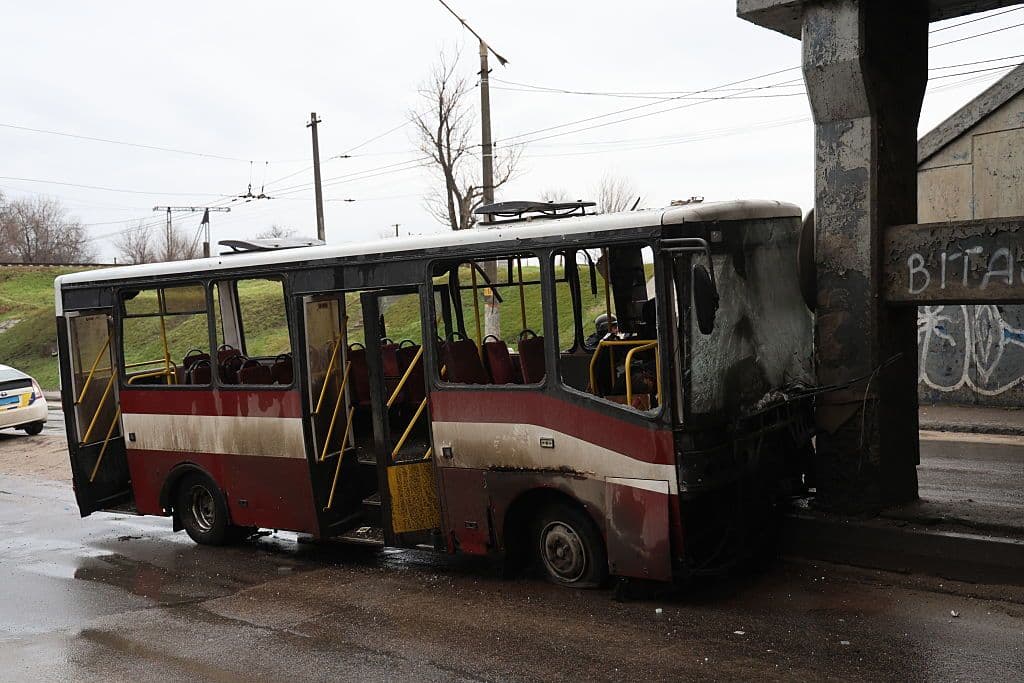
A passenger bus hit by Russian forces remains on a road at the site of the strike in Kherson, Ukraine. (Olexandr Kornyakov/Suspilne Ukraine/JSC “UA:PBC”/Global Images Ukraine via Getty Images)
Ukrainian air defenses did what they could. Sixty-four of eighty-five drones were intercepted. It was an impressive number—and an insufficient one. Twenty-one drones got through. Thirteen locations were hit. That is how the math works. Defense reduces damage; it never erases it.
The attacks happened during a ceasefire that existed mostly in statements. The pause applied narrowly, briefly, and not to the places where people died. Sumy. Kharkiv. Donetsk. Zaporizhzhia. Kherson. None were protected.
Each death had a name. A family. A life that ended not because of chance, but because someone decided civilians were acceptable targets.
Negotiators talked. Schedules shifted. Statements were issued.
The drones kept coming. Some were stopped. Some were not. And people kept dying.
The Signal That Carried the Kill
The drones no longer stopped at the front.
They flew farther—hundreds of kilometers into Ukraine’s rear—guided not by line-of-sight radio links but by satellite signal. Defense Minister Mykhailo Fedorov acknowledged the problem plainly: Russia was using Starlink-connected drones to strike deeper than ever before.
BM-35s. Molniyas.
Small airframes, suddenly given reach. With satellite internet onboard, they no longer depended on proximity to operators. They could navigate, loiter, adjust, and strike well beyond what traditional systems allowed. Cities once considered out of range were no longer safe.
The contradiction cut straight through Ukraine’s defenses. Ukrainian soldiers depended on Starlink to fight. Commanders trusted it more than radios for long-range, secure communication. Units held lines, coordinated fire, and called for help through the same network now helping Russian drones find their targets.
SpaceX insisted it did not sell terminals to Russia. That statement could be true and still irrelevant. Starlink hardware reached Russian hands anyway—through intermediaries, black markets, captured Ukrainian units reprogrammed for new use, and channels no public denial could close fast enough.
For Ukraine, abandoning Starlink was not an option. The system was embedded into how the war was fought. Cutting it off would blind front-line units faster than any Russian strike.
For Russia, exploiting it was an opportunity too valuable to ignore.
SpaceX found itself trapped between irreconcilable realities: enabling Ukrainian resistance while its technology was weaponized against Ukrainian civilians. Whether tighter controls could meaningfully limit Russian use—or merely slow it—remained uncertain.
What was certain was the effect.
The drones flew farther. The strikes reached deeper. And a technology built to connect the world became another vector for death in a war where every advantage carried its own shadow.
Holding the Line While the Pressure Builds
Oleksandr Syrsky met his commanders away from cameras and speeches, in rooms where maps were already worn thin at the folds. These were officers whose units were still in contact, still trading fire, still absorbing pressure that never fully eased.
They spoke about what was working and what was failing. How units held together under sustained assault. How command links broke under jamming and exhaustion—and how they were restored. How wounded soldiers were pulled back under fire, which evacuation routes stayed open, and which ones collapsed when Russian artillery found them.
Russian forces were building reserves again. The tempo was rising. Syrsky and his commanders worked through how enemy tactics were shifting—where assaults were thickening, where deception was replacing brute force, and where the next pressure points were likely to emerge. The discussion was not about victory speeches. It was about durability.
Every decision circled the same priority: keep units controllable, keep them supplied, and keep as many soldiers alive as possible while holding ground against an enemy willing to spend lives freely.
Before the meeting ended, Syrsky moved through the room and placed honors into the hands of men who had already returned to the line. Steel Cross. Silver Cross. Military Honor. No ceremony, no applause—just acknowledgment of endurance and professionalism in battles that rarely made headlines.
The awards marked moments of courage. The meeting itself reflected the larger truth of the war: command had become an exercise in survival. Adapt fast enough. Hold cohesion long enough. Preserve people where the enemy treated them as expendable.
Outside the room, the front kept moving. Inside, the work was about making sure Ukraine’s soldiers could move with it—and not break.
The Day’s Meaning
Two wars unfolded at once, and they barely touched.
In conference rooms, diplomats spoke in careful language about frameworks and progress. Bilateral talks here. Trilateral talks there. Schedules penciled in, then made provisional. The word “constructive” floated free of detail, unanchored to outcomes or commitments. Ukraine’s future was discussed in formats where Ukraine itself was often absent.
On the ground, nothing waited.
The power grid failed without a single new strike, collapsing under the accumulated weight of months of damage. Frontline units traded ground and lives according to battlefield logic, not diplomatic calendars. Civilians were killed by drones that slipped through defenses because some always do. Balloons drifted into NATO airspace, unchallenged but carefully observed. Hybrid pressure continued because it could.
What the day revealed was not confusion, but alignment—just not the kind diplomats advertised.
Russia no longer needed to escalate to exert pressure. The damage already done was sufficient. Infrastructure failed on its own. Casualty mathematics still favored Moscow. Hybrid operations continued below thresholds that demanded response. Even technology meant to keep Ukraine fighting was being exploited to extend Russian reach.
Negotiations fragmented into overlapping tracks that produced motion without clarity. The sequencing mattered. Frameworks were shaped before Ukraine entered the room. Timelines bent around unrelated crises. Humanitarian mechanisms stalled even as peace language expanded. The process moved forward as if Ukrainian agency were optional.
The contradiction was not accidental. It was structural.
Diplomacy proceeded as though battlefield realities could be paused. The battlefield proceeded as though diplomacy did not exist. Between them lay civilians, infrastructure, and exhausted systems absorbing consequences neither side in the negotiating rooms would bear.
Some lights came back on. Others did not.
Some talks ended. Others were scheduled.
The war did not adjust.
The day’s meaning was simple and brutal: damage compounds faster than diplomacy, and pauses cannot undo what has already been broken.
Prayer For Ukraine
- For civilians who were targeted simply for being present — the young woman in Sumy, the elderly in Kharkiv, the water workers in Donetsk — pray for comfort for grieving families, healing for the wounded, and protection for those who must continue living and working under constant threat.
- For Ukraine’s energy workers and infrastructure teams, pray for strength, wisdom, and endurance as they repair systems pushed beyond design limits, often working through darkness, cold, and exhaustion to keep hospitals, water, and heat functioning.
- For soldiers holding the frontline, pray for preservation of life, clarity in command, and resilience of spirit — especially as they face an enemy willing to spend lives freely and press forward regardless of cost.
- For Ukrainian leaders and negotiators, pray for discernment, courage, and agency — that decisions about Ukraine’s future would not be made without Ukraine, and that truth would not be buried beneath diplomatic convenience.
- For an end to the machinery of violence — drones, missiles, hybrid attacks, and quiet escalations — pray that the cycle of damage already set in motion would be broken, that restraint would replace cruelty, and that justice, not exhaustion, would shape the path to peace.