
September 7, 2026
Prepared by Diana Bozhyk
Ukraine’s Prosecutor General Ruslan Kravchenko resigned hours after vowing to stay in his post, as anti-corruption investigators continued tying him to a scheme protecting fraudulent call centers. Ukrainian commander Andriy Biletsky filmed himself walking calmly through Svyatohirsk to disprove Putin’s claim the town had fallen, part of a broader pattern researchers documented in detail today, including a fabricated encirclement of 2,000 Ukrainian troops that even Russia’s own military bloggers dismissed as fiction. Kyiv issued a red missile alert despite an agreed pause on strikes against the capital, Germany and Russia traded diplomatic closures over the Leipzig drone attack, and Ukraine’s military intelligence chief warned Russia likely has enough resources to keep fighting through 2028.
THE DAY’S RECKONING
Ruslan Kravchenko spent the morning insisting he wouldn’t resign. By evening, he had. Ukraine’s Prosecutor General reversed course entirely within a single day, stepping down from the office responsible for prosecuting the very corruption investigators had spent a week tying to his own name. It’s the kind of reversal that tells you more than either statement alone.
Elsewhere, the day’s other reversal was quieter but just as telling: a Ukrainian general walked calmly through a town Vladimir Putin had publicly claimed to have captured, daring Russia’s own propaganda machine to explain the gap. It couldn’t. Kyiv, meanwhile, spent the evening under a red missile alert despite a truce that was supposed to protect exactly that. Germany and Russia traded consulate closures. Russia and North Korea opened a bridge between them, literally, as their alliance keeps deepening in ways that used to be unthinkable. And Ukraine’s own intelligence chief said out loud what everyone already suspected: Russia probably has enough left in the tank to keep fighting for two more years. Nothing today ended cleanly. Everything today measured exactly how much longer this might run.
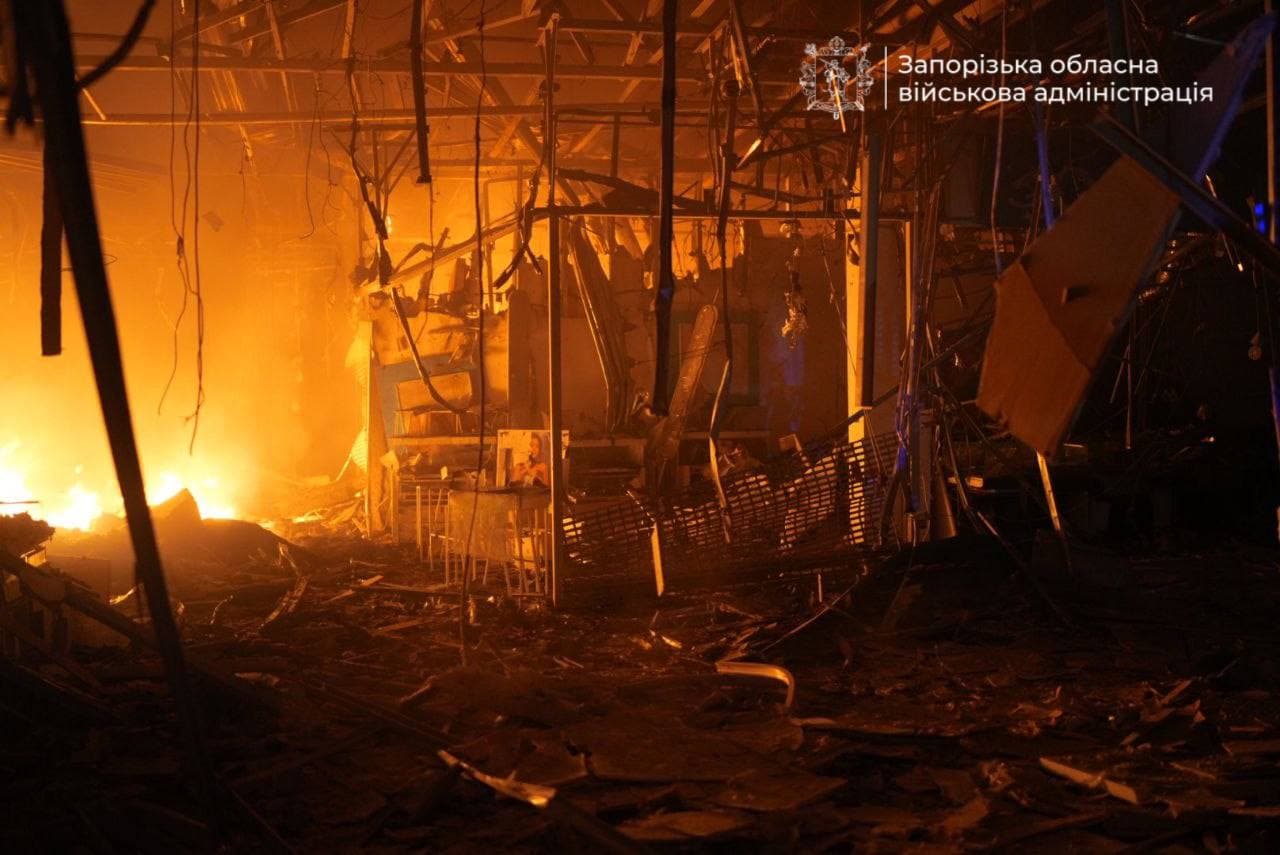
A photo capturing the aftermath of a Russian attack on a shopping mall in the southeastern city of Zaporizhzhia, published by Zaporizhzhia Oblast Military Administration in the early hours of. (Zaporizhzhia Oblast Military Administration / Telegram)
PROSECUTOR GENERAL KRAVCHENKO RESIGNS HOURS AFTER VOWING TO STAY
Ukraine’s Prosecutor General Ruslan Kravchenko submitted his resignation to President Zelensky and parliament today, reversing an earlier statement the same morning in which he’d insisted he had no plans to step down. “This is a political decision. And I made it consciously,” Kravchenko wrote on Telegram. “I do not want the position of prosecutor general to be used as an instrument of political confrontation.” He maintained his innocence throughout, thanking prosecutors who “honestly perform their work” and “document Russian crimes.”
The resignation follows a week of mounting pressure since NABU and its prosecutorial partner SAPO revealed a criminal organization allegedly protecting fraudulent call centers in exchange for systematic bribes, laundered through property and shell accounts. A second suspect, Yelyzaveta Ivakhnenko, was detained alongside deputy department head Serhii Kropyva, with bail set at $450,000. Court materials disclosed at a September 6 hearing describe a close relationship between Kropyva and Kravchenko, alleging Kropyva arranged renovation work at a house in the elite Kozyn neighborhood where Kravchenko’s family lives — a property Kravchenko says his family rents rather than owns. Recordings reference an unnamed “boss” identified by the patronymic “Andriiovych” who previously led Russia’s State Tax Service, details matching Kravchenko precisely, though NABU has stopped short of formally naming him as a suspect.
UKRAINE PROVES PUTIN LIED ABOUT THREE BATTLEFIELD CLAIMS
Brigadier General Andriy Biletsky, commander of Ukraine’s 3rd Army Corps, published video today of himself walking unarmed and unhelmeted through Svyatohirsk, standing before its historic monastery to directly refute Putin’s September 1 claim that Russian forces had seized the town. “I want to appeal to the Russian military and political leadership. Take off your clown noses and colorful wigs. Stop making fools of yourselves. The 60th Mechanized Brigade of the 3rd Army Corps is in full control of the city,” Biletsky said, noting Ukrainian frontline positions sit more than a dozen kilometers away. A Kremlin-affiliated military blogger publicly acknowledged the video’s accuracy, warning that Russia’s own culture of dishonest reporting creates real operational risk when units can’t call in strikes on ground they falsely claim to hold.
It was one of three specific fabrications researchers dismantled today from Putin’s September 1 remarks. Putin claimed Russian forces controlled Kozacha Lopan in Kharkiv Oblast; Ukraine’s 14th Army Corps says the settlement remains fully Ukrainian, with Russian assaults there costing 178 soldiers killed and 210 wounded since fighting began. Most strikingly, Putin claimed Russian forces had encircled 2,000 Ukrainian troops in a 460-square-kilometer pocket near Vovchansk — a claim even the influential Kremlin-aligned blogger Rybar dismissed, warning any attempt to “close” a pocket that doesn’t exist would produce only mass Russian casualties. Independent monitor DeepState found stable front lines in the area for at least two months, with no evidence of combat activity resembling an encirclement at all.
KYIV’S RED ALERT BREAKS THE QUIET THE TRUCE WAS SUPPOSED TO BRING
Kyiv issued a red missile threat warning at 7:42 p.m. today, despite an agreement between Russia and Ukraine meant to spare the capital from strikes through the end of the US envoys’ visit. Monitoring channels reported jet-powered drones approaching from multiple directions — toward Brovary, Kaharlyk, and along both banks of the Dnipro — prompting Ukraine’s Air Force to urge residents to shelter. A Russian strike separately damaged a house and car in Brovary district and a warehouse in Boryspil district, though no casualties were reported.
The alert capped weeks of disruption severe enough that Prime Minister Serhii Koretskyi convened an emergency meeting today over Kyiv’s collapsing public transport, as repeated air-raid alerts keep suspending metro service across the Dnipro and stranding residents at packed bus stops. “The safety and comfort of people are our shared and unconditional priority,” Koretskyi said, ordering local authorities to fix the bottleneck immediately.
The disruption reflects a deliberate Russian shift toward near-continuous daytime drone activity, one that keeps testing exactly how narrowly Moscow intends to interpret any promise it makes about sparing specific cities from specific kinds of strikes. Ukrainian and Russian accounts even disagreed on when the truce technically began and ended, with Ukrainska Pravda reporting a Saturday-to-Tuesday window while Russian state media described a shorter Friday-to-Monday span — a discrepancy that, whatever its cause, left both governments free to interpret their own compliance however proved most convenient.
GERMANY AND RUSSIA TRADE DIPLOMATIC CLOSURES
Russia’s Foreign Ministry announced today it’s closing Germany’s consulate in St. Petersburg by September 18 and ordering all of Germany’s Goethe-Institut branches in Russia shut by September 13 — direct retaliation for Berlin’s own closure of Russia’s Bonn consulate and Berlin cultural center following Germany’s formal accusation that Russian intelligence orchestrated last month’s drone attack at Leipzig Airport. Russia called Germany’s actions “unfriendly” while declining to address the underlying accusation directly.
The tit-for-tat marks the most concrete diplomatic escalation yet from an incident that’s already reshaped German rhetoric toward Moscow. Beyond the closures, Berlin is reportedly preparing tougher EU sanctions alongside additional air-defense and intelligence support for Ukraine — a package Foreign Minister Wadephul first signaled would take weeks to finalize given the EU’s unanimity requirement for major sanctions listings.
For a relationship already strained by Russian rhetoric comparing Germany’s response to pre-World War II diplomatic maneuvering, today’s closures suggest neither side currently sees any reason to de-escalate the exchange. It’s the first time since the war began that Germany and Russia have engaged in this kind of direct, tit-for-tat diplomatic retaliation, marking a genuine escalation beyond the sanctions and rhetorical criticism that had otherwise defined the relationship’s deterioration over the past four and a half years.
NATO SCRAMBLES JETS NEAR THE BALTICS AS RUSSIA AND NORTH KOREA OPEN A BRIDGE
NATO fighter jets scrambled three separate times between August 31 and September 6 in response to Russian military aircraft operating near the Baltic states, according to Lithuanian defense ministry data — including two Russian Il-20 reconnaissance flights toward Kaliningrad without active transponders or filed flight plans, and a separate object that briefly entered Estonian airspace before NATO jets intercepted it. Baltic officials said they’re maintaining vigilance without raising their overall threat assessment, with Latvia’s prime minister specifically noting the risk of direct invasion remains low.
The same day, Russia and North Korea opened their first-ever road bridge across the Tumen River, connecting Russia’s Khasan with North Korea’s Tumangang in a ceremony joined online by both countries’ prime ministers, Mikhail Mishustin and Park Thae-song. Named after a Soviet officer credited with saving North Korea’s founding leader from assassination in 1946, the crossing supplements the two countries’ only prior land link, a 1959 railway bridge.
Officials from both sides insisted the crossing serves only trade purposes, but the symbolism lands amid a military relationship that’s grown dramatically since Putin and Kim signed a strategic partnership in 2024 — North Korea has since sent thousands of troops to fight in Kursk Oblast and supplied artillery shells and ballistic missiles in exchange for cash and technology, with Ukrainian intelligence saying Russia may ask Pyongyang for up to 50,000 more troops. Experts who spoke to Ukrainian media questioned whether a purely civilian framing can be taken at face value, given how closely the timing tracks the broader deepening of military cooperation between the two governments.
UKRAINE’S SPY CHIEF: RUSSIA CAN FIGHT THROUGH 2028
Ukraine’s military intelligence chief, Oleh Ivashchenko, offered an unusually candid assessment today: despite Russia’s economy being far weaker than at the war’s start, Moscow likely has enough resources to keep fighting for two more years. “We do not rule out that these resources will last through 2027 and 2028,” he told Ukrinform, citing labor shortages, a widening federal deficit, and a deteriorating banking sector as Russia’s core vulnerabilities — even as military spending keeps climbing regardless.
Ivashchenko also confirmed a significant escalation risk: units of Russia’s 101st Missile Brigade, equipped with the nuclear-capable Oreshnik intermediate-range missile, are now deployed in Belarus. He warned Russia is preparing combined winter strikes using ballistic and cruise missiles alongside jet-powered Shahed drones and new AI-guided loitering munitions — the Banderol and Dan-T, capable of 500 to 700 kilometers per hour with warheads exceeding 130 kilograms — in packages that could exceed 500 drones in a single day. He said Ukrainian intelligence already knows many of the facilities Russia intends to target and the approximate timing, framing the coming months as a race to adapt faster than Russia can escalate. “I can’t please you and I can’t mislead people,” he said. “As the head of intelligence, I have to speak objectively.”
A SHOPPING CENTER IN MYKOLAIV, GONE
Epicentr K confirmed today that a Russian drone attack completely destroyed its Mykolaiv shopping center, leaving 520 employees without work — many of whom had already been relocated there after earlier Russian strikes destroyed the company’s facilities in Kherson, Zaporizhzhia, and Odesa. The attack began September 4 with strikes hitting the building’s central section; staff and emergency crews contained several small fires before a sixth strike hit the furniture warehouse directly, forcing everyone to shelter for roughly 30 minutes while flames, driven by strong winds, spread across 42,000 square meters and brought down the building’s walls.
“If it weren’t for the last hit, we would have saved the shopping center. We really tried hard,” said facility director Oleksandr Dmytryshyn. Epicentr K operates 72 shopping centers nationwide with roughly 38,000 employees, some 4,600 of whom currently serve in Ukraine’s armed forces; the company generated $1.9 billion in revenue last year.
The Mykolaiv location’s total loss illustrates a pattern that’s repeated across multiple Ukrainian regions this year: companies relocating away from the most dangerous areas, only to find that no location in the country currently guarantees genuine safety from Russian strikes. For the 520 workers now without jobs, many of whom had already rebuilt their lives once after fleeing earlier destruction elsewhere, the loss represents not just an economic setback but a second displacement inside the same ongoing war.
RUSSIA’S WAR SPENDING HITS A RECORD, EU AID STAYS PARTLY FROZEN
Russian federal spending tied to the war reached a record 10.687 trillion rubles — roughly $123.4 billion — in the first half of 2026, according to an analysis of finance ministry data by researcher Janis Kluge, a 30 percent increase over the same period last year. Military spending now consumes 43.8 percent of all federal budget expenditure and 57.3 percent of government revenue, both record shares; roughly two-thirds of that spending is classified. Russia’s federal deficit reached $74.5 billion in the first seven months of 2026 — already twice the government’s original full-year target.
Ukraine, meanwhile, unlocked €418 million in EU support today after finally appointing overdue Anti-Corruption Court judges and designating an electricity market operator — but €4.8 billion in broader EU macro-financial assistance remains frozen behind 14 unmet reform benchmarks spanning civil-service law, state-aid rules, and energy-sector governance, according to the RRR4U coalition’s latest monitoring report. Progress with the IMF and World Bank has been similarly uneven: Kyiv met its June benchmarks on state bank strategy but missed several August deadlines, jeopardizing the next review under its $692.4 million IMF arrangement, while a $1 billion World Bank loan component remains stalled behind a dozen unmet policy commitments spanning private-sector financing and labor-market integration.
UN WARNS ON KILLER DRONES AS UKRAINE STRIKES THREE MORE REFINERIES
UN High Commissioner for Human Rights Volker Turk told the Human Rights Council today he was “horrified” by reports that a fully autonomous Russian drone killed three Ukrainian civilians in Zaporizhzhia on July 6, calling for an urgent global ban on weapons capable of killing without human involvement. The New York Times reported last month that the drone, programmed only to travel toward a general area, chose its exact target — likely propane tanks at a gas station — entirely on its own. Turk’s comments came days after 128 countries agreed at the UN on a formal definition of autonomous weapons, with a decision on launching full treaty negotiations expected in November.
The same day, President Zelensky confirmed Ukrainian long-range strikes hit oil refineries in Ryazan Oblast, Perm Krai, and Tatarstan, alongside a drone storage site in Kursk Oblast and an unspecified target in the Black Sea. The Ryazan refinery — struck previously in May and July — processes roughly 17 million tons of crude annually; the Perm facility, hit repeatedly since a Russian defector’s sabotage cleared the way for an August 21 strike, processes over 13 million tons. Perm’s governor confirmed the strike killed one person and injured four when debris damaged an apartment building, even as Russian air defenses claimed to intercept 306 drones nationwide overnight.
REGIONAL CASUALTIES ACROSS THE COUNTRY
Russian attacks killed at least three people and injured 38 more nationwide over the past day, spread across seven regions. Kherson Oblast bore the heaviest toll: two killed and 14 injured, including five civilians wounded by drones that same morning. Dnipropetrovsk Oblast lost one person with six injured; Donetsk Oblast reported seven injured; Zaporizhzhia Oblast reported four injured; Kharkiv Oblast reported five men wounded, aged 25 to 69; and Sumy Oblast reported two injured, a woman hurt by mortar fire and a man by artillery shelling.
In Odesa Oblast, an overnight drone strike hit a private house with no injuries reported as of the day’s tally. The pattern, spread thin across so many regions simultaneously, has become the war’s defining daily rhythm — no single strike dramatic enough to dominate headlines on its own, but the cumulative toll remaining brutally consistent regardless of which specific community absorbs the worst of any given night. It’s the kind of violence that rarely generates international coverage, yet adds up, day after day, to a toll that quietly exceeds most single dramatic headline strikes when totaled across a full week or month of ordinary Ukrainian life under fire.
EUROPE QUIETLY PLANS FOR UKRAINE’S VETERANS
Police forces in Poland, Germany, and Czechia — the three EU countries hosting the largest Ukrainian populations — are jointly preparing a security-threat analysis covering the potential return of Ukrainian war veterans once the fighting ends, confirmed to reporters this week though details remain undisclosed. Polish police cited historical precedent from the Balkans and Afghanistan, warning that postwar demobilization has “historically proven” links to rises in organized crime, weapons trafficking, and veteran recruitment by criminal groups, while stressing the analysis relies on “hard statistical data, not generalizations or stereotypes.”
Ukrainian veterans’ advocates pushed back firmly against treating the population as a collective risk. “I would not put veterans and criminals in the same sentence,” said Yana Chapailo of the Ukrainian Defenders Leadership Center, arguing veterans bring skills and resilience that could benefit host countries rather than threaten them. Ukraine’s Veterans Ministry echoed the point, noting most veterans entered service from ordinary civilian careers — as entrepreneurs, engineers, doctors, and teachers — and are likely to return to exactly those professions once the fighting ends.
Analysts warned the bigger danger may be political rather than criminal: Russian disinformation exploiting isolated incidents to drive a wedge between Ukrainians and their host communities, particularly given how vulnerable Polish-Ukrainian relations have already proven to exactly this kind of manipulation. “If we talk about Russian propaganda, we are not so well prepared,” one Polish foreign-affairs analyst noted, arguing the more urgent preparation may be communications strategy rather than policing.
ZELENSKY: “PUTIN NEEDS TRUMP”
President Zelensky told Axios today he believes Vladimir Putin is unlikely to “antagonize” Trump ahead of the US midterm elections and may even be angling to hand him a diplomatic win — even as Moscow simultaneously views the coming winter as leverage to break Ukrainian resolve. “My feeling is that Putin needs Trump,” Zelensky said, while insisting Kyiv has already exhausted its own capacity for concessions and that any settlement requires genuine security guarantees alongside economic backing.
Zelensky described a possible narrow de-escalation track distinct from full peace talks — quiet arrangements covering energy facilities, grain shipments, and oil and gas exports specifically meant to get both sides through winter without a full ceasefire. He confirmed Washington is assembling a separate winter aid package covering both military and LNG supplies, and floated September’s UN General Assembly session in New York as a potential venue for further talks. Separately, UK Prime Minister Andy Burnham and Trump discussed continuing to work toward a ceasefire in a call the same day, according to Downing Street — one more thread in a diplomatic push that, for all its recent activity, has yet to produce anything Zelensky himself expects to end the war before winter arrives.
SKEPTICISM FROM WASHINGTON’S FORMER AMBASSADORS
Three former US ambassadors to Ukraine cautioned today that the weekend’s renewed diplomatic activity shouldn’t be mistaken for genuine Russian willingness to compromise. William Taylor said Moscow, not Kyiv or Washington, remains the central obstacle, noting he’d seen nothing indicating Putin has abandoned his maximalist demands. John Herbst called the current push one of the more substantial US diplomatic efforts in months but said it remains unclear whether anything genuinely new sits behind Witkoff’s claim that Moscow offered “new ideas.” Geoffrey Pyatt welcomed the renewed engagement while stressing the fundamental question remains whether Russia is prepared to de-escalate at all.
Taylor floated one possible framework: acknowledging Russia’s de facto control of roughly 19 percent of Ukrainian territory without granting legal recognition of Russian sovereignty over it, effectively freezing the dispute rather than resolving it — though he added there’s no indication Putin would actually accept such an arrangement. All three ambassadors agreed that credible security guarantees, potentially including European troops backed by American air power and intelligence, would be essential to any settlement Ukraine could realistically accept, and that the coming weeks would reveal whether the weekend’s diplomatic momentum produces anything more concrete than another round of cautiously optimistic statements from officials on every side of the table.
FRANCE’S FAR RIGHT WARNS IT WON’T FUND UKRAINE FOREVER
Jordan Bardella, co-leader of France’s far-right National Rally party, said in an interview published today that France “cannot continue financing Ukraine indefinitely and without any guarantees,” citing France’s own budget deficit. He stopped short of calling for abandoning Ukraine outright, saying France should still help defend Ukrainian territorial integrity, and noted his party has long called for a ceasefire alongside security guarantees for Kyiv.
The comments carry real weight given the National Rally’s political trajectory: the party remains France’s most popular, with co-leader Marine Le Pen considered the frontrunner for next year’s presidential election after a July court ruling reopened her path to run despite an embezzlement conviction. President Macron, term-limited and unable to run again, has been one of the most consistent European voices backing Ukraine and helped found the Coalition of the Willing, the 30-plus-country group coordinating security guarantees and potential postwar peacekeeping arrangements.
A National Rally government would mark a significant shift in French support for Kyiv, even as the party has tried distancing itself from its more overtly pro-Russian positions since 2022. Bardella’s framing — support in principle, but not indefinitely and not without conditions — reflects a broader pattern emerging across several European countries, where continued backing for Ukraine increasingly competes with domestic fiscal pressure and rising nationalist sentiment for political priority.
WINTER PREPARATIONS AND A FEW LOOSE ENDS
Kyiv is stockpiling food and drinking water reserves capable of feeding up to 25,000 people through its Humanitarian Headquarters, with another 20,000 food packages planned for purchase, city officials confirmed today, part of broader preparation for potential prolonged blackouts this winter. Separately, curfew hours in the capital will shorten by an hour starting September 10, running from 1 a.m. to 5 a.m., with public transit extended to match.
China reportedly asked Ukraine to avoid striking Vladivostok during a four-day economic forum this week, a request Kyiv agreed to honor despite the city’s distance of more than 6,500 kilometers from Ukraine — a small diplomatic courtesy that nonetheless illustrates how far Ukraine’s long-range strike campaign now reaches, and how carefully Kyiv weighs which targets are worth the diplomatic friction of hitting.
And in Russia, unverified reports suggested a Sochi oil depot, struck by Ukrainian drones on September 4, may have reignited overnight — a claim neither confirmed by local authorities nor accompanied by any reported air-raid alert, leaving its accuracy, like so much else in this war’s daily churn of claims, genuinely uncertain. Separately, a fire tore through a shopping center in Russian-occupied Mariupol overnight, part of a pattern of similar blazes at the same retail chain’s locations across occupied Donetsk Oblast throughout August, though the cause there too remains unconfirmed.
A RESIGNATION, A DEBUNKED LIE, A RED ALERT
By nightfall, today’s reversals told their own story. A prosecutor who insisted he’d stay resigned within hours. A Russian claim of capturing a town got disproven by the very general whose troops supposedly lost it. A truce meant to protect Kyiv broke by evening, red alert and all.
Ukraine’s spy chief said the war could run two more years. Ukraine’s top prosecutor is out of a job. And somewhere in occupied Zaporizhzhia, a family that no longer exists is the reason a UN official stood up today and asked the world to ban weapons that choose their own targets. Nothing today resolved. Everything today measured how much distance still separates today’s diplomacy from tomorrow’s actual peace.
A PRAYER FOR UKRAINE
1. For the Three Killed Today, Wherever They Fell
Lord, three people are gone tonight across Kherson, Dnipropetrovsk, and beyond, each death folded into a nationwide count too easy to read past. We ask you to see each one individually, not as a statistic but as a life that mattered completely to someone still grieving. Comfort the 38 injured and their families, and let no death in this war go unmourned simply because it wasn’t the deadliest of the day.
2. For a Prosecutor’s Office in Transition
Father, we pray for Ukraine’s justice system as it navigates a leadership change born from scandal rather than choice. Give whoever leads next the integrity this moment demands, and give investigators the courage to keep following evidence wherever it leads, regardless of rank or connection to power. Let this transition strengthen accountability rather than simply delay it once again, and let the country’s trust in its own institutions grow rather than erode.
3. For Every Family Still Displaced by This War
Lord of the homeless, we lift up the 520 workers in Mykolaiv who lost their jobs today when a shopping center burned, many of them already displaced once before by earlier strikes elsewhere in the country. Give them resilience to rebuild again, and give Ukraine’s economy enough strength to absorb loss after loss without breaking the people who depend on it for their livelihood.
4. For Wisdom as Winter’s Shadow Grows Longer
God of foresight, we pray for Ukraine’s leaders preparing for a winter Russia has openly promised to make brutal. Give them clarity in stockpiling what’s needed and courage in demanding what allies have been slow to provide. Protect ordinary Ukrainians from a season being weaponized against them, and let this be the winter that finally breaks the pattern of dread that precedes it every year.
5. For Truth to Outlast Every Fabricated Victory
God of truth, we thank you for every soldier, researcher, and journalist willing to walk into a supposedly “captured” town and simply show what’s actually there. Let truth keep outpacing propaganda, however determined the lies. And give the world patience to keep checking the record, one debunked claim at a time, until even the most stubborn fiction can no longer stand.
In Your mercy, in Your justice, in Your time — bring this war to its end, and let the ending be worthy of what Ukraine has endured.