
From a submarine burning in Novorossiysk to diplomats stuck on the ten percent that decides everything, December 15 showed how fast the war is evolving—and how hard it is to end.
The Day’s Reckoning
Morning broke with fire on the water. At Novorossiysk Naval Base, an underwater Ukrainian drone struck a Russian submarine once believed invisible, sending flames and shockwaves across a harbor deep inside Russian territory. Hours later in Berlin, negotiators emerged from quiet rooms to declare ninety percent agreement on a peace framework—while carefully sidestepping the ten percent that decides borders, sovereignty, and whether the war truly ends.
Far from the chandeliers and microphones, Ukrainian soldiers fought a different kind of battle beneath Kupyansk. Russian troops had crawled through gas pipelines to infiltrate the city, turning civilian infrastructure into underground invasion routes. Ukrainian units sealed the tunnels and hunted the intruders while, above ground, residents waited for electricity that might not come. Across eastern Ukraine, the power grid hovered on the edge of collapse, battered by strikes timed to break repairs faster than crews could restore them.
In Brussels, frozen Russian billions became leverage on briefing tables—abstract numbers weighed against shattered substations, blacked-out neighborhoods, and a winter that refused to pause for diplomacy. In Moscow and Rostov, drone alerts and fires pushed the war further inward, reminding Russians that distance no longer guaranteed insulation.
By nightfall, nothing had resolved. The submarine was crippled. The pipelines were blocked. The talks were praised. The disagreements remained untouched.
December 15 revealed the war’s central truth: progress and paralysis can exist in the same day. Technology races forward. Diplomacy inches ahead. And the question that matters most—how much of Ukraine remains Ukraine—still has no answer.
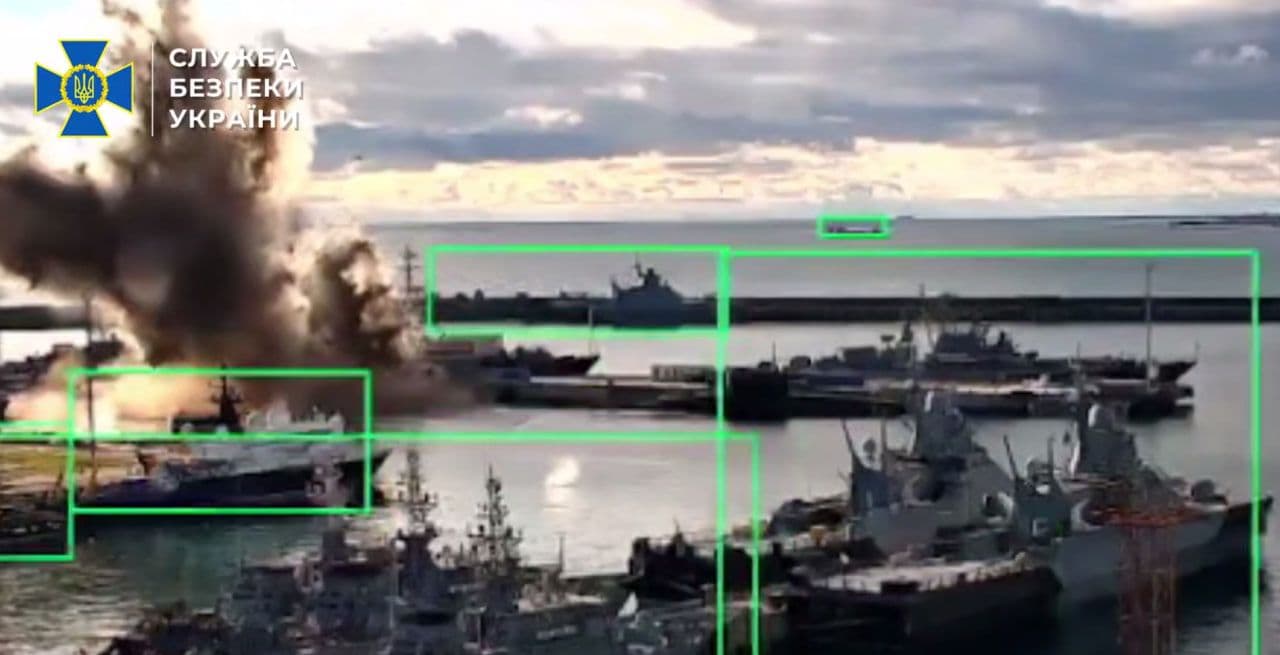
Flames erupt at Novorossiysk Naval Base as a Russian submarine is struck at the pier—an instant when a weapon built to hide is suddenly, violently exposed. (SBU)
When the Sea Betrayed the “Black Hole”
They called it the “Black Hole”—a submarine built to disappear. The Russian Project 636 Varshavyanka absorbed sound, slipped past sonar, and waited offshore to launch Kalibr missiles toward Ukrainian cities. Russian naval planners believed it was untouchable, one of their most survivable weapons. That belief shaped Ukraine’s response: not to hunt it the old way, but to change the battlefield itself.
Footage released by the Security Service of Ukraine shows the moment the myth collapsed. Explosions ripple along the submarine’s hull as it sits docked at Novorossiysk Naval Base in Krasnodar Krai. The attackers were “Sub Sea Baby” underwater drones—machines that traveled hundreds of kilometers from Ukrainian-controlled waters, threading Russian coastal defenses without crews, signals, or margin for error. When they reached the pier, they struck cleanly. The SBU described the damage as critical. Four Kalibr launchers would never fire again.
NASA’s FIRMS satellite data confirmed the aftermath: fires burning near the naval base, smoke rising from a harbor Russia considered safe simply because it lay on the mainland. The submarine had been hiding in plain sight, believing geography itself was protection.
This was more than a successful strike. It was proof of acceleration. Ukraine weaponized underwater drones, solved long-range autonomous navigation under combat pressure, and hit a target Russian doctrine treated as immune. The Black Hole could vanish from sonar—but not from innovation.
Beneath the Streets of Kupyansk
While negotiators spoke of ceasefires in Berlin, another war unfolded in the dark beneath Kupyansk. Russian soldiers crawled through gas pipelines—on hands and knees, for days—using civilian infrastructure as underground invasion routes into the city. The tactic had worked before in Avdiivka and Sudzha. This time, they tried again, betting that darkness and steel would hide them.
It didn’t.
Ukrainian forces identified the pipeline routes and ruptured them, sealing off the passages and trapping Russian personnel inside. Fire control was established over every possible exit. Between one hundred and two hundred Russian soldiers were believed to remain inside Kupyansk, dependent on drones for survival. The resupply was crude and risky. Drones dropped what they could—light food, small items—often missing targets and exposing positions. Heavy weapons, ammunition, and sustained logistics never arrived.
Colonel Viktor Trehubov confirmed Ukrainian clearing operations were underway, carefully avoiding destructive urban combat where possible. A Ukrainian brigade NCO said his unit had already reclaimed surrounding settlements and forest belts, with troops operating in northern Kupyansk itself. Russian claims of control over Petropavlivka collapsed under geolocated footage, another instance where battlefield reality punctured Moscow’s information war.
Even Russian military bloggers stopped pretending. One admitted their forces held only fragments of northern and central Kupyansk, with most of the city either contested or lost. Another described Russian troops in the west as “desperately fighting,” forced back across the Oskil River as Ukrainian interdiction intensified. Manpower superiority—once assumed—was gone.
Four days underground showed Russian resolve. Ukraine’s response showed something else: detection, containment, and methodical elimination. Innovation met counter-innovation. And once again, no shortcut delivered victory.
Ninety Percent Peace, Ten Percent War
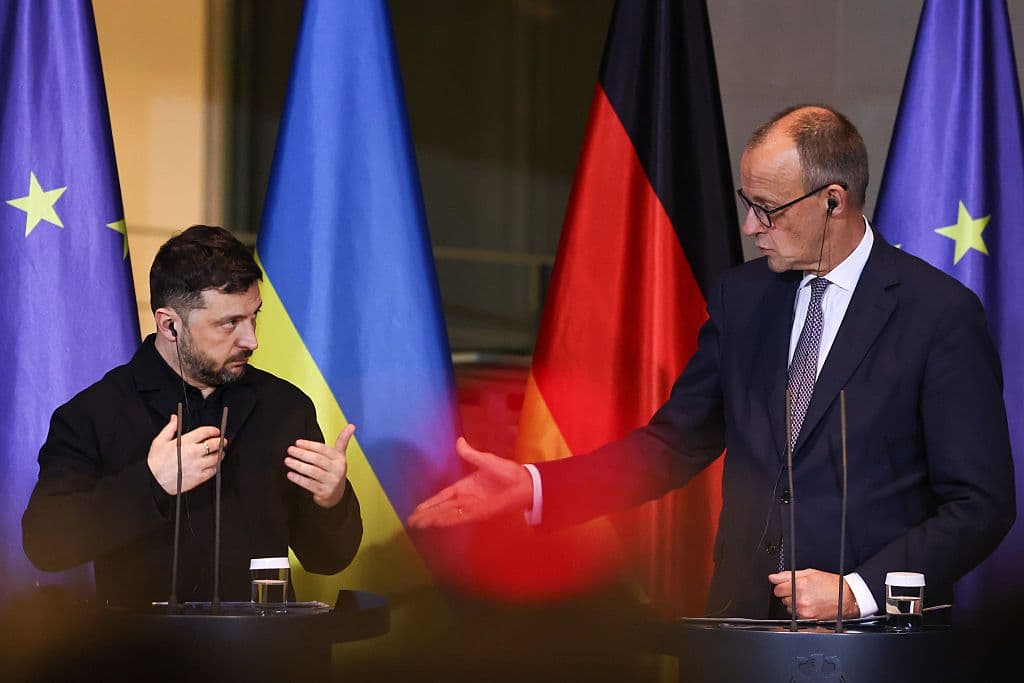
Berlin, under chandeliers and cameras: Volodymyr Zelensky stands beside Friedrich Merz as Ukraine’s future is debated in calm rooms far from the front—where every unanswered question still carries a human cost. (Krisztian Bocsi / Bloomberg via Getty Images)
For two days in Berlin, Ukraine’s future was discussed in calm rooms far from the front. President Volodymyr Zelensky sat across from American and European officials alongside Defense Council Secretary Rustem Umerov, U.S. envoy Steve Witkoff, and Jared Kushner. When the meetings ended, aides briefed reporters with optimism. Ninety percent of the issues, they said, were resolved. European leaders spoke of “significant progress.” President Trump was reportedly pleased.
The missing ten percent was everything that mattered.
Which land would remain Ukrainian. What “NATO-like” security guarantees actually meant in practice. Who would monitor a ceasefire—and what would happen when it broke. And whether Russia would accept any deal that did not deliver what it had demanded since the war began.
American officials confirmed that security guarantees dominated the talks, but details remained carefully withheld. They suggested Zelensky and Vladimir Putin would ultimately need to resolve territorial questions themselves—a diplomatic abstraction complicated by reality. Putin had refused to meet Zelensky before the invasion, during early negotiations, and throughout every subsequent attempt. Moscow’s position had not shifted: Ukraine must give up territory, limit its military, and accept arrangements that would leave it vulnerable to future attack.
Zelensky was blunt. Any version of Donbas under Russian control was unacceptable, he said. Ukraine would not recognize occupation—neither legally nor in practice. That clarity collided directly with American pressure to consider concessions in Donetsk and Luhansk.
European leaders outlined a sweeping security framework: long-term military support for an 800,000-strong Ukrainian force, a European-led presence inside Ukraine with U.S. backing, binding response commitments, reconstruction funded in part by frozen Russian assets, and continued EU integration. It was serious. It was detailed.
And it was precisely what Russia had already rejected.
The talks moved forward. The fundamentals did not.
When the Lights Became Targets
While diplomats spoke of peace, Russian planners focused on darkness. Missiles and drones were aimed not at front lines but at wires, substations, and transmission corridors—the quiet arteries that move power from western Ukraine’s generators to cities in the east. The goal was precise: cut the country in half electrically, fracture the grid into isolated “energy islands,” and let winter do the rest.
European officials watching the data were blunt. Eastern Ukraine stood at the edge of blackout, one senior diplomat warned, with Kyiv itself no longer immune. Ukrainian energy expert Volodymyr Omelchenko described the rhythm of the assault: massive combined strikes every seven to ten days, timed to hit just as repair crews finished restoring earlier damage. Distribution systems in Chernihiv, Sumy, Kharkiv, Kherson, and Odesa were hit again and again—not by chance, but by design.
The night of December 14 into December 15 followed the script. Russian forces launched 153 Shahed, Gerbera, and other drones from multiple directions—Kursk, Oryol, Millerovo, Smolensk, Primorsko-Akhtarsk, and occupied Crimea. Ukrainian air defenses destroyed 133 of them. Seventeen still got through. Ten locations were struck. Homes burned. Energy facilities went dark in Kharkiv and Kherson.
Further south, glide bombs slammed into Odesa Oblast’s logistics network. Bridges over the Dniester near Zatoka and the Sarata River near southern Sarata were hit by weapons chosen for cost and efficiency—cheap guided munitions launched from expensive aircraft, gambling damage against risk.
The strategy was brutally simple. Break what can’t be defended everywhere. Destroy faster than repairs can be made. Turn electricity into leverage. This was not about military necessity alone—it was about pressure, exhaustion, and the quiet threat that resistance would be paid for in darkness.
Money Frozen, War Unfrozen
In Brussels, the war was measured in spreadsheets. As EU leaders prepared for a December summit, the European Commission pushed a plan that could finally turn frozen Russian money into Ukrainian lifelines. The idea was legally elegant and politically fragile: replace roughly €210 billion in immobilized Russian central bank assets with EU-backed bonds, then use the interest from that Russian cash to guarantee a reparations loan for Ukraine. No seizure. No expropriation. Immediate money, minimal legal risk—or so the architects hoped.
The resistance came from Belgium.
As host to Euroclear, where most of the frozen assets sit, Belgium saw itself in Moscow’s legal crosshairs. Officials feared retaliatory lawsuits, financial retaliation, and long-term damage to Europe’s financial credibility. Brussels demanded iron-clad guarantees that the risk would be shared. Italy and others quietly agreed. The Commission’s proposed “three-tier defense” was not enough to break the standoff.
Moscow struck where it knew Europe was vulnerable—law. Russia’s Central Bank filed a lawsuit demanding 18.2 trillion rubles, roughly $229 billion, from Euroclear. The message was unmistakable: touch the money and pay the price. Russian officials promised to use “all available legal and other mechanisms,” flooding the debate with uncertainty precisely when unanimity was required.
The timing was no accident. Frozen assets were leverage—potential bargaining chips in future peace talks. American officials had already floated the idea that some funds could return to Russia in a settlement. By threatening Belgium directly, Moscow aimed to keep the money locked away, unusable, and politically radioactive.
EU foreign policy chief Kaja Kallas acknowledged the tension. “We are not there yet,” she said, insisting leaders would not leave empty-handed. But the gap remained stark: Europe debated liability while Ukraine counted nights without power.
The irony was brutal. Russian missiles destroyed cities. Russian money could rebuild them. And Russia was fighting—successfully, for now—to keep that money frozen.
Jets on the Table, Drones in the Balance
In Warsaw, the question was simple: what do you do with old fighters when a neighbor is still fighting for the sky? Polish Deputy Defense Minister Cezary Tomczyk offered an answer—six to eight MiG-29s, scheduled for retirement by the end of December, could either be parked in museums, cut for scrap, or sent east to keep Ukrainian pilots alive.
But the proposal wasn’t just about aircraft. Poland’s defense leadership framed it as a trade. Warsaw would hand over Soviet-era jets that Ukraine already knew how to fly. In return, Poland would gain access to something far more current—Ukraine’s hard-won expertise in drone and anti-drone warfare, refined under constant attack. Years of battlefield improvisation had turned Ukrainian units into laboratories, producing tactics and technologies that no peacetime program could replicate.
Ukraine already operated roughly forty MiG-29s, including fourteen provided by Poland and thirteen by Slovakia since the full-scale invasion began. The additional aircraft would not transform the air war, but they would fill gaps, extend patrols, and buy time. For Poland, the transfer would complete a transition already underway—relying on American F-16s and South Korean FA-50s while shedding legacy systems.
The exchange marked a shift in how military aid now worked. This was no longer a one-way pipeline from donor to recipient. It was collaboration between partners with different strengths—Poland offering hardware, Ukraine offering knowledge paid for in combat.
Zelensky’s longer vision made that clear. Plans to rebuild Ukraine’s air force around Swedish Gripens and French Rafales stretched into the 2030s. Countries making those plans were not betting on a quick peace. They were preparing for a future that still required air power—and allies who understood the sky had changed.
Turning Battlefield Ingenuity into Assembly Lines
In Berlin, the war briefly shifted from explosions to manufacturing. On December 15, Quantum Systems and Frontline Robotics announced a joint German-Ukrainian venture to mass-produce drones designed by Ukrainians and proven in combat. The new company, Quantum Frontline Industries, will build those drones in Germany and ship them to Ukraine in quantities determined by Kyiv’s Defense Ministry.
These were not experimental designs. They were tools refined under fire—adjusted after failures, improved because mistakes cost lives. What Ukraine could innovate but not scale alone would now move through German factories, turning frontline improvisation into reliable supply.
Sven Kruck, co-CEO of Quantum Systems, said Ukrainians had already transformed drone warfare; the next step was transforming production itself. Frontline Robotics CEO Yevhen Tretiak was more direct: the goal was thousands of drones, delivered fast, to push back Russian forces.
The announcement coincided with Germany unveiling a ten-point defense plan during President Zelensky’s visit, placing joint production and procurement at its core. The message was clear. This war would not be sustained by improvisation forever.
The battlefield had taught the lessons. Industry was now catching up.
Fire on the Caspian Horizon
The war reached farther east overnight. Ukrainian drones struck the Astrakhan Gas Processing Plant in southern Russia, igniting fires at a facility that feeds Russia’s military machine. It was the third hit on Caspian Sea energy infrastructure in a week—and a clear signal that distance was no longer protection.
Astrakhan is not a symbolic target. The plant produces sulfur, gasoline, diesel, and fuel oil—materials tied directly to Russia’s ability to manufacture explosives and sustain operations. Knocking it offline meant more than economic loss; it meant friction inside the machinery of war itself.
Ukrainian broadcaster Armyinform reported a second blow in the Caspian: a strike on a Lukoil offshore platform at the Korchagin oil and gas condensate field. Production halted. Roughly twenty thousand barrels a day went dark, along with gas capacity measured in the hundreds of millions of cubic meters. Not decisive alone—but disruptive, especially when repeated.
Regional governor Igor Babushkin confirmed drone attacks and fires at industrial sites, offering few details. But the scale was clear. Astrakhan is one of Russia’s largest sulfur producers, turning out millions of tons each year. Sulfur fuels explosives as much as it fuels profit, making the target militarily valuable even before the flames appeared.
The strikes marked a widening arc of Ukrainian reach. Drones that can fly to the Caspian can reach deep into Russia’s energy heartland west of the Urals. Each refinery fire and halted platform carried the same message: the war is no longer contained. Its costs are now arriving on Russian shores far from the front.
Moscow Learns the Sound of Drones
Night in Moscow no longer means quiet. Air defense systems snapped awake as drones moved toward the capital, forcing residents to count explosions instead of hours. Mayor Sergey Sobyanin said at least eighteen drones were intercepted on approach, with the total rising to twenty-five by morning. The Defense Ministry reported a far larger picture—146 drones downed across twelve regions overnight, then sixteen more just after dawn.
In several Moscow districts, residents reported blasts echoing through the dark. Officials confirmed no casualties and no serious damage. Airports told a different story. Flights at Zhukovsky and Domodedovo were temporarily halted, aircraft held on tarmacs or diverted, another familiar disruption in a city learning how modern war interrupts ordinary life.
The material damage was limited. The psychological effect was not.
These attacks were never about leveling Moscow. They were about repetition. Sirens. Alerts. Interceptions announced before breakfast. Each disruption reminded Muscovites that the war had slipped past television screens and border maps. It could pause flights, rattle windows, and rewrite routines—even when nothing was officially “hit.”
This was the new normal. Not devastation, but intrusion. Not destruction, but presence. A capital that once watched the war from a distance now lived with its echoes, learning that safety could no longer be assumed simply because the front lay hundreds of kilometers away.
A Night of Fire Across Dnipropetrovsk
The attack came after dark, spreading outward instead of forward. Russian drones and rockets slammed into communities across Ukraine’s Dnipropetrovsk region, turning a quiet night into scattered pockets of fire. Shahed-type drones buzzed overhead as multiple-launch rocket systems followed, the two weapons working together to reach places far from any active front line.
In the Synelnykove district southeast of Dnipro, attack drones struck the Mykolaivka community. Two men—29 and 42 years old—were wounded as explosions tore through civilian infrastructure and ignited fires. Further east, drones hit Pavlohrad and Pyatykhatky, damaging buildings and setting a transportation business ablaze, the kind of target that keeps daily life moving until it suddenly doesn’t.
To the south, the Nikopol district took rocket fire. Grad systems shelled the Marhanets community near the Dnipro River, injuring three civilians: a 19-year-old man, a 51-year-old woman, and a 55-year-old man. None were combatants. All were treated as outpatients, carrying injuries meant to remind survivors how close the war can reach.
Above them, Ukrainian air defenses worked through the night, shooting down 22 drones before they could strike. Many more still got through.
The pattern was unmistakable. This was not about terrain or tactical gain. It was about pressure—hitting homes, businesses, and neighborhoods well beyond the battlefield. In Dnipropetrovsk, the war arrived not as a line on a map, but as a night when civilians once again became targets.
What Ukrainians Will—and Will Not—Accept
The numbers landed quietly, but they spoke with unusual force. A poll released by the Kyiv International Institute of Sociology on December 15 cut through months of speculation about what Ukrainians actually want from peace. Only nine percent supported holding elections before a ceasefire. A quarter would consider voting if fighting stopped and security guarantees were in place. A clear majority—fifty-seven percent—said elections could only come after a full peace agreement.
The data punctured a popular narrative abroad. Claims that Ukrainian leaders resisted elections to cling to power did not survive contact with public opinion. Ukrainians were not afraid of democracy. They were unwilling to pretend normal politics could exist under missile fire.
More telling were the red lines. Seventy-five percent rejected any peace deal that required abandoning Donbas, shrinking Ukraine’s military, or accepting vague promises without firm security guarantees. At the same time, seventy-two percent said they could accept freezing the front lines—if Ukraine received real protection and never formally recognized occupied land as Russian.
The contradiction wasn’t confusion. It was clarity.
Ukrainians distinguished between compromise and surrender. They understood what “occupation” meant because many had lived it—or watched neighbors disappear into basements, prisons, or deportation trains. They knew what happened when Russian control settled in: torture, erased language, broken families, vanished futures.
Sixty-three percent said they were prepared to endure the war for as long as necessary. Not because they wanted endless fighting, but because they knew the cost of the alternative.
The poll exposed a widening gap. American pressure leaned toward territorial concessions most Ukrainians rejected outright. European talk of security guarantees came closer to public sentiment—but trust depended on whether those guarantees would hold when tested.
For Ukrainians, the choice was stark. Peace mattered. Survival mattered more.
When the Border Went Dark
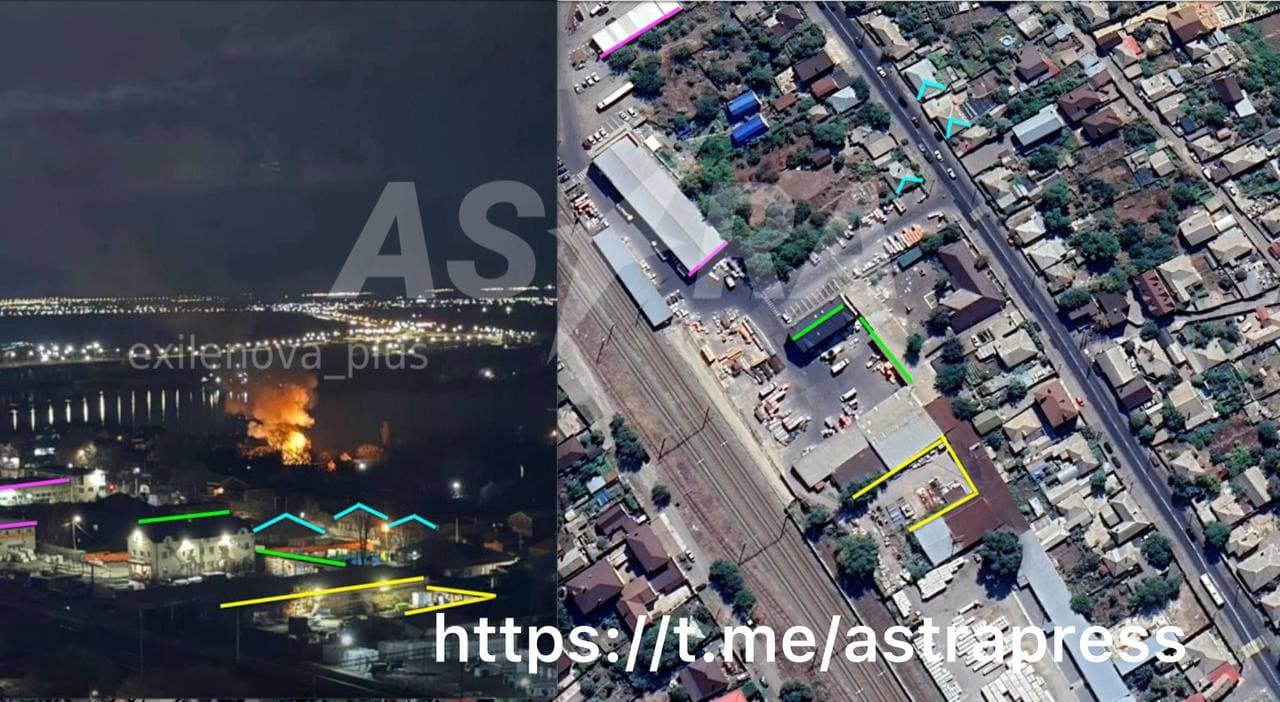
Night in Russia’s Rostov Oblast: flames claw upward after a drone strike, turning the war inward and reminding border regions that the front no longer stops at the map’s edge. (Astra)
The lights went out first.
Overnight, a Ukrainian drone struck the Luch thermal power plant in Russia’s Belgorod Oblast, knocking out roughly ten percent of the region’s heat supply. Belgorod is not just another border province—it is a launchpad for Russian attacks into Ukraine. That made the power station more than infrastructure. It made it part of the war.
Geolocated footage later showed twisted metal and damaged engineering systems inside the plant. No casualties were reported. The strike unfolded as part of a wider operation—146 drones crossing into twelve Russian regions in a single night, a coordinated reminder that Ukraine’s reach now moves in several directions at once.
Further south, the war rippled through Rostov Oblast. Authorities reported damage to residential buildings and a high-voltage power line. Water pumping stations shut down, cutting supply to several communities. Investigators suggested the intended target may have been a nearby branch of the Novoshakhtinsk Oil Products Plant, just two kilometers away—another node in Russia’s energy network feeding its military machine.
Flames lit the night sky in Rostov, a visual echo of a war Russians were told would stay far away.
These strikes were not random. They followed a pattern. Hit the systems that move power, fuel, and water. Disrupt the logistics that sustain offensive operations. Force Russia to defend its own border regions while complicating attacks outward.
Every darkened power station and silent pump carried the same message: the front is no longer fixed. It stretches backward into infrastructure once assumed untouchable. And for Russia’s border regions, the war has begun arriving not as headlines—but as outages, shortages, and fire in the night.
Where the War Never Pauses
While diplomats debated frameworks and percentages, the fighting never slowed. On December 15, Russian forces pressed attacks across the eastern front, probing for weakness in a dozen directions where the war resets itself every morning.
North of Sumy City, Russian units pushed toward Andriivka but failed to hold ground. In northern Kharkiv Oblast, assaults flared near Vovchansk, Vovchanski Khutory, Synelnykove, Prylipka, Lyman, and Vilcha—short advances measured in meters, not momentum.
Farther south, the Slovyansk–Lyman axis absorbed sustained pressure. Russian forces attacked near Lyman and surrounding settlements—Novoselivka, Drobysheve, Serednie, Kolodyazi, Zarichne. Ukrainian defenders held Stavky and Novoselivka, but at a cost. One brigade spokesman described a grim imbalance: six to ten Russian soldiers pressing against each Ukrainian position.
The Siversk direction followed the same pattern. Russian assaults rolled toward Siversk itself and nearby villages—Dronivka, Yampil, Ozerne, Zakitne, Serebryanka, Pereizne, Vasyukivka, Svyato-Pokrovske—relentless, grinding, rarely decisive. In southeastern Kostyantynivka, geolocated footage showed small Russian gains, paid for slowly.
Around Pokrovsk, attacks came from every side—northwest near Hryshyne and Rodynske, east toward Myrnohrad, southwest near Kotlyne, Udachne, and Molodetske. Elsewhere—Novopavlivka, Oleksandrivka, Dobropillya, Hulyaipole—Russian units attacked without confirmed progress.
Ukraine struck back where it could. In western Zaporizhia, Ukrainian forces advanced south of Stepnohirsk. In occupied Donetsk City, drones hit a Russian ammunition depot and a Geran drone warehouse at the airport.
No breakthroughs. No collapse. Just the daily crucible—where armies collide, adjust, and return the next morning to do it again.
What December 15 Revealed
December 15 laid bare the war’s central contradiction. Movement everywhere. Resolution nowhere. Ukrainian underwater drones shattered assumptions once thought permanent. European leaders aligned on security frameworks. Negotiators claimed progress measured in percentages. Russian submarines burned. Frozen billions edged closer to becoming Ukrainian lifelines.
And yet the map did not change.
Russia still occupied Ukrainian land. Ukraine still refused to surrender it. The talks stalled where they always stall—on territory, on guarantees, on whether peace meant safety or only a pause. The power grid still flickered under attack. The front still moved by meters and bodies.
Each dimension of the war told the same story in a different language. Technology surged ahead faster than doctrine could follow. Tactics evolved underground and underwater. Diplomacy advanced in rooms where the hardest questions remained politely unanswered. Public opinion hardened as Ukrainians weighed compromise against survival and chose neither illusion nor surrender.
Berlin’s negotiators were not pretending. Real progress was made—on mechanisms, funding, and enforcement. But the core question remained immune to process: how much of Ukraine would still exist as Ukraine. Russia demanded land as payment for peace. Ukraine refused the bill. That equation did not balance.
The frozen Russian assets symbolized the gap between possibility and will. The money exists. The need is immediate. Legal caution and political risk still stand in the way. What could stabilize Ukraine instead waits in escrow.
Beyond conference halls, the war followed its own logic. Kupyansk was cleared. Infrastructure was hit. Drones flew. Adaptation answered adaptation. Neither side saw a better option than continuing.
Wars usually end through collapse, compromise, or conquest. On December 15, none were close. Progress accumulated. Endings did not.
Somewhere between a burning submarine in Novorossiysk and confident briefings in Berlin sat the truth of the day: ninety percent solved can still leave everything that matters unresolved.