
As Russian missiles rained on the capital in a catastrophic dawn assault, Ukraine’s own government imploded from within—then struck back with flames across occupied Crimea.
The Day’s Reckoning
The sirens screamed first. Then came the explosions—wave after wave, hour after hour, until dawn broke over a capital city half-buried in smoke. By the time November 28 ended, Kyiv had endured one of war’s cruelest paradoxes: devastation from without and collapse from within.
While 596 Russian drones and 36 missiles tore through the night sky—killing at least two, injuring 37, and leaving half the city without power—Ukraine’s presidential compound witnessed its own detonation. Andriy Yermak, the man who’d wielded more influence than any unelected official in modern Ukrainian history, resigned in disgrace as anti-corruption agents raided his home. The head of the President’s Office, chief negotiator with Washington, architect of backroom deals—gone before breakfast, consumed by a scandal that reached into the highest chambers of power.
Yet even as Kyiv’s government fractured, its military proved the war’s other truth: Ukraine could still burn Russia’s war machine faster than Moscow could rebuild it. Ukrainian drones erased air defenses across Crimea, torched the Saratov refinery for the fifth time this season, and turned the Afipsky plant into an inferno visible from the front lines. In Zaporizhzhia, Russian troops who’d been hammering toward Hulyaipole suddenly went quiet, their offensive stalling as Ukrainian defenders reclaimed lost ground.
The day revealed what three years of war had forged: a nation that could survive catastrophe on two fronts at once, fighting enemies both foreign and homegrown, and somehow still standing when the sun set.
A Capital Under Siege
You’re in a Kyiv metro station at 11 p.m., watching families arrive with inflatable mats and tents, pets tucked under arms, children already half-asleep. The air raid sirens haven’t sounded yet. But everyone knows. The warnings spread through messaging apps—hundreds of drones heading west, missiles loading across Russia. By the time explosions echo through the tunnels, you’re already underground.
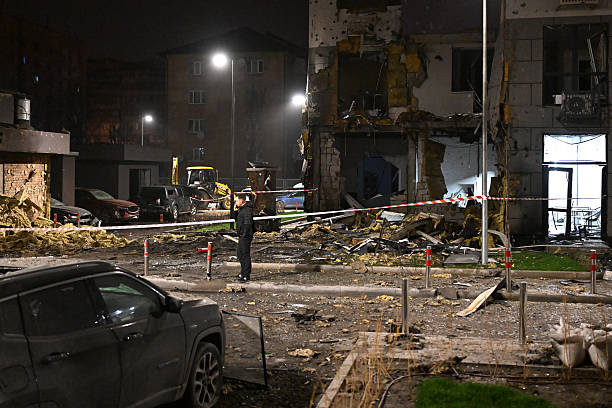
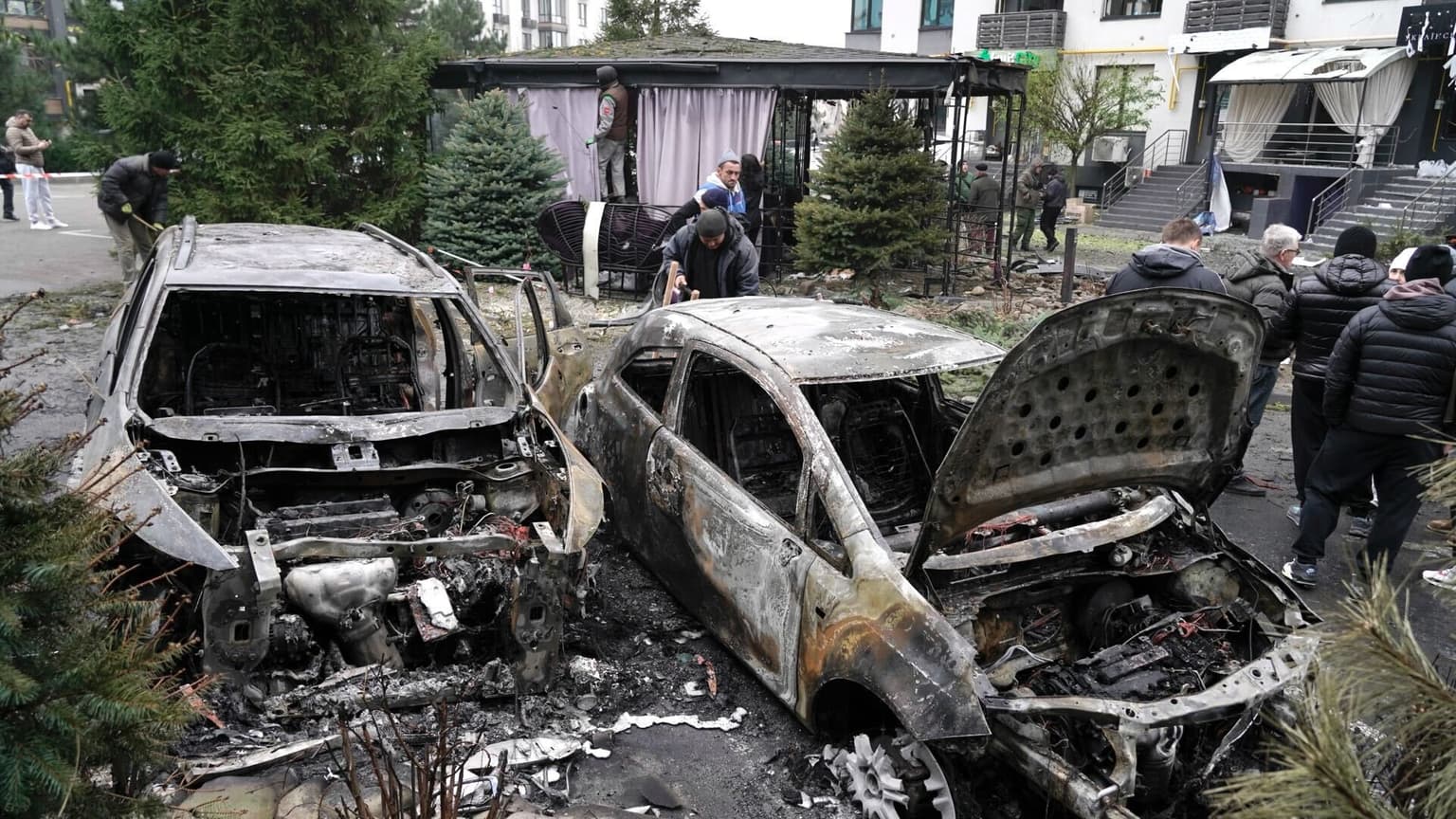
The attack began after 1 a.m. and didn’t stop. Russian forces hurled 596 Shahed drones and 36 missiles at Ukraine—the largest combined assault in months. Ukrainian air defenses clawed down 558 drones and 19 missiles, but the rest found their marks. Six districts across Kyiv erupted in flame. High-rises buckled. Cars melted into asphalt. Rescuers pulled bodies from rubble where apartments used to be.
Victor Mazepa stood before what remained of his car, a burned shell of metal and glass. His wife and child had sheltered during the attack. He’d stayed in the bathroom when the drone hit. “Was,” he said, gesturing to the wreckage. “But everyone is alive—that’s the main thing.”
Around 7 a.m., Russia launched a second wave. Kinzhal hypersonic missiles screamed toward the capital. Power grids failed. Half the city went dark. Water pressure dropped across the right bank. Transmission lines severed, distribution centers destroyed, electricity vanishing block by block.
In the Dniprovskyi district, apartments on upper floors simply ceased to exist—walls blown out, furniture exposed to open air. By morning’s end, two dead, 37 injured, and a city that had learned to measure disaster not in what was lost but in what still stood.
Russia attacks Kyiv regularly, targeting civilian infrastructure to break morale rather than seize military advantage. But the capital refuses to break. Families descend into metro stations with practiced calm. Children bring toys. Parents bring coffee. And when dawn comes, they return to streets where smoke still rises, ready to rebuild whatever Russia destroyed in the night.
The Reckoning Inside the Compound
While Kyiv burned, another explosion detonated in Ukraine’s corridors of power—this one silent, bureaucratic, and just as devastating.
At dawn on November 28, agents from the National Anti-Corruption Bureau arrived at Andriy Yermak’s residence. They carried search warrants tied to Operation Midas, the largest corruption probe of Volodymyr Zelensky’s presidency. By evening, Yermak had resigned. The man who’d run Ukraine’s Presidential Office since 2020, who’d negotiated with Washington and Moscow, who’d accumulated power so vast that critics called him a shadow president—was gone.
The investigation centers on Timur Mindich, a longtime Zelensky associate. Prosecutors allege Mindich orchestrated a $100 million theft from funds meant to fortify Ukraine’s energy infrastructure through Energoatom. Eight suspects have been charged. Law enforcement sources say one of the luxury homes financed through the scheme was intended for Yermak himself. Anti-corruption prosecutors nicknamed him “Ali Baba.”
European officials called Yermak “toxic” and expressed relief at his downfall. Yet the resignation came at the worst possible moment. Yermak had just been appointed to lead Ukraine’s delegation in critical peace talks with the United States—talks centered on a plan critics say favors Russia’s demands.
Zelensky announced a “reset” of the Presidential Office. Candidates whispered in Kyiv’s corridors include Prime Minister Yuliia Svyrydenko, Digital Transformation Minister Mykhailo Fedorov, military intelligence chief Kyrylo Budanov, and Defense Minister Denys Shmyhal.
The scandal exposed a contradiction Ukraine has struggled to resolve since 2022: how to fight a war for survival while purging the corruption that has plagued the country for generations. NABU’s raid showed that even wartime proximity to the president offers no immunity. Yet the timing—simultaneous with mass Russian attacks and delicate negotiations—raised questions about whether Ukraine could afford to clean its own house while defending it from invasion.
Crimea Burns, Air Defenses Die
Hundreds of miles south, Ukrainian drones slipped through Russian airspace like ghosts hunting targets already marked for death.
The Saky airfield in Novofedorivka, Crimea, had been fortified since 2022—layered defenses, hardened bunkers, the kind of installation Russia believed untouchable. Ukrainian forces disagreed. On the night of November 27, drones descended on the base. First, they eliminated the Pantsir S1 and Tor-M2 air defense systems—$60 million worth of Russian protection vaporized in minutes. Then, with the skies defenseless, Ukrainian strikes tore into the hangar storing long-range Forpost and Orion drones. Fire consumed the facility. Satellite imagery later confirmed heat signatures where the building once stood.
Ukraine’s General Staff reported the destruction of “key elements of the enemy’s air defense system.” Translation: Russia could no longer protect this corner of occupied Crimea. Every subsequent Ukrainian strike would face weaker resistance.
The assault didn’t stop at Saky. Ukrainian forces hit a command center and military truck nearby. They targeted the Yodobrom chemical plant, just 250 meters from the Saky thermal power plant, sparking fires that drew crowds to windows across Feodosia. Witnesses reported drones circling for hours, explosions echoing across the shoreline, tracer rounds carving desperate arcs as Russian gunners fired at shadows.
In Russian-occupied Donetsk and Luhansk, Ukrainian strikes hammered troop concentrations and fuel depots. The pattern was identical: systematic destruction of the logistics that kept Russia’s army moving. Fuel burns. Ammunition explodes. Command centers go silent.
Ukraine’s Unmanned Systems Forces announced they’d destroyed three major air defense systems over three days: Buk-M1, Buk-M2, and Tor-M2. Total value: $60 million. For Russia, the calculus was catastrophic: every billion spent on air defense could be erased in a single night. Fire by fire, refinery by refinery, airbase by airbase, Ukraine was dismantling the machine.
The Refineries That Fuel Russia’s War
While Crimea’s air defenses died, Russia’s oil heartland burned again.
The Saratov Oil Refinery—a sprawling complex producing more than 20 petroleum products and supplying the Russian army—erupted in flames for the fifth time this fall. Ukrainian drones navigated hundreds of miles of airspace, evaded whatever defenses remained, and struck with surgical precision. Fire climbed the towers. Black smoke billowed into a sky so clear you could see it from neighboring towns. Regional officials called it “minor damage,” a lie they’d told four times before.
Farther south, the Afipsky Oil Refinery in Krasnodar Krai became the night’s second casualty. The plant processes 6.25 million tons of oil annually—2.1% of Russia’s total refining output. More importantly, it sits just 200 kilometers from the front lines, supplying diesel and aviation kerosene directly to troops fighting in Ukraine. Ukrainian strikes ignited a blaze covering 250 square meters. Russian officials insisted only “technological equipment” was damaged. Satellite data told a different story.
The Afipsky plant had been hit before—twice in August, once in September. Each time, Russia repaired the damage. Each time, Ukraine returned. The strategy wasn’t to destroy the refineries permanently; it was to force Russia into an endless loop of repair, downtime, and vulnerability. Every day a refinery sat offline was a day Russian trucks couldn’t refuel, helicopters couldn’t fly, armored vehicles sat idle.
Ukraine has transformed its drone program into an industrial-scale campaign against Russian energy infrastructure. The refineries are massive, the distances vast, but the drones are cheap and the targets can’t hide.
Russia’s air defense network—built to stop NATO jets and cruise missiles—struggles against swarms of small, cheap drones flying low and slow. By morning, both refineries smoldered. Ukrainian commanders reviewed satellite images and planned the next strike. And somewhere in the Donbas, a Russian tank crew waited for fuel that would arrive days late, if it arrived at all.
Justice Comes to Sumy’s Executioners
The names came too late to matter to the dead, but they came.
On June 3, 2025, Russian forces fired BM-21 Grad rockets into the center of Sumy, a city far from the front lines, killing six and injuring over 30, including three children. The strike had no military value. It targeted a street, homes, the ordinary rhythm of civilian life. The rockets fell, people died, and for months, the killers remained anonymous—just another entry in the long ledger of Russia’s war crimes.
Then, on November 28, Ukraine’s Security Service named them.
Vladimir Shchipitsyn, commander of the 30th Motorized Rifle Regiment, planned the attack and oversaw the artillery that carried it out. His subordinates—Lieutenant Colonel Vitaly Orlov, the regiment’s chief of staff and first deputy commander, and Lieutenant Colonel Damir Garnayev, the chief of artillery—prepared the strike and executed the orders. Captain Dmitry Volobuev, commander of the rocket artillery battery, issued the final command to fire.
The SBU charged all four in absentia. The chances they’ll ever face trial are slim. Russian officers rarely answer for atrocities committed on Ukrainian soil. But the names now exist in the public record—indexed, documented, waiting for the day when borders shift and accountability becomes possible.
Elsewhere, a grimmer truth emerged from the Pokrovsk direction. Prosecutors reported that Russian soldiers had executed a Ukrainian prisoner of war near the village of Hnativka in early November. The captive’s hands were bound. One soldier beat him repeatedly with an assault rifle. When the prisoner stopped responding, they shot him. The killing was filmed, as so many are, another piece of evidence in a war that generates atrocities faster than courts can process them.
Ukraine has documented hundreds of executions of prisoners of war since the invasion began. The Geneva Conventions forbid the intentional killing of captives. Russia ignores them. Its soldiers kill with impunity, knowing prosecution is unlikely and consequences even less so. The war crimes accumulate like debts no one expects to collect—until, occasionally, names emerge, charges are filed, and the illusion of lawlessness cracks just slightly.
The victims in Sumy will not return. The executed prisoner in Hnativka will not rise. But the record grows, one name at a time, a ledger of accountability that waits for history’s judgment.
The Toll Rises in Ternopil
DNA doesn’t lie, even when hope does.
The death toll from Russia’s November 19 strike on Ternopil climbed to 35 after forensic analysts identified a 73-year-old man whose remains had been too fragmented to recognize. He’d lived on the street the missile hit—a neighborhood of modest homes and small gardens, the kind of place where neighbors know each other’s names. The blast left so little of him that only genetic testing could confirm his identity.
Five people remain missing, including one child. Their families cling to possibilities that shrink with each passing day. Were they vaporized? Buried under rubble not yet cleared? Or did they flee the blast and wander, disoriented, into the chaos that followed? The questions have no answers yet, only the silence of investigations that move slower than grief.
Ninety-four people were injured in the strike, 18 of them children. Of the 35 confirmed dead, six were children—small bodies caught in explosions they couldn’t understand, lives ended before they’d truly begun. The missile didn’t discriminate. It struck a residential area with no military value, no strategic purpose beyond terror.
Ternopil, a city in western Ukraine far from active combat zones, has become a symbol of Russia’s willingness to target civilians anywhere, anytime. The attack followed a familiar pattern: missiles launched from occupied Crimea or Russian airbases, guided by coordinates that prioritize population density over military necessity. The goal isn’t to seize territory; it’s to break spirits, to make survival feel like waiting for the next strike.
Forensic teams continue sifting through wreckage, collecting fragments, running tests. Each identification brings closure to one family and renewed anguish to others still waiting. The missing child’s parents have stopped asking when their son will be found. Now they ask if. The answer, when it comes, will arrive in a report, clinical and final, another name added to a list too long to bear.
North Korea’s Suicide Soldiers
The indoctrination begins in political classes held twice a week, sessions where North Korean soldiers deployed to Ukraine learn the value of dying well.
Instructors praise the “heroic services” of troops who detonated grenades rather than face capture, framing self-destruction as the highest form of loyalty to Kim Jong-un. The military promotes slogans glorifying such sacrifices: “If you give your life, you live forever.” “Let’s learn from the warriors who blew themselves up.” The message is unambiguous—better to die by your own hand than risk the shame of surrender.
Daily NK reported that North Korea has made these tactics central to its training for soldiers sent to Russia. The sessions claim the North Korean army has “achieved a record of distinction unmatched even by the Russian soldiers,” a boast designed to instill pride in suicidal devotion.
Ukrainian forces have already documented cases of North Korean soldiers blowing themselves up on the battlefield. In early 2025, Ukraine’s Special Operations Forces released video of a soldier detonating a grenade as Ukrainian troops closed in. The footage shows a figure crouched in a trench, clutching the explosive, waiting for the moment when capture becomes inevitable. The explosion is brief. The silence that follows lasts forever.
Pyongyang deployed roughly 11,000 to 12,000 troops to Russia in late 2024 to help repel Ukraine’s advance in Kursk Oblast, though Western diplomats suggest the number may be higher—perhaps 20,000 to 30,000. Most are young, undertrained, and unfamiliar with modern warfare. Their role is less to win battles than to absorb casualties, freeing Russian soldiers for offensives elsewhere.
The policy of encouraged suicide reflects North Korea’s broader strategy: soldiers are expendable, loyalty is absolute and returning home alive matters less than dying in a way that serves the regime’s narrative. The soldiers themselves have no choice. They go where ordered, fight where deployed, and die when instructed—by enemy fire or their own grenades. Either way, the regime calls it glory.
Russian Becomes Mandatory in Pyongyang’s Schools
The announcement came from Moscow, not Pyongyang, revealing how deeply the two regimes have intertwined.
Alexander Kozlov, Russia’s Natural Resources Minister, told a meeting of the intergovernmental commission on November 28 that Russian has become a compulsory subject in North Korean schools starting in fourth grade. The timing is deliberate. As North Korea sends thousands of soldiers to die in Ukraine, it’s preparing the next generation to speak the language of their patron.
Kozlov noted that North Korea has some 600 specialists in the Russian language and that the countries have deepened cooperation in banking, engineering, medicine, and geology. Russia is building a center for Russian-language education at Kim Chol Junior Normal University.
The language policy mirrors a broader strategy of dependence. North Korean students will learn Russian not as cultural enrichment but as preparation for integration into Moscow’s sphere. More than 3,000 Russian schoolchildren currently study Korean, though most learn it as a second or third foreign language—a hobby, not a necessity. For North Korea, Russian is becoming essential.
The effort coincides with military cooperation that has already sent thousands of North Korean troops to the front lines and may soon bring 12,000 North Korean workers to Russia’s Alabuga Special Economic Zone to manufacture Shahed-type drones.
Analysts at cybersecurity firm Gen Digital recently observed Russia’s Gamaredon and North Korea’s Lazarus collective sharing resources—an unprecedented level of cooperation between two state-backed cybercrime units. The language mandate is another piece of the same puzzle: Russia and North Korea are building an alliance that extends beyond weapons shipments to cultural integration, technological collaboration, and long-term strategic alignment.
North Korean authorities have not commented on Kozlov’s remarks. But the direction is unmistakable. As soldiers die in Ukrainian trenches, children in Pyongyang classrooms are learning the language of the country that sent them there. The war may end someday, but the dependency Russia is building will outlast it.
Hulyaipole: The Offensive That Stalled
For days, Russian forces had been hammering toward Hulyaipole, a strategic crossroads in Zaporizhzhia Oblast. Artillery pounded Ukrainian positions. Assaults came in waves. Military bloggers posted triumphant updates claiming Russian troops had reached the city’s outskirts. Then, on November 28, the offensive simply stopped.
Ukrainian forces, including the 33rd Separate Assault Regiment, repelled 20 Russian attacks near Zatyshshia, Solodke, Chervone, Dobropillia, Pryluky, Varvarivka, and Hulyaipole itself. The Southern Defense Forces confirmed Ukrainian troops had regained control of contested areas, pushing Russian forces back from positions they’d briefly held. Three military sources told Ukrainian outlet Hromadske that Russian troops had been spotted on the city’s outskirts and that the 102nd Territorial Defense Brigade had engaged them in gunfights within the town—but by day’s end, those incursions had been crushed.
The pattern was familiar: Russia advances through fog or concentrated firepower, seizes a few streets or fields, then stalls when Ukrainian defenses harden. The Southern Defense Forces admitted the situation remained “difficult” but insisted Ukrainian troops were not surrounded. The truth was simpler—Hulyaipole hadn’t fallen, and Russia’s attempt to take it had cost far more than the ground gained.
A Ukrainian intelligence source reported that Russian forces had “significantly decreased the intensity of their assaults” toward Hulyaipole, suggesting the offensive had exhausted itself. Units that had been pressing forward were now digging in, waiting for reinforcements or resupply.
Hulyaipole sits on critical road networks linking Russian-occupied territories to the front lines farther west. Losing it would complicate logistics and expose supply routes to Ukrainian strikes. Holding it required constant pressure—pressure Russia could no longer sustain. The offensive had promised momentum. It delivered casualties. And when the day ended, Hulyaipole remained in Ukrainian hands, one more town Russia had tried and failed to seize.
Britain’s Drone Factory for Ukraine
The announcement came with little fanfare, but its implications rippled far beyond the press release.
Kyiv and London have agreed to begin licensed production of the OCTOPUS anti-aircraft drone at British industrial facilities, Defense Minister Denys Shmyhal announced on November 27. “This is a historical precedent,” Shmyhal wrote, calling it “the next important step that will allow the production of Ukrainian interceptors in Great Britain, which have proven their effectiveness in the fight against Shaheds.”
Mass production is planned—potentially several thousand units per month, all destined for Ukraine’s air defense. Bloomberg reported the UK aims to manufacture around 2,000 OCTOPUS drones monthly. President Volodymyr Zelensky presented the drone during his October visit to the UK, and Prime Minister Keir Starmer agreed to produce the first batch for trials.
Technical specifications remain classified, but the OCTOPUS has demonstrated strong performance in combat. It operates effectively at night, under heavy electronic warfare interference, and at low altitudes. The UK Ministry of Defence estimates the drone costs less than 10% of the value of the targets it destroys, offering a far cheaper alternative to traditional air-defense missiles.
Defense analysts praised the cost-efficiency. London is even considering OCTOPUS as a component of a future European “drone wall”—a continuous air-defense shield along NATO’s eastern flank to counter Russian drone threats.
The partnership marks the first major Ukrainian-British joint project to result from bilateral technology exchange. Ukraine’s Ukrspecsystems developed the OCTOPUS with support from British scientists and engineers. Ukrspecsystems UK will produce the drones at its facility in Mildenhall, eastern England.
Russia launches up to 800 drones a night, a peak that hit 810 in September. Ukraine’s response: build more interceptors, faster and cheaper than Russia can replace its Shaheds. Britain’s entry shifts the balance, adding capacity Ukraine desperately needs and proving that Western support can evolve beyond weapons shipments to technology transfer and co-production.
When Corruption Crosses Borders
The Czech foundation Gift for Putin had raised money quickly—donations pouring in from supporters eager to fund Ukrainian defense. The goal was clear: purchase Flamingo cruise missiles from Fire Point, a Ukrainian weapons manufacturer. Then the doubts arrived.
“We collected the money very quickly, but serious doubts arose that it would not go to the product for which the collection was made,” Dalibor Dědek, one of the foundation’s leaders, told Czech outlet Idnes on November 28. “So, we did not go to them and now we are looking for a suitable alternative.”
The decision came after Dědek received new information from Ukrainian military intelligence, HUR. Martin Ondráček, another foundation leader, was more direct: “We understand that there is a certain amount of reluctance to spend money on this particular missile, because there is a real suspicion that the manufacturer is connected to people around Andriy Yermak.”
The foundation is now seeking other weapons manufacturers. The announcement arrived on the same day NABU agents raided Yermak’s residence—timing that underscored how far the corruption scandal had spread. It wasn’t just Ukraine’s Presidential Office under scrutiny; it was the ecosystem of defense contractors orbiting it.
Fire Point had been working to rehabilitate its image since the Kyiv Independent broke news of a corruption investigation into the company in August. The firm responded by announcing ambitious new projects and bringing on former U.S. Secretary of State Mike Pompeo as an adviser—a move designed to project legitimacy.
But credibility can’t be manufactured faster than suspicion spreads. Czech donors, watching the Yermak scandal unfold, decided the risk wasn’t worth it. The episode revealed an uncomfortable truth: Ukraine’s fight against corruption affects international fundraising, weapons procurement, and the willingness of foreign supporters to trust that their donations will reach the battlefield rather than disappearing into schemes that enriched Yermak’s circle.
Putin’s Peace Theater
Vladimir Putin wants everyone to know he’s open to negotiations—as long as Ukraine surrenders first.
Speaking in Kyrgyzstan on November 27, the Russian president claimed peace talks with Ukraine are “legally impossible” because Kyiv’s wartime leadership lacks legitimacy. He argued that President Volodymyr Zelensky’s decision not to hold elections during martial law was a “fundamental strategic mistake.” The argument is legally dubious and politically transparent: Putin wants a different Ukrainian government, one he can control or manipulate, before he’ll consider ending the war.
At the same time, Putin reiterated his preconditions for a ceasefire: Ukraine must withdraw from the unoccupied parts of Donetsk, Luhansk, Zaporizhzhia, and Kherson oblasts—territories Russia illegally annexed in 2022 despite not fully controlling them. Such a withdrawal would force Ukraine to abandon its Fortress Belt, the fortified defensive line that has anchored Ukrainian defenses since 2014.
Putin’s demands aren’t a peace proposal; they’re a maximalist wish list designed to fail. He insists the international community must recognize Russia’s territorial conquests, not just Ukraine. He claims any violations of an agreement would justify Russia employing “all retaliatory measures.” Translation: Putin wants legal cover to reinvade whenever convenient.
Meanwhile, Kremlin spokesperson Dmitry Peskov confirmed that Russia had received the “main parameters” of a U.S.-proposed peace plan discussed in Geneva. The plan, originally 28 points, was trimmed to 22 after EU, U.S., and Ukrainian officials scrambled to rewrite it in Ukraine’s favor.
Putin called the plan a “set of issues” rather than a finalized treaty, suggesting Russia views it as a starting point for further demands rather than a serious framework for peace. He’s setting information conditions to stall the process, exploiting the lack of clarity about prior U.S.-Russian discussions to add opacity and delay. The negotiations aren’t about peace; they’re about positioning for the next phase of war, whenever that comes.
The Economic Vise Tightens
Russia’s economy is learning what Ukraine’s military has known for months: the war’s costs compound faster than propaganda can hide them.
Inflation officially sits at 6.8%, but Russians feel it differently. “Prices are now rising faster than wages,” Elena, a 27-year-old event manager from Moscow, told Bloomberg. Sberbank data shows Russians cutting back on food purchases—milk, pork, buckwheat, and rice sales fell 8-10% in September and October. Retail demand is collapsing not because shelves are empty, but because wallets are.
The Center for Strategic Research warned in November that “there is almost no chance left to avoid a recession,” noting output declines across more than half of Russian industries. Steel demand has dropped sharply. Coal mining faces its worst conditions in a decade. Car sales fell nearly 25% in the first nine months of the year.
Russia’s largest grocery chain, X5 Group, reported higher revenues driven purely by inflation, but net income fell almost 20%—proof that rising prices don’t equal rising prosperity. The banking sector is deteriorating. Troubled corporate debt climbed to 10.4%, while retail debt distress rose to 12%.
Ukrainian drone strikes on oil refineries have spiked fuel prices and created shortages in some regions. Oil and gas revenues fell over 20% in the first ten months of the year. The budget deficit hit 1.7% of GDP in October and is expected to reach 2.6% by year’s end.
Oleg Buklemishev, head of the Center for Economic Policy Research at Lomonosov Moscow State University, warned of an impending crisis. “The immunity of the Russian economy has been severely weakened,” he said. “A systemic crisis may not occur in 2026, but a steady deterioration in economic conditions will continue.” He added that maintaining normal economic functioning would require scaling down military operations.
The realization, he said, has not fully come. “But the warning bells are already ringing.”
Orban’s Moscow Pilgrimage
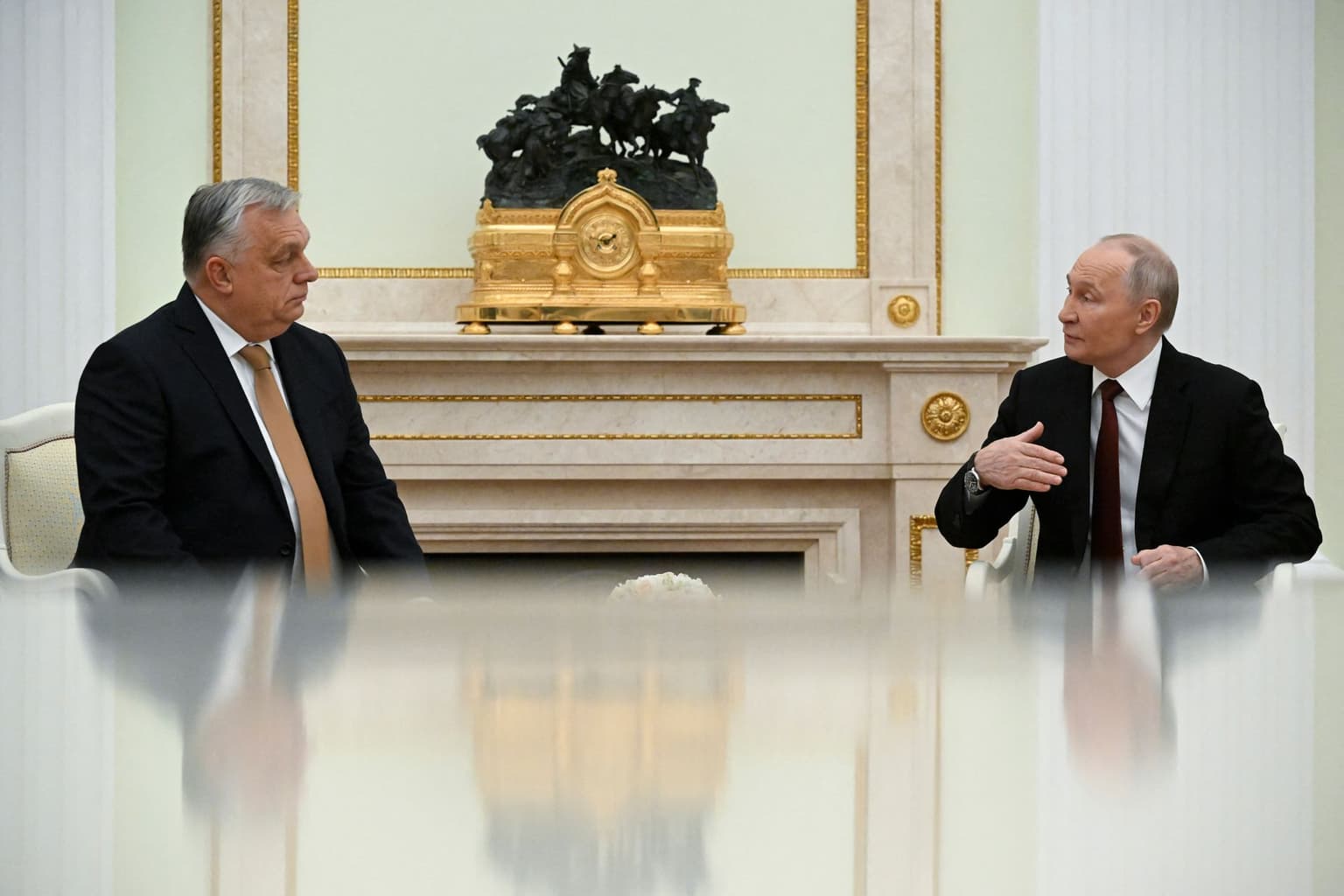
While most European leaders keep Putin at arm’s length, Viktor Orban flew to Moscow to embrace him.
The Hungarian prime minister arrived in Russia’s capital on November 28, praising the relationship between Moscow and Budapest as standing on “the very best” of their shared history. He met with Putin for three hours to discuss energy cooperation and peace talks on Ukraine.
Orban’s stated mission: secure Hungary’s energy supply for winter and beyond. “I am going to ensure that Hungary’s energy supply is secured for the winter and next year,” he said in a Facebook video before the trip. Asked whether Russia’s war on Ukraine would feature in discussions, he replied, “We can hardly avoid that.”
Hungary remains heavily dependent on Russian energy despite the EU’s broader strategy to reduce reliance on Moscow. Orban has continued to maintain close ties with the Kremlin throughout the war, setting Hungary apart from most NATO and EU allies. Earlier this month, the U.S. granted Hungary an exemption from sanctions to continue using Russian oil and gas, following Orban’s lobbying during a meeting with President Donald Trump.
Hungary imported 8.5 million tons of crude oil and more than 7 billion cubic meters of natural gas from Russia so far this year. Russia’s Rosatom is also constructing an expansion to Hungary’s Paks I nuclear facility under a 2014 agreement.
Orban revived the idea of hosting a “peace summit” in Budapest between Trump and Putin, an initiative shelved earlier this year. While most European leaders have distanced themselves from Moscow, Orban continues to question the effectiveness of Western military aid to Kyiv and has positioned Hungary as an advocate for renewed dialogue.
The meeting underscored Hungary’s outlier status within the EU and NATO. Orban’s willingness to travel to Moscow, shake Putin’s hand, and discuss energy deals while Ukraine endures mass attacks reveals a calculation: that Hungary can profit from neutrality, that Russian energy is worth more than European solidarity.
Belgium Threatens the Russian Asset Plan
While Ukraine fights for survival, Belgium fights over liability.
Belgian Prime Minister Bart de Wever sent a letter to European Commission President Ursula von der Leyen on November 27, labeling the EU’s plan to lend frozen Russian assets to Ukraine as “fundamentally wrong.” The plan would lend approximately 140 billion euros ($162 billion) in immobilized Russian central bank reserves to Ukraine, using windfall profits from those assets to repay the loan over time.
De Wever’s objection: Belgium could be left solely responsible if the scheme collapses. He demanded ironclad guarantees that his country wouldn’t bear the fallout alone, suggesting alternative financing methods instead.
The stakes are enormous. Ukraine’s finances will run dry in mid-2026. Kyiv needs 136 billion euros ($157 billion) in combined military and financial funding from foreign partners for 2026-2027. The reparations loan scheme is the most viable option on the table, yet Belgium—whose support is crucial—refuses to back it without absolute protection from risk.
Approximately $300 billion of Russian central bank foreign reserves were immobilized by sanctions in February 2022. Roughly two-thirds ($215 billion) are held at Euroclear, a financial institution based in Belgium. This makes Belgium central to any plan involving those assets. De Wever’s obstruction could derail the entire initiative.
Legal experts dismissed Belgium’s concerns as overblown. “Belgium’s arguments are misplaced and have been rebutted multiple times long ago,” said Bart Szewczyk, lawyer at Covington & Burling. Timothy Ash, fellow at Chatham House, called the objections “total bullshit,” adding that alternative financing options would also imply higher borrowing costs.
The European Commission is expected to provide a legal basis for the plan this week. But de Wever’s letter signals that political will may be harder to secure than legal justification. The December 18-19 European Council meeting offers another chance—and possibly the last before Ukraine’s finances collapse.
Thirteen Years for Fighting on the Wrong Side

Vasyl Verameichyk knew the risks when he crossed the border to join Ukraine’s fight. He’d served in Belarus’s military, understood how Lukashenko’s regime operated, and chose to defy it anyway. Just days after Russia launched its full-scale invasion, he enlisted in Ukraine’s Armed Forces, joining the Kastus Kalinouski Regiment—a unit of Belarusian volunteers fighting on Ukraine’s side.
On November 28, a Belarusian court sentenced him to 13 years in prison.
Independent outlet Belsat reported the sentencing, citing Verameichyk’s wife. The former Belarusian officer had served in the regiment until a dispute with a staff officer cut his service short, temporarily preventing him from re-entering Ukraine. Fellow volunteers said he’d been searching for ways to return to the front when Belarusian security services caught up with him.
In November 2024, Verameichyk was detained in Vietnam—a country far from any active conflict zone, where he’d presumably felt safe. He was extradited to Belarus in what volunteers believe was a coordinated operation by Minsk’s security apparatus. The regime views the Kalinouski Regiment as a hostile entity, a symbol of Belarusian resistance to Lukashenko’s alliance with Russia.
When news of Verameichyk’s arrest first broke, Belarusian volunteers in Ukraine attempted to rally Kyiv to facilitate his release. The effort went nowhere. Belarus has been one of Russia’s closest allies throughout the invasion, allowing Russian forces to launch attacks from its territory.
The 13-year sentence is both punishment and deterrent. Verameichyk will spend over a decade in a Belarusian prison for the crime of defending a country his own government helped invade. Belarus has also been recruiting its own citizens to fight for Russia. As of October 2025, more than 300 Belarusians fighting for Moscow have been killed in Ukraine. The contrast is stark: Belarusians who fight for Russia die as casualties. Those who fight for Ukraine die as heroes—or, if captured, are imprisoned as traitors.
What the Day Revealed
November 28 was a day of fire and fracture, of explosions in the sky and implosions in the corridors of power. Russia launched its largest combined assault on Kyiv in months, killing, wounding, and plunging half the capital into darkness. Ukraine’s government collapsed from within as its most powerful unelected official resigned in disgrace. And yet, even as the capital burned and the Presidential Office shattered, Ukraine’s military struck back—erasing Russian air defenses in Crimea, torching refineries across Russia, and repelling offensives in Zaporizhzhia.
The day exposed the war’s twin realities. First, that Ukraine can survive catastrophe on multiple fronts simultaneously—foreign invasion and domestic corruption, mass missile attacks and political implosion—and still function as a state and military force. Second, that survival is not victory, and endurance is not resolution.
Russia’s economic vise is tightening, but not fast enough to force Putin’s hand. Inflation erodes Russian purchasing power, refineries burn, and fuel shortages spread, yet Moscow shows no sign of scaling back military operations. The Kremlin’s theory of victory remains unchanged: outlast Western support, grind forward incrementally, and wait for Ukraine or its allies to blink first.
Ukraine’s challenge is equally stark. It can destroy Russian refineries and repel Russian offensives, but it cannot yet reclaim occupied territory or force Russia to negotiate in good faith. Kyiv’s government can purge corrupt officials and reform institutions, but it cannot do so without risking political instability at the worst possible moment.
By nightfall, smoke still rose from Kyiv’s apartment blocks and Crimea’s airfields. Ukrainian forces dug new trenches along the same bloody ridges. Russia prepared its next wave of missiles. The lines had shifted, the players had changed, but the story remained the same: a war that grinds forward because neither side can afford to stop, and neither can force the other to surrender.