
As 596 drones and 36 missiles bore down on Ukraine’s capital through the darkest hours, the shelters filled with families clutching pets and blankets—and the morning revealed a city half-darkened, half-defiant.
The Day’s Reckoning
The warnings came before the sirens. By 11 p.m. on November 28, Kyiv residents were descending into shelters, sensing what satellite feeds confirmed: Russia was launching one of its largest combined strikes of the war. Underground parking lots transformed into sanctuaries—children on inflatable mats, cats in carriers, dogs pressed against their owners.
For ten hours, Russian forces hurled 596 Shahed drones and 36 missiles at Ukraine’s capital. Ukrainian air defenses shot down 558 drones and 19 missiles. The 35 that broke through killed three, injured 52, and left half the capital without electricity. Apartment towers burned in six districts.
The assault matched diplomatic theater. As Ukrainian negotiators prepared for Washington peace talks, Russian missiles screamed toward neighborhoods. As Kremlin propagandists flooded social media with AI-generated “mass surrenders,” Russian drones violated Moldovan airspace. While Putin’s envoys whispered about ceasefires, his forces demonstrated Russia’s version of peace: submission under bombardment.
Ukraine answered. While Kyiv burned, Ukrainian drones struck two Russian shadow fleet tankers, turned the Afipsky Oil Refinery into an inferno, and set bomber repair facilities ablaze in Taganrog. The message: Russia strikes civilians, Ukraine strikes the machine.
The Siege of Morning
The first explosion came at 1 a.m., a sharp crack that echoed across the Dnipro. Then another. Within minutes, the night sky turned to fire.
Russian forces had launched 596 Shahed-type drones and 36 ballistic and cruise missiles—a swarm so dense that air defense crews worked in shifts. Ukrainian defenders shot down 558 drones and 19 missiles, filling the darkness with tracer rounds and orange blooms. But 35 drones and missiles broke through, carving destruction across 22 locations.
Victor Mazepa was in his bathroom when the strike came. The blast hurled debris against his building in Solomianskyi district, igniting his car below. His wife and child were in a shelter. “Here is my car. Was,” he said later. “But everyone is alive—that’s the main thing.”
In Sviatoshynskyi district, a drone slammed into a three-story building, sparking a fire that consumed the second floor. Rescuers pulled a man’s body from rubble hours later. In Dniprovskyi and Shevchenkivskyi districts, multiple apartments disintegrated. A child was injured. Seventeen victims were hospitalized. Fifty-two more treated for burns and shrapnel wounds.
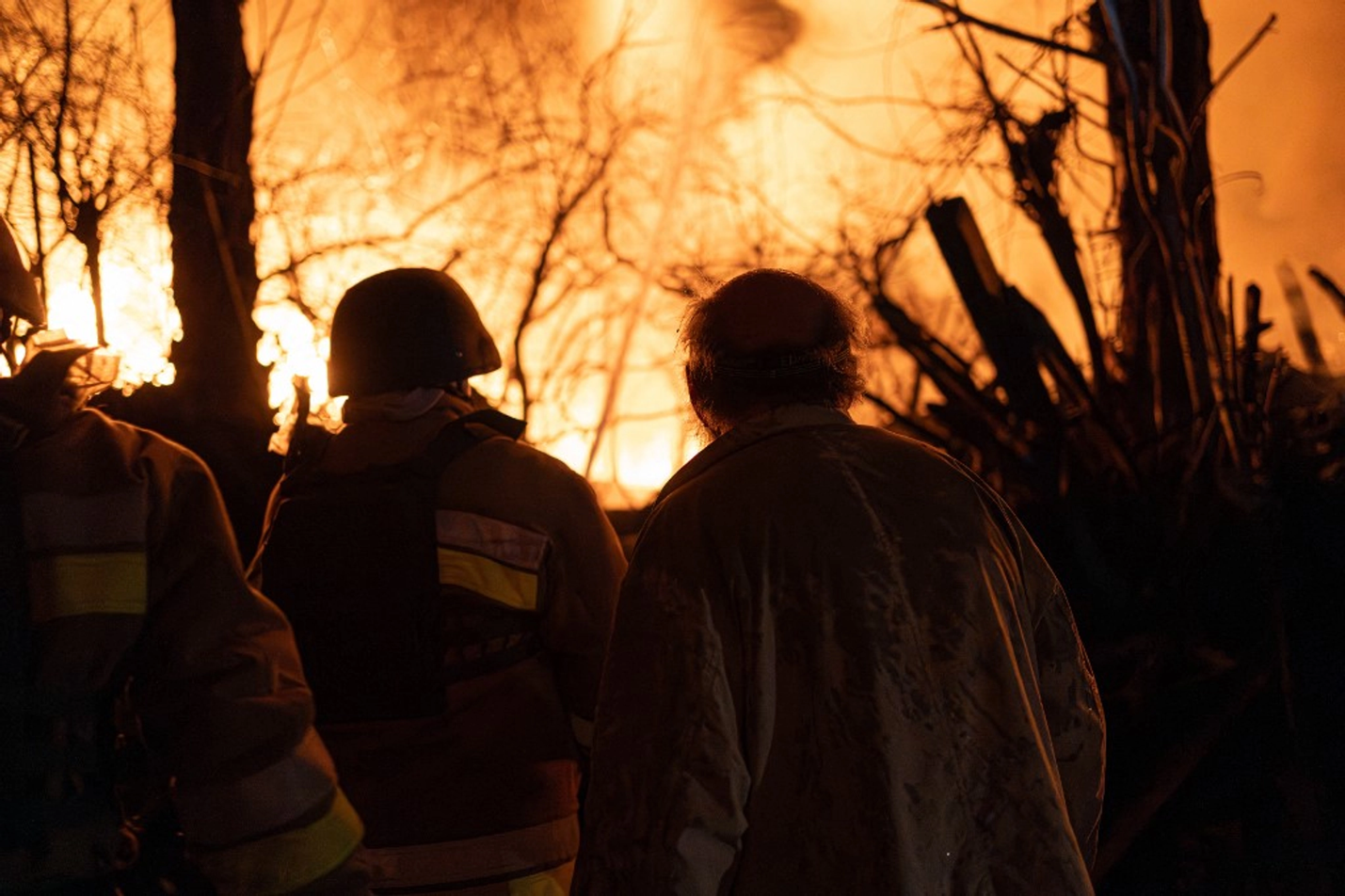
The assault didn’t stop at dawn. At 7 a.m., Russian forces launched a second wave—dozens more missiles, including Kinzhal hypersonics. Power grids failed. The western half of Kyiv went dark. Water pressure dropped. Energy CEO Vitaliy Zaichenko confirmed: “Almost half of Kyiv is without electricity.”
By the all-clear at 8:55 a.m.—nearly ten hours later—fires had consumed six apartment buildings. In Brovary, a drone obliterated two floors, forcing 52 evacuations. In Fastiv, a 55-year-old woman died. In Vyshhorod, another strike killed a man and injured 19, including four children. DTEK restored power to 360,000 households by day’s end, but the scars remained.
Striking the Lifeline: Shadow Fleet Burns
The Black Sea was calm when the drones arrived. Two oil tankers, the Kairos and Virat, were steaming toward Novorossiysk to load Russian crude—empty hulls ready to carry $70 million in oil revenues that would fund more missiles. They never made it.
Ukrainian Sea Baby naval drones closed the distance at high speed. Footage captured the moment: fireballs erupting from hulls, smoke billowing, crew scrambling for lifeboats as the tankers listed and burned. Both vessels suffered critical damage. Both were effectively decommissioned.
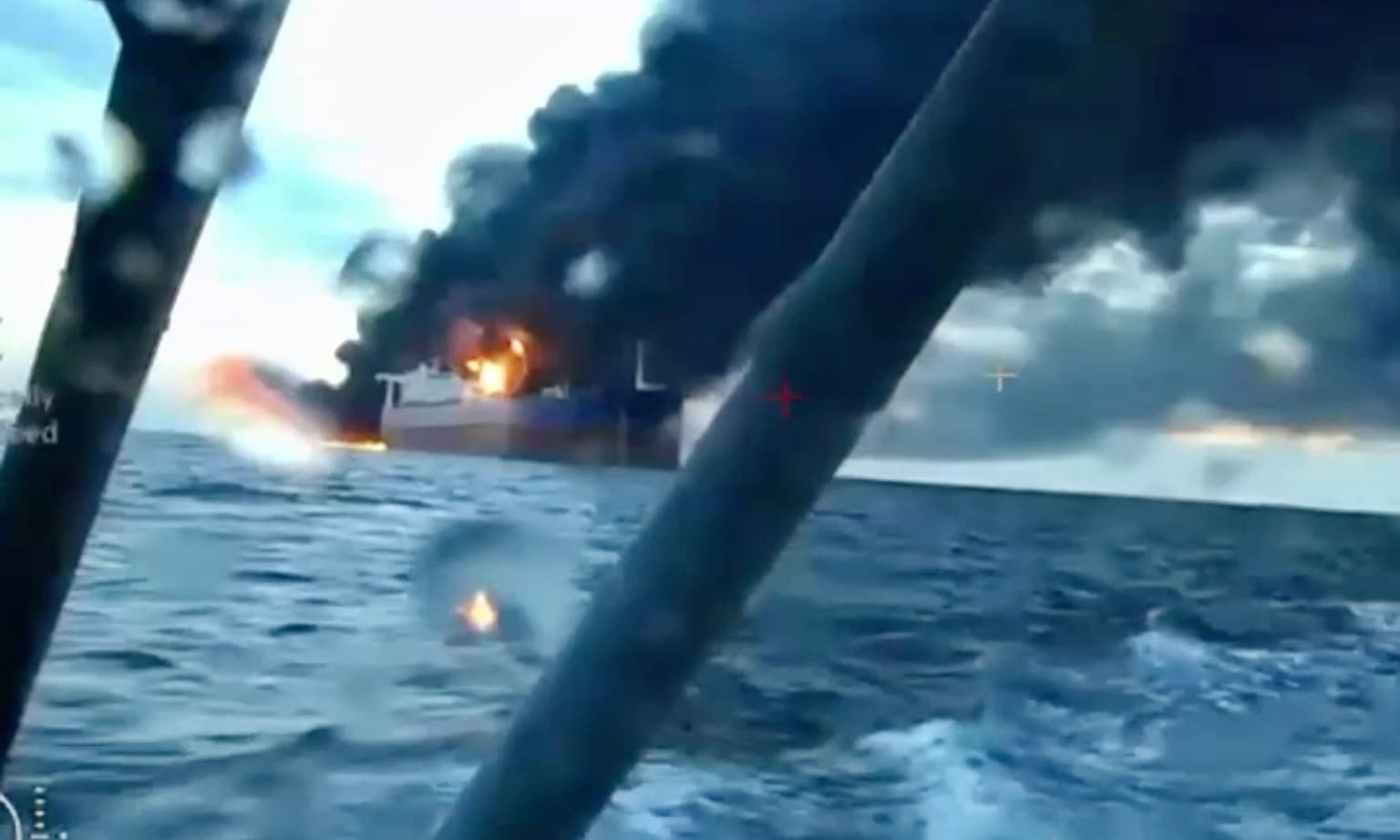
The strike was unprecedented. For the first time, Ukraine had attacked Russia’s shadow fleet—the network of aging tankers Moscow uses to evade Western sanctions. The Kairos and Virat were both sanctioned vessels, flagged by the U.S. and EU for transporting Russian crude to India. Destroying them announced that no part of Russia’s war economy was beyond reach.
Turkey’s Foreign Ministry expressed “concern,” noting the strikes occurred within Turkey’s Exclusive Economic Zone. Turkish rescue teams evacuated 25 crew members. Russian milbloggers accused Ukraine of violating a “non-aggression pact”—a claim as absurd as dishonest. Russia withdrew from the Black Sea Grain Initiative in July 2023, and no agreement protects its shadow fleet.
Hours later, Ukrainian drones targeted the Caspian Pipeline Consortium’s marine terminal in Novorossiysk, damaging a critical mooring device and forcing suspension of all loading operations. Kazakhstan’s Foreign Ministry protested, calling it an attack on “civilian infrastructure.” But the damage was done. Tankers were towed away. Pipelines shut down. Russia’s Black Sea oil exports faced serious operational constraints for the first time since the war began.
Refinery Flames and Bomber Smoke
While the Black Sea burned, Ukraine’s Unmanned Systems Forces turned inland. The target: the Afipsky Oil Refinery in Krasnodar Krai, processing 6.25 million tons of oil annually—2.1 percent of Russia’s total refining capacity. Located 200 kilometers from the front, the refinery supplies diesel and aviation kerosene directly to Russian forces. It burned again on November 29.
Geolocated footage showed flames climbing refinery towers, black smoke pouring skyward. Russian sources reported fires covering 250 square meters and damaged equipment, though they insisted storage tanks remained intact. The Ukrainian General Staff confirmed explosions in the target area. Whether the damage would disrupt fuel supplies remained unclear, but Ukraine’s deep-strike campaign showed no signs of slowing.
The same night, Ukrainian drones found the Beriev Aircraft Repair Plant in Taganrog, Rostov Oblast. The facility modernizes Tu-95 strategic bombers and A-50 airborne early warning planes—the systems Russia uses to launch long-range strikes against Ukrainian cities. Ukrainian forces struck the Tu-95 repair shop, igniting a fire that consumed the building.
Footage also emerged from the Alabuga Special Economic Zone, where a Shahed drone battery storage facility burned. The cause remained unclear, but the timing was suggestive. Alabuga is a primary production site for the same drones that had terrorized Kyiv hours earlier.
The Ukrainian General Staff confirmed one more strike: the November 25 attack on Tuapse Marine Oil Terminal successfully destroyed an RV-5000 vertical storage tank. From refineries to bomber plants, from oil terminals to drone factories, Ukraine’s campaign methodically dismantles the infrastructure powering Russia’s invasion. The fires will be extinguished. Repairs will take months. And in that gap, Ukraine’s defenders gain precious time.
Diplomatic Theater in the Shadow of Strikes
While Kyiv smoldered and refineries burned, diplomacy churned forward. President Volodymyr Zelensky confirmed on November 29 that a Ukrainian delegation led by National Security and Defense Council Secretary Rustem Umerov had departed for the United States to continue negotiations on the latest peace plan. The talks would build on the November 23 Geneva meeting, where American, Ukrainian, and European representatives worked to revise a 28-point proposal that initially demanded sweeping concessions from Kyiv.
Zelensky described the American approach as “constructive”—a diplomatic euphemism barely concealing tension. The original plan, crafted by Trump’s Special Envoy Steve Witkoff and Kremlin aide Kirill Dimitriev, skewed so heavily toward Russia it amounted to capitulation. In Geneva, Ukrainian negotiators stripped out some provisions. Former Presidential Office Head Andriy Yermak, who led the delegation before resigning amid corruption investigations, claimed credit for ensuring “the 28-point document no longer exists.” But no new framework has been finalized.
The timing of Russia’s assault was deliberate. Putin’s strategy is transparent: intensify military pressure during talks, creating the illusion that Ukraine’s position is untenable. Russian state media amplified this, spreading false claims that the frontline is collapsing, and Ukrainian forces are deserting en masse. A prominent Kremlin-affiliated milblogger felt compelled to issue a corrective, noting the frontline is not collapsing.
Yermak’s resignation added turbulence. The National Anti-Corruption Bureau searched his property November 28 as part of a major Energoatom embezzlement probe. Yermak announced plans to deploy to the front. Lawmakers expect Zelensky to name a replacement soon, with Prime Minister Denys Shmyhal appearing the strongest contender.
The talks will continue. The drones will continue. And Ukraine must navigate preserving sovereignty without succumbing to the fiction that peace can be purchased through surrender.
Forging the Arsenal: Ukraine Prepares to Export War
Nearly three weeks after President Zelensky announced Ukraine would open arms for export, officials revealed the policy is shifting to implementation. The first sales offices will open in Berlin and Copenhagen—a move that seems contradictory. Why export weapons while relying on foreign military aid?
The answer lies in drones. Ukraine now manufactures enough unmanned systems to meet frontline needs and export abroad. Bloomberg estimates Ukraine can build four million drones annually. The war has evolved into a conflict dominated by robotics, with the front becoming a 10-15 kilometer “kill zone” due to drone saturation. Ukrainian engineers refine systems based on real-time frontline feedback—testing no Western lab can replicate.
Officials say Ukraine’s defense-industrial base has annual capacity of $35 billion, though only half is funded. “Long-range weapons alone may exceed $35 billion in value by 2026, with the entire sector reaching $60 billion,” Umerov told Kyiv Post. Yet most producers operate below capacity. Export planning must begin now—not just for revenue but to share combat-tested expertise with European partners facing Russian hybrid aggression.
The Danish and German platforms will showcase technologies, serve as negotiation hubs, and support cooperation with governments and private partners. Private producers worry the offices could become bureaucratic bottlenecks. Officials insist on oversight to prevent Russian entities posing as buyers, maintaining approved destination lists.
The initiative operates under “Build in Ukraine, Build with Ukraine,” starting with the Danish model encouraging investment in Ukrainian production. Frontline needs take absolute priority—export contracts may be paused if required. Officials expect first contracts no earlier than mid-2026. By then, Ukraine’s combat-tested technologies may define European defense manufacturing for a generation.
The Frontline That Never Sleeps: Eastern Dynamics
While diplomats maneuvered and drones struck, the war’s grinding infantry battles continued across a thousand-kilometer front. In the east, Russian forces launched mechanized assaults near Kupyansk, advanced incrementally in Pokrovsk and Hulyaipole directions, and maintained pressure across multiple axes.
Near Kupyansk, Russian forces conducted a reinforced platoon-sized motorized assault November 28, pushing north of Petropavlivka with at least twelve vehicles, including an MT-LB and two BTRs. Ukrainian brigades destroyed all twelve. Geolocated footage confirmed Russian advances during the assault, but the result was familiar: a few hundred meters gained at the cost of an entire assault element. Commander-in-Chief Oleksandr Syrskyi refuted Russian claims that Moscow controls Kupyansk, noting Ukrainian forces detected signatures for only 40 Russian military radio users—suggesting limited presence at best.
In Pokrovsk, the industrial city remains the focal point of Russia’s eastern campaign. Ukrainian Air Assault Forces Commander Brigadier General Oleh Apostol reported Ukrainian forces maintain control of areas within Pokrovsk, though presence is deliberately low-profile to avoid artillery targets. Russian forces are preparing elements of the 76th VDV Division to deploy—a sign Moscow will commit better-trained units. Ukrainian drone interdiction forces Russian infantry to walk kilometers on foot for logistics.
In Hulyaipole, fog played a critical role November 29, grounding drones and allowing Russian assault groups to maneuver freely. Once air cleared, Ukrainian drones resumed operations and balance reasserted itself. Across the broader Donetsk front—Siversk to Kostyantynivka to Novopavlivka—Russian forces attacked dozens of settlements but made minimal confirmed advances. Ukrainian forces also achieved a marginal advance north of Filiya, puncturing narratives of unrelenting Russian momentum. The eastern front remains what it has been: grinding attrition where both sides trade blood for negligible territorial gains.
The Economic Vise Tightens
Russia’s economy showed new fracturing signs under war-first budgeting. On November 27, President Putin signed a law increasing Russia’s Value-Added Tax from 20 to 22 percent, generating an additional one trillion rubles annually—roughly $11.9 billion—by shifting federal budget deficits directly onto the Russian population.
The VAT increase confesses economic stress. Putin also signed the 2026-2028 federal budget, allocating 235 trillion rubles (roughly $3 trillion) for 2026, rising to 276 trillion rubles by 2028. The budget includes a target inflation rate of no more than four percent—a target bearing no resemblance to reality. The Kremlin has struggled with high inflation since February 2022. U.S. Treasury Secretary Scott Bessent noted in October that Russia’s real inflation exceeds 20 percent, starkly contrasting the Russian Central Bank’s official 8.2 percent claim.
To cushion rising prices, Putin signed a law November 28 raising minimum salary to 27,093 rubles monthly (approximately $349) starting January 1, 2026. The increase admits Russia’s counter-inflationary measures are stagnating and consumer purchasing power is weakening. Raising minimum wage while increasing VAT creates contradictory dynamics: workers nominally earn more, but purchasing power erodes as goods become expensive and cash flow stagnates.
The economic vise tightens, but pain spreads unevenly. Russia’s war economy remains functional, but at the cost of long-term growth, consumer welfare, and stability. The question isn’t whether Russia can sustain its trajectory indefinitely—it cannot. The question is whether economic pain will translate into political pressure sufficient to alter the Kremlin’s war calculus. Every percentage point of inflation adds weight to a burden that will eventually become unsustainable.
The Calculus of Defeat: What Europe Stands to Lose
A study published November 25 by Corisk, and the Norwegian Institute of International Affairs laid bare a calculation European leaders cannot ignore: a Russian military victory would cost Europe twice as much as a Ukrainian victory.
Under the first scenario—Russian partial victory—Moscow’s forces would advance westward toward the Dnipro, forcing Ukraine to accept terms favorable to the Kremlin. Ukraine could lose half its territory, face political destabilization, and risk state failure. Between six and eleven million more Ukrainians would flee toward Europe, generating €524-952 billion in refugee-related expenses over four years. Additional defense spending for NATO’s eastern flank would push Europe’s total costs to €1.2-1.6 trillion.
Following settlement, Russia could redirect resources toward Moldova, Baltic states, or Nordic regions. European governments would need to rapidly build defenses while dealing with migration strain and domestic polarization.
Under the second scenario—Ukrainian partial victory—costs drop dramatically. With proper support, Ukraine could rebuild superior combat power and begin retaking occupied territory, forcing Russia into talks safeguarding Kyiv’s vital interests. The study estimates Ukraine requires 1,500-2,500 battle tanks, 2,000-3,000 artillery systems, up to eight million drones, air defense, and strategic missiles over one or two years.
Europe’s estimated cost for enabling Ukrainian victory—including military aid, industrial support, and reduced refugee burdens—totals €522-838 billion over four years, roughly half the cost of Russian victory. Confiscation of frozen Russian assets could reduce expenses by up to 50 percent.
The message is unambiguous: supporting Ukraine is the most cost-effective investment Europe can make in its own security. The only question is whether European leaders will act before costs become irreversible.
The Airspace War Beyond Borders
The war’s shadow passed over NATO territory again. Balloons from Belarusian airspace—more than 60—drifted into Lithuanian airspace on November 28-29, forcing Vilnius International Airport to suspend operations, impacting 22 flights and 3,000 travelers. It was the third closure in recent months.
The balloons are hybrid warfare that Russia and Belarus wage against NATO’s eastern flank. The incursions are deliberate provocations, testing NATO response mechanisms and normalizing airspace violations. The goal isn’t immediate military objectives but condition-setting for future conflict—what analysts call “Phase Zero” operations preparing for possible NATO-Russia war.
Belarus, Russia’s de facto cobelligerent, serves as a convenient deniability buffer. Balloons launch from Belarusian territory, allowing the Kremlin to distance itself while achieving the strategic objective of destabilizing NATO’s eastern members.
Meanwhile, Russian drones violated Moldovan airspace during the Kyiv assault, forcing Moldova to close airspace for over an hour. Two Gerbera drones—cheaper equivalents of Iranian Shaheds—entered Moldovan territory late November 28, posing “direct danger to aviation safety” before returning to Ukrainian territory. Moldovan President Maia Sandu condemned violations as “hostile actions of intimidation and destabilization.”
The violations matter because they demonstrate Russia’s war against Ukraine isn’t contained. It spills across borders, disrupts civilian aviation, and tests resilience of NATO and partners. Each violation without consequence emboldens the next. Each incursion inches the conflict closer to the line separating regional war from continental catastrophe.
The Information War: Collapse Narratives and Reality Checks
Russian state media is selling a fiction: the frontline is collapsing, Ukrainian forces are deserting en masse, and Russian forces will soon drive on Kyiv. Following Putin’s November 27 press conference, Kremlin-affiliated outlets spread false claims using AI-generated videos of Ukrainian “mass surrenders” and fabricated reports of undefended areas. The goal is transparent: coerce the West and Ukraine into capitulating to demands Russia cannot secure militarily.
A prominent Kremlin-affiliated milblogger pushed back, affirming the frontline is not collapsing, Russia is far from victory, and forces remain engaged in positional warfare along the entire front. The milblogger noted Ukrainian forces continue defending in Kharkiv Oblast, including counterattacking in eastern Vovchansk and resisting assaults in Kupyansk and Borova directions. The assessment directly contradicts Putin’s claims.
That even pro-war Russian commentators issued correctives suggests how far Kremlin propaganda has drifted from reality. Putin’s narrative of inevitable victory serves domestic political purposes and aims to undermine Western support. But it creates vulnerabilities. When the gap between propaganda and reality becomes too wide, credibility erodes—even among audiences predisposed to believe the Kremlin.
The information war matters because it shapes international perceptions. If Western policymakers believe Ukraine’s position is untenable, they’ll pressure Kyiv into unfavorable terms. If Russian citizens believe victory is imminent, they’re less likely to question costs. If Ukrainian soldiers believe the frontline is collapsing, morale suffers.
None of these narratives are true. The frontline is not collapsing. Russia is not on victory’s verge. Ukraine retains capacity to resist, adapt, and strike back. The challenge is ensuring truth reaches audiences that matter most.
The War’s Widening Ripples
While primary drama unfolded across Ukraine and Russia, the war’s influence reached unexpected corners, touching human rights organizations and political dynasties.
Russia’s Ministry of Justice designated Human Rights Watch an “undesirable organization” November 28, effectively banning the group and making participation a criminal offense. The move came after Russia forced closure of Human Rights Watch’s Moscow office in 2022. Philippe Bolopion, executive director, noted the irony: “Our work hasn’t changed, but what’s changed, dramatically, is the government’s full-throttled embrace of dictatorial policies, its staggering rise in repression, and the scope of war crimes its forces are committing in Ukraine.”
The designation underscores the Kremlin’s intensifying civil society crackdown following full-scale invasion. Organizations documenting human rights abuses represent threats to a regime depending on controlling information. By banning Human Rights Watch, Russia sought to eliminate one more witness to atrocities.
Thousands of kilometers away in South Africa, the war touched a political dynasty. Duduzile Zuma-Sambudla, daughter of former President Jacob Zuma, resigned from parliament November 29 after being accused of helping lure 17 South African men to fight for Russian forces. Zuma-Sambudla stepped down from the National Assembly “with immediate effect,” though party officials insisted resignation was voluntary, not an admission of guilt.
South Africa’s government confirmed 17 citizens were stranded in Donbas after being tricked into fighting for Russian mercenaries. Ukrainian authorities warned more than 1,500 foreign mercenaries from 48-plus countries currently fight alongside Russian forces. Recruitment networks extend across Africa, Latin America, and Asia—exploiting poverty, promising contracts, delivering men into a meat grinder.
The stories illustrate Russia’s strategy breadth. The war extends into legal systems, political institutions, recruitment networks, and accountability infrastructure. Russia seeks to control not just territory, but information and the ability of independent observers to document what happens.
What November 29 Revealed
The 1,374th day arrived with fire and left with smoke. Russia’s ten-hour assault on Kyiv demonstrated cruelty masquerading as strategy—an attempt to terrorize civilians while diplomats discussed peace. The calculus was transparent: intensify pain, degrade morale, force Ukraine to accept favorable terms before the battlefield delivers a different verdict.
Ukraine’s response was equally clear: strike the infrastructure sustaining the assault. Shadow fleet tankers burned in the Black Sea. Refineries erupted in Krasnodar Krai. Pipeline terminals shut down in Novorossiysk. Across Russia’s industrial heartland, war machinery sputtered and smoked—a reminder that Ukraine’s reach extends deep into systems powering Russia’s invasion.
The day revealed the war’s central paradox. Russia can strike civilians with impunity, launching hundreds of drones to terrorize cities. But it cannot translate terror into military victory. The frontline grinds forward in meters, not kilometers. Russian assaults consume manpower at unsustainable rates. While Moscow’s propaganda churns out collapse fantasies, reality on the ground is positional warfare—grinding, brutal, unresolved.
Ukraine cannot yet reclaim seized territories. But it can deny Russia the decisive breakthrough, degrade economic systems sustaining invasion, and strike targets that matter more than any fog-captured village. The war endures because neither side can impose its will. Russia maintains initiative but cannot achieve momentum. Ukraine maintains cohesion but cannot yet transition to large-scale counteroffensives.
The negotiations will continue. The drones will continue. The fundamental question remains: can diplomacy produce peace reflecting Ukraine’s sacrifices, or will the war grind on until one side exhausts the will to continue? November 29 offered no answers. It only deepened the question, adding fire to the tally and smoke to the horizon.