
October 14 brought a new kind of battlefield—where weather grounded drones, armor rolled through mud, and the illusion of steady Western aid finally broke. As Moscow threatened NATO itself, Ukraine fought on under a storm that was more than just rain.
The Day’s Reckoning
It was a day when rain became the battlefield’s silent accomplice. Morning downpours grounded Ukrainian drones just as Russian armor rolled forward through the mud, and by evening, the numbers told a darker truth — Western military aid had fallen nearly in half. Between those two moments, the nature of the war revealed itself with brutal clarity: Russia attacking under cover of weather, Moscow’s officials extending threats beyond Ukraine’s borders into NATO territory, and Europe’s support systems faltering despite their polished acronyms and promises.
This was the war’s 1,329th day — a conflict now shaped as much by the skies as by strategy, where rain could shift the balance of power, and where Russia’s imperial ambitions no longer stopped at alliance borders. It was a day that stripped away illusions: about diplomacy’s reach, about aid’s reliability, and about how close this war has come to swallowing the very security order that once seemed unshakeable.
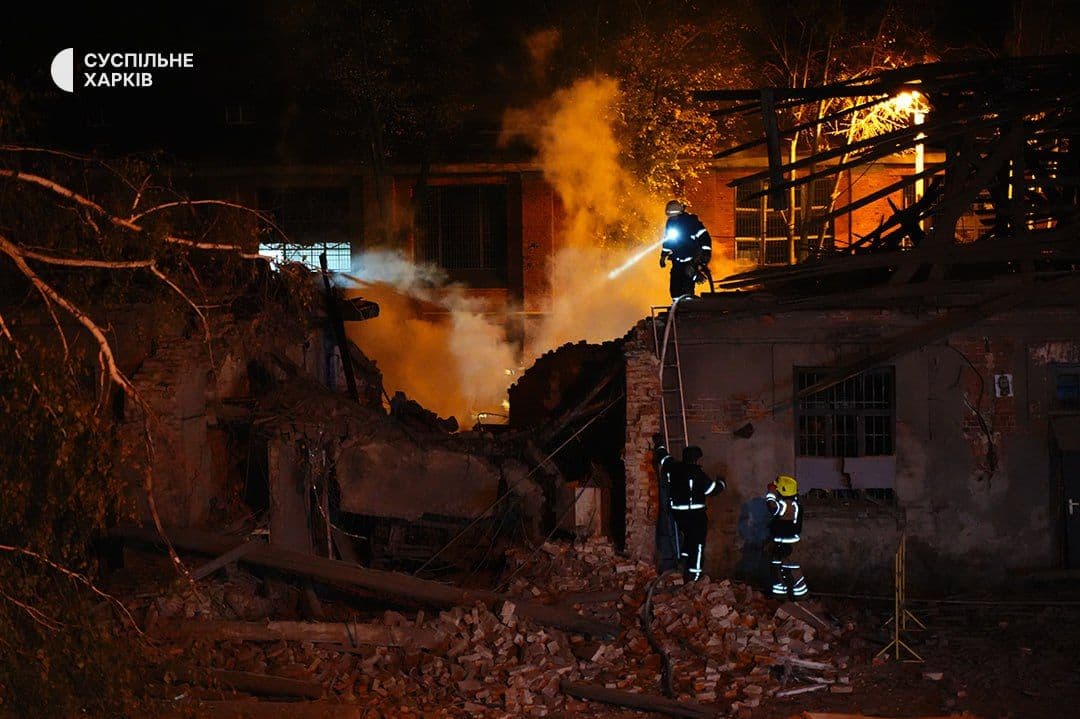
Aftermath of a Russian airstrike on a hospital in Kharkiv, where guided bombs tore through wards filled with patients. (Suspilne Kharkiv / Telegram)
Armor in the Rain: When the Weather Became the Frontline
Morning rain slicked the fields near Dobropillya as Russian armor pushed through the mist — a rare mechanized thrust in a war that had mostly devolved into infantry skirmishes and drone duels. Ukraine’s 1st Azov Army Corps reported that sixteen tanks and armored vehicles, joined by motorcycle-borne infantry, advanced in a coordinated assault aimed at Shakhove. Within hours, Ukrainian defenders destroyed thirteen armored vehicles, three tanks, and three motorcycles — but not before the Russians gained a few dozen meters of mud-soaked ground.
For the first time in months, Russia’s assault looked like something from the war’s earlier years: armored columns rolling forward under the cover of bad weather. Drones — the eyes of Ukraine’s defense — were blinded by the rain. Electronic warfare systems jammed what few managed to fly, and infantry poured from the vehicles to storm Ukrainian trenches.
The participants told their own story. Units from Russia’s 5th Motorized Rifle Brigade and 155th Naval Infantry Brigade — experienced formations, not conscripts — were deployed here, signaling that Moscow had chosen to risk valuable assets for a symbolic push. Weather reports confirmed light rain over the Dobropillya front that morning, exactly the kind of conditions Russian commanders now waited for before launching mechanized operations.
Analyst Kostyantyn Mashovets noted that these same units had struggled for weeks to seize Shakhove. The return to heavy armor suggested a gamble: trade equipment for speed, tanks for territory, metal for momentum. For most of 2025, Russian strategy had favored low-cost infiltration — creeping forward with infantry and accepting slow progress. But this assault showed a new calculation. Moscow was again willing to burn through vehicles if it meant moving the line, even slightly.
In the end, the advance was measured in meters, not miles. Yet it revealed a deeper shift — that in the fourth year of war, even the weather itself had become a weapon.
Weather Warfare: When the Sky Chose Sides
The rain did not just fall—it shifted the balance of the battlefield. Ukrainian commanders in the Pokrovsk sector reported that Russian forces had begun timing their assaults with the weather itself, striking hardest when rain and fog grounded Ukraine’s drones. Losses rose by nearly a fifth, but the pattern held: whenever the skies turned gray, Moscow’s troops moved.
Captain Hryhorii Shapoval of Ukraine’s Eastern Group of Forces said attacks had surged 25–30% in the past ten days, the uptick matching every spell of poor visibility. It was no coincidence. Russian commanders had learned to read the clouds like a tactical map, waiting for fog or wind to silence Ukrainian surveillance before unleashing armor and infantry.
One open-source analyst tracked the same logic in the Lyman direction, where Russians built a makeshift bridge across a river while Ukrainian drones sat grounded by gusting winds. Through that narrow window, five tanks, a fighting vehicle, and self-propelled artillery rumbled across the improvised span, undetected. The weather itself had become cover—nature serving as Russia’s camouflage.
For nearly two years, Ukraine’s drones had turned open fields into death traps for Russian armor. Now, Moscow’s adaptation was chilling in its simplicity: it could not out-innovate Ukrainian technology, but it could outwait it. Clouds, rain, and fog became the Kremlin’s most reliable allies.
For Ukrainian defenders, that meant fighting blind when storms rolled in—forced to rely on fewer, less effective systems just when Russian forces were most aggressive. The drones that once made clear skies their greatest advantage had become their weakness under gray ones. As the autumn rains deepened, the war had found a new frontier, one that no general could command: the weather itself.
The Baltic Warning: When Moscow Spoke of NATO as the Next Frontier
In Moscow’s Duma, the language of empire resurfaced — this time aimed squarely at NATO itself. Vyacheslav Volodin accused Latvia of “persecuting” Russian speakers and declared that Russia must “protect its compatriots” in the Baltic states. It was the same script once used to justify invasions of Moldova, Georgia, and Ukraine — now rewritten for countries shielded by Article 5.
Moments later, Leonid Slutsky, leader of Russia’s Liberal Democratic Party, expanded the circle of threat. He claimed that Russians in Latvia were part of the Russkiy Mir — the “Russian World” — an idea so elastic it stretches from medieval Kyivan Rus through the Soviet Union to anyone who merely feels kinship with Russia. It is an ideology built to erase borders, and its latest invocation marked a deliberate extension of Moscow’s narrative battlefield into NATO territory.
The danger was not in what Russia could do tomorrow, but in what it was rehearsing today. By invoking its supposed duty to defend “compatriots abroad,” the Kremlin was laying groundwork — testing whether the West would treat such rhetoric as noise or as prelude. Every repetition of that narrative served a purpose: to normalize the unthinkable.
For Latvia, Estonia, and Lithuania — nations that built vibrant democracies after decades of occupation — the statements carried existential weight. Russian speakers in these countries vote, serve in parliament, and broadcast freely in their own language. Yet Moscow portrays them as victims, twisting reality into justification. It doesn’t matter that the facts are false; the ambiguity is enough.
These words were not diplomacy — they were a probe. Not into territory, but into resolve.
The Theater of Peace: When the Kremlin Spoke of Surrender as Diplomacy
Once again, Moscow played its favorite role — the reluctant warrior longing for peace. Dmitry Peskov, the Kremlin’s spokesman and master of contradiction, announced that Russia was ready for a “peaceful settlement,” but had “no alternative” to continuing the war. In his telling, Russia was the victim of circumstance, forced to destroy what it claimed to be saving.
The performance was familiar. Russia’s definition of peace has never changed: a demilitarized Ukraine, a government loyal to Moscow, and a binding promise never to join NATO or any Western alliance. These are not negotiation points; they are terms of surrender dressed in diplomatic language.
For years, the Kremlin has perfected this act — speaking the language of diplomacy while pursuing the logic of conquest. Peskov’s latest statement fit the script precisely: Russia claims to seek dialogue, then blames Ukraine’s refusal to capitulate for prolonging the war. It is victim-blaming elevated to statecraft, the illusion of reason concealing the machinery of aggression.
By declaring there were “no alternatives,” Peskov was not describing a lack of options, but a refusal to consider any that didn’t end with Ukrainian subjugation. Behind the veneer of calm rationality lay a truth the world has heard before: Russia will keep killing until Ukraine agrees to die quietly.
For Western mediators still searching for common ground, the message could not be clearer. After nearly four years of devastation, sanctions, and international isolation, Moscow’s position has not softened — it has hardened into ideology. What the Kremlin calls “peace,” Ukraine rightly recognizes as extinction.
The Aid Illusion: When Promises Outran Deliveries
Behind the conference tables and polished communiqués, the numbers told another story. A new report from the Kiel Institute revealed that total military aid to Ukraine had fallen by forty-three percent during July and August — the steepest decline since the first months of the invasion. It happened just as NATO’s much-touted “Prioritized Ukraine Requirements List” was meant to guarantee stability.
Europe’s contribution had slipped even further, down fifty-seven percent despite new funding channels meant to sustain flow. The PURL mechanism — designed to let European allies purchase U.S. weapons for Kyiv — had produced more paperwork than firepower. Deliveries began only in mid-September and amounted to a fraction of what Ukraine had once received when Europe scrambled to cover the gaps left by Washington’s political paralysis.
Christoph Trebesch, who leads the Ukraine Support Tracker, called the drop “surprising,” but in Ukraine, surprise had long since been replaced by exhaustion. Bureaucratic innovation had replaced tangible support; the mechanisms worked; the weapons did not arrive.
Financial and humanitarian aid remained steady — the kind that wins headlines but not battles. What vanished was the lifeblood of defense: ammunition, vehicles, and replacement systems for the drones and guns worn down by daily attrition. The decline came precisely as Russia intensified its mechanized assaults and learned to use rain as armor.
Denmark, Sweden, Norway, the Netherlands, and Germany all announced new pledges through PURL — nearly two billion dollars combined — but money on paper did not stop tanks in mud. American envoy Matthew Whitaker promised “big” announcements at the upcoming NATO defense ministers’ meeting, assuring allies that “the system is working smoothly.” Yet the field reality was plain: smooth processes could not compensate for empty warehouses.
As the data made clear, the war’s front line was no longer only in the trenches — it ran through the ledgers of Europe’s ministries. Promises were plentiful. Deliveries were not.
Sanctions Without Teeth: Promises That Keep the War Alive
In Washington’s polished meeting rooms, the language of resolve still flowed easily. U.S. Treasury Secretary Scott Bessent sat with Ukrainian Prime Minister Yuliia Svyrydenko, praising cooperation and reaffirming America’s commitment to Ukraine’s sovereignty. Behind the diplomatic warmth, though, the conversation returned to an old refrain — sanctions.
Bessent promised that the United States would “intensify pressure” on Moscow and target nations still buying Russian oil. It was the kind of line Kyiv had heard before — firm in tone, soft in detail. There was no timeline, no list of countries, no concrete enforcement mechanism. “Intensify” was a word meant for headlines, not handcuffs.
Svyrydenko, ever pragmatic, focused on what could be built rather than what might be promised. The new U.S.–Ukraine Reconstruction Investment Fund was moving forward, with early projects planned in energy, minerals, and infrastructure — the bones of a long-term future. Yet even as Ukraine planned for recovery, the war kept dismantling its present.
Energy and sanctions were two sides of the same fight. While Russia bombed Ukraine’s power plants, it used oil profits to fund more missiles. Every loophole in sanctions was another drone in the sky, another transformer in flames. Effective enforcement could have starved the Kremlin’s war machine; instead, it merely slowed its heartbeat.
The meeting ended with affirmations and photographs — symbols of partnership in a time of exhaustion. But until promises become pressure, and pressure becomes deprivation, Russia will keep finding fuel for its war in the gaps between Western words.
Hospital in the Crosshairs: When Healing Became a Target
The beds were still made when the bombs fell. In Kharkiv’s Saltivsky district, a hospital that had sheltered more than a hundred patients became the latest precision-marked target of Russia’s war. Two guided KAB bombs struck the facility, tearing through walls meant for recovery, not defense, and injuring at least fifty-seven people.
The precision of the weapons removed all doubt. As the hospital’s surgical director, Oleksiy Dotsenko, explained, these were guided munitions — the kind that can tell one building from another. The strike was not a mistake of aim but of intent.
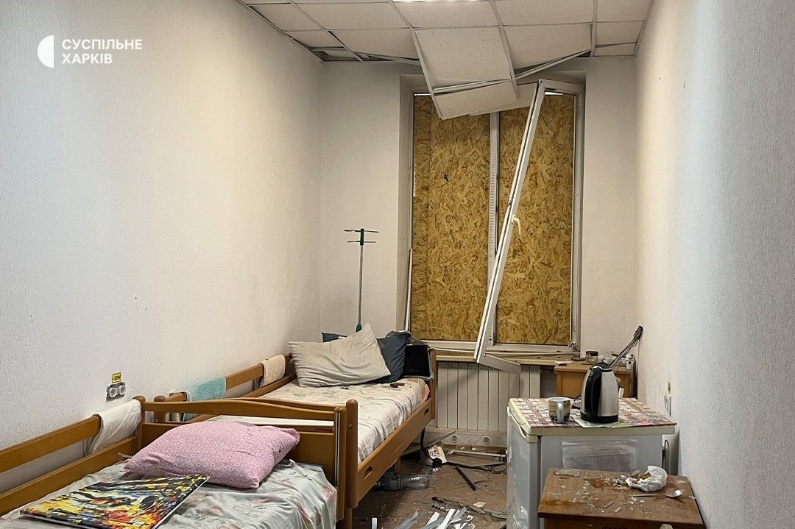
Hospital ward damaged by a Russian airstrike in Kharkiv, where guided bombs struck a facility still filled with patients. (Suspilne Kharkiv / Telegram)
“Russia boasts that it does not harm civilians,” said patient Svitlana Vodolazka, her voice shaking amid the broken glass and plaster dust. “But look—are we not civilians?” Her words carried the ache of three years of false assurances. Hospitals, schools, apartment blocks — each had been hit too many times for coincidence to be believed.
President Zelensky called it “an utterly terrorist, cynical attack on a place where lives are being saved.” The attack followed a familiar rhythm: an overnight wave of drones targeting Ukraine’s energy network, then daylight bombings against civilians and hospitals, stretching Ukraine’s defenses across two fronts — power and people.
Elsewhere in the city, guided bombs ripped through dormitories and enterprises, shattered power lines, and left thirty thousand families without electricity. Governor Oleh Syniehubov listed the damage with grim precision; Mayor Ihor Terekhov spoke of neighborhoods left in darkness.
The strikes were not about military gain. They were about exhaustion — breaking the rhythm of recovery, the faith that hospitals could still mean safety. Even the rooms where the wounded were meant to heal now bore the marks of war.
Holding the Line: Ukraine’s Counterstrokes in the Shadows
While Russian armor clawed for meters in the east, Ukrainian troops were still advancing — quietly, deliberately, in places that mattered less for size than for signal. Verified footage showed Ukrainian gains near Oleksiivka north of Sumy and south of Stepnohirsk in Zaporizhia Oblast. The movements were measured in dozens of meters, yet they spoke of endurance: proof that even under strain, Ukraine’s army retained the power to push back.
In Sumy Oblast, Ukrainian units recaptured ground inside areas Russia had tried to convert into a “buffer zone” along the northern border. Each counterattack undermined Moscow’s attempt to present inevitability. Russian milbloggers, quick to claim victory, were instead describing Ukrainian strikes near Kindrativka and Varachyne — the defenders had become the hunters again.
Further south, around Stepnohirsk, Ukrainian pressure forced Russian troops into small, scattered assault groups. The terrain itself favored defenders: broad open fields, few trees, nowhere to hide. A brigade spokesperson said Russian soldiers were trying to infiltrate Mala Tokmachka, but even those efforts faltered in plain sight, their movements exposed to Ukrainian fire and drones.
The gains were modest, but their meaning ran deeper. They compelled Russia to defend as well as attack, draining men and equipment from other fronts. Each reclaimed trench, each shattered outpost, reminded the country — and the world — that Ukrainian resistance was not just survival. It was movement.
The Front That Never Sleeps: Meters Traded for Lives
Across the long eastern arc of the front, the pattern held: Russia attacked everywhere, advanced almost nowhere, and bled for every meter gained. The battles stretched from Myrnohrad to Lyman — names that now meant endurance rather than geography.
Russian channels claimed fresh victories: the seizure of Balahan, progress north of Lysivka, advances near Velykomykhailivka. But when the smoke cleared, geolocated evidence showed something smaller — infiltration attempts, not breakthroughs. In some sectors, Ukrainian strikes caught Russian assault groups mid-movement, erasing the ground they had just claimed online.
In the Siversk direction, Ukrainian officers described chaos more than strategy. Lieutenant Colonel Dmytro Zaporozhets reported that Russian troops attacked in small, scattered groups — sometimes as individuals — their daily tempo nearly halved since September. Weather was part of the reason; rain had grounded drones and clogged tracks, turning assaults into trudging slogs through mud and shellfire.
Around Lyman, Russian commanders sent in newly contracted Spetsnaz recruits, many barely trained and fighting without armored support. They were sent forward not as shock troops, but as proof that Moscow could still advance somewhere, anywhere.
The war here no longer moved in lines — it pulsed, retreated, and returned. Each village taken or lost cost days of lives and tons of ammunition, the front shifting by meters and measured in blood. Both armies fed men into the furnace, knowing that the fire no longer forged victory — only endurance.
The Day’s Reckoning: When Facts Contradicted Narratives
The day stripped away illusions. Russia’s rain-covered assault near Shakhove proved how weather had become a weapon, blunting Ukraine’s drone advantage and restoring movement to Moscow’s armor. The Kiel Institute’s data revealed another truth — Western aid mechanisms worked on paper, not in practice.
Moscow’s rhetoric widened, now targeting NATO itself under the guise of “protecting compatriots,” while new U.S. promises on sanctions again arrived without enforcement. The hospital strike in Kharkiv showed the result: a regime that kills civilians with precision and pays no price.
And yet Ukraine still advanced, inch by inch, reminding the world that endurance itself is strategy. The war has entered a stage where adaptation outweighs diplomacy and resilience measures more than territory — and both sides now fight not for progress, but for time.