
August 23, 2026
Prepared by Diana Bozhyk
President Zelensky flatly rejected calls for wartime elections, calling them a “tsunami” that would split the country, while revealing new details about his falling-out with former defense minister Mykhailo Fedorov over a rejected “Ministry of War” plan. Russian forces advanced east of Slovyansk in one of the war’s most fortified sectors, even as Ukraine struck Russian jets, air-defense systems, and an Iskander missile launcher near the border and confirmed Dnipropetrovsk Oblast is nearly fully liberated. Russian strikes killed at least seven people nationwide, including two in a Donetsk village and one in a double-tap drone attack on a train, while Vladimir Putin called the deadly strike on a Kryvyi Rih shopping mall a “positive” development for his war effort.
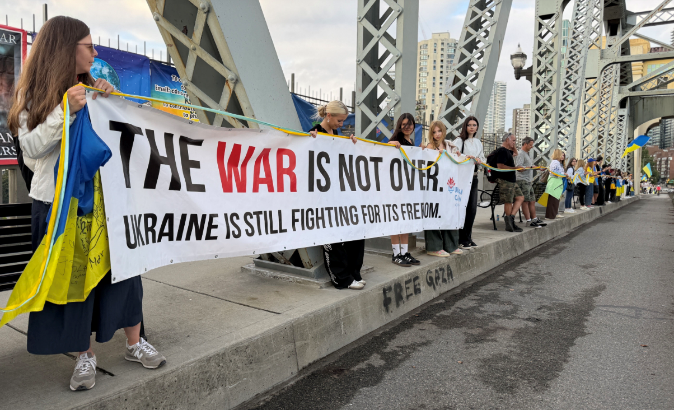
Demonstrators unfurl a 550-meter-long (1,800-foot-long) ribbon at the Burrard Street Bridge in Vancouver, Canada, for the city’s Ukrainian Independence Day rally on Aug. 23, 2026, as Ukraine marks 35 years of independence. (Tamara Nowakowsky/The Kyiv Independent)
THE DAY’S RECKONING
Volodymyr Zelensky spent today doing something unusual for a wartime president: sitting with journalists for hours and answering, in detail, nearly every hard question they had. Why won’t he hold elections? What actually happened with Fedorov? How bad is the money situation? Can Ukraine really stop Iskander missiles it can’t intercept? He answered all of it, at length, with numbers attached.
The numbers themselves told their own story. A $27 billion defense budget hole. Only 264 Patriot missiles received this year against a request for 360. A missile launcher hunted down and destroyed near the border because interceptors are too scarce to rely on. Nearly all of Dnipropetrovsk Oblast finally free, down to just three villages and ten square kilometers. Meanwhile, Russian forces kept doing what they’ve done all summer — grinding forward east of Slovyansk in small, costly increments, while Vladimir Putin told his own state media that a drone strike on a shopping mall in Zelensky’s hometown had a “positive” effect on his war. Two very different men, spending the same day explaining, in their own ways, exactly how far they’re each willing to go.
ZELENSKY REJECTS WARTIME ELECTIONS AND DETAILS THE FEDOROV FALLOUT
President Zelensky used a lengthy briefing with journalists today to shut down, in the clearest terms yet, the idea former defense minister Mykhailo Fedorov floated last week: holding elections while the war is still underway.
“Elections right now are a tsunami for the state that will split Ukraine,” Zelensky said. “My strategy is to bring the country to the end of the war and preserve an independent and sovereign state. And I am fulfilling it.” He argued that despite months of outside pressure to hold a vote, no partner has ever offered a concrete plan for conducting one safely — accounting for frontline soldiers, millions of refugees abroad, and voters in active war zones — while Russia refuses even a basic ceasefire.
Zelensky also gave his most detailed account yet of what actually drove Fedorov’s dismissal in July: a serious conflict with then-Commander-in-Chief Oleksandr Syrskyi over a proposal Fedorov brought him for a restructured “Ministry of War,” under which the military chain of command would have run differently. “I called him at the beginning and said: the Ministry of War, where there is no commander-in-chief and the chief of the General Staff is effectively under you — forget this presentation,” Zelensky said, adding that Fedorov initially agreed but later kept pursuing similar changes through other channels. “Two weeks before the decision, I told them I was giving them an opportunity: meet yourselves, resolve it. They did not meet,” he said. “It cannot work like that.” He said he’d offered Fedorov four other government roles since, all rejected, and that the two men hadn’t spoken in weeks.
FRONTLINE MATH: DNIPROPETROVSK NEARLY FREE, A DEFICIT UKRAINE CAN’T IGNORE
Alongside the political drama, Zelensky delivered genuinely significant battlefield and budget news: one region is nearly fully liberated, and the money to keep fighting is running dangerously short.
Citing a report from Commander-in-Chief Mykhailo Drapatyi, Zelensky said Ukrainian forces have almost entirely liberated Dnipropetrovsk Oblast, with only three small villages — roughly four square miles combined — still occupied, and Russian forces largely absent even from those. He said Ukraine aims to reach territorial parity by the end of 2026: Russia has occupied roughly 382 square miles of Ukrainian territory this year so far, against 316 square miles Ukraine has reclaimed, with another localized operation expected to conclude by the end of August.
The financial picture is less encouraging. Zelensky confirmed Ukraine’s Defense Ministry is operating with a $27 billion budget deficit, after funds originally set aside for the second half of the year were spent early to accelerate domestic drone production. Kyiv is now working with France and Germany to unlock a planned €30 billion in European funding to cover the gap, plus another $8 to 10 billion needed just to begin procuring weapons for 2027. Zelensky warned that if Russia succeeds in capturing the rest of Donetsk and Luhansk oblasts by year’s end — Putin’s current deadline for his generals — Moscow could redirect its planned 300,000 newly mobilized troops toward new fronts entirely, including a theoretical offensive from Russia’s Bryansk region toward Ukraine’s Chernihiv and Kyiv oblasts, an area Ukrainian intelligence is now watching for early troop buildup.
HUNTING LAUNCHERS INSTEAD OF MISSILES
With Ukraine’s stock of Patriot interceptors running perilously low, Zelensky revealed the country has shifted tactics — going after the launchers that fire Russia’s ballistic missiles instead of only trying to catch the missiles themselves.
Ukrainian forces destroyed an Iskander-M ballistic missile launcher near the international border, Zelensky said, part of a newer, deliberate campaign to hunt down mobile launch systems before they can fire. “At one point they were planning to launch an attack, but didn’t go through with it. This is no coincidence,” he said. “We’re working to prevent them from carrying out large-scale missile attacks. These are individual, complex operations, and we’re now starting to see the first results.” He said Russia can produce up to 1,300 ballistic missiles a year and currently holds roughly 600 to 630 in reserve — a stockpile Ukraine’s air defenses, badly short on interceptors, have no realistic way to fully counter through missile-on-missile defense alone.
The interceptor shortfall is stark: Ukraine has received only 264 Patriot missiles this year against a requested 360, and is hoping to secure 5 to 10 percent of total US stocks, with Kyiv prepared to pay for them outright. Germany has separately agreed to supply 600 PAC-2 missiles for 2027 and 2028. Longer-term, a joint European-Ukrainian project called Freyja, aimed at building an alternative anti-ballistic missile system, has moved from political discussion into actual technical development, Zelensky said — a slower path to relief, but one that doesn’t depend entirely on convincing allies to hand over scarce existing stock.
THE MUSK STANDOFF
Buried inside today’s briefing was an unusually candid account of a diplomatic mess involving Elon Musk, Starlink, and a miscommunication Zelensky said damaged Ukraine’s relationship with the White House.
Zelensky said Ukraine is seeking Musk’s approval to use Starlink-equipped drones over Russian territory specifically to strike ballistic missile launchers before they fire — technology that’s already proven effective in the 30-to-125-mile zone behind the front line, where Russian logistics have taken a beating. Musk has so far called the idea an “escalation” and refused, though Zelensky said he “may change his mind once he sees further arguments.” The friction traces back to a breakdown under Fedorov’s tenure: Zelensky said his own Defense Ministry told him Musk had already approved Starlink use over Russia and that only Trump’s sign-off remained. After securing Trump’s agreement and lining up EU funding, Zelensky learned Musk had never actually approved it. “He said that I kind of tricked him because Musk denied Ukraine the use of Starlink on the territory of Russia,” Zelensky said of Trump’s reaction. “I went back to our defense ministry and they said that maybe that’s how it was indeed.”
Despite the damage, Zelensky said talks with Musk are continuing alongside members of the Trump administration, with “more encouraging feedback” recently. Russia, meanwhile, is developing its own Starlink alternative, called Rassvet, though Zelensky said it remains far behind in coverage and quality. “I treat this as just another challenge,” he said.
RUSSIA ADVANCES EAST OF SLOVYANSK
While diplomacy and budgets dominated headlines, the actual front line moved in one of its most consequential directions this week: toward Slovyansk, one of the anchor cities of Ukraine’s Fortress Belt defensive line.
Russian forward units advanced across several tactical areas simultaneously east and southeast of the city, according to Ukrainian military observer Kostyantyn Mashovets, reaching the southeastern outskirts of Pyskunivka from newly consolidated positions on the southern bank of the Siverskyi Donets River. Russian forces also infiltrated the southern outskirts of Mykolaivka, a settlement Ukrainian troops managed to repel a separate infiltration attempt against the same day — a tactical prize Russia wants specifically because seizing it would let Russian forces bypass the difficult river terrain that’s stalled their advance from the north for over a year. Russian commanders are running a dual effort, Mashovets said, trying to link forces near Kryva Luka and Rai-Oleksandrivka to eventually launch a coordinated assault on Slovyansk from both dominant terrain to the east and south at once.
The advance matters partly because of how badly it fits Putin’s own timeline. Zelensky said Putin has now given Russian commanders a December 31 deadline to fully seize Donetsk Oblast — the 15th such deadline since 2022, none of them met — and that 70 to 80 percent of all Russian personnel losses this year are occurring specifically in the Kostyantynivka direction. Zelensky put Russia’s total 2026 casualties at roughly 267,000, including 155,000 killed, a staggering toll for gains still measured in single-digit square miles most weeks.
UKRAINE’S DEEP STRIKES: SUBSTATIONS, JETS, AND A LAUNCHER NEAR THE BORDER
Ukraine’s Unmanned Systems Forces reported a sweeping set of strikes against Russian air-defense and logistics infrastructure, hitting 11 of 14 targeted sites across Krasnodar Krai, Rostov Oblast, and occupied Crimea in a single coordinated operation. At Vityazevo airfield in Krasnodar, Ukrainian drones struck a Su-33 and a MiG-29 fighter jet alongside an Orion strike drone — a platform Russia has increasingly repurposed to launch cheap Banderol cruise missiles against Ukrainian ports. Additional strikes hit an S-400 air-defense position, a Pantsir-S1 system, and eight separate radar installations spread across all three regions, part of a deliberate campaign to degrade Russia’s ability to defend its own rear areas from further Ukrainian strikes.
Elsewhere, Ukrainian forces struck a 500-kilovolt electrical substation in Krasnodar Krai and a power substation in Russia’s Kursk Oblast, while footage confirmed a fire at an Ozon logistics complex in Orenburg City — the retailer’s second direct hit this month, forcing the evacuation of more than 300 employees and a suspension of all regional deliveries. Ukraine’s General Staff separately confirmed strikes on a repair unit and logistics depots in occupied Crimea and Luhansk Oblast, plus fuel and equipment targets just across the border in Belgorod Oblast. Ukrainian officials say the strategy has evolved beyond simply starting fires: drone operators are now using intelligence support from France and the US to identify and destroy specific, hard-to-replace components inside these facilities, aiming to keep them offline for months rather than days.
A DOUBLE-TAP ON A TRAIN, ALMOST
Overnight, Russia launched 127 Shahed- and Gerbera-type strike drones and Parodiya decoys at Ukraine from five directions. Ukrainian forces intercepted 97; the rest struck 22 locations, with debris landing at three more, damaging agricultural, residential, and electrical infrastructure across six oblasts.
Railways bore a disproportionate share of the violence. A double-tap Geran-type drone strike hit an electric train at Lymanivka station in Kharkiv Oblast, killing one person and injuring four more. Separately, a jet-powered Shahed drone struck the locomotive of a 593-passenger train traveling from Zhytomyr to Odesa — but Ukrainian Railways’ monitoring team spotted the threat in advance and evacuated everyone, including 15 children, before impact; Russian forces then struck the same locomotive a second time, hitting empty wreckage rather than people. “Today, Russia attacked this electric train for a second time while rescuers were working,” the infrastructure minister said, noting Russian forces have now struck Ukraine’s railways 1,534 times this year alone, killing 52 Ukrzaliznytsia employees and injuring 317 since the war began.
Regional casualties added up throughout the day: Zaporizhzhia Oblast lost three people with 20 injured, after 559 separate strikes hit 40 settlements in a single 24-hour window; Donetsk Oblast lost two with five injured; Kherson Oblast counted 11 injured; Kharkiv Oblast three injured, including eight hurt in a separate jet-powered drone strike on a Kharkiv residential district; and Dnipropetrovsk Oblast two injured. A drone strike on a post office in Lozova, Kharkiv Oblast, sparked a fire covering 3,750 square feet.
TWO KILLED IN SOFIIVKA AS 141 HOMES ARE DAMAGED
A Russian strike on the settlement of Sofiivka, in the Kramatorsk community of Donetsk Oblast, killed two people, injured two more, and damaged 141 private homes — one of the most destructive single strikes of the day by property count, even without a correspondingly high casualty toll.
Emergency crews recovered one victim’s body from beneath the rubble of a private house after removing roughly two tons of collapsed building material. The strike ignited fires in three separate locations — an outbuilding, a private home, and two civilian vehicles — but firefighters had to suspend their response partway through due to the threat of continued Russian shelling in the area, a recurring hazard that’s made even routine firefighting a calculated risk in frontline Donetsk communities.
Sofiivka’s location within the broader Kramatorsk area places it squarely inside the Fortress Belt corridor Russian forces have spent months trying to break through from multiple directions — making strikes like this one as much a piece of the broader campaign against Ukraine’s eastern defenses as an isolated tragedy. For the residents of a village most outsiders will never hear named again, the toll is simpler and more immediate: one neighbor dead, dozens of houses too damaged to safely live in, and a fire crew that had to abandon its own work halfway through because staying meant risking becoming casualties themselves.
RUSSIA HITS AN AMERICAN COMPANY’S FACTORY
Russian drones struck a factory belonging to Mondelez International — the US food and snack conglomerate behind Oreo, Cadbury, and Toblerone — in the town of Trostianets, Sumy Oblast, damaging the facility and injuring several employees, though no fatalities were reported.
Foreign Minister Andrii Sybiha framed the strike in unusually pointed terms for a Ukrainian official, calling it “a direct blow to American economic interests in Europe” rather than simply another attack on Ukrainian infrastructure. It’s a deliberate rhetorical choice: by emphasizing the American ownership of the damaged factory, Sybiha appears to be making the case that Russian strikes increasingly threaten foreign investment and international business interests inside Ukraine, not just Ukrainian lives and property — an argument aimed squarely at building the case for continued, and increased, American engagement. Sybiha used the incident to renew calls for more air-defense support and to push for passage of the Sanctioning Russia Act, tying a single factory strike directly to Ukraine’s broader diplomatic ask for tougher economic pressure on Moscow. Trostianets sits roughly 18 miles from the Russian border, well within range of the daily artillery, drone, and glide-bomb strikes that have made life in Sumy Oblast a matter of constant calculation for residents and businesses alike.
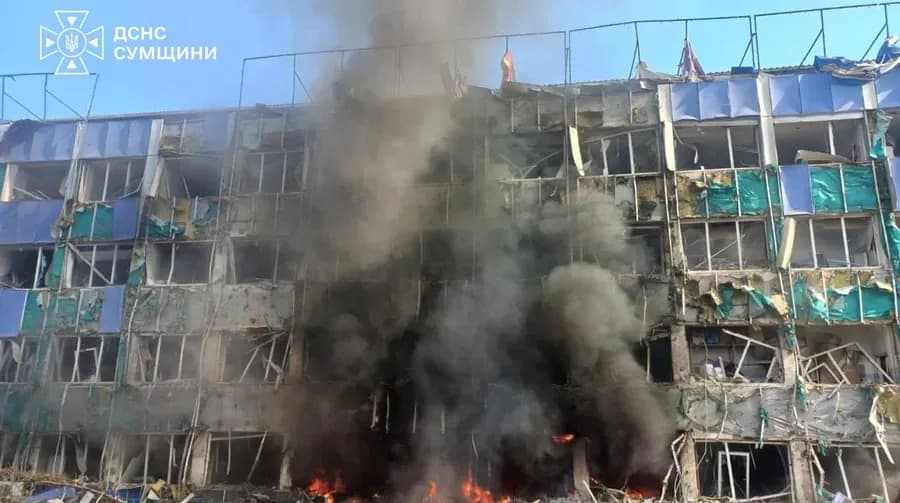
The aftermath of a Russian attack on the Mondelez plant in the city of Trostianets, Sumy Oblast, Ukraine. (Andrii Sybiha/X)
PUTIN DEFENDS THE KRYVYI RIH ATTACK AS “POSITIVE”
A day after a Russian double-tap drone strike killed 16 people at a Kryvyi Rih shopping mall, Vladimir Putin used a state television interview to describe the broader strike campaign that produced it as working exactly as intended.
Speaking to Kremlin propagandist Pavel Zarubin, Putin claimed Russian strikes on Ukraine affect the course of the war in the “most direct and positive way,” insisting Russian forces have increased their pace of advance and are “confidently solving the tasks” of what Moscow still calls its “special military operation” — a characterization directly contradicted by battlefield data showing Russia’s rate of advance has steadily declined since January. Addressing Ukraine’s own strikes on Russian oil and logistics infrastructure, Putin claimed Kyiv had “opened a Pandora’s box” by targeting Russian economic sites, insisting Russia’s retaliatory strikes are “more destructive” — despite Russia having systematically targeted Ukrainian civilians since the war’s opening days in 2022, years before Ukraine’s deep-strike campaign against Russian refineries began.
Putin also repeated his dismissal of Ukrainian ceasefire proposals as “exotic and unacceptable,” accusing Kyiv of trying to intimidate ordinary Russians and disrupt September’s parliamentary elections. Search operations in Kryvyi Rih continued through the day, with authorities reporting nine people, including two children, still missing as of the latest count — meaning the mall’s confirmed toll of 16 dead and 140 injured, 23 of them children, may not yet be final.
UKRAINE’S WILDBERRIES CAMPAIGN, BY THE NUMBERS
Zelensky put a specific price tag today on one of Ukraine’s most sustained deep-strike campaigns of the year, framing months of attacks on Russia’s largest online retailer as calculated retaliation rather than random economic sabotage.
He said the Wildberries strikes alone have caused roughly 1 trillion rubles — about $12.5 billion — in direct damages, with total associated economic losses for Russia’s economy potentially reaching 3 trillion rubles, or $36.3 billion, once ripple effects are included. Zelensky described the campaign explicitly as retaliation for Russia’s own years-long pattern of striking Ukrainian logistics companies like Ukrposhta and Nova Poshta, framing it as a proportional response rather than an escalation. He also confirmed, for the first time in detail, that Ukraine’s SBU has been running an 18-month campaign known internally as Operation “Kylym” — Ukrainian for “Carpet” — specifically designed to force Russian military airports to halt operations through sustained, repeated strikes. Pushing back on Russian claims that Ukraine targets civilian aviation, Zelensky was blunt: “We are not terrorists.”
The dollar figures matter beyond bragging rights. Every ruble Russia spends rebuilding a warehouse or refinery is a ruble not spent on the front line, and every strike that keeps a facility offline for months rather than days compounds that pressure over time — the same logic Ukrainian officials have applied to the oil-refinery campaign now visibly straining Russia’s domestic fuel supply.
RUSSIA’S POST-ELECTION MOBILIZATION PLANS
Zelensky offered new detail today on what Ukrainian intelligence expects from Russia once September’s parliamentary elections conclude: a large mobilization wave, deliberately designed to avoid the political backlash that came with Russia’s only prior draft.
Russia plans to mobilize roughly 300,000 people after the vote, Zelensky said, but will structure it as “peripheral mobilization” — avoiding Moscow and St. Petersburg specifically to minimize visible disruption in the cities where political blowback would matter most to the Kremlin. “As we understand, it won’t happen in the central cities. But I don’t think they will succeed in hiding it,” he said. The approach echoes the lesson Russia learned in autumn 2022, when its first and only wartime mobilization triggered a mass exodus of hundreds of thousands of Russians and long lines at border crossings, particularly into Georgia — a political embarrassment Putin has avoided repeating since, relying instead on financial incentives and regional recruitment quotas.
Ukraine, meanwhile, is quietly considering its own mobilization adjustments. The secretary of parliament’s defense committee, Roman Kostenko, said officials are discussing changes to Ukraine’s draft age after financial incentives failed to meaningfully boost voluntary enlistment, though he declined to say whether the age would rise or fall and stressed Ukraine isn’t moving away from compulsory mobilization altogether. He denied any plan to strip exemptions from parents of three or more children, and confirmed no changes are planned to women’s service, which remains voluntary.
INDEPENDENCE DAY EVE: ALLIES ARRIVE IN KYIV
With Ukraine’s 35th Independence Day just a day away, allied leaders began arriving in the capital, and Kyiv’s diplomatic calendar filled up fast with events meant to underscore that international attention hasn’t faded five years into the war.
Foreign Minister Sybiha welcomed leaders and senior officials from Denmark, Estonia, Finland, Latvia, Lithuania, and Norway at Kyiv’s railway station, with Lithuanian President Gitanas Nauseda confirming he’d join both Flag Day and Independence Day events before the Coalition of the Willing’s meeting the following day. “We feel we are not alone. Our allies are with us,” Sybiha wrote. Separately, the UN Security Council confirmed it will hold a dedicated session on Ukraine on August 24 — Independence Day itself — initiated by Denmark, France, Greece, Latvia, and the UK, with briefings expected from senior UN political and humanitarian officials against the backdrop of what the UN has separately confirmed was the deadliest month for Ukrainian civilians since March 2022.
Zelensky also met former US Vice President Mike Pence at a National Prayer Breakfast held in Kyiv, briefing him on Russia’s “ongoing ballistic missile terror” and again pressing the case for expanded Patriot production licenses. Farther from the capital, in the Croatian coastal city of Pula, members of the local Ukrainian community unfurled a 35-meter Ukrainian flag in the old town square, marking the same anniversary from abroad — a small but pointed reminder that this year’s Independence Day is being marked not just in Kyiv, but everywhere Ukrainians have been displaced to since 2022.
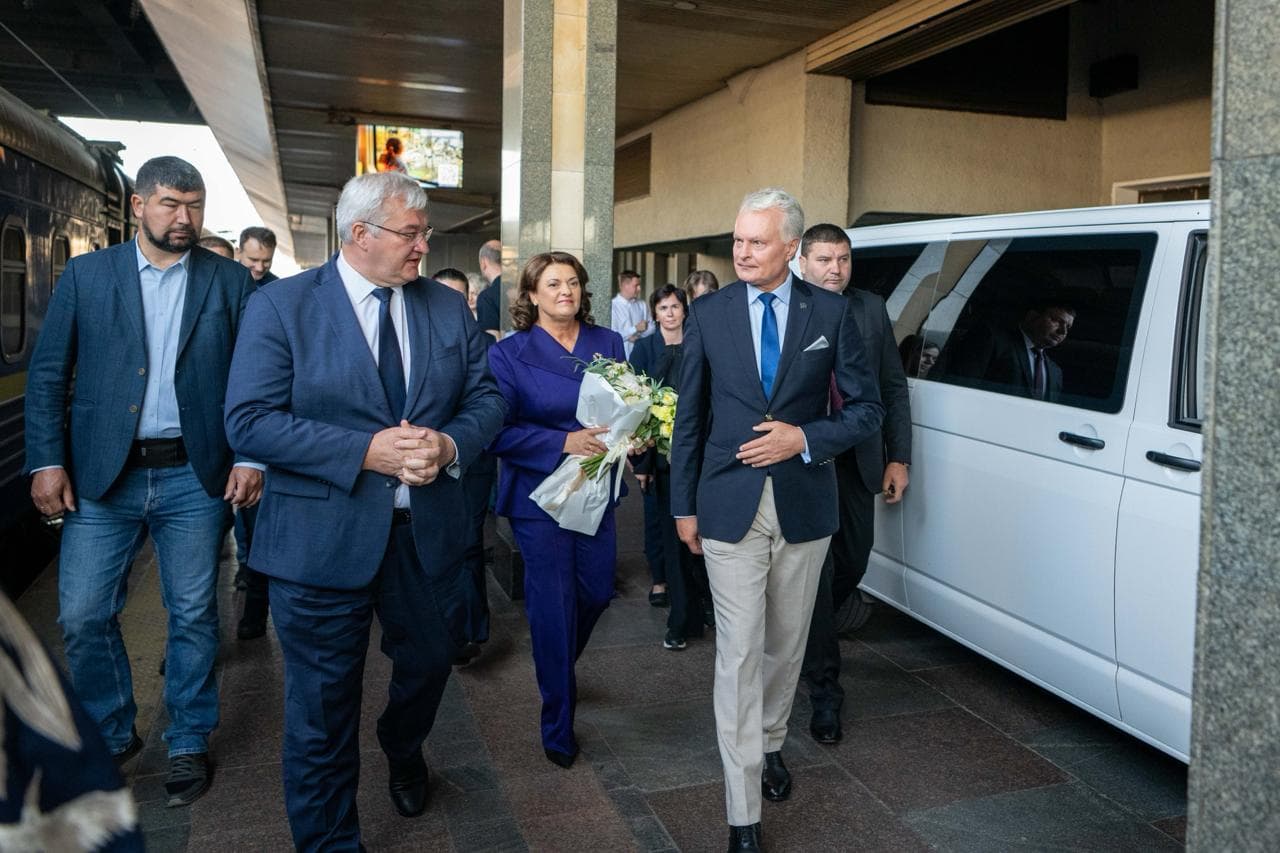
Lithuanian President Gitanas Nauseda and First Lady Diana Nausediene walk alongside Ukrainian Foreign Minister Andrii Sybiha in Kyiv. (Andrii Sybiha / X)
FINLAND AND NORWAY DEEPEN THEIR COMMITMENTS
Two Nordic countries backed up today’s diplomatic symbolism with concrete new commitments, one industrial and one financial.
Ukraine and Finland signed a set of formal defense-industrial agreements during a roundtable meeting between Zelensky and Finnish President Alexander Stubb, covering joint drone production, expanded maritime uncrewed systems, and a new joint venture to manufacture ground robotic vehicles. Finnish companies Insta, Boomeranger, and Patria all signed agreements with Ukrainian counterparts as part of the deal. “Today we are taking another step toward deepening our cooperation, combining Ukrainian combat experience with Finnish technologies,” Zelensky said, while Stubb called the partnership a win for both countries across land, sea, and air domains. The agreement extends Ukraine’s “Drone Deal” framework, following similar pacts already signed with Estonia and the Netherlands earlier this summer.
Separately, Norway’s government announced plans to provide Ukraine with 85 billion Norwegian kroner — roughly $9.2 billion — in 2027, matching its 2026 support level rather than scaling back. Prime Minister Jonas Gahr Støre personally delivered the news to Zelensky during a Kyiv visit, with the funding set to run through Norway’s Nansen Support Programme and prioritize direct weapons procurement from Ukraine’s own defense industry. “Support and reconstruction of Ukraine are also important for European security,” Støre said, framing the commitment as an investment in the continent’s stability rather than a one-time gesture. The pledge builds on Norway’s already substantial support, including a $302 million contribution to NATO’s Prioritized Ukraine Requirements List earlier this year.
A DEFICIT, A LAUNCHER, A FALLING-OUT EXPLAINED
By nightfall, the day’s throughline was less about any single event and more about how much both sides revealed today, deliberately, about the shape of their own strain. Zelensky opened up about budget shortfalls, a broken relationship with Fedorov, and a Musk negotiation gone sideways. Putin, for his part, told his own state media that killing sixteen people in a shopping mall counted as a win.
East of Slovyansk, Russian soldiers keep dying in single-digit territorial increments toward a deadline Putin has already missed fifteen times before. In Sofiivka, a family buried someone pulled from two tons of rubble. And in Kyiv tonight, ambassadors from six countries are settling into hotel rooms ahead of tomorrow’s Independence Day, arriving not because anything has been resolved, but because showing up, after five years, has become its own form of answer.
A PRAYER FOR UKRAINE
1. For the Two Lost in Sofiivka
Lord, two people are dead tonight in Sofiivka, one of them pulled from beneath two tons of rubble by rescuers who couldn’t even finish their work safely before the shelling threatened again. We grieve every home among the 141 damaged today, every family now sorting through what’s left. Comfort those who mourn, protect the emergency workers still risking their own safety to help others, and hold this small community as it begins, again, to rebuild.
2. For the Missing in Kryvyi Rih
Father, nine people remain missing tonight in the wreckage of a shopping mall, including two children whose families are still waiting for any word at all. We ask for mercy in the not-knowing, and for eventual answers, however hard, rather than permanent uncertainty. Comfort the families of the 16 already confirmed dead, and be present with rescue workers still searching through rubble days after the strike.
3. For a Nation Weighing Impossible Trade-offs
Lord of wisdom, we pray for Ukraine’s leaders as they navigate decisions with no good options — a budget stretched past its limits, a democracy paused for survival, a president explaining hard choices to a public that’s exhausted from making them. Give clarity where certainty isn’t possible, and give the Ukrainian people patience with leaders doing their genuine best inside constraints none of them chose.
4. For the Soldiers Dying by the Thousands for Single Villages
God of the fallen, we lift up every soldier, on every side of this war, sent forward to die for ground measured in fractions of a mile. We grieve the scale of loss that’s become almost impossible to comprehend in raw numbers. Give commanders wisdom to value lives over deadlines, and give grieving families, in Ukraine and in Russia alike, whatever comfort is possible amid loss this vast.
5. For Every Ally Who Chose to Show Up
God of solidarity, we give thanks for the leaders arriving in Kyiv tonight, choosing presence over distance as this country marks another Independence Day it shouldn’t have had to fight so hard to keep. Bless the partnerships being signed and the funding being pledged. Let the simple, human choice to stand physically alongside a nation still under fire mean something lasting, and let this solidarity outlast the news cycle that celebrates it today.
In Your mercy, in Your justice, in Your time — bring this war to its end, and let the ending be worthy of what Ukraine has endured.