
August 19, 2026
Prepared by Diana Bozhyk
Ukraine’s parliament confirmed Yevhen Khmara as defense minister and reappointed Andrii Sybiha as foreign minister, even as Vladimir Putin publicly admitted Ukrainian strikes are damaging Russia’s economy while gasoline disappeared from most of the country’s gas stations. Russian forces killed at least 17 people nationwide overnight, including four civilians in a deliberately targeted minibus in Kherson and two police officers in a drone strike on Zhytomyr’s headquarters, while Ukraine struck a major oil-refining hub in Bashkortostan and, for the first time, grain vessels docked at Russian ports. Kyiv and Moscow also exchanged 103 prisoners of war each, even as a corruption scandal reached into President Zelensky’s own office.
THE DAY’S RECKONING
Imagine standing in a Moscow gas station line that’s grown so routine the government just sent in armed security to manage it. That’s Russia today — a country whose president just admitted, in his own carefully hedged words, that Ukrainian strikes are genuinely hurting the economy, even as he insisted everything is basically fine. It’s the kind of contradiction that’s hard to sustain forever, and today it strained visibly at the seams.
Meanwhile Ukraine kept doing what it’s been doing for months: hitting the infrastructure that keeps Russia’s war funded, this time a three-refinery complex in Bashkortostan and, for the first time confirmed, actual grain ships docked at Russian ports. Back home, Ukraine’s parliament quietly did something almost mundane by comparison — it confirmed two new cabinet ministers, closing a monthlong leadership gap. And in the space between those two stories sat the war’s ordinary cruelty: four women killed execution-style in a Kherson minibus, two police officers dead in Zhytomyr, a corruption scandal creeping uncomfortably close to the president’s own office. Nothing today changed the war. Everything today measured exactly how much both sides are still willing to spend on it.
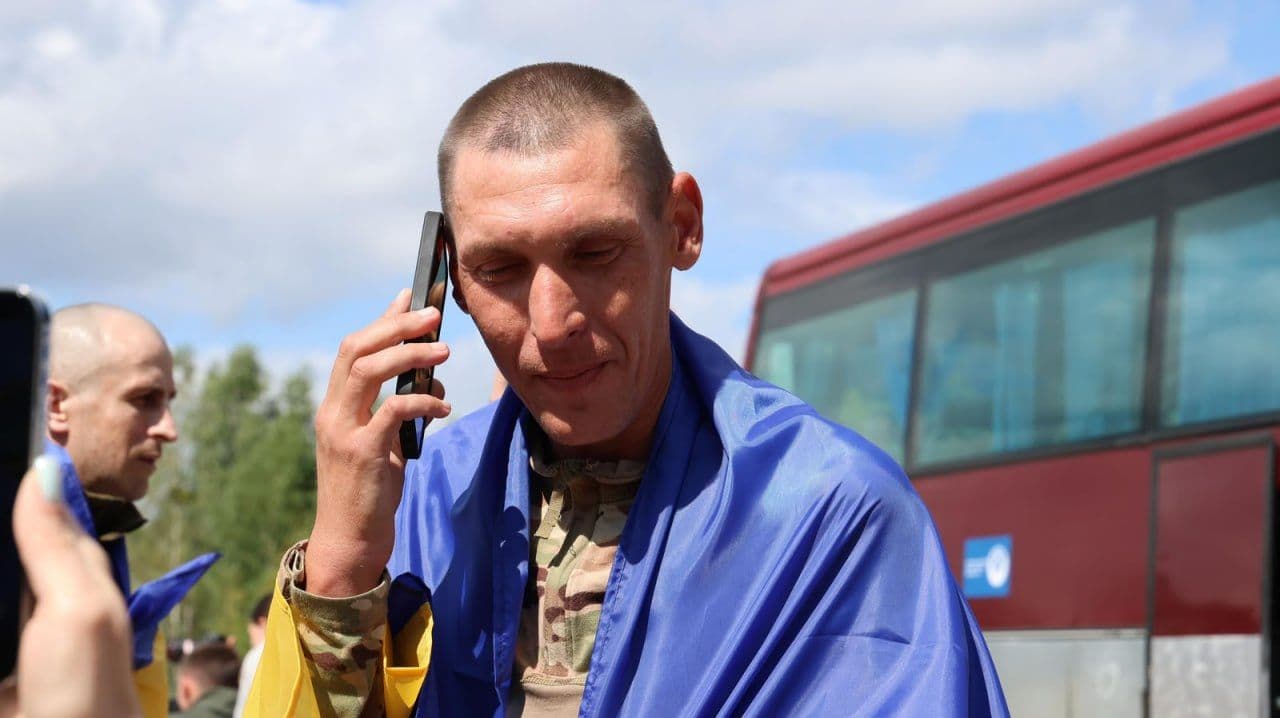
A Ukrainian service member speaks on the phone after returning from Russian captivity in a prisoner exchange. (Volodymyr Zelensky/Telegram)
PUTIN’S UNCOMFORTABLE ECONOMICS
For the first time in months, Vladimir Putin publicly acknowledged what Russians have been quietly experiencing for weeks: the war is genuinely hurting the economy, not just costing lives. Speaking to a Kremlin economic council, Putin characterized Russia’s GDP growth as a “modest” but positive one percent, while conceding that “external pressure” and what he called “terrorist attacks” — Kremlin code for Ukraine’s long-range strike campaign — are weighing on growth. He acknowledged some Wildberries logistics facilities need “restoration” after Ukrainian strikes, while insisting overall trade infrastructure remains fully functional, and ordered his cabinet to draft a program to rebuild damaged warehouse capacity.
The gap between Putin’s framing and daily reality is stark. Russian state media reported gasoline was available at just 28 percent of the country’s gas stations this week, down sharply from 41 percent the previous week, with shortages now reaching even Moscow, a city the Kremlin has long tried to shield from the war’s visible costs. Attempts to fix the fuel shortage are creating new ones: Russian refineries are diverting aromatic hydrocarbons — chemicals also needed for defense manufacturing — toward lower-quality gasoline production, triggering a separate shortage of motor oil.
The strain is visible in how Moscow is responding, not just what it’s saying. Russia has deployed Rosgvardia, its militarized internal security force, to at least 13 gas stations amid fears of violence over fuel access, and the Kremlin’s legislative commission approved a bill granting emergency responders expanded authority to use firearms. Authorities also quietly cancelled Red Square’s annual military music festival, a rare public admission that security resources are stretched thinner than the Kremlin wants to admit.
UKRAINE CONFIRMS NEW DEFENSE AND FOREIGN MINISTERS
More than a month after President Zelensky abruptly dismissed Mykhailo Fedorov as defense minister, Ukraine’s parliament formally closed that leadership gap. Lawmakers confirmed Yevhen Khmara, a major general and longtime SBU special-operations veteran, as defense minister by a vote of 312 to the 226 required, and separately reappointed Andrii Sybiha as foreign minister with 266 votes and no opposition.
Khmara, who commanded the SBU’s Alpha special operations center and led the 2022 operation to liberate Snake Island, had to formally leave military service before his appointment could be finalized, since Ukrainian law requires the defense minister to be a civilian. “I stand before you as a civilian, discharged from military service,” he told lawmakers. He’s now Ukraine’s fifth defense minister since the full-scale invasion began, following a string of predecessors who each lasted between six months and two years in the role. In his own remarks, Khmara outlined a philosophy centered on asymmetric warfare: “We will destroy the infrastructure, fleet, logistics, fuel, and energy facilities and enterprises that are working for the war against Ukraine,” he said, signaling continuity with the long-range strike strategy his predecessor championed.
Sybiha, reappointed after a summer reshuffle briefly stripped him of the title on a technicality, laid out three priorities for his renewed term: securing “a just peace,” continuing Ukraine’s EU and NATO integration path, and strengthening support for the roughly four million Ukrainians now living abroad.
FEDOROV WON’T GO QUIETLY
Even with his old job formally filled by someone else, Mykhailo Fedorov isn’t stepping out of public life — he’s stepping further into it, in a way that’s making even his own supporters uneasy.
A day after releasing a pointed video address arguing Ukraine needs a legal mechanism to hold elections during wartime and accusing the government of a “systemic crisis of governance,” Fedorov found himself analyzed less as a dismissed minister and more as an emerging political rival. One political scientist described the address bluntly as “a bid for the role of opposition leader,” noting it deliberately featured blurred images of figures inside Zelensky’s inner circle. Even demonstrators who’d spent weeks marching for his reinstatement seemed caught off guard. “What was good about Fedorov was that he was a manager, not a politician. And now he’s gone from being a manager to being a politician,” one protester told reporters, describing the address as disappointing rather than validating.
Separately, officials familiar with the matter told reporters Fedorov is now considering a trip to the United States as early as next week, though it’s unclear who he’d meet there. He’s reportedly remained in close contact with SpaceX CEO Elon Musk over using Starlink terminals to help counter Russian ballistic missiles — a technical relationship that predates his dismissal and that he appears to be maintaining independently of his former government role, regardless of where his political future ultimately leads.
103 FOR 103: A PRISONER EXCHANGE
Amid everything else, Ukraine and Russia carried out one of the few forms of direct cooperation the war still allows: a prisoner exchange, each side releasing 103 captured service members back to their home country.
Ukraine’s returning soldiers came from the Armed Forces, State Border Guard Service, and National Guard, President Zelensky said, including troops who’d defended Mariupol during its brutal 2022 siege and fought across nearly every major front of the war since. Ukraine’s human rights commissioner said most of the released men were soldiers and sergeants, ranging in age from 26 to 59, with some seriously wounded or seriously ill. “We remember every man and woman who still remains in captivity. We are doing everything possible to bring all our people home,” Zelensky said. Russia’s defense ministry confirmed it received its own 103 service members in return, saying they were immediately sent to Belarus for medical and psychological support.
The exchange follows a broader, if inconsistent, pattern of humanitarian cooperation that’s persisted even as the war grinds on elsewhere: Ukraine and Russia swapped 160 prisoners each in late June, and continued exchanging the remains of fallen soldiers as recently as August 13, when Ukraine received 261 bodies Russia claimed belonged to Ukrainian troops. For the families involved, each exchange remains a rare moment when the war’s abstractions become, briefly, a name coming home.
UKRAINE STRIKES A REFINING HUB AND, FOR THE FIRST TIME, GRAIN SHIPS
Overnight, Ukrainian forces struck the Ufa Oil Refining Hub in Russia’s Bashkortostan Republic — a complex of three separate refineries roughly 745 miles from the border — with Ukrainian defense analysts assessing the strike destroyed a primary refining unit at the hub’s Bashneft facility. Regional officials confirmed the strike, and satellite footage showed smoke rising from the complex. It’s the latest entry in Ukraine’s monthslong campaign to systematically degrade Russia’s refining capacity, a campaign that’s now visibly contributing to the fuel shortages rippling across the country.
Separately, Bloomberg reported the first confirmed strikes specifically against grain vessels at Russian ports, with unspecified actors hitting at least five grain ships near Novorossiysk and Tuapse over the past two days. Russian authorities have reportedly downplayed the incidents. The strikes land awkwardly against the backdrop of Ukraine’s own recent offer of a Black Sea moratorium on maritime strikes — a proposal Russia’s foreign ministry formally rejected days earlier — meaning any Ukrainian role in these particular strikes would represent an escalation against exactly the kind of target a moratorium was meant to protect, even as Russia refuses the deal that would have spared them.
Separately, Ukraine’s General Staff confirmed additional detail on its mid-August strike on the Progress Space Rocket Center in Samara, saying the attack specifically destroyed a Soyuz engine assembly workshop and sparked a fire covering more than 50,000 square feet, while a related strike hit an aircraft maintenance facility at the nearby Aviakor plant.
MEANWHILE, AT THE ACTUAL FRONT — THE NORTH AND EAST
Away from headline strikes, the ground war produced modest, contested movement in several directions at once.
Ukrainian forces appear to have advanced slightly north of Bilyi Kolodyaz in northern Kharkiv Oblast, while Russian forces separately attempted, and were repelled in, a flag-raising mission near Vovchansk meant to fabricate the appearance of territorial gain. Near Kupyansk, Russian assault units reportedly seized the eastern part of Kivshrivka, consolidating a position Ukrainian military observers had already flagged as contested days earlier — one of the more concrete Russian advances reported this week. Ukrainian forces, meanwhile, kept striking Russian military assets well behind the line in occupied Luhansk Oblast, hitting a drone depot, a supply warehouse, and equipment concentrations across three separate locations.
Near Kostyantynivka, Russian sources published fresh footage purporting to show soldiers raising flags over Novomykolaivka to claim the village had fallen — footage independent researchers assess was likely doctored or AI-altered, part of the Kremlin’s ongoing information campaign to manufacture the appearance of sweeping gains. Near Dobropillya, Russian forces claimed to have seized the settlement of Vodyanske, while a Ukrainian brigade commander in the area reported Russian forces are visibly massing infantry for a future push toward the town — an unusual, deliberate buildup that a commander in the sector said Russian forces haven’t used in at least two to three months, suggesting a more calculated offensive than the improvised infiltration tactics recently common elsewhere.
MEANWHILE, AT THE ACTUAL FRONT — THE SOUTH AND CRIMEA
Further south, Ukrainian forces kept up pressure on occupied Crimea even as ground fighting elsewhere stayed largely static.
Near Hulyaipole, Russian forces continued attacking without confirmed gains as Ukrainian counterattacks held the line, while a Ukrainian regiment commander noted the notoriously lethal “kill zone” in the area — the stretch of contested ground too dangerous for either side to move through safely — isn’t currently expanding the way it did last winter, though he warned it typically grows again as autumn and winter approach. In western Zaporizhzhia Oblast, Russian sources claimed to have seized Mala Tokmachka near Orikhiv, a claim that remains unconfirmed by independent monitors. Ukrainian forces struck back at Russian logistics across the region, hitting a rocket-artillery system in occupied Nikopolskyi Raion and destroying a convoy of trucks and fuel tankers along a key supply highway near Berdyansk.
In occupied Crimea, Ukrainian strikes hit a ground relay station used to guide Russian strike drones near Olenivka, while a Crimea-focused monitoring channel reported disabled substations and explosions near Yalta, Sevastopol, and several other occupied towns, adding to a broader pattern of degraded power and logistics across the peninsula. That same monitor reported hotel occupancy in occupied Crimea has fallen by roughly a third this summer, a rare civilian-facing data point suggesting the strikes and resulting shortages are measurably affecting daily life for people living under occupation, not just military logistics.
A MASSACRE IN A KHERSON MINIBUS
The single most deliberate act of violence today happened not on any front line, but on an ordinary morning street in Kherson City. A Russian first-person-view drone struck a civilian minibus in the city’s Korabelnyi district just before 9 a.m., killing four people and injuring five more — all of the injured women, according to regional officials.
President Zelensky didn’t mince words describing the pattern this fits: what Ukrainian officials have taken to calling Russia’s “human safari” in Kherson, a sustained campaign of FPV drones deliberately hunting individual civilians going about ordinary life, rather than targeting military infrastructure. “The vicious Russian ‘safari’ against our people in Kherson has long gone beyond anything a normal person could imagine,” Zelensky said, adding a pointed criticism of Ukraine’s own allies: “While partners hesitate over additional supplies of defense equipment, the Russians have long run wild.” Nine more people were injured elsewhere in Kherson Oblast over the same 24-hour period, with strikes damaging three apartment buildings, a restaurant, and multiple vehicles.
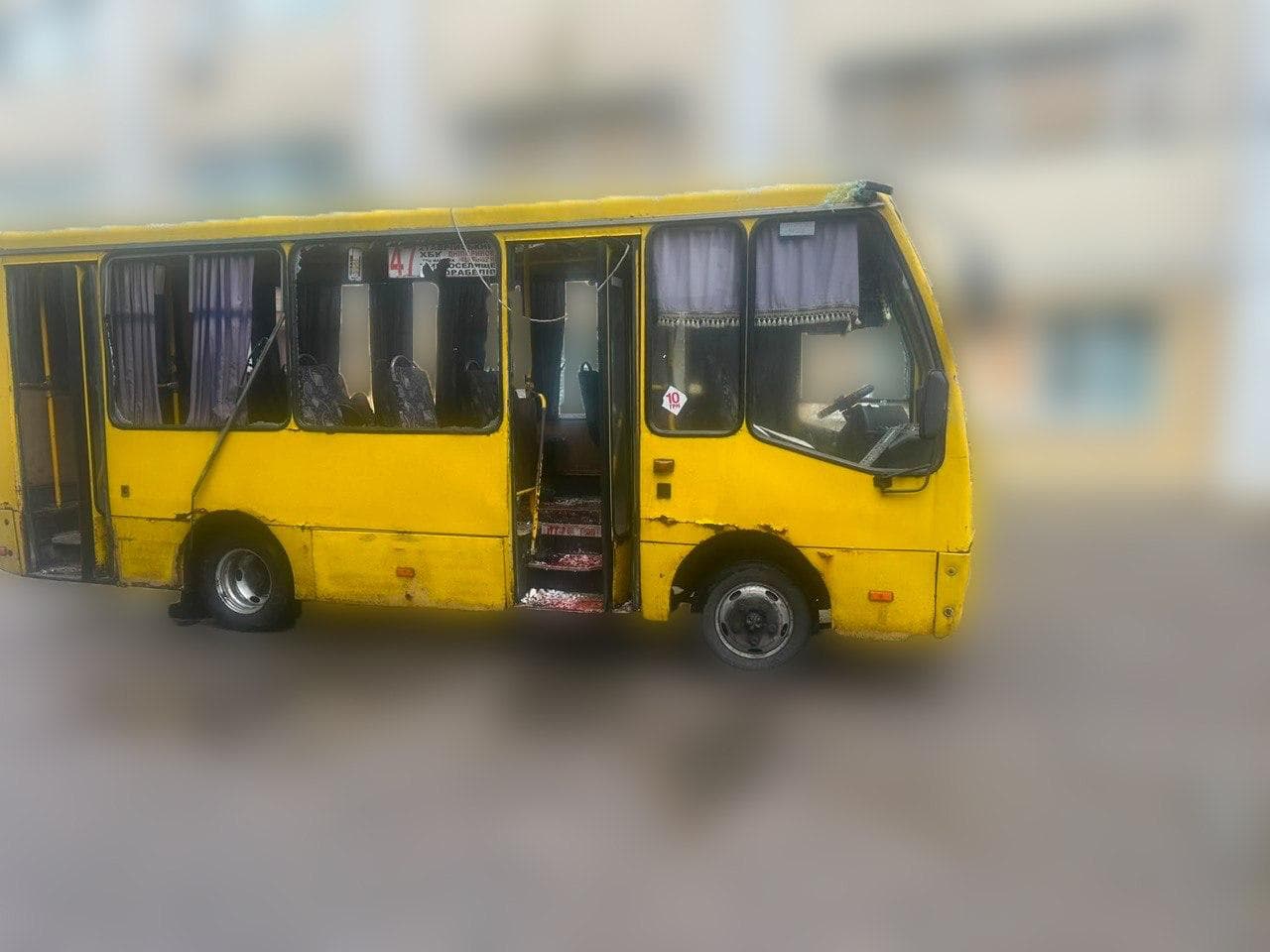
A minibus damaged in a Russian drone strike in Kherson’s Korabelnyi district. (Oleksandr Prokudin/Telegram)
Kherson City sits close enough to Russian-held territory across the Dnipro River that operators can pilot drones directly into residential streets in real time, turning ordinary movement — walking to work, riding a minibus — into a form of Russian roulette that residents now navigate daily, with no reliable way to know which vehicle or intersection will draw an operator’s attention next.
ZHYTOMYR’S POLICE HEADQUARTERS BOMBED
Russian forces struck the regional headquarters of Ukraine’s National Police in Zhytomyr with Banderol-type loitering munitions, killing two police officers and injuring at least 40 people, according to national police leadership. The strike ignited fires on the building’s roof and fourth floor, sending police officers, firefighters, and other emergency responders scrambling to fight the blaze and assist the wounded even as the building they worked in remained an active strike site.
“This is yet another manifestation of the true nature of Russian aggression — terror directed against people and those who protect them,” national police chief Maksym Tsutskiridze said, explicitly framing the strike as an attack on the concept of public safety itself rather than a military target with any legitimate strategic value. He directed a message to the officers who kept working through the attack: “Once again, the enemy is not just hitting buildings. It is deliberately attacking people who work every day for the safety of others.” He thanked them for “staying at your posts despite the pain and loss.”
The strike came just eleven days after Russia previously hit Zhytomyr with jet-powered drones, injuring three people and damaging civilian infrastructure — part of an escalating pattern in which Zhytomyr, a regional capital with no obvious front-line military significance, has absorbed repeated attacks in quick succession this month.
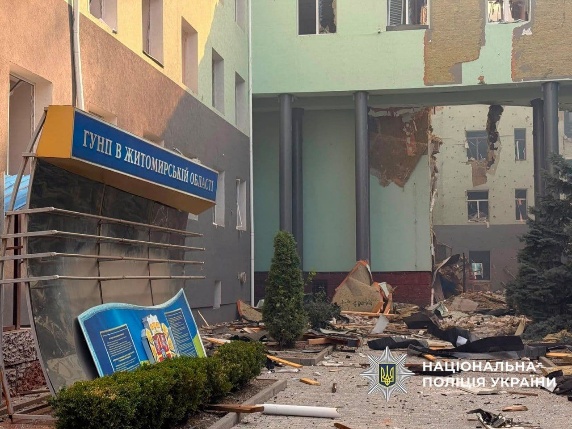
The building of the Main Directorate of the National Police in Zhytomyr Oblast following a Russian Banderol drone strike. (National Police of Ukraine/Telegram)
THE OVERNIGHT TOLL: 17 DEAD NATIONWIDE
Overnight, Russia launched two Iskander-M ballistic missiles and 65 Shahed-type, Gerbera-type, and Banderol drones and decoys at Ukraine from three separate directions. Ukrainian forces intercepted 56 drones and two of the Banderol munitions; the rest struck 10 locations, with debris landing at three more, hitting energy, transportation, residential, agricultural, and commercial infrastructure across seven oblasts and triggering power outages in four more.
The nationwide toll, combining overnight strikes with the day’s other attacks, reached at least 17 dead and 54 injured. Kharkiv Oblast bore the heaviest confirmed losses, with 10 people killed and 23 injured over the reporting period, largely reflecting the finalized toll from the previous night’s strike on Pechenihy. Zaporizhzhia Oblast reported two killed and 10 injured, with regional officials noting Russian forces carried out over 1,000 individual strikes against 52 separate settlements across the region in a single day. Donetsk Oblast lost one person in Druzhkivka, with four more injured, while Sumy Oblast reported three injuries from a mix of mortars, artillery, drones, and guided bombs. The Kherson minibus attack and Zhytomyr police strike, detailed separately above, added their own tolls on top of these regional totals — a reminder that the headline number, however grim, still understates just how many separate acts of violence a single Ukrainian day actually absorbs.
A CORRUPTION SCANDAL REACHES ZELENSKY’S OWN OFFICE
Ukraine’s anti-corruption investigators moved directly against the president’s inner circle today, a rare and politically uncomfortable escalation even by the standards of Ukraine’s ongoing reckoning with wartime graft.
President Zelensky dismissed his deputy chief of staff, Iryna Mudra, after the National Anti-Corruption Bureau searched her premises as part of an investigation into an alleged criminal organization involving senior officials from the President’s Office and current and former lawmakers. Investigators allege Mudra helped launder roughly $3.4 million in bail money through a state-owned bank for a suspect in a separate corruption case, and that unidentified figures within the President’s Office had separately tasked her with bringing that same bank under direct presidential-office control. Audio recordings published by investigators appeared to show Mudra describing pressure from a figure referred to only as “David” and from a man identified as “Timur” — a reference that appears to point toward Timur Mindich, a Zelensky associate already at the center of Ukraine’s largest ongoing corruption investigation.
Mudra confirmed she’d been formally charged but said she had not been detained. The Kyiv Independent separately noted that Mudra’s sister holds a senior post at Ukraine’s securities regulator overseeing cryptocurrency policy — a potential conflict of interest that experts say may help explain years of delay on virtual-asset legislation international partners, including the IMF, have pushed Ukraine to finalize since 2022.
UKRAINE’S MISSILE PROGRAM SPEEDS UP
Ukraine’s push to build its own ballistic missile capability took a concrete step forward today, even as the company behind it continues operating under a cloud of corruption scrutiny.
Fire Point, the manufacturer behind Ukraine’s Flamingo cruise missile, announced it’s tripling its budget for a solid rocket fuel plant under construction in Denmark to $175 million, after the company’s original site proved inadequate for its needs. CEO Iryna Terekh said the company’s first ballistic missile, the FP-7, with a range of roughly 190 miles, should be ready by the end of September, while a longer-range FP-9 model capable of reaching targets up to 530 miles away is expected by year’s end — a timeline that would put Moscow itself within theoretical range. “Russians understand exclusively the language of strength,” Terekh said, arguing the missiles would strengthen Ukraine’s position in any future negotiations rather than simply adding to the battlefield.
The announcement lands alongside ongoing scrutiny of Fire Point itself: the company has faced sustained corruption allegations tied to Timur Mindich, the same figure implicated in the scandal that touched Zelensky’s office today, with audio evidence reportedly linking him to the firm despite the company’s denials. Ballistic missiles, unlike the cruise missiles Ukraine already produces, travel at speeds that can exceed 2,000 miles per hour on their final approach, making them far harder to intercept — a capability gap Ukraine has watched Russia exploit against its own cities for years, and one it’s now racing to close from the other direction.
ACCOUNTABILITY ABROAD
Two separate legal and diplomatic developments today touched on accountability questions that have simmered for years without full resolution.
Croatian police arrested a Ukrainian man identified only as “Vladimir Z.” on a German warrant tied to the September 2022 sabotage of the Nord Stream gas pipelines, which Germany’s prosecutors describe as a trained diver who “participated in the necessary dives” during the operation. He’s set to be extradited to Germany to face charges of causing an explosion and constitutional sabotage, joining another Ukrainian suspect Germany charged in July. Ukraine’s own prosecutors have separately said they’ve found no evidence linking Kyiv’s government to the operation, and analysts note any political fallout in Germany is likely to be limited, since Ukrainian involvement in the sabotage has been publicly assumed for years without significantly denting German public support for Ukraine.
Separately, Foreign Minister Sybiha praised Hungary’s decision to formally close a money-laundering investigation into a Ukrainian bank convoy that Hungarian authorities had controversially seized back in March, briefly detaining Ukrainian bank employees and holding roughly $82 million in cash and gold. Hungarian investigators ultimately determined no crime had occurred, following an internal probe Hungary’s prime minister ordered after Ukrainian officials called the original seizure “state terrorism.” “Betting on anti-Ukrainian rhetoric for domestic gain yields nothing but political defeat and shame,” Sybiha said, calling for accountability for those who orchestrated what he characterized as a politically motivated seizure in the first place.
TWO STORIES ABOUT WHAT RUSSIA WILL DO FOR MANPOWER
Two very different stories today illustrated the lengths Russia’s war machine will go to secure the people it needs — one through coercion against a Ukrainian, the other through deception against its own citizens.
Mykhailo Puryshev, the Mariupol volunteer who revealed days earlier that Russia’s FSB had blackmailed him into traveling to Moscow by threatening to conscript his son, confirmed in a video update that he’s now safe and no longer in Russia. “You are a miracle! I am recording this video safely, not on the territory of the Russian Federation. Thank you to each of you,” he said, thanking supporters and human rights organizations for their advocacy while declining to share further details about how he got out or the fate of his son.
Meanwhile, a Russian investigative outlet revealed that roughly 2,000 job advertisements for “security guards” at Wildberries and Ozon warehouses have appeared on a major Russian classifieds site since Monday — a thinly disguised recruitment drive for military contracts targeting men desperate enough, or unaware enough, to sign up before what recruiters described as an anticipated mobilization. Recruiters reportedly promised applicants they wouldn’t be sent to fight in Ukraine, assurances that don’t match the actual military contracts applicants are asked to sign, according to the outlet’s reporting. The tactic reflects a genuine recruitment shortfall: one German security-affairs analyst estimated Russian military enlistment fell roughly 10 percent in the first half of this year compared to the same period last year, even as Moscow’s official 2026 recruitment target remains a steep 409,000 contract soldiers.
SPORTS BANS HOLD, AND A DRONE LANDS IN TURKEY
Two smaller stories rounded out the day, both touching on how the war keeps surfacing in places far removed from any battlefield.
The International Biathlon Union confirmed it has no plans to reconsider Russia’s suspension from competition at its upcoming September congress, despite a formal request from Russia’s national biathlon federation. The IBU’s position, unchanged since the ban’s imposition in 2022, stands in contrast to a wave of other sports bodies — including handball, volleyball, boxing, and motorsports — that moved to lift similar bans after the International Olympic Committee reinstated Russian and Belarusian athletes in July. Nine EU countries have since urged that any sporting organization readmitting Russian athletes be stripped of EU funding, with two EU diplomats saying the issue could even be folded into the bloc’s next sanctions package.
Separately, a suspected drone crashed into the grounds of a police station in Trabzon, on Turkey’s Black Sea coast, shattering windows and damaging vehicles but causing no injuries. Turkish officials said the object’s origin remains under investigation, with no confirmed link to Russia’s war, though the incident follows a Russian Gerbera-type drone found washed up on Turkey’s coast just last week — part of a broader, still-unfolding pattern of Russian-linked drone debris and stray munitions turning up along NATO’s southeastern edge.
A GAS LINE, A MINISTRY CONFIRMED, A MINIBUS TARGETED
By nightfall, the day’s contradictions sat side by side without resolving into anything simpler. Russia’s president admitted, carefully, that the war is costing his country more than he’d like to say out loud, while ordinary Russians waited in gas lines patrolled by armed security. Ukraine confirmed two ministers, exchanged 103 prisoners, and struck a refinery and grain ships a thousand miles from home — proof of a system still functioning under pressure that would break most governments.
And in Kherson, four women died in a minibus because a drone operator somewhere across the river decided they were worth the ammunition. That’s the number that doesn’t fit neatly into any larger narrative about economics or diplomacy or missile programs. It’s just a fact, added today, to a list that’s already far too long.
A PRAYER FOR UKRAINE
1. For the Four Women in the Kherson Minibus
Lord, four women are dead tonight in Kherson, killed on an ordinary morning commute by someone who chose to see them as a target rather than as people. We cannot make peace with a war that hunts civilians deliberately, by name of sport rather than necessity. Receive each of them, comfort the five survivors and their families, and let Kherson’s daily terror be seen clearly for what it is, not softened into a statistic.
2. For the Officers of Zhytomyr
Father, we lift up the police officers killed and wounded today defending a building that should never have been a target — people whose job was protecting others, struck while doing exactly that. Comfort their colleagues who kept working through fire and fear. Give Ukraine’s first responders courage that doesn’t waver, and give their families the support this loss demands, for as long as it takes.
3. For a Volunteer Who Made It Home
Lord of deliverance, we give thanks for Mykhailo Puryshev’s safe return, a small mercy after real fear. We pray now for his son, still navigating whatever danger remains, and for every family facing a version of this same impossible choice quietly, without an audience. Protect the vulnerable from those who would use love as leverage, and grant the same deliverance to others still trapped in similar binds.
4. For Honesty in High Places, on Both Sides
God of truth, we pray for accountability that reaches everywhere it needs to — a corruption scandal at Ukraine’s own presidential office, a Kremlin unable to fully hide the cost of its war from its own people. Give investigators on all sides courage to follow evidence wherever it leads, even into rooms of power that resist scrutiny. Let truth-telling be rewarded rather than punished, in Kyiv and in Moscow alike.
5. For Every Prisoner Still Waiting
Lord of the captive, we give thanks for 103 soldiers who came home today, and we hold in prayer everyone still waiting for their own exchange, their own name called. Comfort the families who watched today’s list and didn’t find who they were looking for. Let every exchange, however small against the scale of this war, be a genuine sign that return is still possible.
In Your mercy, in Your justice, in Your time — bring this war to its end, and let the ending be worthy of what Ukraine has endured.