
In Vyborg harbor, a $222 million Russian military icebreaker lists on its side, struck by a drone that flew nearly 1,000 kilometers. In Leningrad Oblast, fires rage at Russia’s largest Baltic oil terminal for the second time in three days, halting crude exports as global oil prices crack $100 a barrel. In a Russian psychiatric ward, a pro-Kremlin blogger sits confined for saying publicly what the milbloggers whisper privately — that Putin has dragged Russia into a war it cannot win. The 1,126th day of Russia’s full-scale invasion: when Ukraine’s drones reached places no one thought possible, and Moscow’s answer was to silence the people saying so.
THE DAY’S RECKONING
March 25, 2026. In Belgorod Oblast, the sirens came after the bombs.
Not before. After. Because the Kremlin’s push to force citizens off Telegram and onto its state-controlled Max app had quietly disabled the only warning system that worked. Residents reported hearing nothing — no alert, no notification — until strikes had already hit. Then the sirens.
Nine hundred kilometers northwest, Ukrainian drones were threading through Russian air defenses over the Gulf of Finland. Flames tore through the Novatek Ust-Luga oil terminal — Russia’s largest Baltic export hub, 130 million tons of cargo a year — and kept burning. A second wave found the Vyborg Shipbuilding Plant. By morning, a $222 million FSB patrol icebreaker lay listing on its side in the harbor. The first Russian military vessel ever struck in the Baltic Sea.
On Russian social media, a milblogger was doing the math nobody in the Kremlin wanted published: at current rates of advance, Russia would need 100 years to take the rest of Ukraine. In a psychiatric ward somewhere in Russia, Ilya Remeslo — a pro-Kremlin blogger who had called the war a “dead-end” — sat confined after authorities committed him for saying what millions privately believe.
In Washington, a MAGA congresswoman was organizing a congressional meeting with Russian lawmakers. In Reuters, Zelensky was disclosing that the US had offered security guarantees — contingent on Ukraine surrendering its Donbas positions. And across global energy markets, traders were absorbing a Reuters report that 40% of Russia’s oil export capacity had been knocked offline — the worst disruption in modern Russian history — while oil prices sat above $100 a barrel.
Five simultaneous crises. One grinding day of war.
THE NIGHT THE BALTIC BURNED
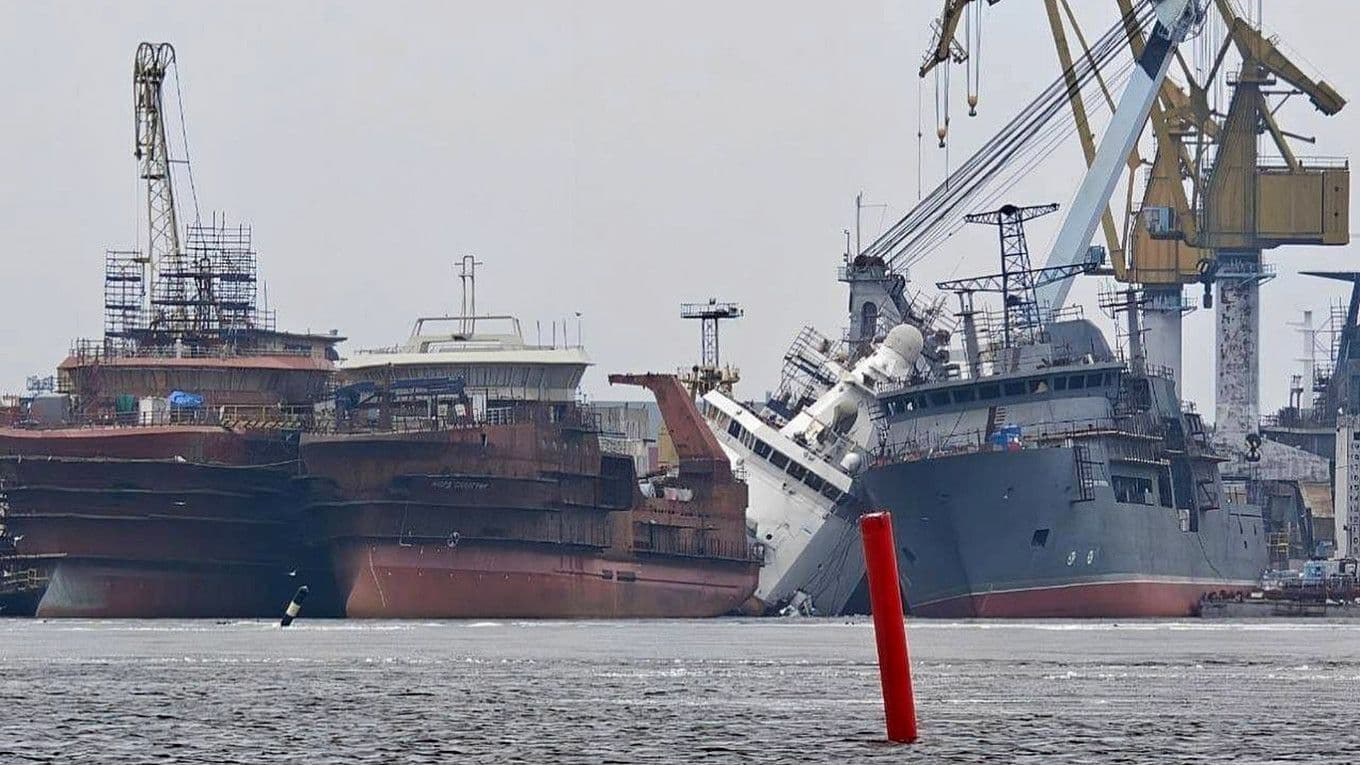
A photograph showing a Russian military icebreaker keeled over after being damaged by a Ukrainian drone strike on Vyborg, Russia. (Telegram)
Somewhere over the Gulf of Finland, in the small hours of March 25, a swarm of Ukrainian drones crossed a threshold Russia thought it had secured forever.
They’d flown 900 kilometers to get there — threading through layered air defenses, hugging terrain, navigating the darkness. The first wave found the Novatek Ust-Luga terminal: Russia’s largest Baltic export hub, 130 million tons of cargo a year, a financial artery feeding Putin’s war machine. The oil tank farm caught first. Then the loading infrastructure. Governor Alexander Drozdenko confirmed the strike and told officials to contain the blaze. Bloomberg reported what the governor didn’t: crude loading had stopped entirely. It was the second hit on Leningrad Oblast oil terminals in three days — Transneft-Port Primorsk had burned two nights earlier.
The second strike was more audacious. Ukrainian drones found the Vyborg Shipbuilding Plant — a Baltic port city that was Finnish soil before Stalin annexed it in 1944 — and hit the Dzerzhinsky, a Project 23550 Purga-class patrol icebreaker worth 18 billion rubles, approximately $222 million, built to serve Russia’s FSB Border Service. By morning, photographs showed it keeled over on its side among the other vessels in harbor.
The first Russian military ship ever struck in the Baltic Sea. Nearly 1,000 kilometers from Ukrainian territory.
Since 2022, Ukraine has methodically destroyed Russia’s Black Sea Fleet. The Baltic Fleet assumed it was watching from a safe distance. It isn’t anymore.
Two drones strayed off course into Latvia and Estonia — one exploding in a field near Kraslava, another clipping a chimney at Estonia’s Auvere power station. No casualties. Estonia’s foreign ministry response was surgical: “This is a concrete consequence of Russia’s full-scale war of aggression.” Latvia’s Defense Minister cut his visit to Ukraine short and flew home.
THE WINDFALL THAT WENT UP IN FLAMES
In Moscow’s finance ministry, someone had run the numbers on Iran.
Oil above $100 a barrel. Russia pumping at capacity. The war in the Middle East — devastating for everyone else — was supposed to be a windfall. The math looked beautiful.
Then Ust-Luga caught fire. Again.
Reuters confirmed what energy traders were already calculating on March 25: Ukrainian drone strikes, pipeline damage, and tanker seizures have knocked out approximately 40% of Russia’s oil export capacity — roughly 2 million barrels per day. The worst disruption to Russian oil supply in modern history. Not from Western sanctions. From Ukrainian drones.
The damage is everywhere at once. Primorsk and Ust-Luga, Russia’s two biggest Baltic export ports, are suspended after the overnight strikes. Novorossiysk on the Black Sea is running below capacity following earlier hits this month. The Druzhba pipeline — Russia’s overland route to Hungary and Slovakia — has been largely offline since January, after Ukrainian strikes damaged infrastructure Russia itself had previously attacked.
And overnight, the Kirishi oil refinery took another hit. It sits 800 kilometers from Ukraine’s border. It processes 6.6% of Russia’s total oil refining volume. It has been struck before. It burned again.
The cruelty of the timing is almost elegant. Putin had watched oil prices surge past $100 and seen relief. The Iran war was supposed to fund his war. Instead, the terminals that should be loading tankers around the clock are on fire, the pipelines are dark, and the shadow fleet dodging European interdiction is moving less oil than ever.
Kyiv’s position is straightforward: Russian oil infrastructure is a valid military target.
The results speak for themselves.
SIRENS AFTER THE BOMBS: HOW THE KREMLIN’S CENSORSHIP IS KILLING ITS OWN PEOPLE
The bombs hit first. The sirens came after.
In Belgorod Oblast — a Russian border region that absorbs Ukrainian strikes with grim regularity — residents reported something that should be impossible: no warning at all. No push notification. No alert. Just the sound of explosions, and then the wail of sirens confirming what had already happened.
The mechanism of failure is the Kremlin’s own doing. Russia’s missile warning system runs on push notifications through Telegram. When the Kremlin throttled Telegram to force citizens onto its state-controlled Max app, it quietly severed the alert chain that kept border residents alive. Governor Vyacheslav Gladkov had warned this was coming — calling it one of the region’s “most pressing” problems. Nobody fixed it. On the night of March 25, his warning became a body count waiting to happen.
The Kremlin’s response to the backlash reveals how rattled it is. Russia’s Federal Antimonopoly Service announced it won’t fine Russians for advertising on Telegram or YouTube until end of 2026. Translation: the ban is moving slower than planned, the state alternatives aren’t ready, and Moscow is buying time while hoping no one notices it’s still throttling the platforms it officially tolerates.
Then there is Ilya Remeslo.
The pro-Kremlin blogger criticized Putin on March 17 — calling the war a “dead-end,” accusing him of wanting “endless wars,” of overstaying his presidency, of ruining Russia’s economy. By March 19, Russian opposition sources reported that authorities had forcibly committed Remeslo to a psychiatric hospital.
It’s a Soviet tactic: no trial, no charges, just a diagnosis.
Meanwhile, The Bell reported that Moscow’s three-week internet blackout — ordered by the FSB “from above” — targeted areas near air defense deployments. The goal, apparently: stop Ukrainians from geolocating Russian missile batteries through internet connectivity patterns.
The Kremlin is censoring its people to hide its weapons. Its people are dying because the warnings don’t come.
ONE HUNDRED YEARS: THE VERDICT RUSSIA’S GENERALS DON’T WANT YOU TO READ
This didn’t come from Washington. It didn’t come from a NATO briefing room or a Western think tank.
It came from inside Russia. And it was savage.
A prominent Russian milblogger — writing from within the information ecosystem the Kremlin is desperately trying to control — published his verdict on March 25: at current rates of advance, Russian forces would need approximately 100 years to seize the rest of Ukraine. The figure tracks almost exactly with ISW’s independent calculation of 83 years, based on February 2025 data.
The critique was surgical. Russian infantry are failing with small-group infiltration tactics against Ukrainian drone dominance. Armored vehicles still have no adequate protection against FPV drones — a vulnerability Ukrainian forces identified and weaponized years ago, while Russian factories kept producing the same unprotected vehicles. Front-line commanders are rewarded for filing optimistic reports, not accurate ones, creating a military culture built on comfortable lies. Training is too short. The industrial base is too slow.
And then the trap Putin has built for himself.
Fixing any of this requires stopping. Factories need to go offline to retool. Troops need to be pulled back for proper training. Recruits need more time before deployment. Every reform that could make Russia’s military effective would reduce the relentless frontline pressure Putin demands. He has chosen grinding advance over structural competence.
He is getting neither.
The milblogger didn’t spare the generals. Putin and Chief of Staff Gerasimov have claimed the capture of Kupyansk multiple times — a city Zelensky visited in person in December 2025, still flying Ukrainian flags. The lie is known. It persists anyway.
This may be the milblogger’s last honest dispatch. The anticipated Telegram ban will push voices like his onto state platforms, where verdicts like this one won’t be permitted.
THE OFFENSIVE THAT STARTED BEFORE IT WAS READY
The spring offensive has begun. Russia just isn’t prepared for it.
ISW assessed on March 19 that Russia’s spring-summer 2026 campaign had already started. But Ukrainian military observer Kostyantyn Mashovets delivered an inconvenient detail: the Russian Western Grouping of Forces never finished its preparations for the assault on Lyman — the gateway city that unlocks everything north of the Fortress Belt.
The logic of the campaign runs like a locked chain. Take Lyman, then threaten Slovyansk and Kramatorsk — the fortified cities of Ukraine’s Fortress Belt. Take the Fortress Belt, then claim Donetsk Oblast. Miss Lyman, and the entire northern axis stalls before it starts. Russia missed Lyman.
They attacked anyway.
Between March 17 and 19, Russian forces launched mechanized assaults in the Borova and Lyman directions — six separate axes, 25 to 28 armored vehicles, up to 95 motorcycles, ATVs, and buggies. Textbook preparations preceded it: drone strikes on Ukrainian logistics, guided glide bombs on supply lines, attempts to destroy crossings and dams along the Siverskyi Donets River to cut Lyman’s resupply routes.
The Ukrainian commander who described it used the word “textbook” without irony. Russia did everything by the manual. The manual isn’t working.
The deeper problem is visible in the force composition itself. Motorcycles. ATVs. Buggies. These are not the tools of an army confident in mechanized assault — they are the adaptations of one that has learned, at catastrophic cost, that drone-saturated battlefields shred armored columns. Now Russian forces are reportedly deploying unmanned ground vehicles to probe Ukrainian “kill zones” where any vehicle with a human inside becomes a target.
The offensive started. The gateway is still closed. And the tools Russia is sending to open it keep getting destroyed.
METERS, NOT MILES: A DAY ON THE LINE
Somewhere east of Slovyansk, small Russian infantry groups are moving on foot through the outskirts of Lyman — probing, infiltrating, looking for gaps. They attacked near Lyman, northeast and southeast of the city, east toward Slovyansk. Russian sources claimed advances near Nykyforivka and Lypivka. None confirmed. The spring thaw is drying the soil, making mechanized movement possible again, and Russian commanders are preparing for what comes next.
Near Kostyantynivka, Ukrainian forces moved the other direction. Geolocated footage confirmed advances in the city’s southeastern neighborhoods and north of Ivanopillya. No headlines. No dramatic breakthrough. Just terrain taken, denied to Russia, never easily given back.
At Pokrovsk, Russian reinforcements have been arriving since March 11 — assault groups of 15 to 20 soldiers, poorly trained, sent anyway. They’re coming on motorcycles and in vehicles, which means they’re dying on motorcycles and in vehicles. FPV drones don’t distinguish between a tank and a trail bike. The milblogger said Russian forces haven’t solved this problem. The reinforcement composition confirms he’s right.
In the south, Russia took ground. Confirmed advances in southern Myrne, in the Hulyaipole direction. Ukrainian forces counterattacked near Myrne, Novoselivka, and Hirke — pushing back where they could. In Zaporizhzhia, a different kind of accounting: Ukrainian strikes destroyed a Buk air defense system, fuel depots, and two trains loaded with weapons and ammunition. Russia advances in meters. Ukraine destroys supply chains.
In Kharkiv, Russian forces no longer drive to the fight. They walk — two to ten kilometers on foot before attacking, equipment pulled back into Belgorod Oblast to keep it out of drone range. Ukraine’s kill zone has grown so large that Russian doctrine has inverted: the attacker now hides from the defender.
FIFTEEN SHAHEDS OUT OF 556: THE NIGHT LVIV BURNED
They came from four directions simultaneously — Oryol, Kursk, Bryansk, Millerovo, Crimea — 147 drones fanning out across Ukraine in the dark. Shahed-type. Gerbera-type. Italmas-type. Ukrainian air defenses worked through the night and destroyed 121 of them.
Twenty-four got through. Eighteen locations hit. 161,000 homes and businesses lost power across six oblasts.
One of those locations was Lviv.
Russian drones struck the center of a UNESCO-listed heritage city 1,000 kilometers from the front lines, damaging residential buildings, injuring at least two people, sending 27 to seek medical help by morning — seven hospitalized, three in serious condition. Mayor Andriy Sadovyi stood near a burning building and said he had “many questions for everyone.”
The response came from Robert Brovdi — callsign “Madyar,” commander of Ukraine’s Unmanned Systems Forces. It was not gentle.
“Not a single night in 2026 has been quiet,” he wrote. Russia has launched at least 100 drones every night this month. Some nights, 400 to 500. His forces intercept 95 to 97% of them. “There is no air defense system on Earth capable of destroying 100% of such attacks.”
Fifteen Shaheds out of 556 reached their targets that night.
Three percent.
Sadovyi walked his comments back the next morning — “emotional and inappropriate,” he said, standing near the same streets he’d been watching burn. He expressed deep respect for Ukraine’s air defense forces. Brovdi accepted it and moved on: “Take care of people, and we will continue working in the sky.”
Russia’s answer to a 3% success rate is volume. Deputy Chief of the General Staff Anatoly Kontsevoy announced plans to train over 70,000 drone operators in 2026. Campus recruitment has been running since January.
More operators. More drones. More nights like this one.
TRANSPONDER ON. FLIGHT PLAN FILED. DEAD ANYWAY.
Pavel Koshkin did everything right.
His transponder was on. His flight plan was filed with the correct authorities. He ran a YouTube channel about light aircraft — a hobbyist, a pilot, a man who loved small planes and followed every rule that governed them. Last Friday, he took off near Kolomna, southeast of Moscow, with a passenger named Vadim.
A Tor surface-to-air missile found them first.
Russian air defense operators, nerves shredded by months of Ukrainian drone attacks, saw something in the sky near a facility that manufactures Iskander ballistic missiles and pulled the trigger. The Czech-manufactured Alto NG ultralight — transponder broadcasting, flight plan on file — disintegrated. Koshkin and Vadim died in the wreckage.
“Pavel always flew properly, with all required formalities,” wrote aviation blogger Igor Volkov from France. “But the stupidity and blindness of the soldiers know no bounds. Tired of drones, they simply pulled the trigger — and two people lost their lives.”
Koshkin leaves behind a pregnant wife and a two-year-old child.
This is not an aberration. According to The Insider, at least 17 Russian aircraft have been destroyed by Russian air defenses since 2022. The geometry of the problem is merciless: hundreds of drones fill Russian skies every night, and the operators tasked with stopping them are exhausted, under pressure, and working with systems that cannot always tell a Shahed from a hobby plane.
Russia didn’t send a missile after Pavel Koshkin.
But it created the conditions — the war, the drone swarms, the hair-trigger air defenses, the exhausted operators — that guaranteed someone like him would die.
The cameras on board, Volkov noted, almost certainly captured everything.
No one will ever see the footage.
GIVE UP THE GROUND, THEN WE’LL PROTECT YOU
Zelensky chose his words carefully. The content was still explosive.
Speaking to Reuters on March 25, the Ukrainian president disclosed what Washington has been quietly pushing: the United States is prepared to finalize security guarantees for Ukraine — but only after Kyiv withdraws its troops from the parts of Donbas it still controls.
“The Americans are prepared to finalize these guarantees at a high level once Ukraine is ready to withdraw from Donbas,” Zelensky said.
Then he explained, with careful precision, why that’s a trap. Withdrawal means surrendering Ukraine’s strongest defensive positions — terrain that protects not just Kyiv, but potentially all of Europe. The guarantee arrives after Ukraine gives up the ground that makes the guarantee necessary.
Trump, Zelensky said, is pressing harder as the Iran war consumes Washington’s attention and munitions. “President Trump, unfortunately, in my opinion, still chooses a strategy to put more pressure on the Ukrainian side.” Russia, he assessed, is playing a patient game — waiting for Washington to lose interest and walk away from the peace process entirely.
The diplomatic picture is bleak. A US-Ukraine security document was “100% ready” in January. It still isn’t signed, stalled after talks in Miami. Zelensky thanked Trump for continuing Patriot deliveries — “I’m very grateful to President Trump, and to his team” — then immediately noted the supply “is not as large as we need.”
Two irreconcilable positions remain locked in place. Russia demands Ukrainian withdrawal from Donbas before any agreement. Ukraine demands a freeze on current front lines as the only realistic starting point.
Neither has moved.
The gap between them is not a negotiating space. It is the war itself.
THE GRANDSON OF THE MAN WHO ARMED HITLER COMES TO WASHINGTON
History has a sense of irony.
The leader of the Russian delegation flying to Washington to meet members of the US Congress is Vyacheslav Nikonov — the grandson of Vyacheslav Molotov, the Soviet Foreign Minister who signed the Nazi-Soviet Pact in 1939. That agreement carved up Eastern Europe, enabled Hitler’s western offensive, and set the conditions for the deadliest war in human history.
His grandson is coming to the United States Institute of Peace. On March 27.
The visit was organized by Republican Representative Anna Paulina Luna — a Trump loyalist who co-sponsored the “Ukraine Fatigue Resolution” in 2023, calling for an end to all US support for Kyiv. It marks the first parliamentary-level engagement between the two countries since Russia’s 2022 invasion. It comes despite the fact that Washington has sanctions on Russian legislators for that same invasion. A junior State Department official will attend each meeting as a note-taker.
Dmitry Peskov, the Kremlin’s spokesperson, was delighted. “We welcome any efforts to revive dialogue with the United States in any area.”
Razom for Ukraine was not. “The members of this delegation are currently prosecuting a war of aggression against a neighboring country,” said Advocacy Director Mykola Murskyj. “Poll after poll has shown that majorities of Americans support continued assistance to Ukraine. The White House should heed their view rather than host Kremlin functionaries for talks unlikely to yield results.”
The Russian delegation spans four parties. In Russia’s tightly controlled political system, that distinction is largely theatrical — every party backs the war, every legislator serves the Kremlin.
Molotov made his pact at a table, too.
BIDEN GAVE IT ALL TO UKRAINE: TRUMP SAID IT. HERE ARE THE ACTUAL NUMBERS.
Trump said it. Hegseth said it. Leavitt said it.
Ukraine took America’s weapons. Now there aren’t enough to fight Iran.
A Kyiv Post fact-check went looking for the evidence. Here’s what the record actually shows.
The US transferred $65 to $69 billion in military aid to Ukraine between 2022 and early 2025. Most of it — artillery, anti-tank missiles, armored vehicles, ATACMS, HIMARS — was designed to fight Russian tanks and infantry. The air defense component totaled roughly $10 to $12 billion, including three Patriot batteries. Of everything sent to Ukraine, exactly one weapon system can engage an Iranian ballistic missile: the PAC-3 interceptor.
Now the numbers that matter.
Over four years, the US transferred between 500 and 800 PAC-3s to Ukraine. In less than one month of fighting Iran in the Gulf, the US and its allies fired between 800 and 1,200 — roughly twice Ukraine’s entire four-year allocation, gone in weeks. Meanwhile Russia launched 2,000 to 3,000 ballistic missiles at Ukrainian cities, requiring continuous Patriot response. Lockheed Martin produces 550 to 650 PAC-3s per year for all customers worldwide. One war strained that. Two wars broke it.
Ukraine didn’t cause the shortage. Two simultaneous wars did.
The footnote is brutal. In August 2025, Zelensky offered Trump a $50 billion, five-year drone deal — specifically to develop the interceptor technology that Gulf states now desperately need against Iranian Shaheds. Trump said no. By March 2026, Ukrainian interceptor drones were destroying every second Shahed entering Ukrainian airspace. By March 17, 201 Ukrainian drone defense specialists were already deployed to Qatar, UAE, Saudi Arabia, Kuwait, and Jordan — protecting US military facilities.
Trump turned down the help. Then blamed Ukraine for the shortage.
FROM FIVE VOLUNTEERS TO THE FIRST CHECK: UKRAINE BUILDS WHILE IT FIGHTS
In Kyiv, while the Baltic burned, a different kind of milestone was being recorded.
The governing board of the U.S.-Ukraine Reconstruction Investment Fund — URIF, born from the minerals deal that nearly shattered Washington’s relationship with Kyiv in early 2025 — approved its first investment. The winner, chosen from more than 200 applicants: Sine Engineering, a Lviv-based startup that makes satellite-independent navigation software. Drones using Sine’s technology fly without GPS. Over 150 Ukrainian drone manufacturers depend on it.
Andriy Chulyk founded the company in 2022 with five volunteers. It now employs 200 people, with a European office in Finland. The investment amount wasn’t disclosed. The symbolism was unmistakable — the minerals deal, once a crisis, is producing results.
In Houston, the bills were coming due.
Energy Minister Denys Shmyhal stood before American investors and named the number: $91 billion. That’s what rebuilding Ukraine’s energy sector will cost over the next decade, after Russia’s bombing campaign destroyed nine gigawatts of generation capacity last fall and winter — leaving millions without heat through the harshest winter of the war.
The deals signed in Houston were practical and urgent. Naftogaz agreed with Solar Turbines to repair gas turbines inside Ukraine rather than shipping them abroad — cutting months from reconstruction timelines. Denver-based Aspect Holdings signed on to develop Ukrainian hydrocarbon production. Naftogaz aligned itself with American Petroleum Institute standards, signaling a permanent pivot away from Russian energy frameworks.
Back in Kyiv, the government allocated Hr 13 billion — $291 million — for next winter’s preparations, including anti-drone shields for infrastructure left exposed last summer.
“Our priorities are protecting energy infrastructure,” Prime Minister Yuliia Svyrydenko said.
Winter is eight months away. The work starts now.
TEACHING CHILDREN TO FIGHT, KEEPING SOLDIERS FROM GAMBLING: UKRAINE DIGS IN
Two hundred and sixty-three members of parliament voted yes.
Ukraine’s Verkhovna Rada passed a law replacing basic military training with “Fundamentals of National Resistance” — a course that will run across every level of education, from secondary school through university. Shooting exercises. First aid. Crisis response. How to survive what’s coming. Deputy Education Minister Mykola Trofymenko was precise about what this isn’t: “This is not mobilization.” The bill goes to Zelensky’s desk.
A country preparing for three more years of war looks like this.
Defense Minister Mykhailo Fedorov spent time this week doing something rare for a minister: he sat with assault soldiers and infantrymen from 13 different front-line units and listened. What they told him was bleak. Soldiers rotating through combat positions for months without relief because there is no one to replace them. Logistics strangled by drone attack. Equipment shortages. Morale fraying at the edges. Fedorov promised “key changes” to mobilization policy and AWOL prevention — set service periods, financial incentives for infantry, solutions designed for the people doing the hardest dying.
The details matter. The promises are being watched.
Ukraine’s Digital Transformation Ministry moved on a different front: blocking soldiers from online gambling platforms. Addiction has become a documented problem. Worse, some platforms have been tied to Russian data collection — soldiers registering on casino sites, unknowingly handing personal information to the enemy. The new system blocks access silently, without telling the platform why, protecting identities while cutting off the pipeline.
Across the front lines, Russia is sealing occupied territory tighter. Residents over 60 will soon be banned from receiving calls from abroad — severing the last link between elderly civilians and the relatives they haven’t seen since 2022.
“Control over the population is tightening every day,” said Luhansk Oblast Military Administration head Oleksii Kharchenko.
It is.
BOARD THEM: BRITAIN JOINS THE HUNT FOR PUTIN’S GHOST TANKERS
On March 25, Downing Street gave its armed forces and law enforcement a new order: board them.
Russian shadow fleet vessels sailing through UK waters are now subject to interdiction — Royal Navy and law enforcement personnel authorized to stop, board, and seize sanctioned tankers on sight. Britain joins France, Germany, and Italy in actively hunting a network that has kept Russian oil flowing to global markets despite four years of Western sanctions.
Keir Starmer didn’t use diplomatic language. “Putin is rubbing his hands at the war in the Middle East because he thinks higher oil prices will let him line his pockets. That’s why we’re going after his shadow fleet even harder — not just keeping Britain safe but starving Putin’s war machine of the dirty profits that fund his barbaric campaign in Ukraine.”
The shadow fleet is built for invisibility. Hundreds of tankers cycling through shell companies, fictitious registrations, and rotating national flags — designed so that no single paper trail leads back to Moscow. France began tearing at that invisibility in September 2025. The US seized the Bella 1 tanker in the North Atlantic in January. France intercepted another vessel in the Mediterranean on March 20. Now Britain has joined, with the Royal Navy already providing tracking support to European allies and military personnel trained for boarding armed vessels that refuse to surrender.
Russia’s response came from senior Kremlin aide Nikolai Patrushev on March 19: Moscow is considering escorting shadow fleet tankers with naval warships.
Ghost tankers with military escorts.
What began as a sanctions enforcement problem is edging toward something that looks like naval confrontation — in the same Baltic and North Sea waters where Ukrainian drones just sank a Russian military icebreaker.
Two Ultimatums, Zero Overlap: The Iran-US Non-Negotiation
The Middle East’s diplomatic deadlock has direct implications for Ukraine, and March 25 illustrated why. The White House sent Iran a 15-point proposal via intermediaries, including restrictions on nuclear and ballistic missile programs and reopening of key maritime routes. Iran responded with demands that amount to a complete reversal of US regional policy: closure of all US military bases in the Gulf, full lifting of sanctions, reparations for strikes, retention of its missile program without limitations, an end to Israeli operations in Lebanon, and a new Strait of Hormuz arrangement giving Iran the right to collect transit fees.
A US official described Iran’s demands as ‘unrealistic.’ Defense Secretary Hegseth’s framing—’We negotiate with bombs’—summarized Washington’s dual-track approach. Iran, according to Axios, has told mediators it no longer trusts US diplomatic outreach, citing instances where negotiations coincided with military strikes. The two positions leave, as analysts noted, no room for compromise. Officials expect the war to continue for weeks or longer as both sides test whether battlefield pressure can shift negotiating terms.
The Ukraine implications: Trump is increasing pressure on Kyiv to accept concessions while simultaneously fighting a war in the Gulf that is consuming US munitions and attention. The more protracted the Iran conflict, the less bandwidth Washington has for Ukraine diplomacy—which is exactly the dynamic Russia is counting on.
MCDONALDS IN MYKOLAIV, KIM JONG-UN IN PYONGYANG: THE WAR’S STRANGE EDGES
Mykolaiv has been shelled regularly since 2022. It sits near active front lines. Its residents stayed anyway.
By the end of March, they’ll be able to order a Big Mac.
McDonald’s is preparing to reopen in Mykolaiv — the latest expansion in a quiet story of corporate defiance. The chain now runs 124 locations across 29 Ukrainian cities and seven villages, having opened its 14th Lviv restaurant just six days ago. Mykolaiv will be the first frontline city to return to the menu after four years of closure. The company won’t announce the exact date until it happens — security conditions can change overnight — but preparations are in their final stages.
A city that refused to leave is getting its McDonald’s back.
Ukraine’s fuel company OKKO made a different kind of statement: it acquired a 272 MW wind power project in Ternopil Oblast. No fanfare. Just a Ukrainian company investing in the infrastructure of a country it expects to still exist.
In Pyongyang, the signals ran the other direction.
Belarusian President Alexander Lukashenko sat across from Kim Jong-Un and North Korean First Deputy Prime Minister Kim Tok Hun to finalize a friendship and cooperation treaty — plus approximately ten additional agreements covering agriculture, education, healthcare, commerce, industry, science, and information sharing. Belarus is Russia’s closest ally. North Korea has troops actively fighting in Ukraine. Every accord signed in Pyongyang is another strand in the authoritarian network sustaining Russia’s war machine.
McDonald’s in Mykolaiv. Wind turbines in Ternopil. A friendship treaty in Pyongyang.
The war’s texture, on a single day.
WHAT MARCH 25TH REVEALED
The icebreaker lists in Vyborg harbor. The oil terminal burns at Ust-Luga. In Belgorod, residents are still trying to understand why the sirens came after the bombs.
These three images from a single night tell the story of where this war stands.
Russia is bleeding from wounds it cannot explain to its own people. Forty percent of oil export capacity gone — not from Western sanctions, but from Ukrainian drones and European boarding parties. A $222 million warship destroyed in waters Moscow considered untouchable. A warning system disabled by the Kremlin’s own censorship. The milbloggers who built careers supporting this war are now writing that it will take 100 years to finish — and being committed to psychiatric hospitals for saying so.
Putin’s grip is tightening precisely because it’s slipping.
Ukraine is doing something harder to photograph: building. A resistance curriculum in schools. A defense minister sitting with infantry soldiers, writing down what they need. A drone navigation startup receiving the first check from a US reconstruction fund. An energy minister in Houston, staring at a $91 billion repair bill and signing agreements anyway. McDonald’s returning to a frontline city that never evacuated.
These are not the actions of a country that expects to lose.
The diplomatic picture is darker. Washington is pressing Kyiv to surrender Donbas positions in exchange for guarantees that haven’t been written yet. Molotov’s grandson flies to Washington while the bombs are still falling. Iran is consuming American attention and American missiles, and Russia is counting the days until Washington looks away.
Day 1,126. The fires burn. The line holds. The questions pile up faster than the answers.
Nobody knows which reality will matter more when this finally ends.
PRAYER FOR UKRAINE
- Protection Over the Defenders Holding the Line
Lord, we lift up the Ukrainian soldiers fighting today along the Lyman front, near Pokrovsk, across the Kharkiv kill zone, and in every trench and position from Sumy to Zaporizhzhia. They are exhausted. They have been in their positions for months without rotation, without relief, without enough men to replace them. You see each one by name. Protect them with a protection that no drone, no artillery shell, no infiltrating column can overcome. Give their commanders wisdom, their bodies endurance, and their hearts the courage to hold one more day.
- Comfort for the Civilians Who Had No Warning
Father, we pray for the people of Belgorod who ran for shelters in the dark — only to find the sirens came after the bombs. We pray for the residents of Lviv who woke to explosions in a UNESCO heritage city far from the front, for the 161,000 homes left without power across six oblasts, for the seven people still hospitalized this morning. Meet them in the aftermath. Bring warmth to the cold, healing to the wounded, and peace to those who cannot sleep without wondering if tonight will be worse.
- Wisdom for Leaders Navigating an Impossible Moment
God of wisdom, we pray for President Zelensky as he faces pressure from Washington to surrender the defensive positions that protect his people, in exchange for guarantees that have not yet been written. Give him clarity when the choices are impossible. Give him courage to speak truth to power — as he did to Reuters this week — and discernment to know which pressures to resist. Raise up leaders in Washington, in Europe, and across the world who will stand for justice and not abandon Ukraine in pursuit of a convenient peace.
- Justice for a People Under Occupation
Lord of justice, we pray for the Ukrainians living under Russian occupation — the elderly in Luhansk Oblast who will soon be banned from receiving phone calls from their children and grandchildren abroad, cut off from the only voices that remind them they are not forgotten. We pray for Ilya Remeslo, confined to a psychiatric hospital for telling the truth, and for every voice in Russia silenced for saying this war is wrong. Let justice not sleep. Let the record of these crimes be preserved. And let the day come when every act of occupation and repression is answered.
- Endurance and Restoration for a Nation That Refuses to Break
Faithful God, we see Ukraine building even while it bleeds. A drone startup receiving its first investment. An energy minister in Houston signing agreements to rebuild $91 billion worth of destruction. A parliament voting to teach its children how to survive and resist. McDonald’s returning to Mykolaiv — a frontline city that never evacuated, a city that chose to stay. Sustain this extraordinary people through what lies ahead. Restore what has been destroyed. Bring allies who will not waver, resources that will not run dry, and the justice that this nation has earned through four years of unimaginable courage. Bring an end to this war — on terms that honor the sacrifice of every Ukrainian who has given everything to defend it.