
Ukraine Daily Briefing
April 13, 2026 • Day 1,510 of the Full-Scale Invasion
Hungary’s Viktor Orban — Vladimir Putin’s last true ally inside the European Union — was swept from power in a landslide on April 12, as Peter Magyar and his Tisza party secured a two-thirds parliamentary majority, shattering sixteen years of Kremlin-friendly rule in Budapest. The Easter ceasefire that Russia announced and then promptly ignored collapsed under the weight of 10,721 documented violations — including the execution of Ukrainian prisoners of war — while Russian drones continued to kill civilians and knock out power from Kherson to Chernihiv. On Ukraine’s Defense Industry Worker Day, Zelensky revealed that drones and robots had, for the first time in the history of this war, captured an enemy position entirely without infantry — a milestone that signals the battlefield is changing faster than most observers have yet grasped.
The Day’s Reckoning
Picture a basement in the village of Yahidne, Chernihiv Oblast. It is March 2022. Russian soldiers herd 380 civilians — men, women, elderly, and nearly 80 children — at gunpoint through a door and down into the dark. The youngest child is six weeks old. The space allotted to each person is less than half a square meter. No ventilation. No medical care. No light. No adequate sewage. Over 27 days, ten people die inside that basement. Seven more are executed in the village above.
Four years later, on April 13, 2026, Ukraine’s Security Service charged the general who ordered it. Denis Barilo commanded the 55th Separate Motor Rifle Brigade. He is now indicted in absentia. The basement in Yahidne has been turned into a memorial.
This is the war’s moral core — and it ran alongside everything else that happened on this particular Sunday: the collapse of Europe’s most Kremlin-friendly government, the implosion of a ceasefire that Russia violated over ten thousand times in thirty-two hours, and a Ukrainian president standing before his nation’s defense workers to announce that robots had just captured a Russian position without a single Ukrainian soldier crossing the wire.
Finland’s president told an audience in Washington that Ukraine is now killing Russian soldiers at a rate of 35,000 per month — 95 percent of them by drone — and that Russia cannot replace those losses. An economist in Berlin calculated that Russian death compensation payments in the first quarter of 2026 imply roughly 25,000 dead Russian soldiers in ninety days, up from 10,000 in the same period two years ago.
The ceasefire ended. The drones kept flying. And in Budapest, a new government was sworn in that believes Ukraine has the right to defend itself.
The Kremlin Loses Its Shield: Orban Is Gone
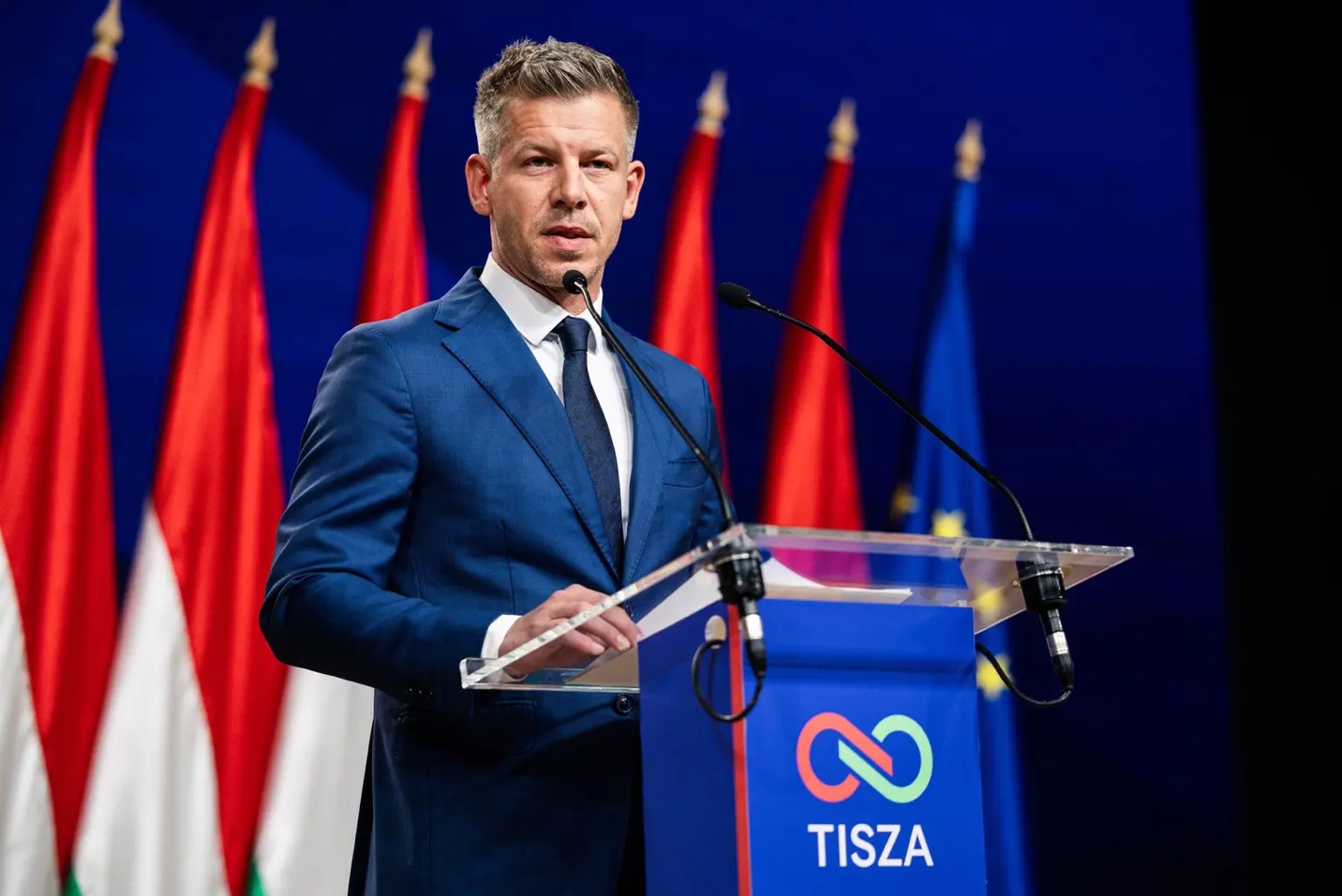
Peter Magyar, Hungary’s incoming prime minister, at a news conference following his election victory in Budapest, Hungary. (Akos Stiller/Bloomberg via Getty Images)
For sixteen years, Viktor Orban operated as Moscow’s man in Brussels — vetoing sanctions packages, blocking aid disbursements, traveling to Moscow and Beijing while his EU partners wrote checks to Kyiv, and giving Vladimir Putin something no amount of military spending could buy: a seat at the European table. That ends now.
Peter Magyar and his Tisza party won the Hungarian parliamentary elections on April 12 with a margin so decisive — more than two-thirds of parliamentary seats — that it left no ambiguity. Orban conceded. The man Putin personally endorsed in the campaign is out. The Kremlin responded with studied indifference: spokesperson Dmitry Peskov announced Russia would not congratulate Magyar because Hungary remains an “unfriendly country,” while Foreign Minister Lavrov offered to build a relationship depending on how Budapest “understands its national interests” — a phrase that in diplomatic language means: do as we say.
Russian milbloggers were less composed. Some worked to minimize the loss. Others wrote plainly that the Kremlin had just lost its most important EU ally — the one who had blocked the 90-billion-euro loan to Kyiv and the 20th package of Russia sanctions. That veto power is now gone.
Magyar held a press conference and told a Kyiv Independent reporter exactly what he thought: Ukraine has the full right to defend itself, no country has the right to demand that another give up territory, and the mistakes of the 1994 Budapest Memorandum — when Ukraine traded its nuclear arsenal for vague assurances — must not be repeated. He invoked Hungary’s 1956 revolution, calling the notion of forced territorial concession “unworthy of our freedom fighters.” He said he would not call Putin but would answer if Putin called him — to tell him to stop the killing.
The Kremlin is projecting confidence. That projection requires ignoring the obvious: one of its most durable geopolitical assets in Europe has just been dismantled by Hungarian voters.
The Ceasefire That Wasn’t: 10,721 Violations in 32 Hours
The Orthodox Easter ceasefire was supposed to last from the evening of April 11 through the night of April 13 — thirty-two hours of silence. What followed instead was thirty-two hours of documentation.
Ukraine’s General Staff tallied 10,721 Russian violations: 119 ground assaults, 1,567 artillery strikes, 2,205 Italmas-type strike drones and Lancet loitering munitions, and 6,830 FPV drone strikes. The Russian Ministry of Defense, with a discipline that would be admirable if it weren’t farcical, issued its own counter-accusation — 6,558 Ukrainian violations, including five ground assaults and 694 drone strikes — and claimed its air defenses shot down 11 Ukrainian drones over Belgorod and Kursk.
Then came the detail that no accounting can paper over: Ukrainian Ombudsman Dmytro Lubinets reported that Russian forces executed four Ukrainian prisoners of war near Veterynarne, Kharkiv Oblast, and killed members of a Ukrainian evacuation group near Hulyaipilske, Zaporizhia Oblast — after the ceasefire had already begun.
Two civilians were killed across Ukraine during the truce period. At least two more were wounded in Kherson. Russian drones continued to fly — 98 of them were launched overnight April 12 to 13, 65 of them Shahed-type, fired from Oryol, Bryansk, Kursk, Rostov, Krasnodar, and occupied Crimea. Ukrainian forces downed 87. Nine struck their targets. The energy grid in Chernihiv region lost 12,000 customers. Zaporizhzhia and Chernihiv oblasts reported power outages as Russian strikes resumed immediately after the truce expired.
The lesson written in these numbers is one that military analysts have offered before: a ceasefire without explicit terms, third-party monitors, and a mechanism to resolve disputes is not a ceasefire. It is a pause in which one side rests and the other counts.
Drones Over Kherson, Sumy, Zaporizhzhia: The Relentless Civilian Cost
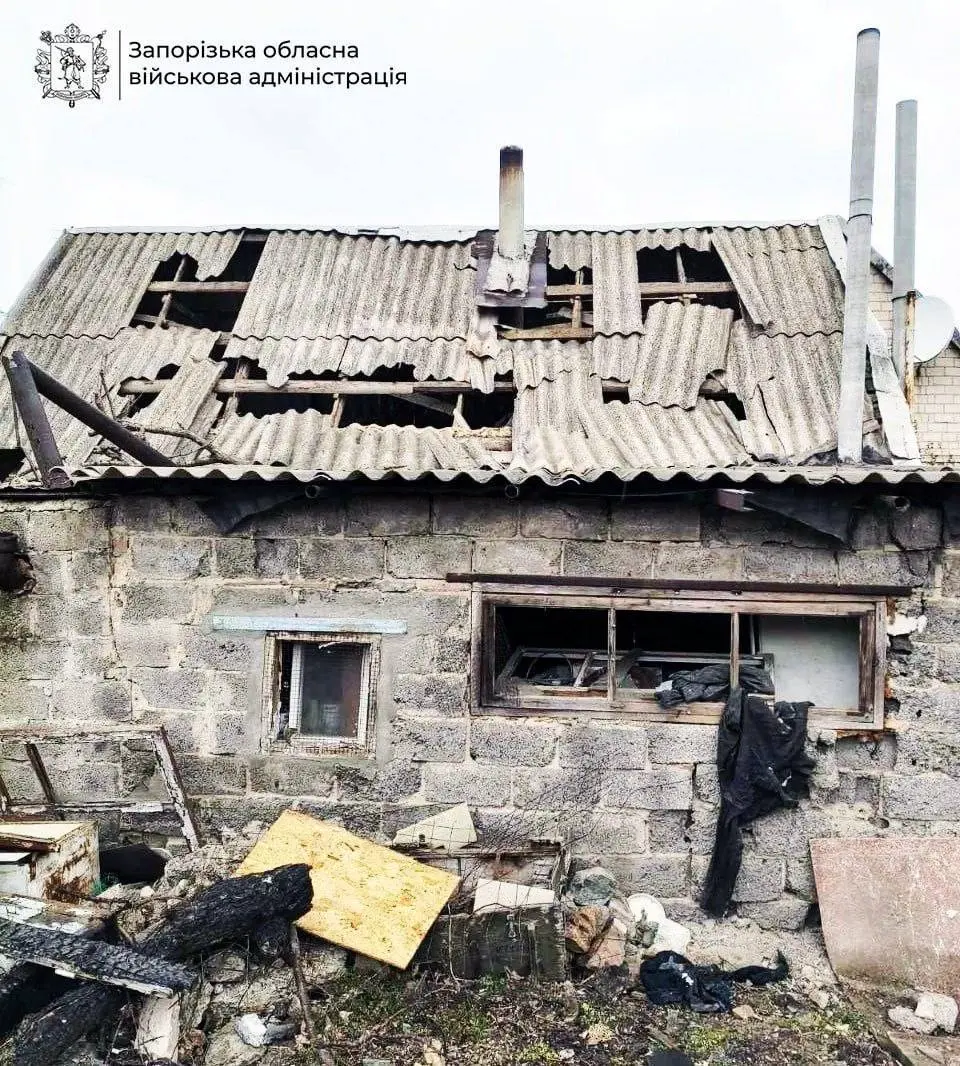
Aftermath of a Russian attack against Zaporizhzhia Oblast, Ukraine. (Zaporizhzhia Oblast Military Administration)
She was 89 years old. She was in Osokorivka, in the Kherson region, at approximately 11:20 in the morning. A Russian first-person-view drone found her. She was killed.
Two hours later in Kherson city’s Dniprovskyi district, a man walking down the street was struck by a drone. Shrapnel wounds to the head and limbs. A concussion. A closed head injury. He was taken to hospital in moderate condition. Russian forces had also shelled the Korabelnyi residential district around 1 a.m., destroying a vehicle and setting multiple fires.
In Sumy, a Russian drone struck a police vehicle in Bilopillia around 1 p.m. while the officer inside was on duty. Minor injuries. The car destroyed. Police documented it as a war crime — part of what Ukrainian authorities describe as a deliberate Russian pattern of targeting law enforcement officers in frontline communities.
Zaporizhzhia region absorbed 456 separate Russian attacks on 28 settlements over 24 hours, including 431 FPV drone strikes, three airstrikes, two MLRS strikes, and 20 artillery strikes. A drone strike on Novooleksandrivka wounded ten police officers and one civilian. In the Kharkiv region, five settlements came under attack, wounding at least four people. In Donetsk Oblast, two civilians were killed in Kramatorsk and Druzhkivka.
The drones — Shahed, Gerbera, Italmas, Geran-2, Molniya — came from multiple directions simultaneously, fired from Russian territory and occupied Crimea. Aviation, anti-aircraft units, electronic warfare, and mobile fire groups worked to intercept them. The war’s civilian casualty toll is not a side effect. It is, as analysts have noted, a policy.
500 Kilometers from Moscow: The Cherepovets Chemical Plant Strike
Residents in Cherepovets were told to seal their windows. Stock up on water. Get protective masks ready. The messages spread through local online chats as fires burned at the Apatit chemical complex on the city’s industrial waterfront — 500 kilometers northeast of Moscow, deep inside what Russia treats as its safe interior.
Ukrainian drones struck the facility overnight April 12 to 13. The Cherepovets branch of JSC Apatit produces phosphate-based fertilizers, sulfuric acid, ammonia, and ammonium nitrate — the last three of which have direct dual-use military applications. The plant has 900,000 tons of annual ammonia production capacity. Geolocated footage showed fires visible at multiple points on the site. Vologda Oblast Governor Georgy Filimonov said 13 drones had approached the industrial zone and acknowledged emergency services responding to debris sites — but stopped short of confirming direct damage to the facility.
This is the second time Ukrainian drones have targeted the same plant, after a March 27 strike also prompted reports of explosions in Cherepovets. The plant is owned by PhosAgro, whose major shareholders have been under Western sanctions since 2022. The strike fits Ukraine’s established doctrine: identify infrastructure with military-industrial applications, hit it repeatedly, force Russia to choose between repairing damage and defending against the next wave.
Vologda Oblast sits where most Russian strategic planners assumed Ukrainian drones could never reach in meaningful numbers. The assumption has not aged well.
The Arithmetic of Attrition: Russia’s Manpower Equation Is Breaking Down
The numbers coming out of Germany and Helsinki tell a story the Kremlin would prefer not to discuss in public. Economist Janis Kluge of the German Institute for International and Security Affairs studied the budgets of Russian federal subjects — the regional governments that process death compensation payments — and concluded that Russian forces recruited between 800 and 1,000 soldiers per day in the first quarter of 2026. That sounds like a lot until you compare it to the same quarter in 2025: 1,000 to 1,200 per day. Recruitment is down 20 percent year-over-year.
More starkly: Kluge’s analysis of compensation payments implies that Russian authorities acknowledged approximately 25,000 soldiers killed in the first quarter of 2026 — up from 20,000 in Q1 2025 and roughly 10,000 in Q1 2024. Deaths are rising. Recruitment is falling. The gap between the two is growing.
Ukraine’s “I Want to Live” initiative put the daily recruitment figure at 940 — below the 1,100 to 1,150 needed to meet Russia’s annual target of 409,000 contract soldiers, and far below the roughly 85,290 casualties Ukrainian General Staff data shows Russian forces suffered in the same period. Signing bonuses have reached a record 1.47 million rubles — about $19,300 — and at least 12 Russian regions increased bonuses by 50 to 80 percent since mid-February. They are paying more for fewer takers.
Finland’s President Alexander Stubb told the Brookings Institution in Washington that Ukraine is currently killing around 35,000 Russian soldiers per month, 95 percent of them by drone, and that the loss ratio stands at one Ukrainian soldier for every five Russians. In 2025, he said, Russia gained less than one percentage point of Ukrainian territory at a cost of 400,000 casualties — roughly 150 to 157 casualties per square kilometer. The cost of the advance is rising. The pace of recruitment to sustain it is falling.
Zelensky confirmed this week that Russian forces appear to have begun committing strategic reserves to the battlefield to compensate. When reserves are deployed to fill gaps caused by casualties, the army is no longer building capacity. It is consuming it.
‘Ukraine Is on Top’: Finland’s President Makes the Strategic Case in Washington
Alexander Stubb is a former prime minister of Finland, a country that shares a 1,300-kilometer border with Russia and joined NATO in 2023. He is not given to reckless optimism. So, when he told the Brookings Institution on Monday that Ukraine is currently “in a much better place than it has been at any stage in this horrific war,” the statement carried weight.
Stubb’s argument rested on three pillars. First, attrition: Russian casualties are unsustainable, Ukraine’s loss ratio has improved dramatically, and drone warfare has shifted battlefield mathematics in ways that favor the defender with industrial capacity and technical ingenuity. Second, reach: in March 2026, more drones and missiles flew from Ukraine into Russia than flew the other direction. Ukraine has struck Russia’s oil infrastructure, its Iskander missile factories, and facilities deep inside Russian territory that were supposed to be safe. Third, relevance: Ukraine’s expertise in drone warfare, air defense, and unmanned maritime systems has become something the world — including Gulf states seeking to defend against Iranian threats — actively needs and is paying for.
“There is only one country in the alliance that can come close” to Ukraine’s current war-fighting capacity, Stubb said. “And that’s the United States.” He drew the conclusion explicitly: Western support for Ukraine is not charity. It is strategic self-interest. The countries that have been thinking of aid to Ukraine as altruism have the relationship backward.
His most likely scenario for the year: the war continues. That, he said, is exactly why Europe must prepare for next winter now.
Robots Took the Trench: Ukraine’s Defense Industry Comes of Age
April 13 is Ukraine’s Defense Industry Worker Day, and Zelensky used the occasion not to speak abstractly about production capacity, but to announce something that had never happened before in this war — or in any war: Ukrainian unmanned ground systems and drones captured an enemy position entirely without infantry. The Russian soldiers inside surrendered. No Ukrainian soldier crossed the wire. No Ukrainian soldier was lost.
“For the first time in the history of this war, an enemy position was taken exclusively by unmanned platforms and drones,” Zelensky said. The systems involved — Ratel, Termit, Ardal, Borsuk, Zmiy, Protector, Volia — have carried out more than 22,000 front-line missions in three months. Twenty-two thousand times, in Zelensky’s framing, a robot went into the most dangerous zone instead of a soldier.
Behind this milestone is an industry that has transformed beyond recognition. Ukraine now produces millions of FPV drones per year. Its long-range missile programs — Flamingo, Ruta, Peklo, Neptune, Palyanytsia, Vilha — are no longer experimental prototypes. They are operational weapons. The Ruta Block 2 cruise missile, developed with Dutch-Swiss manufacturer Destinus, has a range exceeding 450 kilometers and a 250-kilogram warhead. Rheinmetall and Destinus announced on April 13 a joint venture to produce cruise missiles and rocket artillery systems at industrial scale for European and NATO markets — the demand signal from Ukraine’s battlefield experience flowing into Western production lines.
Zelensky also revealed that Ukrainian interceptor systems are already operating in the Gulf states — Saudi Arabia, the UAE, Qatar — as part of security partnerships that are now generating revenue for Ukraine. “Made in Ukraine,” he said, “is synonymous with something effective and powerful.” The defense industry that barely existed at the start of the full-scale invasion now supplies the majority of weapons used on Ukraine’s front lines, exports technology to dozens of partners, and is attracting foreign investors.
The war built this industry. The industry is now beginning to change the war.
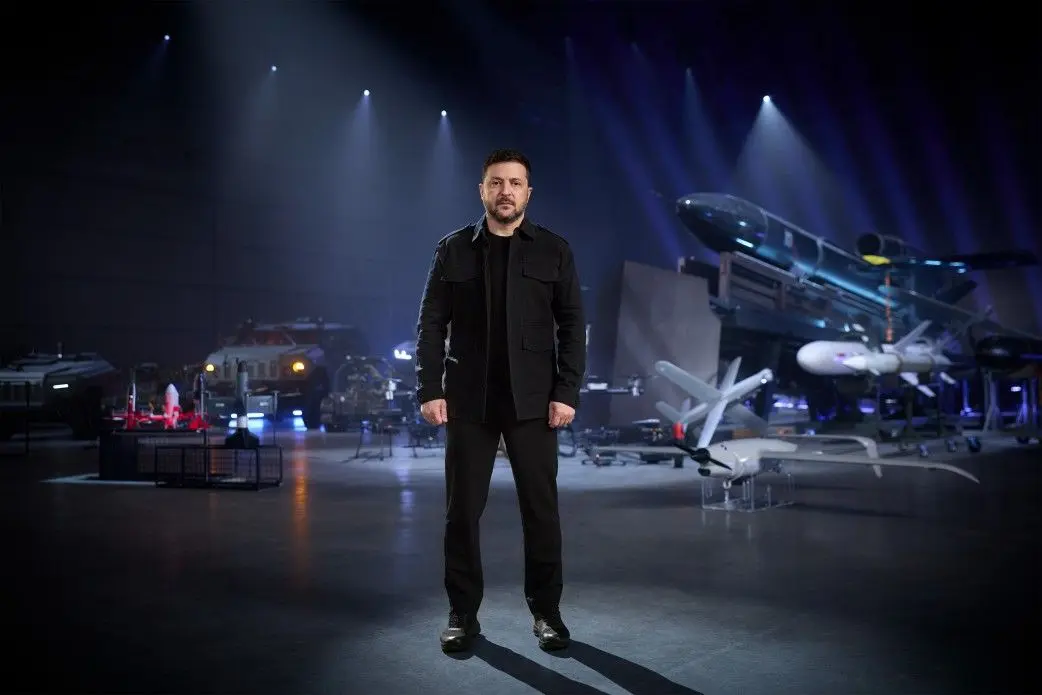
President Volodymyr Zelensky stands among Ukrainian-made weapons. (Presidential Office)
Patrushev’s Warning: Moscow Eyes Finland and the Baltics
It would be easy to dismiss Nikolai Patrushev as a hardliner who says hardliner things. He was Security Council secretary for two decades before Putin moved him to a presidential aide role — the kind of man who has been in the Kremlin’s inner circle through every significant escalation of the past twenty years. When he speaks, the words are chosen deliberately.
On April 13, Patrushev told the Russian state newspaper Rossiyskaya Gazeta that Finland and the Baltic states have been allowing Ukrainian drones to fly through their airspace — and that this constitutes “direct NATO participation in strikes against Russia.” Analysts at ISW assessed plainly that this may signal Russian forces planning to violate the airspace of Finland and the Baltic states in retaliation.
The claim about Ukrainian drones transiting NATO airspace is disputed. The implication — that Russia considers itself entitled to respond militarily in NATO territory — is the more significant sentence. Patrushev is setting rhetorical conditions: establishing a grievance, naming a provocation, building a justification. Whether Russian forces actually act on it is a separate question. The language being laid down is the preparation for the possibility.
Finland joined NATO specifically because it no longer trusted that these kinds of statements would remain rhetorical. The Baltic states have been warning about exactly this pattern for years. They are watching.
The Grinding Lines: Sumy, Donetsk, and the Persistence of Pressure
In northern Sumy Oblast, Russian forces pressed offensive operations on April 13 but made no confirmed advances. Ukrainian forces pulled back near Myropilske — the 14th Army Corps acknowledged the repositioning in plain language, saying units had “moved to a new prepared border” to preserve personnel. The gray zone in Sumy has grown since Russia built up roughly 50,000 troops along the border following Ukraine’s Kursk incursion. Russian infiltration attempts continue; Ukrainian counterattacks have blunted the larger advances, but the frontier is not static.
Across the Donetsk axis, Ukrainian forces made a confirmed advance northeast of Lyman. Russian milbloggers claimed additional gains around Lyman, south of Ozerne, and near Kryva Luka — claims not yet geolocated. In the Kostyantynivka-Druzhkivka area, Russian forces conducted infiltration missions without changing the forward line. Near Pokrovsk, Russian forces attacked from multiple directions — from Hryshyne in the northwest to Udachne and Molodetske in the southwest — and did not advance.
In the southern axis, Ukrainian forces continued clearing Stepnohirsk. Ukraine’s Main Military Intelligence Directorate reported the destruction of more than 20 Russian armored vehicles near the settlement, including tanks, infantry fighting vehicles, and electronic warfare equipment. GUR said Ukrainian forces maintain air superiority in the Stepnohirsk area despite Russian concentration of elite FPV units — a significant claim in a war where air superiority is contested at nearly every point of contact.
The Oleksandrivka direction saw a Russian advance into the southeastern edge of Berezove, confirmed by geolocated footage of Ukrainian forces shelling a Russian ammunition cache inside the settlement. The Hulyaipole direction saw Russian infiltration attempts that did not change the line. Kharkiv Oblast saw continued Russian attacks near Vovchansk, Synelnykove, and Tsehelne without confirmed advances.
The front is not moving decisively in either direction. The pressure is constant. The cost, on both sides, never stops accumulating.
The Basement in Yahidne: Justice Moves at Its Own Pace
The village of Yahidne has a prewar population of a few hundred people. In March 2022, Russian soldiers forced 380 of its residents — including 80 children, the youngest six weeks old — into a school basement at gunpoint, using the school’s upper floors as a military base. They were held for 27 days. Less than half a square meter per person. No light, no ventilation, no adequate sanitation, no medical care. Ten died underground. Seven more were executed in the village above.
Four years later, on April 13, 2026, Ukraine’s Security Service formally charged General Denis Barilo in absentia for his role in commanding these events. Barilo led the 55th Separate Motor Rifle Brigade of the 41st Combined Arms Army. His unit ran the occupation of Yahidne. The charges filed against him are violations of the laws and customs of war under Ukraine’s criminal code.
Fifteen of his soldiers were sentenced in absentia by a Chernihiv court in March 2024. Now the general joins them. The SBU says “comprehensive measures” are underway to find and punish him — which is diplomatic language for: he is in Russia, beyond current reach, and has been charged so the record is clear.
The basement in Yahidne has been turned into a memorial. Visitors can descend and stand in the space where those 380 people lived for twenty-seven days. The walls still carry the marks left by people waiting to see if they would survive. That memorial now has a named defendant to stand beside it in the ledger of this war’s accounting.
The Flags Return to the Pool: World Aquatics Reinstates Russia
While Ukrainian cities absorbed drone strikes and Ukrainian families buried soldiers, the World Aquatics Bureau voted on April 13 to lift sanctions on Russian and Belarusian athletes — allowing them to compete in swimming, diving, artistic swimming, high diving, and water polo under their national flags, uniforms, and anthems.
Bureau president Husain Al Musallam said the organization had “helped ensure that conflict can be kept outside the sporting competition venues” and that pools must remain places of peaceful competition. The statement did not mention the hundreds of Ukrainian athletes and coaches killed by Russian strikes, or the hundreds of Ukrainian sports facilities destroyed by Russian missiles and drones.
The decision follows a trajectory established at the 2026 Winter Paralympic Games in Italy, where Russian and Belarusian athletes competed under national flags — and where the International Paralympic Committee’s president expressed openness to allowing wounded Russian soldiers who fought in Ukraine to participate. The gradual normalization of Russian representation in international sport, while Russia’s military continues to shell Ukrainian cities, is a contradiction that the governing bodies of international athletics have chosen not to resolve.
Europe Scales Up: Rheinmetall and Destinus Build a Missile Factory
The announcement came quietly alongside everything else on April 13: Rheinmetall, Germany’s largest defense manufacturer, and Destinus, the Dutch-Swiss aerospace company that already supplies Ukraine’s Ruta missile-drone hybrid, announced a joint venture to produce cruise missiles and rocket artillery systems at industrial scale.
The venture — Rheinmetall Destinus Strike Systems, with Rheinmetall holding 51 percent — is expected to launch in the second half of 2026, pending regulatory approval. Its explicit purpose is to bridge the gap between battlefield demand and production capacity: thousands of units per year growing to tens of thousands, targeting European and NATO markets. Rheinmetall CEO Armin Papperger will combine his company’s manufacturing infrastructure with Destinus’s system architecture and scalable design platform.
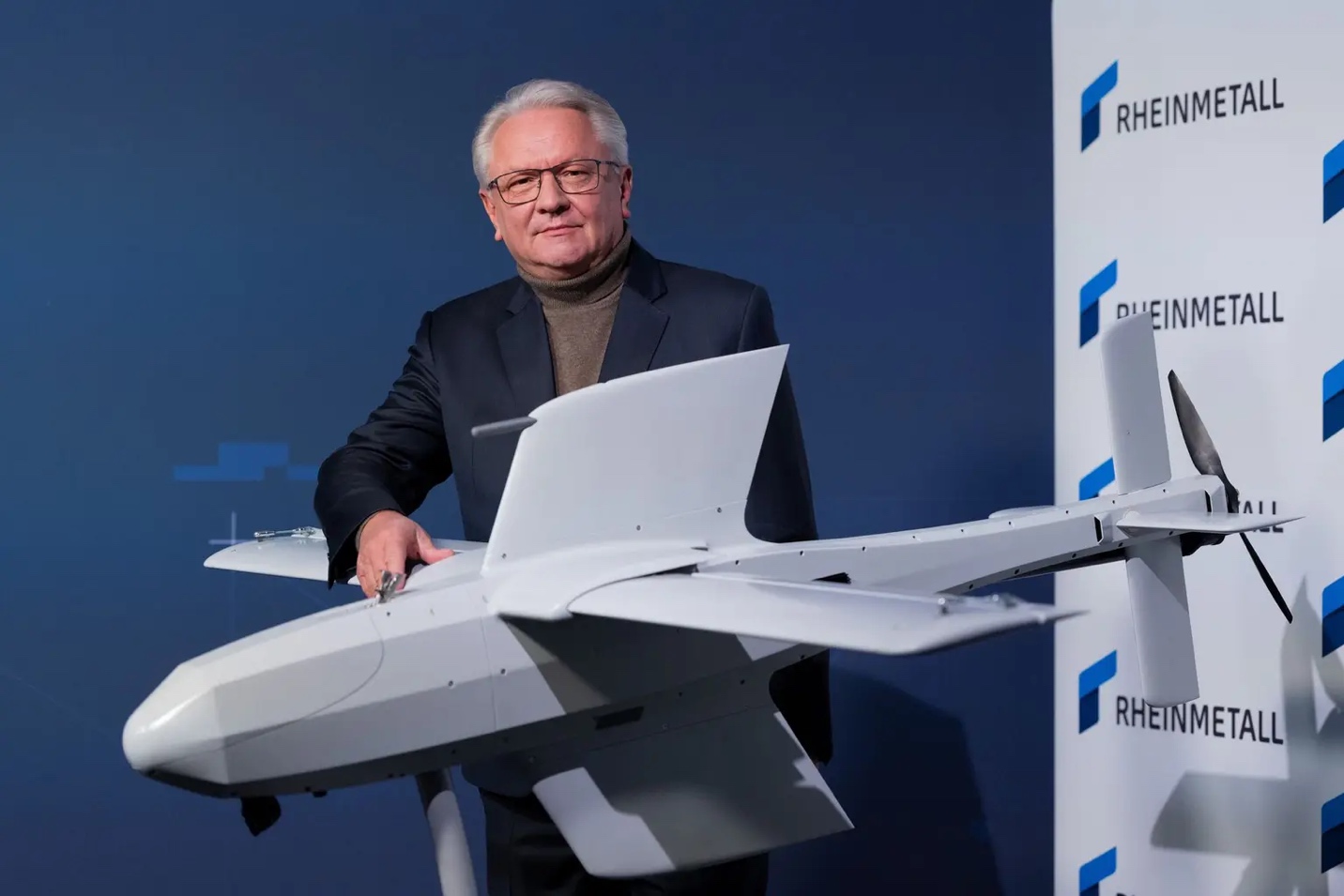
Armin Papperger, CEO of Rheinmetall AG, stands next to the new FV-014 drone at the annual press conference at Group headquarters. (Rolf Vennenbernd/picture alliance via Getty Images)
Destinus has an unusual pedigree: its co-founder and CEO, Mikhail Kokorich, is a Russian national who publicly renounced his Russian citizenship at the end of 2024 and has been supplying Ukraine with strike systems since. The Ruta Block 2, unveiled in early 2026, has a range exceeding 450 kilometers and a 250-kilogram warhead — already operational in Ukraine’s arsenal.
The deeper significance is structural. Ukraine’s battlefield has become the proving ground for a new generation of affordable, mass-producible strike systems. The lessons learned there are now flowing into European industrial planning. The continent that spent thirty years drawing down its defense manufacturing is now building back — not from blueprints drawn in peacetime, but from specifications written in combat.
What April 13th Means
Somewhere in Yahidne, the basement memorial stands open. In Budapest, Peter Magyar is forming a government. In Cherepovets, fires burned at a chemical plant 500 kilometers from Moscow. On the front lines of Donetsk and Zaporizhzhia, drones flew in both directions through the ruins of a ceasefire that lasted thirty-two hours and was violated ten thousand times.
The war did not pause for Easter. It never really does. But the architecture around it shifted — slowly, irreversibly — in ways that matter. Russia lost its man in Brussels. Russia cannot recruit soldiers as fast as it is losing them. Ukraine can now take a trench without sending in a soldier. A 89-year-old woman in Kherson is gone. A Russian general has been named for what was done in a basement in 2022.
The weight of those facts does not resolve into clarity. It accumulates. Day 1,510.
A Prayer for Ukraine
1. For the 89-Year-Old Woman in Osokorivka
Lord, she was 89 years old. She had lived through the Soviet Union and its collapse, through independence and its fragile peace, through two years of full-scale war — and then a drone found her on a Sunday morning. We do not know her name in these reports. We ask that You do. Receive her in whatever peace this world was not able to give her. And let the ones who launched that drone answer for it — if not in this life, then in the one that follows, before a judgment that sees everything.
2. For the Children of Yahidne — Especially the One Who Was Six Weeks Old
Father, in March of 2022, a six-week-old infant was carried into a basement and kept there for twenty-seven days. We do not know what that child remembers, or does not remember, or carries in their body without knowing why. We ask for Your mercy on every child who passed through that darkness — the ones still living, who are now four years older and still in a country at war, and the ones who did not survive. Let the memorial in that basement be a place of reckoning, not just a place of grief.
3. For the Prisoners Who Were Executed During the Ceasefire
God of justice, they were prisoners of war. The ceasefire had already begun. The rules that govern even war say they should have been safe. They were not. We name before You the four soldiers executed near Veterynarne, and the evacuation group killed near Hulyaipilske — men and women who had already surrendered or who were trying to help others survive. We ask for justice we cannot yet see. We ask that the record of this day not be buried.
4. For the Engineers and the Soldiers They Are Replacing
Lord, Zelensky called them the invisible heroes. They work in factories and laboratories, designing systems that carry names like Ratel and Zmiy and Volia — and on April 13 one of those systems captured a Russian position without a single Ukrainian soldier having to cross the wire. Twenty-two thousand missions in three months. Twenty-two thousand times, a machine went instead of a person. Bless the engineers who built that capacity. Sustain the soldiers who still have to cross the wire when the machines cannot. And hold those who will not come home — in whatever reckoning awaits us all.
5. For the Long Arc of Justice
A general has been charged. A basement has become a memorial. A government that served the Kremlin’s interests for sixteen years has been voted out of power by people who chose differently. These are not victories. They are markers. The war is still on Day 1,510. The drones are still flying. The bills are still unpaid. But something is moving — slowly, at great cost, against enormous resistance — in the direction of accountability. Hold that arc, God. Do not let it bend back.
In Your mercy, in Your justice, in Your time — bring this war to its end, and let the ending be worthy of what Ukraine has endured.