
Ukraine Daily Briefing | April 24, 2026 | Day 1,521 of the Full-Scale Invasion
Ukraine and Russia exchanged 193 prisoners of war each on April 24 — the 73rd such swap since the full-scale invasion began, continued from the Easter exchange — as Ukraine’s General Staff simultaneously fired the commander of the 14th Mechanized Brigade and demoted the 10th Army Corps commander over the Kupyansk logistics scandal that left soldiers drinking rainwater. Russia launched two Iskander-M ballistic missiles and 107 drones at Ukraine overnight, killing six and wounding 40 while also striking a grain-loaded merchant ship in Odesa Oblast — Day 1,521, when soldiers came home and other soldiers were being counted for the failures that kept them from eating.
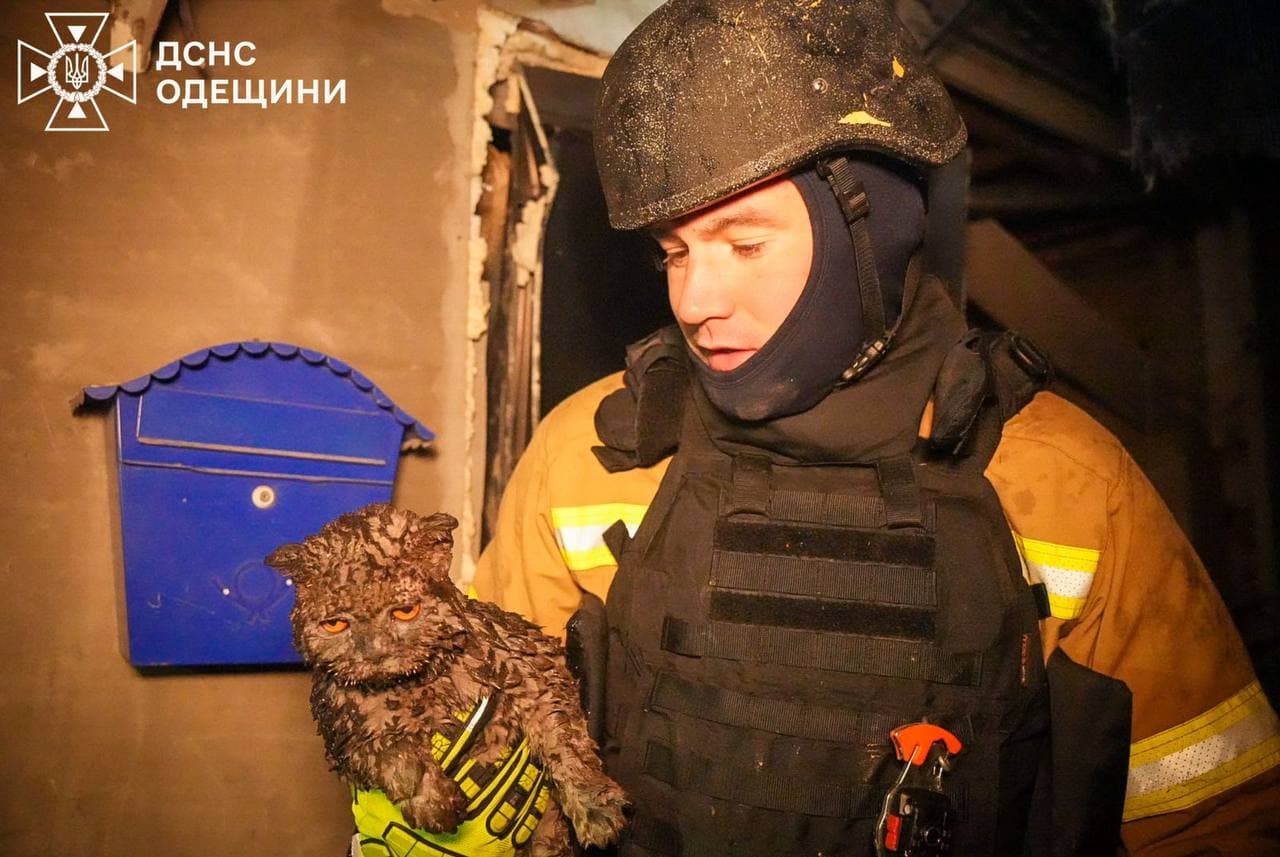
An emergency worker rescues a cat following a Russian drone attack on Odesa overnight. (State Emergency Service / Telegram)
The Day’s Reckoning
There are two kinds of accountability in this war, and they ran on parallel tracks on April 24. One was a prisoner exchange: 193 Ukrainian soldiers emerging from Russian captivity, many from illegal detention in Chechnya, some facing fabricated criminal charges in violation of the Geneva Conventions. The youngest was 24. The oldest was 60. They had served in Luhansk, Donetsk, Kharkiv, Zaporizhzhia, and Kursk sectors. They came home.
The other was a dismissal. The commander of the 14th Separate Mechanized Brigade, Anatolii Lysetskyi, was fired. The commander of the 10th Army Corps, Serhii Perts, was demoted. The reason was publicly framed around the logistics scandal: photos of emaciated soldiers from the 2nd Mechanized Battalion had gone viral two days earlier, showing men gaunt and hollow-eyed, drinking rainwater, losing consciousness from hunger. But Ukrainian sources told Ukrainska Pravda the decisions had been made days before the photos were published — the images accelerated the announcement, not the decision.
Ukraine’s General Staff simultaneously acknowledged what those soldiers had been living: Russian strikes on Oskil River crossings have significantly complicated logistics for units near Kupyansk. Troops are now being supplied by watercraft and heavy drones. Russia’s elite Rubikon drone unit is specifically tasked with disrupting logistics, turning resupply runs into continuous high-risk operations. Food and water were being delivered by drones that Russian FPV operators were actively hunting.
Overnight, Russia launched two Iskander-M ballistic missiles from Rostov Oblast and 107 drones. Six people were killed across Ukraine. A drone struck a merchant ship flying the flag of St. Kitts and Nevis in Odesa Oblast — it was heading to load Ukrainian grain. Russia’s Central Bank cut its key rate to 14.5 percent, its eighth cut in 12 months, while Ukraine’s foreign intelligence service reported that Russia’s federal deficit in the first quarter of 2026 has already exceeded its planned deficit for the entire year. The Pentagon circulated an internal email floating options to suspend Spain from NATO for refusing to support the Iran war. NATO said there is no mechanism for suspension.
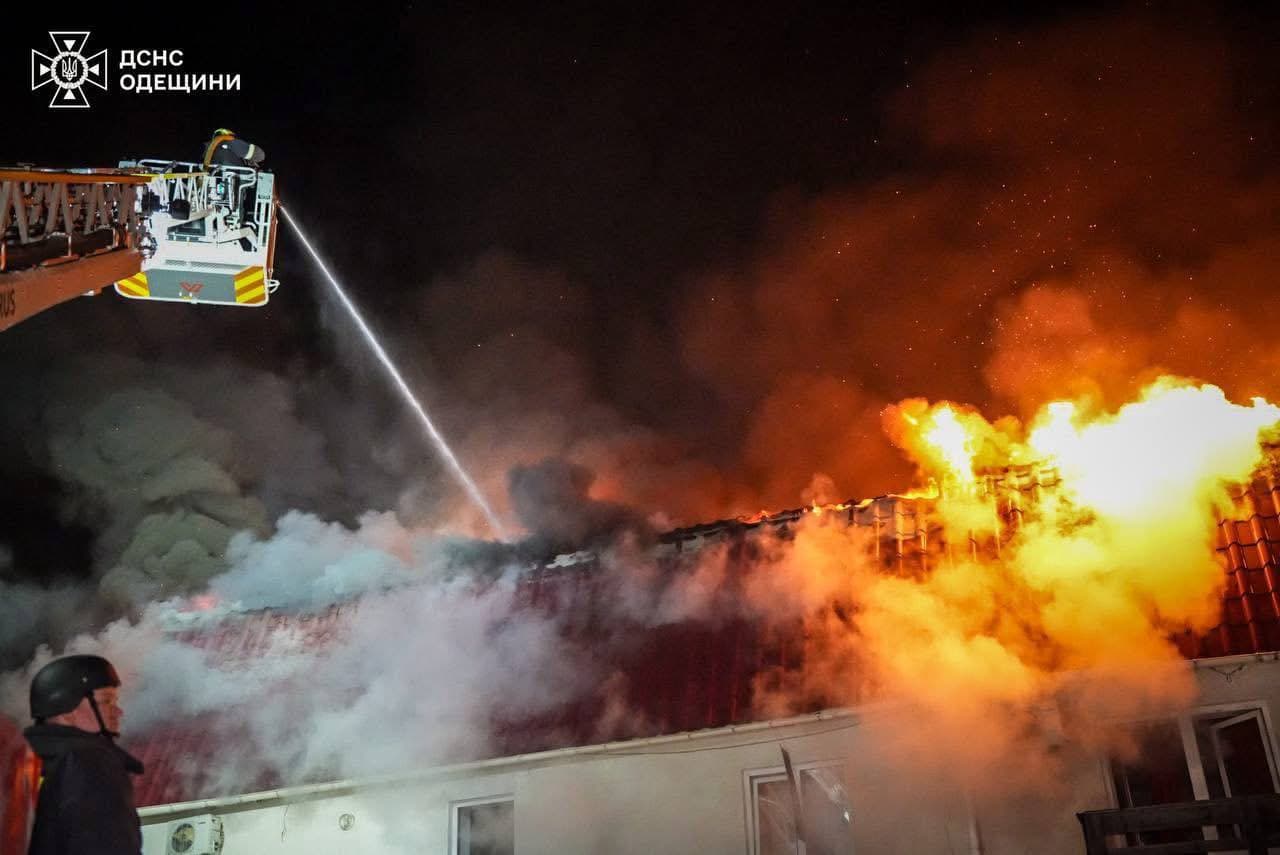
Aftermath of a Russian attack on Odesa Oblast, Ukraine, overnight. (Ukraine’s Emergency Service)
Day 1,521. Men came home. Other men were fired. The front held, barely, somewhere near the Oskil.
193 Soldiers Return: The 73rd Prisoner Exchange and the Conditions They Were Held In
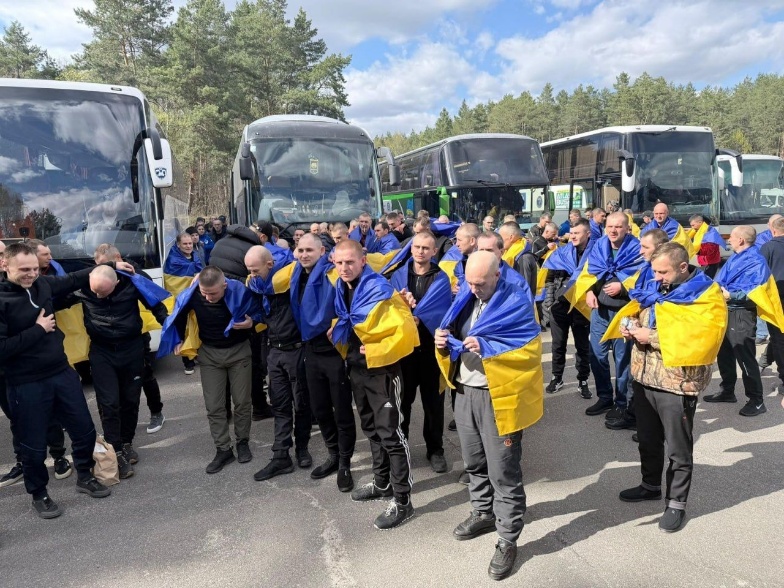
The 73rd prisoner exchange since the start of the full-scale invasion took place on April 24, with 193 Ukrainian soldiers returning to Ukrainian-controlled territory in exchange for 193 Russian soldiers. The exchange was mediated by the United States and the United Arab Emirates, and was a continuation of the Easter exchange phase launched on April 11. Those returning included personnel from the Armed Forces, National Guard, State Border Guard Service, National Police, and State Special Transport Service.
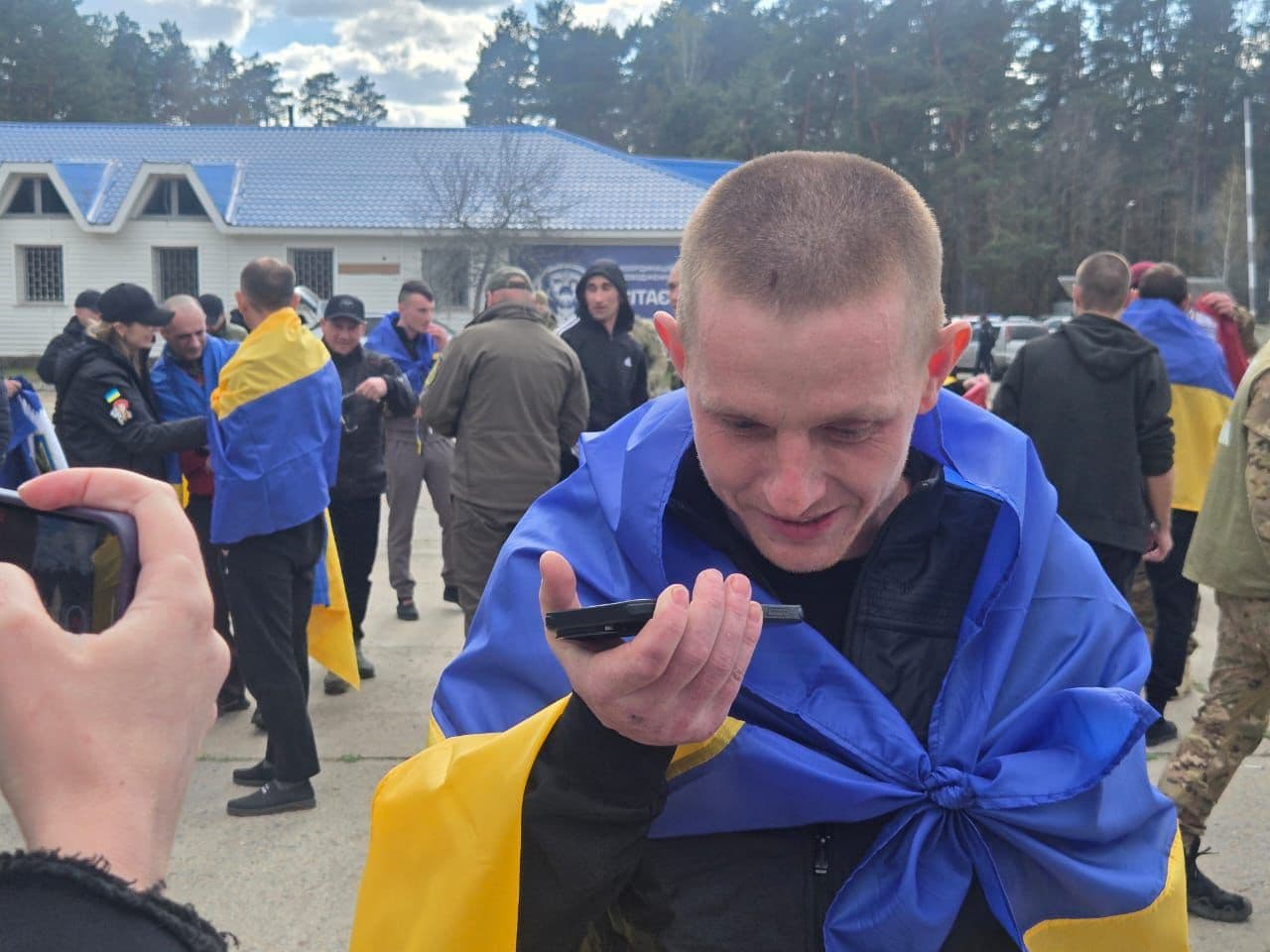
A Ukrainian prisoner of war released from Russian captivity calls his loved ones after arriving in Ukrainian-controlled territory. (Volodymyr Zelensky/Telegram)
Most of those released had been unlawfully held in Russia’s Chechnya region. Some faced fabricated criminal cases in violation of the Geneva Conventions. The released group included wounded soldiers, officers, and service members born in the 2000s — some of the youngest soldiers Ukraine has fielded. The youngest returned prisoner is 24; the oldest is 60. They had served across the most contested sectors of the front.
Since February 2022, Ukraine has brought back more than 7,000 Ukrainians through exchanges. Over 2,500 Ukrainian POWs are estimated to remain in Russian captivity. Zelensky said Ukraine continues working daily to bring all captives home and expressed gratitude to international partners supporting the process.
Fired and Demoted: Ukraine’s Military Accountability on the Kupyansk Front
Ukraine’s General Staff announced on April 24 the dismissal of 14th Separate Mechanized Brigade commander Anatolii Lysetskyi and the demotion of 10th Army Corps commander Serhii Perts. The official grounds: losing Ukrainian positions, providing inadequate support to frontline troops, and concealing the true situation in the sector. Taras Maksimov was named as the new brigade commander; Artem Bohomolov will command the corps. Perts was transferred to the position of chief of staff of Operational Command East.
The announcement followed the viral spread of photographs showing four soldiers from the 2nd Mechanized Battalion in a state of severe physical deterioration — gaunt, hollow-eyed, losing consciousness from hunger, drinking rainwater. The post that shared the images was written by the daughter of a former soldier from the unit, Ivanna Poberezhniuk. A soldier’s wife, Anastasiia Silchuk, separately described a seven-month pattern of supply failures: food and water sometimes taking 7 to 14 days to arrive; communication disruptions lasting 3 to 4 days at a time. Ukrainian sources told Ukrainska Pravda the command decisions had been made before the photos were published.
The General Staff acknowledged that Russian strikes on Oskil River crossings have significantly complicated logistics for units in the Kupyansk area. Troops are now supplied by watercraft and heavy cargo drones. Russia’s Rubikon drone unit is specifically tasked with disrupting Ukrainian logistics, targeting supply vehicles at extremely high frequency. Commander-in-Chief Syrskyi has ordered an inspection to ensure all frontline units are properly supplied. An internal investigation is ongoing.
107 Drones, Two Ballistic Missiles, a Grain Ship Struck: Russia’s Overnight Campaign
Russian forces launched two Iskander-M ballistic missiles from Rostov Oblast and 107 Shahed, Gerbera, Italmas, and other drones overnight on April 23 to 24, from Bryansk, Oryol, Smolensk, Rostov, Krasnodar, and occupied Crimea. Ukrainian air defenses intercepted 96 drones. The two ballistic missiles and at least 10 drones struck nine locations; debris from downed drones fell at two additional sites.
The strikes killed six people and wounded 40 across the country. In Donetsk Oblast, two people were killed in Oleksiievo-Druzhkivka and one in Mykhailivka; seven others were injured. In Odesa Oblast, a married couple aged 75 was killed and at least 14 were injured when drones struck residential buildings; 36 residents including two children were evacuated. In Zaporizhzhia Oblast, one person was killed and one injured. In Kherson Oblast, Russian forces targeted 30 settlements, injuring seven people — civilians struck while walking or traveling by car and scooter. In Dnipropetrovsk Oblast, Russian forces struck Kryvyi Rih twice, injuring three people. One person was injured in Kharkiv Oblast’s Kozacha Lopan. A 45-year-old woman was injured by drone debris in Mykolaiv Oblast. A 56-year-old woman was injured in Sumy Oblast.
Russian drones also struck a merchant vessel flying the St. Kitts and Nevis flag that was en route to an Odesa port to load Ukrainian grain. The targeting of a civilian cargo ship carrying grain continues a deliberate Russian campaign to disrupt Ukrainian grain exports — a campaign that directly affects food security not only in Ukraine but in the countries that depend on Ukrainian agricultural exports.
Russia’s War on Rails: 1,200 Strikes in 2025, 352 More in 54 Days of 2026
Ukrainian Railways director Oleh Yakovenko presented a full accounting of Russia’s campaign against Ukrainian rail infrastructure at a conference on April 23: 1,200 strikes against railway infrastructure in 2025 alone — more than in 2023 and 2024 combined. In the first three months of 2026, Russian forces conducted 352 additional strikes. Since the start of the full-scale invasion, Russia has struck approximately 17,300 railway infrastructure facilities and pieces of rolling stock, damaging roughly 7,300 and destroying approximately 9,900. Forty railway workers have been killed while on duty.
The breakdown by category is precise and devastating: in 2025 and Q1 2026 combined, Russian strikes damaged 209 locomotives, 239 passenger carriages, 371 freight wagons, 86 railway bridges, and 50 stations. More than 300 locomotives have been struck since February 2022; approximately 50 cannot be returned, restored, or modernized. Because Russian drones now hunt supply vehicles even in relatively populated areas, trains on some routes in the east and south have been replaced by buses — more mobile, harder to track.
ISW assesses the rail campaign as part of Russia’s broader battlefield air interdiction strategy — degrading Ukrainian logistics not only at the front but across the entire logistical depth of the country. The same campaign that starved the soldiers near Kupyansk operates at scale across every front-line supply corridor Ukraine uses.
Atlant-Aero Confirmed Destroyed: Neptune Missiles Hit Russia’s Drone Production Plant in Taganrog
Ukraine’s General Staff confirmed on April 24 that the April 19 Neptune missile strike against the Atlant-Aero defense-industrial enterprise in Taganrog, Rostov Oblast destroyed two production facilities and damaged four additional buildings. Satellite imagery captured on April 24 shows at least three damaged and one destroyed building at the site.
The Atlant-Aero plant manufactures Molniya-class strike and reconnaissance drones and components for Orion UAVs — the Orion weighing approximately one ton, capable of carrying up to 250 kilograms of payload including guided bombs and cruise missiles. Destroying this facility directly reduces Russia’s capacity to produce the systems it uses to strike Ukrainian civilian targets. Ukraine’s General Staff separately confirmed that the April 22 strike in occupied Sevastopol damaged the conning tower of a Russian FSB Border Service Project 22460 Rubin-class patrol ship. Ukraine previously struck an S-300V air defense TELAR in Belgorod Oblast in mid-April, confirmed on April 24.
Russia’s Economy: Rate Cut, Record Deficit, and the War’s Fiscal Reckoning
Russia’s Central Bank cut its key interest rate from 15 to 14.5 percent on April 24 — the eighth consecutive cut from the record highs imposed to control wartime inflation, and the third cut in 2026. Central Bank Chair Nabiullina simultaneously raised the average rate forecast for 2026 to 14 to 14.5 percent, up from 13.1 to 14.3 percent, citing significantly increased inflationary risks from the Middle East conflict and Russia’s own fiscal policy. She warned that if the Iran conflict drags on, consequences for Russia’s economy could outweigh the benefits of elevated oil export prices.
The rate cut masks a more serious structural picture. Ukraine’s Foreign Intelligence Service reported that Russia’s federal deficit reached 4.6 trillion rubles ($61 billion) in the first quarter of 2026 alone — significantly exceeding Russia’s planned deficit of 3.8 trillion rubles for the entire year. Russia has depleted its sovereign wealth fund’s liquid reserves to fund the war and was forced to sell physical gold reserves in November 2025. The VAT was raised from 20 to 22 percent as of January 1, 2026, placing the burden of war spending directly on Russian households.
Planned layoffs in Russia increased by 43 percent since June 2025, reaching 105,147 as of April 1, with trade union officials attributing the trend to federal and regional budget shortfalls. Grocery prices have risen sharply in early 2026. The official inflation figure of 5.7 percent is widely considered an undercount. Russia’s unemployment rate appears at historic lows only because the country is experiencing severe labor shortages — with workers pulled into the military and defense industry — which itself is driving wage inflation and contributing to the broader inflationary spiral the Central Bank claims to be managing.
Putin’s Approval Falls for Seven Straight Weeks as Russia Counts the Cost of Its Own War
Three separate Russian polling institutions published data showing a medium-term decline in Vladimir Putin’s approval rating. Russian state-owned VTsIOM reported that Putin’s approval fell for the seventh consecutive week, from 66.7 percent during the week of April 6 to 12 to 65.6 percent during April 13 to 19. Trust in Putin fell to 71 percent in the same period. The independent Levada Center recorded Putin’s March 2026 approval rating at 80 percent — a two-point decline from February and the lowest Levada has recorded since November 2022, immediately following Russia’s unpopular partial mobilization.
The divergence between polls is itself a story. The Kremlin-linked FOM polls show Putin at approximately 76 percent — nearly ten points higher than VTsIOM in the same period. A source inside a government-associated media organization told Russian opposition outlet Meduza that the Presidential Administration’s political bloc has instructed Russian state media to either cite FOM’s more favorable numbers or omit polling data entirely. That notable state polling institutions are publishing declining approval numbers despite such pressure suggests that elements within the Kremlin may be using the data to signal growing domestic discontent — and to pressure Putin regarding the censorship campaign that is increasingly disrupting ordinary Russian life.
Sumy Oblast: New Offensive Southeast of Sumy City, Myropilske Seized
Russian milbloggers reported on April 24 that Russian forces have launched a new offensive operation southeast of Sumy City toward Novodmytrivka and Taratutyne — a direction that had seen minimal activity for approximately two months since roughly February 2026. A milblogger claimed Russian forces advanced into Taratutyne. This resumption of offensive pressure southeast of Sumy City opens a new axis of advance distinct from the border operations north of the city that have defined recent fighting in the oblast.
Kharkiv: Zemlyanky Deadline, Kupyansk Infiltrations, BAI Campaign Intensifies
Ukraine’s 16th Army Corps reported on April 24 that elements of the Russian 12th Rifle Battalion of the 69th Motorized Rifle Division are attacking from Dehtyarne and Nesterne toward Zemlyanky, northeast of Kharkiv City, with the stated goal of seizing the settlement by April 30. Russian forces are attempting to cross the international border in small assault groups to advance toward Zemlyanky.
Geolocated footage confirmed Russian infiltration missions in both northern Kupyansk and eastern Kupyansk-Vuzlovyi. Russian forces continue to target Oskil River crossings as part of the wider BAI campaign — a campaign that ISW assesses is designed not only to pressure the Ukrainian rear but to create the logistical conditions that would facilitate larger future offensive operations. In the Borova direction, Russian forces continued offensive operations without confirmed advances.
Donetsk: Kostyantynivka Advances, Motorcycle Assaults, Glide Bomb Preparation
Ukrainian forces recently advanced east of Kostyantynivka, geolocated footage published April 23 confirmed. In the Kostyantynivka direction, Russian forces continued to use motorcycles and ATVs in assault operations — repelled near Chasiv Yar — while a Ukrainian unit commander reported that Russian forces are prioritizing glide bomb strikes to destroy Ukrainian defensive positions before launching infantry attacks. Russian milbloggers noted that Kostyantynivka’s dense urban environment is being used by Russian forces to conceal themselves from Ukrainian drones, and compared the evolving situation to Pokrovsk.
In the Pokrovsk direction, geolocated footage published April 24 shows Ukrainian forces operating in western Rodynske, north of Pokrovsk — confirming a Ukrainian counterattack and continued Ukrainian presence in the settlement. A Ukrainian brigade spokesperson reported that Russian forces conduct up to 20 assaults per day and conduct infiltration operations in groups of two or three people on a near-continuous basis. Since roughly April 10, Russian forces have been attacking in larger motorized groups using ATVs and motorcycles, which Ukrainian forces find difficult to intercept.
In Slovyansk, the military administration head reported that Russian MLRS fire, aerial bombs, and drone strikes have now damaged 50 percent of high-rise buildings and 25 percent of private houses in the city. Ukrainian SOF struck a Russian repair base in occupied Klynkyne (144 kilometers from the frontline) and a rear concentration point in eastern Manhush (102 kilometers from the frontline) between April 16 and 24. In the Dobropillya, Novopavlivka, and Oleksandrivka directions, Russian forces continued operations without confirmed advances; in Oleksandrivka, Russian forces have introduced long-range FPV drones that are difficult to intercept even with electronic warfare systems.
Southern Axis: Stepnohirsk Held, Crimea Struck, Kherson ‘Human Safari’ Continues
A Russian milblogger acknowledged that Ukrainian forces maintain control over northern Stepnohirsk, west of Orikhiv, directly contradicting earlier Russian claims. Russian forces continued limited offensive operations in western Zaporizhzhia Oblast without confirmed advances. Ukrainian SOF struck a Russian material and technical support warehouse in Smile, Zaporizhzhia Oblast (35 kilometers from the frontline) and an ammunition depot in Trudove (40 kilometers from the frontline) between April 16 and 24. Russian forces continued their “human safari” drone strike campaign targeting civilians in the Kherson direction alongside limited ground attacks.
NATO in Crisis: Pentagon Eyes Spain Suspension, Poland Questions Article 5, No Mechanism Exists
The Pentagon circulated an internal email on April 24 outlining options to punish NATO allies that declined to provide access, basing, and overflight rights for US military operations against Iran. One proposal involves suspending “difficult” allies from key NATO roles; another suggests reassessing US support for certain European territorial claims. Spain has been specifically targeted because its government refused to allow US forces to use its bases or airspace for strikes against Iran. A NATO official told the Kyiv Independent directly: “NATO’s Founding Treaty does not foresee any provision for suspension of NATO membership, or expulsion.” Spanish Prime Minister Sanchez reaffirmed his country’s commitment to the alliance while defending its right to act within international law.
Polish Prime Minister Tusk gave an interview to the Financial Times on April 24 that captured the anxiety running through NATO’s eastern flank: “Europe’s biggest, most important question is if the United States is ready to be as loyal as it is described in our treaties.” Tusk said he wanted to believe Article 5 was still valid “but sometimes, of course, I have some problems.” Poland, which borders both Kaliningrad and Belarus, has become NATO’s top defense spender and is building Europe’s largest land army. Tusk warned Russia could attack the alliance within months.
NATO’s Military Committee head Adm. Dragone said on the sidelines of the Kyiv Security Forum on April 24 that there is no indication the PURL weapons delivery program for Ukraine is being reduced: “PURL works. There are no signs of a decrease in effort. The flow continues.” EU Military Committee head Gen. Clancy said he and Dragone discussed Ukraine’s current priorities with Commander-in-Chief Syrskyi. Despite JD Vance’s statements that Washington will no longer fund weapons for Ukraine and Trump’s threats against NATO, the operational delivery mechanism continues to function as of April 24.
Belarus Militarizes Without Independent Intent: Latushko at PACE
Belarusian opposition figure Pavel Latushko told the Parliamentary Assembly of the Council of Europe in Strasbourg on April 24 that Belarus is actively militarizing, reforming its mobilization system, and preparing society psychologically for war — but that an independent Belarusian attack on Ukraine remains unlikely. Belarus’s mobilization reserve now numbers around 289,000 people, with territorial defense adding up to 150,000 more. Belarus has received 4,600 new weapons systems in 2024 and increased defense spending by 32 percent. Latushko said decisionmaking authority for deploying Belarusian forces has been transferred to the All-Belarusian People’s Assembly.
“To play the role of Putin’s assistant — yes, Lukashenko will always do that,” Latushko said. “But to launch an aggression on his own — that’s unrealistic.” Budanov, speaking at the Kyiv Security Forum, said Ukraine is closely monitoring Belarus but does not expect any sudden escalation. “Do not worry. There will be no surprise,” he said — while simultaneously saying Ukraine cannot rule out any possibility and that being strong provides “room to maneuver.” Budanov also reiterated that Ukraine will not accept territorial concessions: “I am absolutely certain no one in Ukraine will agree to recognize the loss of even a millimeter of our territory.”
Zelensky to Jeddah, Merz on EU Accession, US-EU Minerals Deal
President Zelensky traveled from Cyprus to Saudi Arabia on April 24 for talks with Crown Prince Mohammed bin Salman, their second meeting this month following a March 27 defense deal on air defense technology cooperation. The two nations are developing a strategic partnership in air defense — leveraging Ukraine’s battlefield expertise countering Iranian-designed drones, which Saudi Arabia faces from the same origin — along with energy and food security. “We have set tasks for our teams, and I expect their prompt and full implementation,” Zelensky said.
German Chancellor Merz proposed at the Cyprus EU summit on April 24 a strategy to accelerate Ukraine’s EU accession path, including allowing Kyiv to participate in European Council meetings without voting rights as an interim step. Merz acknowledged that “immediate accession of Ukraine to the EU is, of course, not possible.” Ukraine has rejected partial membership formulas, insisting on full membership as the only acceptable goal. The Hungarian bloc against opening accession clusters is expected to dissolve once Peter Magyar’s Tisza party forms Hungary’s new government by mid-May, ahead of the Cyprus EU Presidency’s June 30 end date.
US Secretary of State Rubio and EU Commissioner Sefcovic signed a memorandum of understanding on critical minerals on April 24, establishing a US-EU Critical Minerals Action Plan aimed at securing and diversifying supply chains for materials essential for clean energy, electronics, and defense. Ukraine — with significant reserves of lithium, graphite, manganese, and titanium — is central to the strategy, having signed its own minerals agreement with the United States in April.

European Union Trade Commissioner Maros Sefcovic and US Secretary of State Marco Rubio shake hands after signing a memorandum of understanding for a strategic partnership on critical minerals at the State Department in Washington, DC. (Annabelle Gordon / AFP via Getty Images)
US Legislation on Russian Religious Persecution, 21st Sanctions Package Begins
A bipartisan group of US lawmakers introduced the Countering Russia’s War on Faith Act on April 23, requiring the Secretaries of State and Defense to jointly report on Russian efforts to violate religious freedoms in Ukraine and occupied territories, and directing the president to impose sanctions on those certified to have done so. The bill was introduced in the House by Representatives Wilson and Cohen, with companion Senate legislation by Senators Kennedy and Whitehouse. More than 600 churches, synagogues, mosques, and other religious sites have been damaged or destroyed since 2022; more than 50 Ukrainian clergy have been killed. Protestant, Catholic, Crimean Tatar Muslim, and Orthodox communities not aligned with the Russian Orthodox Church have faced raids, forced re-registration, and criminal prosecution in occupied territory. Foreign Minister Sybiha welcomed the legislation: “Russia must be held accountable for its systematic assault on religious freedom.”
Ukraine and the EU have simultaneously begun consultations on the 21st sanctions package, EU diplomat Kallas confirmed on April 24: “It sends a very clear signal to Russia that they cannot outweigh us.” Ukraine is pushing for the package to shut down Russian cryptocurrency channels for sanctions evasion, further restrict Russia’s maritime oil trade, expand the sanctioned bank list, and add sanctions on oligarchs. Lithuanian Foreign Minister Budrys called for a maritime services ban on Russian oil trade and sanctions on Lukoil and Rosatom.
Roskomnadzor Plot, Chornobyl Anniversary, and the Bomb in the Car
Russia’s FSB announced on April 24 that it had foiled a plot to bomb officials from Roskomnadzor — Russia’s internet censorship regulator — in a car bombing. The FSB detained seven people it described as “supporters of far-right and neo-fascist ideology, recruited by Ukrainian special services via Telegram,” including a 22-year-old Moscow resident who was shot dead after allegedly opening fire on arresting officers. Criminal cases were opened for weapons trafficking and terrorism.
The announcement comes as Roskomnadzor faces growing domestic anger over throttling Telegram and WhatsApp, imposing rolling internet outages, and pushing users toward the state-backed messaging service Max. Putin acknowledged the outages publicly for the first time the day before. Whether the alleged bomb plot reflects genuine domestic resistance or is an FSB narrative construction designed to justify further censorship cannot be independently verified — but its timing, one day after Putin’s own acknowledgment of public discontent over internet restrictions, is notable.
Ukraine marks the 40th anniversary of the Chornobyl disaster on April 26. The New Safe Confinement structure built to contain the site was punctured by a Russian drone in February 2025, losing its ability to function as designed. Greenpeace published a report in April warning of possible radioactive releases. The EBRD is working to secure approximately €500 million for repairs expected to take three to four years. Russia occupied the plant on the first day of its 2022 invasion; its soldiers dug trenches in the Red Forest. The plant’s director told AFP in December 2025 that another Russian strike could cause the radiation shelter to collapse.
Six people died. 193 came home. A commander was fired, another demoted, for letting soldiers drink rainwater for weeks while pretending the situation was under control. Russia’s federal deficit exceeded its annual target in a single quarter. Putin’s approval has fallen for seven consecutive weeks, and the state polling agencies that report it have been instructed to use better numbers or say nothing. A drone struck a grain ship. The Chornobyl confinement needs half a billion euros in repairs because Russia shot a hole in the structure built to prevent the next nuclear disaster. Day 1,521 ends the way it began: with the gap between what is reported and what is real wider than it should be, on both sides of this war.
A Prayer for Ukraine
1. For the 193 Who Came Home
Lord, they are home. Most were held in Chechnya, some on fabricated charges, some wounded. The youngest is 24. The oldest is 60. They have been in Russian captivity for months or years while Ukraine negotiated their return, one exchange at a time. Receive them as they step onto Ukrainian soil — in whatever condition, with whatever they carry from what was done to them there. Let the people waiting for them have what they need to help them come back. And hold the more than 2,500 who did not come home today.
2. For the Soldiers Near Kupyansk Who Were Drinking Rainwater
Father, food has now arrived. The photos are public. The commanders have been fired. The General Staff has acknowledged the Oskil crossings are under constant Russian fire. None of that changes what happened — men losing consciousness from hunger at positions they were holding because no one fixed the supply line for seven months. Be with those soldiers in whatever healing looks like for them. And let the accounting that has begun — internal investigations, inspections, new command — result in something that actually protects the next rotation.
3. For the Railway Workers
God, 40 railway workers have been killed on duty since 2022. Seventeen thousand facilities struck. The trains that slow to a stop when a drone alert sounds, passengers evacuating into fields. The engineers who keep running the routes in the south and east where buses now run instead because the drone risk is too high. Their work is not heroic in the way soldiers are called heroic — it is quieter than that, and just as necessary. Hold them on every run. Let more of them come home than the count already demands.
4. For the Families Who Published the Photos
God, Ivanna Poberezhniuk posted pictures of starving soldiers because the chain of command had failed them and she had no other option. Anastasiia Silchuk described seven months of delays and silence. They were not acting as journalists or activists — they were acting as people with no other recourse. The system moved only after the photos went public. Hold those who are forced to do the system’s work when the system fails. Let the investigation that follows result in something that does not require the next family to do this again.
5. For the 40th Anniversary of Chornobyl
Lord, in two days Ukraine marks the disaster that shaped a generation and a country. The sarcophagus needs half a billion euros in repairs because Russia flew a drone into the structure built to contain it. Forty years since April 26, 1986, the work of containment is still not finished — and now it is threatened again by the same country that concealed the original disaster for days while the radioactive cloud moved over Europe. Be with those who do the slow, uncelelebrated work of keeping the site safe. And may the world remember, on April 26, that Ukraine has been living with Chornobyl for 40 years, and living with Russia’s war for four — and has not stopped.