
Ukraine Daily Briefing | April 23, 2026 | Day 1,520 of the Full-Scale Invasion
Ukrainian drones struck the Gorky oil pumping station in Nizhny Novgorod Oblast — 800 kilometers inside Russia, a critical node in the Druzhba pipeline — less than 24 hours after oil through that same pipeline resumed flowing toward Hungary and Slovakia, triggering massive fires visible from across the region. That same night, Russian drones killed nine people across Ukraine, including three in a Dnipro apartment building where two girls aged nine and fourteen were pulled from the rubble. In Cyprus, Zelensky stood beside European Council President Costa and Commission President von der Leyen as the EU formally adopted the €90 billion support loan and its 20th sanctions package — Day 1,520, when the pipeline that unlocked Europe’s money burned on the same night the money was approved.
The Day’s Reckoning
Picture the pipeline. It runs from central Russia westward, across Ukraine, into Slovakia and Hungary — carrying Russian crude that both countries depend on for the overwhelming majority of their oil supply. For nearly three months it sat idle, its suspension the lever that Viktor Orban used to block €90 billion in EU funding to Ukraine. Then Ukraine repaired it. Orban lost his election. On the morning of April 23, oil began flowing to Slovakia at 2 a.m. By the afternoon, the EU Council had formally adopted the loan and the 20th sanctions package.
By the time the ink was dry in Brussels, Ukrainian drones were already flying toward Nizhny Novgorod.
The Gorky oil pumping station — a Transneft facility 800 kilometers inside Russia, a critical relay point on the very pipeline whose restoration had just unlocked European money — was struck overnight, sparking fires across 20,000 square meters. Separate strikes hit the Novokuibyshevsk petrochemical plant in Samara Oblast, an oil depot in occupied Feodosia, a power substation in occupied Melitopol, and a Russian Tor-M2 air defense system in Bryansk Oblast.
Russia’s drones were meanwhile killing civilians. In Dnipro, a drone struck a 13-story apartment building: three dead, ten wounded, including two children — nine and fourteen — hospitalized. In Sumy Oblast, two 67-year-old men were killed. A woman died at a railway facility in Zhytomyr. A 77-year-old woman was killed by a glide bomb in Zaporizhzhia. Nine dead and 29 injured across the country before evening.
In Cyprus, Zelensky called the EU package “a great signal.” Slovak Prime Minister Fico told reporters he did not trust Kyiv and feared the pipeline could be shut again once Ukraine received its money. Prince Harry stepped off a train in Kyiv and called for American leadership. Trump said Harry wasn’t speaking for the U.K. Tuapse burned for a third day, black rain falling. Russian commanders, intercepted calls revealed, were torturing foreign recruits before sending them into suicidal assaults. Day 1,520.
Eight Hundred Kilometers Deep: Ukraine Strikes the Heart of Russia’s Pipeline Network
The Gorky oil pumping station sits in the village of Meshikha, 47 kilometers south of Nizhny Novgorod. It is a Transneft facility handling crude oil along routes including Surgut–Gorky–Polotsk, feeding the Lukoil refinery in Kstovo, and serving as a relay point for the Druzhba pipeline system. Ukraine’s Security Service Special Operations Center “A” struck it overnight on April 22 to 23, damaging three oil storage tanks and sparking fires across 20,000 square meters. Flames reached 50 meters into the sky. The strike came less than 24 hours after Hungary’s MOL confirmed that oil had resumed flowing through the Ukrainian section of Druzhba.
The same night, SBU drones struck the Novokuibyshevsk petrochemical plant in Samara Oblast — the second consecutive night of attacks in the region after April 17 to 18. One person was killed in Novokuibyshevsk; two others were hospitalized in Samara after a drone struck a residential building. In occupied Crimea, Ukrainian forces struck the JSC Marine Oil Terminal in Feodosia — hit five times, sparking a fire — and a power substation in occupied Melitopol. A source in the SBU described the strategic logic directly: “Damage to such key facilities causes serious disruptions to oil supply logistics within Russia. This directly affects Russian budget revenues, which are used to finance the war against Ukraine.” By Kyiv Post count, Ukrainian forces have carried out approximately 550 strikes against Russian oil infrastructure since July 2025.
Twenty-Two Air Defense Systems Down in April: Ukraine’s Campaign Against Russia’s Anti-Drone Shield
Ukrainian Unmanned Systems Forces commander Major Robert “Magyar” Brovdi reported on April 23 that Ukrainian forces struck a Russian Tor-M2 air defense system in Bryansk Oblast overnight — bringing to 22 the total number of Russian air defense systems destroyed in Russia and occupied Ukraine in April 2026 alone. The USF also destroyed two Tor-M2 systems and one Osa-AK system in occupied Donetsk and Zaporizhzhia oblasts in the same operational cycle.
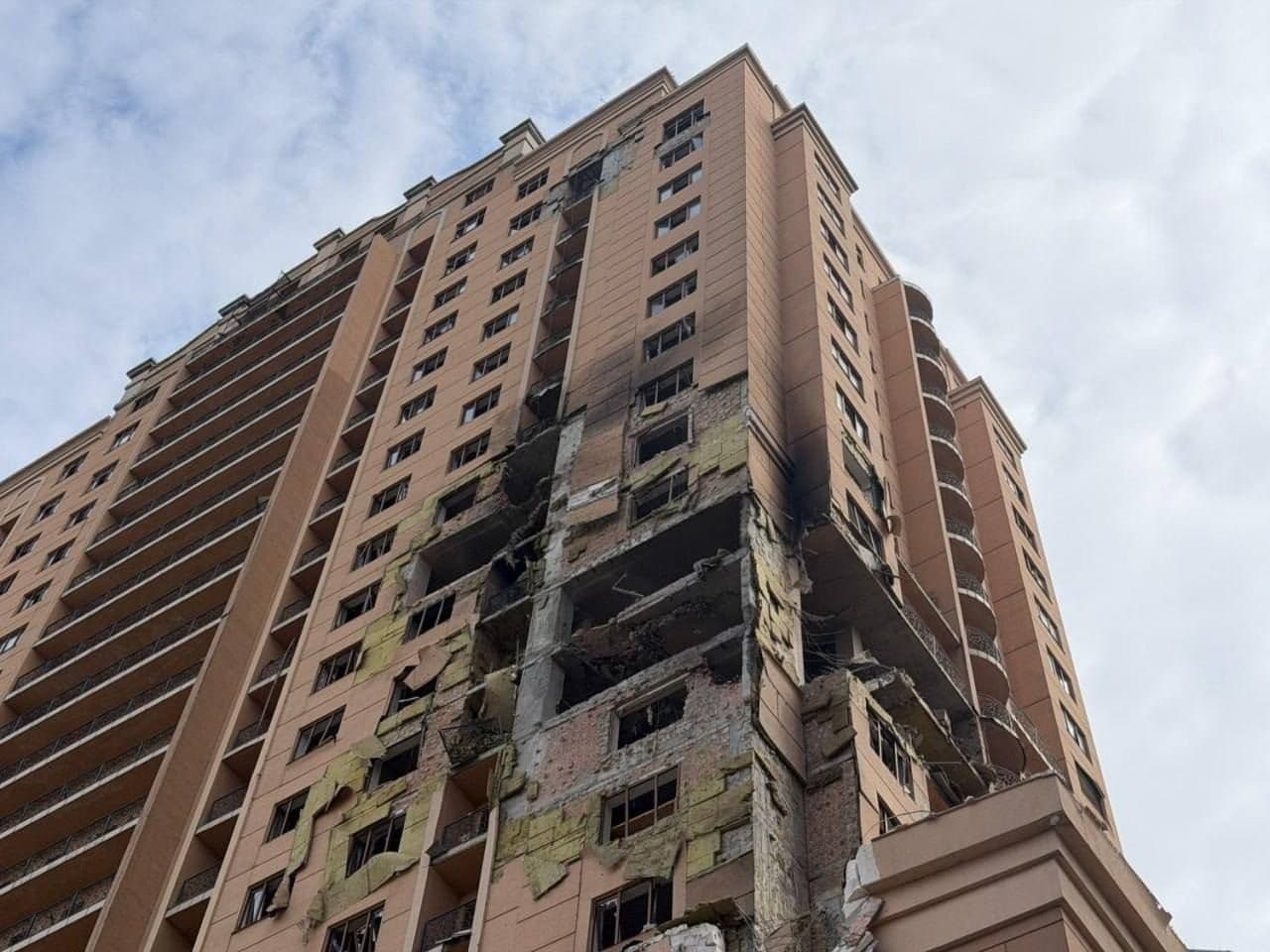
A damaged building housing a Russian FSB command post in Russian-occupied Donetsk, Donetsk Oblast. (Exilenova+/Telegram)
Brovdi also confirmed the April 22 FSB strike in occupied Donetsk: eight precision FP-2 drone hits on a command post and base of the FSB’s Mobile Operations Directorate, responsible for sabotage operations, intelligence recruitment, terrorist attacks, arson, and coordination of Russian proxy forces. The operation — conducted jointly with fighters from the 1st Corps of the Ukrainian National Guard Azov — killed 12 FSB officers and injured 15 others.
Ukrainian forces additionally struck a Russian P-18 radar system near occupied Yevpatoria in Crimea, roughly 170 kilometers from the frontline, and continued their short-range strike campaign against drone control infrastructure near Strilecha on the Kharkiv-Russia border.
Three Dead in a Dnipro High-Rise, Nine Dead Across Ukraine: The Human Cost of April 23
Imagine being nine years old and waking up in hospital. A drone struck your building in the night. You are in moderate condition, which is what doctors say when they mean you are alive but the rest is uncertain. A fourteen-year-old girl is in the bed nearby.
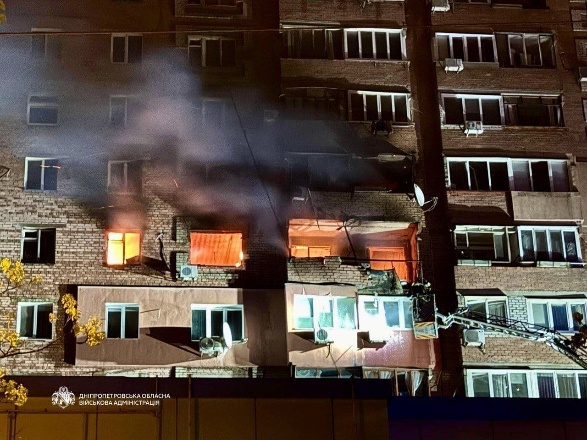
Aftermath of a Russian attack against Dnipro, Ukraine, overnight. (Oleksandr Hanzha/Telegram)
In Dnipro City, a Russian drone struck a 13-story apartment building, killing three people and injuring ten. Four people including the two girls were hospitalized in moderate condition. Across Ukraine that day, Russian strikes killed nine people total and wounded 29. Two 67-year-old men died in the Velyka Pysarivka and Hlukhiv communities of Sumy Oblast. A woman was killed at a railway facility in Zhytomyr Oblast. A 77-year-old woman died in a glide bomb strike on Komyshuvakha in Zaporizhzhia Oblast. One person was killed in Mykhailivka in Donetsk Oblast’s Kramatorsk district. A 66-year-old man was killed in Kharkiv Oblast’s Cherkaski Tyshky. In Kherson Oblast, Russian forces targeted 42 settlements, injuring 11 people — including a 49-year-old garbage truck driver struck by a drone in Tekstylne, suffering shrapnel wounds, a concussion, and a traumatic brain injury. Chernihiv Oblast was left with 152,000 subscribers without power after Russian strikes on energy infrastructure.
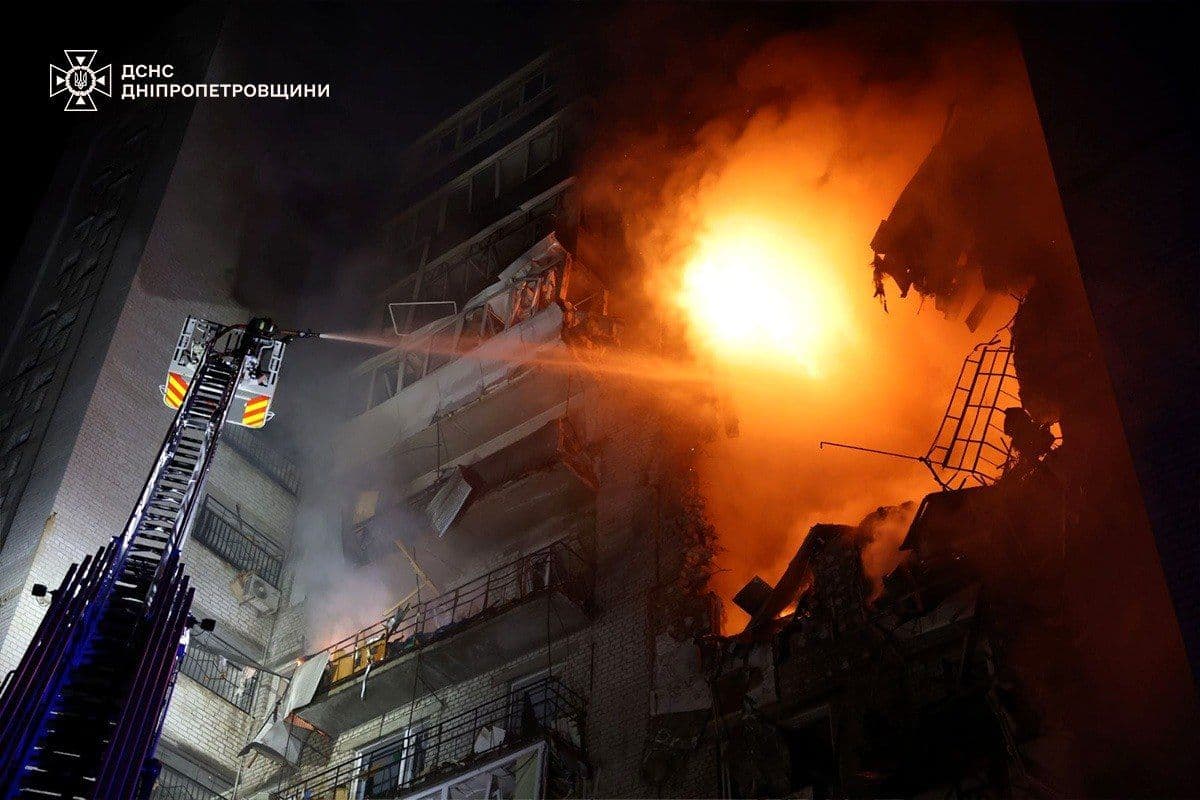
Aftermath of a Russian attack against the city of Dnipro, Dnipropetrovsk Oblast, overnight. (Ukraine’s Emergency Service)
Russia launched 155 drones overnight from Kursk, Oryol, Millerovo, Primorsko-Akhtarsk, and Shatalovo. Ukrainian forces downed 139. Eleven struck nine locations. A Russian unmanned surface vessel approaching an Odesa Oblast port was intercepted by the Ukrainian Navy.
Two Elderly Dead, Apartments Destroyed: Russia Strikes Residential Odesa
Russian strikes on Odesa overnight killed two people — a married couple, both aged 75 — and injured at least 15. One drone struck a three-story building, destroying apartments and injuring six. Two separate two-story buildings were destroyed; rescuers pulled one person from rubble and evacuated 20 residents including two children. Eight of the 15 injured remained in hospital. More than 140 rescuers were deployed across the city through the morning. SES psychologists provided support to more than 50 residents — including three children — experiencing acute stress at impact sites. The strikes also damaged port infrastructure in Odesa Oblast.
The €90 Billion Lands: Formal Adoption, 20th Sanctions Package, and Fico’s Warning
The European Council formally adopted the €90 billion ($106 billion) support loan for Ukraine and the 20th Russia sanctions package on April 23. The loan allocates 60 billion euros to defense industrial capacity and 30 billion to macroeconomic support; Ukraine repays only if Russia pays reparations, with frozen Russian assets at Euroclear covering any shortfall. Zelensky said the first tranche would arrive between May and June, directed toward arms production, weapons procurement, energy system preparation for winter, and critical infrastructure. Hungary, Slovakia, and Czechia opted out of contributing.
The 20th sanctions package includes 120 new listings — the highest number in two years — adding 46 more vessels to the shadow fleet list (total now 632), transaction bans on 20 additional Russian banks (total now 70), restrictions on financial institutions in Azerbaijan, Kyrgyzstan, and Laos for sanctions evasion, a ban on Russian crypto asset service providers and the ruble-backed stablecoin RUBx, transaction bans on the ports of Murmansk and Tuapse, and the first-ever listing of a third-country port — the Karimun oil terminal in Indonesia. The EU activated its anti-circumvention tool for the first time, banning exports of computer numerical control machines and radios to Kyrgyzstan. The package also includes four Russian cultural figures — including Hermitage director Mikhail Piotrovsky — for their roles in illegal archaeological excavations and cultural looting in occupied Crimea.
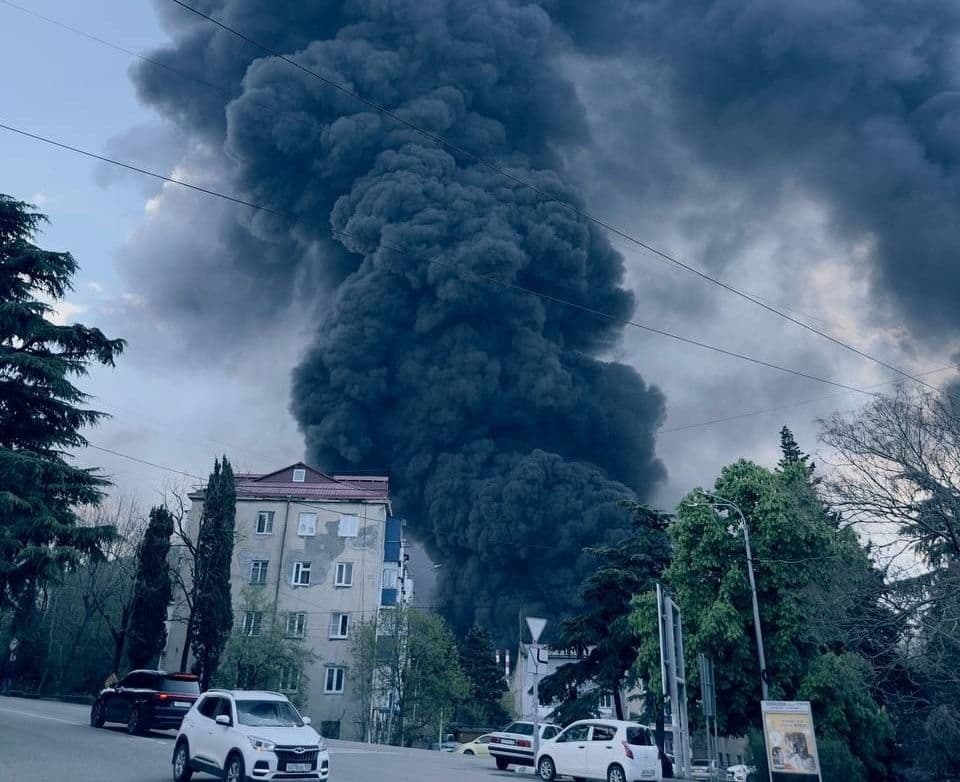
A column of smoke rises above an oil refinery in the Russian city of Tuapse, Krasnodar Krai, following a Ukrainian strike. (Exilenova+/Telegram)
Slovak Prime Minister Fico offered a discordant note. Speaking to reporters on April 22, Fico said trust between Bratislava and Kyiv was poor and expressed concern that once Ukraine received its loan money, oil supplied via Druzhba could be halted again. The statement reflects the fragility of the arrangement that unlocked the funds: a pipeline carrying Russian oil, whose continued operation Kyiv cannot guarantee against future Russian attacks, underpins the political conditions attached to Europe’s largest financial commitment to Ukraine’s survival.
Zelensky in Cyprus: Accession Clusters ‘Without Delay,’ €1 Billion in Business Deals
Zelensky arrived in Cyprus on April 23 for an informal EU summit, meeting Costa and von der Leyen in a trilateral session. Von der Leyen called for opening Ukraine’s EU accession negotiation clusters “without delay.” Costa called the loan and sanctions “two very important steps” and said it was “time to look forward and prepare the next step” — formal accession cluster openings. The EU-Ukraine Business Summit running alongside the political meeting produced over €1 billion in signed deals: 161 million euros in EU guarantees for emerging defense and space technologies (unlocking up to €400 million in investment), a €500 million EIB package for urgent reconstruction, a €360 million EBRD package for small and medium enterprises targeting up to €3.4 billion in additional investment, and two joint defense ventures — French firm Shark Robotics with Tencore on drones, and Danish Gomspace with Stetman on nanosatellites.
Black Rain in Tuapse: Russia’s Burning Refinery Becomes an Environmental Crisis
The Tuapse oil refinery continued burning on April 23 for a third consecutive day following Ukrainian strikes on April 16 and April 20. Residents posted videos of black puddles forming after rainfall, oil droplets coating car surfaces, and thick smoke settling over the city. Air quality readings showed benzene, xylene, and soot concentrations two to three times above normal. Local authorities did not issue an official air quality statement until the third day of the fire.
“This is honestly some kind of environmental disaster. What am I supposed to do? I do not want to stay here anymore,” a Tuapse resident said on social media. Another, driving past the still-burning refinery, addressed Putin directly: “We went to the polls, we voted for you, we believed in you… But at some point, it all collapsed. I do not know whether to believe you, to believe the government, who to believe.” Russian environmental monitoring firm Risksat published satellite imagery showing an oil slick spanning approximately seven square kilometers in the Black Sea near Tuapse, being pushed toward the coastline. Pro-Russian Telegram channels compared the situation to Hiroshima and Chernobyl — both comparisons are false, but their circulation reflects the psychological rupture underway in a Russian city that cannot be told the truth about what is happening to it.
Myropilske Lost, Kupyansk Infiltrated, VDV Struggling to Rotate: The Northern Front
Ukrainian Joint Forces Task Force spokesperson Colonel Trehubov confirmed on April 23 that Russian forces have seized Myropilske, east of Sumy City, and have advanced two to three kilometers deep in some areas along the international border. Russian forces are prioritizing offensive operations east and southeast of Sumy City. In the Kupyansk direction, Trehubov confirmed that Russian forces have intensified infiltration missions north of Kupyansk near Holubivka and are working to eliminate the Ukrainian bridgehead on the left bank of the Oskil River — while separately confirming that Russian forces do not hold permanent positions in Kupyansk-Vuzlovyi, directly refuting Gerasimov’s claims.
Russian forces are also struggling with the planned rotation of VDV elements in Sumy Oblast. Elements of the 9th Motorized Rifle Regiment are failing to effectively replace the 119th VDV Regiment as planned; elements of the 83rd Separate VDV Brigade may redeploy to the Yunakivka area near Sumy City. The rotation difficulties confirm what Ukrainian resistance in Sumy Oblast has cost Russia’s elite airborne forces. Northeast of Kharkiv City, geolocated footage showed Ukrainian forces striking Russian servicemembers northwest of Bochkove after a Russian infiltration mission.
Lyman Buildup, Fabricated Flags at Pokrovsk, Suicides Ordered: The Donetsk Front
A Ukrainian brigade spokesperson in the Lyman direction reported on April 23 that Russian forces are concentrating equipment for a planned mechanized assault while striking Ukrainian logistics routes to prevent personnel rotations and ammunition resupply. In the Slovyansk direction, geolocated footage shows Ukrainian forces striking Russian positions in eastern Rai-Oleksandrivka after an infiltration mission. In the Kostyantynivka direction, Russian forces continued operations without confirmed advances; geolocated footage confirms Ukrainian forces hold positions northeast of Stinky and in southern Chasiv Yar in areas Russian sources had claimed.
In the Pokrovsk direction, Russian state TV Perviy Kanal published footage of two soldiers from the 35th Motorized Rifle Brigade raising a flag claimed to be in Hryshyne. Geolocated analysis published April 23 identified the actual location as Mykailivka — roughly 40 kilometers from Hryshyne. The flag-raising was staged. In the Dobropillya tactical area, Ukrainian forces struck a Russian infiltration mission south of Zapovidne; a milblogger claimed Russian forces seized Novyi Donbas. In the Novopavlivka and Oleksandrivka directions, Russian forces continued operations without advance.
Intercepts published by Ukrainian sources described Russian military commanders ordering subordinates to beat foreign recruits — specifically avoiding injuring their legs so they could still march — before sending them into near-suicidal assault missions. Ukraine’s Military Intelligence separately confirmed that multiple Kenyan nationals serving in Russia’s military were killed earlier in 2026; one had reportedly contacted Ukraine’s HUR surrender hotline before his death. The combination of tortured recruits and foreign nationals killed on the front lines illustrates the composition and command culture of the force Russia is deploying.
Orikhiv 15 Kilometers Away, Charivne Held: Ukraine’s Southern Axis Holds
Ukrainian Southern Defense Forces spokesperson Colonel Voloshyn stated on April 22 that Russian forces remain 15 kilometers from Orikhiv — directly contradicting Russian claims of ongoing street fighting within the city — and that Russian forces would need to seize Novodanylivka before any assault on the city could begin. Geolocated footage confirms Ukrainian forces operating within Charivne in areas Russian sources had claimed. In the Kherson direction, Russian forces continued limited ground attacks toward Dnipro River delta islands without advancing. USF Commander Brovdi confirmed the destruction of a Russian Tor-M2 and Osa-AK system in occupied Zaporizhzhia Oblast during recent operations.
Drinking Rainwater on the Front Line: The Malnourished Soldiers of the 14th Brigade
Photographs shared on social media on April 23 showed four Ukrainian soldiers visibly gaunt and emaciated, identified as fighters from the 2nd Mechanized Battalion of Ukraine’s 14th Separate Mechanized Brigade. “The guys are on the positions without food or water. Command isn’t responding. The fighters are losing consciousness from hunger, drinking rainwater,” the post read. Ukraine’s Ministry of Defense confirmed the situation within hours, with the brigade commander taking personal control: “Logistics are complicated, but we are working to fix supply issues and rotate the troops. This should not happen — but conditions on some parts of the front are extremely difficult.”
An April 15 brigade update had already shown footage of a Russian FPV drone hunting an unmanned ground vehicle delivering food and supplies — illustrating the operational reality. Supply routes that are safe one day become kill zones the next. Ammunition takes priority under battlefield pressure; food falls behind. The brigade is believed to be operating in the Kupyansk sector of the Kharkiv front. The episode is a concrete illustration of the gap between the reported operational tempo — 688 assaults in the Pokrovsk direction in 22 days — and the human conditions sustaining that defense.
Cosmodrome Tours and Drone Lessons: Russia’s Industrial Militarization of Ukrainian Children
The Russian Ministry of Defense reported on April 16 that cadets from the Nakhimov naval schools in occupied Mariupol and Sevastopol were taken to the Plesetsk Cosmodrome in Arkhangelsk Oblast, where they toured the launch pad and watched the launch of a Soyuz-2.1b rocket. The Plesetsk Cosmodrome is a military facility used for the launch of nuclear-capable ICBMs and military satellites. The MoD-run Nakhimov naval academies in occupied areas systematically militarize and indoctrinate Ukrainian children aged 10 to 13, preparing them for future service in the Russian military.
Separately, Rostec subsidiary Technodinamika announced drone operation courses for teenagers aged 13 to 17 at the Artek International Children’s Camp in occupied Crimea throughout April — teaching FPV drone piloting, chemical engineering, AI, robotics, and prototyping. The US State Department sanctioned Artek in 2023 for placing children in “patriotic re-education programs” and preventing them from returning to their families. Russia is transforming Artek into a central hub for the militarization of Ukrainian children, with a major state defense conglomerate now directly running the programs.
A Europol investigation separately identified 45 additional Ukrainian children who Russia has forcibly transferred or deported since 2022, following a two-day online hackathon involving 40 investigators from 18 countries. Europol identified transportation routes, individuals involved in the deportations, and facilities where the children were taken. Ukraine has confirmed at least 20,570 forced transfers or deportations; the Yale Humanitarian Research Lab was tracking 35,000 as of 2025.
Recruited by Telegram, Sent to Blow Up Schools: Russia’s Campaign Against Ukrainian Teenagers
Ukrainian authorities disrupted two Russian-directed school attack plots on April 23. In Kirovohrad Oblast, a 15-year-old was apprehended after assembling an IED from household materials on instructions from a Russian Telegram handler, with plans to detonate it at his school and attack classmates with a firearm and knife. A seized device, components, communication records, and a firearm were recovered. The teenager has been charged with preparing a terrorist act, carrying up to ten years imprisonment.
In Odesa Oblast, an 11-year-old was identified at the stage of recruitment — Russian operatives had planned to send him a package containing a firearm and knife for a school attack. The SBU confirmed both cases were linked to the Telegram channel “ETERSSA,” used to recruit Ukrainian minors. Handlers told the teenagers their actions served a “just goal” and allegedly encouraged them to take their own lives afterward to eliminate witnesses. The cases are the latest in a documented pattern: earlier this year a teenager assembled two police-station IEDs in Kremenchuk for the same double-tap design — first blast to draw responders, second to kill them.
Putin Admits the Internet Cuts, Russia Prepares Baltic Narratives, Dutch Intelligence Warns
Vladimir Putin acknowledged publicly for the first time on April 23 that government restrictions on mobile internet are affecting the daily lives of Russians in urban centers and border regions. He justified the outages as security measures during Ukrainian strikes and called for the government to be more transparent about them after the fact — while ordering whitelisting of banking and transportation apps during future outages. The acknowledgment is the most senior public admission yet; Kremlin spokesman Peskov had previously been the highest official to address the issue, in mid-March. ISW assessed the acknowledgment as a response to declining approval ratings as Russians increasingly bear the costs of the war.
Russia’s Security Council accused Lithuania on April 23 of creating a “hotbed of tension” near Kaliningrad and militarizing under the guise of a Russian threat. Deputy Foreign Minister Grushko claimed NATO’s Joint Expeditionary Force exercises are practicing a naval blockade and seizure of Kaliningrad — accusing the alliance of deliberate escalation. ISW assessed these statements as part of a structured cognitive warfare campaign building the narrative conditions for potential future Russian aggression against the Baltic states or Poland, using Kaliningrad as a pretext.
The Dutch intelligence service AIVD, publishing its 2025 annual report on April 23, said Russia is preparing for a prolonged strategic confrontation with the West and that in its 80-year history the agency has “never seen a threat picture like now.” The AIVD cited Russian cyber operations in 2025 targeting Signal and WhatsApp accounts of government officials and military personnel, linked to the Russian-connected hacking group “Laundry Bear,” which also breached Dutch police systems, exposing contact details of tens of thousands of employees.
Torture Chambers at Zaporizhzhia Nuclear Plant, Russian Demographics in Mariupol, Kherson-North Korea Ties
Research by Ukrainian human rights organization Truth Hounds identified at least seven torture chambers in Enerhodar used to pressure Zaporizhzhia nuclear plant employees to sign contracts with Rosatom. At least 78 employees are held in these facilities. Despite the pressure, 2,500 employees — including 15 licensed reactor operators — have refused Russian contracts, with many in hiding. Rosatom has directed FSB agents to investigate “unreliable” staff and has attempted to restart the shutdown plant and connect it to Russia’s energy grid, despite serious nuclear safety risks from the destruction of the Kakhovka reservoir cooling water supply.
In occupied Mariupol, Russia’s own statistics reveal the scale of demographic replacement: three quarters of apartments have been purchased by Russian citizens from Russia, primarily from Moscow and Siberian federal districts. Russian Deputy PM Khusnullin has previously confirmed that locals account for only 30 percent of housing purchases across all occupied Ukraine. A draft Voronezh Oblast decree published April 16 would restrict all vehicle transit between occupied Luhansk Oblast and Russia to a single checkpoint at Buhaivka — tightening the physical controls on movement out of occupied territory. VTB Bank separately reported that savings account volumes in occupied Ukraine grew 10 percent in Q1 2026. The Kherson Oblast occupation administration met with North Korea’s ambassador to Russia on April 15, discussing agricultural, cultural, and business cooperation — another vector of the growing Moscow-Pyongyang relationship extending into occupied Ukrainian territory.
Ukraine Asks Turkey to Host Talks, Ankara Prepares NATO Summit, Chornobyl Needs Half a Billion
Ukraine formally asked Turkey to host direct talks between Zelensky and Putin, Ukrainian officials confirmed on April 23. Moscow effectively ruled out the format, reiterating that Putin would only attend to finalize an already-negotiated end to the war — not to negotiate. Turkey appears to be taking on a more active diplomatic role nonetheless: a veteran Turkish diplomat told reporters that the upcoming NATO summit in Ankara is expected to refocus attention on support for Ukraine. NATO Secretary General Rutte separately reiterated the alliance’s commitment to Turkey’s defense, saying NATO would do “what’s necessary” to defend the country.
The EBRD confirmed it is working to secure approximately €500 million to help Ukraine repair the Chornobyl confinement structure after it was struck by a Russian drone. The Chornobyl New Safe Confinement — the massive steel arch built to contain the 1986 disaster site — was damaged in the attack. In April 2026, the disaster’s 40th anniversary, the structure that was built to prevent another radiological catastrophe is itself in need of emergency repair. Russia has been invited to the G20 summit in Miami at the highest level, Russia’s Foreign Ministry announced on April 23. A US State Department spokesperson confirmed that as a G20 member, Russia has been invited to all working-level meetings, adding that “President Trump has been clear that Russia is welcome to attend.”
Gun Incidents, Budanov’s Warning, and Ukraine’s Weapons Surge: Domestic Security Under Pressure
Ukraine has witnessed a string of gun incidents in recent days. A man was detained in Lviv after firing a recreational revolver in his apartment building. Another was arrested in Ivano-Frankivsk for firing a shot during a road rage incident. Separately, authorities foiled a Russian-directed plot to recruit teenagers to carry out school shootings — raising questions about how weapons are reaching civilians and minors. Presidential Office head Kyrylo Budanov weighed in, saying he opposes any easing of Ukraine’s gun laws and hinting at existing loopholes in the system that allowed some individuals to obtain weapons who should not have been able to.
On Ukraine’s defense industry expansion: a TFU survey of 42 defense companies found that 90 percent received requests for international cooperation in Q1 of 2026, led by the US (36 percent), Germany (29 percent), Denmark (21 percent), UAE (19 percent), and the UK (17 percent). Defense Minister Fedorov announced that since the beginning of 2026, military units have ordered drones, unmanned ground vehicles, and electronic warfare equipment worth 14 billion UAH ($319 million) through Brave1 Market using performance-based ePoints, with over 181,000 units delivered. Fedorov also reported that in March 2026, over 35,300 Russian soldiers were killed or seriously wounded, and over 151,200 targets were destroyed.
One Thousand Synthetic Videos and Prince Harry: Russia’s AI War and Ukraine’s Unlikely Allies
Researchers have identified more than 1,000 synthetic AI-generated videos forming part of a structured Russian “narrative kill chain” — a modular disinformation system targeting soldiers, civilians, and Western audiences simultaneously. Ukraine’s Center for Countering Disinformation cited Sensity AI research documenting how generative AI is now deployed as a mass tool of cognitive warfare. Military-facing content pushes narratives of a failing front line and undermines trust in commanders. Civilian content normalizes Russian occupation conditions. Western-audience content discredits Ukraine and argues against continued support. Russian soldiers and state media reporters have additionally been training teenage influencers in Moscow on video production, AI use, and audience growth strategies. The goal, analysts say, is not persuasion but epistemic chaos — producing enough synthetic content that genuine evidence of Russian atrocities can be dismissed as AI-generated.
Prince Harry made a surprise visit to Kyiv on April 23, arriving by train for the Kyiv Security Forum. He told ITV News he wanted “to remind people back home and around the world what Ukraine is up against.” Addressing the forum, he invoked the Budapest Memorandum: “The United States has a singular role in this story. Not only because of its power, but because when Ukraine gave up nuclear weapons, America was part of the assurance that Ukraine’s sovereignty and borders would be respected.” He called it “a moment for American leadership” and called on Putin directly to end the war. Trump, asked at the White House, replied: “Prince Harry is not speaking for the U.K., that’s for sure. I think I’m speaking for the U.K. more than Prince Harry.”
The pipeline that unlocked €90 billion burned on the same night the money was approved — and both happened on the same day that nine Ukrainians were killed in their beds, in their streets, in a garbage truck in Kherson. Russia struck a Dnipro apartment building and a 9-year-old and 14-year-old were hospitalized in moderate condition. Intercepts described commanders beating foreign recruits before sending them to die. Children from occupied Mariupol watched missile launches at a Russian cosmodrome. Tuapse burned for a third day, black rain falling, residents telling Putin — through a phone camera — that their trust had collapsed. Fico said he did not trust Kyiv. Prince Harry said America had a role to play. Day 1,520 ends the way most days in this war end: with the gap between what is happening and what is acknowledged wider than it should be, and Ukraine still standing in that gap.
A Prayer for Ukraine
1. For the Two Children in Dnipro’s Hospital
Lord, a drone struck their building in the night. They are nine and fourteen. They are in moderate condition, which is the language doctors use when they mean alive but uncertain. Be present in those hospital rooms tonight. Steady the hands working around them. And receive the three who did not survive the same building — people who had no part in this war except to live in it.
2. For the Two 67-Year-Old Men in Sumy Oblast
Father, they were killed in separate villages on the same morning by the same campaign. We don’t know their names. We know they were born in 1959, lived through the Soviet collapse, rebuilt their lives in independent Ukraine, and died in it. Receive them. Let someone who loved them know they are remembered here.
3. For the Soldiers Drinking Rainwater Near Kupyansk
God, four men appear in photographs gaunt and hollow because the supply route to their position is a kill zone and ammunition travels it before food does. Hold them tonight. Let the food arrive. And hold the officers who must choose, in real time and under fire, between what their soldiers need and what the mission requires — the weight of that choice is not administrative. It is moral.
4. For the Children Taken to the Cosmodrome
Father, children from occupied Mariupol and Sevastopol were taken to a military facility and shown a rocket launch. They are between ten and thirteen years old. They did not choose to be there. Russia is trying to make them into something — loyal, militarized, forgetting. Be near them in whatever they are being made into, and keep something alive in them that remembers who they were. Let de-occupation come before the forgetting is complete.
5. For Justice, Moving Through Its Necessary Channels
God of justice, 45 more children were identified by 40 investigators from 18 countries — routes mapped, individuals named, facilities documented. The 20th sanctions package listed an Indonesian oil terminal for the first time because circumvention leaves traces if someone looks. The tribunal is coming. These are not nothing. Hold those who keep building the case in rooms where patience runs thin and the powerful still have lawyers. In Your mercy, in Your justice, in Your time — bring this war to its end, and let the ending be worthy of what Ukraine has endured.