
Ukraine Daily Briefing | April 26, 2026 | Day 1,523 of the Full-Scale Invasion
Ukrainian drones struck the Yaroslavl oil refinery — one of Russia’s five largest, processing 15 million tons of crude per year — along with a chemical plant in Volgograd Oblast where five workers were hospitalized with acid burns, as a separate operation damaged three Russian warships, a reconnaissance vessel, and a MiG-31 fighter jet in Sevastopol’s naval base and Belbek Airfield. Russia answered with 144 drones killing eight people across Ukraine, shelling a residential street in Kramatorsk, and striking another cargo vessel in Odesa Oblast — Day 1,523, the 40th anniversary of Chornobyl, when Ukraine struck at the industrial foundations of the country that built the Soviet machine and whose war now threatens to make the confinement structure collapse.
The Day’s Reckoning
Forty years ago today, the fourth reactor at the Chornobyl Nuclear Power Plant exploded. The Soviet Union hid it for days. The cloud moved northwest across Europe. People were told it was safe. One hundred and sixteen thousand were eventually evacuated from a zone that will not be inhabitable for generations. The accident remains the deadliest nuclear disaster in the history of civilian energy production.
Today, the structure built to contain that reactor — the New Safe Confinement, a massive steel arch completed in 2016 at a cost of €1.5 billion — has a hole in it from a Russian drone strike in February 2025. The EBRD is working to secure approximately €500 million for repairs that will take three to four years. EU Energy Commissioner Dan Jorgensen traveled to Kyiv on April 26 and said nuclear safety is “not an option” but “a cornerstone of European and global security.” IAEA Director General Grossi visited Ukraine and said Chornobyl “is a living responsibility, not history.” Moldovan President Sandu arrived in Kyiv and then traveled to the exclusion zone to honor those who gave their lives in the cleanup.
While the anniversaries were observed, Ukraine’s drones were flying. The Yaroslavl oil refinery — Slavneft-YANOS, controlled by Rosneft and Gazprom, one of Russia’s five largest refineries — caught fire overnight. A separate drone strike burst a high-pressure sulfuric acid pipeline at a Apatit nitrogen complex in Volgograd Oblast, approximately 700 kilometers from the border, hospitalizing five workers with chemical burns. Strikes on Sevastopol’s naval base and Belbek Airfield damaged two large landing ships, a reconnaissance vessel, a training center, a radar station, a radio intelligence headquarters, and a MiG-31 fighter jet — what the SBU’s acting head called “methodically destroying key elements of the enemy’s military infrastructure.”
Russia’s drones killed eight people across Ukraine. A residential street in Kramatorsk was shelled, killing a woman and a man walking outside. A 48-year-old and 72-year-old were killed in the Sumy border zone. In Zaporizhzhia Oblast, 788 attacks were launched against 50 settlements in a single day. A church in Chernihiv was damaged. And Mediazona confirmed 213,858 Russian military dead — a number everyone acknowledges is a fraction of the actual count.
Day 1,523. Forty years since the reactor exploded. The war that threatens to make it explode again continues on schedule.
Yaroslavl Refinery Struck, Apatit Chemical Plant Hit in Volgograd: Ukraine’s Deep Strike Campaign
Ukrainian drones struck the Slavneft-YANOS refinery in Yaroslavl City overnight on April 25 to 26, causing a fire at the facility. The plant, jointly controlled by Rosneft and Gazprom Neft, is one of Russia’s five largest refineries by processing volume, handling approximately 15 million tons of crude oil per year, and produces gasoline, diesel, and jet fuel for Russia’s central regions and military logistics. Ukraine’s General Staff confirmed the strike and said the ELOU-AT-4 installation — a key unit for raw materials primary processing — may have been among the targets hit. The Yaroslavl Oblast Governor said air defense forces repelled a “massive” drone attack but acknowledged the fire at the refinery.
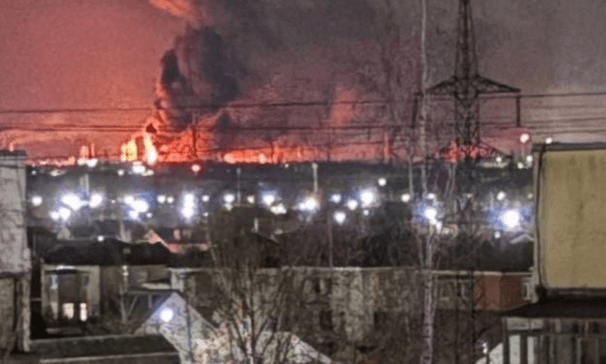
What purports to be fire burning at an oil refinery in Yaroslavl, Russia overnight. (Exilenova Plus/Telegram)
Simultaneously, a separate drone strike in Vologda Oblast hit the Apatit nitrogen complex in Volgograd Oblast. A high-pressure sulfuric acid pipeline was burst in the strike. Five employees sustained chemical burns and were hospitalized; Russian state media RIA Novosti later reported a total of ten injured. Volgograd Oblast Governor Filimonov confirmed the incident. Volgograd is approximately 700 kilometers from the Ukrainian border. No fire broke out at the plant, but the acid pipeline rupture constitutes a chemical release at industrial scale. No fire broke out at the chemical plant, but the acid pipeline rupture constitutes a different category of damage: a chemical release at industrial scale with ongoing environmental consequences.
Additional drone activity on the same night was recorded in Tambov Oblast near Michurinsk; Belgorod Oblast, where strikes on Alekseyevka and Rzhevka killed one person and injured five; and near Moscow. Russia’s Defense Ministry claimed 203 drones intercepted across multiple regions, including areas near Moscow, Crimea, and the Black Sea. ISW has counted at least 10 Ukrainian strikes against Russian oil and gas infrastructure in the two weeks since approximately April 12. Ukraine has been increasing the range, volume, and intensity of its long-range strike campaign steadily since March 2026, supported by growing domestic drone production.
Sevastopol Operation: Three Ships, a MiG-31, and the Nerve Center of the Black Sea Fleet Struck
Ukraine’s Security Service reported on April 26 that a coordinated SBU Alpha special forces operation overnight struck the Russian Black Sea Fleet’s naval base and Belbek Airfield in occupied Sevastopol, launching at least 71 drones. The confirmed targets hit: the Yamal, a Ropucha-class large landing ship; the Filchenkov, a Tapir-class large landing ship; the Ivan Khurs, a Yury Ivanov-class reconnaissance vessel; the Lukomka Black Sea Fleet Training Center; the headquarters of Russia’s Air Defense Forces’ radio-technical intelligence unit; the MR-10M1 Mys-M1 coastal radar station; a MiG-31 interceptor aircraft at Belbek; and Belbek Airfield’s maintenance section.
Sevastopol’s Russian-installed occupation governor Razvozhaev acknowledged the attack was one of the largest strike campaigns ever conducted against the city and claimed air defenses downed 71 drones. One civilian was killed, four injured. Seventeen houses, civilian cars, shops, and railway contact lines were damaged by falling drone wreckage. Ukrainian SBU acting head Khmara described the operation’s logic: “Every such operation follows a clear logic: we are methodically destroying key elements of the enemy’s military infrastructure — the fleet, aviation, reconnaissance, and air defense. This results not only in direct losses of equipment but also in the destruction of the enemy’s ability to control airspace, provide cover for its forces, and plan new attacks.”
Ukraine’s General Staff additionally confirmed prior strikes: the destruction of a Kasta-2E1 radar station in occupied Melitopol and a Pantsir-S1 surface-to-air missile system in occupied Mariupol from operations on April 24. Ukrainian forces also struck Russian military trains in the Menchuhove and Kelerivka areas of occupied Donetsk Oblast.
144 Drones, Eight Dead: Russia’s Overnight Campaign and Its Civilian Toll
Russian forces launched 144 Shahed-type, Gerbera, Italmas, and other drones overnight on April 25 to 26, from Kursk, Bryansk, Oryol, Millerovo in Rostov Oblast, Primorsko-Akhtarsk in Krasnodar Krai, and occupied Donetsk City. Ukrainian forces downed 124. Nineteen drones struck 11 locations; debris fell at six additional sites. Russian forces also struck a Palau-flagged cargo vessel in Odesa Oblast.
The confirmed civilian toll across Ukraine on April 26: In Donetsk Oblast, two people were killed — one in Oleksiievo-Druzhkivka and one in Druzhkivka — and five were injured across the region. In Zaporizhzhia Oblast, two people were killed and four injured across the Zaporizhzhia and Polohy districts; Russian forces launched 788 separate attacks against 50 settlements in the oblast in a single day. In Sumy Oblast, a 48-year-old and a 72-year-old man were killed in a drone strike in the Bilopilska community, less than 5 kilometers from the Russian border. In Kherson Oblast, 36 settlements were targeted including the regional center; six people were injured; a 69-year-old woman later died in hospital from injuries sustained in Sadove village. In Dnipropetrovsk Oblast, one person was killed in Nikopol district, four injured near Synelnykove. In Kharkiv Oblast, 18 settlements were targeted, four people injured. In Odesa Oblast, drones struck residential buildings and port infrastructure, injuring one. In Mykolaiv Oblast, a 74-year-old woman was injured in the village of Lupareve. In Chernihiv, Russian forces struck the city — damaging houses, high-rise residential buildings, civilian vehicles, and a church — with no casualties. Total: at least eight killed, 21 or more injured in Russian attacks over the 24-hour period.
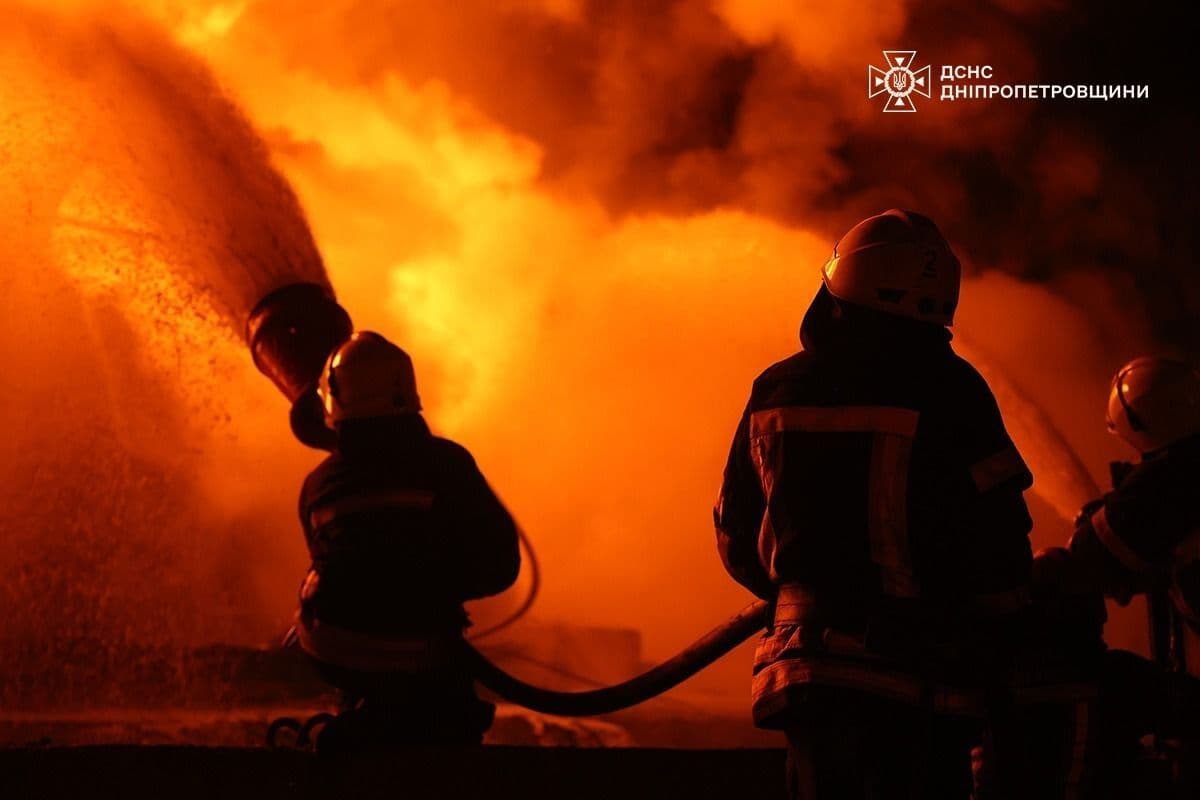
Aftermath of a Russian attack on Dnipropetrovsk. (State Emergency Service of Ukraine)
Kramatorsk: A Residential Street, Two Dead, a War Crime Investigation Opens
Russian forces shelled a residential neighborhood in Kramatorsk on the morning of April 26, killing two civilians — a woman and a man who were walking outside at the time of the strike — and injuring a 50-year-old man who was hospitalized in moderate condition with blast injuries, fractures, and shrapnel wounds. Eight residential buildings were damaged. The Donetsk Regional Prosecutor’s Office opened a pre-trial investigation as a war crime. The type of weapon used was still being determined. Kramatorsk is one of the largest Ukrainian-held cities in Donetsk Oblast and has been a consistent target of Russian strikes throughout the full-scale invasion.
Chornobyl at 40: A Damaged Confinement, a Threatened Nuclear Plant, and Europe’s Collective Responsibility
April 26, 2026 marks the 40th anniversary of the Chornobyl nuclear disaster. At 1:23 a.m. on April 26, 1986, the fourth reactor of the Chornobyl Nuclear Power Plant exploded, initiating a meltdown while releasing radioactive material across Ukraine, Belarus, and much of Europe. The Soviet Union hid the scale of the disaster for days. An exclusion zone covering 116,000 former residents was created. The accident remains the deadliest nuclear disaster in the history of civilian energy production.
Zelensky, Prime Minister Svyrydenko, Moldovan President Sandu, EU Energy Commissioner Jorgensen, and IAEA Director General Grossi all marked the anniversary on April 26. Sandu traveled to the exclusion zone and visited the plant site, saying disasters “know no borders — neither should solidarity.” IAEA’s Grossi, speaking at a “Restoring Nuclear Safety” conference in Kyiv, said: “Chornobyl is not history. It is a living responsibility.” Jorgensen told reporters the cost of repairing the confinement structure — damaged by a Russian drone strike in February 2025 — is “not just Ukraine’s workers’ affair but a collective responsibility.” The EBRD is working to secure approximately €500 million for repairs expected to take three to four years.
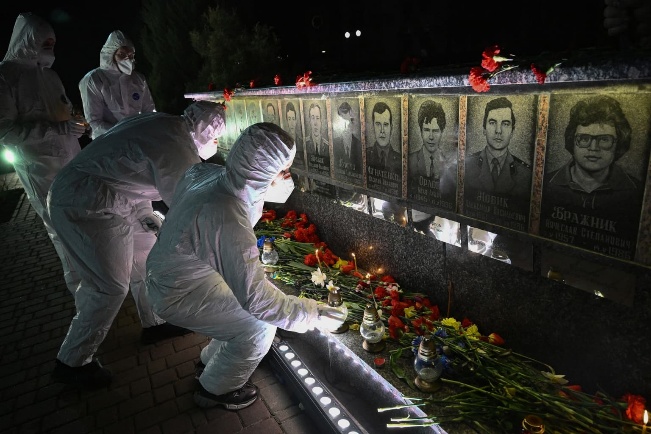
Participants dressed in white hazmat suits, representing liquidators, place candles in front of a memorial for Chornobyl victims, during a commemoration ceremony marking the 40th anniversary of the explosion at the Chornobyl nuclear power plant, the worst civilian nuclear disaster in history, in the town of Slavutych, amid the Russian invasion of Ukraine. (Genya Savoliv / AFP via Getty Images)
The war has created a second front of nuclear risk. Russian forces occupy the Zaporizhzhia Nuclear Power Plant in Enerhodar — Europe’s largest. Since occupation, Russian forces have used the site as a military base, neglected basic maintenance, placed the facility in the path of artillery and drone fire, and attempted to connect it to Russia’s energy grid despite serious safety risks from the destruction of the Kakhovka reservoir cooling water supply. Truth Hounds documented at least seven torture chambers in Enerhodar used to coerce plant employees to sign contracts with Rosatom. “Russia continues to flout global nuclear safety principles,” Svyrydenko said, drawing a direct line between Soviet-era concealment and current Russian behavior.
Moldovan President in Kyiv: Transnistria Reintegration, EU Accession, Energy Cooperation
Moldovan President Maia Sandu arrived in Kyiv on April 26 for an official visit with Zelensky, her first visit to Ukraine since early in the full-scale invasion. The two leaders discussed security cooperation, cross-border coordination, energy and infrastructure protection, and both countries’ EU accession paths. Zelensky said Ukraine and Moldova are working to ensure all six EU accession clusters open promptly and that membership becomes a “shared success.” Moldova was granted EU candidate status in 2022 and began formal negotiations in 2024.
Sandu raised the question of Transnistria — the strip of Ukrainian-Moldovan borderland that has been under Russian-backed separatist control since 1992 and where approximately 1,000 to 1,500 Russian troops remain stationed. She said Moldova is discussing with EU partners a reintegration process built on demilitarization, de-oligarchization, and democratization, and needs international support to achieve it. “Ukraine’s greatest contribution so far has been keeping the Russian army far from Moldova’s borders. This allows us to seek a peaceful resolution,” Sandu said. Russia has been planning a buffer zone in the Transnistria region, according to the Ukrainian Presidential Office.
€5.4 Billion for Winter: Ukraine’s Energy Survival Strategy for 2026
First Vice Prime Minister and Energy Minister Shmyhal presented Ukraine’s energy resilience plan at the Ukraine Energy Coordination Group conference in Kyiv on April 26. Ukraine requires at least €5.4 billion to prepare its energy system for the upcoming winter: repairing 4.5 GW of existing infrastructure and adding 2 GW through distributed cogeneration and renewable energy sources. International partners — the EU, UK, Italy, and Nordic-Baltic states — pledged approximately €100 million to the Ukraine Energy Support Fund during the summit. A funding gap of €829 million remains for already-approved critical projects.
Shmyhal identified active air defense — specifically more Patriot systems and PAC-3 missiles — as the “number one priority” for protecting energy sites from Russian ballistic threats. Ukrainian experts have identified usable equipment from eight decommissioned thermal power plants across Europe that is ready for physical transport to damaged Ukrainian facilities. Shmyhal also expressed interest in resuming diesel pipeline supplies from Hungary, involving Ukrtransnafta and MOL, citing current fuel market challenges. The energy conference coincided with the formal disbursement preparations for the first €45 billion tranche of the EU’s €90 billion loan, which Zelensky said will be directed primarily toward defense industry, drone production, and energy protection before winter.
Three New PURL Contributors, €400 Million More for Air Defense
Three additional countries pledged approximately €400 million to the Prioritized Ukraine Requirements List program, Zelensky announced on April 26. The contributing countries were not disclosed. The pledges were finalized during the Cyprus meetings earlier in the week. The PURL mechanism allows international partners to fund the immediate purchase of US-made weapons — particularly anti-ballistic interceptor systems — to bridge the gap while European production capacity scales up. The new pledges bring PURL’s total to approximately $5.4 billion. The Ramstein format, which coordinates military assistance to Ukraine from over 50 countries, has provided more than $150 billion in military assistance since 2022.
Frontlines: Oleksandrivka Consolidation, Hulyaipole Porous, Donetsk Strikes Continue
In the Oleksandrivka direction, Ukrainian observer Mashovets reported on April 26 that Russian forces hold Berezove and southern Novohryhorivka after moving reinforcements to the area to prevent further Ukrainian advances. Ukrainian forces liberated Vorone, southeast of Oleksandrivka — a settlement ISW assesses Russian forces had seized on a prior date. In the Hulyaipole direction, Mashovets described the frontline as dynamic and porous, with Russian small infantry groups operating west of Hulyaipilske, between Hulyaipilske and Novoselivka, west of Hirke, west of Dobropillya, and near Verkhnya Tersa — while Ukrainian forces simultaneously hold positions northwest of Solodke, east of Dobropillya, and on the northwestern outskirts of Hulyaipole itself. ISW adjusted its terrain assessment for fields west of Hulyaipole to reflect an infiltration zone rather than confirmed Russian advance.
In the Kostyantynivka direction, geolocated footage published April 25 and 26 confirmed Ukrainian forces striking Russian positions in northeastern and southwestern Kostyantynivka, on the southern outskirts, and in eastern Dovha Balka and south of Stepanivka — all after what ISW assessed as Russian infiltration missions. Russian forces continued offensive operations in the Slovyansk, Dobropillya, Pokrovsk, Novopavlivka directions without confirmed advances; a milblogger claimed Russian forces advanced over northeastern Novopavlivka. In Sumy Oblast, Ukrainian forces struck a Russian command and observation post in Tetkino, Kursk Oblast, using an AASM Hammer, and a manpower concentration near Sopych. Russian forces launched an infiltration mission in southeastern Kindrativka, north of Sumy City. Elements of the 352nd Motorized Rifle Regiment appear to have redeployed from the Kupyansk direction to the Sumy direction, with their Molniya-2 FPV drone crews now reportedly striking Ukrainian forces in Sumy Oblast. In Kharkiv Oblast and the Kupyansk direction, Russian forces continued offensive operations without confirmed advances.
North Korea Opens War Memorial, Belousov Awards Medals in Pyongyang
North Korea opened a museum and memorial complex on April 26 honoring its soldiers who fought alongside Russian forces in Ukraine and Kursk Oblast, Russian state media TASS reported. The opening coincided with the arrival of Russian Defense Minister Belousov in Pyongyang — the second visit by a senior Russian official to North Korea in recent days. Belousov awarded medals to North Korean soldiers for missions conducted in Russia’s Kursk Oblast, attended the memorial opening, and met with North Korean defense officials. The memorial reportedly bears the names of both Russian and North Korean servicemen killed while fighting Ukrainian troops.
State Duma chairman Volodin — a close Putin ally — also traveled to Pyongyang for the memorial opening. Putin sent Kim Jong Un a personal message, thanking him for helping repel the Ukrainian incursion into Kursk Oblast and expressing confidence in deepening bilateral ties. Approximately 12,000 North Korean troops participated in the 2024 counteroffensive in Kursk, with South Korean media reporting that around 11,000 remain stationed there. Russia and North Korea signed a comprehensive strategic treaty with a mutual defense pact in June 2024. The public military memorial — honoring foreign nationals killed while fighting a war Russia officially calls a “special military operation” — is a new level of official acknowledgment of the Russia-North Korea military partnership.
213,858 Confirmed Russian Military Dead, 1.3 Million Total Losses Estimated
Mediazona, in collaboration with BBC Russia, confirmed the identities of 213,858 Russian military personnel killed in Ukraine as of April 26 — an increase of 5,103 names since their last update in early April. The investigators use obituaries, posts by relatives, regional media reports, and official statements. They note the actual total is significantly higher, as their methodology only captures those who can be publicly identified. Ukraine’s General Staff estimates Russia has lost approximately 1,325,650 troops total — killed, wounded, missing, and captured — since February 24, 2022. Zelensky said earlier in 2026 that Russian losses are running above 35,000 per month. Russia has not published official military casualty figures.
Russia’s Africa Corps Expelled from Kidal, Minister with Kremlin Ties Killed in Mali
Russia’s Africa Corps was expelled from the northern Malian city of Kidal on April 26 following two days of clashes with the separatist Azawad Liberation Front. The FLA said it had reached an agreement permitting Malian forces and their Russian allies to withdraw from their position; the town is now under rebel control. Separately, Mali’s Defense Minister Sadio Camara — who had close ties to Russia and the Wagner Group — was killed on April 25 when assailants attacked his residence near Bamako. An al-Qaeda affiliate in West Africa claimed responsibility.
Camara had been a key political figure enabling Russia’s Africa Corps expansion in Mali following the 2021 military coup that displaced Western partners including France. Russia’s embassy condemned the killing; Russia’s Foreign Ministry suggested — without evidence — that Western security forces may have been involved in training the attackers. The simultaneous withdrawal from Kidal and death of a key Kremlin-aligned minister represents the most significant setback for Russia’s Sahel strategy since Wagner’s absorption into the Defense Ministry following Prigozhin’s death in 2023.
US Intercepts Iranian Vessel in Arabian Sea, Waiver on Russian Oil Expires in Weeks
The US Central Command reported on April 25 that a US Navy helicopter and the guided-missile destroyer USS Pinckney intercepted the Iranian merchant vessel M/V Sevan in the Arabian Sea, ordering it to turn back toward Iran under escort. The Treasury Department had sanctioned Sevan and 18 other vessels on April 24 for transporting Iranian oil and gas to foreign markets. Sevan had transported approximately 750,000 barrels of Iranian propane and butane to Bangladesh between August and November 2025. Since the start of the US naval blockade, 37 vessels have been redirected.
The US sanctions waiver allowing purchase of Russian oil stranded at sea — General License 134B, issued April 17 — expires May 16. Treasury Secretary Bessent said on April 25 he does not expect another extension. The waiver had been granted after appeals from developing countries at IMF and World Bank meetings; Bessent said the stranded Russian oil has been “largely sucked up.” Meanwhile, the Iran-US ceasefire continues under an indefinite extension after Trump canceled Witkoff and Kushner’s planned Pakistan trip, saying there was “no reason” to make the journey. Brent crude remains elevated from the peak of nearly $120 per barrel reached in March.
Nearly 90 Georgian Fighters Fallen: Commander Bacho Bebia Killed on April 20
Decorated Georgian company commander Bacho Bebia, who led Ukrainian Armed Forces soldiers in combat and fought for Ukraine, was killed by Russian fire on April 20. His death brings the total number of Georgian volunteer fighters killed while defending Ukraine to nearly 90. Bebia had commanded AFU soldiers in active operations and was among the Georgian volunteers who have fought alongside Ukrainian forces throughout the full-scale invasion. Georgia has no formal military agreement with Ukraine, and those who come do so as individual volunteers, many of them veterans of Georgia’s own wars with Russia in 2008 and the broader experience of living under Russian military and political pressure. Their presence, and their losses, are a measure of what this war means beyond Ukraine’s borders.
Forty years since the reactor exploded, and the building built to contain it has a hole from a Russian drone. The refinery in Yaroslavl burns. The acid pipeline in Volgograd Oblast leaks into the air. The landing ships in Sevastopol are damaged. A woman and a man walking on a Kramatorsk street are dead. Russia launched 788 attacks on 50 settlements in Zaporizhzhia in a single day. North Korea opened a memorial to the soldiers it sent to die in someone else’s war. Mali’s pro-Russian defense minister was killed by insurgents as Russia’s Africa Corps retreated from Kidal. And in Kyiv, the leaders of Ukraine and Moldova stood together in the exclusion zone of the worst nuclear disaster in history and said: what the Soviet Union did in secret, Russia is doing in plain sight. Day 1,523.
A Prayer for Ukraine
1. For the Dead of April 26, 1986 — and of April 26, 2026
Lord, forty years ago first responders walked into the reactor building without protective equipment because no one told them what was inside. They died within weeks. Their names are on the memorial at the exclusion zone. Today, a woman and a man were killed walking down a street in Kramatorsk. A 48-year-old and a 72-year-old were killed in Sumy Oblast less than five kilometers from the border. A 69-year-old woman died in hospital in Kherson. Receive all of them. The disaster does not stop. The anniversary changes nothing about the present.
2. For the Workers at the Volgograd Chemical Plant
Father, five people are in hospital tonight with acid burns. They were working the night shift at a fertilizer plant 800 kilometers from any front line, and a drone burst a high-pressure pipeline. They are workers in a plant that makes fertilizer. Be near them as they recover. And hold those who will have to go back to work at that plant in the days ahead, knowing what flew in from the south overnight.
3. For the Zaporizhzhia Nuclear Plant Workers Who Refused
God, 2,500 employees have refused to sign contracts with Rosatom. Fifteen of them are licensed reactor operators. They are in hiding. Russian FSB agents are investigating those deemed unreliable. The torture chambers in Enerhodar exist to break the ones who hesitated. These workers are holding the line against a second Chornobyl with no weapons except refusal. Protect them. Let their refusal hold until the occupation ends.
4. For Sandu and Zelensky in the Exclusion Zone
Lord, two presidents stood in the Chornobyl exclusion zone today on the 40th anniversary of the disaster, in the middle of a war, and said: solidarity has no borders. Moldova is small and Russia is large and the pressure on Chisinau does not stop. Sustain the alignment they chose. Protect Moldova’s independence. And let the reintegration of Transnistria — demilitarized, de-oligarchized, democratic — come in the way it was described today: peacefully, with international support, because Ukraine kept the Russian army far enough away.
5. For Justice, Even in Mali, Even in Pyongyang
God of justice, Russia opened a memorial in North Korea today to soldiers it sent to die in a war it calls a special operation, in a foreign country, for an empire. The Africa Corps retreated from Kidal. The pro-Russian minister is dead. These are not Ukraine’s victories, but they are part of the accounting — the slow reckoning by which empires discover the limits of their projection. Hold those who are documenting it: the 213,858 names confirmed, the torture chambers mapped, the chemical burns measured, the radar stations destroyed. In Your mercy, in Your justice, in Your time — bring this war to its end, and let the ending be worthy of what Ukraine has endured.