
Ukraine Daily Briefing | April 25, 2026 | Day 1,522 of the Full-Scale Invasion
Russian forces launched 666 missiles and drones at Ukraine overnight and into the afternoon of April 25 — the fourth strike of over 500 weapons in April 2026 — targeting Dnipro City for more than 20 consecutive hours, conducting a deliberate double-tap strike on first responders, killing at least six people and wounding at least 47 in the city alone. Simultaneously, Ukrainian drones were reported striking Yekaterinburg and Chelyabinsk — 1,600 to 1,700 kilometers from the front — while drone debris from the Russian assault fell on Romanian territory, scrambling British RAF Typhoons to patrol NATO airspace — Day 1,522, when the number 666 became the measure of what one night of this war costs.
The Day’s Reckoning
Picture a four-story residential building in Dnipro City at 3 a.m. Then picture the same building six hours later, when the first responders have arrived, when people are being pulled from the rubble — and a second strike hits the same location, targeting the rescuers and the officials who came to help the survivors of the first. This is what Dnipro Mayor Borys Filatov described as a deliberate double-tap strike. It is not a tactic of war. It is a war crime, repeated on purpose.
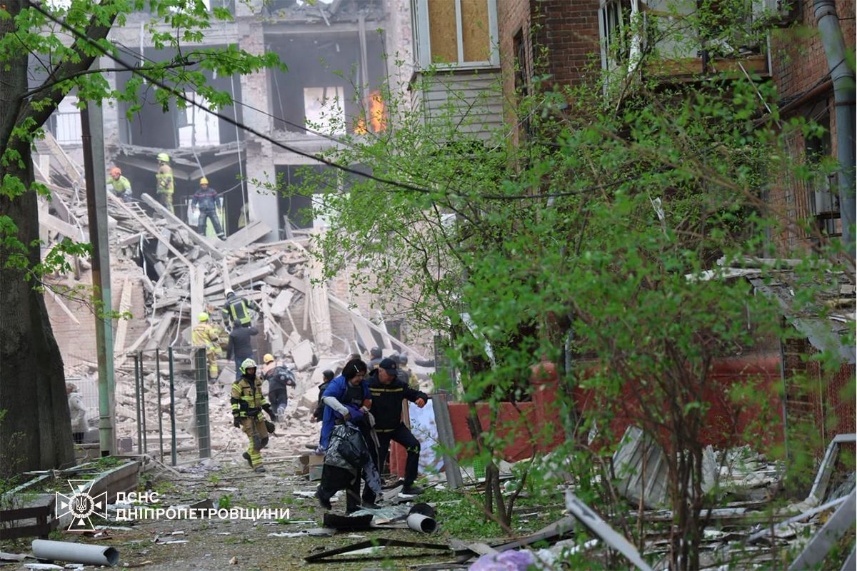
The aftermath of a Russian strike against Dnipro, Ukraine. (State Emergency Service/Telegram)
Russia launched 47 missiles and 619 drones overnight into the morning of April 25 — 12 Iskander-M ballistic missiles and S-300s, 29 Kh-101 cruise missiles, one Iskander-K, five Kalibrs, and roughly 400 Shaheds among the drones. It was the fourth Russian strike of over 500 weapons in April 2026 alone. Ukrainian air defenses intercepted 610 targets. Thirteen missiles and 36 drones struck 23 locations. Dnipro City was the primary target and absorbed strikes for over 20 hours. At least six people were killed nationally. At least 47 were injured in Dnipropetrovsk Oblast alone, including five children. By afternoon, Russia launched a second strike on Dnipro, hitting another residential building and killing one more person, injuring seven.
While Dnipro burned, Ukrainian drones were reported reaching Yekaterinburg in the Ural Mountains — 1,600 kilometers from the front line — and Chelyabinsk City nearby, in what would represent some of the longest-range drone strikes of the entire war. A Russian official acknowledged Ukraine had made the Urals an “immediate threat zone.” Drone debris from the overnight Russian barrage fell on Romanian territory near the port of Reni. British RAF Typhoons were scrambled at 2 a.m. to patrol NATO airspace.
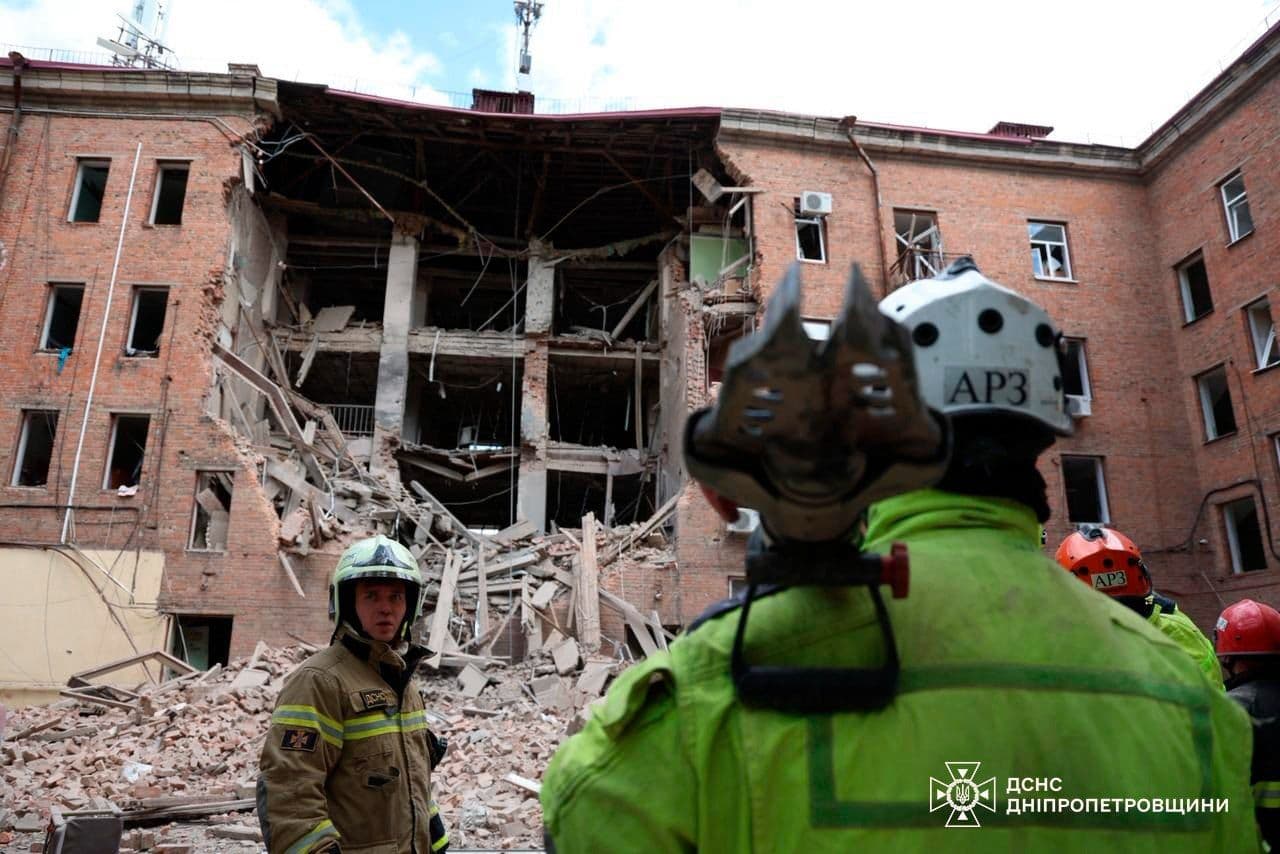
The aftermath of a Russian strike against Dnipro, Ukraine. (State Emergency Service/Telegram)
Zelensky, speaking from the rubble of his country, demanded the immediate implementation of air defense agreements reached in Cyprus. In Washington, Trump was evacuated from the White House Correspondents’ Dinner after a gunman opened fire at the security checkpoint. He was unharmed. The shooter was detained. The dinner was to be rescheduled. The war, unlike the dinner, would not be.
666 Missiles and Drones: Anatomy of Russia’s Largest April Strike
The strike package launched on the night of April 24 to 25 was the fourth time in April 2026 that Russia launched more than 500 aerial weapons in a single campaign — a frequency that Ukrainian military intelligence has assessed as deliberate, designed to degrade air defenses faster than they can be replenished. The composition: 12 Iskander-M ballistic missiles and surface-to-air missiles repurposed for ground attack; 29 Kh-101 cruise missiles launched by Tu-95MS strategic bombers from the Caspian Sea area at approximately 2:30 a.m.; one Iskander-K cruise missile; five Kalibr cruise missiles; and 619 Shahed, Gerbera, Italmas, and other drones, of which roughly 400 were Shaheds. Launch platforms spanned Bryansk, Oryol, Smolensk, Rostov, Krasnodar, and occupied Crimea.
Ukrainian forces intercepted 26 of the Kh-101 cruise missiles, all four Kalibrs, and 580 drones — 610 total intercepts. Thirteen missiles and 36 drones reached their targets at 23 locations. Debris from downed weapons fell at nine additional sites. The strikes hit Dnipro City, Chernihiv, Odesa, Kharkiv, Cherkasy, Mykolaiv, Kyiv Oblast, and Bila Tserkva. In Bila Tserkva — 80 kilometers south of Kyiv — a strike caused a large fire with heavy smoke, prompting authorities to advise residents to seal their windows. Six settlements in Mykolaiv Oblast were left without power. The national civilian toll: at least six dead and over 30 wounded, including two children, with numbers still rising as rescue operations continue into the afternoon.
ISW and Ukrainian military analysts assess this as a deliberate Russian strategy: launch massive multi-wave strikes using long-range drones and cruise missiles first — which Ukraine intercepts at high rates — to exhaust interceptor stockpiles before ballistic missiles arrive, which Ukraine struggles to intercept without Patriot systems. Russia typically withholds missiles for several days before launching large combined packages. GUR Deputy Head Major General Skibitskyi assessed that Russia is increasing the frequency of such strikes specifically to destroy Ukrainian infrastructure and shape the battlefield for the Spring-Summer 2026 offensive.
Double-Tap in Dnipro: 20 Hours of Strikes, Rescuers Targeted, at Least 47 Wounded
Dnipro City was the primary target of the April 25 campaign and received strikes for over 20 hours. The Dnipropetrovsk Oblast Military Administration head Hanzha described the attacks as purposefully targeting residential areas. A four-story residential building was partially destroyed in the overnight phase; the bodies of four people were recovered from the rubble and five more remained feared trapped as rescue crews worked through the morning.
Mayor Filatov then reported what he described as a deliberate double-tap: a second strike against first responders and Ukrainian government officials who had gathered at the site to coordinate rescue operations. This tactic — targeting rescuers at the scene of a previous strike — is documented across multiple Russian strike campaigns in this war and constitutes a war crime under international humanitarian law.
In the afternoon of April 25, Russian forces launched a second distinct strike against Dnipro City, hitting another residential building, killing one additional person and wounding seven more. By the time the afternoon toll was added to the overnight toll: at least six civilians killed in Dnipro, 46 wounded including five children, with 11 people remaining hospitalized. A 9-year-old boy was among those injured in the city.
In Kharkiv, strikes targeted the Nemyshlianskyi, Kyivskyi, and Shevchenkivskyi districts. A 54-year-old man and an 18-month-old boy — who suffered an acute stress reaction — were injured. A public transport stop was destroyed and a gas pipeline and private residence were damaged. In Odesa Oblast, three single-story residential buildings and a farm building were destroyed, with seven vehicles damaged and two people injured. In Zaporizhzhia Oblast, a Russian drone struck a civilian microbus in the village of Yurkivka, killing one person and wounding four. In Kherson City’s Dniprovskyi district, a Russian UAV struck a 52-year-old man walking outside at 6:30 a.m.; he was hospitalized with explosive injury, concussion, blast injuries, and a traumatic brain injury.
Drone Debris Falls on Romania: RAF Typhoons Scrambled Over NATO Territory
Debris from Russian drones fell on Romanian territory during the overnight strike, the Romanian Ministry of Defense confirmed on April 25. British Royal Air Force Eurofighter Typhoon jets were scrambled at 2:00 a.m. to monitor Romanian airspace. Pilots reported radar contact with a target approximately 1.5 kilometers from the Ukrainian port city of Reni and were authorized to engage the drones. Drone wreckage was subsequently found in Romania’s Galati region; it slightly damaged an auxiliary farm building and an electrical pole. No casualties were reported on Romanian soil.
The Romanian Defense Ministry issued a formal condemnation: “Such incidents demonstrate the Russian Federation’s disrespect for international law and endanger not only the safety of Romanian citizens but also the collective security of NATO.” The incident is the latest in a pattern of Russian drone debris falling on NATO member territory — a pattern that has repeatedly tested the alliance’s political will to respond without triggering Article 5 activation.
The Urals in the Crosshairs: Ukrainian Drones Reported Striking 1,700 Kilometers Into Russia
Geolocated footage published on April 25 shows smoke and damage to an apartment building in Yekaterinburg, Sverdlovsk Oblast, after a reported Ukrainian drone strike. A separate smoke plume was observed near the Chelyabinsk Metallurgical Plant in Chelyabinsk Oblast, with locals reporting explosions. Chelyabinsk Oblast Governor Teksler claimed that Russian forces repelled the strike against unspecified infrastructure, causing no damage — a claim that conflict with the footage circulating publicly.
Yekaterinburg and Chelyabinsk are each approximately 1,600 to 1,700 kilometers from the international border with Ukrainian-held territory. If confirmed, these would rank among the longest-range drone strikes Ukraine has conducted in the war. TASS reported that Ukrainian forces may have used an FP-1 long-range drone launched from Kharkiv Oblast. Ukraine previously struck the oil refinery in Ukhta, Komi Republic — over 1,780 kilometers from the border — in August 2025, and struck it again with an FP-5 Flamingo missile in February 2026.
The response from Russian officials and milbloggers was notable in its candor. Artem Zhoga, the Kremlin’s presidential representative to the Ural Federal District and a former commander of Russian proxy forces in Donbas, stated that “the Urals have now become vulnerable to Ukrainian drone strikes” and that Russians must now be vigilant. A prominent milblogger called for Russia to immediately increase air defenses near the Urals. Russian Security Council Secretary Shoigu had acknowledged in March that the Urals are in the “immediate threat zone” of Ukrainian drone strikes. The Ural region contains a significant concentration of Russian defense industrial base facilities — the factories and production lines that manufacture the weapons Russia is using against Ukrainian cities. Ukraine’s campaign to reach and strike them is not random. It is aimed at the source.
Ukrainian Deep Strike Campaign: Ammunition Depots, Command Posts, Drone Control Hubs
While Russia struck Ukrainian cities, Ukraine struck Russian military infrastructure across depth. The Ukrainian General Staff reported on April 25 that overnight strikes hit a Russian ammunition depot near occupied Bilolutsk in Luhansk Oblast (roughly 97 kilometers from the frontline), a command and observation post near occupied Lysychansk (36 kilometers from the frontline), and a troop concentration near occupied Solontsy (28 kilometers from the frontline). In Donetsk Oblast, Ukrainian SOF struck an equipment depot near occupied Boykivske (115 kilometers from the frontline) and a command and observation post near occupied Novopetrykivka (40 kilometers from the frontline).
In the Zaporizhzhia direction, Ukrainian forces struck equipment depots near occupied Novovasylivka (94 kilometers from the frontline), a command and observation post near occupied Svyatotroitske (63 kilometers from the frontline), drone control points near Hulyaipole and Zaliznychne, and a Russian manpower concentration area. In Sumy Oblast and across the border, Ukrainian forces struck a Russian command and observation post in Tetkino, Kursk Oblast, using an AASM Hammer precision glide bomb, and a manpower concentration near Sopych, northwest of Sumy City. A Russian troop concentration near Rodynske in the Pokrovsk direction was also struck overnight.
Sumy: New Offensive Southeast of the City, Fighting Continues North and Northeast
Russian forces continued attacking north, northeast, and southeast of Sumy City on April 25. The resumption of offensive operations toward Novodmytrivka and Taratutyne — southeast of Sumy City — which began April 24 after roughly a two-month pause, continued with reports of Russian movement toward Taratutyne. This southeast axis opens a new direction of pressure distinct from the northern border operations that have defined the Sumy front in recent months.
Kharkiv: Motorcycle Assault Toward Vovchanski Khutory, Bochkove Claimed, Kupyansk Pressure Intensifies
The Ukrainian 16th Army Corps reported on April 25 that elements of the Russian 127th Motorized Rifle Regiment of the 71st Guards Motorized Rifle Division conducted a motorized assault toward Vovchanski Khutory northeast of Kharkiv City for the first time in a long time, using dried-out roads to attempt to move rapidly through the drone kill zone. Ukrainian forces repelled the assault. The Russian MoD separately claimed that elements of the Russian 126th Motorized Rifle Regiment seized Bochkove, northeast of Kharkiv City — a claim ISW has not independently confirmed.
In the Kupyansk direction, Russian forces intensified infiltration attempts but did not advance. Colonel Trehubov confirmed that Russian forces have resumed infiltration attempts through Holubivka north of Kupyansk and via gas pipes, with particular activity near Kivsharivka southeast of Kupyansk. Russian forces continued offensive operations north of Borova without advance.
Donetsk: Kostyantynivka Held, Pokrovsk Advances, Bilytske Claimed
In the Kostyantynivka-Druzhkivka tactical area, geolocated footage published April 24 confirmed Ukrainian forces maintaining positions in southeastern Kostyantynivka, contrary to Russian claims. Ukrainian forces struck a Russian position northeast of Malynivka after a Russian infiltration mission, and hit a Russian manpower concentration area near Kostyantynivka overnight. Russian forces continued operations in the area without confirmed territorial advances.
In the Pokrovsk direction, geolocated footage published April 24 confirms Russian forces recently advanced northwest of Hryshyne. A Russian milblogger claimed Russian forces seized Bilytske, north of Pokrovsk, and advanced southwest of the settlement. A Ukrainian brigade spokesperson reported that Russian forces increase the size of infiltration groups during poor weather — exploiting low drone visibility — and are primarily using infantry on foot close to the frontline while deploying motorcycles and ATVs in rear areas. Ukrainian forces struck a Russian troop concentration near Rodynske overnight. Russian forces continued limited operations in the Dobropillya, Novopavlivka, and Oleksandrivka directions without confirmed advances. The Slovyansk direction saw continued offensive operations with Ukrainian counterattacks ongoing.
Southern Axis: Hulyaipole Infiltration, Zaporizhzhia Counterattacks, Kherson ‘Human Safari’
In the Hulyaipole direction, geolocated footage confirmed a Russian infiltration mission northwest of Myrne, southwest of Hulyaipole, which Ukrainian forces struck. Ukrainian forces continued their strike campaign in the Zaporizhzhia direction, hitting equipment depots and drone control points across occupied territory. Russian forces continued offensive operations in western Zaporizhzhia Oblast as Ukrainian forces counterattacked. The “human safari” drone strike campaign targeting civilians in the Kherson direction continued alongside limited Russian ground attacks.
Russia’s Economy Contracts for the First Time Since 2023 as Putin’s Rating Hits a Four-Year Low
Russia’s GDP contracted in January and February 2026 by 1.8 percent compared with the same period the previous year, according to Rosstat, Russia’s official statistics agency — the first economic contraction since 2023. Experts assessed the drop will be difficult to offset even with the additional oil revenue Russia has gained from elevated global prices during the Middle East conflict. The Russian economy faces compounding pressures: years of war spending, labor shortages from military recruitment, and Western sanctions weakening trading capacity.
The economic deterioration coincides with Putin’s approval rating reaching its lowest recorded level since before the February 2022 invasion. VTsIOM showed Putin’s approval at 65.6 percent for the week of April 13 to 19 — a decline of 4.5 points since late March and more than 12 points below late December 2025. The decline tracks a Kremlin crackdown on the Russian internet that has directly disrupted daily life: in March, Russian authorities blocked Telegram, YouTube, and Facebook, attempting to push users toward the state-approved “super-app” Max, which critics warn could be used as a mass surveillance tool. Rolling internet outages — affecting Moscow and other major cities — have disrupted online banking, GPS navigation, and communications. Putin acknowledged the outages publicly for the first time on April 24. The Kremlin has instructed state media to cite more favorable polling numbers from the FOM institute or omit polling data entirely.
Kremlin Prepares Russians for New Mobilization Call-Up
A prominent Kremlin-affiliated Russian ultranationalist milblogger, Mikhail Zvinchuk of the Rybar channel, gave an interview on Russian state television on April 21 in which he publicly framed the case for a future reserve call-up — without naming it as mobilization. Zvinchuk argued that Russia’s problem is not manpower quantity but unit cohesion: up to 80 percent of Russia’s personnel casualties in 2025, he claimed, were among first-time volunteer and contract soldiers operating in small assault groups sent on missions “on the fly.” The solution, he argued, requires the simultaneous one-time recruitment of a large number of people to build properly cohesive formations — an argument that functions, in practice, as a preparation of the Russian public for accepting another reserve call-up.
ISW assesses that the Kremlin has been setting conditions for limited, rolling reserve call-ups to compensate for rising casualties and a falling recruitment rate. Zvinchuk’s appearance on state television with this framing is consistent with the Kremlin’s practice of using coopted media figures to socialize difficult policy changes before they are announced officially — the same pattern preceded the September 2022 partial mobilization that generated significant domestic discontent. Russia’s recruitment rate is falling; its casualty rate is rising. The arithmetic points in one direction.
Orban Steps Down From Parliament, Keeps Fidesz Chairmanship Bid
Outgoing Hungarian Prime Minister Viktor Orban announced on April 25 that he will step down from parliament following Fidesz’s electoral defeat on April 12, while signaling his intention to remain as party chairman if re-elected at the party’s upcoming congress. Orban said the parliamentary mandate “belongs to Fidesz” and should be returned, with his role needed instead to reorganize what he called the national movement. A nationwide party meeting is planned for the following week; the leadership congress has been delayed to June, when delegates will vote on his continued chairmanship. Peter Magyar’s Tisza party secured a decisive victory in the April 12 elections with record voter turnout, ending Orban’s 16-year grip on power.
Zelensky in Azerbaijan: Defense Deals, Six Agreements, Trilateral Talks Offer
Zelensky arrived in Azerbaijan on April 25 for talks with President Aliyev in Gabala — his first official visit to the South Caucasus since Russia’s full-scale invasion. The two leaders signed six bilateral agreements spanning defense-industrial cooperation, energy, food security, and trade. Ukraine has already deployed a team of military specialists to Azerbaijan to share drone warfare and air defense expertise; Zelensky briefed on their work before the summit. “We will definitely develop our cooperation and co-production,” Zelensky said.

President Volodymyr Zelensky (left) wtith Azerbaijani President Ilham Aliyev in Gabala, Azerbaijan. (Ilham Aliyev/X)
Zelensky also voiced readiness for trilateral peace talks among Ukraine, Russia, and the United States to take place in Azerbaijan — “if Russia is ready for diplomacy.” The offer puts Baku forward as a potential neutral venue, a significant gesture given Azerbaijan’s maintained relations with both Ukraine and Russia — a relationship that deteriorated when Russian air defenses shot down an Azerbaijani airliner in December 2024, killing 38 people. Aliyev highlighted bilateral trade now exceeding $500 million and pledged to grow it further.
Russian Oil Waiver Will Not Be Extended Again, Bessent Says
US Treasury Secretary Scott Bessent said in an interview published April 25 that Washington does not plan to renew the sanctions waiver allowing countries to purchase Russian oil stranded at sea after the current General License expires on May 16. “I wouldn’t imagine that we’d have another extension. I think the Russian oil on the water has been largely sucked up,” Bessent said. The waiver had been issued April 17 — after Bessent had initially said it would not be renewed — following appeals from “vulnerable and poor countries” at IMF and World Bank meetings. Bessent said the same logic applies to Iranian oil: without another extension, Iran would have to start shuttering production within days.
Trump Evacuated from White House Correspondents’ Dinner After Shooting
US President Trump and First Lady Melania Trump were rushed off stage and evacuated from the White House Correspondents’ Dinner at the Hilton hotel in Washington on the evening of April 25 after a gunman opened fire at the security checkpoint. Seven to eight shots were fired. A Secret Service agent was injured. The suspect charged a checkpoint armed with multiple weapons and was taken down by Secret Service agents. Law enforcement moved toward the suspect’s California apartment. Trump said he was unharmed, praised Secret Service and law enforcement, and said the dinner would be rescheduled in 30 days. World leaders including Canadian Prime Minister Carney and Mexican President Sheinbaum expressed relief. The suspect’s motive was not immediately confirmed; Trump said it was unclear whether the incident was connected to the US war with Iran.
Trump Cancels Iran Envoy Trip, Witkoff and Kushner Stay Home
Trump announced on April 25 that he had personally canceled a planned trip by envoys Steve Witkoff and Jared Kushner to Pakistan for indirect talks with Iran. “I said, nope, you’re not making an 18-hour flight to go there. We have all the cards,” Trump said. Iranian Foreign Minister Araghchi had already left Islamabad before the planned meeting, effectively ending the diplomatic round. The cancellation comes as the Iran-US ceasefire continues under an indefinite extension. The same envoys — Witkoff and Kushner — are the ones whose continued absence from Kyiv Zelensky has criticized repeatedly.
Trump Extends Israel-Lebanon Truce for Three More Weeks
US President Trump announced on April 25 that he extended the ceasefire between Israel and Lebanon for an additional three weeks, following talks with senior Israeli and Lebanese representatives in the Oval Office alongside Vice President Vance, Secretary of State Rubio, and US ambassadors to both countries. Trump called it a “very historic meeting” and said the US would continue working with Lebanon to defend itself against Hezbollah. The initial truce had been reached earlier in April as Washington sought to prevent regional escalation. Trump said he looks forward to meeting Israeli Prime Minister Netanyahu and Lebanese President Aoun.
Countering Russia’s War on Faith: US Bipartisan Legislation Targets Religious Persecution in Ukraine
A bipartisan group of US lawmakers introduced the Countering Russia’s War on Faith Act in both the House and Senate on April 25. The legislation, led by Helsinki Commission Chairman Joe Wilson and supported by senators Kennedy and Whitehouse, requires the Secretaries of State and Defense to jointly report on Russian efforts to suppress religious freedom in Ukraine and occupied territories, and directs the president to impose sanctions on those found complicit. More than 600 places of worship have been damaged or destroyed during the invasion; more than 50 Ukrainian clergy have been killed. Protestant, Catholic, Crimean Tatar Muslim, and Orthodox communities not aligned with the Russian Orthodox Church have faced raids, forced re-registration, and criminal prosecution in occupied territory. Foreign Minister Sybiha welcomed the measure. The legislation also comes amid Congressional scrutiny of the US Treasury’s General License 134B, a 30-day sanctions waiver on Russian oil sales that Zelensky condemned as “money for war.”
Russia’s Signal Phishing Campaign: Berlin Names Moscow, 300 German Accounts Breached
Germany publicly attributed a large-scale phishing campaign against Signal messaging accounts to Russia on April 25, Der Spiegel reported, citing German government sources. Berlin said the attack “presumably originated in Russia” and targeted at least 300 accounts belonging to individuals in the political sphere, including Bundestag President Julia Klöckner. The attackers persuaded users to disclose security verification codes and passcodes, allowing access to personal accounts, group chats, and phone numbers. Affected individuals were notified by German security services; their devices were checked to halt data leakage.
The campaign is consistent with a global Russian cyber operation targeting Signal and WhatsApp accounts of government officials, military personnel, and civil servants that the Dutch AIVD described in March. The FBI’s director said in March that Russian intelligence-linked actors were specifically targeting messaging services. Signal acknowledged the attacks publicly. The campaign forms part of Russia’s broader hybrid warfare strategy against Ukraine’s Western allies — shifting from ransomware and financially motivated attacks toward disruptive and destructive operations targeting government communications infrastructure.
666 missiles and drones. A four-story building in Dnipro, a double-tap on the rescuers, an afternoon strike on a second building. Drone debris on Romanian farmland, RAF Typhoons over NATO airspace at 2 a.m. Ukrainian drones over the Ural Mountains, 1,700 kilometers from the front. A Kremlin milblogger on state television explaining why Russia needs to mobilize again without calling it mobilization. Orban resigning from parliament with plans to remain. Zelensky offering Azerbaijan as a peace venue while Russia strikes his cities for 20 consecutive hours. Trump evacuated from a dinner in Washington. The envoys who should be in Kyiv are not going to Pakistan either. Day 1,522 ends the way the war has always ended each day: with everything still unresolved, and Ukraine absorbing the cost of that.
A Prayer for Ukraine
1. For Dnipro, Struck Twice in One Day
Lord, a four-story building came down in the night and people climbed over the rubble looking for survivors, and then a second strike hit the rescuers. Six dead in the city. A 9-year-old boy injured. Five more still feared under the debris when the afternoon brought another strike on another building. Be present in Dnipro tonight — in the hospitals, in the shelters, in the apartments that are still standing and full of people who are trying to understand whether to stay or leave. Hold the rescuers who went back after the double-tap. They went back.
2. For the 18-Month-Old Boy in Kharkiv
Father, the medical record says ‘acute stress reaction.’ An 18-month-old does not have words for what happened when the drone struck. He has only the body’s memory of the sound and the shaking and the sudden terror. Be near him. Be near whoever is holding him. Let him grow up in a country that is no longer being bombed, and let that come soon enough that what happened tonight does not define what he becomes.
3. For the Civilian Killed in the Minibus in Zaporizhzhia
God, someone was riding a minibus in Yurkivka. Four others were wounded. A vehicle on a road — not a military column, not a supply truck, not an ammunition depot. A minibus. Receive the one who died in it. Let the four who were wounded recover. And let the courts and tribunals that are building their cases have enough evidence from enough days like this one to produce consequences that match the scale of what is being documented.
4. For the Rescuers Who Went Back After the Double-Tap
God of the courageous, they knew the tactic. Everyone knows the tactic. Russia strikes once, waits for rescuers to arrive, strikes again. They went anyway. Some of them were injured in the second strike. None of them stopped. This is the shape of Ukrainian civil courage in the fourth year of this war: not the absence of fear, but the decision to go back into the rubble regardless. Hold them. Let them come home from the shift.
5. For the Factories in the Urals and the Reckoning They Represent
Lord, Ukrainian drones reached the Ural Mountains tonight — 1,700 kilometers from the front — and a Russian official said his region is now vulnerable. Those mountains contain the factories that make the weapons that kill Ukrainians. The drones are trying to reach the source. We do not pray for destruction. We pray for this war to end before every last missile in every last depot has been launched at every last apartment building in Dnipro. Bring it to an end. In Your mercy, in Your justice, in Your time — bring this war to its end, and let the ending be worthy of what Ukraine has endured.