
Ukraine Daily Briefing | May 7, 2026 | Day 1,534 of the Full-Scale Invasion
Ukraine struck the Lukoil-Permnefteorgsintez oil refinery in Perm — 1,500 kilometers from the front line, one of Russia’s largest — setting fires at the isomerization unit and the AVT-2 crude processing unit. The same night, Ukrainian forces struck a Project 22800 Karakurt-class missile corvette near Kaspiysk, Dagestan, capable of launching Kalibr cruise missiles, and drones reportedly hit a Defense Ministry logistics complex in Naro-Fominsk, 70 kilometers southwest of Moscow. Zelensky named these strikes “long-range sanctions.” Russia responded by formally announcing its May 8–10 ceasefire terms, threatening a “massive missile strike” and possible Oreshnik IRBM launches against Kyiv if Ukraine disrupted the parade, and urging foreign diplomats to evacuate the capital — a threat every major Western government rejected. Russian attacks on May 7 killed 13 Ukrainians and injured 54, including five dead in Sumy, which declared a day of mourning. Russia canceled its Victory Day parade in Perm hours after the refinery strike; total parade cancellations now stand at ten jurisdictions.
The Day’s Reckoning
The night of May 6 to 7 was Ukraine’s answer to 1,820 ceasefire violations. Zelensky called it explicitly: “long-range sanctions.” The Lukoil-Permnefteorgsintez refinery in Perm — 13 million tons of oil per year, jet fuel and diesel for Russian forces, 1,500 kilometers from the Ukrainian border — was struck by drones of the Ukrainian Unmanned Systems Forces’ 1st unit overnight. Explosions and fires broke out at the isomerization unit and the AVT-2 crude oil processing unit. By morning, the Perm regional governor had acknowledged the strike on an “industrial facility” and Perm City had canceled its May 9 parade.
The same night, Ukrainian forces struck a Karakurt-class small missile corvette near the Russian naval base in Kaspiysk, Republic of Dagestan — a vessel capable of launching Kalibr cruise missiles from the Caspian Sea. Separately, Ukrainian drones reportedly struck the Nara production and logistics complex in Naro-Fominsk, Moscow Oblast — a Defense Ministry facility for storing and distributing military supplies, 70 kilometers southwest of the Kremlin. The Naro-Fominsk claim could not be independently verified, but it arrived on the same night that 26 drones were downed approaching Moscow itself, with flight restrictions imposed at Vnukovo and Domodedovo airports.
Russia’s response was to escalate its threats. The Russian Defense Ministry formally announced the terms of its May 8–10 ceasefire while simultaneously warning it would launch a “massive missile strike” on Kyiv’s decision-making centers if Ukraine disrupted the parade. Russian State Duma deputies went further: they invoked the Oreshnik intermediate-range ballistic missile by name, calling the statements Russia’s “last warning to Brussels.” The Russian Foreign Ministry summoned ambassadors and formally urged foreign diplomatic missions to evacuate Kyiv. Germany, the EU, Poland, and others each responded with the same word: no.
Thirteen Ukrainians were killed across the country on May 7. Five in Sumy, where officials declared a day of mourning. Six in Donetsk Oblast. Two in Zaporizhzhia. Fifty-four more were injured. The Kremlin’s own milbloggers, meanwhile, criticized the MFA’s threats as empty — noting that if Russia could strike Kyiv’s decision-making centers, it should have done so already, and that a large-scale strike against central Kyiv would only “waste Russian leverage.”
Perm Lukoil Refinery Struck: Fires at AVT-2 and Isomerization Units
Ukrainian Unmanned Systems Forces Commander “Magyar” Brovdi confirmed on May 7 that the USF’s 1st unit struck the Lukoil-Permnefteorgsintez refinery in Perm City overnight. The Ukrainian General Staff confirmed fires at the isomerization unit and the AVT-2 crude oil processing unit. The refinery is designed to process approximately 13 million tons of oil annually and produces gasoline, diesel, and jet fuel used to support Russian armed forces. Geolocated footage published on May 7 shows smoke rising from the facility. Defense outlet Militarnyi reported the An-196 Lyutyi long-range drone was used in the attack.
Perm Krai Governor Dmitry Makhonin acknowledged “a Ukrainian drone struck an industrial facility in Perm City,” stated there were no casualties, and noted that an apartment building and administrative building were also damaged. Independent Russian outlet Astra confirmed the facility as the Lukoil-PNOS refinery based on available footage and noted it is “one of Russia’s largest and most technologically advanced refineries.” Astra also reported that the defense company JSC UEC-STAR — which produces engine components for MiG-31 fighter jets and Ka-52 and Mi-8 helicopters — is located 600 meters from the building that was struck.
This is the second consecutive week that Ukrainian drones struck Perm oil facilities; an oil pumping station in the city was hit on April 29 and 30. Ukraine’s Defense Ministry stated it struck 14 Russian refineries throughout April. Zelensky said on May 7 that he had also mentioned recent strikes in Chelyabinsk, Yekaterinburg, Novorossiysk, and Tuapse. The total damage to Russian oil infrastructure from Ukrainian long-range strikes in 2026 stands at approximately $7 billion, according to Zelensky. Makhonin announced hours after the strike that Perm City’s May 9 Victory Day parade was canceled, “to ensure the safety of residents and not to distract law enforcement.”
Karakurt Corvette Struck Near Kaspiysk; Logistics Hub Hit Near Moscow
The Ukrainian General Staff reported on May 7 that Ukrainian forces struck a Project 22800 Karakurt-class small missile corvette near the Russian naval base in Kaspiysk, Republic of Dagestan, approximately 1,000 kilometers from the front line. The Karakurt class is capable of launching Kalibr cruise missiles. The extent of damage is still being assessed. The strike extends Ukraine’s naval interdiction campaign, which has previously struck Karakurt-class vessels in the Black Sea and Azov Sea, to the Caspian Sea — a body of water Russia previously considered beyond the reach of Ukrainian strikes.
Ukrainian drones also reportedly struck the Nara production and logistics complex in Naro-Fominsk, Moscow Oblast, a Russian Defense Ministry facility used to store and distribute military supplies, according to independent Telegram outlet Exilenova Plus. Naro-Fominsk is approximately 70 kilometers southwest of Moscow and 390 kilometers from Ukraine’s northeastern border. The claim could not be independently verified by the Kyiv Independent. Separately, Moscow Mayor Sobyanin reported that 26 drones were downed approaching Moscow overnight, with temporary flight restrictions imposed at Vnukovo and Domodedovo airports.
Russia’s Ceasefire Announcement and the Oreshnik Threat
The Russian Defense Ministry formally announced on May 7 the terms of its unilaterally-declared ceasefire: all Russian forces will completely cease hostilities from midnight May 8 to midnight May 10, including ground operations, frontline drone and artillery strikes, and long-range drone and missile strikes. The MoD called on Ukraine to “follow this example” and reiterated its warning that Russian forces will launch a “massive” missile strike on Kyiv’s decision-making centers if Ukraine does not comply. Kremlin aide Yuri Ushakov confirmed Russia deliberately did not invite foreign leaders to the celebrations this year and revoked the accreditation of foreign journalists for the parade.
Russian State Duma deputies — who function as amplifiers of Kremlin rhetorical lines — claimed on May 7 that Russian forces may use Oreshnik intermediate-range ballistic missiles in retaliatory strikes against Kyiv, calling the statements Russia’s “last warning to Brussels.” ISW assessed that the invocation of the Oreshnik reflects Putin’s pattern of periodically deploying or threatening the weapon at key moments to attempt to compel capitulation, and that the threats are primarily a cognitive warfare effort to disguise the weakness that Ukraine’s deep-rear strikes have exposed. ISW noted that Russia has conducted failed efforts to compel Ukrainians to leave Kyiv through false portrayals of Russian military capabilities throughout the war.
Russian milbloggers offered pointed internal criticism: one said Russian forces should have struck Kyiv’s decision-making centers earlier in the war if they have the capability; a second questioned why Russia does not respond to daily Ukrainian strikes on Russian cities and oil infrastructure; a third VKS-affiliated milblogger argued that a genuinely effective strike on central Kyiv would require a large package of drones, missiles, and Oreshniks and would “waste” remaining Russian options for leverage, leaving only strikes on military targets or nuclear weapons. The conclusion of the milblogger analysis is that Russia is unlikely to follow through on its most dramatic threats.
Every Western Embassy Stays in Kyiv; Fico Will Skip the Parade
Russian Foreign Ministry spokesperson Zakharova formally urged all foreign diplomatic missions and international organization offices in Kyiv to ensure the “timely evacuation” of staff and citizens ahead of May 9, citing an “inevitable retaliatory strike.” The responses arrived in sequence throughout May 7. German Foreign Minister Johann Wadephul: “We will not be intimidated by this.” EU spokesperson El-Anouni: “As for us, the EU, we will not change our posture or presence in Kyiv. Russian attacks are a daily reality in Kyiv and elsewhere in Ukraine.” Ukrainian FM Sybiha thanked Germany, Poland, the EU, and all partners who “clearly opposed Russia’s attempts to intimidate the foreign diplomatic corps in Ukraine.” No embassy announced any plan to reduce its Kyiv presence.
Slovak Prime Minister Robert Fico will travel to Moscow for Victory Day but will not attend the parade itself and will only lay flowers at the Tomb of the Unknown Soldier, Slovakia’s Deputy Foreign Minister Rastislav Chovanec confirmed at a European Affairs Committee meeting on May 7. Fico may convey messages from Zelensky to Putin and obtain information on how Putin views efforts to end the war. Fico is the only EU leader traveling to Moscow; Lithuania, Latvia, and Estonia have barred him from using their airspace. Zelensky said Ukraine “does not recommend” that foreign representatives attend the May 9 parade, and noted that some Russia-friendly countries had reached out to Ukraine about their plans.
Kremlin Internal Documents: Russia’s “After Victory” End-State Scenario
Russian investigative outlet Dossier Center published on May 7 presentation slides titled “After Victory,” reportedly created by employees of Russian Presidential Administration Deputy Head Sergei Kiriyenko, outlining the “most plausible scenario” for the end of the war and frameworks for selling a peace agreement to the Russian population. A source close to the Presidential Administration told Dossier Center the presentation was created because of Kremlin concern about poor battlefield performance and the war’s effect on the Russian economy. Work reportedly began as early as February 2026.
The presentation’s “most plausible scenario” envisioned: Russia gaining control of Donetsk and Luhansk oblasts, withdrawing from Sumy and Kharkiv oblasts, freezing the frontline in Kherson and Zaporizhzhia oblasts; the United States signing two separate peace agreements with Russia and Ukraine; U.S. sanctions lifted, European sanctions maintained; Ukraine with neutral status as a “buffer zone” between Russia and the West; Zelensky remaining as president; and only “symbolic and restrained denazification” of Ukraine. The presentation acknowledged that continuing the war would require full economic mobilization, general conscription, and would worsen Russia’s demographic crisis. It also outlined strategies for silencing ultranationalist milblogger opposition to a peace deal, including threatening them with discrediting the military.
ISW assessed that Russia may have intentionally leaked the slides as a cognitive warfare effort to portray itself as willing to compromise. The scenario is not Russia’s official negotiating position and presents as a major concession territory Russia has not seized and is unlikely to seize militarily in the near to medium term. The framing — that Russia would “withdraw” from Sumy and Kharkiv oblasts — describes pulling back from positions Russian forces currently hold in limited areas of those oblasts, not a genuine territorial concession.
13 Killed, 54 Injured; Sumy Declares Day of Mourning
Russian attacks on May 7 killed 13 people and injured 54 across Ukraine. In Sumy Oblast, five people were killed and twelve injured; Sumy City Council declared May 7 a day of mourning. In Donetsk Oblast, six people were killed and six injured. In Zaporizhzhia Oblast, two people were killed and twelve injured; Russia struck the region 797 times, targeting 50 settlements. In Kharkiv Oblast, eight people were injured across 15 settlements, with civilian infrastructure damaged. In Kherson Oblast, twelve people were injured, with critical civilian infrastructure struck. In Dnipropetrovsk Oblast, four people were injured across five settlements from approximately 30 artillery and drone strikes.
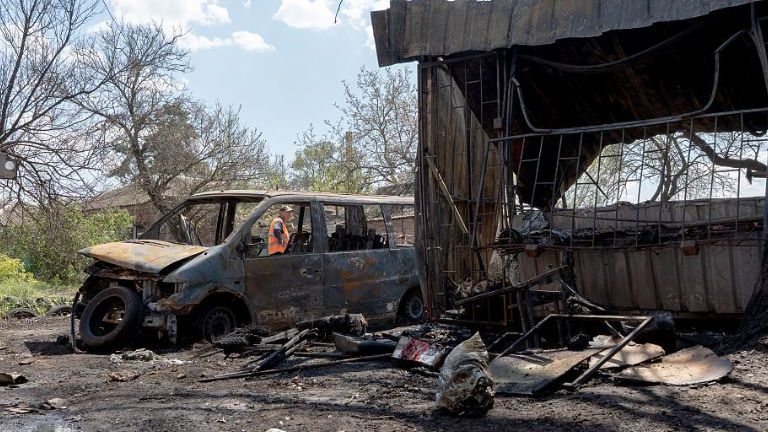
A burned vehicle and damaged structure are seen following a Russian drone attack, in Kharkiv. (Polina Kulish / Gwara Media / Global Images Ukraine / Getty Images)
Russia launched 102 Shahed, Gerbera, Italmas, Parodiya, and other drones overnight from Bryansk, Kursk, and Oryol cities; Millerovo, Rostov Oblast; Primorsko-Akhtarsk, Krasnodar Krai; occupied Donetsk City; and occupied Hvardiiske, Crimea. Ukrainian forces downed 92 of 102 drones; eight struck six locations; debris fell on four additional locations. Russian forces struck railway infrastructure in Mykolaiv Oblast and residential infrastructure in Kharkiv Oblast. Russia also struck locomotives and railway networks in several regions while continuing attacks against Ukraine’s energy system.
Drones Enter Latvia: Two Crash Near Rezekne Oil Facility
Latvia’s National Armed Forces reported on May 7 that several drones entered Latvian airspace from Russia, with two crashing on Latvian territory. One drone crashed near an oil storage facility in Rezekne in eastern Latvia near the Russian border; the second had not been located as of the initial report. Latvian officials confirmed the crashed drone carried a warhead. Authorities stated they could not shoot down the drones due to uncertainty about civilian safety in populated areas. Latvian Defense Minister Andris Spruds stated that preliminary information suggests the drones were Ukrainian, directed at targets in Russia, and emphasized that Ukraine has every right to defend itself and to strike legitimate military targets on Russian territory.
The Russian Defense Ministry claimed on May 7 that Russian forces detected six drones, two French Rafale jets, and two F-16 jets in Latvian airspace, and that Russian forces downed one drone in Russian airspace near Pskov Oblast. ISW assessed the Russian MoD’s framing is a continuation of Russia’s effort to set informational conditions to justify potential future air defense activity against NATO airspace, portraying Baltic states as passively allowing Ukrainian strike drones to use their territory. A false claim circulated on social media alleging a “Ukrainian drone” struck a Latvian passenger train and forced passengers to sign NDAs; Latvian police formally refuted this as “deliberately disseminated false information.” The train fire on May 5 near Nicgale was caused by suspected engine damage.
Umerov Arrives in Miami; Three Priorities for U.S. Talks
Rustem Umerov, Secretary of Ukraine’s National Security and Defense Council, arrived in Miami on May 7 to meet U.S. envoy Steve Witkoff, President Zelensky confirmed. A White House official confirmed meeting preparations were underway. Zelensky outlined three priorities for the talks: first, humanitarian issues including a new round of prisoner-of-war exchanges; second, diplomatic progress, with Ukraine in constant contact with the U.S. while aware of parallel U.S.-Russia communications; third, specific security tasks related to U.S.-Ukraine cooperation. Zelensky said Umerov had been given “several specific security-related instructions.”
Ukraine is also preparing agreements with European partners on drone production deals and expanded joint technological cooperation. Key unresolved sticking points in the broader peace process include Russian territorial demands over Donetsk Oblast, the status of the Zaporizhzhia nuclear power plant, and Ukraine’s insistence on freezing the current front line as the basis for any ceasefire. Moscow has not made negotiations a priority; Russian Foreign Minister Lavrov said in April that talks with Ukraine are “not currently a priority.” Bloomberg reported that Kyiv had hoped Witkoff and Kushner would travel to Ukraine but Washington has grown cautious about renewed engagement that might again fail to produce results.
Frontline: Pryshyb Claimed, Mechanized Repelled in Kupyansk, Rubikon Targets Lyman Logistics
A Russian milblogger and a source reporting on the Northern Grouping of Forces claimed on May 7 that Russian forces seized Pryshyb, northwest of Lyman, in the Slovyansk direction; ISW has not independently confirmed this claim. In the Kupyansk direction, a Ukrainian brigade reported repelling a Russian mechanized assault on May 7, destroying one armored fighting vehicle and 12 all-terrain vehicles. A second Ukrainian brigade in the Kupyansk direction stated Russian forces have recently intensified activity, likely in order to claim battlefield successes ahead of Victory Day, but are not conducting large group assaults. A third Ukrainian brigade reported Russian forces continue small-group infiltration missions in the area. Russian forces additionally struck Izyum with glide bombs.
The spokesperson of a Ukrainian brigade in the Lyman direction reported on May 7 that elite drone operators of the Rubikon Center for Advanced Unmanned Technologies have intensified strikes targeting Ukrainian logistics, fortifications, and troop movements in the direction. ISW assesses Rubikon as largely responsible for Russia’s operational battlefield air interdiction successes — degrading Ukrainian capabilities ahead of ground operations. A Ukrainian servicemember reported that both sides are struggling to move in the Lyman direction because Russian drones track any movement, creating additional complications for logistics on both sides.
In the Kostyantynivka-Druzhkivka area, a company commander reported that Russian forces have reduced the frequency of infiltrations due to low success rates, but are now deploying mine-equipped unmanned ground vehicles and heavy bomber drones. The line of contact has not moved more than one kilometer in either direction in three years. In western Zaporizhzhia Oblast, a Kremlin-affiliated milblogger stated the situation is “worsening for Russian forces” as Ukrainian forces restored positions between Stepnohirsk, Pavlivka, and Orikhiv. Ukrainian forces struck a Russian BM-21 Grad MLRS near Hulyaipole with FPV drones, producing secondary detonation from exploding ammunition. Russian forces conducted limited operations in Sumy, Kharkiv, Velykyi Burluk, Borova, Slovyansk, Dobropillya, Pokrovsk, Novopavlivka, Oleksandrivka, Hulyaipole, western Zaporizhzhia, and Kherson directions without confirmed advances.
Ukrainian Mid-Range Strikes on Russian Rear Assets
Ukrainian forces struck a Russian drone pilot training center in Khrustalnyi, Luhansk Oblast (90 km from the front), on May 5, confirmed by geolocated footage published May 7. The General Staff reported strikes on a Russian command post in Sosnivka, Luhansk Oblast (80 km), and a fuel and lubricants warehouse near Smolyanynove (54 km) overnight May 6–7. Ukrainian forces also struck a drone command post near occupied Yasne, Donetsk Oblast (67 km), a manpower concentration near occupied Dersove (126 km), a logistics depot and command and observation point of the Russian 5th Combined Arms Army in occupied Donetsk Oblast, and a manpower concentration near occupied Smile, Zaporizhzhia Oblast (34 km). Ukrainian forces struck a Russian Peroed electronic warfare system worth approximately $30,000, a drone signal amplifier, and a vehicle in the North-Slobozhansk direction.
Russia’s Occupied Territories: Children’s Deportation, Cossack Schools, Artek Drones
ISW published a detailed assessment on May 7 of Russia’s escalating summer deportation campaign for Ukrainian children. Russian Deputy Prime Minister Chernyshenko claimed approximately 50,000 children from occupied Ukraine will attend summer camps in Russia and occupied territories in 2026. Documented transfers include 160 children from occupied Starobilsk Okrug to camps in Karachay-Cherkessia, 500 children from occupied Luhansk Oblast to camps in occupied Crimea sponsored by Voronezh Oblast, and children from occupied Zaporizhzhia Oblast to camps in Crimea and the Republic of Karelia under the “Day After Tomorrow” program. ISW assesses the summer camp programs are a primary mechanism for Russification and indoctrination of Ukrainian youth, exposing them to pro-Russian ideals they carry back to occupied communities.
Russian Cossack organizations are expanding into occupied Ukrainian schools: Cossack classes will begin in schools in occupied Donetsk City, Makiivka, Dokuchayevsk, and Mariupol on September 1, 2026, for students from fifth grade upward, focusing on patriotic education, Russian military history, and providing preferential university admission to Cossack-affiliated institutions. The Artek children’s center in occupied Crimea — already sanctioned by the U.S., UK, and EU for its role in child deportation — jointly funded a 3D printing lab in occupied Kherson Oblast that has been printing drone and tactical munitions components for Russian forces since March, with “hundreds” of components produced. Zarnitsa 2.0, Russia’s military-patriotic youth competition, held its municipal stage for 360 students in occupied Zaporizhzhia Oblast, with training in drone control, tactical medicine, and combat engineering.
In occupied Donetsk Oblast, the occupation administration has identified over 26,000 properties as “ownerless” since June 2023, transferred approximately 20 percent to municipal ownership, and is now seizing 32 enterprises and 400 properties in newly captured areas. The occupation administration requires at least 7,000 apartments to house workers imported from Russia to fill staffing shortages — explicitly using housing as an incentive for Russian relocation. In occupied Zaporizhzhia Oblast, occupation official Vladimir Rogov acknowledged in a Telegram post that “hundreds of thousands” of lifelong residents have been unable to register their own property rights for four years, describing the disenfranchisement as “systemic.” A resident of occupied Enerhodar was sentenced to five and a half years in prison for social media posts calling for strikes on Russian oil refineries.
Forest Fire in Chernihiv; Russia Drops Propaganda Leaflets on Sumy
A massive forest fire is burning across approximately 2,400 hectares of northern Chernihiv Oblast near the Russian border, Ukraine’s Northern Forest Office reported on May 7. Emergency crews cannot access the area because it lies within a five-kilometer border zone where Russian FPV drones continuously operate. The fire, designated an “emergency situation,” was caused by Russian attacks on May 5. Workers are attempting to prevent the fire from spreading further but cannot reduce the area already burned. Nine separate forest fires in Sumy and Chernihiv oblasts were reported over a three-day period from falling Russian drones; 16.3 hectares were destroyed in the earlier incidents.
Russian drones dropped propaganda leaflets and counterfeit banknotes over Sumy City. The leaflets contained messages invoking themes of “shared roots” and “brotherhood,” including slogans such as “Our grandfathers were brothers in the trenches.” Imitation cash was dropped alongside the leaflets to attract civilian attention. Sumy Regional Military Administration head Oleh Hryhorov warned residents: “It is an attempt at provocation. Be careful.” Ukrainian law enforcement and military agencies warned that items dropped from drones could conceal explosive devices and urged residents not to approach them.
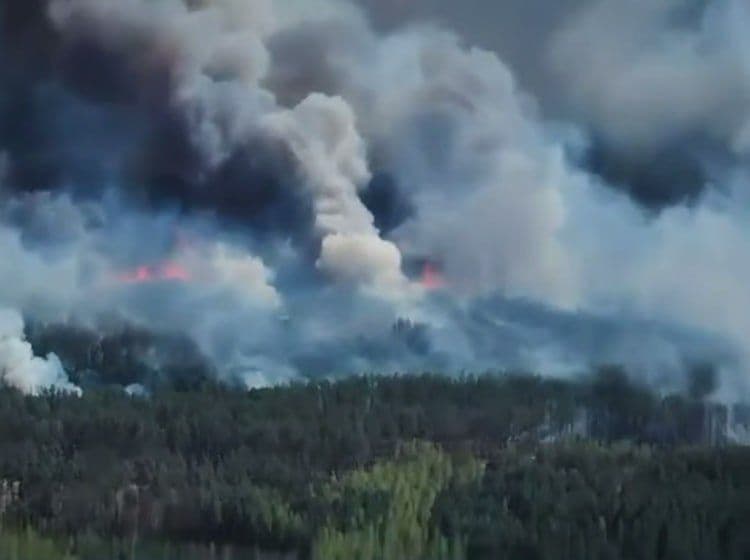
A massive forest fire caused by Russia’s war is burning across northern Chernihiv Oblast, Ukraine. (Ukraine’s Northern Forest Office/Facebook)
Armenia Says It Is Not Russia’s Ally; IOC Lifts Belarus Sports Sanctions; Hungary ECFR Survey
Armenian Prime Minister Nikol Pashinyan stated on May 7 that Armenia “is not an ally” of Russia’s war against Ukraine and confirmed he will not attend the May 9 Victory Day parade in Moscow. The Russian Foreign Ministry summoned the Armenian ambassador on May 7 to express “righteous indignation” over Zelensky’s visit to Yerevan on May 4, calling Armenia’s hosting of Zelensky a “betrayal.” Zakharova accused the “friendly, brotherly country” of Armenia of hosting a “terrorist.” Pashinyan’s response was direct: Armenia sent humanitarian aid to Ukraine and is not on Russia’s side. Armenia formally remains a CSTO member but has been drifting toward the EU; President Khachaturyan signed legislation last year to begin EU accession.

Illustrative image: A woman walks past a Victory Day banner in central Moscow. (Igor Ivanko / AFP via Getty Images)
The IOC Executive Board withdrew its recommendation for sanctions against Belarusian athletes on May 7, potentially allowing Belarus to compete under its national flag in international sports. Restrictions on Russian athletes remain in place, with the Russian Olympic Committee still suspended. Belarus has not directly participated in the war but allowed Russia to use its territory as a staging ground for the February 2022 invasion. Separately, a European Council on Foreign Relations survey of Magyar’s Tisza party voters in Hungary published on May 7 found that only 41% support unblocking Ukraine’s EU accession talks, while 57% of Tisza voters oppose military aid to Ukraine and 14% oppose financial aid. Nationally, only 12% of Hungarians support military aid and 24% support financial aid. Magyar has confirmed his government will not send arms to Ukraine but is expected to end Orban-era obstruction of EU-level aid initiatives.
Italy’s UniCredit announced the sale of its Russian subsidiary. Schengen visa issuance to Russian citizens surged. The International Federation of Journalists expelled the Russian Union of Journalists. Perm City canceled its Victory Day parade; total parade cancellations in Russian jurisdictions now stand at ten.
ICRC Responds on Oleshky; Ceasefire Context
Ukraine’s Human Rights Ombudsman Dmytro Lubinets reported on May 7 that the ICRC indicated readiness to assist in organizing evacuation of civilians from Oleshky in occupied Kherson Oblast. Lubinets had previously appealed to both Russia’s human rights commissioner and the ICRC for over a month without response. The ICRC’s confirmation of readiness to engage is the first institutional response to Ukraine’s documented request for evacuation corridors. As of May 7, approximately 2,000 civilians remain in Oleshky with no safe evacuation route, limited food, no running water, and under constant Russian drone threat.
Russia will impose total mobile internet restrictions in Moscow on May 9 — including the previously available “whitelisted” sites — with only fixed-line internet and Wi-Fi unaffected. The Russian digital development ministry confirmed the restrictions, citing security during Victory Day events. ISW’s assessment: the ceasefire Russia is proposing while simultaneously threatening massive missile strikes against Kyiv is not a good-faith peace initiative. Its function is to protect a parade, not to protect lives. The decision on whether to honor it — or to respond in a “mirror-like manner” — now rests with Ukrainian commanders on the night of May 8.
The Weight of May 7
Ukraine struck the Perm Lukoil refinery, a Karakurt warship in the Caspian Sea, and a logistics hub near Moscow. Zelensky called them “long-range sanctions.” Every Western embassy stayed in Kyiv. Perm canceled its parade. Ten jurisdictions have now canceled.
Russia threatened Oreshnik missiles against Kyiv. Russia’s own milbloggers said: if you could do it, you should have done it already; a large strike would waste your remaining leverage. The Kremlin’s most dramatic threats are being quietly undermined by the people who most want Russia to win.
Thirteen people died. Five in Sumy, where the city declared a day of mourning. Six in Donetsk Oblast. Two in Zaporizhzhia, where Russia struck 797 times across 50 settlements. A forest fire burning 2,400 hectares in Chernihiv cannot be reached because the drones never stop.
The Kremlin’s internal documents envision a peace deal that requires Russia to withdraw from Sumy and Kharkiv oblasts as a “concession.” These are territories Russia entered weeks ago and cannot fully hold. Russia is preparing to sell a withdrawal as a victory. The slides say so plainly.
Tomorrow is May 8. Russia’s ceasefire begins at midnight. Ukraine will decide what that means.
A Prayer for Ukraine
1. For the Thirteen Who Died on May 7
Lord, five in Sumy Oblast. Six in Donetsk Oblast. Two in Zaporizhzhia. Sumy City declared a day of mourning for people killed on a Wednesday in May, in what has become the most common kind of Wednesday in Ukraine. Receive each of them. Hold the 54 who are injured across the country. And hold Sumy, which has mourned too many Wednesdays.
2. For the Forest That Is Burning
Father, 2,400 hectares of forest are burning in northern Chernihiv Oblast near the Russian border, and the firefighters cannot reach it because the drones never stop. The fire was set by Russian attacks. The forest is dying in a border zone where no one can go. We pray for the emergency workers watching from a safe distance, unable to do the work they came to do. And we pray for the land itself — the soil and the trees and the water table under them — which has no ambassador, no diplomatic immunity, and no evacuation option.
3. For the Children in the Summer Camps
God of children, 50,000 children from occupied Ukraine will be sent to Russian summer camps this summer. They will return to occupied communities carrying Russian ideologies they were given without their parents’ consent. Some will not return at all. The Artek center that organizes their transit is now also printing drone components. We pray for each of those children by the name we do not know — that something in them remains untouched. That the adults in their lives who remember Ukraine as it was can give them enough of it to hold onto.
4. For the Diplomats Who Stayed
Lord, Russia told every foreign embassy in Kyiv to leave. Germany said no. The EU said no. Poland said no. Ukraine’s Foreign Minister thanked them by name. We pray for the diplomats who are in Kyiv tonight — not for their physical safety alone, though that too — but for the meaning of their presence. That the people of Kyiv, who sleep in the city that Russia has threatened to strike with Oreshnik missiles, know that they are not alone in it.
5. For the Night of May 8 to 9
God of justice, the ceasefire Russia announced begins at midnight tonight. We do not know yet what Ukraine will decide. We do not know if the guns will go quiet or if the drones will fly. We know only that Russia proposed this ceasefire while threatening to destroy Kyiv, while invading a kindergarten in Sumy, while setting forest fires it will not let anyone extinguish. We pray for the Ukrainians who will be awake at midnight — the commanders, the soldiers, the civilians in cities Russia has promised to strike if its parade is inconvenienced. Give them wisdom, and courage, and the kind of protection that only You can give. Bring this war to its end — not for a parade, but for the living.