
Ukraine Daily Briefing | May 8, 2026 | Day 1,535 of the Full-Scale Invasion
U.S. President Donald Trump announced on May 8 a three-day ceasefire from May 9–11 and an exchange of 1,000 prisoners of war from each side, brokered through American mediation. Zelensky signed a formal decree authorizing Russia’s Victory Day parade by excluding Red Square from Ukrainian weapons targeting from 10 a.m. Kyiv time on May 9. Hours before the announcement, Ukraine struck the Slavneft-YANOS oil refinery in Yaroslavl — one of Russia’s five largest, processing 15 million tons annually — the Lukoil-Permnefteorgsintez refinery for the third time in a week, a drone depot and air navigation center in Rostov-on-Don, the 42nd Motorized Rifle Division headquarters in Grozny’s Khankala neighborhood, and an FSB building in Znamenskoe, Chechnya. Russia, meanwhile, launched 140 combat engagements and 850 drone strikes on May 8 in violation of its own ceasefire, while fires spread across the Chornobyl Exclusion Zone after drone crashes ignited 1,180 hectares. Russian forces have likely lost their last positions in central Kupyansk. Six Ukrainians were killed and 58 injured. Zelensky confirmed Ukraine expects Trump’s envoys in Kyiv at the turn of spring and summer.
The Day’s Reckoning
The day resolved, against most expectations, with a deal. Trump announced it on Truth Social in capital letters: a three-day ceasefire, May 9–11, and 1,000 prisoners of war from each side. Zelensky confirmed Ukraine had received the request and accepted. Kremlin aide Ushakov confirmed Russia agreed. Zelensky signed an official decree: Red Square would be excluded from Ukrainian weapons targeting for the duration of the parade beginning at 10 a.m. Kyiv time on May 9. “Red Square is less important to us than the lives of Ukrainian prisoners who can be returned home,” he said. The decree made clear that only Red Square was off-limits; the rest of Russia was not mentioned.
Before the announcement, Ukraine had been conducting strikes across Russia at an intensity calibrated to demonstrate exactly what the ceasefire was being offered to prevent. The Slavneft-YANOS refinery in Yaroslavl — 15 million tons per year, one of Russia’s five largest, 700 kilometers from the Ukrainian border — was struck and set ablaze. The Lukoil-Permnefteorgsintez refinery in Perm was struck for the third time in a week, this time also hitting the Perm oil pumping station operated by Transneft. Drones struck a drone storage depot and the air navigation administrative building in Rostov-on-Don — suspending operations at the regional air traffic control center and forcing restrictions at 13 southern Russian airports, with 80+ flights delayed or canceled and 14,000 passengers stranded. Geolocated footage confirmed hits on the 42nd Motorized Rifle Division headquarters in Grozny’s Khankala neighborhood, and on an FSB building in Znamenskoe, Republic of Chechnya. The Radar Research and Development Center in Rostov-on-Don was also struck the previous night.
The day’s other landmark: Russian forces have likely lost their final positions in central Kupyansk. A Russian milblogger reported that the last group of approximately 20 soldiers who had been encircled in the Kupyansk City Hospital since December 2025 — holding on for five months while Ukrainian forces systematically eliminated every other Russian position in the city — “fought their last battle” after a Ukrainian airstrike destroyed the hospital. ISW assessed that Russian forces likely no longer hold positions in central Kupyansk.
Russia, meanwhile, reported conducting 140 combat engagements and 850 drone strikes on May 8 — while simultaneously claiming its unilateral ceasefire was in effect and blaming Ukraine for violations. Zelensky: “All this clearly shows that there was not even an imitation of a ceasefire from the Russian side.” The Chornobyl Exclusion Zone, where two crashed drones ignited fires, was burning across 1,180 hectares as firefighters worked around unexploded ordnance left from Russia’s 2022 occupation of northern Ukraine.
Trump’s Ceasefire Announcement and Zelensky’s Parade Decree
Trump posted his announcement on Truth Social: “I’m pleased to announce that there will be a THREE DAY CEASEFIRE (May 9th, 10th, and 11th) in the War between Russia and Ukraine. The Celebration in Russia is for Victory Day, but, likewise, in Ukraine, because they were also a big part and factor of World War II. This Ceasefire will include a suspension of all kinetic activity, and also a prison swap of 1,000 prisoners from each Country.” Trump claimed the ceasefire had been agreed to by both Zelensky and Putin, and wrote: “Hopefully, it is the beginning of the end of a very long, deadly, and hard fought War.”
Zelensky confirmed Ukraine received the request and is working to prepare for the prisoner exchange. His signed decree formally excludes Red Square from Ukrainian targeting during the parade from 10 a.m. Kyiv time on May 9 and includes precise GPS coordinates of the area. A Presidential Office official clarified: “They were concerned about one specific square, and now, as part of the diplomatic process, permission has been granted to hold a parade in that square.” In terms of a broader ceasefire, Ukraine will respond to Russia in kind. Zelensky called on the U.S. to pressure Russia into maintaining the truce: “We expect the United States to ensure the implementation of the agreements by the Russian side.” Kremlin aide Ushakov confirmed Russia agreed to the three-day ceasefire and the 1,000-for-1,000 prisoner exchange. Kremlin spokesman Peskov took exception to the tone of Zelensky’s decree: “Woe to anyone who tries to make light of Victory Day. And we don’t need anyone’s permission.”
Yaroslavl Refinery, Perm Third Strike, Rostov-on-Don Air Navigation Hub
Ukrainian forces struck the Slavneft-YANOS oil refinery in Yaroslavl City overnight May 7–8, confirmed by the Ukrainian General Staff and Zelensky on May 8. The refinery is one of Russia’s five largest, processing approximately 15 million tons of crude oil annually and producing gasoline, diesel, and jet fuel. The facility is jointly owned by Rosneft and Gazprom through the Slavneft joint venture. Yaroslavl Oblast Governor Yevrayev acknowledged a Ukrainian drone struck an industrial facility in the oblast. Geolocated footage shows a large fire at the refinery’s territory. Yaroslavl is approximately 700 kilometers from Ukraine’s border and 230 kilometers northeast of Moscow.
The SBU confirmed a third strike on the Lukoil-Permnefteorgsintez refinery in Perm overnight May 7–8, this time also striking the Perm linear production dispatch station operated by Transneft — a strategic hub that distributes crude in four directions including toward the refinery itself. A fire broke out at a crude oil processing unit; a storage tank at the pumping station was damaged. Perm Krai Governor Makhonin confirmed a Ukrainian drone struck an industrial facility in Perm City. Satellite imagery shows smoke rising from the refinery. The SBU said the strikes aim to disrupt oil processing, complicate military logistics, and force Moscow to divert resources to repairs. Zelensky stated the total damage to Russian oil infrastructure in 2026 now stands at approximately $7 billion.
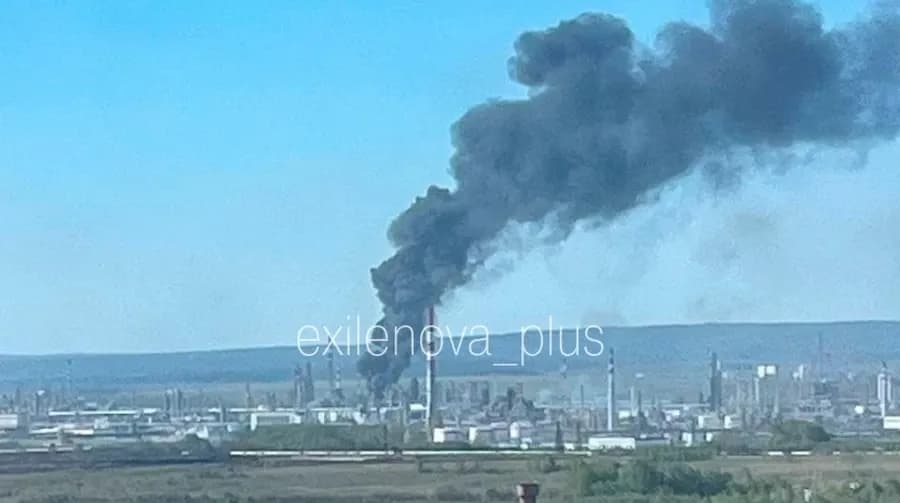
Smoke rises above the Lukoil-Permnefteorgsintez oil refinery in Perm, Russia, following a reported Ukrainian drone strike overnight. (Telegram)
Ukrainian drones struck a drone storage depot in Rostov-on-Don, causing explosions and fire in the city’s western industrial district near the Empils chemical plant and the Radar Scientific and Technical Center. Ukrainian drones also struck the administrative building of the Southern Russia Air Navigation branch — the regional center managing air traffic across southern Russia — temporarily suspending its operations. Russia’s Transport Ministry confirmed the strike. Rosaviatsia introduced temporary airport restrictions at 13 southern Russian airports including Sochi, Krasnodar, Grozny, Mineralnye Vody, and Volgograd. The Association of Russian Tour Operators reported over 80 flights delayed or canceled, with at least 14,000 passengers awaiting departure. Rostov-on-Don Mayor Skryabin declared a state of emergency in the Zheleznodorozhny District.
Grozny and Znamenskoe: Ukraine Strikes Chechen Military HQ and FSB
Geolocated footage published on May 7 shows Ukrainian forces striking a building in Grozny’s Khankala neighborhood — approximately 865 kilometers from the front line — where the headquarters of the Russian 42nd Motorized Rifle Division (58th Combined Arms Army, Southern Military District) is reportedly located. The 42nd MRD is one of Russia’s most prominent units, historically stationed in Chechnya and deployed extensively in Ukraine. Separately, geolocated footage published on May 8 shows Ukrainian drones striking a Russian FSB building in Znamenskoe, Republic of Chechnya, approximately 810 kilometers from the front line. Ukraine previously struck an FSB border guard building in occupied Crimea’s Armiansk in late May.
Also confirmed from previous nights: geolocated footage from May 7 shows fires at the Radar Research and Development Center in Rostov-on-Don following a likely Ukrainian strike. The strikes in Chechnya and Rostov-on-Don represent continued expansion of Ukraine’s mid-range strike campaign into military headquarters, intelligence buildings, and defense research facilities well behind the front.
Kupyansk: Russia Loses Its Last Position in the City Center
A Russian milblogger reported on May 7 that a group of roughly 20 Russian soldiers who had reportedly remained encircled in the Kupyansk City Hospital since December 2025 — surrounded, resupplied by drone, and reduced from a larger group by Ukrainian operations over five months — “fought their last battle” after a Ukrainian airstrike destroyed the hospital. The milblogger’s phrasing implied Russian forces no longer hold positions in central Kupyansk. Ukrainian Joint Forces Task Force Spokesperson Trehubov had previously reported only six active Russian call signs in the city center in March, and approximately ten in April. Russian sources reported as of May 8 that fighting continues only in the town’s northwestern outskirts. ISW assessed that Ukrainian forces likely eliminated any enduring Russian positions in central Kupyansk, while noting it has not observed granular evidence sufficient to formally update its control-of-terrain assessment. ISW will continue monitoring.
Azov Corps Drones Reach Mariupol: Interdiction of Highways 105 km from Front
The Ukrainian 1st Azov National Guard Corps reported on May 8 that it struck Russian military targets near occupied Mariupol, Donetsk Oblast — approximately 105 kilometers from the front line — and is conducting drone interdiction of Russian logistics at depths of up to 160 kilometers from drone operator positions. Geolocated footage from May 6 and 8 confirms Ukrainian drones operating along and striking a truck on the T-0509 Mariupol-Donetsk City highway at a point roughly 95 kilometers from the front. Additional footage from the Azov Corps shows drones operating within Mariupol itself along the M-14 Mariupol-Berdyansk-Melitopol highway. The T-0509 supplies Russian forces operating north of Mariupol and the ongoing Russian offensive against Ukraine’s Fortress Belt; the M-14 supports Russian logistics to the Orikhiv direction and the Dnipro’s east bank.
ISW assessed that Ukraine’s ability to strike moving targets over 100 kilometers from the front line — in areas where Russia previously conducted logistics with relative impunity — will achieve partial battlefield air interdiction effects, degrading Russia’s ability to conduct offensive operations and support for future Ukrainian counterattacks. ISW has observed a marked increase in the intensity and frequency of Ukrainian mid-range strike operations since March 2026. The 1st Azov Corps released drone footage of Mariupol, showing the Azovstal Steel Plant and Russian military facilities: “Azov is already patrolling its hometown. For now, from the air. But there’s more to come.”
Russia Claims Ceasefire While Launching 140 Engagements and 850 Drone Strikes
Russia’s Defense Ministry claimed on May 8 that its forces “fully ceased combat operations” from midnight as part of the unilateral ceasefire and acted only in response to Ukrainian actions, asserting Ukraine committed 1,365 ceasefire violations including 153 artillery strikes and 887 drone attacks. Ukraine’s account: Russian forces conducted 140 combat engagements on May 8, launched over 850 drone strikes including FPV and Lancet loitering munitions, and the heaviest fighting occurred along the Slovyansk axis. “All this clearly shows that there was not even an imitation of a ceasefire from the Russian side,” Zelensky said. Russia also continued Oreshnik missile threats: Russian Foreign Minister Lavrov stated Russia would show “no mercy” if Ukraine tried to disrupt Victory Day. ISW assessed Lavrov’s invocation of Oreshniks remains primarily a cognitive warfare tool and that Russia’s most dramatic threats are unlikely to be executed because doing so would eliminate remaining leverage.
Russian forces launched 67 Shahed, Gerbera, Italmas, Parodiya, and other drones overnight May 7–8 from Bryansk, Kursk, Oryol, Millerovo (Rostov Oblast), Primorsko-Akhtarsk (Krasnodar Krai), and occupied Hvardiiske (Crimea). Ukrainian forces downed 56 of 67 drones; 11 struck eight locations; debris fell on seven locations. Russian strikes damaged residential, railway, and industrial infrastructure in Dnipropetrovsk and Kharkiv oblasts.
Six Killed, 58 Injured; Chornobyl Exclusion Zone Burns 1,180 Hectares
Russian attacks on May 8 killed six people and injured 58 across Ukraine. In Donetsk Oblast, four people were killed: two in Dobropillia, one in Kramatorsk, one in Maiaky, with three others injured. In Sumy Oblast, one 52-year-old woman was killed and three injured; Russian forces conducted nearly 50 attacks on 31 settlements over the past 24 hours. In Zaporizhzhia Oblast, one person was killed and twelve injured; Russia struck 48 settlements 917 times. In Kherson Oblast, 22 people were injured by strikes on civilian infrastructure. In Kharkiv Oblast, ten people were injured including three children — two 7-year-old girls and a 15-year-old girl in Kharkiv City — across 17 settlements. In Dnipropetrovsk Oblast, eight people were injured in approximately 30 strikes across the oblast; fires broke out in Pavlohrad.
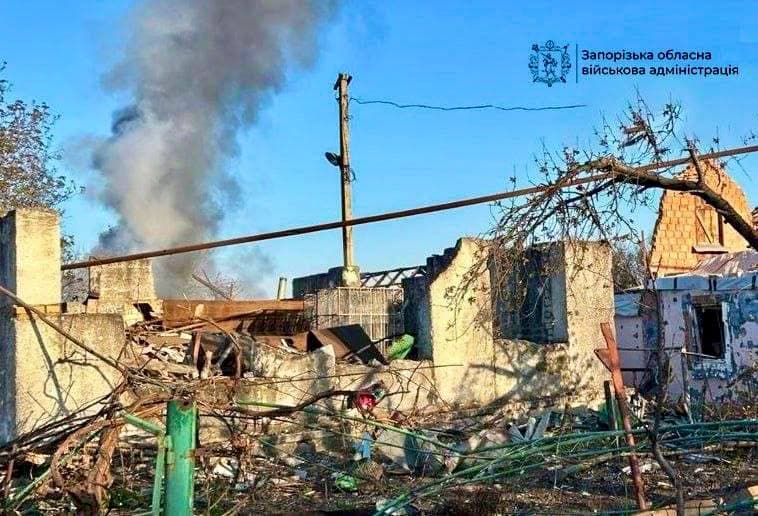
Aftermath of a Russian overnight strike on Zaporizhzhia Oblast. (Zaporizhzhia Regional Military Administration/Telegram)
The Chornobyl Radiation and Ecological Biosphere Reserve reported on May 8 that two drone crashes caused a fire in the Chornobyl Exclusion Zone spanning at least 1,180 hectares. Dry weather conditions, high winds, and landmines left from Russia’s 2022 occupation of northern Ukraine are complicating firefighting efforts. Radiation levels in the area remain within normal limits: 0.19 to 0.35 μSv/h, according to the reserve. Ukraine’s Ministry of Internal Affairs confirmed radiation is stable as of late morning. Emergency crews face suspended operations in sections of forest contaminated with explosive hazards. Separately, the forest fire in Chernihiv Oblast near the Russian border has expanded from 2,400 hectares on May 7 to approximately 4,300 hectares on May 8; the fire front is now moving toward Russian territory. Firefighters cannot access the area due to continuous Russian FPV drone operations in the five-kilometer border zone.
Lukashenko in Moscow; Parade Guest List; Corruption Tapes Expand
Belarusian President Alexander Lukashenko arrived in Moscow on May 8 ahead of the May 9 Victory Day parade. Russian and Belarusian state media confirmed Putin and Lukashenko will meet on May 8 to discuss bilateral cooperation. Among the foreign leaders confirmed for the celebrations: Slovak PM Robert Fico (who will not attend the parade itself but will meet Putin and lay flowers at the Tomb of the Unknown Soldier), Malaysian King Sultan Ibrahim, and Laotian President Thongloun Sisoulith. Milorad Dodik, former president of Bosnia and Herzegovina’s Republika Srpska, is also expected. The Kremlin confirmed it deliberately did not invite foreign leaders from Western countries and revoked journalist accreditations from ARD, ZDF, Sky News, AFP, Rai, and NHK, permitting only Russian state media coverage.
New leaked audio transcripts in Ukraine’s largest ongoing corruption scandal were published on May 8 by Ukrainska Pravda and lawmakers, expanding the alleged scheme beyond the energy sector. The latest episode reportedly implicates the banking and defense industries and centers on the construction of four luxury homes near Kyiv. A man referred to only as “Vova” — a diminutive of Volodymyr — is briefly mentioned as involved. Presidential Office Adviser Mykhailo Podoliak stated on May 7 that Zelensky’s comments on the scandal must wait until after a court ruling: “Next comes the court’s decision, and after that there may be political commentary.” The transcripts contain additional alleged links between Zelensky’s former business partner Timur Mindich and then-Defense Minister Rustem Umerov. Ukraine’s Defense Ministry anti-corruption watchdog formally called for Umerov’s suspension. Podoliak called it “a bit strange” to make personnel decisions based on published transcripts. In the span of one year the scandal has produced nine criminal charges and cost three ministers their positions.
Russian Kremlin Demands Ukrainian Withdrawal from Donetsk as Ceasefire Precondition
Kremlin Presidential Aide Yuri Ushakov stated on May 7 that another round of trilateral U.S.-Ukrainian-Russian negotiations makes no sense until Ukraine takes “one serious step”: withdrawing from unoccupied Donetsk Oblast. ISW assessed this demand explicitly: Russian forces have been unable to seize the unoccupied part of Donetsk Oblast on the battlefield. The demand is for Ukraine to surrender territory Russia cannot take militarily, as a prerequisite for Russia to agree to a ceasefire it can use as a platform for a renewed offensive against less prepared Ukrainian positions. ISW notes that Russian battlefield performance is declining: Russian daily advances have fallen to 2.9 square kilometers per day in the first four months of 2026, Russian forces suffered a net territorial loss in April, and Russian casualty rates are exceeding recruitment rates. The Kremlin is demanding its largest concession at the moment of its weakest leverage.
The Kremlin’s internal “After Victory” presentation (leaked May 7) also outlined a reframing strategy for domestic audiences: shifting the propaganda narrative from “territories seized” toward “territories held,” acknowledging that the original objectives are no longer achievable. Kremlin employees have reportedly been instructed to reframe the war around what Russia controls rather than what it failed to capture. Russia is also reportedly testing the Sarmat ICBM again after multiple failed tests. Commander-in-Chief Syrskyi reported Russia is deploying four additional anti-drone regiments, 24 battalions, and 162 batteries around Moscow and Krasnodar Krai in response to Ukrainian strikes, and is copying Ukrainian drone organizational solutions. Russia’s 2026 FPV drone production target is 7.3 million units; 7.8 million combat UAV components.
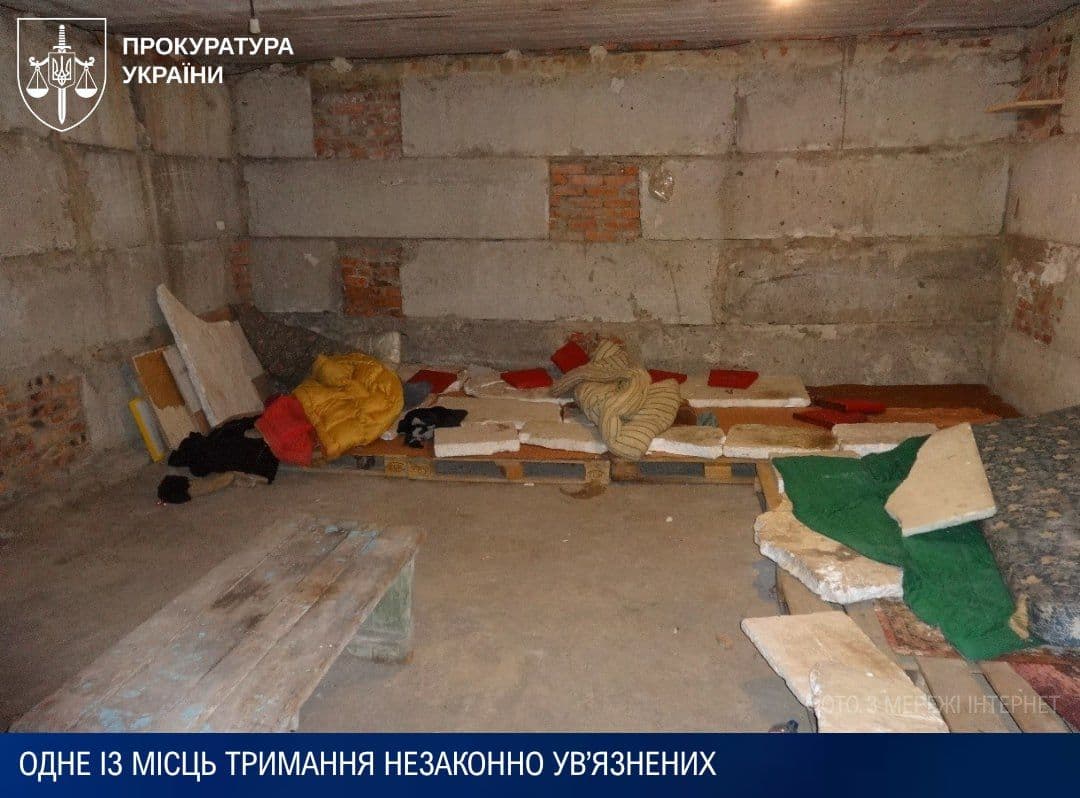
The interior of the Russian-controlled Izolyatsia prison camp in occupied Donetsk. (Ruslan Kravchenko / Telegram)
Syrskyi: Ukrainian Drones Carried Out 357,000 Combat Missions in April
Commander-in-Chief Syrskyi reported on May 8 that Ukrainian drone systems carried out nearly 357,000 combat missions in April 2026, striking more than 160,700 verified targets — a 2 percent increase over March. Ukraine suppressed over 7,700 Russian drone operator positions during the month. Mid-range strike systems operating at 20–250 kilometers struck 424 Russian targets in April. Ground robotic systems now handle over 60 percent of logistics transportation for front-line troops, also conducting casualty evacuation and mine-laying operations. Since December 2025, for five consecutive months, Ukrainian unmanned systems units alone have neutralized more Russian personnel than Russia has managed to recruit. Syrskyi also noted Russia is copying Ukrainian drone tactics, techniques, and organizational structures, deploying additional turbojet-engine drones and expanding electronic warfare use in border regions.
Umerov Meets Witkoff and Kushner; U.S. Envoys Expected in Kyiv
Rustem Umerov, Secretary of Ukraine’s National Security and Defense Council, met U.S. envoys Steve Witkoff and Jared Kushner in Miami on May 8. Zelensky confirmed on May 8 that the negotiations were “substantive” and that Ukraine expects Trump’s envoys to visit Kyiv “at the turn of spring and summer.” Topics discussed: humanitarian issues including POW exchanges, peace process efforts, and details of Washington-backed security guarantees for Ukraine. This is the first confirmed meeting between Umerov and Witkoff and Kushner together. The Trump envoys have previously traveled to Moscow to meet Putin but have not yet visited Ukraine.
Secretary of State Rubio told reporters in Italy on May 8 that U.S. efforts to broker peace have “stagnated” and “have not led to a fruitful outcome for a variety of reasons.” Rubio said the U.S. remains open to playing a mediating role “if it can be productive” but “we don’t want to waste time and energy on efforts that are not moving forward.” He described the war as a “tragedy” and said: “Every time I hear about these things, it just reminds us why this war needs to end.” Rubio also said the U.S. is reassessing global military commitments given limited resources and competing priorities.

U.S. Secretary of State Marco Rubio speaks to the press in Rome. (Stefano Rellandini/AFP via Getty Images)
Frontline: Ukrainian Advances in Slovyansk and Hulyaipole Directions
Ukrainian forces recently advanced in the Slovyansk direction: geolocated footage from May 7 shows Russian forces striking Ukrainian positions in northern and eastern Dibrova, Kramatorsk Raion, indicating Ukrainian forces advanced in those areas. In the Hulyaipole direction, geolocated footage from May 7 confirms Ukrainian forces advanced northwest of Solodke. Russian forces claimed but did not confirm the seizure of Kryva Luka east of Slovyansk. Russian forces conducted infiltration missions in southern Kostyantynivka; geolocated footage from May 8 shows Ukrainian forces striking Russian servicemembers along the T-0504 Pokrovsk-Kostyantynivka highway after a Russian infiltration. Ukrainian forces maintained positions in areas Russian sources previously claimed, including near southern Novodmytrivka north of Kostyantynivka. Myropillya northwest of Sumy City: the Ukrainian Kursk Group of Forces stated the Russian MoD’s May 2 claim of seizing the town is false.
Ukrainian forces struck two Russian Buk-M3 air defense systems in occupied Donetsk Oblast, a Tor-M2 air defense system near Mykhailivka in Zaporizhzhia Oblast, a Kasta-2E radar near Mysove in Crimea, a Strela-10 air defense system and drone control points in occupied Zaporizhzhia Oblast, and a communications tower in occupied Donetsk Oblast. In occupied Luhansk Oblast, Ukrainian forces struck railway tank cars carrying fuel, an underground fuel storage facility, an additional fuel depot, an ammunition depot, and a manpower and equipment concentration. Russian forces in the Oleksandrivka direction continue to experience coordination issues after losing Starlink access in February 2026; a Ukrainian officer noted infantry activity has declined and decision-making speed has fallen. Russian forces continued operations in Kupyansk, Borova, Pokrovsk, Novopavlivka, Oleksandrivka, western Zaporizhzhia, and Kherson directions without confirmed advances.
War Crimes and Accountability: France Arrests Izolyatsia Collaborator; AFP Documents Torture
Law enforcement authorities in France arrested on May 8 a Ukrainian man charged with committing war crimes at the Russian-run Izolyatsia torture prison in occupied Donetsk. The man, who had been living as a refugee in France since 2021, is accused of voluntarily collaborating with Russian occupation authorities from 2017–2019 and assisting the prison head in torturing detainees. Nine victims have been identified. France’s National Anti-Terrorist Prosecutor’s Office opened a criminal investigation after Ukrainian prosecutors and Truth Hounds appealed for French cooperation. The suspect faces charges of war crimes and crimes against humanity. Ukraine’s Prosecutor General Kravchenko: “No borders will be a protection for individuals involved in crimes against Ukrainians.” The arrest is only the second time a foreign country has detained an individual for crimes committed in Ukraine, following Finland’s 2023 arrest of Russian-Norwegian Rusich co-leader Yan Petrovsky.
AFP published on May 8 a detailed investigation into systematic torture of Ukrainian prisoners in Russian detention, based on nine testimonies including from three former Russian prison officers who have since fled Russia. Former prison guards confirmed they were given explicit verbal authorization for unrestricted violence against Ukrainian prisoners of war, with no documentation required and no accountability. Documented abuse: beatings on arrival to every detention center, mock executions, simulated hangings, electric shocks including to genitals, forced stress positions, food deprivation, forced singing of Soviet songs, and systematic isolation from outside contact. Artem Andriyenko’s case: a Ukrainian surgeon carving “Glory to Russia” onto a prisoner’s stomach during surgery. The WHO registered more than 3,000 attacks on Ukraine’s healthcare system on May 8 during 1,534 days of war.
Ukraine’s GDP Fell 0.5% in Q1 2026; Inflation at 8.6%; Shadow Fleet and Starlink
Ukraine’s State Statistics Service reported on May 5 that real GDP fell 0.5% year-on-year in the first quarter of 2026 and 0.7% quarter-on-quarter, reversing recovery momentum from 2024–2025. The National Bank of Ukraine downgraded its 2026 GDP growth forecast to 1.3%, citing weaker Q1 results, fragile energy infrastructure, and the accumulating economic fallout from the Middle East war. Drivers of the contraction: electricity generation sector collapse due to Russian infrastructure strikes, transport sector disruption from strikes on Ukrzaliznytsia locomotives and ports, and restrained fiscal policy linked to external financing delays. Mining, trade, and agriculture posted gains. Ukraine’s Consumer Price Index rose 8.6% as rising fuel and logistics costs were passed to consumers. The NBU forecasts recovery to 2.8–3.7% GDP growth in 2027–2028 as conditions normalize.
Ukraine’s delegation to Washington raised concerns during the Miami talks that sanctioned vessels in Russia’s shadow fleet may be using Starlink satellite internet terminals in potential violation of U.S. sanctions policy. The concern was prompted by a Kyiv Independent investigation finding indications that some sanctioned vessels carry Starlink systems. Ukrainian officials acknowledged to U.S. counterparts they lack conclusive evidence; the claims currently rely on sailors’ testimonies. The delegation asked the U.S. to verify independently. The matter was not raised with the Treasury Department for lack of substantiated proof. Separately: Russian oligarchs have initiated nine international arbitration cases against Belgium over 185 billion euros in frozen assets, using a 1989 Soviet-era investment treaty. The European Commission stated it is ready to assist Belgium in defending the claims.
Global Perception Survey: U.S. Now Ranks Below Russia; Kremlin Reframes War Narrative
A survey by Nira Data commissioned by the Alliance of Democracies Foundation and published May 7 — based on 46,000 respondents across 85 countries — found that global perception of the United States has fallen for a third consecutive year. The U.S. ranked 128th of 132 countries and institutions, with a net perception score of –16, placing it four spots below Russia (126th, –11). Ukraine ranked 62nd with a positive score of +9. Switzerland and Canada tied for first at +36. The U.S. score has fallen 38 points since 2024 when it held a positive rating of +22; it fell 10 points in the past year alone. Only 22 of 84 countries held a positive perception of the U.S. in 2026. Israel ranked last at –24.
Kremlin officials have reportedly been instructed to reframe domestic war narratives — shifting from emphasizing territorial gains to emphasizing territory held — in acknowledgment that the original strategic objectives are no longer achievable. Putin’s spokesman Peskov also said Russia is ready to engage with Europe on Ukraine if the EU initiates the conversation, after EU Council President Costa said the bloc is open to dialogue. Russia also reportedly tested the Sarmat ICBM again after multiple earlier failures. Russian propaganda leaflets were distributed in Kramatorsk, Slovyansk, and Sumy Oblast border areas by drones ahead of Victory Day, containing messages invoking “shared Soviet roots” and suspicious QR codes; military and law enforcement warned residents not to approach the materials.
Russia’s Total Civilian Toll Since 2022 and WHO Healthcare Attacks
Ukraine’s Prosecutor General’s Office reported on May 8 that Russian strikes against Ukraine have killed over 17,400 civilians and injured over 43,000 since February 2022, including 400 children killed and 2,400 children injured. Russian attacks destroyed or damaged over 320,000 civilian infrastructure facilities including 86,000 residential buildings, 5,000 educational institutions, 1,400 medical institutions, 900 cultural buildings, and 330 religious buildings. The WHO registered more than 3,000 attacks on healthcare facilities during 1,534 days of full-scale war, with 80 percent targeting outpatient clinics, hospitals, and care settings, and 20 percent targeting ambulances and health vehicles. WHO Europe Director Hans Kluge: “Every one of these attacks is a violation of international humanitarian law. This cannot be normalised.” According to the UN, 12.7 million people in Ukraine require humanitarian aid.
The Russia-Iran military cooperation dimension: The Economist published on May 7 a confidential document attributed to Russian military intelligence (GRU) outlining plans to deliver 5,000 short-range fiber-optic drones to Iran and an unspecified number of satellite-guided long-range drones, along with training programs for Iranian personnel. The plan reportedly included recruiting drone operators from 10,000 Iranian nationals studying in Russian universities. Zelensky: “Of course, all the experience Russia gained during the war against Ukraine is being passed on to Iran.” It remains unclear whether the plan was fully implemented.
The Weight of May 8
Trump announced a three-day ceasefire and a prisoner swap. Zelensky signed a decree that formally permitted Russia to hold its parade on a specific square in Moscow. Red Square is safe. The war continues everywhere else.
Ukraine struck the Yaroslavl refinery, Perm for the third time, the 42nd Division headquarters in Grozny, an FSB building in Chechnya, a drone depot and air navigation hub in Rostov-on-Don. Russia disrupted air travel for 14,000 passengers at 13 airports. The Kremlin held its ceasefire while launching 140 combat engagements and 850 drone strikes.
Russia’s last soldiers in central Kupyansk fought their last battle at a hospital they had been using as a fortress since December. They held for five months. The hospital is destroyed now.
The Chornobyl Exclusion Zone is burning. The Chernihiv border forest has grown to 4,300 hectares. The firefighters cannot reach either one.
France arrested a man for Izolyatsia. AFP documented the torture. The WHO counted 3,000 attacks on Ukrainian hospitals. The Prosecutor General’s Office counted 17,400 dead civilians. These are the numbers that will travel with the ceasefire into whatever comes next.
A Prayer for Ukraine
1. For the Six Who Died on May 8
Lord, four in Donetsk Oblast. One woman, 52 years old, in Sumy Oblast. One in Zaporizhzhia. Six people killed on the day Ukraine and Russia agreed to a three-day pause. Receive them. Hold the 58 who were injured — including the two seven-year-old girls and the 15-year-old in Kharkiv City. And hold the families who are learning, on the eve of a ceasefire, that the ceasefire was too late for someone they loved.
2. For the Prisoners of War
Father, 1,000 Ukrainians may come home from Russian captivity in the coming days. Some of them have been in Russian hands since 2022. Some will come back carrying injuries that will not heal quickly. Some will not be on the list. We pray for the 1,000 who may return — that the exchange holds, that no procedural failure delays it, that the buses and the trains run and the lists match and the people get across. And we pray for the more than 22,000 who remain: the military prisoners, the 15,378 civilians illegally detained, the people whose families have not had news in years. Let this exchange be the first of many. Let it be a beginning.
3. For the Chornobyl Forest and the Chernihiv Border
God of creation, the Chornobyl Exclusion Zone is burning. The Chernihiv border forest has grown to 4,300 hectares. The firefighters are prevented from reaching either fire because of drones and landmines and five-kilometer exclusion zones where anything that moves is targeted. These are not just forests. Chornobyl is the most damaged radioactive land in Europe, where one disaster was already too many. We pray for the emergency workers working around unexploded ordnance to contain what they can. And we pray for the wind to change.
4. For the 17,400 Civilians Killed
Lord, the Prosecutor General’s Office counted them: 17,400 civilians killed by Russian strikes since February 2022. Over 43,000 injured. Four hundred children dead. 2,400 children injured. 86,000 homes destroyed. 5,000 schools. 1,400 hospitals. These numbers were compiled on the day Ukraine and Russia agreed to three days of silence. The silence does not undo any of these numbers. But we pray that it is a door, and not just a performance, and that what walks through it is something that moves toward ending the count.
5. For the Ceasefire That Begins at Midnight
God of justice, a ceasefire begins tonight. This one was brokered by the United States. Zelensky agreed. Putin agreed. The terms include a prisoner exchange. The precedent includes an Easter truce violated 10,721 times. We pray for the people of Ukraine who will go to sleep tonight in the first hours of something that has been called a ceasefire — not knowing whether the silence will hold until morning, or whether drones will fly, or whether the 1,000 names on a list will cross the border in one piece. Give Ukraine’s soldiers the wisdom to navigate what comes. Give the prisoners hope. And give the people of Ukraine — who have heard this word before and been disappointed — enough rest to face what comes on May 12, whatever it is.