
Ukraine Daily Briefing | May 9, 2026 | Day 1,536 of the Full-Scale Invasion
Russia’s Victory Day parade lasted 45 minutes, featured no military hardware for the first time since 2007, aired North Korean troops on Red Square for the first time ever, and was reviewed by the commander responsible for the siege of Mariupol. Putin said “victory will be ours” without once describing the battlefield situation. By evening, a Russian drone had struck a nine-story apartment building in Kharkiv’s Industrial district, injuring five including two 8-year-old boys. A 67-year-old man was killed by an FPV drone in Zaporizhzhia Oblast; a 46-year-old woman was killed by shelling in Dnipropetrovsk Oblast. Ukraine recorded 51 combat engagements after the ceasefire took effect; Russia claimed Ukraine committed 8,970 violations. The 1,000-for-1,000 prisoner exchange stalled: Putin accused Ukraine of withdrawing; Kyiv denied it. Russian forces used the ceasefire to regroup, rotate, resupply, and fortify positions across the Kupyansk, Lyman, and Slovyansk directions. Peter Magyar was inaugurated as Hungary’s prime minister, ending Viktor Orbán’s 16-year rule. Trump floated sending a delegation to Moscow and said he was considering redeploying U.S. troops from Germany to Poland.
The Day’s Reckoning
Forty-five minutes. No tanks. No armored vehicles. No missiles. North Korean soldiers in the column. The entire parade streamed on a slight time delay in case Ukrainian drones appeared. That is what Victory Day 2026 looked like in Moscow — the holiday Russia uses to perform its claim to superpower status, reduced to an infantry march surrounded by more than 100 air defense systems, with mobile internet cut across the capital so the drones could not navigate by cellular signal.
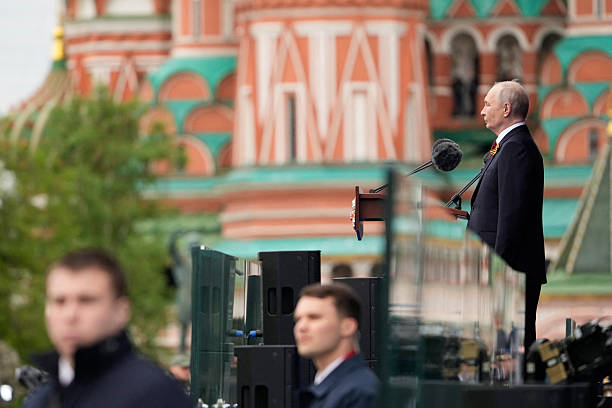
Under heavy security, Russian President Vladimir Putin gives a speech during the Victory Day military parade at Red Square in central Moscow. Russia celebrated the 81st anniversary of the Soviet Union’s victory over Nazi Germany in World War II (Pavel Bednyakov / POOL / AFP via Getty Images)
Putin spoke for about 20 minutes. He did not describe the battlefield situation in Ukraine once. He said “victory will be ours.” He invoked the Soviet generation that defeated Nazi Germany. He said Russia was fighting “the globalist wing of Western elites.” He said the war was coming to an end. He said he was willing to meet Zelensky in a third country — to sign and finalize an agreement, not to continue negotiations. The gap between what Putin said and what is observable on the battlefield is the defining political fact of the day.
By evening, a drone had struck a nine-story apartment building in Kharkiv. A 67-year-old man was killed by an FPV drone on a road in Zaporizhzhia Oblast. A 46-year-old woman was killed by shelling in Dnipropetrovsk Oblast. Ukraine reported 51 combat engagements after the ceasefire took effect. Russia claimed Ukraine had violated the ceasefire 8,970 times. The prisoner exchange — 1,000 for 1,000, the largest single swap of the war — had not happened. Putin said Ukraine withdrew from it. Kyiv said that was not true. The U.S. was asked to serve as guarantor.
In Budapest, Peter Magyar was inaugurated as Hungary’s prime minister. He raised the EU flag outside Parliament. Zelensky congratulated him, calling it “symbolic that this inauguration is taking place on Europe Day.” In Warsaw, Trump said he might send 5,000 U.S. troops from Germany to Poland. In Bratislava, Robert Fico’s meeting with Putin in Moscow produced — according to the Kremlin — no messages from Zelensky, only Fico’s own account of what Zelensky had told him.
The Parade: 45 Minutes, North Korea, Mordvichev, and the Video Screen
Russia’s 2026 Victory Day parade on Red Square lasted approximately 45 minutes and featured no military hardware of any kind — the first such parade since 2007. No tanks. No armored vehicles. No missile launchers. A video screen displayed Russia’s most modern military hardware in footage, because the equipment itself was deemed too valuable or too exposed to risk on an open square. Mobile internet and SMS services in central Moscow were cut for the duration of the event and restored by the Digital Development Ministry only after the parade concluded.
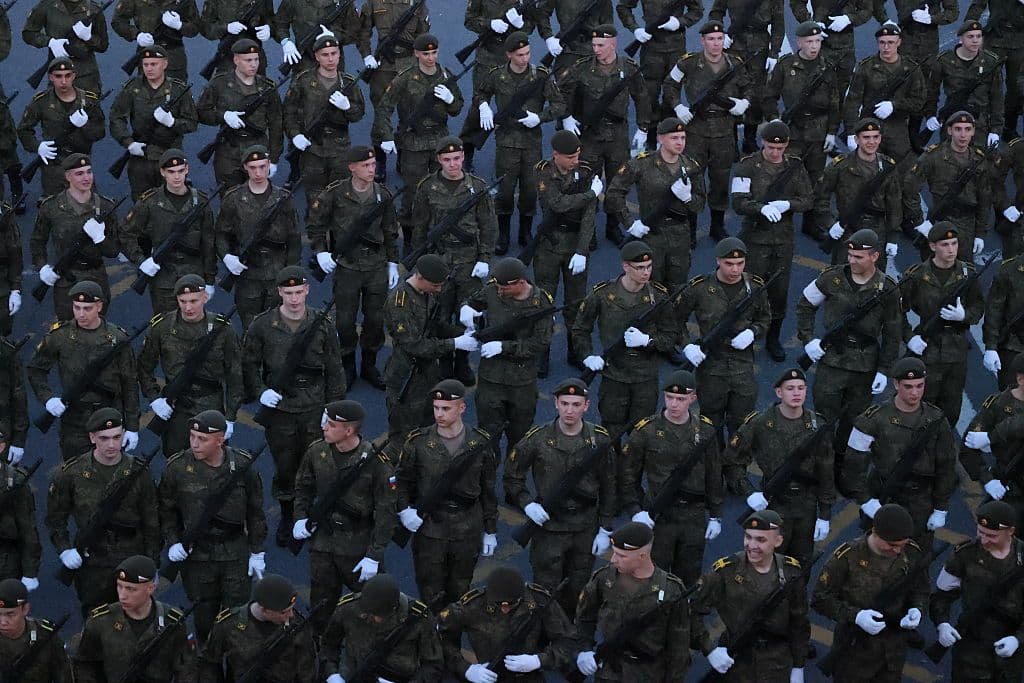
Russian military officers and cadets who will participate in the May 9 Red Square Military Parade, gather for the rehearsals in Moscow, Russia. (Contributor / Getty Images)
The parade was commanded by Colonel General Andrei Mordvichev, known for his direct command role during the Russian siege of Mariupol — a siege that killed tens of thousands of Ukrainian civilians and reduced a city of 430,000 to rubble. It was reviewed by Defense Minister Andrei Belousov. Foreign attendees: Belarusian leader Alexander Lukashenko, Kazakh President Kassym-Jomart Tokayev, Uzbek President Shavkat Mirziyoyev, Malaysian King Sultan Ibrahim Sultan Iskandar, and Laotian President Thongloun Sisoulith. Slovak PM Robert Fico was in Moscow but did not attend the parade, meeting Putin separately. Chinese President Xi Jinping and North Korean leader Kim Jong Un — both present in 2025 — did not attend. The parade included, for the first time in Red Square history, a column of North Korean soldiers who fought against Ukrainian forces during Russia’s Kursk incursion in Winter and Spring 2025.
ISW assessed that the truncated parade format directly reflects the Kremlin’s inability to reliably defend deep rear areas, including the capital, from Ukrainian drone strikes. A Radio Liberty OSINT investigation based on satellite analysis found that Russia is constructing an additional protective ring of Pantsir-S1 surface-to-air missile systems mounted on high-altitude towers around Moscow; the first tower was geolocated near Kashira, Moscow Oblast, as early as February 2026. The total number of air defense units — Pantsir, S-300, and S-400 batteries — encircling the capital now exceeds 100 individual systems, recreating a layered Soviet-style defensive layout that uses former Cold War positions. In an unprecedented move for a civilian infrastructure service, the popular Russian navigation app Yandex Maps blurred satellite imagery of Putin’s Valdai residence — treatment previously applied only to military-industrial plants and defense facilities. Reports indicate the Valdai site is now protected by more than 25 dedicated air defense systems.
Putin’s Speech: “Victory Will Be Ours” Without Once Describing the War
Putin’s Victory Day address commemorated the 81st anniversary of the Soviet victory over Nazi Germany and positioned the war in Ukraine as the current generation’s equivalent of the Great Patriotic War. He said the moral strength of the Soviet generation “inspires the soldiers carrying out the goals of the special military operation today.” He described the enemy as “the globalist wing of Western elites fighting against us through the hands of Ukrainians.” He said Russia’s unity is what makes it strong. He said Russia’s victory is inevitable. He did not once describe Russian battlefield positions, Russian territorial gains, or the status of the Spring-Summer 2026 offensive.
At a press conference following the parade, Putin said he believes the war “is coming to an end.” He said he would be willing to meet Zelensky in a third country to sign and finalize an agreement — not to negotiate one. He said he would potentially be willing to meet European leaders who had not disparaged Russia. He claimed the prisoner exchange is ready from Russia’s side but that Ukraine had not submitted proposals. ISW assessed: Russian forces have made no operationally significant advances in the last year. Russian forces seized Toretsk after 14 months, Siversk after 41 months, and Pokrovsk after two years, all at enormous cost, and capitalized on none of the seizures to make further advances. The Spring-Summer 2026 offensive has yielded minimal progress. Russia suffered a net territorial loss in April 2026. Putin’s claim that victory is inevitable is not supported by any observable battlefield metric.
The Ceasefire: 51 Engagements, 8,970 Claims, and a Drone in Kharkiv
The ceasefire announced by Trump on May 8 took effect at midnight. The night of May 8–9 was the quietest of the war since 2022, with Russia launching only one Iskander-M missile and 43 drones after 6 p.m. on May 8 — though it is unclear whether these were launched before or after midnight. Ukrainian air defenses downed 34 drones; strikes occurred at six locations; debris fell on two more. A 70-year-old man and his 49-year-old son were killed in a drone strike on an agricultural enterprise in Novhorod-Siverskyi district, Chernihiv Oblast, with a 55-year-old man injured. It is unclear whether this strike preceded the ceasefire.
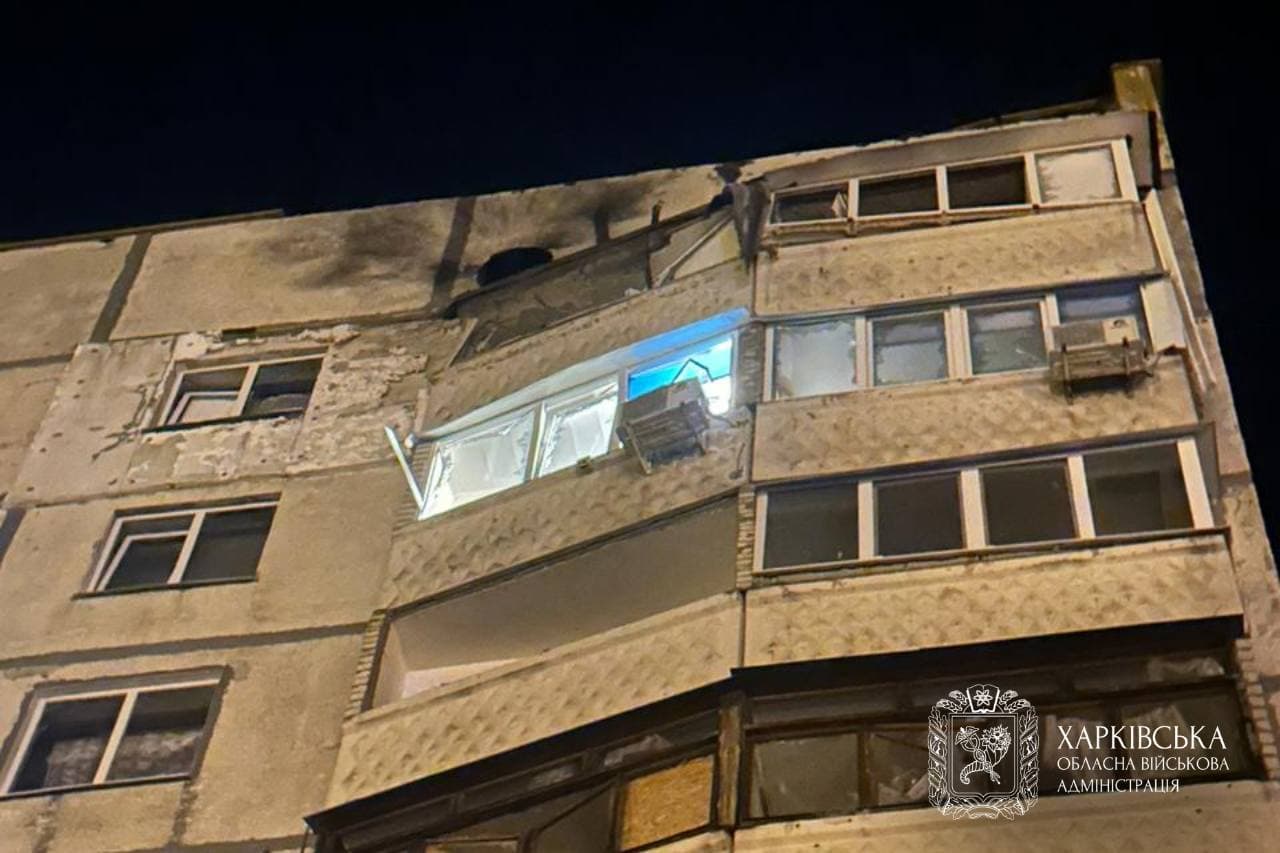
An apartment building hit by a Russian drone attack late in the evening. (Oleh Syniehubov / Telegram)
During daylight on May 9, Ukraine recorded 51 combat engagements after midnight, confirmed by the General Staff. Ukrainian officials reported Russian drones struck residential infrastructure in Kharkiv and Kherson oblasts. In Kharkiv City’s Industrial district in the evening, a Russian drone hit a nine-story apartment building; five people were injured including two 8-year-old boys who suffered acute stress reactions. In Zaporizhzhia Oblast’s Polohivskyi district, a Russian FPV drone struck a car, killing a 67-year-old man and injuring two others. In Dnipropetrovsk Oblast, Russian shelling killed a 46-year-old woman and injured an 87-year-old woman. Russia claimed Ukraine committed 8,970 ceasefire violations including 12 ground attacks, 1,173 artillery and mortar strikes, and 7,151 drone strikes. ISW assessed there was a reduction in overall hostilities — particularly in northern Ukraine — but not a cessation. The ceasefire notably lacked explicit enforcement mechanisms, credible monitoring, or defined dispute resolution processes.
The POW Swap: Stalled, Disputed, Waiting on Washington
The 1,000-for-1,000 prisoner exchange brokered by Trump has not taken place as of May 9. Following the parade, Putin told reporters that Russia is ready for the exchange but alleged that Ukraine had not submitted proposals and had withdrawn from an earlier offer involving 500 detainees. The Ukrainian Presidential Office denied the allegations: “Not true.” A source close to the Ukrainian Presidential Administration told Suspilne that work on facilitating the exchange is still ongoing and that the outcome depends on Washington’s role as guarantor. Zelensky emphasized throughout May 9 that the return of Ukrainian POWs is a top priority and credited U.S. mediation for making the agreement possible: “Red Square is less important to us than the lives of Ukrainian prisoners who can be returned home.”
Russia Used the Ceasefire to Regroup, Rotate, and Resupply
ISW assessed on May 9 that Russian forces systematically used the reduction in operational tempo to conduct rotations, reinforcements, redeployments, and logistics across the theater. Ukrainian military sources reported Russian forces regrouped, rotated, resupplied, and fortified positions in the Kupyansk, Lyman, and Slovyansk directions and in northern Kharkiv Oblast. The Ukrainian 7th Rapid Reaction Corps reported elements of the 90th Tank Division — redeployed from the Oleksandrivka and Novopavlivka directions since early May — operating in the Pokrovsk direction. The Russian military command has established new command posts in Myrnohrad, east of Pokrovsk, to support attacks toward Rodynske. A source reporting on the Russian Western Grouping of Forces stated that the ceasefire allowed Russian forces to advance and consolidate positions northwest of Lyman — positions Ukrainian drone activity had previously prevented them from fortifying. ISW assessed that Russian forces will likely use any continued reduction in tempo on May 10 and 11 to further regroup and resume reinvigorated offensive operations once the ceasefire period ends. Russia has used every previous ceasefire in this war for the same purpose.
Frontline: Ukrainian Advances in Kharkiv Oblast and Borova; Russian Deadline for Kramatorsk Outskirts
Ukrainian forces advanced north of Starytsya in northern Kharkiv Oblast, the 2nd Khartiya National Guard Corps confirmed on May 9, describing the operation as an assault conducted across April and May 2026. Ukrainian forces also recently advanced in the Borova direction: geolocated footage from May 8 shows Russian forces shelling a Ukrainian position near the O-131307 road northwest of Nadiya, indicating no Russian positions were between the Ukrainian position and their own lines. Ukrainian forces struck a Russian field ammunition depot near occupied Berestove, roughly 16 km northeast of Borova. Russian forces reported ceasefire violations by Ukraine in northern Kharkiv Oblast, including attempted river crossings, and continued assaults on the morning of May 9.
In the Kostyantynivka-Druzhkivka area, a Ukrainian brigade spokesperson reported that Ukrainian intelligence indicates the Russian military command has set a May 30 deadline to reach the outskirts of Kramatorsk, with a planned attack near Maiske and Vyrolyubivka. Russian forces intend to redeploy two fresh battalions to the area; activity has reduced in recent days as heavy equipment accumulates. Ukrainian forces struck a large depot in occupied Bakhmut, destroying approximately 10 of 20 pieces of heavy equipment on site. Russian forces conducted an infiltration in northeastern Kostyantynivka and attempted an infiltration in Kryva Luka east of Slovyansk — geolocated footage shows Russian troops raising flags there but ISW assesses this as an infiltration mission, not a confirmed seizure. Russian forces are intensifying use of unmanned ground vehicles for supply and ammunition delivery in the Slovyansk direction, and deploying heavy hexacopter drones to mine Ukrainian ground lines of communication.
In Donetsk Oblast, Russian forces continued assaults near Pokrovsk without advancing; a Ukrainian commander reported Russian use of vehicle-towed trailers for infantry transport and Molniya fixed-wing “mothership” drones carrying FPV drones. Russian forces counterattacked in the Novopavlivka and Oleksandrivka directions. In the Hulyaipole direction, geolocated footage shows a Russian infiltration in southern Verkhnya Tersa. In western Zaporizhzhia Oblast, drone operators of the newly identified Russian “Group 23” detachment struck a civilian vehicle in Zaporizhzhia City — the first evidence ISW has observed of this unit’s existence. Ukrainian forces continued mid-range strikes in occupied Luhansk Oblast, destroying a 9T452 transporter-loader for a BM-27 Uragan MLRS, two trucks, and damaging a command vehicle. Ukrainian drone units report they are now capable of striking camouflaged targets at 30–40 km from the front. In the Kherson direction, elements of the Russian Unmanned Systems Regiment of the 18th Combined Arms Army are reportedly flying drones over Kherson City — first evidence ISW has observed of this unit.
BDA Confirmed: Sverdlov Plant, GRAU Arsenal, Bryansk Chemical Plant, Radar Center Destroyed
The Ukrainian General Staff provided updated battle damage assessments on May 8 for several previously reported strikes. An April 30 strike damaged a production building at the Sverdlov explosives plant in Dzerzhinsk, Nizhny Novgorod Oblast. An April 25 strike struck a building at an arsenal of the Russian Main Missile and Artillery Directorate (GRAU) in Kedrovka, Sverdlovsk Oblast — over 1,600 kilometers from the Ukrainian border. A May 2026 strike damaged infrastructure of the Bryansk Chemical Plant in Seltso, Bryansk Oblast. OSINT satellite imagery published on May 9 confirms that the May 7–8 strike destroyed the main building and partially burned a second building at the Radar Research and Development Center in Rostov-on-Don. Ukrainian forces also struck a Russian Tunguska air defense system near Nezevayevka in Bryansk Oblast (roughly 30 km from the border) and continue to maintain a presence at unspecified locations in Kursk Oblast, per Commander-in-Chief Syrskyi.
AI Turret Against Fiber-Optic Drones Deployed to Frontline
Defense Minister Fedorov reported on May 9 that Ukrainian forces have fielded an AI-guided kinetic turret capable of downing fiber-optic FPV drones — the EW-resistant drones that cannot be jammed because they use optical cable rather than radio frequency communication. The system, developed by a member of the Brave1 defense cluster, uses automated optical tracking to autonomously identify, track, calculate flight paths, and engage incoming UAVs without relying on radio-frequency countermeasures. The turret was first field-tested by the K-2 Brigade and is now deployed with more than 10 different units on critical front sectors. Fedorov released combat footage showing the turret engaging Russian drones in real time. The next step, he said, is “scaling the solution” across the broader air defense network. Separately, Ukrainian unmanned systems forces achieved a world-first: launching an interceptor drone from an unmanned surface vessel to down a Shahed-type UAV at sea.
352,000 Russian Dead: Mediazona and Meduza’s Updated Estimate
Independent Russian media outlets Mediazona and Meduza published on May 9 an updated estimate of Russian military deaths since February 2022: at least 352,000 Russian servicemembers killed through the end of 2025. The figure is based on Russia’s publicly accessible Probate Registry tracking inheritance cases, Rosstat data, Russian court records, and a verified database compiled by the outlets, BBC News Russian, and volunteers. For the first time, the estimate incorporates soldiers declared missing and presumed dead by court order — approximately 90,000 cases — in addition to approximately 261,000 confirmed deaths through probate records. The outlets note the figure is very likely a conservative estimate due to reporting limitations. Total Russian casualties including seriously wounded are reported at approximately 1.3 million as of February 2026. Ukraine’s General Staff figure as of May 9: approximately 1,340,270 total losses since February 24, 2022.
Peter Magyar Inaugurated as Hungary’s Prime Minister; Orbán’s 16-Year Rule Ends
Peter Magyar was inaugurated as Hungary’s Prime Minister on May 9 during the inaugural session of the new Parliament — Europe Day — following Tisza’s 141-seat supermajority win in April’s elections. Magyar called on Hungarian President Tamas Sulyok to resign by May 31, accusing him of covering up abuses under Orbán. The EU flag was raised outside Parliament. Zelensky congratulated Magyar: “Ukraine is ready to deepen cooperation with Hungary and build strong relations based on good neighbourliness.” Magyar has pledged to restore EU ties, end energy dependence on Russia by 2035, and review the Paks II nuclear project with Rosatom. He has, however, ruled out sending military aid to Ukraine, said Ukraine’s EU accession would go to a referendum, and conditioned a full reset on Ukraine addressing the rights of the Hungarian minority. Magyar suggested meeting Zelensky in Berehove in early June. Hungary under Orban had raised Russian gas imports from 60% to 90% of total imports between 2021 and 2025.
Fico in Moscow: No Messages Passed; Russia-Slovakia Energy Ties Discussed
Slovak Prime Minister Robert Fico met Vladimir Putin in Moscow on May 9 after skipping the parade itself, laying flowers at the Tomb of the Unknown Soldier. Kremlin aide Ushakov told reporters that Fico did not convey any messages from Zelensky to Putin. Fico described his meetings with Zelensky to Putin but passed no formal communication. The leaders discussed Russian-Slovak relations, energy supplies, and potentially resuming a bilateral intergovernmental commission dormant since 2021. Fico told Putin that Russia and Slovakia “cannot limit their cooperation to the energy sector alone.” The visit drew criticism from within Slovakia: MP Michal Simecka stated “there is no normal, legitimate reason why Fico should spend this day in Moscow.” Lithuania had summoned the Russian ambassador on May 8 to formally protest Russia’s threats to evacuate diplomatic missions from Kyiv, describing the statements as “a direct threat to use force” in violation of the UN Charter.
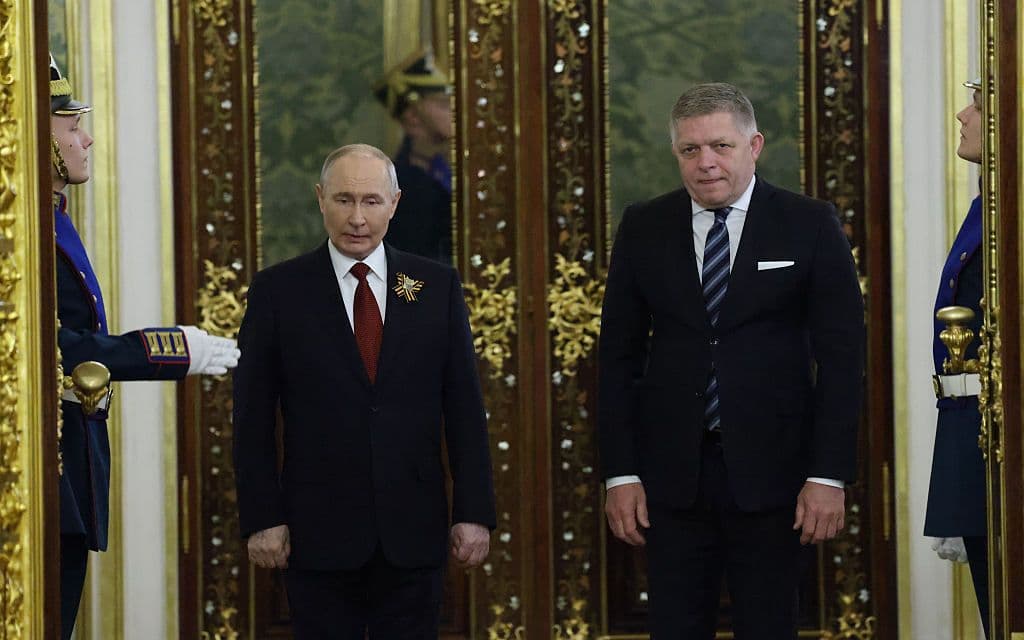
Russian President Vladimir Putin (L) and Slovak Prime Minister Robert Fico (R) enter the Great Kremlin Palace during their talks after the Victory Day parade in Moscow, Russia. (Contributor/Getty Images)
Trump on Delegation to Moscow, Poland Troop Move, and Rubio’s “Deadlock”
Trump told reporters on May 9 that he would be willing to send a U.S. delegation directly to Moscow as part of efforts to end the war: “Well, I would do that. I would very much like to see this war ended.” He provided no timeline or composition. He also said it is “possible” he would redeploy approximately 5,000 U.S. troops from Germany to Poland, citing strong U.S.-Polish relations and Polish President Nawrocki’s welcome of additional troops. The Pentagon had announced the Germany withdrawal on May 1. Rubio confirmed in Rome on May 8 that U.S.-mediated negotiations have reached a “deadlock” and “have not led to a fruitful outcome.” He said the U.S. remains ready to mediate if circumstances change but will not invest effort in an unproductive process. The Umerov-Witkoff-Kushner Miami talks focused on a 20-point peace framework; key sticking points remain Russian territorial demands over Donetsk Oblast and the status of the Zaporizhzhia Nuclear Power Plant.
Kremlin spokesman Peskov stated Putin is “ready for talks with everyone” but will not be the first to restart diplomatic contacts with European capitals, saying Brussels was responsible for reducing ties “to zero.” European Council President Costa said the EU sees “potential” for future negotiations with Putin and is consulting with the 27 EU member states; Costa acknowledged that “nobody has seen any sign from Russia that they want effectively to engage in serious negotiations.” The EU is coordinating its own position before entering any process but will not interfere with the U.S.-led track.
The Weight of May 9
The parade lasted 45 minutes. Putin did not describe the battlefield once. He said victory is inevitable. He did not say when, or how, or at what price, because the answers to those questions are not in his favour.
Russia used the day’s silence to rotate troops and resupply positions in the Kupyansk, Lyman, and Slovyansk directions. A drone hit a nine-story building in Kharkiv before dark. A 67-year-old man was killed on a road in Zaporizhzhia by an FPV. A 46-year-old woman was killed by shelling in Dnipropetrovsk. Fifty-one combat engagements were recorded after the ceasefire took effect.
The prisoner exchange has not happened. Putin said Ukraine withdrew from it. Ukraine said that is not true. Washington is being asked to guarantee what it brokered.
In Budapest, Orbán’s 16-year rule ended. The EU flag went up outside Hungary’s Parliament on Europe Day. In Moscow, Fico met Putin and passed no messages. In Warsaw, Trump said he might send troops from Germany to Poland.
Mediazona and Meduza counted 352,000 Russian dead. The number is likely conservative. Putin said victory will be ours. The parade was 45 minutes long and had no tanks.
A Prayer for Ukraine
1. For the Dead on the Day of the Ceasefire
Lord, three people died on the first day of the ceasefire before it was clear the ceasefire existed: a 70-year-old man and his 49-year-old son in Chernihiv Oblast, killed in a drone strike on an agricultural enterprise; a 67-year-old man killed by an FPV drone on a road in Zaporizhzhia Oblast; a 46-year-old woman killed by shelling in Dnipropetrovsk. Receive them. And hold the two 8-year-old boys in Kharkiv who were in a residential building when the drone hit, who survived but who will carry that sound. The ceasefire did not reach them in time.
2. For the 1,000 Who May Come Home
Father, 1,000 Ukrainians are supposed to cross from Russian captivity in the coming days. Some have been there since 2022. Some have been beaten in facilities designed to break them. Some will have injuries that will not be named in any exchange document. The exchange has not happened yet. Putin says Ukraine withdrew. Ukraine says that is not true. Washington is being asked to hold both sides to what was promised. We pray for the 1,000 names on a list somewhere in a coordination process. That the list holds. That the buses run. That the people get across. And that what they come back to is a country still standing.
3. For the Soldiers in the Rotations
God of mercy, while Moscow marched, Russia’s armies rotated. Fresh units moved into the Kupyansk, Lyman, and Slovyansk directions. Supplies came forward. Positions were fortified in places Ukrainian drones had previously made inaccessible. The silence that was called a ceasefire was used as a logistics window. We pray for the Ukrainian soldiers who observed the pause while watching Russian forces prepare the next assault. Give them the endurance they need for what comes after May 11.
4. For Hungary, and What Comes After Orbán
Lord, Peter Magyar was inaugurated as Hungary’s prime minister on Europe Day. The EU flag rose outside Parliament. He said he wants to end Hungary’s dependence on Russian energy and restore the country’s place in Europe. He has not yet said he will support Ukraine. The polls in Hungary are not favorable. The years of anti-Ukrainian propaganda have left their mark. We pray for what is possible in the space that has opened — that the opening is real and not just rhetorical, and that the people of Hungary, given honest information about the war and its stakes, find their way toward their neighbour.
5. For a Ceasefire That Means Something
God of justice, a ceasefire is in effect. Russia used it to regroup. Ukraine recorded 51 engagements anyway. A drone hit Kharkiv. Three people died. This is what every ceasefire in this war has looked like from the inside. We do not pray for the ceasefire to succeed because we have been here before. We pray for what a ceasefire is supposed to lead toward: a negotiation that is real, terms that are enforceable, a document that protects life rather than a parade. We pray for the diplomats and the negotiators and the translators and the people with the lists — that they do not lose their nerve, that Washington stays engaged, that May 12 brings something other than a return to the full weight of everything that preceded May 9. Bring this war to its end. In Your mercy, in Your justice, in Your time.