
Ukraine Daily Briefing | May 16, 2026 | Day 1,543 of the Full-Scale Invasion
Prepared by Dayana Bozhyk
Ukraine struck the Nevinnomyssk Azot chemical plant in Stavropol Krai — southern Russia’s largest chemical plant and Russia’s largest producer of nitrogen fertilizers and ammonia used to make explosives — 540 kilometers from the front. In a week of deep strikes, Ukraine’s USF confirmed 55 strikes on 23 strategic targets; the 16th and 17th Russian air defense units were eliminated in the first half of May alone. Russia’s Chief of the General Staff Gerasimov briefed Putin on claimed advances west of Kupyansk — a city Russian forces have not taken — in his fifth consecutive month of fabricated battlefield reports; Russian milbloggers who track the front line say his claims exceed even the most expansive pro-Russian accounts. Russia launched 294 drones overnight, killing three civilians and injuring 63 across Kherson, Zaporizhzhia, Donetsk, Kharkiv, Odesa, Sumy, and Dnipropetrovsk. Ukraine advanced in the Hulyaipole direction. The U.S. allowed its Russian oil waiver to expire without renewal, effectively tightening sanctions at sea. Putin confirmed a May 19–20 state visit to Beijing to sign a new strategic cooperation declaration with Xi. Chinese FM Wang Yi announced U.S. and Chinese cooperation to broker peace in Ukraine. France committed to cooperating with Ukraine on anti-ballistic missile defense. Ukraine repatriated 528 bodies of fallen soldiers. Zelensky confirmed 55 deep strikes in a week and declared Ukraine’s “long-range sanctions” will continue to expand in distance and frequency.
The Day’s Reckoning
The Nevinnomyssk Azot plant sits in Stavropol Krai, 540 kilometers from the Ukrainian front line, and produces up to 1 million tons of ammonia and more than 1 million tons of ammonium nitrate annually — ammonium nitrate being the primary component of the explosive mixtures used in Russian artillery shells. Ukraine struck it overnight on May 15–16. Fires broke out. Residents reported explosions. Geolocated footage confirmed the blaze. Stavropol Krai Governor Vladimirov acknowledged the attack. Ukraine’s National Security Council advisor Kovalenko had previously described the facility as “a critical component of Russia’s defense-industrial complex.” Ukraine has struck it before: March and January 2026, and multiple times in 2025.
On the same day, General Valery Gerasimov — Russia’s Chief of the General Staff, the country’s highest-ranking military officer — met with the Western Grouping of Forces and presented battlefield assessments that Russian milbloggers who actually track the front line described as not just inaccurate but “egregious even in comparison to the most expansive ultranationalist claims.” Gerasimov claimed Russian forces are advancing west of Kupyansk, toward Shevchenkove — implying Russian forces have taken Kupyansk. They have not. ISW assesses Russian forces hold positions in roughly 14.2 percent of Kupyansk. Russian milbloggers say the actual figure is 14 percent. Gerasimov claimed Russian forces seized all of Borova. One milblogger responded: not a single person who produces maps of the battlefield is claiming Russian forces have even entered Borova. This was Gerasimov’s fifth consecutive month of fabricated reports to the highest level of the Russian command.
The broader picture from May 16: Ukraine advanced in the Hulyaipole direction. Russia launched 294 drones overnight, 269 were downed, 20 struck 15 locations. Three civilians were killed and 63 injured. France committed to cooperating with Ukraine on anti-ballistic missile defense. The U.S. allowed its Russian oil waiver to expire without renewal. Putin announced a state visit to Beijing on May 19–20 to sign a new strategic cooperation declaration with Xi Jinping. Chinese FM Wang Yi said the U.S. and China are cooperating to broker peace in Ukraine. The architecture of whatever comes next is being built on multiple tracks simultaneously.
Ukraine Strikes Nevinnomyssk Azot: Russia’s Largest Nitrogen Explosives Supplier
Ukrainian forces struck the Nevinnomyssk Azot chemical plant in Nevinnomyssk, Stavropol Krai, overnight May 15–16, Russian independent outlet Astra reported on May 16, corroborated by geolocated footage confirming fires at the facility. The plant is roughly 540 kilometers from the front line. Ukrainian defense outlet Militarnyi identified the Nevinnomyssk Azot plant as southern Russia’s largest chemical plant and Russia’s largest producer of nitrogen fertilizers, producing up to 1 million tons of ammonia and over 1 million tons of ammonium nitrate annually. Ammonium nitrate is the primary explosive compound used in Russian artillery shells and various munitions. Ukraine’s National Security Council Andrii Kovalenko had previously described the plant as “a critical component” of Russia’s defense-industrial complex. Stavropol Krai Governor Vladimir Vladimirov acknowledged a Ukrainian strike near Nevinnomyssk, claiming air defense units repelled the attack — a claim inconsistent with confirmed fires at the facility. Ukraine has struck the plant previously in March 2026, January 2026, and multiple times in 2025.
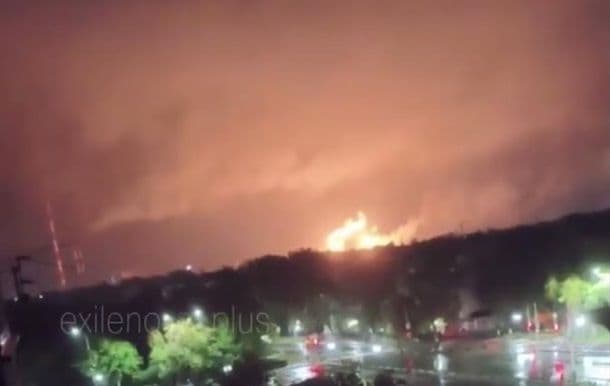
A screenshot of a video where a fire is seen at Russia’s Nevinnomyssky Azot chemical facility, following explosions. (Exilenova_plus/Telegram)
Zelensky Confirms 55 Deep Strikes in a Week; USF’s 16th and 17th Air Defense Kills
Zelensky published a Telegram statement on May 16 summarizing what he called Ukraine’s week-long “long-range sanctions” campaign, describing it as a multi-agency operation by the AFU, SBU, HUR, and Unmanned Systems Forces. USF Commander Magyar Brovdi confirmed 55 strikes hitting 23 high-value strategic targets across mainland Russia and occupied territory in the preceding days. Confirmed targets from the campaign: the Ryazan Oil Refinery (17.1 million tons/year); the Astrakhan gas plant (motor fuel production halted); the Nevinnomyssk Azot plant (ammonia and explosives production); a Be-200 Altair amphibious aircraft and Ka-27 helicopter at Yeysk Airbase; a missile boat and minesweeper at Kaspiysk Naval Base in Dagestan; a cargo ship at occupied Berdyansk; a Redut-2US military communications complex; a Tor-M2 in Luhansk Oblast; a Pantsir-S1 in Crimea. Brovdi noted the Tor and Pantsir represented the 16th and 17th Russian air defense systems eliminated in the first half of May alone. Zelensky: “This is a completely fair response to what the Russians are doing. Both the distance and frequency of these long-range strikes will continue to expand.”
Gerasimov’s Fifth Consecutive Month of False Battlefield Reports
Russian Chief of the General Staff Army General Valery Gerasimov met with the Western Grouping of Forces on May 16 and made a series of claims about the Kupyansk, Borova, and Lyman directions that ISW assessed as “highly inaccurate” and “egregious even in comparison to the most expansive Russian ultranationalist claims in the area.” Gerasimov claimed Russian forces are advancing west of Kupyansk toward Shevchenkove — a claim implying Russian forces hold Kupyansk. ISW assesses they hold approximately 14.2 percent of the city. Gerasimov claimed Russian forces entered Velyka Shapkivka; ISW assesses Russian forces are approximately four kilometers away. Gerasimov claimed Russian forces seized all of Borova; ISW has not observed evidence Russian forces have entered Borova at all — a point explicitly confirmed by a Russian milblogger who stated “not a single milblogger who produces maps is claiming Russian forces have even entered Borova, much less seized it.” Gerasimov claimed 85 percent of Lyman is seized; ISW assesses Russian forces have infiltrated 0.06 percent of the city.
The Russian MoD on May 16 separately claimed elements of the 121st Motorized Rifle Regiment seized Kutkivka north of Kupyansk, and the MoD claimed Russian forces seized Borova — neither of which ISW could confirm with available evidence. ISW assessed this is the fifth consecutive month in which the highest echelon of the Russian military command has presented fabricated advances, and that “these aggrandized claims of fictional advances may indicate that the highest echelon of the Russian military command is either unaware of or unwilling to admit the realities of the battlefield even to itself, and is therefore allowing its own falsehoods to influence Russian operational and strategic planning.” Gerasimov has identified Shevchenkove (28 kilometers west of Kupyansk) as the next operational objective — an objective that requires first seizing Kupyansk, which Russian forces have not achieved despite years of offensive operations. The Russian ultranationalist milblogger community has warned that Russian command’s false “beautiful reports” are preventing accurate assessment of frontline situations, including the “tense” and “difficult” Ukrainian counterattack pressure northwest, west, and southwest of Orikhiv.
294 Drones Overnight: Three Killed, 63 Injured, Odesa Port and Kharkiv Transit Hit
Russian forces launched 294 Shahed, Gerbera, Italmas, and Parodiya drones overnight May 15–16 from Oryol, Kursk, and Bryansk cities; Millerovo, Rostov Oblast; Shatalovo, Smolensk Oblast; Primorsko-Akhtarsk, Krasnodar Krai; and occupied Cape Chauda and Hvardiiske, Crimea. Ukrainian forces downed 269; 20 struck 15 locations; debris fell at 9 locations. Russian forces also struck civilian, residential, and transport infrastructure in Kharkiv and Poltava cities and Kyiv and Dnipropetrovsk oblasts.
In Kherson Oblast, one person was killed and 23 injured; Russian forces targeted residential areas, damaging five apartment buildings and 19 houses. In the morning, a Russian FPV drone deliberately targeted a commuter minibus in Kherson City’s Central district at 7 a.m., injuring the 60-year-old driver with a concussion, blast-induced traumatic brain injury, and shrapnel wounds to the legs. At 11:45 a.m., Russian artillery from the occupied east bank struck the central residential and commercial sectors of Kherson City, killing one man by shrapnel and injuring two more. In Zaporizhzhia Oblast, one person was killed and 21 injured; Russian forces conducted 850 attacks on 53 settlements over 24 hours; two men aged 30 and 40 were hospitalized in the city. In Donetsk Oblast, one person was killed and four injured. In Sumy Oblast, seven people were injured. In Kharkiv Oblast, five people were injured. In Odesa Oblast, two people were injured; Russian strikes damaged port infrastructure, cutting power to 39 settlements and 22,662 subscribers. In Dnipropetrovsk Oblast, one person was injured; the Nikopol, Kryvyi Rih, and Synelnykove districts were struck over 20 times, destroying 17 automobiles and 15 mopeds in Nikopol and 10 additional vehicles; a cruise missile struck an industrial facility in Kryvyi Rih.
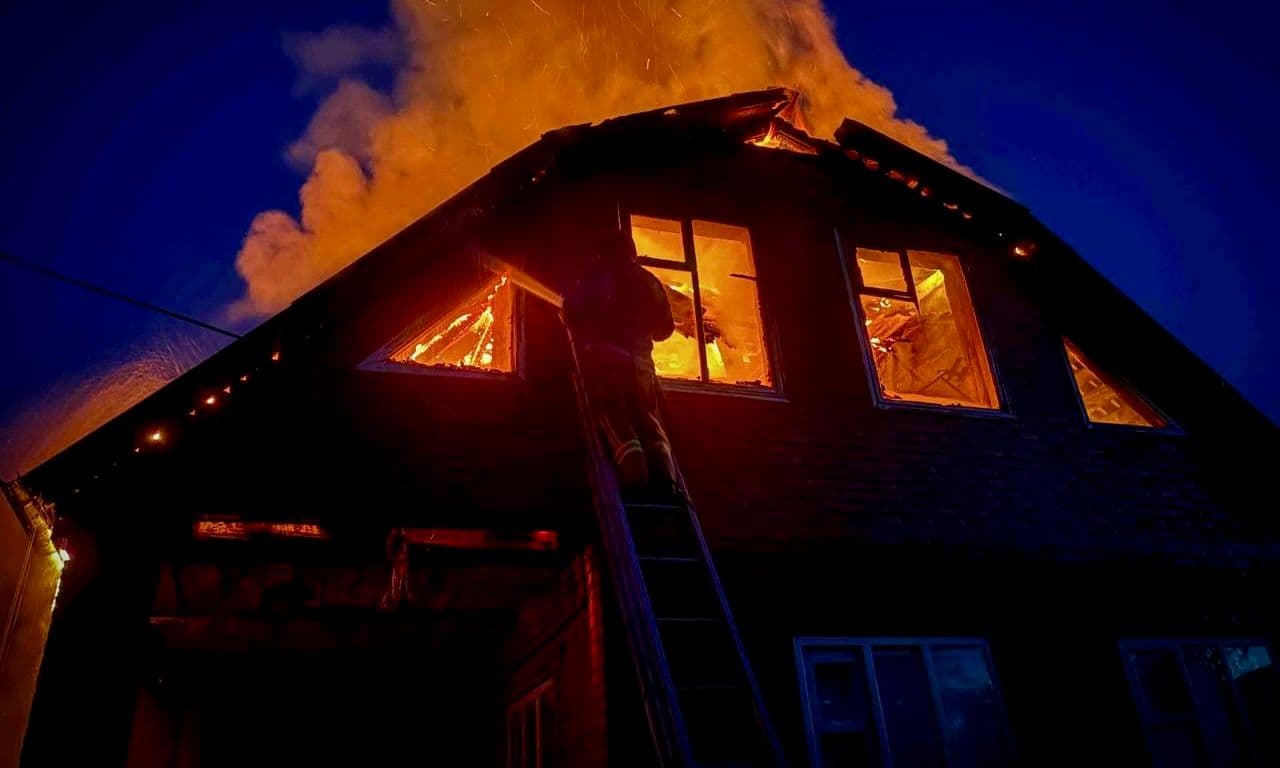
A house caught fire after a Russian attack on Sumy Oblast. (State Emergency Service / Telegram)
In Kharkiv City, the morning Molniya drone strike in the central Shevchenkivskyi district damaged three subway entrances, three public transport stations, and the overhead electrical grid for trams and trolleybuses, injuring one person. A second Molniya drone strike on the Kyivskyi district hit a garage cooperative, injuring three men. Drone debris fell on a children’s playground in the Kyivskyi district. In Poltava Oblast, multiple private homes were damaged. In Kyiv Oblast, a drone was suppressed over Vyshhorod district, damaging a private home and a municipal utility enterprise; seven utility and transport vehicles were damaged by falling debris.
Frontline: Ukrainian Advance in Hulyaipole; Russian Pipeline Infiltrations; Kramatorsk Kill Zone
Ukrainian forces recently advanced southeast of Staroukrainka west of Hulyaipole, confirmed by geolocated footage published May 15. Ukrainian Southern Defense Forces Spokesperson Voloshyn reported on May 16 that Russian forces are using natural gas pipelines for infiltrations into Ukrainian rear areas — training at specialized grounds in occupied Ukraine, establishing telephone lines within pipelines, and digging tunnels to bypass damaged sections. Russian forces are attempting to advance toward Verkhnya Tersa from the south while continuing to attack toward Hulyaipilske and Charivne. A Ukrainian battalion commander confirmed Ukrainian forces have controlled Mala Tokmachka since 2023, contrary to Russian claims; the commander estimated Russian forces have lost 2,000 soldiers attempting to take it.
In the Kramatorsk direction, a Ukrainian brigade spokesperson reported on May 16 that Russian forces are extending the kill zone deeper into Ukrainian rear areas, with the zone now approaching Kramatorsk itself. Russian forces are using Molniya FPV drones for longer-range rear strikes and accumulating equipment near occupied Bakhmut (13 km from the front) — assessed as preparation for a spring-summer offensive against the Fortress Belt. Russian forces in the Pokrovsk area are using troop concentration points as Molniya drone launch platforms and for reconnaissance, confirmed by geolocated footage of a Ukrainian airstrike on a Russian concentration point in central Pokrovsk published May 14. In the Kupyansk direction, Russian infiltration missions continued; geolocated footage confirms Ukrainian forces striking a Russian infiltrator north of Kupyansk. In Sumy Oblast, geolocated footage shows Ukrainian forces striking a Russian servicemember south of Sopych after a Russian infiltration mission.
Ukrainian mid-range and short-range strikes on May 15–16: a materiel depot in occupied Baranykivka, Luhansk Oblast (23 km); a drone control point near Hrafske, Donetsk Oblast (71 km); personnel concentrations near Shakhtarsk (66 km) and Mykhailivka (61 km); a command post near Pokrovsk; a troop concentration and vehicle storage site near Selydove (17 km); a personnel concentration near Yalta, Novopavlivka direction (5 km); a repair unit in occupied Pryvillya, Kherson Oblast (70 km). In the Novopavlivka direction, Russian forces continued limited attacks without confirmed advances. In the Oleksandrivka direction, Russian forces conducted limited attacks and conducted an infiltration mission in northeastern Nove Zaporizhia, confirmed by geolocated footage.
France Commits to Anti-Ballistic Missile Defense Cooperation with Ukraine
Zelensky announced on May 16 following a phone call with French President Macron that France has committed to cooperating with Ukraine on developing anti-ballistic missile defense systems. “France is ready to work on anti-ballistic measures. This is a strong decision and an important step,” Zelensky said. The commitment forms part of Zelensky’s effort to assemble an “anti-ballistic coalition” — a coordinated framework for countering Russian ballistic missiles, which Ukraine can only intercept with U.S.-made Patriot systems and which Russia deliberately uses after first exhausting Ukrainian interceptors with large drone waves. On May 12, Zelensky confirmed that representatives of 13 countries and the NATO Secretary General’s office had met to discuss anti-ballistic missile defense cooperation. France’s commitment represents a significant European nation joining that framework.
U.S. Russian Oil Waiver Expires Without Renewal
The U.S. Treasury Department’s Office of Foreign Assets Control allowed a sanctions waiver permitting the purchase of Russian oil stranded at sea to expire at 12:01 a.m. EDT on May 16 without renewal. Treasury Secretary Bessent had previously stated there were no plans to extend the authorization. The waiver had been introduced in February 2026 amid energy market volatility following U.S. and Israeli strikes on Iran and Tehran’s closure of the Strait of Hormuz, and was renewed on April 17 for one month. The expiration closes a legal exemption that had allowed countries to continue purchasing sanctioned Russian oil cargoes at sea, tightening economic pressure on Russia’s oil export revenues at a time when Ukraine’s deep strike campaign against domestic Russian refinery infrastructure has already reduced Russia’s average refinery capacity to its lowest level since December 2009.
Putin to Beijing May 19–20; U.S.-China Pledge to Cooperate on Ukraine Peace
The Kremlin announced on May 16 that Putin will pay an official state visit to China on May 19–20 at Xi Jinping’s invitation, immediately following Trump’s May 13–15 Beijing summit. The two countries will sign a joint strategic statement and a series of bilateral documents. Putin last visited China in late August–September 2025. China remains Russia’s primary economic lifeline, purchasing the majority of Russian oil under Western sanctions and supplying dual-use goods to the Russian military. Analysts have assessed that Wang Yi’s preemptive statements about peace are intended to signal to the Kremlin that China’s economic support is tethered to expectations of diplomatic flexibility.
Chinese FM Wang Yi stated after the Trump-Xi summit that both the U.S. and China are investing “significant efforts” to broker diplomatic settlements to the wars in Ukraine and the Middle East. Wang Yi: “Complex issues do not have simple solutions, and peace talks cannot be achieved overnight. As both China and the United States are ready to maintain communication and play a constructive role in the political settlement of the crisis, we hope for a swift conclusion to the fighting.” Russian Deputy FM Ryabkov acknowledged on May 16 that U.S.-Russia relations still have “problems” despite high-level contacts, describing progress as “slow and difficult,” and expressing frustration that Washington continues to link economic cooperation to progress on Ukraine.
Belarus as Active Airspace Enabler; Brovdi’s Warning to Lukashenko
USF Commander Magyar Brovdi published a direct warning to Lukashenko on May 16, accusing the Belarusian government of providing “direct tactical assistance” to Russia by opening Belarusian airspace for regular Shahed drone routes targeting Ukrainian energy and civilian infrastructure. Brovdi stated that Ukraine’s EW and monitoring units maintain complete telemetry for all air targets transiting Belarusian airspace, and that this data is court-admissible: “We record the flight of every single Shahed that, taking advantage of the corridors of Belarus, heads to Ukraine.” Brovdi confirmed that Russian drone operators have programmed flight paths deliberately inside a 5–10 km margin within the Belarusian border to avoid Ukrainian air defense interception zones, and that Belarusian defense infrastructure has been modified to support Russian electronic navigation networks, including navigation antennas installed on residential buildings in southern Belarus.
Romania Border Incident; 528 Bodies Repatriated
Romania’s Defense Ministry reported on May 16 that an unexploded projectile was discovered in the yard of an uninhabited house in Pardina, Tulcea County, near the Romanian-Ukrainian border. The projectile was described as an “unguided reactive projectile” containing two kilograms of explosives; the area was secured and the projectile was detonated in a controlled manner. Romania’s Defense Ministry did not specify the suspected origin. The incident follows multiple previous Romanian airspace violations and drone debris landings, including a recent drone landing in a Galati backyard — the first time such an incident caused property damage in Romania. Romania is a NATO member and has signed a bilateral security agreement with Ukraine.
Ukraine repatriated 528 bodies of fallen military personnel on May 16, confirmed by Ukraine’s Coordination Headquarters for the Treatment of Prisoners of War. Forensic examinations and DNA identification are underway at specialized facilities under the Ministry of Internal Affairs. The SBU noted that Russia has at times returned the bodies of its own soldiers during such exchanges. The total number of Ukrainian soldier bodies repatriated since 2022 stands at approximately 18,500. The previous repatriation on April 9 involved 1,000 bodies. The process operates under the ongoing “6,000 for 6,000” baseline framework established in Istanbul talks.
Russian Anxiety About Domestic Strikes Surpasses Front Line Worry
A Kremlin-aligned Public Opinion Foundation poll published May 15, conducted May 1–3 across 97 Russian cities, found that 18 percent of respondents said Ukrainian attacks on Russian territory were the events attracting the most attention in recent days — compared to 16 percent citing battlefield developments in Ukraine. Respondents most frequently cited attacks on major Russian cities, drone strikes, refinery attacks, and the strike on Yekaterinburg (approximately 1,600 kilometers from the Ukrainian border). The share of respondents saying people around them feel anxious rose to 50 percent — four percentage points above the August 2024 level during Ukraine’s Kursk incursion. This is the first recorded instance in the war in which domestic Russian strikes have ranked higher in public concern than front-line combat.
Nina Litvinova Dies; Kyiv Art Hub Faces Eviction; Eurovision Finals
Soviet-era dissident and human rights activist Nina Litvinova died by suicide at 80, Nexta TV reported on May 16. In a final letter published by her cousin, journalist Masha Slonim, Litvinova stated that life had become “unbearable” since Putin attacked Ukraine and began imprisoning thousands of Russians for opposing the war. She had spent decades fighting Soviet totalitarianism and her final years supporting anti-war political prisoners through the banned organization Memorial. Litvinova’s death prompted widespread reaction in Russian opposition circles.
The independent art collective Nahirna 22, operating out of Kyiv’s Institute of Automation and serving as a center of Ukraine’s contemporary cultural resistance, issued a public appeal on May 16 after receiving an eviction notice from the State Migration Service requiring it to vacate by May 31 to accommodate government departments. The collective appealed to cultural and political leaders to prevent what it described as the displacement of an active wartime community space. Ukraine’s singer Leleka competed in the Eurovision Song Contest grand final on May 16 with the song “Ridnym” (“To the dear ones”) — the culmination of Ukraine’s fourth consecutive Eurovision final appearance since the full-scale invasion began.
The Weight of May 16
Ukraine struck Russia’s largest nitrogen explosives plant. The Chief of the General Staff presented fabricated battlefield reports to the Kremlin for the fifth consecutive month. Three civilians were killed and 63 injured as Russia launched 294 drones overnight. Russia’s largest chemical plant in the south is burning.
A 60-year-old minibus driver in Kherson was struck by an FPV drone at 7 a.m. while carrying passengers. At 11:45 a.m., Russian artillery hit the center of Kherson City and killed a man in the street. This is what one day in Kherson looks like.
General Gerasimov told Russian commanders they are advancing west of a city they have not taken, toward an objective that requires first taking it, which requires forces they have not deployed. Russian milbloggers say no one who makes maps claims this. The highest level of the Russian military command either does not know this or refuses to know it. Both possibilities matter.
France committed to anti-ballistic missile defense cooperation. The U.S. oil waiver expired without renewal. Putin heads to Beijing in three days. China and the United States say they are cooperating to broker peace. Ukraine repatriated 528 bodies. The calendar moves forward.
A Prayer for Ukraine
1. For the Three Killed and the Sixty-Three Injured
Lord, one person was killed in Kherson by shrapnel on a midday street. One was killed in Zaporizhzhia. One was killed in Donetsk Oblast. Three on a Saturday in May. Sixty-three others are in hospitals across the country. A 60-year-old minibus driver was struck by an FPV drone at 7 a.m. in Kherson while carrying passengers. Two men aged 30 and 40 were hospitalized with shrapnel from a Saturday afternoon strike on a civilian area in Zaporizhzhia City. Receive the three who died. Hold the sixty-three. And hold the city of Kherson, which is struck daily by a country that holds the other bank of the river and has never stopped firing.
2. For the 528 Brought Home
Father, 528 sets of remains were repatriated from Russian custody on May 16. They are being taken to forensic laboratories. DNA examinations are being conducted. Some will be identified by name and returned to families. Some will take longer. Some may not be identified. Russia has at times returned its own soldiers’ remains during these exchanges, and Ukrainian officials have noted this. Ukraine has repatriated approximately 18,500 bodies since 2022. Behind each of those 18,500 is a family that waited to know. Behind each of the 528 is the same waiting. Let the identifications come through. Let the families be told. And let the number that remains unidentified shrink with each exchange.
3. For Nina Litvinova
God of the long struggle, Nina Litvinova was 80 years old. She had spent her life fighting Soviet totalitarianism, and she spent her last years fighting the war and supporting the people imprisoned for opposing it. She wrote that life had become unbearable since Putin attacked Ukraine. She died on a Saturday in May. We pray for her. And we pray for the thousands of Russians who share what she could no longer bear — who are in prison for opposing the war, who fled the country, who are living in silence inside it. Let her life’s work be recorded. Let the organizations she worked with survive.
4. For the Generals Who Are Told the Truth and the One Who Is Not
Lord, General Gerasimov presented fabricated maps to the Kremlin for the fifth consecutive month. He claimed Russian forces are advancing west of a city they have not taken. Russian milbloggers — who oppose Ukraine and support the war — said his claims exceeded anything they have reported. The highest military officer in Russia is either deceiving his government or has been deceived by his subordinates or has chosen not to know the truth. We do not pray for Gerasimov. We pray for the Ukrainian soldiers on the other side of the line from the plans being made from those false maps — plans that will arrive at their positions regardless of how badly they were conceived. Give them intelligence that is accurate. Give them commanders who deal in what is real.
5. For Peace Built on Something Real
God of justice, France committed to anti-ballistic cooperation. China and the United States said they will cooperate to broker peace. Putin heads to Beijing in three days. The U.S. oil waiver for Russian oil at sea expired without renewal. These are the pieces of something that could become a different situation — or they could become a different set of pressures on Ukraine to accept terms that leave it vulnerable to the next war. We pray for the diplomats and the generals and the presidents and the foreign ministers who are navigating between these possibilities. That the peace they build, if it comes, does not trade Ukrainian lives for a ceasefire that lasts until the next mobilization. In Your mercy, in Your justice, in Your time — bring this war to its end.