
Ukraine Daily Briefing | May 15, 2026 | Day 1,542 of the Full-Scale Invasion
Kyiv observed a day of mourning after 24 were killed — including three children — in the Darnytskyi building strike, with 17 still missing; Ukraine simultaneously welcomed 205 POWs home in the first phase of the U.S.- and UAE-brokered 1,000-for-1,000 exchange. Overnight Ukrainian strikes hit the Ryazan Oil Refinery (one of Russia’s five largest), naval assets in Dagestan, and aircraft at Yeysk Airbase, while Finland closed Helsinki-Vantaa Airport and scrambled F-18s after a suspected drone entered its airspace. Zelensky warned Russia is pressuring Lukashenko to open a new front toward Kyiv or strike a NATO state, even as Russia’s budget deficit hit 150% of its annual plan and the Council of Europe’s Special Tribunal for the crime of aggression advanced to operational status with 36 nations committed.
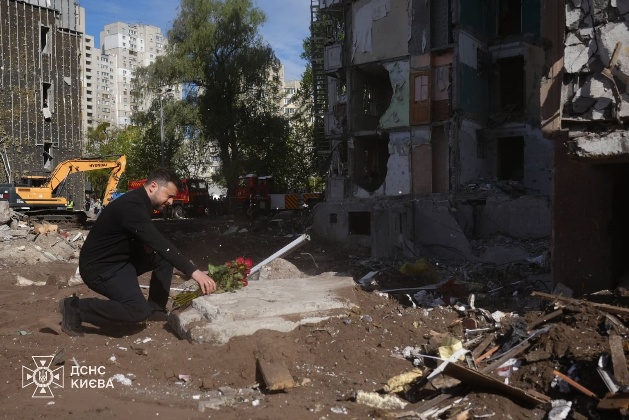
President Volodymyr Zelenskyy pays tribute to the victims at the site of a nine-story residential building partially destroyed by a Russian missile strike in Kyiv, Ukraine. (Ukrainian Presidency / Handout/Anadolu via Getty Images)
The Day’s Reckoning
In Kyiv’s Darnytskyi district, the rescue operation at Krasnopilska Street ended at 8 a.m. after 28 consecutive hours of work. Three thousand one hundred and eighty cubic meters of debris had been cleared. Dog handlers had swept 2,800 square meters. Twenty-four people were confirmed dead, including three children. Seventeen remained missing. Zelensky, diplomats from a dozen countries, and U.S. Ambassador Julie Davis visited the site. “The world must remember the price Ukraine pays every day to prevent Russian aggression from spreading to other nations,” Zelensky wrote. The city was draped in mourning.
That morning, 205 Ukrainians crossed back from Russian captivity — soldiers from the Ground Forces, the Navy, the Air Assault Forces, and the State Border Guard Service, ages 21 to 62, most of whom had been held since 2022. Four of them were civilians from Sumy Oblast who had been kidnapped from their homes by Russian forces in 2025, ages 61 to 85. Russia confirmed 205 Russians had simultaneously crossed in the other direction, receiving them in Belarus. It was the first phase of the 1,000-for-1,000 exchange announced by Trump on May 8. Zelensky thanked the United States and the United Arab Emirates for mediation. He confirmed Ukraine had provided the full list of 1,000 but did not announce a timeline for subsequent phases.
Overnight into May 15, Ukraine’s military had conducted the response Zelensky ordered. The Ryazan Oil Refinery — one of Russia’s five largest, processing 17.1 million tons of crude annually, 460 kilometers from the Ukrainian border — was struck. A large fire broke out; smoke was visible for hours. A Be-200 Altair multirole amphibious aircraft and a Ka-27 ship-based helicopter were struck at Yeysk Airbase in Krasnodar Krai, confirmed by geolocated footage. A small missile boat and a minesweeper were struck at Kaspiysk Naval Base in Dagestan. A Tor-M2 air defense system was struck in occupied Luhansk Oblast. A Pantsir-S1 was struck in occupied Crimea.
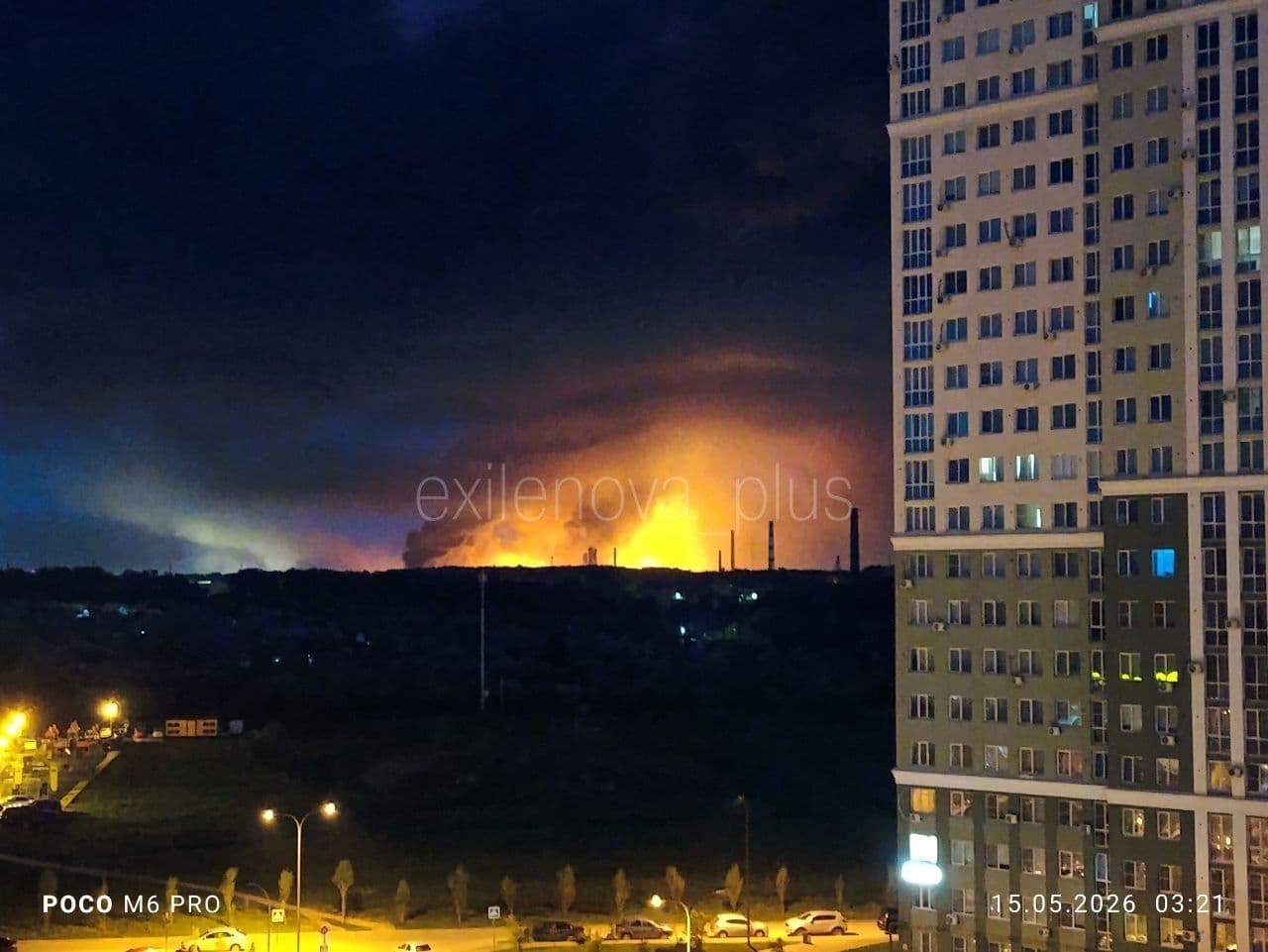
A massive fire is seen emanating from what appears to be the Ryazan Oil Refinery amid a large-scale Ukrainian drone attack. (Exilenova_plus)
Then came the Finland alert. Shortly before midnight on May 14–15, Finnish authorities detected a suspected drone entering Finnish airspace from the direction of Russia or the Gulf of Finland, heading toward the area between Helsinki and Porvoo — where the Neste oil refinery is located. Helsinki-Vantaa Airport was closed. Finnish F-18 Hornets scrambled. Two million residents in southern Finland received emergency instructions to stay indoors and away from windows. Vessels in the Gulf of Finland were rerouted. Flights from Tokyo, Osaka, Hong Kong, and Singapore were diverted to Stockholm and Rovaniemi. Defense forces later said there was no direct military threat. Latvia simultaneously issued airspace warnings. The incident was the first drone-related airport closure in Finland since the full-scale invasion began.
205 POWs Come Home: First Phase of the 1,000-for-1,000 Exchange
Ukraine received 205 prisoners of war and civilian detainees on May 15 — the first phase of the 1,000-for-1,000 exchange announced by Trump on May 8 and brokered by U.S. envoys Witkoff and Kushner with UAE mediation. Ukraine’s Coordination Headquarters for the Treatment of Prisoners of War confirmed that Ukraine submitted its full list of 1,000 names on May 10, prioritized by length of detention. Among those returned: servicemembers from the Ground Forces, Navy, Air Assault Forces, and State Border Guard Service, aged 21 to 62; four Sumy Oblast civilians forcibly removed from their homes by Russian forces in 2025, aged 61 to 85. Almost all Ukrainian POWs had been held for approximately four years — most of the duration of the full-scale invasion. Russia confirmed 205 Russian prisoners simultaneously returned to the Russian side, received in Belarus.
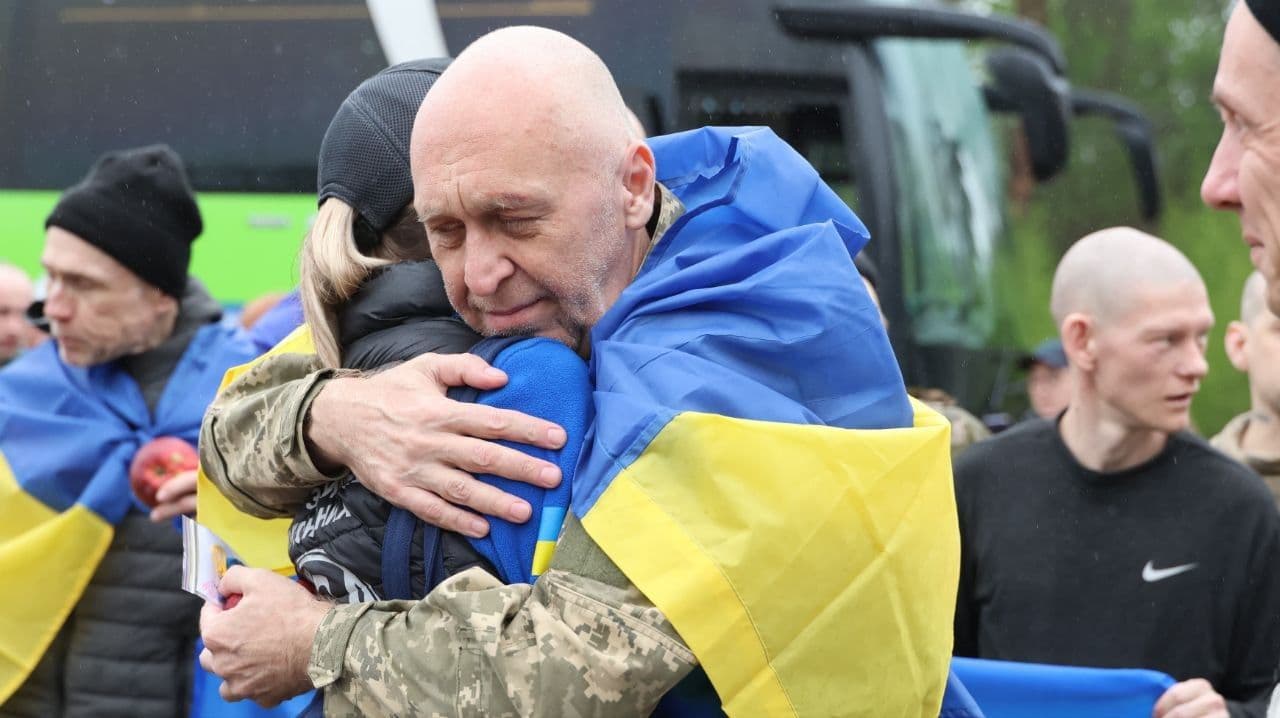
Ukrainian prisoners of war (POWs) greet relatives during an exchange with Russia. (Coordinating Headquarters for the Treatment of Prisoners of War)
The exchange is the largest single POW swap of the war when completed, surpassing the previous largest single-phase exchanges. The Easter swap in April involved 175 Ukrainians and civilians. Zelensky did not announce a timeline or conditions for subsequent phases of the full 1,000-for-1,000 exchange. Ukraine’s Ombudsman Lubinets confirmed the four civilians’ identities but did not name them for security reasons. Zelensky: “Let’s continue to fight for each and every one who still remains in captivity.” The exchange is one of the few functioning direct communication channels between Kyiv and Moscow since the full-scale invasion began in 2022.
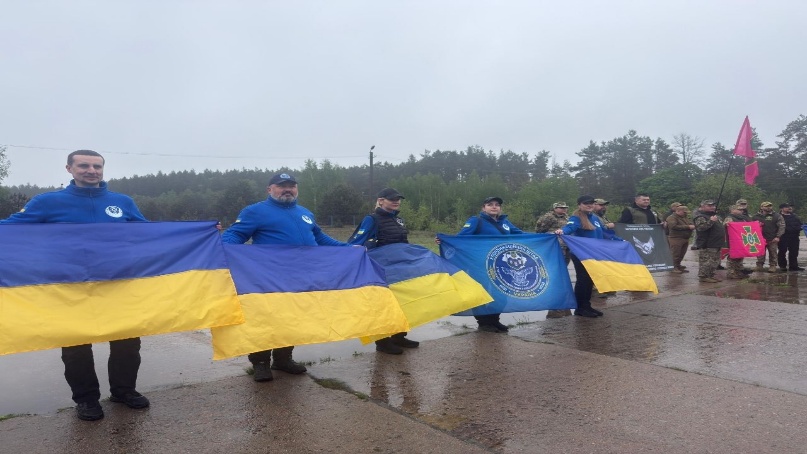
Ukrainian prisoners of war (POWs) greet relatives during an exchange with Russia. (Coordinating Headquarters for the Treatment of Prisoners of War)
Ukraine Strikes Ryazan Refinery, Yeysk Airbase, and Kaspiysk Naval Base
The Ukrainian General Staff confirmed on May 15 that Ukrainian forces struck the Ryazan Oil Refinery in Ryazan Oblast overnight, causing a large fire at the facility. The refinery, operated by Rosneft, is one of Russia’s five largest, with annual processing capacity of 17.1 million tons of crude oil. It produces gasoline, diesel, and jet fuel used to supply Russian armed forces. Geolocated footage confirms a fire at the facility; a satellite imagery analysis by Radio Free Europe showed damage to a pipeline between the oil tank storage area and a workshop. Ryazan Oblast Governor Malkov acknowledged a strike on an unspecified enterprise in the oblast, claiming three people killed and 12 injured — figures the Ukrainian General Staff did not address. Ryazan is approximately 460 kilometers from Ukraine’s northeastern border and 180 kilometers from Moscow. Temporary flight restrictions were imposed at Moscow’s Domodedovo and Sheremetyevo airports; Moscow Mayor Sobyanin reported five Ukrainian drones downed before midnight on May 14.
USF Commander Magyar Brovdi confirmed that Ukrainian SOF, working jointly with the Unmanned Systems Forces, struck a Russian Be-200 Altair multirole amphibious aircraft and a Ka-27 ship-based helicopter at Yeysk Airbase in Krasnodar Krai; geolocated footage published May 15 confirms both strikes. The Be-200 Altair is a jet-powered amphibious aircraft capable of maritime patrol, search and rescue, and anti-submarine warfare. The Ka-27 is a naval helicopter used for anti-submarine and utility missions. The Ukrainian General Staff separately confirmed strikes on a small missile boat and a minesweeper at the Kaspiysk Naval Base in the Republic of Dagestan — extending Ukraine’s naval interdiction campaign to the Caspian Sea for the second time in two weeks. Brovdi also confirmed strikes on a Tor-M2 air defense system in occupied Luhansk Oblast (Bursivka, roughly 105 km from the frontline) and a Pantsir-S1 in occupied Crimea (Khutorok, roughly 156 km from the frontline). Ukrainian forces also struck ammunition depots in occupied Rovenky (129 km) and Yepifanivka (67 km) and a materiel warehouse in occupied Raihorodka (79 km) in Luhansk Oblast. An EW system in occupied Dmytrivka (80–110 km) and an MR-232 Bussol-S radar and FSB coastal intelligence post in occupied Mariupol were also struck.
Finland Airport Closed; Helsinki Scrambles Jets; Latvia Issues Warnings
Finnish authorities temporarily closed Helsinki-Vantaa Airport on the morning of May 15 — the first such closure in Finland since Russia began its full-scale invasion — after detecting what officials described as a suspected drone incursion into Finnish airspace. At least one drone entered Finnish territory, believed to be heading toward the area between Helsinki and the southern city of Porvoo, where the Neste Oyj oil refinery is located. Finnish defense forces raised combat readiness. Finnish Air Force F-18 Hornet fighters scrambled over the Uusimaa region and along the southern coast. Air traffic at Helsinki-Vantaa was restricted; vessels in the Gulf of Finland were rerouted.
Nearly 2 million residents in southern Finland received emergency instructions to remain indoors and stay away from windows. Flights from Tokyo, Osaka, Hong Kong, and Singapore were diverted to alternate airports in Stockholm and Rovaniemi. A Berlin connection via Tallinn was delayed. Finnish defense officials later stated there was no direct military threat to the country. Latvia simultaneously issued warnings about a possible drone threat to its airspace during the same period. The incident follows the May 7 Rezekne crash of Ukrainian drones diverted by Russian electronic warfare near a Latvian oil storage facility, which resulted in Latvia’s defense minister’s resignation and the prime minister’s subsequent resignation. The Finland closure marks a qualitative escalation in the spread of the war’s effects into NATO’s northern flank.
Zelensky: Russia Is Pressuring Lukashenko to Open a New Front
Zelensky stated on May 15, after a briefing from Ukraine’s military and intelligence services, that Russian officials have made fresh contact with Belarusian President Lukashenko and are pressuring him to use Belarusian forces in operations “into Chernihiv and Kyiv oblasts or against an unspecified NATO state.” Zelensky said he possesses details of the conversation between the two countries. He instructed Ukraine’s Defense and Security Forces to strengthen the northern direction and prepare a response plan for approval at headquarters. “Ukraine will undoubtedly defend itself and its people if Alexander Lukashenko makes a mistake and decides to support this Russian intention,” Zelensky wrote.
The warning follows a series of documented Belarusian military developments: the April 29 announcement of rotational mobilization; a March conscription decree for men aged 18–27; roads and artillery positions constructed near the Ukrainian border; Russian reconnaissance balloon carrying a drone signal repeater entering Ukrainian airspace from Belarus in early May; and State Border Guard Service reports on May 4 of Russian logistics infrastructure being built on Belarusian territory. Zelensky has warned since April that Russia seeks to draw Belarus into the war. ISW has repeatedly assessed that Russia uses Belarus as a staging ground, missile and drone launch platform, and potential future maneuver space. The Suwalki Gap — the 70-kilometer corridor between Belarus and Kaliningrad connecting Russia to the Baltic states — is specifically named as one axis under consideration for operations against NATO.
Zelensky Warns of Russian Reconnaissance of Kyiv Decision-Making Centers
Zelensky stated on May 15 that Ukrainian intelligence obtained Russian documents outlining plans for strikes against approximately 20 political and military facilities frequented by senior Ukrainian officials in and around Kyiv City. He published reconnaissance photographs reportedly from the Russian plans dated early March 2026, showing an underground tunnel, a presidential administration building, and a presidential residence. Zelensky said Russian authorities have been developing these plans for a “long time” but have intensified reconnaissance activity since the start of the Iran conflict — likely to exploit Ukraine’s Patriot interceptor shortages as Western stockpiles are consumed in the Middle East theater. The Kremlin’s repeated May 9 threats to strike decision-making centers in Kyiv if Ukraine disrupted the parade have not resulted in a strike, but Zelensky’s disclosure indicates Moscow has not abandoned the targeting work.
Council of Europe Special Tribunal Advances; Claims Commission Progress
The Secretary-General of the Council of Europe gave formal approval at the Chisinau summit of 46 European foreign ministers on May 15 to move from political commitment to operational setup of the Special Tribunal for the crime of aggression against Ukraine. Thirty-six nations and the EU have committed to the tribunal. The Netherlands has completed preparatory work to host the court in The Hague. “Today is a historic day … The Hague will restore justice from the ruins of war,” said Ukrainian FM Sybiha. Council of Europe Secretary-General Alain Berset: “Action now needs to be taken to follow up on this political commitment by securing the Tribunal’s functioning and funding.” The EU committed 10 million euros ($12 million) in January to fund evidence collection; signatories must now agree on further funding, composition, and operational timeline. Ukraine expects the court to be fully operational in 2027. The tribunal’s cross-hairs include Putin, his inner circle, Lukashenko, and potentially North Korean leadership.
Foreign ministers also noted progress on the International Claims Commission. The Register of Damage — the evidentiary foundation for compensation claims — has received over 150,000 submitted claims. However, only five countries (Estonia, Iceland, Ireland, Latvia, and Ukraine) plus the EU have ratified the convention; 25 ratifications are required before the commission can begin work. The central unresolved question remains: once damages are awarded, who pays? Approximately $305 billion in frozen Russian assets is the primary candidate, but this covers only about half the World Bank’s $588 billion reconstruction estimate for Ukraine. An EU diplomat suggested the frozen assets mechanism would need to be substantially scaled up or supplemented by other sources.
Russia’s Budget Deficit at 150% of Annual Plan; VTsIOM Switches to Door-to-Door Polling
Ukraine’s Foreign Intelligence Service reported on May 12 that Russia’s budget deficit reached $78.4 billion in the first four months of 2026 — almost twice the same period in 2025 and over 150 percent of Russia’s planned full-year deficit of $50.5 billion. Russian government spending in January–April 2026 was $235 billion, 15.7 percent above the same period in 2025. Military spending, social transfers, and sector subsidies are consuming increasing budget shares. Russia raised VAT in January 2026 to offset costs; it also spent $14.8 billion on public debt interest in those four months. Forbes reported that 209,000 small- and medium-sized businesses closed in Russia in Q1 2026 — 9 percent more than Q1 2025 — partly due to higher VAT. Russian regional governments more than doubled monthly recruitment spending from 358 million rubles in 2025 to 802 million rubles per month in 2026, per Vazhnye Istorii. The federal government regularly loans and forgives regional debts, including on May 14 for Arkhangelsk, Kaluga, Lipetsk, Orenburg, Smolensk, and Tula oblasts. Putin publicly cited positive economic indicators on May 15 but did not mention that the Ministry of Economic Development lowered Russia’s 2026 GDP growth forecast from 1.3 percent to 0.4 percent, nor that GDP declined year-on-year in January and February.
Russia’s state pollster VTsIOM announced on May 15 that it is switching from telephone-only to a combined phone-and-door-to-door methodology, effective immediately. The stated reason: communication restrictions, anti-spam filters, and growing phone fraud had made it difficult to reach certain age groups by phone. The methodological change comes after Putin’s phone-based approval rating fell by 12.2 percentage points between late December and late April — to 65.6 percent, the lowest level since the full-scale invasion began — following seven consecutive weeks of decline. Under the new combined methodology, the first poll (week of May 4–10) recorded a 1.1 percent rise in approval to 66.8 percent. ISW assessed that the methodological change is consistent with the Kremlin’s ongoing censorship and information management campaign, and that the slight rise in ratings appears connected to the changed sampling rather than a genuine shift in Russian public opinion.
Putin’s Fast-Track Citizenship for Transnistria; Sanctions and Kh-101 Production
Putin signed a decree on May 15 simplifying the citizenship process for residents of Moldova’s Russian-occupied Transnistria region — waiving Russian residency requirements, history and civic knowledge tests, and language proficiency requirements. The decree continues Moscow’s passportization pattern previously applied to Georgia’s Abkhazia and South Ossetia (May 2025) and Ukraine’s occupied territories (March 2026, made indefinite). Ukrainian lawyer Nataliia Yurlova: “The goal of the new decree is to passportize as many people as possible, pressuring them.” The Kremlin uses passportization to create legal pretexts for claiming protectorship over foreign nationals and, historically, to justify military intervention.
Ukrainian Presidential Commissioner for Sanctions Policy Vlasyuk stated on May 15 that the Kh-101 cruise missiles used in the May 14 strike were produced in Q2 2026, confirming Russia is launching missiles almost immediately after production rather than stockpiling. The missiles still incorporate significant Western components, including parts manufactured in late 2025 and early 2026, despite ongoing sanctions. Vlasyuk noted that U.S. efforts to stop supplies of Western AI modules to Russia have likely prevented Russia from deploying AI in Shahed drones at scale. The Ukrainian MoD reported that Ukraine’s intercept rate for Kh-101, Kh-55, and Kh-555 cruise missiles since January 2026 is 88 percent; the rate for ballistic missiles is much lower as it depends entirely on Patriot systems. Russian demands for sanctions relief in peace talks, combined with declining Western Patriot interceptor supplies due to Middle East consumption, represent a compounding risk to Ukraine’s air defense.
Russian Overnight Strike: 3 Killed, 60 Injured, Odesa and Kharkiv
Russian forces launched five Kh-31P anti-radar missiles from the Black Sea, one Kh-35 anti-ship missile from Crimea, and 141 Shahed, Gerbera, Italmas, and Parodiya drones overnight May 14–15. Ukrainian forces downed the Kh-35 and 130 drones; five Kh-31P missiles failed to reach targets. Seven drones struck six locations; debris fell on seven more. Russian strikes damaged port, residential, and railway infrastructure in Odesa, Zaporizhzhia, and Chernihiv oblasts. Ukrenergo reported power outages in Chernihiv, Dnipropetrovsk, Sumy, Kharkiv, and Odesa oblasts.
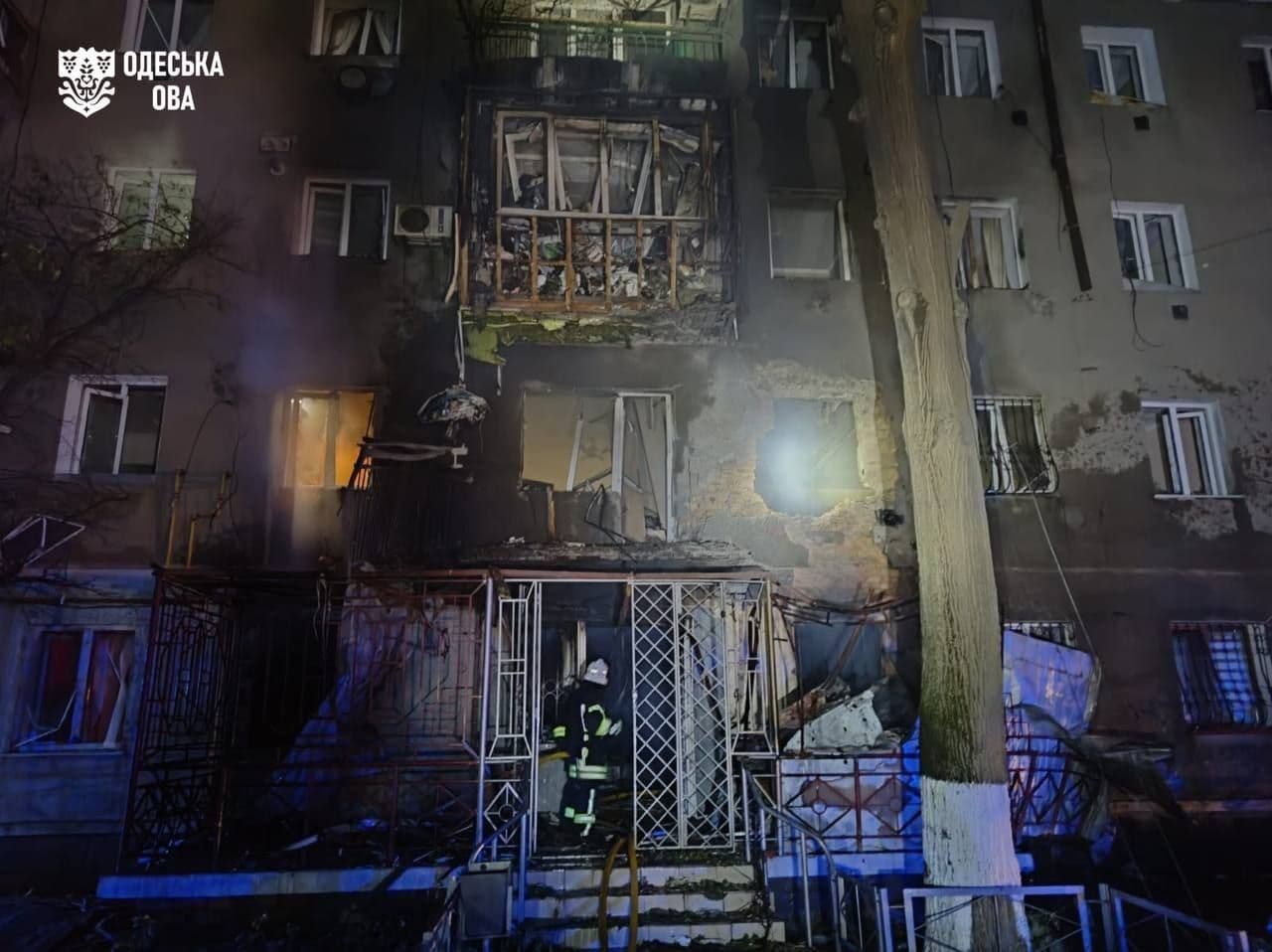
The aftermath of a Russian drone attack on Odesa overnight. (Odesa Oblast Governor Oleh Kiper/Telegram)
Casualties on May 15: two killed and 13 injured in Kherson Oblast; one killed in Zaporizhzhia Oblast’s Polohy District; 39 injured in Kharkiv Oblast across five settlements including Kharkiv City, struck by drones and glide bombs; four injured in Dnipropetrovsk Oblast near Nikopol; two injured in Odesa Oblast; two injured in Sumy Oblast (a man on a motorbike hit by a drone; a 17-year-old boy wounded by a glide bomb in his village). Overnight May 15–16, Russian drones struck Odesa Oblast’s Izmail district — power infrastructure damaged, 39 settlements lost electricity, 22,000 consumers cut off — and a drone hit Kharkiv City’s central Shevchenkivskyi district, damaging two metro entrances, a trolleybus, and public transport infrastructure; no casualties in Kharkiv.
Frontline: Ukraine Liberates Odradne; Advances in Kostyantynivka; Pokrovsk Intensifying
Ukrainian forces liberated Odradne east of Velykyi Burluk in Kharkiv Oblast, confirmed by the Ukrainian Joint Forces Task Force, 16th Army Corps, and geolocated footage showing a Ukrainian flag raised in the settlement’s center on May 15. In the Kharkiv direction, the Russian MoD claimed elements of the 126th Motorized Rifle Regiment (71st MRD, 14th AC, Leningrad MD) seized Chaikivka northeast of Kharkiv City; a Russian milblogger also claimed Russian advances west of Rybalkyne northeast of Kharkiv City. Ukrainian drone strikes and wooded terrain continue to prevent Russian forces from deploying combat vehicles in northern Kharkiv Oblast. In the Kupyansk direction, Russian forces conducted infiltration missions; footage from May 14 shows Ukrainian forces striking a Russian position in western Kurylivka after an assessed infiltration. Russian sources claimed elements of the 68th MRD and 1st Guards Tank Army seized Petropavlivka east of Kupyansk — the third such unconfirmed claim since January 2026. The Russian military command attached an assault detachment of the 26th Tank Regiment (47th Tank Division, 1st GTA) from the Kupyansk direction to the 144th MRD in the Slovyansk direction — the second reported piecemealing of forces for the 144th MRD in recent days.
Ukrainian forces recently advanced in northwestern Ivanopillya and in central and eastern Kostyantynivka, confirmed by geolocated footage from May 13–14. Mashovets assessed that Russian forces are operating in less than 10 percent of Kostyantynivka and advancing at a maximum of one kilometer per week; Ukrainian counterattacks near Illinivka, Berestok, and Chasiv Yar are blocking any Russian breakthrough into central and western Kostyantynivka. The Ukrainian 7th Rapid Reaction Corps Spokesperson Polevyi reported on May 15 that Russian forces near Pokrovsk and Myrnohrad have intensified assaults after pausing and accumulating forces during the May 9–11 ceasefire, leveraging spring foliage and urban cover — including camouflaging howitzers under garbage containers. A Russian milblogger claimed Russian advances south of Vasylivka northwest of Pokrovsk. In the Hulyaipole direction, Russian forces attempted a mechanized assault with armored vehicles and motorcycles near Hulyaipilske — a shift from the usual small infantry groups. Russian forces also attacked toward Verkhnya Tersa from the south, likely responding to Ukrainian successes west and northwest of Hulyaipole. In Mala Tokmachka, a Ukrainian battalion commander stated Ukrainian forces have controlled the settlement since 2023 and that Russian forces have lost approximately 2,000 soldiers attempting to seize it. Ukrainian forces also struck a cargo ship carrying ammunition near occupied Berdyansk (roughly 100 km from front) and hit vehicles on the M-14 Mariupol-Berdyansk highway.
Ukrainian Drone Teams Shut Down NATO Aurora 2026 Exercise in Sweden
Ukraine’s 1st Army Corps Azov reported on May 15 that two Ukrainian drone teams — from the 1st National Guard Brigade “Buravei” and the 20th National Guard Brigade “Lyubart” — participated in NATO’s Aurora 2026 exercise in Sweden (April 27 – May 13) and so dominated the force-on-force scenarios that organizers had to stop training and “resurrect” destroyed units three times. In one mechanized assault, Ukrainian FPV pilots destroyed 28 of approximately 32 major pieces of equipment. In another scenario, Ukrainian drones overran the defenses of a military airfield in less than 20 minutes with no drone losses. Exercise organizers curtailed Ukrainian participation in certain stages to allow other units to complete training — the 18,000-strong NATO force from 13 nations was being eliminated too quickly. Swedish brigade commander Andreas Gustafsson: “They are miles ahead of us when it comes to drone warfare, so we really appreciate them coming here to share their experience with us, and we have a lot to learn from them.” Ukrainian drone operators also briefed Swedish, French, British, and Dutch service members on UAV coordination and electronic warfare operations.
Drone Swarms and Autonomous Warfare: Ukraine’s Next Phase
A Drone Autonomy conference held in Lviv on May 15, organized by the Iron Cluster defense coalition, assembled Ukrainian military officers, defense industry representatives, and international experts to assess the state of autonomous drone swarm technology. Deputy Commander-in-Chief of the Armed Forces Lebedenko confirmed: “Today we have such projects. They’re not large-scale, but they’re growing — mass deployment is possible in the coming years.” Ukrainian-American firm Swarmer, listed on Nasdaq, confirmed it has been deploying early swarm technology in combat since April 2024; its systems allow operators to autonomously deploy groups of drones to an area before human pilots engage individual targets. Defense AI Center A1 head Danylo Tsvok confirmed swarm systems are “currently in the testing phase.”
Conference participants cautioned that drone swarms represent only one component of the broader autonomy race. Yaroslav Azhnyuk of Fourth Law argued that full autonomy covers navigation, target selection, and execution across all drone types — not only coordinated swarms. He compared the full autonomy challenge to developing an entire software platform rather than a single feature. Russia has “likely fielded a fully autonomous unmanned system in combat,” per a Center for Strategic and International Studies April 2026 report. Russia’s AI and drone programs are its stated top military priorities. Anton Melnyk of MITS Capital: “Either we will achieve this — together with NATO partners — or the enemy will.”
Eurovision Finals; Russian UN Vehicle Attack Confirmed on Video; Euro-Broadcasting Row
Ukraine’s singer Leleka qualified for the Eurovision Song Contest final on May 14 and will compete on May 16 with the song “Ridnym” (“To the dear ones”). Ukraine has won Eurovision three times — 2004 (Ruslana), 2016 (Jamala), and 2022 (Kalush Orchestra). British lawmakers condemned Eurovision director Martin Green after he said it was “theoretically” possible for Russia to participate if its state broadcaster demonstrated independence from the Kremlin. MPs Josh Newbury and Nigel Huddleston called the response an “affront” and “outrageous.” Russia has been barred from Eurovision since February 25, 2022.
Russian milblogger Osvedomitell Alex posted and then deleted a video on May 15 showing the FPV attack on the United Nations OCHA humanitarian vehicle in Kherson City on May 14. The video opens with the logo of Russia’s Dnepr Group of Forces. OCHA confirmed the vehicle was clearly marked as humanitarian and that the organization had notified both the Ukrainian and Russian military before the mission. The milblogger claimed the vehicle lacked approvals; OCHA confirmed prior notification had been given. Between January and April 2026, three humanitarians were killed and ten injured in 56 documented incidents. A second UN truck was struck in Dnipropetrovsk Oblast on May 12, injuring the driver. Attacking a clearly marked humanitarian vehicle is a war crime under international law. Ukraine’s FM Sybiha called for a UN Security Council meeting in response.
The Weight of May 15
The rescue operation ended at 8 a.m. Twenty-four dead. Seventeen still missing. The building had been nine stories tall. Zelensky visited the site. Diplomats from a dozen countries stood beside him.
Two hundred and five Ukrainians came home from Russian captivity. Most had been held for four years. Four of them were civilians from Sumy Oblast, aged 61 to 85, kidnapped from their homes last year. Zelensky thanked the United States and the UAE. He said: “Let’s continue to fight for each and every one who still remains.”
Ukraine struck the Ryazan refinery, two naval vessels in the Caspian, a Be-200 amphibious aircraft and a Ka-27 helicopter in Krasnodar Krai. Finland closed its largest airport for the first time since the invasion began. Two million Finns were told to shelter indoors. F-18 Hornets scrambled over Helsinki. Latvia issued airspace warnings. The drone reached the country that borders Russia and the Arctic Ocean.
Russia is pressuring Belarus to open a new front. The Special Tribunal for the crime of aggression formally advanced toward operational status with 36 countries committed. Russia’s budget deficit is at 150 percent of plan. Putin changed his polling methodology. The first result under the new method showed a rise. The methodology, not the war, changed.
A Prayer for Ukraine
1. For the Twenty-Four Dead and the Seventeen Still Missing
Lord, the search ended after 28 hours. Twenty-four people were counted. Seventeen could not be found. A nine-story building in Darnytskyi district is now rubble. A city observed a day of mourning. Zelensky stood at the site. Ambassadors stood beside him. The cameras recorded it. We ask only that the world not stop recording. That the 17 who are still missing be found — or if not found, be named. That the three children who died in that building — whose names have not yet been released — be held by more than an official count.
2. For the 205 Who Came Home
Father, they crossed the border on the morning of a day of mourning. Twenty-one years old. Sixty-two years old. Sailors. Paratroopers. Border guards. Four civilians in their sixties and seventies who were taken from their homes in Sumy Oblast by Russian soldiers last year. Most of them have been in Russian custody for four years. We do not know what those four years were. We know what the AFP investigation described: beatings on arrival, mock executions, electric shocks, forced singing, food deprivation, systematic isolation. We pray for each of those 205 people as they arrive at the medical centers. As they see their families. As they try to sleep in a safe room for the first time in years. Let the other 795 follow. Let all the rest follow them.
3. For Finland and the Countries on Russia’s Border
God of nations, a drone entered Finnish airspace and 2 million people were told to shelter indoors before dawn. The Helsinki airport closed. F-18s flew over Helsinki. Latvia issued airspace warnings. This is what it means to border Russia in 2026: that a drone can reach your oil refinery before your air defenses know it is there, that your airport can close without warning, that your residents can wake to an emergency notification from the government telling them not to stand near windows. We pray for Finland, Latvia, Estonia, Lithuania, Poland, and every nation on Russia’s western border. For their defense ministers and air defense commanders. For the decisions being made in the early hours of the morning when a blip appears on a radar screen and no one is certain yet what it is.
4. For the People of Transnistria
Lord, Putin signed another fast-track citizenship decree — this time for Transnistria. The same mechanism was used for Abkhazia, South Ossetia, and Ukraine’s occupied territories. A Ukrainian lawyer said: “The goal is to passportize as many people as possible, pressuring them.” This is the legal infrastructure of annexation, built one decree at a time. We pray for the people of Transnistria — who have lived in a frozen conflict for over thirty years, who did not choose to be caught between Russia’s imperial ambitions and Moldova’s territorial integrity — that they are protected, not weaponized. That the pattern that destroyed Crimea, Donetsk, and Luhansk does not repeat itself on the Dniester River.
5. For the Special Tribunal and the Long Arc
God of justice, 36 nations and the EU committed to a court that will try Vladimir Putin for the crime of starting a war. The Netherlands is preparing The Hague to host it. The Secretary-General of the Council of Europe moved from signatures to action. Ukraine expects the court to be operational in 2027. It will be too late for the 24 people who died in Darnytskyi district. It will be too late for the 17 still missing. It will be too late for the 205 people who spent four years in Russian detention. It will be too late for all of the 17,400 documented civilian dead. But it will not be too late to say that what Russia did has a name in law, and that the name carries consequences, and that the world decided it mattered. Let the tribunal open. Let the evidence hold. In Your mercy, in Your justice, in Your time — bring this war to its end.