
Ukraine Daily Briefing | May 21, 2026 | Day 1,548 of the Full-Scale Invasion
Prepared by Dayana Bozhyk
Russia and Belarus completed joint nuclear force exercises on May 21, with Moscow deploying Iskander-M missiles and nuclear munitions to Belarusian territory for the first time — a milestone that reflects how thoroughly Lukashenko’s sovereignty has been absorbed into the Kremlin’s war machine. Ukraine responded by striking its 11th Russian oil refinery of the month, hitting Rosneft’s Syzran facility more than 800 kilometers from the Ukrainian border, as Reuters confirmed that central Russia’s entire refining network — responsible for 30 percent of the country’s gasoline and 25 percent of its diesel — has halted or reduced operations. Zelensky identified five Russian scenarios for a renewed northern offensive and ordered an unprecedented reinforcement of the Chernihiv-Kyiv defensive line.
THE DAY’S RECKONING
Picture a convoy of heavy military vehicles moving through a Belarusian forest. Not Russian forest. Belarusian. The footage, released by Belarus’s own Defense Ministry, shows what officials claim are nuclear warheads in transit to launch positions — Iskander-M ballistic missile systems being loaded, prepared, exercised on soil that a decade ago was constitutionally prohibited from hosting them.
This is what May 21st looked like from the strategic level: Russia staging nuclear weapons exercises inside a neighbor’s country while simultaneously watching its domestic fuel industry collapse under the weight of Ukrainian drone strikes. The Syzran refinery near the Volga — over 800 kilometers from Ukraine’s border, processing nine million tons of crude per year for the Russian Air Force and military units across central and southern Russia — was struck overnight, becoming the 11th major refinery hit this month. Across the country, the central refining network had already gone dark. Kirishi: shut since May 5. Moscow: halted. Ryazan: halted. Yaroslavl: suspended. Kstovo: burning.
Eight hundred kilometers north of the Syzran flames, Latvia declared its third consecutive day of drone-related air alerts as an unidentified UAV entered Latvian airspace. NATO Baltic Air Policing scrambled jets. Residents sheltered. The Baltic sky had become a second front.
And in the Kremlin, Russia’s gold reserves fell for the fourth consecutive month — the lowest since March 2022, the first month of the invasion. The war machine is running on borrowed metal.
THE BELARUS GAMBIT: NUCLEAR WEAPONS CROSS THE BORDER
The Belarusian Constitution once declared the country a non-nuclear state. That clause was removed in 2022 under what ISW assessed as direct Kremlin pressure. On May 21, the consequences became concrete.
Russia and Belarus completed the second stage of combined nuclear force exercises, with both Putin and Lukashenko presiding over the finale. The Russian Ministry of Defense claimed that nuclear munitions were physically transferred to Belarus, where Belarusian forces practiced receiving, equipping, and moving specialized warheads and Iskander-M launch vehicles. Simultaneously, Russia fired a Yars intercontinental ballistic missile from the Plesetsk cosmodrome, a Sineva ICBM from a submerged submarine, Zircon and Kinzhal hypersonic missiles, and cruise missiles from Tu-95MS bombers. The entire nuclear triad performed at once.
The exercises involved 64,000 personnel, over 200 missile launchers, and eight strategic submarines — the largest nuclear exercises since the Cold War. Putin announced that the biennial “Union Shield” exercises, due in 2027, may for the first time include a nuclear component.
Lukashenko, with characteristic double-messaging, simultaneously declared that Belarus had “no intention” of entering the war — and offered to meet Zelensky “anywhere, in Ukraine or Belarus.” Kyiv dismissed the offer immediately. “Since 2022, it has been obvious that this man’s words mean nothing,” Zelensky adviser Dmytro Lytvyn said. “We should pay attention to his actions.”
The actions: Belarus allowed Russia to use its territory for the 2022 Kyiv offensive. Belarus’s territory is now hosting nuclear exercises. Zelensky has identified five Russian scenarios for an offensive through northern Ukraine via Belarus. The Ukrainian SBU and Defense Forces launched what the General Staff described as “unprecedented” enhanced security measures across Chernihiv, Kyiv, Zhytomyr, Volyn, and Rivne oblasts.
SYZRAN BURNS: UKRAINE’S 11TH REFINERY STRIKE OF THE MONTH
Zelensky confirmed the strike on Telegram at dawn. The target: Rosneft’s Syzran Oil Refinery in Samara Oblast, 800 kilometers from Ukraine’s border, processing nine million tons of crude per year. The refinery supplies fuel to the Russian Air Force and military units across central and southern Russia, and exports petroleum products via the Volga River and the Caspian Sea. The mission was carried out by operators from the 1st Separate Center and the 413th Regiment of Ukraine’s Unmanned Systems Forces in coordination with Special Operations Forces.
Geolocated footage and NASA FIRMS data confirmed a large fire at the industrial zone. Samara Oblast Governor Fedorishchev acknowledged the strike. Two civilians were reported killed. “This is yet another of our long-range sanctions against the Russian oil refining industry,” Zelensky said, “and we will continue along this path.”
The path runs deep. According to data compiled by Vot Tak, Ukraine has now struck at least 24 of Russia’s 33 major oil refineries since the full-scale invasion began — 158 strikes in total. In the first five months of 2026 alone, Kyiv recorded 32 strikes, nearly matching all of 2024’s 34. The Syzran strike was the 11th time that specific facility has been hit, placing it behind only Ryazan and Saratov, each struck 15 times.
CENTRAL RUSSIA’S REFINING NETWORK GOES DARK
Reuters reported on May 20 what the strike pattern had been building toward for weeks: virtually all major oil refineries in central Russia have halted or significantly scaled back production. The Kirishi refinery in Leningrad Oblast, one of Russia’s largest at 20 million tons per year, has been fully shut since May 5. The Moscow Oil Refinery halted “to mitigate risks” after the May 17 strike. Ryazan halted after May 15. Yaroslavl’s primary processing unit suspended after May 15 and was struck again on May 19. The Kstovo Lukoil refinery was hit again overnight May 19-20.
The combined capacity offline: 238,000 tons per day, 83 million metric tons per year — a quarter of Russia’s total refining capacity. USF Commander Brovdi confirmed 10 major refineries struck this month, 6 forced to halt. ISW has previously assessed that Western sanctions are restricting Russia’s access to the specialized parts needed for repairs — meaning the damage compounds.
Russia’s oil revenues present a paradox. The war in the Middle East has temporarily boosted global prices, and Reuters reported Russia’s oil and gas revenues for May are set to rise 39 percent year-on-year to 700 billion rubles. But revenues from January to May declined by roughly a third compared to the same period last year. Ukraine’s NBU described the oil windfall as “financial doping” — the last factor preventing budget collapse in an economy that contracted 0.3 percent in Q1 2026 for the first time since early 2023. Ukraine’s central bank concluded Russia’s economic model has transformed into a “military-administrative one” in a state of “fragile equilibrium.”
RUSSIA’S GOLD RESERVES HIT A FOUR-YEAR LOW
The Russian Central Bank reported on May 20 that gold reserves fell for the fourth consecutive month in April 2026, totaling 73.9 million ounces — the lowest since March 2022, the opening month of the full-scale invasion. Volume declined 200,000 ounces in April and 900,000 ounces since January, setting a record annual decline since 2002 according to the World Gold Council.
Russia began selling gold reserves for the first time in November 2025. Its sovereign wealth fund’s liquid reserves have been steadily depleted since the invasion began. High wartime spending, a budget deficit already at 1.9 percent of GDP against an annual target of 1.6 percent, and the structural collapse of its civilian investment base are all compounding. Ukraine’s NBU assessment is blunt: “High oil prices remain the only factor preventing a budget collapse.” No economist, however, can pinpoint when that factor will be insufficient — a war state that disregards its citizens’ welfare generates only weak internal pressure, and Russians continue enlisting for high contract salaries.
ZELENSKY’S FIVE SCENARIOS: THE NORTH BRACES
Zelensky convened a Supreme Commander-in-Chief Staff meeting focused on the Belarus-Bryansk direction on May 21. Ukraine’s military and intelligence briefed him on five specific Russian scenarios for expanding the war through northern Ukraine toward Chernihiv and Kyiv. He issued instructions to strengthen the defensive line and ordered the Foreign Ministry to prepare diplomatic pressure specifically targeting Belarus.
He also visited Slavutych — the city near the Belarusian border built for Chernobyl workers — to personally inspect local defenses. “They must understand: consequences will follow and be significant,” Zelensky said of the Lukashenko regime. The General Staff described the enhanced northern security measures as “unprecedented” in scale, involving the SBU’s Anti-Terrorist Center, National Police, Armed Forces, National Guard, and State Border Guard Service across five oblasts.
Zelensky said Russia currently lacks the troop capacity to sustain a renewed full-scale Belarus front but could pursue “political decisions of a different format” — a reference to Transnistria-style incremental absorption. In Brussels, Syrskyi told the Ukraine-NATO Council that Russia has lost 141,500 military personnel since January 2026, of whom more than 83,000 were killed. “Every day, the Russian army loses at least a thousand soldiers,” he said.
FRONTLINE: KHARKIV ADVANCES, POKROVSK GRINDING, ZAPORIZHZHIA COUNTERATTACKS
The Russian MoD claimed elements of the 82nd Motorized Rifle Regiment seized Shesterivka northeast of Kharkiv City and identified the west bank of the Siverskyi Donets River toward Rubizhne as the next tactical objective. A Kremlin-affiliated milblogger also claimed seizure of Starystya and advances north of Rybaklyne. A Ukrainian source reported counterattacks retook lost positions south of Vovchansk.
Russian forces launched at least four drone strikes against vehicles on the Kharkiv City M-03 ring road on May 21, including two against police cars — a deliberate tactic of striking first responders. “Russian forces often use sleeper drones against passing vehicles and then strike the police who respond to the scene,” said Kharkiv Oblast Patrol Police Head Levchenko. The practice, previously documented in Kherson Oblast as a “human safari,” is spreading to other frontline areas.
In Pokrovsk, a Ukrainian battalion officer reported Russian forces deploying additional drone and artillery crews and dropping more KAB guided glide bombs, while launching fewer infantry assaults than this time last year. Russian forces are experimenting with electric bicycles for silent movement and increasingly deploying unmanned ground vehicles — though keeping them five to seven kilometers behind the front line to avoid loss.
In western Zaporizhzhia, Ukrainian counterattacks liberated Mala Tokmachka and Bilohirya and advanced along the E-105 highway east of Plavni, effectively halting Russian progress toward Orikhiv and Zaporizhzhia City. Meanwhile, Russia is reportedly moving over 1,000 troops from the 272nd Tank Division at Kupyansk to reinforce the 144th Motorized Rifle Division in the Slovyansk direction — the third such transfer, indicating Russia may have abandoned its Kupyansk offensive.
UKRAINE DOUBLES DRONE INTERCEPTION RATE; PRIVATE AIR DEFENSE EXPANDS
Defense Minister Fedorov announced on May 21 that Ukrainian forces doubled their interception rate of Russian long-range drones from January to May 2026, even as Russian strike packages grew 35 percent larger in the same period. Interceptor drone supply has grown 2.6 times. The goal is a 95 percent interception rate — current performance already exceeds 90 percent for Shahed-type UAVs, Zelensky confirmed.
Ukraine is simultaneously developing low-cost interceptor missiles specifically designed to counter jet-powered Shahed variants — faster drones that can reach 600 km/h. Fedorov said prototypes are already in testing and production is slated to scale “tenfold” ahead of fall-winter 2026, when Russian infrastructure strikes historically intensify.
The private air defense sector is expanding in parallel. Twenty-seven Ukrainian businesses have joined a private air defense project, with two fully operational in Kharkiv and Odesa oblasts. Local governments can now finance territorial community air defense groups under Air Force operational command. Russia is meanwhile constructing 10 new drone launch ports for jet-powered Geran-4 and Geran-5 drones at the Tsimbulova Airfield in Oryol Oblast — indicating it intends to scale both the size and variety of its nightly strike packages.
THE BALTIC SKY: LATVIA’S THIRD ALERT, DRONE INCURSIONS SPREAD
Latvia declared its third consecutive day of drone-related air alerts on May 21 after an unidentified UAV entered Latvian airspace. NATO Baltic Air Policing deployed fighter jets. Residents were instructed to shelter and apply the “two-walls rule.” Latvia’s armed forces deployed additional units to the eastern border.
The pattern across the Baltic is forming: Lithuania’s first-ever nationwide air alert on May 20. Estonia’s drone interception on May 18. Latvia’s three alerts in three days. Finland’s Helsinki-Vantaa Airport closure on May 15. The suspected mechanism: Russian electronic warfare jamming Ukrainian drones in flight and redirecting them across NATO borders. The political consequence: Latvia’s Prime Minister resigned on May 14 after a Ukrainian drone diverted by Russian countermeasures struck a Latvian oil facility on May 7.
The Lithuanian State Security Director called the situation “sharpening.” European Commission President von der Leyen called Russia’s threats “unacceptable.” The EC spokesperson: “Without Russia’s war of aggression, there’d be no drones crashing into EU space. Responsibility for everything is with Russia.” Fifteen Baltic MEPs wrote an open letter to EU leadership calling for solidarity.
RUSSIAN STRIKES: 116 DRONES, AGRICULTURAL WORKERS TARGETED
Russian forces launched one Iskander-M ballistic missile from Rostov Oblast and 116 drones overnight May 20-21. Ukrainian air defenses downed 109; the Iskander-M and five drones struck five locations. At least 14 civilians were injured in Dnipro. One civilian was killed and 11 others injured in Konotop, Sumy Oblast.
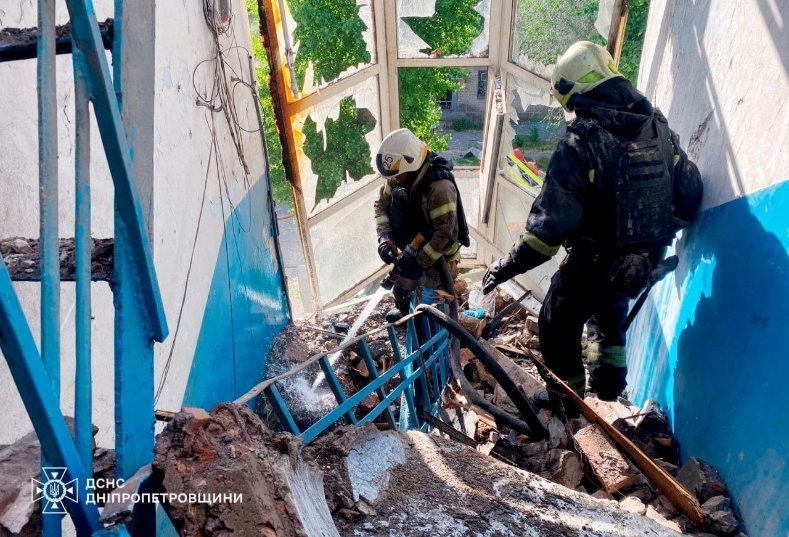
Rescue workers in a house damaged in a Russian strike on Dnipro. (Ukraine’s State Emergency Service / Telegram)
The agricultural sector bore particular weight. A Russian Geran drone struck a farm bus in Chernihiv Oblast’s Semenivka community on May 20, killing one agricultural worker and injuring two others. A drone strike late on May 20 ignited a warehouse fire at a Novhorod-Siverskyi agricultural enterprise. A third strike on May 21 morning injured a 33-year-old tractor operator working in a field.
Across all oblasts on May 21: six injured in Kharkiv Oblast, one killed by a drone striking a truck; one killed and six injured in Dnipropetrovsk; a 94-year-old woman killed in Sumy; ten injured in Kherson after Russian forces targeted 45 settlements; two injured in Zaporizhzhia from a guided aerial bomb. Russian milbloggers claimed strikes against trains near Kamyanske and Kryvyi Rih.
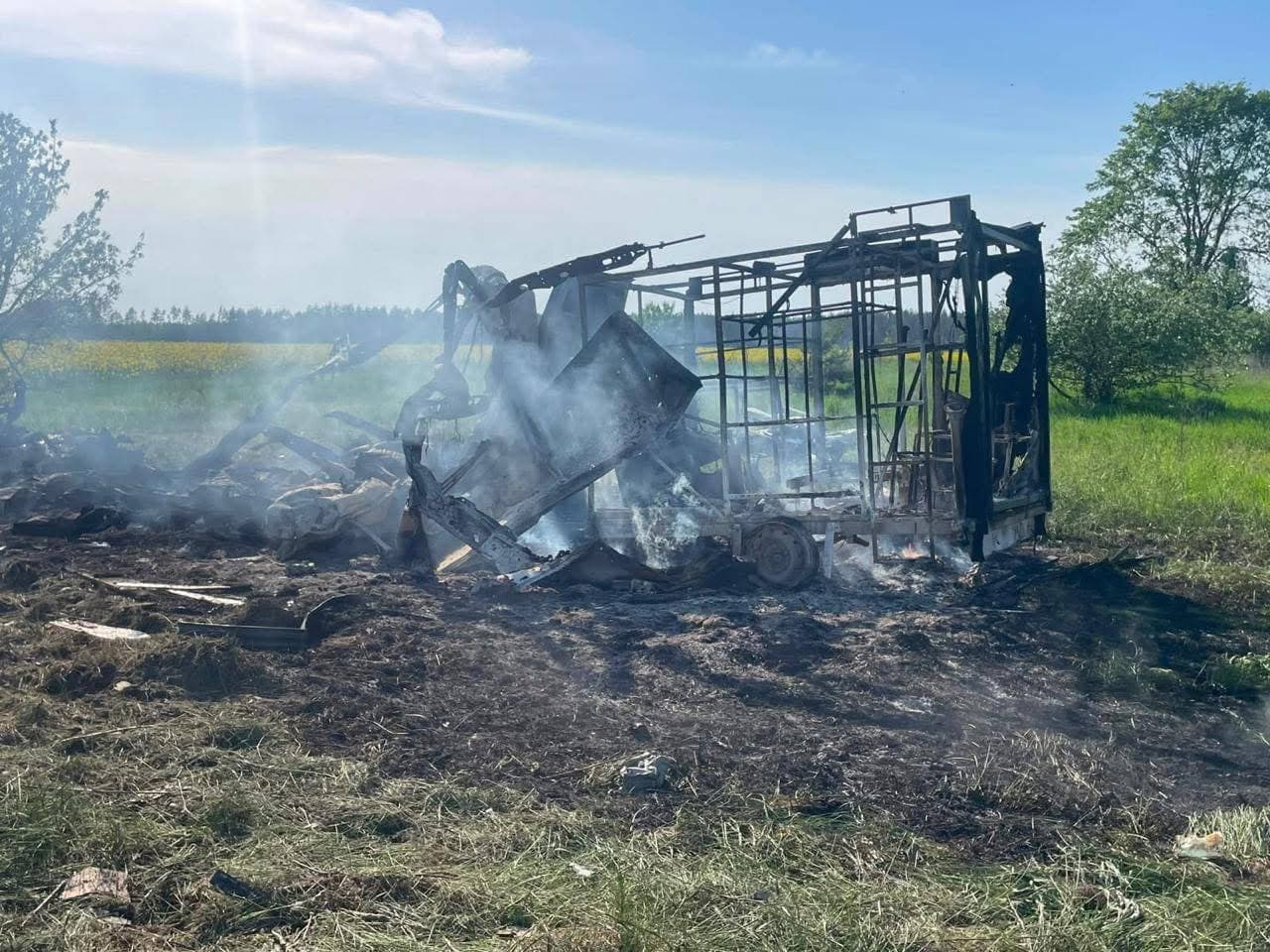
A Russian strike destroyed a farm bus in the Semenivka community, Chernihiv Oblast. (Chernihiv Oblast Governor Viacheslav Chaus/Telegram)
KREMLIN MEDIA BLACKOUT; RUSSIA SUPPRESSES ‘BAN’ COVERAGE AHEAD OF ELECTIONS
Russian opposition source Meduza reported on May 21 that the Kremlin’s political bloc has instructed state and pro-government media to stop using the word “ban” in articles. The directive: reduce coverage of Kremlin bans, restrictions, and fines on freedom of speech and expression. Media may cover the lifting of bans but not their imposition.
The timing is calculated: September 2026 State Duma elections are approaching. United Russia General Council Secretary Yakushev publicly declared the party is not “a party of prohibitions.” The framing requires suppressing evidence to the contrary — which includes sending critical milbloggers to frontline assault units or imprisoning them, restricting VPNs and foreign messaging platforms, and cutting mobile internet access in ways that impose “tangible hardships in the everyday lives of Russians,” as ISW assessed.
The Kremlin’s censorship of censorship coverage is a measure of what it fears. It fears that ordinary Russians, who continue to live inside the consequences of wartime restrictions, will connect those restrictions to the party asking for their votes.
GERMANY’S MERZ PROPOSES ASSOCIATE EU MEMBERSHIP FOR UKRAINE
German Chancellor Friedrich Merz circulated a letter to EU leaders dated May 18, calling for the creation of an “associate membership” for Ukraine and other candidate countries to maintain momentum while full accession proceeds. The proposal would grant Ukraine participation in EU leaders’ meetings, a seat in the college of EU Commissioners, non-voting membership in the European Parliament, and partial representation in the European Court of Justice.
Ukraine has ruled out “ersatz membership,” preferring full accession as quickly as possible. Merz tried to address this by arguing the status “would not be membership light” and would “further accelerate the accession process.” Hungary has been blocking Ukraine’s accession clusters for a year, though Budapest stopped blocking the €90 billion EU loan in April.
The day’s counterweight: Hungary’s new Agriculture Minister announced plans to reinstate the ban on Ukrainian agricultural produce, which had lapsed when the previous government ended its emergency measures. The ban is illegal under EU law. European Parliament trade committee member Karlsbro called it “deeply regrettable” and said she would immediately raise the issue with Trade Commissioner Sefcovic.
TRUMP DEPLOYS 5,000 TROOPS TO POLAND; US MILITARY POSTURE SHIFTS
U.S. President Trump announced on May 21 via Truth Social that the United States would send an additional 5,000 troops to Poland, crediting his personal relationship with newly elected Polish President Karol Nawrocki as the rationale. The announcement came two days after Vice President Vance told reporters a Poland deployment had been delayed, and a week after the Pentagon canceled a planned 4,000-troop deployment to Poland.
The reversal reflects the volatility of U.S. military planning in Europe under the current administration. The backdrop: Trump has simultaneously reduced the U.S. military presence in Germany by 5,000 troops, generating tension with Chancellor Merz. European allies are watching the Poland announcement for signs of whether it represents a durable strategic commitment or another improvisation.
Russia moved nuclear weapons into Belarus. Ukraine struck its 11th refinery of the month, 800 kilometers inside Russia. Latvia declared its third straight drone alert. Gold reserves fell to their lowest since the first month of the war. The Kremlin instructed state media to stop using the word “ban.”
A quarter of Russia’s refining capacity is offline. Zelensky is preparing responses to five northern scenarios. The Baltic sky is no longer quiet. And in a Belarusian forest, heavy vehicles moved through the trees carrying what officials said were nuclear warheads — on territory that was constitutionally nuclear-free until the Kremlin decided otherwise.
Day 1,548. The war expands by category even when the front lines move slowly.
A PRAYER FOR UKRAINE
1. For the Farm Worker on the Bus in Semenivka
Lord, a man went to work on May 20. He boarded a farm bus in Chernihiv Oblast in the early morning, as agricultural workers do, going out to tend the fields. A Russian Geran drone found the bus. He was killed. Two of his colleagues were injured. He was not a soldier. He was not near the front. He was a farm worker in a bus in a region that was fighting just to remain Ukrainian. Receive him. Hold his family. And hold the emergency workers who have now responded to so many farm buses, tractors in fields, and warehouse fires that this, too, has become a practiced grief.
2. For the Children in Belarusian Shelters and Baltic Schools
Father, on May 20, school principals in Lithuania received instructions to move children to shelters. They did. On May 21, Latvia declared its third consecutive day of drone alerts. Residents were told to use the two-walls rule — a civil defense instruction that Baltic parents are now explaining to their children. These are NATO countries. These are EU member states. These children are learning to shelter not because their countries are at war, but because a war nearby has made the sky unpredictable across an entire region. Protect them. And let the leaders building the Baltic air defense umbrella have the resources and the speed the moment requires.
3. For the Defenders Holding the Northern Line
God of justice, Zelensky has identified five Russian scenarios for a renewed offensive through the north. The SBU and Defense Forces have launched what the General Staff called unprecedented security measures across five oblasts bordering Russia and Belarus. The soldiers and officers now reinforcing the Chernihiv-Kyiv line are being asked to hold against a threat that may not come — or may come at any time. The weight of that uncertainty is its own kind of combat. Sustain them. Give wisdom to the commanders reading the intelligence. And for those already stationed in border communities who have lived under this threat every day since February 2022 — let them know they have not been forgotten.
4. For the Operators Who Flew 800 Kilometers in the Dark
Lord, the operators of Ukraine’s 1st Separate Center and 413th Regiment flew unmanned aircraft 800 kilometers into Russia overnight to strike a refinery supplying fuel to the military that is killing their people. The mission was planned, executed, and confirmed. A large fire burned at the Syzran facility. These young men and women are conducting precision strategic operations from screens in undisclosed locations, carrying the weight of what they are doing with clarity about why. They are not asking for recognition. They are asking for the strikes to work, for the war to end, and for those they love to still be alive when it does. Bless their work. Protect their minds. And let the pressure they are building translate into the leverage that ends this.
5. For the Long Arc
God of history, Russia moved nuclear weapons into Belarus today. The country that constitutionally renounced nuclear hosting until the Kremlin decided otherwise. Gold reserves are falling. Refineries are burning. And yet no economist can say when it ends — because a state that disregards its citizens has no natural floor, and the men who start wars rarely stop them before they choose to. We do not know when this ends. We know what Ukraine has paid for every day it has continued. We know what the farm workers, the school children in shelters, the defenders on the northern line, and the drone operators in the dark have given. Let that not be wasted. Let it accumulate into something that matters. In Your mercy, in Your justice, in Your time — bring this war to its end, and let the ending be worthy of what Ukraine has endured.