
Ukraine Daily Briefing | May 23, 2026 | Day 1,185 of the Full-Scale Invasion
Ukrainian forces drove armored columns up to five kilometers into Russian-held territory near Borova, striking the 20th Combined Arms Army during a regroup — one of the most significant Ukrainian ground thrusts in weeks. Overnight, Ukraine struck the Metafrax chemical plant in Perm Krai — more than 1,700 kilometers deep — while also hitting Russian Black Sea Fleet warships and the massive Sheskharis oil terminal at Novorossiysk. President Zelensky warned that Russia was readying a combined missile and drone assault on Kyiv, possibly including the Oreshnik hypersonic ballistic missile, as a Russian drone murdered a man attending a funeral during Day of Heroes commemorations in Sumy.
The Day’s Reckoning
Picture a funeral procession moving through the outskirts of Sumy on a spring morning. Mourners gathering during the national Day of Heroes. A minute of silence for fallen soldiers. Then the drone comes — quietly, invisibly — and one more person is dead, fourteen others bleeding in the grass.
That is the war Russia is fighting: not just against Ukrainian lines, but against Ukrainian life. Against the rituals of grief. Against the act of remembering.
On the same day that drone found its way to a cemetery, Ukrainian armored columns were driving five kilometers into Russian-held ground near Borova — striking the 20th Combined Arms Army while it was mid-regroup, knocking aside the 3rd and 144th motorized rifle divisions. Fifteen armored vehicles in the assault. A penetration that Russian milbloggers acknowledged with something close to alarm.
Meanwhile, in the Black Sea, Ukrainian drones were catching warships at anchor in Novorossiysk. A guided-missile corvette. A Kalibr-armed frigate. The shadow fleet tanker Chrysalis. And 1,700 kilometers to the northeast, above the Ural foothills, the Metafrax chemical plant burned — a facility woven into Russia’s military-industrial supply chain.
And over all of it, Zelensky issued his gravest warning in weeks: Russian intelligence — confirmed by American and European partners — suggests an Oreshnik strike may be coming. Perhaps tonight. Possibly targeting Kyiv itself.
This is Day 1,185. A funeral drone and a five-kilometer breakthrough. Fires in Perm and a fleet taking hits in Novorossiysk. The weight of this day is impossible to hold all at once.
“While Russia Regrouped”: The Borova Breakthrough
The timing could not have been better — or worse, depending on which side you were on.
Ukrainian forces launched a mechanized assault southeast of Borova at the precise moment Russian forces in the area were reorganizing. At least 15 armored vehicles advanced simultaneously toward Maliivka, Lozove, and Vovchyi Yar. Russian milbloggers, watching the footage in real time, reported something they rarely admit: that Ukrainian vehicles had penetrated up to five kilometers into Russian-controlled territory before Russian strikes caught them.
The units absorbing the blow were no reserves. The 3rd and 144th motorized rifle divisions of the 20th Combined Arms Army — a formation of the Moscow Military District — took the full force of the Ukrainian thrust. That these elite-adjacent formations were “regrouping” when the assault hit suggests a breakdown in situational awareness that will require uncomfortable explanations in Moscow.
Russian milbloggers acknowledged Ukrainian forces now operate in Andriivka, Ridkodub, Vovchyi Yar, and southwestern Karpivka. One blogger wrote what amounted to a warning: Russian forces may struggle to prevent further Ukrainian advances south of Borova. Another had said the day before that Kremlin command had exaggerated success around Kupyansk so consistently that weak points in the defensive line went unaddressed — and Ukrainian forces, he noted, had noticed.
This is what institutional dishonesty costs. When commanders report up the chain that everything is fine, everything eventually is not.
1,700 Kilometers: Perm Burns, and the Black Sea Fleet Bleeds
The strike on the Metafrax Chemicals plant in Perm Krai did not make headlines the way a missile barrage does. There were no dramatic rescue operations, no collapsed apartment blocks. There was, instead, a factory — one that supplies chemical products to Russia’s military-industrial complex — that stopped production.
Perm Krai sits more than 1,700 kilometers from the Ukrainian front line. That is farther than Paris is from Warsaw. That is not supposed to be within range. That calculation is now obsolete.
Zelensky announced the strike himself, naming the facility and its role in Russian war production. This is the logic of Ukraine’s deep strike campaign made explicit: if the thing that makes the thing that kills Ukrainians can be destroyed, destroy it.
The same overnight campaign found targets far closer to the front. Ukrainian forces struck the Sheskharis oil terminal and Grushova oil depot in Novorossiysk — together representing one of the largest oil throughput facilities on the Black Sea, capable of moving up to 75 million tons of crude oil annually, with combined tank farm volumes exceeding 2.4 million cubic meters. Both facilities caught fire.
In the naval basin at Novorossiysk, Ukrainian Unmanned Systems Forces also struck a Project 1239 hoverborne guided-missile corvette and the Admiral Essen — a Project 11356 frigate capable of launching Kalibr cruise missiles, the same weapon system that has struck Ukrainian cities throughout the war. The shadow fleet tanker Chrysalis, serving Russia’s oil export sanctions evasion network, was also hit in the Black Sea.
Russia moved its Black Sea Fleet from Sevastopol to Novorossiysk to protect it from Ukrainian strikes. The strikes followed.
The Oreshnik Warning: Zelensky’s Gravest Alert
On the evening of May 23, Volodymyr Zelensky did something presidents rarely do: he told his country, in plain language, that a weapon capable of hitting Kyiv might be launched against them that night.
“Our intelligence services reported receiving data, including from American and European partners, about Russia preparing a strike with the Oreshnik missile,” Zelensky said. He was not hedging. He urged Ukrainians to use shelters, to take air raid alerts seriously, to protect their lives — because, he added, “Russian madness truly knows no bounds.”
The Oreshnik is not a conventional weapon. It is an intermediate-range ballistic missile — believed to be a modified version of the Rubezh surface-to-surface system, itself derived from Soviet-era ballistic missile designs — capable of delivering multiple warheads at hypersonic speed. Russia first used it against Dnipro in November 2024. In January 2026, it struck Lviv. Both uses were designed as demonstrations: Look what we can reach. Look what you cannot stop.
The Kremlin had already threatened strikes on “decision-making centers” in Kyiv if Ukraine targeted Russia’s Victory Day celebrations on May 9. Ukraine did not attack. Russia launched a massive strike against Kyiv just days after the ceasefire anyway.
The U.S. Embassy in Kyiv issued its own security alert about a “potentially significant air attack” within a 24-hour window — the same window Zelensky named. Foreign Minister Sybiha did not use diplomatic language in response: “Concerns and condolences are not enough. We need concrete action increasing the cost of war for the aggressor already now.”
“Cynical Attack”: The Drone at the Funeral
The Day of Heroes is Ukraine’s National Day of Commemoration — a moment set aside to honor those killed defending the country. In Sumy, residents gathered at the central cemetery. Youth groups organized a minute of silence. A flower-laying ceremony took place at the Alley of Glory.
Then, on the outskirts of the city, a Russian drone found a funeral procession.
One man was critically wounded in the strike. Fourteen others were injured. Doctors worked to save the man’s life. They could not. Regional authorities described it as a “cynical attack.” The word does not fully carry the weight.
Sumy sits roughly 30 kilometers from the Russian border. It lives under the constant shadow of cross-border drone, missile, and artillery fire. But this particular strike — against mourners, against the act of burial, against the specific ritual by which a nation honors its dead — was not accidental proximity to a military target. There are no military targets at a funeral.
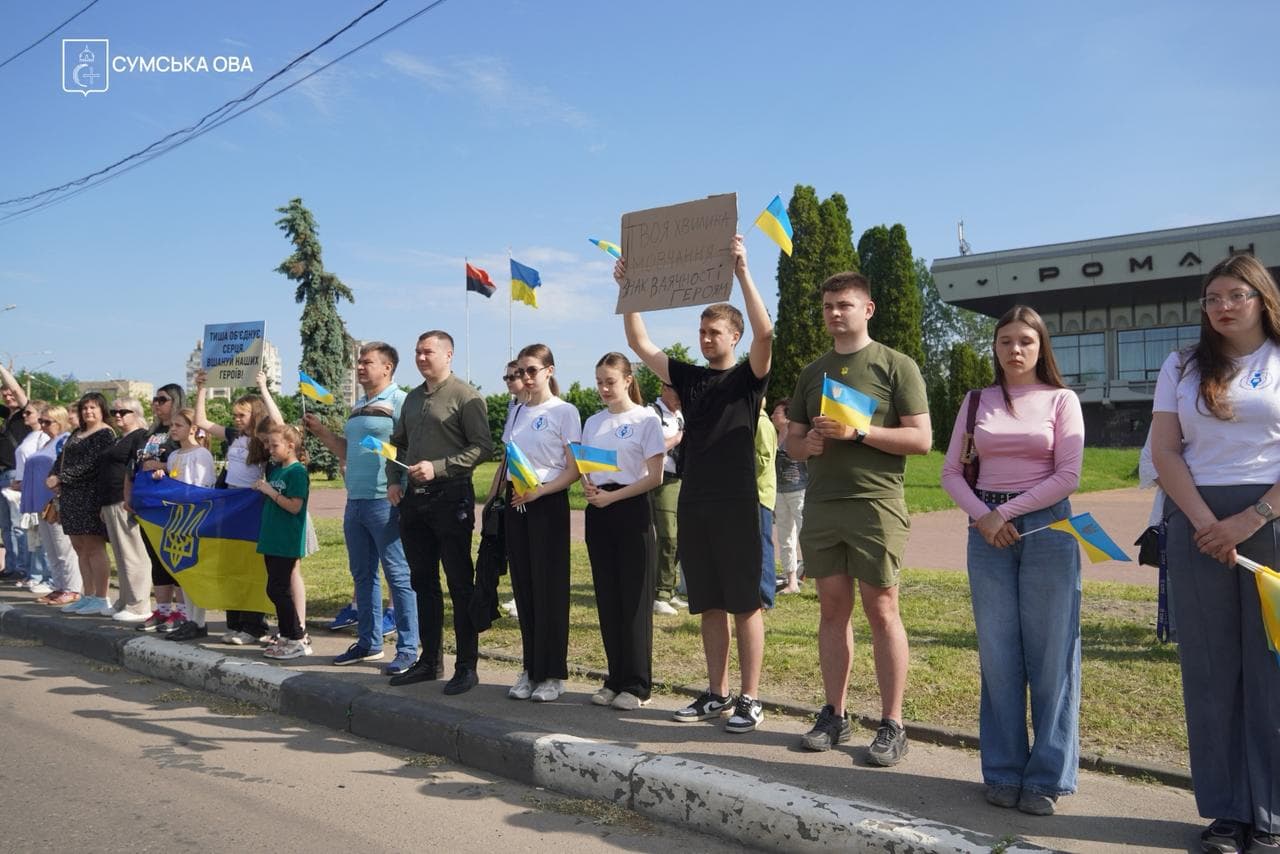
Residents gather during Day of Heroes commemorations in Sumy. (Sumy Oblast Military Administration/Telegram)
Russia has struck funerals, memorial gatherings, and civilian commemorations throughout the full-scale war. In October 2023, a strike on a memorial gathering in the village of Hroza in Kharkiv Oblast killed 51 people — nearly every adult in the village — in what became one of the most documented atrocities of the invasion. Sumy on May 23 is a smaller number. It is the same policy.
124 Drones, Five Dead, Sixty-Two Wounded: The Nightly Toll
Russia launched 124 drones overnight on May 22 to 23 — Shahed-type, Gerbera-type, Italmas-type, and Parodiya decoys — fired from multiple directions: Kursk, Oryol, Bryansk, Millerovo, Shatalovo, Primorsko-Akhtarsk, and occupied Crimea. Ukrainian air defenses downed 102 of them. Twelve struck their targets. Debris from the others fell across five locations.
In Kherson Oblast, Russian FPV drones continued what residents now call a “human safari” — the deliberate hunting of civilians on streets, on bicycles, in vehicles. A 69-year-old cyclist in the village of Kostyrka was struck by an FPV drone, suffering shrapnel wounds and a concussion. One person was killed across the oblast; 20 were wounded. Russian strikes damaged eight private houses, a church, and several vehicles.
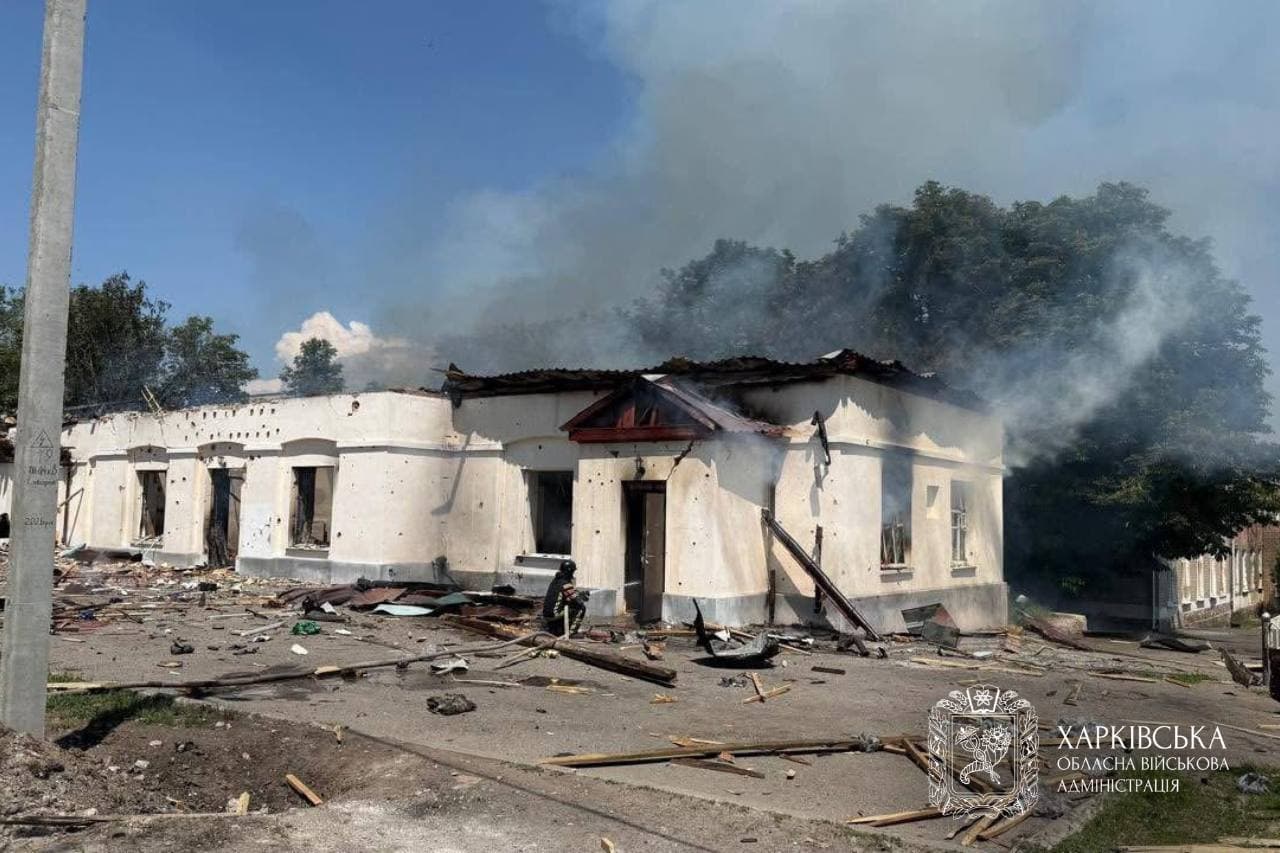
The aftermath of a Russian drone strike in Balakliya, Kharkiv oblast. (Oleh Synehubov / Telegram)
In Kharkiv Oblast, three people were killed and five wounded. Russian forces attacked Kharkiv city and 17 settlements using Geran-2, Lancet, Molniya, and FPV drones. In Zaporizhzhia Oblast, one man was killed and two others wounded as Russian forces launched 819 strikes against 45 settlements in a single day. Dnipropetrovsk Oblast recorded 16 injured across 40 separate Russian attacks. In Donetsk Oblast, seven were wounded — including four people in Kramatorsk.
In Odesa, a Russian missile struck civilian infrastructure, injuring nine people including three children aged 8 to 12. One adult was in serious condition.
Five dead. Sixty-two wounded. One day.
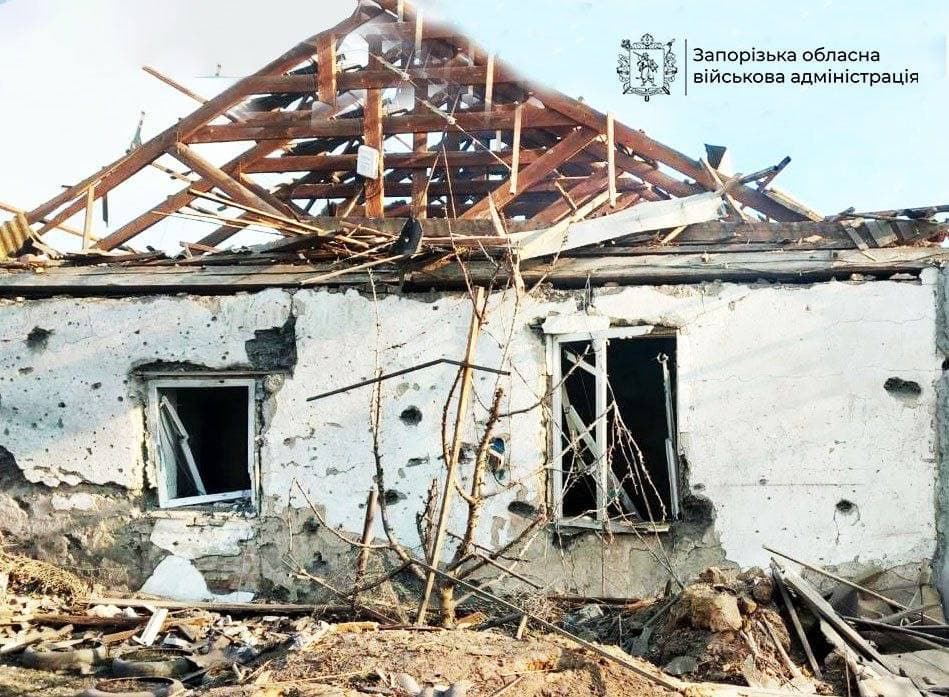
The aftermath of a Russian attack in Zaporizhzhia Oblast. (Zaporizhzhia Oblast Military Administration/Telegram)
The Eastern Front: Pressure Held, Positions Tested
Across the long eastern front, the pattern of May 23 was consistent: Russian forces attacking, not advancing; Ukrainian forces counterattacking, often with success.
In the Lyman direction, something unusual was happening. The spokesperson of a Ukrainian brigade reported that Russian forces were pulling artillery and armored vehicles closer to the front — but refusing to use them. The reason: Ukrainian drones. Russian small groups were struggling to establish positions at all, according to a Kremlin-affiliated milblogger who described the situation with notable candor. Battlefield air interdiction was working.
In the Pokrovsk direction, Russian forces were accumulating artillery systems inside the residential areas of Pokrovsk and Myrnohrad — using civilians as cover for military hardware. Ukrainian forces were detecting and striking these positions. Russian forces also intensified assaults on Rodynske north of Pokrovsk, likely to establish drone pilot positions that would reduce Ukraine’s kill zone.
In northern Sumy Oblast, Ukrainian forces cleared Ryasne — southeast of Sumy City — and the surrounding area, following a Russian mechanized assault earlier in the month. In the Kupyansk direction, geolocated footage showed Ukrainian forces striking a Russian position in Kupyansk-Vuzlovyi after what appeared to be a Russian infiltration mission.
In western Zaporizhzhia Oblast, Ukrainian forces continued counterattacking west of Orikhiv, with reports of armored vehicle use near Plavni and toward Kamyanske. Russian milbloggers acknowledged the situation remained difficult for their forces in that sector.
Logistics Under Fire: Ukraine’s Mid-Range Strike Campaign
While the deep strike campaign grabbed the headlines, Ukraine’s mid-range drone operations continued dismantling Russian logistics along the entire front.
The Ukrainian General Staff reported strikes on a Russian ammunition depot in occupied Prechystivka — roughly 40 kilometers behind Russian lines. Along the H-20 Mariupol-Donetsk City highway, a critical Russian supply artery, geolocated footage showed Ukrainian FPV drones destroying Russian trucks northeast of Buhas and northeast of Dolia, both roughly 70 kilometers from the front. A third burning truck was filmed northeast of Pryvilne, 90 kilometers deep, on the same highway corridor.
In occupied Zaporizhzhia Oblast, Ukrainian forces struck a Russian communications hub in Smile and a technical equipment warehouse in Forlivske. In occupied Crimea, the Dzhankoi train station was closed to passengers on May 23 — Russian occupation authorities cited unspecified reasons — as Crimean monitoring channels reported four overnight explosions in the area. Ukrainian mid-range drones have been increasingly targeting Russian logistics in rear areas, and the Dzhankoi closure fits the pattern: the railway junction is a key node for supplying Russian forces in southern Ukraine.
In occupied Kherson Oblast, Ukraine’s Unmanned Systems Forces struck a Russian drone control point in Oleshky — a facility used to direct the very FPV drones hunting civilians in Kherson city across the river.
The $400 Million Letter: Senators Demand the Pentagon Move
A bipartisan group of U.S. senators sent a letter to Defense Secretary Pete Hegseth on May 23 demanding the immediate release of a $400 million military aid package for Ukraine that has been frozen at the Pentagon for months.
The letter was co-authored by Republican Senator Chuck Grassley and Democratic Senator Dick Durbin — and co-signed by six senators in total, three from each party. The package was approved by Congress in December 2025 as part of a $900 billion defense spending bill. Hegseth told the House Armed Services Committee in late April that the funding had been unlocked. The Senate, as of May 23, had received no spending plan — despite a promised delivery date of May 15.
“Any further delays — particularly as the Department reportedly plans troubling U.S. troop withdrawals from the region — risks our ability to adequately deter Russia,” the letter warned. The senators noted that Ukraine had “persistently and bravely repelled a four-year Russian onslaught” and deserved continued American support.
The Trump administration has not issued any new defense aid through Presidential Drawdown Authority since January 2025. A workaround through NATO partners — the Prioritized Ukraine Requirements List — remains active, and the State Department approved a $108 million sale of HAWK air defense system equipment on May 21. But the Kiel Institute reported in February that U.S. military aid to Ukraine fell 99 percent in 2025. Europe is now carrying the majority of the financial and humanitarian load.
The $400 million sits waiting. Senators are asking, in writing, whether anyone at the Pentagon is going to sign the check.
Zvyagintsev at Cannes: Russia’s War Reflected Back From Exile

Russian director and screenwriter Andrey Zvyagintsev poses during a photocall of the film “Minotaure” (Minotaur) at the 79th edition of the Cannes Film Festival in Cannes, southern France. (Photo by AFP)
The Cannes Film Festival, which closes Saturday, has among its favorites for the Palme d’Or a film called “Minotaur” — directed by Andrey Zvyagintsev, the exiled Russian auteur behind “Leviathan” and “Loveless,” set against the backdrop of Russia’s mobilization for the war in Ukraine.
The film depicts a wealthy Russian businessman navigating the country’s wartime callout — not a hero, not a martyr, but a calculating presence in a machinery of destruction. Zvyagintsev spoke at Cannes about the war directly: “Those who agree that it’s time to put an end to this hell, and that it’s a nightmare and a disaster for Russia, those people will understand this film clearly.”
A Russian director, in exile, making a film about what Russia is doing, premiering it to the world at Cannes — and being considered for the highest prize in cinema. The jury is headed by South Korean auteur Park Chan-wook, with Demi Moore and “Nomadland” director Chloe Zhao among the jurors.
The war generates its own cultural reckoning, on multiple fronts. In Sumy, a funeral procession becomes a strike target. On the French Riviera, an exiled Russian filmmaker shows what that same country looks like from the inside. Both things are true at once.
The man at the funeral in Sumy was never identified. Authorities were still working to establish his name when the day’s reports were filed. He attended a ceremony for the dead and became one of them.
Five kilometers of Russian territory yielded near Borova. A chemical plant in Perm gone dark. A frigate and a corvette struck at their moorings. One hundred and two drones downed. Five dead. Sixty-two wounded.
Zelensky told his country to use their shelters tonight. The Oreshnik may be coming. Or it may not. The uncertainty is itself a weapon.
The war grinds forward. The costs accumulate. The name of the man in Sumy is still unknown.
A Prayer for Ukraine
1. For the Man Whose Name We Do Not Yet Know
Lord, we do not know his name. He came to a funeral on the Day of Heroes — perhaps to bury a friend, perhaps to stand with neighbors in their grief — and a drone found him there. He died in surgery. The authorities were still trying to learn who he was. You know his name. You knew him before the war made him anonymous. We pray for his family, wherever they are, receiving news that has no words adequate to it. Let him not be forgotten simply because he has not yet been identified. Let his death not disappear into a statistic. Hold him by name, as only you can.
2. For the Three Children in Odesa
Father, three children — 8, 9, and 12 years old — were carried to hospital after a Russian missile struck civilian infrastructure in Odesa. They were in moderate condition, which means they were conscious, which means they knew what had happened to them. We pray for their recovery, for the parents waiting beside them, for the doctors working with what they have. We pray that these children are allowed to grow into people who remember the war only distantly — not as the thing that marked their bodies before they had a chance to become themselves.
3. For Zelensky and Every Leader Carrying Impossible Weight
God of justice, a president stood before his people and told them the truth: a hypersonic missile may be coming tonight. He asked them to use their shelters. He said Russian madness knows no bounds. It takes something from a person to say that — to know it, to say it plainly, to remain standing. We pray for Volodymyr Zelensky and for every official and commander making decisions under this kind of weight. Give them clarity. Give them the help they are asking for. Let the senators’ letter be answered. Let the $400 million move. Let solidarity become something more than a word.
4. For the Defenders at Borova
Lord, Ukrainian soldiers drove armored columns into Russian lines today — fifteen vehicles into ground that wasn’t theirs to take lightly. Some of them did not come back. The footage shows strikes, burning vehicles, the disorder of real combat. We do not know all the names of those who rode into that assault. We pray for those who survived it. We pray for those who did not. We pray for the brigade commanders watching geolocated footage in real time, making the calls that send people forward. Let the ground they took today matter. Let the cost of it not be wasted.
5. For the Long Arc of This War
God, the Metafrax plant in Perm is dark tonight. The Sheskharis terminal is burning. A frigate that fired Kalibr missiles at Ukrainian cities is damaged at its moorings. These are not small things. But the man at the funeral is still dead. The children in Odesa are still in hospital. The war does not end because one side has a good day. We pray for the day it does end — not a ceasefire that pauses the killing so Russia can reload, but a real end. A just end. We pray for the courage of the nations that could make that end come sooner, if they chose to. In Your mercy, in Your justice, in Your time — bring this war to its end, and let the ending be worthy of what Ukraine has endured.