
Ukraine Daily Briefing | May 30, 2026 | Day 1,557 of the Full-Scale Invasion
Prepared by Dayana Bozhyk
Ukrainian drones destroyed two Tu-142 naval reconnaissance aircraft and an Iskander-M ballistic missile system at Taganrog airbase overnight, while also striking the training camp of the 64th Motorized Rifle Brigade — one of the units responsible for the Bucha massacre — killing a confirmed nine soldiers, wounding nine, and leaving 13 missing. Russia launched a deliberate double-tap strike on a Zaporizhzhia industrial zone: a first drone wave at dawn, a second wave mid-morning while emergency crews were on-site, killing one worker and wounding three. Occupied Crimea introduced fuel vouchers and a 20-liter rationing limit as Ukrainian strikes collapsed the peninsula’s fuel supply. Russia’s Nizhny Novgorod Oblast created a new “Ministry for the Protection of Oblast Facilities” — the first regional drone-defense ministry in Russia. U.S. Defense Secretary Hegseth told reporters at the Shangri-La Dialogue that the U.S. will “find a way” to help Ukraine defend itself.
THE DAY’S RECKONING
The two aircraft were in long-term storage at Taganrog’s aviation plant since 2011. Russian forces had moved them onto auxiliary runways in April and May 2026 — for reasons that remain unclear. Ukrainian drone operators from the USF’s 1st Center found them there and destroyed both, along with an Iskander-M ballistic missile system parked at a nearby launch position. The Iskander has killed Ukrainians in hundreds of strikes on cities and energy infrastructure across four years of full-scale war. The Tu-142s were long-range naval reconnaissance bombers built on the Tu-95 platform — the same family of aircraft Russia uses to launch Kh-101 cruise missile salvoes. Whatever Russia intended to do with them, it will not be done with those two aircraft.
In a separate deep strike overnight, USF’s Magyar Birds and Raid units hit the training grounds of Russia’s 3rd and 36th Combined Arms Armies, including the camp used by the 64th Separate Motorized Rifle Brigade. The 64th Brigade participated in the occupation of Bucha in February–March 2022. More than 1,400 civilians were killed in the Bucha district during that period, including 637 in Bucha itself. Many were executed; their bodies were left in the streets or buried in mass graves. Thirty-seven children were among the dead. The 64th Brigade has continued to fight in Ukraine since then. On May 30, nine of its soldiers were confirmed killed, nine injured, and thirteen missing. Brovdi: “Most likely, these figures are significantly underestimated.”
In Zaporizhzhia city, Russia conducted a double-tap strike on an industrial zone — a deliberate tactic of sending a second wave of drones while emergency responders are still on-site. The first wave arrived in the early morning. Emergency crews pulled a 40-year-old worker from the blast zone; he was rushed to intensive care in critical condition. At 11:30 a.m., a second wave hit the same facility, causing fires and partial structural collapses. The same man died. Three others were wounded. This tactic — striking again while first responders work — has been documented across multiple Ukrainian cities. It is a war crime.
Russia’s Nizhny Novgorod Oblast — more than 600 kilometers from Ukraine’s border, home to one of Russia’s largest oil refineries which Ukraine has struck multiple times in May 2026 — created a new ministry on May 30 specifically for drone defense. Putin acknowledged on May 29 that Russia needs to continue strengthening its air defenses. Nizhny Novgorod’s new ministry is the first of its kind at the oblast level. The Kremlin is shifting the cost of air defense to regions. The regions are creating new government structures to manage it. The war has reached so deeply into Russia’s administrative apparatus that governing drones is now a cabinet-level function.
TAGANROG: TWO TU-142 AIRCRAFT AND AN ISKANDER SYSTEM DESTROYED
USF Commander Brovdi confirmed on May 30 that the 1st Center of the Unmanned Systems Forces struck the Taganrog military airbase in Rostov Oblast overnight, destroying two Tu-142 long-range naval reconnaissance aircraft and an Iskander-M operational-tactical ballistic missile system at a launch position near Mykhailivka, northwest of Taganrog. Geolocated footage published May 30 confirms both the Tu-142 destruction at Taganrog Airport and the Iskander system at its stated location.
The Tu-142 is a long-range marine reconnaissance and anti-submarine aircraft based on the Tu-95 strategic bomber airframe. Satellite imagery analysis by Militarnyi indicated that both aircraft had been in long-term storage at the Taganrog Aviation Plant since 2011, and were moved onto auxiliary runways in April and May 2026. Ukrainian forces also struck a Russian shadow fleet oil tanker at the Taganrog oil depot and the Kurganneftoprodukt oil terminal, damaging a fuel tank and setting fires at the port. Rostov Oblast Governor Slyusar acknowledged a drone strike caused fires at a tanker, a fuel tank, and an administrative building. Two people were injured in the city. Separately, satellite imagery collected May 28 confirmed the May 26–27 Storm Shadow strike destroyed two facilities of a Russian communications and radio support battalion at the Taganrog airbase.
THE 64TH BRIGADE’S TRAINING CAMP STRUCK: NINE KILLED, NINE WOUNDED, THIRTEEN MISSING
USF’s Magyar Birds and Raid drone units, operating under the newly created Deep Strike Center, struck two Russian military training camps overnight May 29–30. The first target: the 3rd Combined Arms Army’s Trokhizbenka training grounds in occupied Luhansk Oblast, 70 kilometers from the frontline — 13 confirmed hits. The second: the 36th Combined Arms Army’s Prymorskyi Posad training grounds in occupied Zaporizhzhia Oblast, 100 kilometers from the frontline — 8 confirmed hits. The Prymorskyi Posad facility was also used by the 64th Separate Motorized Rifle Brigade.
The 64th Brigade was among the Russian units that occupied Bucha in Kyiv Oblast from February to March 2022. When Ukrainian forces liberated Bucha in April 2022, mass graves were discovered. Bodies were found in the streets — some with hands bound, some showing signs of execution. More than 1,400 civilians were killed in the Bucha district during the Russian occupation. Thirty-seven of them were children. The 64th Brigade subsequently continued to operate in Ukraine’s east and south. The May 30 strike killed nine soldiers of the 64th Brigade, wounded nine, and left thirteen missing. Brovdi confirmed the figures while noting they are likely underestimated. Casualties from the 3rd Army training camp strike are still being assessed.
UKRAINE STRIKES ARMAVIR OIL ENTERPRISE, AND CONFIRMS ONGOING CAMPAIGN: 17+ FACILITIES THIS MONTH
Zelensky confirmed that Ukrainian forces struck an oil enterprise of the Southern Oil Company in Armavir, Krasnodar Krai, roughly 475 kilometers from the frontline, overnight May 29–30. The Armavir City Administration acknowledged the strike and resulting damage. Brovdi separately reported that Ukrainian forces struck a gas storage facility near Yenakiieve in occupied Donetsk Oblast, roughly 40 kilometers from the frontline. Ukrainian forces also struck Russian logistics along the M-30 Debaltseve-Luhansk City highway, with a Ukrainian brigade publishing footage showing strikes on several Russian trucks including ammunition carriers, temporarily blocking the road. Geolocated footage confirmed additional truck strikes on the M-03 Slovyansk-Bakhmut highway near Debaltseve.
RUSSIA’S DOUBLE-TAP ATTACK ON ZAPORIZHZHIA KILLS ONE WORKER, WOUNDS THREE
Russian forces struck an industrial zone in Zaporizhzhia city in a two-wave coordinated attack on May 30. The first strike came in the early morning, pulling emergency crews to the site. A 40-year-old worker was extracted from the blast zone with catastrophic mine-blast trauma and shrapnel lacerations and was transported to intensive care in critical condition. At approximately 11:30 a.m. local time, while emergency operations were ongoing, Russian forces launched a second drone wave against the same facility. The second impact triggered a large-scale fire and caused partial structural collapses. The critically injured worker subsequently died. Three additional people were wounded, including a 24-year-old man. Nine apartment buildings near the facility were damaged, one severely.
In Kherson, a Russian loitering munition struck a residential quarter of the Korabelnyi district late on the evening of May 29, injuring three elderly residents: a 55-year-old woman and two men aged 64 and 76. All three sustained shrapnel wounds and acute stress reactions. A Friday evening drone raid on Poltava district damaged private homes, an outpatient clinic, and agricultural buildings, injuring two people.
OVERNIGHT STRIKE: 290 DRONES, 1 ISKANDER, 6 KH-101S; TRAIN STATION IN SHOSTKA DESTROYED; FIVE KILLED
Russian forces launched one Iskander-M ballistic missile from Bryansk Oblast, six Kh-101 cruise missiles from Vologda Oblast, and 290 Shahed, Gerbera, Italmas, and Parodiya drones overnight May 29–30. Ukrainian air defenses downed five Kh-101s and 279 drones. Nine drones struck seven locations; debris fell on ten more. Russian strikes damaged residential, energy, agricultural, rail, and medical infrastructure across Chernihiv, Poltava, Sumy, Zaporizhzhia, and Rivne oblasts.
The attack destroyed the civilian train station in Shostka, Sumy Oblast — struck by several dozen kamikaze drones. Deputy Prime Minister Kuleba confirmed the station was fully destroyed: “The civilian train station, from which hundreds of Sumy Oblast residents set out daily to go about their peaceful business, has become yet another target of the terrorist state.” No staff or passengers were killed because people were in shelters during the attack. In separate Sumy Oblast strikes, a 59-year-old man was killed in a drone attack and two others were injured; 19 settlements were targeted. In Kharkiv Oblast, two people were killed and three injured across 19 targeted settlements. In Zaporizhzhia, one person was killed — the industrial zone worker — and two others injured. In Donetsk Oblast, one person was killed and six injured. In Kherson Oblast, 21 people were injured across 34 targeted settlements, with seven high-rise buildings and 29 houses damaged. In Dnipropetrovsk Oblast, six people were injured.
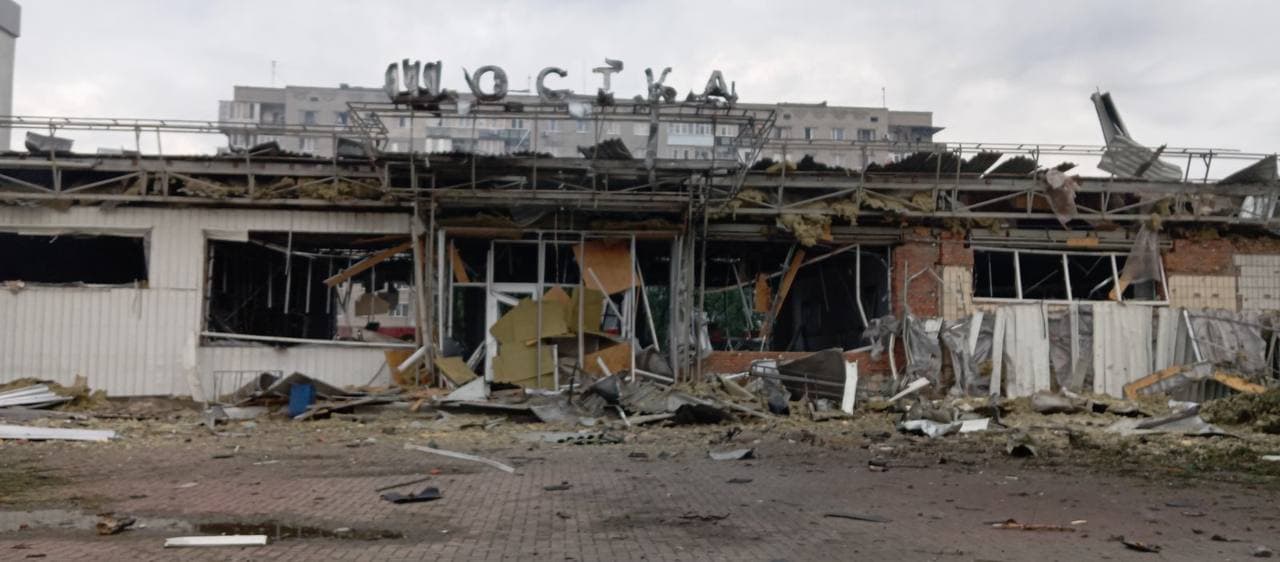
A train station in Shostka, Sumy Oblast, destroyed in a Russian drone attack overnight. (Oleksii Kuleba / Telegram)
OCCUPIED CRIMEA INTRODUCES FUEL VOUCHERS; M-14 HIGHWAY UNDER FIRE; FSB BOAT FACILITY AND FEODOSIA TERMINAL STRUCK
Crimea occupation head Aksyonov announced on May 30 that as of May 31, 95-octane gasoline will be available at ATAN and TES stations only via vouchers, prioritized for municipal and social transport. Purchases of 92-octane gasoline are restricted to 20 liters per vehicle, with refueling canisters prohibited. The rationing follows weeks of fuel shortages caused by Ukrainian strikes on logistics routes and oil infrastructure. Meduza confirmed that Ukrainian strikes on the M-14 Rostov-Crimea highway have caused supply disruptions producing long lines at gas stations across Crimea. Aksyonov claimed shortages would stabilize “within 30 days.”
The Atesh Crimea-based partisan network reported that Russian forces have instructed military convoys on the M-14 to travel only at night and in bad weather, at minimum 120 km/h, and to include a person with a drone detector in each vehicle. Russian forces are also redeploying trained drone observation troops and electronic warfare equipment from frontline positions to protect M-14 logistics — further degrading frontline drone defense. Ukrainian forces struck a Russian FSB boat maintenance facility in occupied Voloshyne, roughly 80 kilometers from the frontline, and a Russian marine oil terminal in occupied Feodosia, roughly 250 kilometers from the frontline, which supplies fuel by sea to occupied Crimea and southern Ukraine.
NIZHNY NOVGOROD CREATES RUSSIA’S FIRST OBLAST-LEVEL DRONE DEFENSE MINISTRY
Nizhny Novgorod Oblast Governor Nikitin signed a decree on May 30 establishing the “Ministry for the Protection of Nizhny Novgorod Oblast Facilities” — the first new oblast-level ministry in Russia specifically created to coordinate air defense and drone protection. The ministry will be headed by Deputy Prime Minister Tuzhilin and will serve as the regional hub for coordinating contributions to Russia’s wider air defense system, protecting critical infrastructure, and supporting the Russian MoD against Ukrainian drone strikes. Nizhny Novgorod Oblast is located more than 600 kilometers from Ukraine’s border but has been struck multiple times this month, including the Lukoil-Nizhegorodnefteorgsintez refinery and a reported drone into the regional court building on May 28.
ISW assessed this as the first instance of an oblast-level Russian government creating a dedicated ministry for air defense. Leningrad Oblast implemented similar administrative reforms in April 2026, and a Russian insider source confirmed on May 28 that the federal government is increasingly shifting air defense funding to regional governments. The pattern: federal MoD installs the systems; regional governments fund them; regional governments now create bureaucratic infrastructure to manage them. Ukraine’s deep strike campaign has penetrated so deeply into Russian domestic governance that a region 600 kilometers from the border needs a government ministry to respond to it.
THE KREMLIN’S MOLDOVA PRETEXT; PUTIN’S FALSE VICTORY NARRATIVE; KAZAKHSTAN RESISTS RUSSIAN PRESSURE
The Russian Embassy in Moldova issued a statement on May 29 preemptively claiming that Moldovan authorities and Western partners may be “staging” a false flag operation to blame Russia for a future drone incident — analogous to the Galati strike in Romania. ISW assessed this as deliberate information preparation: if a Russian drone accidentally strikes Moldova, the embassy’s statement provides a ready-made narrative that the incident was fabricated. Alternatively, it establishes cover for a deliberate false flag attack attributed to others. ISW continues to assess that Putin has adopted a policy accepting the risk of civilian casualties in both NATO states and Moldova as an acceptable consequence of Russia’s strike campaign.
Putin stated at a May 29 press conference that Russian forces are advancing in all directions every day, that only Russia has the right to declare the war nearing completion, and implied Russia’s goals are within reach. These claims contradict Russia’s actual 2026 rate of advance — 2.63 square kilometers per day, down from 13.2 in 2025 — and Ukraine’s liberation of more territory in April than Russia seized. ISW assessed Putin’s statements as designed to pressure Ukraine into surrendering to his demands, and noted they likely reflect the same false maps his generals have been providing him.
Putin’s Central Asian tour, which concluded before his press conference, produced minimal substantive gains: Kazakhstan’s President Tokayev refused to abandon East-West trade corridors bypassing Russia and declined to provide formalized labor migration commitments to address Russia’s domestic manpower shortage. Putin used the remainder of the press conference to threaten Armenia over its European integration trajectory, warning of fuel price termination and suspension from the Eurasian Economic Union ahead of June 7 Armenian elections.
RUSSIA’S DUAL ECONOMY FRACTURING; WAR SPENDING AT 40% OF TOTAL BUDGET
Associated Press analysis published May 30 documented the fracturing of Russia’s domestic economy into a “dual economy”: a heavily subsidized military-industrial sector consuming capital, labor, and materials, set against a stagnating civilian economy starved of investment, personnel, and credit. IISS Senior Fellow Gould-Davies stated the intense pressure of the war has driven up the costs of capital, labor, and commodities while funneling resources almost exclusively into the military-industrial complex. The civilian sector is withering under high interest rates and regulatory burdens that serve the war machine. Gould-Davies warned that to maintain the war, the Kremlin “will have to forcefully mobilize human and material resources” and systematically dismantle “the last post-Soviet market freedoms.”
Russia’s 2026 defense and security budget is 16.84 trillion rubles ($238 billion) — nearly 40 percent of total government spending. Finance Minister Siluanov’s leaked February memo confirmed the war budget will overshoot by $28 billion, with the deficit through April already at $82 billion — $29 billion above the full-year target. State-controlled banks are masking defaults through forced debt restructurings to prevent panic. Nearly half of Russian businesses report severe payment delays from commercial partners. The temporary support from oil prices above $100 per barrel — driven by the Iran conflict — has not resolved the structural deficit.
HEGSETH: ‘WE’LL FIND A WAY’; ZELENSKY HOLDS NEGOTIATIONS MEETING; ZELENSKY ALIGNS WITH EU 20TH SANCTIONS PACKAGE
U.S. Defense Secretary Hegseth addressed reporters at the Shangri-La Dialogue security forum in Singapore on May 30, responding to questions about Zelensky’s letter requesting Patriot PAC-3 missiles. Hegseth praised European defense spending increases and stated: “We want them to be able to defend, and we’ll find a way to make sure we can help them do that.” He offered no specifics. Hegseth revealed that Trump’s 2027 budget will include $56 billion for drone technology dominance, drawing on data from Ukrainian battlefield operations to build advanced automated combat systems.
Zelensky convened a meeting with Presidential Office Head Budanov, Energy Minister Shmyhal, and Security and Defense Council Head Umerov on May 30 to discuss “important negotiations” and near-term priorities. The stated agenda: anti-ballistic defense acquisitions, bilateral drone production agreements with the U.S. and EU, the EU Drone Deal, and preparation for “meetings in several formats.” Zelensky declined to disclose details of the negotiations. The humanitarian track — POW exchanges — and energy sector support for winter were also discussed.
Zelensky signed decrees on May 29 aligning Ukraine’s sanctions with the EU’s 20th package, covering 120 individuals and entities. The package adds restrictions on 16 Russian citizens and 31 companies across Russia, Belarus, UAE, Kyrgyzstan, Kazakhstan, Uzbekistan, and occupied Ukrainian territories; seven Sudanese citizens; 19 Iranian nationals; and 11 Iranian companies linked to ballistic missile and drone production for Russia. Sanctions commissioner Vlasiuk stated Ukraine is “already finalizing” joint work on the 21st EU sanctions package.
RUSSIA’S ZNPP FALSE FLAG CLAIM; UKRAINE DENIES; MEDVEDEV THREATENS NUCLEAR RETALIATION
Rosatom head Likhachev alleged on May 30 that a Ukrainian fiber-optic drone struck the machine room of reactor No. 6 at the Zaporizhzhia Nuclear Power Plant, creating a hole in a wall. He claimed this was Ukraine’s first targeted attack on the plant’s main equipment. Russia provided no photographic or video evidence. Ukraine’s Southern Defense Forces categorically denied the allegation, stating Ukrainian forces act within international humanitarian law, are aware of the consequences of actions at nuclear facilities, and “do not possess fiber-optic drones with sufficient range to strike the ZNPP.” The military called it “another attempt to discredit Ukraine and hide their own criminal actions.”
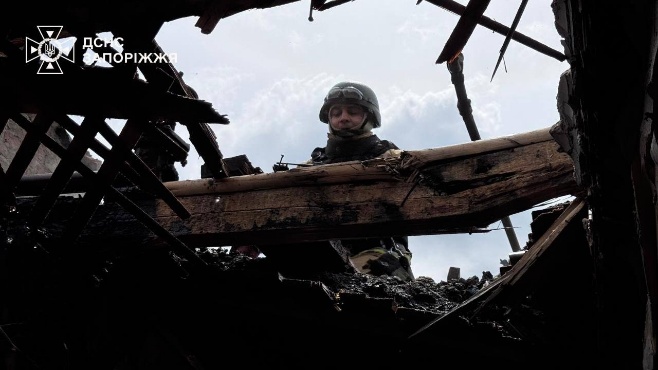
A rescue worker at the site of the Russian attack in Zaporizhzhia. (Ivan Fedorov / Telegram)
Medvedev used the unverified claim to threaten nuclear retaliation, warning of a “new Chornobyl” if Ukraine destroyed a reactor hall and stating Russia could launch symmetrical strikes on Ukrainian nuclear plants or NATO country nuclear facilities. ISW assessed the Rosatom allegation as consistent with Russia’s documented pattern of using the ZNPP as an instrument of nuclear blackmail. The IAEA noted on May 28 that increased drone activity near the ZNPP poses “significant risks to nuclear safety and security.” The plant lost communications for 12 hours on May 27 — the longest blackout since the invasion began.
IRELAND’S ALUMINA PLANT SENDS 83% OF OUTPUT TO RUSSIA; MAY BLOCK EU SANCTIONS
Irish Times reporting published May 30 revealed that 83 percent of Ireland’s alumina exports went to Russia in the first quarter of 2026 — 200,619 tons, the highest since the invasion began. Aughinish Alumina, owned by Russian aluminum giant Rusal, ships its product to Russian smelters where it is converted into aluminum used in weapons manufacturing, according to prior Irish Times investigations. Irish Prime Minister Martin has argued that sanctioning the plant would harm the EU more than Russia. The new data contradicts this claim. Ireland is set to hold the EU Council presidency beginning July 1 and would need to approve the 21st EU sanctions package during its presidency. The package targets Russia’s military-industrial complex suppliers. Aughinish Alumina is a candidate for inclusion. Ireland’s government must decide whether to block it.
ESTONIA INSTALLS ANTI-DRONE DETECTION ON RUSSIAN BORDER; NATO’S OPTIONS AFTER ROMANIA
Estonia’s Police and Border Guard Board deployed its first stationary anti-drone detection and surveillance devices along three sections of the southeastern border with Russia on May 30, with full border coverage targeted by year-end. Interior Minister Taro confirmed the deployment was a direct response to recent drone incidents, including the NATO interception of a suspected Ukrainian drone over Estonian territory on May 19, and subsequent incidents in the following days. The full eastern border will be covered “day by day,” Taro stated.
NATO analysis published May 30 outlined alliance options following the Romania Galati strike: bringing Romania’s U.S.-acquired Merops counter-drone system under NATO command and control; expanding capabilities through the Eastern Flank Deterrence Initiative; and deploying additional detection and defensive assets at the June Eastern Sentry conference. Article 5 has not been discussed in the Romania context. Article 4 consultations — invoked nine times in NATO history, including three times during Russia’s full-scale invasion — remain under consideration. The September 2025 Article 4 meeting requested by Poland led to the launch of the Eastern Sentry operation. Romania has not yet formally invoked Article 4.
FRONTLINE SITUATION: KOSTYANTYNIVKA, KHARKIV KILL ZONE EXTENDED, POKROVSK ATTRITION, REMOTE MINING BEGINS
Ukrainian forces advanced in central Kostyantynivka, confirmed by geolocated footage published May 8 and May 29. Russian forces continued infiltration missions south of the Donetska Railroad in southeastern Kostyantynivka but have not established permanent positions. Russian forces are using FAB-500 glide bombs and fiber optic drones to target bridges over the Kryvyi Torets River in Oleksiievo-Druzhkivka, southeast of Druzhkivka, to interdict Ukrainian logistics on the Fortress Belt highway.
In northern Kharkiv Oblast, a Ukrainian artillery brigade spokesperson reported the kill zone in the direction has doubled or tripled in the past year and now extends into Russian territory. Russian forces are exploiting spring foliage for concealment and using poorly trained or wounded soldiers in repeated small-group assaults, retreating, pulling reserves, and attacking again. In the Pokrovsk direction, Ukrainian 7th Rapid Reaction Corps reported that usually only one or two soldiers from a group of ten Russian infiltrators survive their missions. The Russian 76th Airborne Division poses the most significant threat in the Pokrovsk area due to its consistent access to reinforcements.
A Russian milblogger reported on May 29 that Ukrainian forces have begun remotely mining roads along the M-14 Mariupol-Melitopol highway from drone-dropped munitions at 100–150 kilometers from the frontline, complementing the ongoing Hornet drone interdiction campaign. The mines can disable unarmored vehicles and force road closures. Milbloggers warned this tactic could regularly shut the M-14, slow alternative routes, and end nighttime transport across southern occupied Ukraine.
Ukraine destroyed two Tu-142s and an Iskander at Taganrog. It struck the 64th Brigade’s training camp — the Bucha perpetrators — killing at minimum nine. Russia staged a double-tap attack on Zaporizhzhia’s industrial zone, killing one worker while his colleagues tried to save him. Nizhny Novgorod created a ministry to defend itself from Ukrainian drones. Occupied Crimea introduced fuel vouchers.
Russia’s war budget is 40 percent of total spending and already $29 billion over target. Putin’s press conference described advancing in all directions. His generals’ maps disagree. Ireland sent 83 percent of its alumina to Russia in Q1 2026 while its prime minister argues that sanctioning the plant would harm Europe. Russia’s Embassy in Moldova is pre-writing the narrative for the next drone strike it intends to deny.
Day 1,557. Nizhny Novgorod now has a ministry for drone defense. The war is 600 kilometers from the Ukrainian border and has arrived in the cabinet.
A PRAYER FOR UKRAINE
1. For the Worker Who Died at 11:30 a.m.
Lord, a 40-year-old man went to work in Zaporizhzhia’s industrial zone on May 30. Russian drones struck his facility in the early morning. Emergency crews pulled him from the blast zone in critical condition and rushed him to intensive care. At 11:30 in the morning, while the emergency teams were still working the site, Russia sent a second wave of drones into the same facility. He died. Three others were wounded. The tactic — striking first responders and medical personnel while they work — has a name in international humanitarian law: it is a war crime. We do not know his name yet. We know he was 40. We know he was in a hospital when the second strike killed him. Receive him. Hold whoever waited for him to come home. And let the deliberateness of this double-tap tactic, its calculation and its repetition across Ukrainian cities, be recorded in the case files that will eventually be laid before a tribunal.
2. For the Nine Dead Soldiers of the 64th Brigade
God of justice, this is a prayer that is difficult to pray. Nine soldiers of the 64th Motorized Rifle Brigade were killed in the May 30 strike on their training camp. Nine more were wounded. Thirteen are missing. The 64th Brigade occupied Bucha in 2022. More than 1,400 civilians were killed in the Bucha district during that occupation, including 37 children, many executed and buried in mass graves. The 64th Brigade continued to serve in this war after Bucha. It trained new soldiers. It received reinforcements. It went on killing Ukrainians. We pray for justice — not revenge, but justice. For the families of the 1,400 killed in Bucha who will read this news and feel something that has no clean name. For the Ukrainian drone operators who flew the mission and carry what they did. And for the nine soldiers — who were also, whatever they were in Bucha, human beings whose mothers will be told they are dead. Let justice be what guides what happens next, not hatred.
3. For the Passengers Who Were in Shelters When Shostka Station Burned
Father, the civilian train station in Shostka, Sumy Oblast, was destroyed by several dozen kamikaze drones overnight May 29–30. Hundreds of Sumy Oblast residents pass through that station daily to go about their lives. Nobody was killed because, when the alert sounded, the staff and passengers went to shelters. The station burned. The infrastructure was destroyed. The people survived because the shelter system worked, because someone trained them, because the air raid alerts are taken seriously even after four years. We give thanks for the shelters. We give thanks for whoever sounded the alert in time. We pray for the residents of Shostka who will now have no train service, who will have to find another way to reach work, medical appointments, family. And we ask for the restoration of what was destroyed — not just the building, but the normalcy of a morning commute that people in Shostka were trying to preserve.
4. For Ukraine’s Diplomats Preparing the ‘Important Negotiations’
Lord, Zelensky met with Budanov, Shmyhal, and Umerov on May 30 and said they were preparing “important negotiations”. He gave no details. Anti-ballistic defense and drone production agreements were described as the near-term priorities. The longer context: U.S.-mediated peace talks have been at a standstill since May 22. Russia fired 90 missiles and 600 drones at Kyiv on May 24 and has threatened systematic new strikes. Ukraine is liberating territory in Oleksandrivka. Russia’s false maps are generating unrealistic Kremlin demands. Whatever the “important negotiations” are, they are being prepared by people who have been at war for 1,557 days, who have buried their colleagues and their counterparts, who are simultaneously managing a frontline and a diplomatic calendar. Give them wisdom. Give them partners who understand the moment. And let the negotiations, when they come, be worthy of what Ukraine has paid to get to the table.
5. For Bucha
God of memory, Bucha was liberated in April 2022. The mass graves were found. The photographs went around the world. The International Criminal Court opened investigations. The name became a word for what states do to civilians when no one is watching. More than four years later, the brigade that occupied Bucha is still training soldiers and deploying them to the war. On May 30 it was struck at its training ground, and at least nine of its soldiers were killed. This is not the justice Bucha deserves. It is a step in an attrition campaign, not a reckoning. The reckoning has not come yet. The survivors of Bucha are still waiting. The families of 1,400 dead are still waiting. The children are still in the count. Let the international accountability mechanisms that were created after Bucha — the ICC warrants, the Ukrainian prosecutor’s documentation, the international evidence-gathering — survive long enough to produce verdicts. Let Bucha be a name that means: accountability was possible, and it happened. Not just: the world looked away after a while.