
Ukraine Daily Briefing | June 16, 2026 | Day 1,574 of the Full-Scale Invasion
Prepared by Dayana Bozhyk
A Ukrainian strike knocked Moscow’s largest oil refinery out of action on June 16, deepening a fuel crisis that has pushed Tatneft, Rosneft, and Lukoil to ration gasoline and diesel sales across Russia. At the G7 summit in France, Volodymyr Zelensky held his first face-to-face meeting with Donald Trump in four months, while the Kremlin again rejected any prospect of direct Putin-Zelensky talks. Russian drone and missile strikes killed civilians in Kherson, Zaporizhzhia, and Kharkiv oblasts overnight, and a Ukrainian Su-24 bomber crashed in Khmelnytskyi Oblast, killing both crew members.
THE DAY’S RECKONING
Picture a gas station in Chelyabinsk on June 16: a sign limiting passenger cars to 30 liters of gasoline, cash only, no cards. That scene is now repeating at Tatneft, Rosneft, and Lukoil stations across Russia, from Moscow and St. Petersburg to Samara, Ulyanovsk, and Udmurtia. Hours earlier, Ukrainian drones had knocked out the Moscow Oil Refinery’s main processing unit — the facility supplying aviation fuel to four of the capital’s airports — forcing the entire plant offline.
The fuel crisis is the visible proof of a pattern this briefing has tracked for months: Ukraine’s long-range strike campaign has cut Russian refining capacity by 30 percent and pushed gasoline production to a 16-year low, even as the Kremlin insists nothing has changed. At the G7 summit in France, Zelensky sat across from Trump for the first time in four months and pressed for a U.S.-hosted peace meeting with Putin; Moscow’s answer, delivered the same day, was that no such offer exists and that Zelensky should come to Moscow instead.
June 16, 2026: a day when Russia’s fuel stations ran out of patience for queues, and its negotiators ran out of new ways to say no.
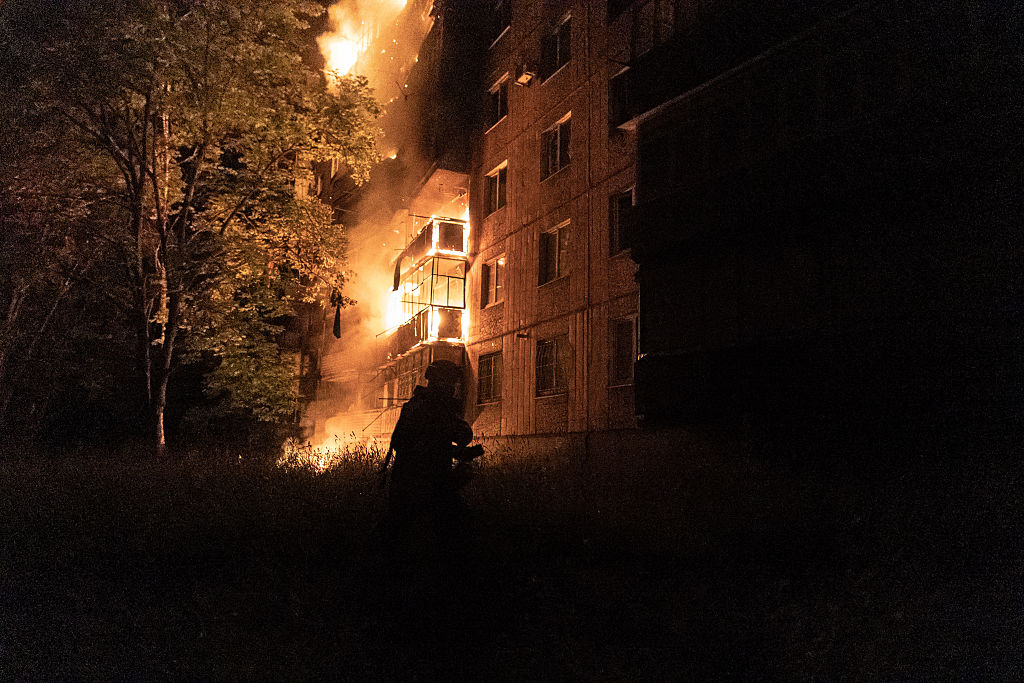
A residential building burns following a Russian drone attack in Druzhkivka, Donetsk Oblast. (Diego Herrera Carcedo/Anadolu via Getty Images)
MOSCOW’S OWN REFINERY GOES DARK
The Moscow Oil Refinery in the capital’s Kapotnya district stopped functioning entirely after a Ukrainian strike overnight on June 15 to 16 damaged its ELOU AVT-6 primary processing unit — the facility responsible for over 38 percent of Moscow Oblast’s fuel consumption and the source of aviation fuel for Domodedovo, Vnukovo, Sheremetyevo, and Zhukovsky airports. Moscow Mayor Sergei Sobyanin acknowledged on Telegram that 25 drones were shot down over the city and that one had damaged a facility at the refinery, reporting no casualties. Industry sources told Reuters the strike knocked the entire refinery out of action, though a second, undamaged unit was expected to restart soon.
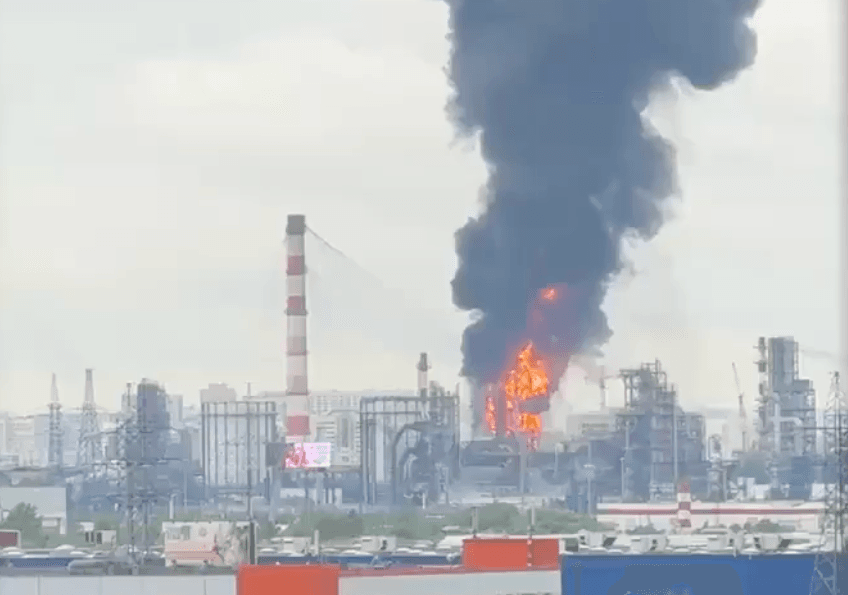
Screenshot from a video showing the aftermath of a Ukrainian drone strike on the Moscow Oil Refinery in the Kapotnya district overnight. (Ukrainian President Volodymyr Zelensky / X)
President Zelensky confirmed Ukraine’s Security Service, Unmanned Systems Forces, Special Operations Forces, and military intelligence carried out the operation. “Russia must be forced to end its war against our people,” Zelensky said, calling Ukraine’s long-range weapons campaign “a just response to Russian strikes — and to the dragging out of a war that must be ended.” The refinery, with a processing capacity exceeding 12 million tons of crude per year, had previously been hit on May 16. Geolocated footage published June 16 showed fires and smoke rising from the site, and the General Staff confirmed the ELOU AVT-6 unit caught fire.
A NATIONWIDE FUEL SQUEEZE: TATNEFT, ROSNEFT, AND LUKOIL ALL RATION SALES
The Moscow refinery strike landed on top of a gasoline and diesel shortage that has been spreading across Russia for weeks. Tatneft, one of Russia’s largest oil companies, introduced fuel purchase limits at gas stations nationwide on June 16, restricting gasoline for passenger cars to 30 liters and diesel to 60 liters per transaction at its Chelyabinsk stations, with truck diesel capped at 300 liters; some stations stopped accepting bank cards entirely, requiring cash only. Tatneft had already limited gasoline to 20 liters and diesel to 40 liters per customer at stations in Moscow and St. Petersburg over the preceding weekend, and Russian sources reported the restrictions began spreading to those cities as early as June 12.
Russian opposition outlet Verstka reported, citing gas station operator hotlines, that state oil company Rosneft, Bashkortostan-owned Bashneft, and Rosneft subsidiary TNK have banned the sale of gasoline in fuel canisters across all Russian federal subjects, citing “increased seasonal demand,” while some hotline operators described general sale limits of about 90 liters per customer in unspecified regions. Rosneft separately capped purchases at 90 liters per vehicle or container, and Lukoil limited sales to 100 liters per transaction. Radio Free Europe/Radio Liberty reported that Tatneft and its subsidiary TANECO have imposed restrictions in Samara, Ulyanovsk, Orenburg, and Nizhny Novgorod oblasts and the republics of Tatarstan, Chuvashia, and Udmurtia. A Russian insider source claimed central Russia, the Volga Federal Okrug, Siberia, and the Far East are increasingly suffering shortages of AI-92 and AI-95 gasoline. Crimea has also reported an extensive fuel shortage as Ukraine has stepped up strikes to cut off the peninsula’s logistics.
The Ukrainian General Staff reported that intermediate- to long-range strikes against 16 oil refineries have reduced overall Russian refining capacity by 30 percent, that Russian oil production has fallen to around nine million barrels per day, and that Russian gasoline production has fallen to a 16-year low. Russia has reportedly extended a decision allowing some refineries to release substandard gasoline and diesel to the domestic market to cope with the shortages. Ukraine’s strike campaign against Russian refineries and logistics since March 2026 has renewed fuel shortages across occupied Ukraine and extended them into Russian regions, and further strikes will likely cause shortages to keep spreading.
THE WEEK’S OTHER STRIKES: A FUEL DEPOT, A DESIGN BUREAU, AND CRIMEAN RADAR
Ukraine’s deep strike campaign over the preceding days extended well beyond Moscow and Tatarstan. Geolocated footage published June 15 showed fires at a fuel depot in Poltavskaya, Krasnodar Krai — roughly 300 kilometers from the frontline — after a reported Ukrainian drone strike; NASA satellite data confirmed heat anomalies there on June 16, and Krasnodar Krai’s operational headquarters acknowledged the fire. The Ukrainian General Staff confirmed Ukrainian forces struck the JSC Central Design Bureau of Instrument-Building in Tula Oblast, which produces radar and radio navigation equipment, and reported that fires were still burning at the Temp Oil Depot in Rybinsk, Yaroslavl Oblast, following a June 14 strike.
In occupied Crimea, Unmanned Systems Forces Commander Major Robert “Magyar” Brovdi reported that Ukrainian forces struck Russian coastal radar systems at Sterehusche, Portove, Snizhne, Sieverne, and Tarkhankut overnight on June 15 to 16. A Crimea-based Telegram channel claimed Ukrainian forces struck a Russian military vehicle on the M-17 Armyansk-Oleshky highway near occupied Kalanchak and may have hit a railway station north of occupied Hvardiiske, where NASA data showed a heat anomaly. A Ukrainian regiment involved in the Crimea strike campaign reported that continued strikes on the Chonhar bridge have left Russia’s 37th Separate Motorized Rifle Brigade struggling to obtain sufficient fuel and ammunition. In response, Crimea’s Russian-installed head Sergei Aksyonov issued a decree banning motorcycles, mopeds, and quad bikes from operating between 8 p.m. and 6 a.m. starting June 17, citing the risk that their engine noise could be confused with drones.
ZELENSKY AND TRUMP MEET AT G7 AS THE KREMLIN REJECTS A PEACE MEETING
President Zelensky and President Trump held their first face-to-face meeting in more than four months on the sidelines of the G7 summit in Evian-les-Bains, France, a roughly 30-minute conversation that came as Kyiv tries to revive stalled peace talks. Trump told reporters at the summit that Russia “should make a deal” with Ukraine and said both Putin and Zelensky appeared open to negotiating, adding that Washington would now turn its attention back to the war following the resolution of the Iran crisis. Zelensky said he briefed Trump on the battlefield situation and that both sides agreed to continue talks during the summit; he separately raised Ukraine’s request for U.S. approval to manufacture anti-ballistic missile systems and interceptors domestically, saying production capacity remains the central obstacle since manufacturing currently happens only in the United States.
Zelensky said on June 16 that he wants peace talks with Putin before the start of winter 2026 to 2027 in a “neutral country,” and that the United States could serve as a venue; he had offered the previous day to meet Putin at the G7 itself, but said Russia gave no clear response. Kremlin aide Yuriy Ushakov claimed Russia has received no offer to organize a Putin-Zelensky meeting in the United States and said the topic did not come up in Putin and Trump’s June 14 phone call; Kremlin spokesperson Dmitry Peskov separately claimed Zelensky never invited Putin to the G7 sidelines at all. Ushakov added that if Zelensky wants a meeting, “let him come to Moscow,” and said U.S. envoys Steve Witkoff and Jared Kushner are expected to visit the Russian capital soon. According to Ushakov, Putin told Trump that Ukrainian strikes on Russian territory would not change Kyiv’s battlefield position — a claim that sits uneasily next to ISW’s assessment that Russian forces suffered net territorial losses of 116 square kilometers in April and 281 square kilometers in May, their worst two-month stretch since 2023.
Zelensky also met separately with U.K. Prime Minister Keir Starmer and Canadian Prime Minister Mark Carney on the summit sidelines. Starmer agreed to new measures backing Ukraine, including additional sanctions on Russia’s shadow fleet and discussion of British involvement in restoring the bombed Kyiv-Pechersk Lavra. Carney announced new Canadian sanctions targeting 162 individuals, entities, and vessels tied to Russia’s shadow fleet, energy revenue, and defense-industrial and disinformation sectors, building on sanctions already imposed in 2026 against more than 3,400 individuals and entities and over 600 vessels.

Germany’s Chancellor Friedrich Merz attends a bilateral meeting with President Volodymyr Zelensky during the G7 summit, in Evian, eastern France. (Michael Kappeler / POOL / AFP via Getty Images)
THE G7 STATEMENT: PRAISE FOR UKRAINE, A $52 BILLION GAP LEFT UNFILLED
G7 leaders released a joint statement saying they are “ready to consider” extending Ukraine licenses to allow increased domestic military production and agreed to increase deliveries of air defense systems, interceptors, and long-range capabilities, citing what they called new battlefield momentum for Ukraine. The statement reaffirmed unwavering support for Ukraine’s sovereignty, condemned Russian strikes on critical infrastructure and cultural heritage, committed to sustained support for Ukraine’s energy security through the coming winter, and pledged to strengthen sanctions on Russia’s oil and gas sectors now that a separate Iran-related deal had freed up diplomatic attention to refocus on the war. An unnamed senior EU official said the U.S. agreed only to “look into” military production licensing, with no decision reached.
What the statement did not address was money. The EU approved a 90 billion euro loan to Ukraine in April 2026, intended to cover two-thirds of Kyiv’s financial and defense needs through the end of 2027 — leaving a roughly $52 billion gap that European Commission President Ursula von der Leyen had pressed G7 leaders to help close. A G7 diplomat told reporters that von der Leyen raised the shortfall during discussions, but that leaders did not get into specifics of who would cover how much; Canada’s ambassador to France declined twice to say whether Ottawa would contribute. Zelensky separately outlined a “winter package” proposal covering physical protection for energy facilities, expanded air defense coverage, and emergency fuel and gas supplies, saying leaders from Canada, Germany, Japan, and other countries had expressed support.
KYIV-PECHERSK LAVRA: THE DAMAGE, THE DENIALS, AND THE INTERNATIONAL RESPONSE
The aftermath of Russia’s June 15 strike on the Kyiv-Pechersk Lavra, a nearly 1,000-year-old UNESCO World Heritage monastery, continued to draw international attention on June 16. Preserve director Maksym Ostapenko said the attack damaged five nationally protected heritage sites, including the Museum of Book Printing and the Museum of Historical Treasures of Ukraine, along with the 17th-century Kushchnyk Tower and the Mystetskyi Arsenal cultural complex; more than 20 fire crews worked under continuing drone and missile threats to keep the blaze from reaching the Dormition Cathedral’s 16th-to-18th-century iconostasis and relics, which were evacuated. Roughly 800 square meters of roofing were damaged. Russian state media claimed the damage came from a Ukrainian Patriot interceptor rather than a Russian drone; Ostapenko rejected the claim, citing recovered carbon-fiber fragments and engine parts consistent with Shahed-type drones, and Ukraine’s Security Service said it recovered fragments of a Russian Geran-2 drone at the site.
French Foreign Minister Jean-Noel Barrot compared the strike to bombing Notre-Dame or Saint-Denis, calling it emblematic of what he described as Russia’s colonial war against Ukraine. European Commission President von der Leyen said the strike showed Russia’s only objective remains “violence and destruction,” and EU foreign policy chief Kaja Kallas called the damage a war crime demanding accountability. Ukrainian Foreign Minister Andrii Sybiha called the strike a deliberate attack on shared cultural heritage and urged international accountability mechanisms. Ostapenko estimated restoration of the cathedral alone could take about two years under ideal conditions if funding is secured and attacks stop; more than 1,700 cultural heritage sites have been damaged or destroyed across Ukraine since the invasion began.
OVERNIGHT STRIKES: 132 DRONES AND TWO BALLISTIC MISSILES, CASUALTIES ACROSS FIVE OBLASTS
Russian forces launched two Iskander-M ballistic missiles from Rostov Oblast and 132 Shahed, Gerbera, and Italmas-type strike drones, along with Parodiya decoys, from Oryol, Kursk, and Bryansk cities, Shatalovo in Smolensk Oblast, Millerovo in Rostov Oblast, and Primorsko-Akhtarsk in Krasnodar Krai overnight on June 15 to 16. Ukrainian air defenses intercepted 114 drones; the two missiles and 16 drones struck nine locations, with debris falling at eight more. The Ukrainian Energy Ministry reported the strikes caused power outages in Donetsk, Dnipropetrovsk, Kharkiv, and Zaporizhzhia oblasts.
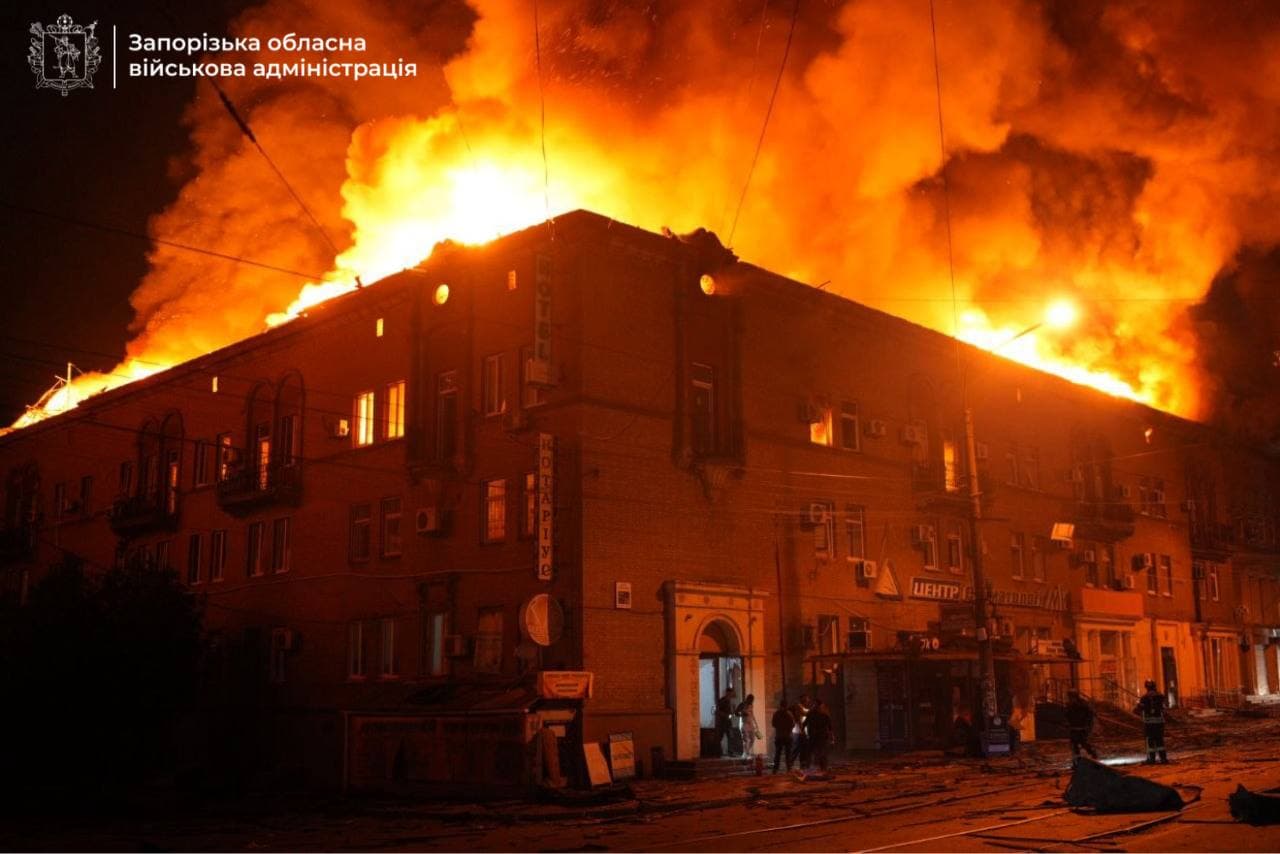
A building burns in Zaporizhzhia following a Russian drone attack overnight. (Ivan Fedorov / Zaporizhzhia Regional Military Administration / Telegram)
In Kherson, a Russian drone struck a minibus in the Korabelny district around 8 a.m., killing one man at the scene; a separate strike around 1:30 a.m. hit an ambulance responding to a call in the same district, injuring two medical workers, ages 51 and 63, both with concussions and blast-related injuries. A Russian strike on a bus in Kherson injured a 75-year-old woman and two men, and when police arrived at the scene, a follow-up strike injured two officers as well; across the wider oblast, one person was killed and 21 injured, including a child, over the 24-hour period. In Kharkiv Oblast, a drone strike on Balakliya injured eight people, including a four-year-old girl and a 13-year-old boy, and set four homes, vehicles, and outbuildings on fire; across the oblast, Russian forces struck 12 settlements with missiles, guided bombs, and drones, injuring 22 people including four children. In Sumy Oblast, one person was killed and seven injured. In Dnipropetrovsk Oblast, a 39-year-old man was injured. In the Kirovohrad region, a drone strike on a livestock complex in the Oleksandrivskyi district killed more than 20 head of cattle and damaged the building.
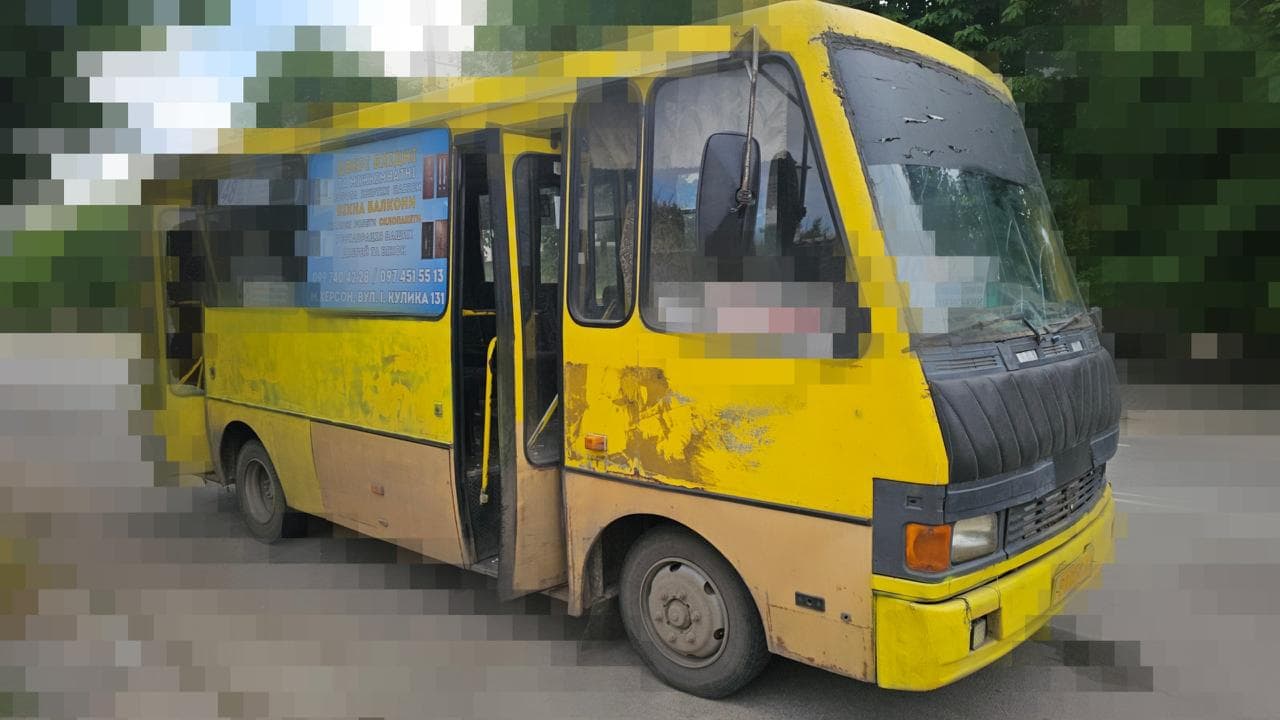
Russian forces attacked a passenger bus in the regional center of Kherson. (Kherson Oblast Governor Oleksandr Prokudin/Telegram)
Zaporizhzhia was hit twice within roughly 24 hours. Russian forces launched five strikes late on June 16, killing one person and injuring at least seven, with dozens of Shahed drones directed at residential areas; one strike caused a large fire in a three-story building, trapping residents inside, and a man was killed when a drone struck his car. The attacks damaged homes and part of Zaporizhzhia National University, along with a shopping center. Regional Governor Ivan Fedorov reported Russian forces carried out 798 strikes on 47 settlements across the oblast over the preceding day, injuring 11 people separately from the city strikes.
CIVILIANS HUNTED BY DRONE NEAR NIKOPOL
Dnipropetrovsk Oblast Military Administration head Oleksandr Hanzha reported that a Russian first-person-view drone struck a group of civilians walking along a road near Nikopol on June 16, killing three people, including an 87-year-old woman and her 51-year-old son; an elderly civilian in a wheelchair was among the dead. Authorities were still working to identify the third victim. Russian forces carried out more than 40 artillery and drone strikes across four districts of the oblast that day: in the Nikopol district, the regional center and the communities of Marhanets, Pokrovska, Chervonohryhorivka, and Myrivka were hit and set ablaze, wounding a 77-year-old woman; in the Kamianske district, a strike on a gas station and nearby vehicles wounded a 61-year-old man and a 36-year-old woman, both treated at home. The Dubovykivka and Zelenodolska communities were also struck.
A SU-24 BOMBER CRASHES IN KHMELNYTSKYI OBLAST, KILLING BOTH CREW MEMBERS
A Ukrainian Air Force Su-24M frontline bomber crashed in Khmelnytskyi Oblast around 7 p.m. on June 16 while carrying out a combat mission, killing both crew members: pilot Major Bohdan Zaharulko and navigator Senior Lieutenant Bohdan Babenko, both of the 7th Tactical Aviation Brigade based at Starokostiantyniv Air Base. “They defended our country until their last breath,” the Air Force said, adding that the cause of the crash remains under investigation and that no civilians were injured. Early reports on Ukrainian Telegram channels had mistakenly identified the aircraft as a MiG-29 before the Air Force’s official confirmation. Ukraine inherited between 100 and 200 Su-24 airframes from the Soviet Union, with the operational fleet shrinking over the years due to combat losses and parts shortages.
UKRAINE EXPANDS ITS DOMESTIC MISSILE AND DRONE SUPPLY CHAIN
Ukrainian defense manufacturer Ukrainian Armor and Czech company AviaNera Technologies signed a partnership at the Eurosatory 2026 defense exhibition in Paris on June 16 to cooperate on producing turbojet and turboprop engines for Ukrainian missiles and drones, with plans to expand production capacity and potentially localize manufacturing in Ukraine through future joint ventures. “Our goal is to create new opportunities for the production of modern engines for missile and unmanned systems,” Ukrainian Armor CEO Vladyslav Belbas said. AviaNera CEO Pavel Cechal said propulsion systems remain a persistent bottleneck for drone and guided-missile production and that the company is expanding capacity and seeking to localize production in key markets including Ukraine. The agreement follows a June 10 memorandum between European missile manufacturer MBDA and Ukrainian Armor on deep-strike capabilities and counter-drone systems, and a June 12 cooperation agreement between Ukrainian drone manufacturer Skyfall and Airbus on defense innovation.
UKRAINE CREATES NEW DRONE UNITS FOR ITS NORTHERN BORDER
Commander-in-Chief Oleksandr Syrskyi said on June 16, following a meeting with military leadership, that Ukraine is creating new unmanned systems units in its northern sector to reinforce border defenses, without specifying which section of the border he meant; Ukraine’s northern border runs along Russia in Sumy, Chernihiv, and Kharkiv oblasts and along Belarus in Kyiv, Zhytomyr, Rivne, and Volyn oblasts. The announcement comes amid continued tension between Kyiv and Minsk: Belarusian leader Alexander Lukashenko denied in an interview published June 15 that Belarus intends to enter the war, saying the country poses no military threat to Ukraine and would only become involved if attacked, while separately acknowledging that opening a new front along the Belarusian border could trigger direct conflict with NATO. Zelensky has previously said Ukraine recorded contacts between Moscow and Minsk aimed at drawing Belarus into new acts of aggression and that Ukraine is prepared to take preventive measures against threats from its northern border.
ONE REMAINING ORESHNIK: A UKRAINIAN INTELLIGENCE FIRM’S CLAIM ABOUT RUSSIA’S MISSILE STOCKPILE
Ukrainian private intelligence firm Dallas Analytics reported that Putin ordered an expedited production run of four additional Oreshnik intermediate-range ballistic missiles following the first Oreshnik strike on Dnipro City in November 2024, and that Russia has since fired three of those four missiles in 2026: one against Lviv Oblast on the night of January 8 to 9, one against Bila Tserkva in Kyiv Oblast, and a third that reportedly crashed in occupied Donetsk Oblast overnight on May 23 to 24 — leaving Russia with one operational Oreshnik remaining from the original order. A source the firm described as being from the Russian Ministry of Defense claimed Oreshnik manufacturing facilities bypassed quality-assurance protocols to meet Putin’s deadlines, and Dallas Analytics said it had obtained Russian procurement documents from March 2025 suggesting a vulnerability in the Soviet-designed GU-503 aviation gyroscope has compromised the missile’s guidance precision, causing deviations of tens of kilometers from intended targets.
EGYPT, GRAIN, AND A SEIZED SHIP IN SWEDEN
Ukrainian Foreign Minister Andrii Sybiha met Egyptian Foreign Minister Badr Abdelatty on the G7 sidelines to discuss the war and bilateral cooperation on grain trade, urging greater international pressure on Russia and reviewing Egypt’s commitment, following an April 3 call between Zelensky and President Abdel Fattah el-Sisi, to stop accepting grain imports from occupied Ukrainian territory. Ukraine’s ambassador to Egypt said one Russian vessel carrying stolen grain was turned back after that call, though roughly ten others have since entered Egyptian ports; Ukraine’s embassy recorded 14 such deliveries in 2026, 11 of them after the presidential call. Sybiha said he welcomed the de-escalation around the Strait of Hormuz and invited Abdelatty to Kyiv.
Separately, a Swedish court ordered the seizure of the cargo vessel Caffa at the request of Ukraine’s Prosecutor General’s Office — the first time a foreign court has arrested a ship at Ukraine’s request over suspected illegal export of stolen goods. Prosecutor General Ruslan Kravchenko said the vessel used a false registration to disguise repeated entries into occupied Ukrainian ports. “This is a tangible result of international legal cooperation between Ukraine and its partners,” Kravchenko said.
A RUSSIAN FRIGATE FIRES WARNING SHOTS IN THE ENGLISH CHANNEL
A Russian Black Sea Fleet frigate, the Admiral Grigorovich, fired warning shots at a British-flagged yacht in the English Channel on June 16 after the civilian vessel drifted close to the warship roughly 20 nautical miles south of the Isle of Wight; no injuries or damage were reported, and two Royal Navy patrol vessels that had been shadowing the frigate since the previous day responded to check on the yacht’s occupants. The incident came two days after Royal Marines from 42 Commando boarded the Smyrtos, a Russian shadow fleet tanker sailing under a Cameroonian flag, in a six-hour operation ordered by Prime Minister Starmer; the tanker had departed Russia’s Ust-Luga port carrying more than 700,000 barrels of sanctioned oil. An Indian national was arrested on suspicion of sanctions violations, while 24 crew members from Georgia and India remained aboard to assist the investigation. Russia called the boarding “state piracy”; the U.K. has sanctioned nearly 600 Russian shadow fleet vessels to date.
The Channel incidents come amid reported Russian hybrid warfare activity on British soil: two men, Ukrainian national Roman Lavrynovych and Ukrainian-born Romanian citizen Stanislav Carpiuc, were convicted at the Old Bailey of conspiring to commit arson at properties linked to Prime Minister Starmer, while a third defendant was acquitted. “Russia is quite literally on our doorstep,” said Liberal Democrat defense spokesman James MacCleary.
By the end of June 16, the contradiction at the center of this war was on full display in two different currencies. In rubles, it showed up as a 30-liter limit at a Tatneft pump and a refinery gone dark in Moscow’s own backyard. In diplomacy, it showed up as a G7 statement praising Ukraine’s battlefield momentum while leaving a $52 billion hole in its budget, and a Kremlin that answered every peace overture with a demand that Kyiv come to Moscow instead. Neither the fuel queues nor the rejected meetings changed the front line that day — but both kept narrowing the room Russia has left to keep fighting on its own terms.
A Prayer for Ukraine
1. For the Three Walking a Road Near Nikopol
Lord, we hold before you an 87-year-old woman, her 51-year-old son, and an elderly neighbor in a wheelchair — people doing the ordinary, defenseless thing of moving from one place to another. A drone found them on a road near Nikopol, and they died there. We do not understand a war that trains its weapons on the very old and the very slow. We ask that you know their names, receive them with mercy, and that the world not grow too numb to be outraged by what was done to them.
2. For the Four-Year-Old Girl and the Thirteen-Year-Old Boy in Balakliya
Father, a drone struck their neighborhood before they could understand what a drone was. A four-year-old and a thirteen-year-old, injured in the night — one just old enough to remember this, one too young to forget it. Guard them in their recovery. Guard whatever sense of safety has not yet been taken from them. And hold close the parents who cannot shield their children from this sky.
3. For Major Bohdan Zaharulko and Senior Lieutenant Bohdan Babenko
God of the living and the dead, two men named Bohdan went up in a Su-24 on a combat mission on June 16 and did not come back. They died in service of a country fighting for its right to exist. We ask that their families receive more than a notification — that they receive the full weight of what these men gave, and that their country eventually becomes the free and whole thing these men believed it could be.
4. For Zelensky, Carrying the Weight of a Winter Deadline
Lord, grant wisdom to a leader who is asking the world to act before the cold comes again — knowing what another winter of bombed heating infrastructure means for his people. He sat across from Trump, met with Starmer and Carney, and still left France with a $52 billion gap and a Kremlin that told him to come to Moscow. Sustain him in the grinding work of persuasion. Give him clarity about where to press and where to wait. And do not let the world’s fatigue become Ukraine’s catastrophe.
5. For the Kyiv-Pechersk Lavra and the Twelve Centuries It Carried
God of history and of holy places, a Russian drone struck one of the oldest monasteries in the Christian world on June 15 — a place that survived Mongol invasion, Soviet closure, and a thousand years of turbulence. Fragments of a Geran-2 were found in its rubble. Fire crews worked through the night under drone threat to save a 16th-century iconostasis. We pray for the curators, the restorers, and the archivists who are now counting the cost. We pray that what was broken can be made whole. And we pray for justice — not abstract, but named and specific and arrived at by lawful means.
In Your mercy, in Your justice, in Your time — bring this war to its end, and let the ending be worthy of what Ukraine has endured.