
Ukraine Daily Briefing | June 17, 2026 | Day 1,575 of the Full-Scale Invasion
Prepared by Dayana Bozhyk
Ukrainian drones struck the Moscow Oil Refinery for the second time in a week on June 17, sparking fires across the Russian capital as fuel shortages spread to 53 Russian regions. The G7 closed its summit in France with a statement praising Ukraine’s battlefield momentum and pledging more air defense, but left a $52 billion budget gap unaddressed. The Kremlin accused Ukraine of striking a bus carrying a Belarusian children’s football team in Bryansk Oblast, killing a woman; Ukraine’s General Staff denied any drone strike occurred and called the claim an information operation. Overnight, Russian forces killed at least 10 civilians and injured more than 60 others across Ukraine.
THE DAY’S RECKONING
Picture the Moscow Oil Refinery on June 17, struck for the second time in a week: fires breaking out across a facility that supplies up to 40 percent of the capital’s fuel, while Russian officials insist 137 of the drones sent to hit it were intercepted before admitting several got through anyway. A few hundred kilometers away in Bryansk Oblast, a different kind of strike was unfolding — not a drone, but a claim. A bus carrying Belarusian schoolchildren had been hit, Russian officials said, and Ukraine was to blame. Ukraine’s General Staff said it had launched no such strike at all.
Both stories point at the same widening gap between what Russia says and what is verifiably true. The G7 summit in France closed with leaders praising Ukraine’s battlefield momentum while quietly leaving a $52 billion hole in its budget unfilled. Crimea’s defense minister called the peninsula’s isolation “hell” for the Russians trying to supply it. And overnight, ten more Ukrainian civilians did not live to see June 18.
June 17, 2026: a day measured in liters of rationed gasoline, in a bus full of children used as a prop, and in a budget gap nobody at the summit wanted to name a number for.
MOSCOW’S REFINERY HIT AGAIN: FIRES ACROSS THE CAPITAL
Ukrainian drones struck the Moscow Oil Refinery for the second time within a week, sparking multiple fires at the facility, which supplies up to 40 percent of Moscow’s fuel. Russian officials said 137 drones were intercepted during a three-hour attack, though several reached their targets regardless; the raid also triggered fires at shopping centers in the capital and coincided with strikes in Russia’s Rostov region, where an oil depot was reportedly burning. The refinery had already been knocked out of action by a Ukrainian strike on June 15 to 16 that damaged its primary ELOU AVT-6 processing unit, a facility responsible for over 38 percent of Moscow Oblast’s fuel consumption and the source of aviation fuel for four of the capital’s airports.
Ukraine’s deep strike campaign that day reached well beyond Moscow: targets tied to missiles, defense, and space industries, along with fuel storage facilities, were hit from occupied Crimea and the Black Sea to the Azov Sea and Russia’s military-industrial belt, including the Rybinsk oil tank farm. Moscow claimed 123 Ukrainian drones were intercepted in the broader wave, but multiple facilities were still struck.
A NATIONWIDE FUEL CRISIS DEEPENS: 53 RUSSIAN REGIONS NOW RATIONING
Russian independent outlet The Bell reported that 53 Russian regions and all five occupied regions of Ukraine are now implementing gasoline sale restrictions for private vehicles, with gas stations in 11 additional Russian regions experiencing shortages despite having no formal restrictions in place; 18 Russian regions and the whole of occupied Ukraine have capped sales at 50 liters. The International Energy Agency reported that Russian crude oil production in May 2026 dropped to 8.7 million barrels per day — roughly five percent below May 2025 and ten percent below Russia’s own May 2026 target — while crude oil exports rose to 5.2 million barrels per day, an increase of 490,000 barrels per day versus May 2025, as Ukrainian strikes force Russia to prioritize limited refined product for the domestic market while maximizing crude exports instead.
Bloomberg reported that Russia’s average crude oil shipments between May 17 and June 14 reached 3.83 million barrels per day, the highest level so far in 2026, though shipments dipped slightly to 3.82 million barrels per day in the week ending June 14. Citing OPEC data, Bloomberg reported Russian oil output in May averaged 9.01 million barrels a day, 690,000 barrels below Russia’s OPEC+ production target, and that Russia now has just above 120 million barrels of oil sitting on vessels at sea ready for export — a roughly 25 percent increase since April. A Kremlin-affiliated military blogger acknowledged that Russia’s rising oil exports are partly a consequence of its declining refining capacity. A U.S. sanctions waiver allowing Russian oil and petroleum products already loaded on vessels at sea expired on June 17 without extension, a development likely to further complicate Russia’s ability to export crude already in transit.
Crimea’s Defense Minister Mykhailo Fedorov said in an interview published June 17 that Ukraine’s medium-range strike campaign is increasingly cutting off the peninsula’s supply routes. “Crimea is being isolated by drones. In the near future, it appears that the Crimean peninsula will turn into an island,” Fedorov said, adding that Ukraine’s Defense Ministry contracted 300 percent more medium-range strike drones in the first four months of 2026 than during all of 2025. “For the Russians, hell is beginning — one that’s very hard to deal with,” he said. “Logistics are being cut off. Crimea is being isolated.” Russian state aviation regulator Rosaviatsia separately issued a restriction banning light aircraft from flying below 5,200 meters over Moscow City and parts of six surrounding oblasts starting June 20, at the request of Russia’s Ministry of Defense — a measure ISW assesses reflects the Kremlin’s continued struggle to defend its rear against Ukrainian drones.
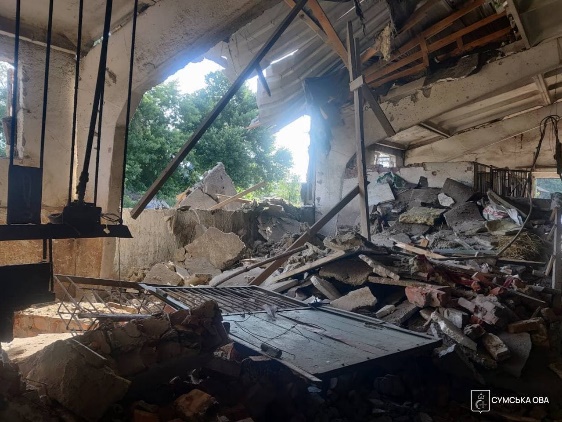
A stable at an equestrian school in Sumy Oblast after it was struck by a Russian drone overnight. (Sumy Oblast Military Administration/Telegram)
UKRAINE STRIKES CRIMEAN BRIDGES, A SHADOW FLEET TANKER, AND RUSSIAN COMMAND POSTS
Ukrainian forces struck a road bridge over the North Crimean Canal near the village of Stavky and another bridge near Voinka in occupied Kherson Oblast overnight, continuing the campaign against transport links connecting Crimea to other occupied territory. The Ukrainian General Staff also reported striking the sanctioned shadow fleet tanker Fina A in the Black Sea, a vessel flying the Equatorial Guinea flag and used to move Russian oil while circumventing the G7 price cap; the tanker is separately sanctioned by the EU, Switzerland, the U.K., and Canada. “The target was successfully struck. The extent of the damage is being assessed,” the General Staff said.
Additional strikes hit a Russian command-and-observation post and a command post near Velyka Novosilka in Donetsk Oblast, along with Russian drone command posts in Zaporizhzhia, Donetsk, Kherson, and Dnipropetrovsk oblasts in Ukraine and in Kursk Oblast in Russia. The Crimean Bridge Telegram channel claimed Russian occupation authorities temporarily closed traffic across the Crimean Bridge connecting the peninsula to Krasnodar Krai.
FRONTLINE: STALEMATE FROM SUMY TO ZAPORIZHZHIA, BUT RUSSIAN COGNITIVE WARFARE EXPANDS
Neither Russian nor Ukrainian forces made confirmed advances along most of the front on June 17. Russian forces conducted infiltration missions in northern Sumy Oblast and northern Kharkiv Oblast, and continued offensive operations without gains in the Kupyansk, Borova, Kostyantynivka-Druzhkivka, Dobropillya, Pokrovsk, Novopavlivka, and Oleksandrivka directions. In the Borova direction, Oskil Hromada Military Administration head Hennadiy Zahoruiko said Russian forces have shifted Lancet loitering munition strikes from the town of Oskil itself to the Oskil-Izyum road after Ukrainian authorities evacuated civilians from the town, suggesting Russian forces deliberately redirected fire toward areas with greater remaining civilian presence.
The Russian Ministry of Defense appears to be expanding its cognitive warfare effort beyond Kostyantynivka to the Lyman direction. Footage published June 17 purportedly showed Russian forces raising flags in Lyman and Pyskunivka, which ISW has reason to suspect is AI-altered; the Russian MoD claimed its 67th Motorized Rifle Division seized 61 buildings in Lyman between June 16 and 17 and destroyed Ukraine’s last ground line of communication into the city — an unusually detailed claim that mirrors the pattern the MoD began applying to Kostyantynivka on June 13. The MoD made similar claims in Kostyantynivka itself, alleging 96 buildings seized over the same period, though Ukrainian 19th Army Corps Commander Brigadier General Alexander Bakulin reiterated that only 93 to 153 Russian servicemembers are actually operating inside the city — a count ISW says indicates Russian forces likely do not control most of the territory they claim to have infiltrated. A Ukrainian brigade spokesperson in the Lyman direction reported that Russian troops are surrendering more frequently as Russian forces intensify pressure there.
Russian forces continued to conduct first-person-view drone strikes deliberately targeting Ukrainian civilians. Donetsk Oblast police reported that an FPV drone struck and killed a civilian in Druzhkivka on June 17, part of what ISW describes as a continuing pattern of “human safari” strikes integrated into Russia’s broader battlefield air interdiction template.
THE G7 SUMMIT CLOSES: MORE WEAPONS PROMISED, NO MONEY COMMITTED
The G7 summit in Evian-les-Bains, France, closed on June 17 with a joint statement reaffirming unwavering support for Ukraine’s sovereignty and agreeing to increase deliveries of air defense systems, interceptors, and long-range capabilities, while pledging to strengthen sanctions on Russia’s oil and gas sectors. The statement said G7 leaders are “ready to consider” extending licenses allowing Ukraine to increase its own military production, though it remained unclear where such production would actually take place: German Chancellor Friedrich Merz said participating states would separately discuss broader licensing for European manufacturers, French newspaper Le Parisien reported that the U.S. and European G7 states agreed to produce air defense systems and long-range missiles under license inside Ukraine, and an official from a separate G7 state told Suspilne that the U.S. had only committed to “looking into” allowing Patriot interceptor production in Europe, with no final decision reached.
A source close to the summit told Suspilne that the looming U.S.-Iran memorandum of understanding, set to be signed June 19, had freed G7 leaders — including President Trump — to refocus attention on Ukraine, and that Trump acknowledged how much Ukraine has achieved since the last G7 summit in June 2025. Two senior EU diplomats separately told Politico that Trump is shaping a deal in which he would back Europe’s position on the war in exchange for European help demining the Strait of Hormuz; French President Emmanuel Macron said any such naval demining mission would require an official U.S. request and consent from regional actors including Iran and Oman, and no agreement was reached at the summit itself.
What the joint statement did not address was money. The EU’s 90 billion euro loan to Ukraine, approved in April 2026, is intended to cover only two-thirds of Kyiv’s financial and defense needs through the end of 2027, leaving a roughly $52 billion gap. European Commission President Ursula von der Leyen raised the shortfall with G7 leaders, according to a G7 diplomat, but leaders did not discuss specific contributions, and the closing statement left the gap unmentioned. Trump himself spent less than two minutes of an hour-long closing press conference on Ukraine, calling the discussions “a productive conversation” and positioning himself as more neutral than the rest of the G7 table: “We had a very good conversation with President Putin and a very, very good conversation with President Zelensky. I think they both want to do something. They just don’t know how to do it,” Trump said, adding thanks to both Putin and Chinese leader Xi Jinping for “staying neutral” on Iran — a characterization that contradicts statements from the Chairman of the Joint Chiefs of Staff and Ukrainian officials that Russia has provided both intelligence and weapons to Iran during its war with the United States. A hotly anticipated second bilateral meeting between Trump and Zelensky did not take place; Trump instead spent time during a dinner with Macron at Versailles signing the Iran memorandum.
EUROPE QUIETLY OPENS A BACK CHANNEL TO MOSCOW
European Council President Antonio Costa’s office confirmed it has established limited diplomatic contact with the Kremlin in recent weeks, with Costa’s chief of staff, Pedro Lourtie, holding telephone conversations with a senior Russian official close to Putin aimed at establishing communication channels rather than negotiating substance. “In the past few weeks, brief contacts at diplomatic level were made to open communication channels but nothing was discussed on substance,” one EU official said, adding that the EU is not a mediator but wants established channels with Russia for any future scenario, since it supports Ukraine in its own peace efforts. Bloomberg reported that some EU countries have floated appointing a special envoy to negotiate with Moscow, an idea Bloomberg described as controversial and risky, and that Putin has suggested former German Chancellor Gerhard Schroeder — who Bloomberg said has effectively been on the Kremlin’s payroll for decades through his work for Gazprom — as a potential interlocutor.
The contacts do not reflect a shift in the EU’s position on the war, officials stressed, and member states have yet to agree on a common approach to direct engagement with Moscow. The development comes as Zelensky has repeatedly called for direct leader-level talks between Ukraine and Russia, proposals the Kremlin has rejected; Putin has also rejected Ukraine’s invitations for a head-of-state meeting on the sidelines of the G7 summit, with Kremlin aide Yuriy Ushakov claiming Russia received no such offer and Kremlin spokesperson Dmitry Peskov separately claiming Zelensky never extended one.
RUSSIA BLAMES UKRAINE FOR A STRIKE ON A BUS OF BELARUSIAN SCHOOLCHILDREN — UKRAINE SAYS IT NEVER HAPPENED
A bus carrying a Belarusian children’s football team from Gomel to the Russian resort city of Gelendzhik was struck in Russia’s Bryansk Oblast on June 17. Acting Bryansk Governor Yegor Kovalchuk initially claimed “Ukrainian terrorists” had attacked the bus, killing a woman and injuring six people including four children. Belarusian Health Minister Alexander Khodzhaev later said eight people were injured, including six children, two of them in serious condition, and that a woman was killed; the bus carried 44 passengers in total, including 28 children, and Kovalchuk said medics from Moscow were traveling to Bryansk to assist. Belarusian independent outlet Nasha Niva identified the woman killed as 44-year-old Victoriya Hrytsenka, the wife of a coach at a Gomel youth sports school who was himself reported to be in serious condition.
Ukraine’s General Staff flatly denied the accusation. “The Armed Forces of Ukraine engage exclusively lawful military targets and do not conduct combat operations against the civilian population,” the General Staff said, stating that Ukrainian forces had not deployed any drones against targets in Bryansk Oblast during the period in question. “We regard such reports as yet another information provocation orchestrated by the Kremlin. Unable to achieve its declared objectives on the battlefield and suffering significant losses, the Russian Federation is increasingly resorting to information manipulation and the fabrication of accusations against Ukraine,” the statement read, adding that it is Russia that systematically violates international humanitarian law by striking Ukrainian cities, hospitals, and schools. ISW was unable to independently verify the Russian and Belarusian claims, but noted that Russian and Belarusian officials used near-identical language accusing Ukraine of deliberately provoking a “harsh” Belarusian response — rhetoric that follows a pattern of recent Russian claims framing its own large-scale strikes on Ukraine as justified responses to alleged Ukrainian attacks on civilians. Belarus’s Foreign Ministry formally condemned the alleged strike as “yet another act of terrorism,” and Russia’s Investigative Committee released video footage of the damaged bus.
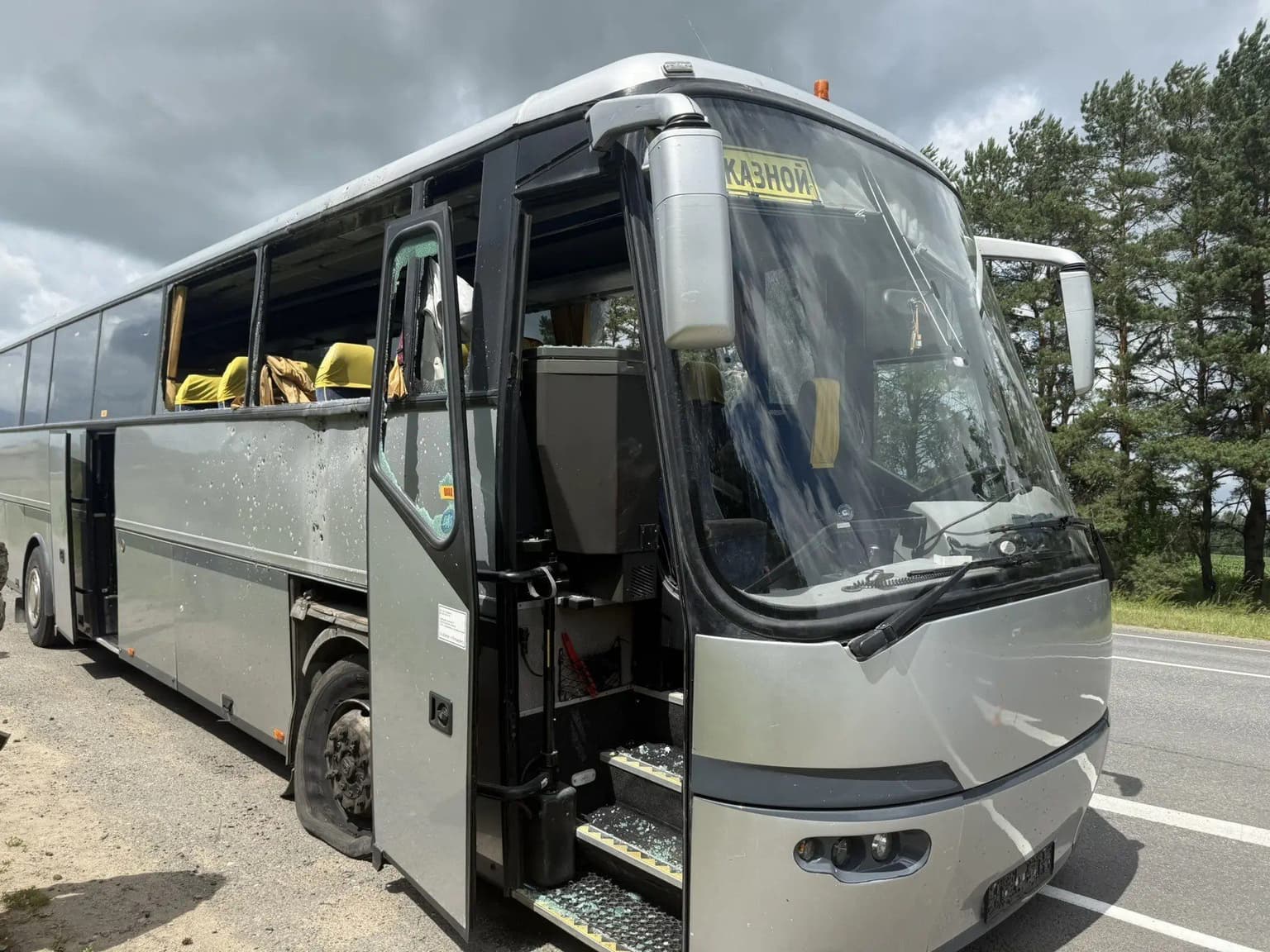
A bus which was allegedly struck in Russia’s Bryansk Oblast. (Yegor Kovalchuk / Telegram)
OVERNIGHT AND DAYTIME STRIKES: AT LEAST 10 KILLED, MORE THAN 60 INJURED ACROSS UKRAINE
Russian forces launched 119 Shahed, Gerbera, and Italmas-type strike drones and Parodiya decoys overnight on June 16 to 17 from Bryansk, Kursk, and Oryol cities, Millerovo in Rostov Oblast, and occupied Cape Chauda in Crimea. Ukrainian air defenses intercepted 97 drones; 20 drones struck 11 locations, with debris falling at six more sites. Russian strikes hit industrial, commercial, educational, and residential infrastructure in Zaporizhzhia and Kharkiv oblasts, and DTEK reported a strike on an energy facility in Dnipropetrovsk Oblast left more than 19,400 consumers without power; the Ukrainian Energy Ministry reported additional outages in Donetsk, Zaporizhzhia, Kharkiv, and Chernihiv oblasts.
Russian attacks across Ukraine killed at least 10 civilians and injured at least 64 others over the 24-hour period. In Sumy Oblast, a Russian drone struck a children’s equestrian school overnight, killing several horses and damaging a stable; no staff were injured, but the Sumy Oblast Military Administration said “the Russians deliberately struck a civilian facility where children trained every day.” Separately, a drone strike killed a 56-year-old man in Sumy’s Kovpakivskyi district and set fire to a gas station; across the wider oblast, seven more people were injured. In Donetsk Oblast, four people were killed and 18 injured, with the city of Sloviansk hit hardest — three killed and eight injured there alone. In Kherson Oblast, two people were killed and 11 injured as Russian forces damaged four apartment buildings, four private homes, a gas pipeline, a farm, and a passenger bus. In Zaporizhzhia Oblast, one person was killed and 14 injured as Russian forces carried out 931 strikes against 50 settlements across the region. In Dnipropetrovsk Oblast, three people were killed and three injured as Russian forces launched more than 40 artillery and drone attacks across four districts, with Nikopol and surrounding communities hit hardest, damaging businesses, an administrative building, shops, a cathedral, private homes, and vehicles. In Kharkiv Oblast, 11 people were injured as Russian forces struck nine settlements with missiles, guided bombs, Shahed and Molniya drones, and FPV drones.
A LOOTED MARIUPOL MUSEUM DIRECTOR FACES WAR CRIMES CHARGES
Ukraine’s Donetsk Oblast Prosecutor’s Office notified the former director of the Mariupol Local History Museum, identified by sanctions records as Natalia Kapustnikova, in absentia of suspicion for handing five original paintings worth roughly $586,000 to Russian occupation authorities at the start of the full-scale invasion. According to prosecutors, Kapustnikova used her access to the museum’s storage to remove paintings by Arkhip Kuindzhi, Ivan Aivazovsky, and Hryhorii Kalmykov from the Arkhip Kuindzhi Art Museum, first moving them to her own home before personally handing them to occupation officials; the works were subsequently transferred to the so-called “Donetsk Republican Museum” and unlawfully entered into Russia’s official museum valuables register. “In this way, the suspect facilitated the enemy’s appropriation of unique works of art that were an inseparable part of Mariupol’s cultural heritage,” prosecutors said. Kapustnikova faces charges under Ukraine’s criminal code for violating the laws and customs of war, carrying a maximum sentence of 12 years. Ukraine’s Defense Intelligence has documented that Russia had stolen or destroyed 2,336 cultural valuables nationwide as of April 1, 2026, including more than 1,200 items from the Kherson regional art museum alone.
NEW EUROPEAN PARTNERSHIPS EXPAND UKRAINE’S WEAPONS PRODUCTION
The Netherlands pledged 500 million euros in new military aid to Ukraine on June 17, split evenly between purchasing drones from Dutch manufacturers and contributing to the NATO-backed Prioritized Ukraine Requirements List, bringing total Dutch PURL contributions to 1 billion euros. “We see that the murderous Putin regime is not successful on the battlefield and therefore intensifies its terror attacks by air. Air defense is now more important than ever for the Ukrainians,” Dutch Defense Minister Dilan Yeşilgöz-Zegerius said, announcing the package during a visit by her Ukrainian counterpart. The two ministries also signed a Letter of Intent on joint defense innovation and research.
Separately, Ukraine’s Brave1 defense-tech platform announced a new Brave France initiative providing 20 million euros to Ukrainian and French companies developing missiles, unmanned systems, and counter-air technologies, funded equally by both sides and signed on the sidelines of the Eurosatory 2026 defense exhibition in Paris; the first grant applications are expected in September. Ukraine plans to formally request an additional $20 billion in emergency military aid at the Ramstein-format Ukraine Defense Contact Group meeting on June 18, on top of funding already committed this year. “Everyone sees that Russia is burning, and we want it to burn even more, but we need financing to do it,” a senior Ukrainian defense official said, warning that without rapid additional funding, Ukraine’s current battlefield advantage could prove temporary.
HUNGARY ORDERS A PROBE INTO THE “GOLD CONVOY” SCANDAL
Hungarian Prime Minister Peter Magyar announced an immediate internal investigation into government agencies implicated in the so-called “gold convoy” scandal that strained relations between Hungary and Ukraine under former Prime Minister Viktor Orban, specifically naming the National Tax and Customs Administration and the Counter Terrorism Center. “The Prosecutor General must address the matter without delay,” Magyar wrote. Hungarian authorities had seized two bank vehicles in early March carrying roughly $82 million in cash and gold en route from Austria to Ukraine, briefly detaining accompanying Oschadbank employees before releasing them; Kyiv condemned the seizure as “state terrorism,” and a subsequent Hungarian media investigation alleged Orban ordered the seizure for political reasons. Hungary returned the seized assets in early May under Magyar’s new government, a step Zelensky welcomed as “a civilized step” toward repairing relations between the two countries.
By the close of June 17, the war’s contradictions were visible on every front at once: a refinery burning for the second time in a week while Russian officials insisted their air defenses had held; a G7 statement full of praise for Ukraine that left $52 billion unaccounted for; and a fabricated claim about a children’s bus that Russian and Belarusian officials repeated within hours of each other, only for Ukraine’s own military to flatly deny it ever happened. None of it changed where the front line sat that night. But each piece — the rationed gasoline, the unfunded pledges, the manufactured outrage — chipped away a little more at how much longer Russia can keep insisting this war is going according to plan.
A PRAYER FOR UKRAINE
1. For the Children of the Equestrian School in Sumy
Lord, a drone struck a stable in Sumy Oblast overnight, killing horses that children trained alongside every day. No one was physically hurt, but a place built for joy and routine has now been touched by war in a way that will not be easy to explain to a child. We pray for those young riders, for the staff who must tell them what happened, and for every small, ordinary place in Ukraine that war keeps finding a way to reach. Let their grief be gentle, and let them find somewhere safe to keep training.
2. For the Families of Sloviansk and Nikopol
Father, three people were killed and eight injured in Sloviansk, and Nikopol was struck more than 40 times in a single day, damaging homes, shops, and even a cathedral. These are not new names to us — they appear in this briefing again and again, towns that absorb strike after strike and somehow keep functioning. We ask for strength for the people who live there, for the rescue workers who respond to the same streets night after night, and for the day when these names stop appearing in casualty reports altogether.
3. For Victoriya Hrytsenka and the Children on the Bus
God of truth, a woman is dead and children are injured after a strike on a bus in Bryansk Oblast, and we do not fully know who is responsible or why. What we do see clearly is how quickly her death was turned into a claim, a talking point, a justification for what comes next. We pray for Victoriya’s family, for her husband recovering from his own injuries, and for the children on that bus who will carry this day with them. We ask You to expose what is false in this war and to protect the people — on every side — who get caught in the space between truth and propaganda.
4. For Those Standing in Line for Gasoline
Lord, fuel rationing has now spread to 53 Russian regions and all of occupied Ukraine, and somewhere tonight a person is standing in a line, uncertain whether there will be enough left when they reach the pump. We do not pray for Russia’s war machine to run smoothly. We pray instead for clarity — that ordinary people on every side of this line begin to see plainly what this war is costing them, and that the costs continue to make the war harder to sustain until it ends.
5. For an End to the Waiting
God of patience, the G7 leaders met for three days and produced a statement full of praise and short on numbers, while $52 billion in unmet need goes unspoken. Diplomats open quiet channels to Moscow that lead nowhere yet. Zelensky keeps offering to meet Putin, and Putin keeps finding new ways to say no. We do not know how much longer this waiting will last. We ask for patience for the people who cannot afford to wait — the wounded in Kherson, the families in Zaporizhzhia, the children in Sumy — and we ask, in Your time and by whatever path leads there, for this war to end in a peace that is actually just.