
Ukraine Daily Briefing | June 18, 2026 | Day 1,576 of the Full-Scale Invasion
Prepared by Dayana Bozhyk
Ukraine launched its largest-ever drone attack on Moscow overnight on June 17 to 18, striking the Moscow Oil Refinery for the third time in a week, grounding all four of the capital’s airports, and sending what residents described as “oil rain” falling over Moscow suburbs. Russia’s own internal communications, intercepted by Ukraine’s Security Service, confirmed that no Ukrainian drone struck the Bryansk bus Ukraine was blamed for the day before. In Brussels, Ukraine’s Western allies pledged $4 billion in new military assistance at the Ramstein-format meeting, while EU leaders extended Russia sanctions for a full year for the first time. Ukraine also repatriated the bodies of 522 fallen citizens. Russia imported gasoline from Asia by sea for the first time, as shortages spread to 53 regions.
THE DAY’S RECKONING
Moscow woke up to “oil rain.” That was the phrase residents in Balashikha used to describe the dark, petroleum-smelling film that settled on their cars, windowsills, and clothing after rainfall mixed with smoke from the burning refinery in Kapotnya. The Moscow Oil Refinery had just been struck for the second time in three days — the third time in a week — in what Russian authorities acknowledged was the largest Ukrainian drone attack on the capital since the full-scale invasion began. All four of Moscow’s major airports were shut down. Aeroflot and its subsidiary Rossiya canceled more than 170 flights. Red Square was closed. Seventeen people, including two children, were injured in the Moscow region alone. Russia’s own defense ministry claimed it shot down 555 drones nationwide — and yet the refinery burned.
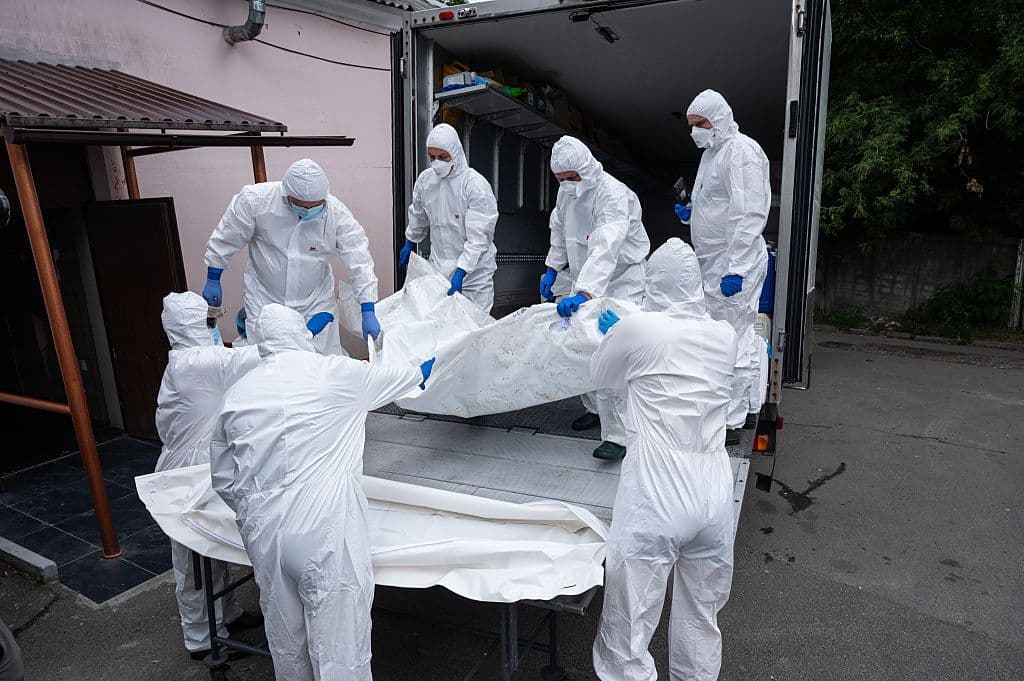
Experts are seen working during the repatriation of the bodies of fallen Ukrainian soldiers in Kyiv, Ukraine. (Danylo Antoniuk/Anadolu/Getty Images)
While Moscow absorbed the strike, a different kind of exposure was unfolding in Kyiv. Ukraine’s Security Service reported that it had intercepted Russia’s own internal government communications from Bryansk Oblast, which concluded that no Ukrainian drone had struck the bus carrying a Belarusian children’s soccer team the day before. Russia had spent 24 hours building a case against Ukraine for an attack that, according to Russia’s own records, never happened.
And in Brussels, nearly 50 countries gathered for the Ramstein-format meeting and pledged $4 billion in new military aid: Patriot missiles, drones, F-16s, and the first-ever joint Ukraine-Germany agreement to produce robotic ground vehicles. EU leaders, meeting at their own summit, extended Russia sanctions for 12 months at a stroke — the first time they have done so for a full year instead of six months. It was the kind of day that made the gap between Russia’s public narrative and the material reality of this war impossible to ignore.
UKRAINE’S LARGEST DRONE STRIKE ON MOSCOW: THE REFINERY BURNS AGAIN
Ukraine launched its most extensive drone attack ever on Moscow overnight on June 17 to 18, striking the Gazprom Neft-owned Moscow Oil Refinery in the Kapotnya district for the second time in three days and the third time in a week. The General Staff reported fires at five locations within the refinery simultaneously, including the combined oil refining unit, secondary processing units, and the tank farm; industry sources told Reuters the attack damaged the Euro+ combined oil refining unit. Moscow Mayor Sergei Sobyanin acknowledged that 194 Ukrainian drones were intercepted over the capital alone — the previous record was 74, set on March 11 — while Russia’s Defense Ministry claimed its forces downed 555 drones nationwide across 17 regions, occupied Crimea, and the Azov Sea. Despite the claimed interception rate, multiple targets were struck.
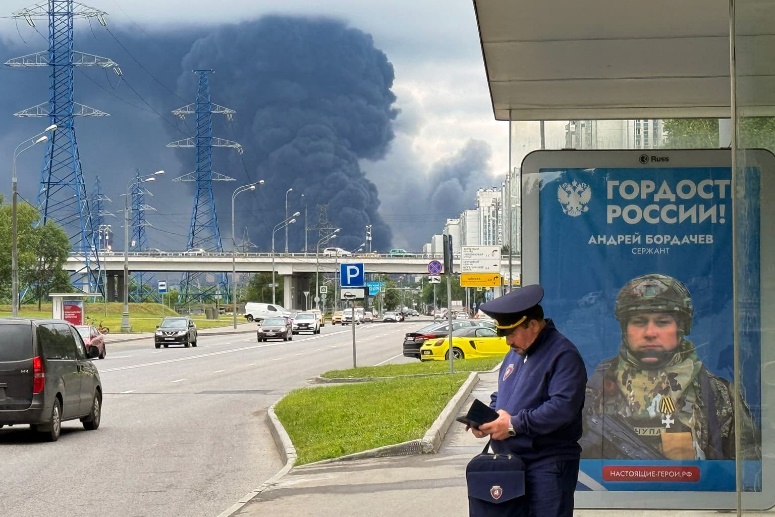
Black smoke rises from the area of the Russian oil producer Gazprom Neft’s Moscow oil refinery on the south-eastern outskirts of Moscow. (AFP via Getty Images)
All four airports in the Moscow air hub — Vnukovo, Domodedovo, Zhukovsky, and Sheremetyevo — grounded flights. Aeroflot and its subsidiary Rossiya canceled more than 170 flights and delayed over 110 others. The Russian interior ministry closed streets around the refinery and restricted sections of the Moscow Ring Road. Red Square was closed; a local monitoring channel reported machine gunners on the towers, walls, and mausoleum, and armored vehicles on the bridges. Seventeen people, including two children, were injured in the Moscow region, according to regional governor Andrey Vorobyov, who confirmed drone damage to residential buildings in Novye Kotelniki, Zhukovsky, and Lyubertsy, as well as private homes in Stepanovo, Masnovo-Zhukovo, Kryukovo, and Pavlovsky Posad. Debris hit the Sadovod shopping center and damaged the roof of the Belaya Dacha mall.
Residents in Balashikha reported what they described as “oil rain” — a dark, petroleum-smelling film on cars, windowsills, and clothing after rainfall mixed with combustion byproducts carried northeast by winds of about 16 km/h. Moscow’s environmental monitoring authorities claimed no deterioration in air quality was recorded. Russian outlet Astra separately documented widespread complaints that Moscow’s warning system failed entirely during the attack: no SMS alerts, no sirens, throughout a strike that residents said lasted from before 4:48 a.m. until around 6:20 a.m. with a brief pause. Authorities in the Moscow-region town of Kotelniki refused to disclose civil defense shelter locations, saying the information would only be released “during mobilization and in wartime,” arguing that air alerts could contribute to panic — even as residents sheltered in their apartments with no guidance.
President Zelensky confirmed Ukraine’s forces carried out the strike and framed it directly as a response to Russia’s June 14 to 15 attack on the Kyiv-Pechersk Lavra. “They struck the Lavra. I said openly that we would prepare a response and that you would see it. I think you are seeing it now,” Zelensky said. “If Putin does not want to end this war, we will not sit quietly. We will respond, and the response must be strong. If Ukraine burns, so will Moscow.” He credited the SBU, GUR, Special Operations Forces, Unmanned Systems Forces, and a Ukrainian missile brigade with carrying out the operation. Zelensky also called for wider international pressure: “Ukrainians, Europeans and Americans must all put pressure on Putin. Russians also need to wake up and put pressure on their leader.” In response, Foreign Minister Lavrov promised fresh Russian strikes on targets upon which “the combat effectiveness of the Ukrainian armed forces directly depends” — a threat that represents no change in Russia’s existing policy of regular, often indiscriminate attacks on Ukrainian cities.
Putin, attending the Russia-ASEAN summit in Kazan roughly 800 kilometers from Moscow, posed for photographs with visiting leaders and made no mention of the strike in his opening remarks. State television channels Perviy Kanal and NTV did not cover the strikes in their daytime broadcasts; Rossiya-1 only quoted official statements. Russian state media instead focused primarily on the need to prosecute residents who filmed the attack. State-affiliated Solovyov Live host Armen Gasparyan urged the FSB to open treason cases against those who recorded footage. “Everyone who sends such footage should be put in prison,” said state television presenter Vladimir Solovyov. Several Russian milbloggers, however, broke from the official line: one noted in a since-deleted post that Ukraine had inflicted substantial damage despite Moscow’s highly developed air defenses; another criticized state media for creating a false reality where “everything is fine”; a third noted that Russians can now “see with their own eyes” that official claims do not match reality. Aviation blogger Fighterbomber initially expressed concern that even Moscow’s protected airspace was allowing repeated strikes on the same targets before deleting the post and insisting Russia still had “an air-defense system unlike any other in the world.”
THE GUKOVO OIL DEPOT AND CONFIRMED DAMAGE FROM EARLIER STRIKES
Ukraine’s Special Operations Forces struck the Rostovnefteprodukt oil facility in Gukovo, Rostov Oblast, overnight in cooperation with a resistance movement inside Russia called Red Spark, the General Staff confirmed. The Gukovo depot stores and ships fuel and lubricants for Russian military use; Rostov Oblast Governor Yuriy Slyusar acknowledged the strike and said one person was killed and two injured. Yaroslavl Oblast Governor Mikhail Evrayev separately claimed that Ukrainian drone strikes forced Russian authorities to close traffic on the Yaroslavl-Moscow highway.
The General Staff also published updated battle damage assessments from earlier operations: the June 14 strike on the Palkino Oil Pumping Station in Yaroslavl Oblast destroyed seven tanks with a total combined capacity of 95,000 cubic meters; the June 13 strike on the Kotovsky oil preparation and pumping station in Volgograd Oblast damaged three RVS-2000 tanks and a section of pipeline; and the June 13 strike on the Tamanneftegaz oil terminal in Krasnodar Krai damaged five large RVSP-30000 vertical storage tanks. NASA satellite data from June 13 to 19 shows an unusually large number of fire anomalies across Russian territory during this period, consistent with the broader pattern of Ukrainian deep strikes.
RUSSIA’S OWN RECORDS PROVE THE BRYANSK BUS CLAIM WAS FALSE
Ukraine’s Security Service reported on June 18 that it had intercepted official internal Russian government communications from Bryansk Oblast — specifically from the “Safe Region” state public institution — concluding that Russia did not detect any Ukrainian drones or other objects near the area where Russian and Belarusian officials claimed Ukraine struck a bus carrying a Belarusian children’s soccer team on June 17. The intercepted documents directly contradict statements made by acting Bryansk Governor Yegor Kovalchuk and Belarusian officials, who spent June 17 accusing Ukraine of deliberately targeting civilians to provoke Belarus into the war. Belarusian President Alexander Lukashenko separately accused Ukraine on June 18 of using the alleged strike to drag Belarus into the conflict.
The SBU said the Russian internal records constitute evidence that the claims are false and part of an information operation following a pattern in which Russia fabricates allegations of Ukrainian strikes against civilians to justify its own large-scale aerial attacks on Ukrainian cities. The intercepted communications do not explain what actually struck the bus or caused the casualties — one woman was killed and eight people, including six children, were injured — but they do establish that Russia’s own internal security apparatus found no trace of a Ukrainian drone in the area at the time.
RUSSIA IMPORTS GASOLINE FROM ASIA FOR THE FIRST TIME AS SHORTAGES HIT 53 REGIONS
Reuters reported, citing four industry sources, that Russia has begun importing gasoline from Asia by sea in June 2026 to manage the spreading domestic shortage — a step Russia had considered but declined to take during the similar fuel crisis in late summer 2025, because domestic supply was ultimately sufficient then. The sources said Russia will receive gasoline cargo shipments at one of its western ports, and that Russia is also increasing imports from Belarus and has previously imported smaller volumes from Kazakhstan; neither Belarus nor Kazakhstan, however, has sufficient reserve capacity to compensate if the shortages worsen. The decision to import by sea in 2026 when Russia did not in 2025 itself signals that this year’s crisis is more severe. The 2026 shortages are hitting at the start of the high summer demand season, when fuel consumption is highest, compounding the problem.
The crisis has a specific structural cause: Ukraine’s long-range strike campaign has removed roughly 30 percent of Russia’s refining capacity from service — analysts cited in reporting cited 2.14 million barrels per day offline — forcing Russia to prioritize limited refined product for the domestic market while maximizing crude oil exports. Fuel rationing now covers 53 Russian regions and all five occupied Ukrainian regions; 18 Russian regions cap sales at 50 liters per vehicle. Reuters separately reported that CBS News cited three Ukrainian officials familiar with Russian intelligence estimates as saying Russia is experiencing a shortage of S-300 air defense missiles, with insufficient key components including guidance seekers and control modules due to Western sanctions. Two officials noted that Russian forces have repurposed S-300 missiles for surface-to-surface strikes against Ukraine, while Ukrainian strikes with more advanced drones are forcing Russia to expend interceptor missiles it would normally reserve for missile defense — depleting both categories simultaneously.
$4 BILLION AT RAMSTEIN: BRITAIN, GERMANY, BELGIUM, SWEDEN, NETHERLANDS AND MORE
Nearly 50 countries gathered for the Ramstein-format Ukraine Defense Contact Group meeting in Brussels on June 18, producing what Defense Minister Mykhailo Fedorov said totaled $4 billion in new military pledges. The United Kingdom announced a £752 million package — approximately $996 million — funded by proceeds from frozen Russian assets under the Extraordinary Revenue Acceleration loan, delivering 150,000 drones, more than 350 air defense missiles including Lightweight Multirole Missiles, and ground-based radar systems, with full delivery expected by year’s end. UK Defense Secretary Dan Jarvis also confirmed the UK will assume command of the Multinational Force for Ukraine Headquarters, with Major General Tom Bateman taking command in July in the rank of Lieutenant General.
Germany pledged $400 million: $200 million through the Prioritized Ukraine Requirements List for air defense ammunition and $200 million through the JUMPSTART mechanism for PAC-3 interceptors for Patriot systems. Berlin and Kyiv also signed agreements on anti-ballistic defense cooperation and joint production of the Termit unmanned ground vehicle in Germany. Belgium committed to delivering seven F-16 fighter jets to Ukraine by year’s end — three operational and four for spare parts — with Defense Minister Theo Francken indicating he would propose transferring all remaining Belgian F-16s to Ukraine in coming years, subject to the pace of new F-35 deliveries. Sweden allocated $108 million to PURL, its fourth contribution, bringing its total PURL support to $543 million. In total, roughly a third of NATO member states plus Australia are now contributing to PURL, with nine countries confirming participation on June 18 alone, collectively directing nearly $1 billion toward Patriot interceptors.
NATO Secretary General Mark Rutte called the meeting a “window of opportunity” for Ukraine and highlighted additional contributions from Norway, Denmark, Spain, Lithuania, Luxembourg, Latvia, Croatia, and Iceland toward long-range artillery ammunition, totaling $540 million, alongside contributions to electronic warfare, infantry fighting vehicles, and training centers. Zelensky told the gathering: “Putin is now relying on one thing, constant missile attacks, and he has ballistic missiles, so we need anti-ballistic capabilities.” He said Ukraine expects concrete outcomes from joint anti-ballistic defense work by winter and pressed for Patriot and anti-ballistic missile systems as top priorities. Fedorov added that Ukraine expects to receive at least $60 billion in international military assistance in 2026 overall, with $40 billion already committed.
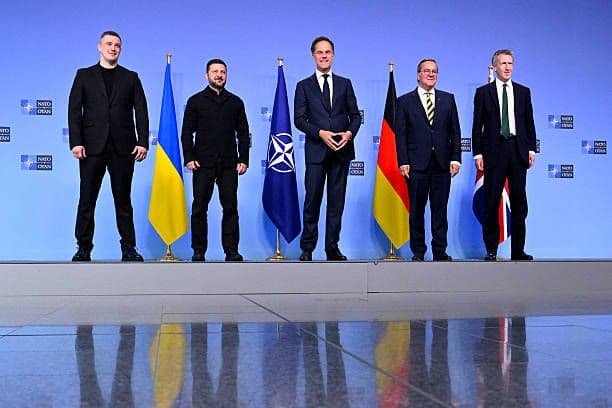
Defence Minister Mykhailo Fedorov, President Volodymyr Zelensky, NATO Secretary General Mark Rutte, Germany’s Defence Minister Boris Pistorius and Britain’s Defence Secretary Dan Jarvis pose before a meeting of the Ukraine Defence Contact Group during a NATO Defence Ministers meeting at the NATO headquarters, in Brussels. (Photo by JOHN THYS / AFP via Getty Images)
EU EXTENDS RUSSIA SANCTIONS FOR A FULL YEAR, ZELENSKY ATTENDS EUROPEAN COUNCIL
EU leaders meeting at the European Council summit in Brussels on June 18 agreed to extend sanctions against Russia for 12 months — the first time the bloc has renewed the measures for a full year rather than the customary six months. The shift reduces the frequency of politically sensitive renewal negotiations and eliminates the leverage that former Hungarian Prime Minister Viktor Orban had repeatedly used to extract concessions during six-month cycles. The decision comes days after the EU adopted a new sanctions round targeting Russia’s energy revenues, military-industrial complex, shadow fleet, and individuals supporting Moscow’s war effort and hybrid operations against Europe.
Zelensky attended the opening of the European Council summit before EU leaders continued without him. Bulgarian Prime Minister Rumen Radev announced his government will seek the removal of Patriarch Kirill — the head of the Russian Orthodox Church and a close Kremlin ally who has publicly supported Russia’s full-scale war against Ukraine — from the EU’s next sanctions package, though he added that Bulgaria would not accept sanctions that threaten the viability of the Lukoil Neftohim Burgas refinery. Radev separately confirmed he will meet Zelensky on June 18 and expressed support for Ukraine’s EU accession process. New Hungarian Prime Minister Peter Magyar, attending his first European Council as the leader who ousted Orban, enabled the review of all previously Orban-blocked sanctions measures, including the Patriarch Kirill question.
RUSSIAN STRIKES ON UKRAINE OVERNIGHT: KYIV, POLTAVA, KHARKIV, SUMY, DNIPROPETROVSK
Russian forces launched seven Iskander-M ballistic missiles and S-400 air defense missiles alongside 239 Shahed, Gerbera, and Italmas-type strike drones and Parodiya decoys overnight on June 17 to 18, from Voronezh, Bryansk, and Kursk oblasts and from Primorsko-Akhtarsk in Krasnodar Krai and occupied Hvardiiske in Crimea. Ukrainian air defenses shot down four of the ballistic missiles and 212 drones; two ballistic missiles and 26 drones struck nine locations, with debris falling at seven more. The strikes damaged educational, residential, commercial, and energy infrastructure in Dnipropetrovsk, Kyiv, and Poltava oblasts, and the Ukrainian Energy Ministry reported power outages in Donetsk, Zaporizhzhia, Mykolaiv, Poltava, and Kharkiv oblasts.
In Kharkiv, Russian guided aerial bombs struck the Kholodnohirskyi district, injuring civilians and damaging around 15 private homes and a warehouse. A Russian Molniya drone struck the technical floor of a high-rise apartment building in Sumy’s Kovpakivskyi district, damaging the roof; no casualties were reported. In Dnipropetrovsk Oblast, Russian forces struck the region more than 20 times with artillery, drones, and missiles, killing two people and injuring 17: in Dnipro city, one person was killed and 12 wounded; in the Nikopol area, one person was killed and five injured including a 56-year-old woman and a 53-year-old man, with a medical clinic, personal vehicles, a gas station, and a cafe damaged. Ukrainian GUR reported that the Russian military command ordered the 58th Combined Arms Army to intensify FPV drone strikes deliberately targeting civilians in Zaporizhzhia City, with additional drones promised for that purpose — a directive ISW assessed as a command-endorsed war crime.
In Kharkiv Oblast, an FPV drone struck two civilians in the village of Ukrainske in the Chuhuiv district on the morning of June 18, killing one and injuring the other. Russian forces struck the Sloviansk direction with combined motorized and mechanized assaults; geolocated footage confirmed fighting along the T-0513 Siversk-Lyman highway in southern Zakitne. Russian forces also struck Krasnopillya in Sumy Oblast with FAB-500 or FAB-1000 guided glide bombs.
FRONTLINE: ONE MARGINAL RUSSIAN ADVANCE IN SLOVYANSK, COGNITIVE WARFARE EXPANDS AGAIN
Russian forces made one confirmed marginal advance in the Slovyansk direction, geolocated footage showing fighting during a June 16 combined motorized and mechanized assault along the T-0513 highway in southern Zakitne. Elsewhere along the front, Russian forces conducted offensive operations in northern Sumy Oblast, northern Kharkiv Oblast, Velykyi Burluk, Kupyansk, Borova, Kostyantynivka-Druzhkivka, Dobropillya, Pokrovsk, Novopavlivka, and Oleksandrivka directions without making confirmed advances. Ukrainian forces counterattacked near Ridkodub, Nove, Novyi Myr, Yatskivka, and Karpivka in the Borova direction, and near Mala Tokmachka in western Zaporizhzhia Oblast, where Ukrainian forces repelled a Russian motorized assault of more than 30 vehicles — primarily motorcycles and ATVs — destroying over 20 motorcycles, up to 12 ATVs, and 10 Russian servicemembers.
The Russian Ministry of Defense expanded its cognitive warfare campaign to Slovyansk, publishing from June 18 daily tactical claims about alleged Russian gains in the city center — the same pattern it began applying to Kostyantynivka on June 13. The MoD claimed its 123rd and 88th Separate Motorized Rifle Brigades seized Rai-Oleksandrivka east of Slovyansk, and published footage purportedly showing Russian flags being raised there and in Lyman and Pyskunivka; ISW assessed the imagery as likely AI-altered. In Kostyantynivka, the commander of Ukraine’s 19th Army Corps confirmed the number of Russian servicemembers operating inside the city remains at 123 to 125, with Russian forces concentrating additional manpower nearby in an apparent attempt to infiltrate the city in larger numbers using small infantry groups simultaneously and bypass it from the flanks. Ukrainian drone strikes continued in the Luhansk Oblast rear, with a Ukrainian brigade commander reporting that improved technology and communications now enable Ukrainian drones to reach all areas of occupied Luhansk Oblast, including areas beyond Starobilsk more than 70 kilometers from the frontline.
Ukraine’s intermediate-range strike campaign against logistics in occupied Kherson Oblast and Crimea also continued on June 18. The General Staff confirmed a strike on the rail bridge over the North Crimean Canal near occupied Rozdolne, used for military and occupation logistics on the Kerch-Dzhankoi railway line; footage showed fires at the site. The Kremlin-affiliated Rubikon Center for Advanced Unmanned Technologies — whose drone units were instrumental in Russian advances in the Pokrovsk and Hulyaipole directions in autumn 2025 — was reportedly redeployed from frontline duties to defend logistics routes in occupied Kherson Oblast, particularly along the M-14 Rostov-Crimea highway, reflecting the strain Ukraine’s campaign is placing on Russian military command priorities. Geolocated footage showed Ukrainian forces striking Russian trucks in occupied Chaplynka and on the P-47 highway north of occupied Novotroitske; satellite imagery confirmed Ukrainian forces struck the road bridge connecting occupied Henichesk with the Arabat Spit at least three times; and Kherson Oblast occupation head Vladimir Saldo acknowledged Ukrainian strikes on oil, gas, electrical, and bridge infrastructure leaving approximately 20,000 residents across 22 settlements without power.
RUSSIA DEPORTS UKRAINIAN CHILDREN TO ABKHAZIA — A NEW FRONT IN A PATTERN OF FORCED TRANSFERS
Kremlin-appointed Children’s Rights Commissioner Maria Lvova-Belova claimed that Russian authorities organized a program in Russian-occupied Abkhazia — the breakaway separatist region of Georgia — for 200 children and their parents from occupied Donetsk and Luhansk oblasts, ostensibly providing psychological support following traumatic events. ISW assessed this as the first documented instance in open-source records of Russian officials facilitating the deportation of Ukrainian children to Abkhazia in an official capacity since 2022, extending a pattern that previously involved transfers to Russia and occupied Crimea. Separately, Rosenergoatom organized and funded summer trips for more than 350 children from occupied Enerhodar to camps on the Black Sea coast in occupied Crimea as part of a “career orientation” program; ISW assessed the program as likely intended to indoctrinate children for future careers in the Russian nuclear industry and to legitimize Russian occupation of the Zaporizhzhia Nuclear Power Plant.
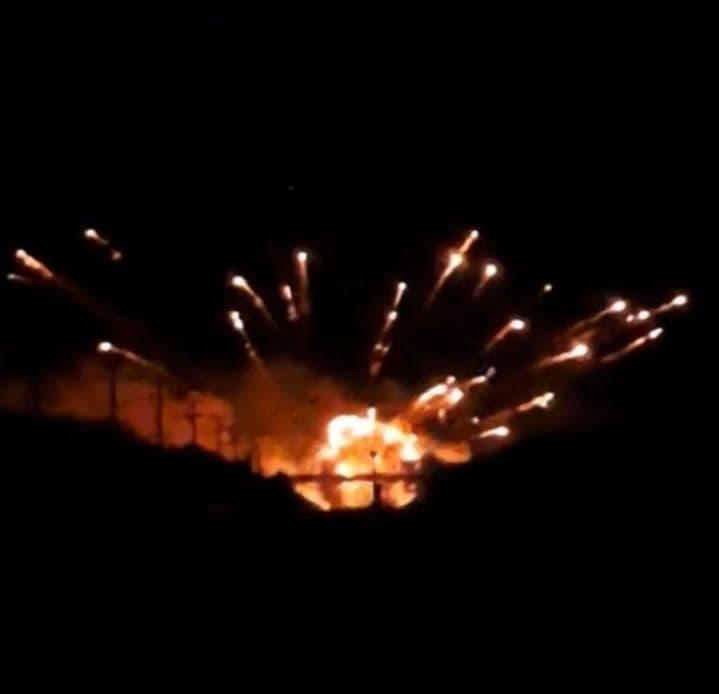
Photo reportedly shows an explosion at a railway bridge in Russian-occupied Crimea after it was attacked by Ukrainian drones overnight. (Exilenova-Plus / Telegram)
In a parallel development that reflects the war’s pressure on Russia’s occupation administration, both the Zaporizhzhia Oblast occupation Defense Headquarters and the Donetsk People’s Republic Defense Headquarters have suspended organized transportation of children to summer camps — citing the “current operational situation,” meaning Ukraine’s strike campaign. The simultaneous expansion of deportation programs and restriction of transportation routes underscores the tension between Russia’s effort to project normalcy in occupied areas and the material reality of Ukrainian strikes disrupting logistics at every level.
RUSSIA TIGHTENS ITS GRIP ON OCCUPIED UKRAINE: COURTS, PASSPORTS, BANKS, AND CENSORSHIP
Putin signed a law lowering the barrier for investment in the free economic zone covering occupied Donetsk, Luhansk, Zaporizhzhia, and Kherson oblasts, reducing the minimum first-year capital requirement from 30 percent to ten percent and authorizing land leases without legal tender. ISW assessed the legislative urgency as a signal that the free economic zone has so far failed to attract the investment the Kremlin hoped for. Putin separately signed a decree establishing 29 magistrate judges in occupied Zaporizhzhia Oblast, while the Russian Supreme Court set the number at 75 in occupied Luhansk Oblast — embedding Russian judicial infrastructure at the most local level of both oblasts. Sberbank, Russia’s state-owned bank, reported it now operates 30 offices, 332 ATMs, and 16,000 payment terminals in occupied areas and has surpassed one million customers in occupied Luhansk Oblast alone, with over 140,000 enrolled in a subscription program available only to residents of occupied Ukraine.
In occupied Zaporizhzhia, the occupation head issued a ban on publishing or sharing online any information, photos, or video related to Ukrainian drone strikes, Russian troop locations, fuel and energy facilities, or communal services — framing the restrictions under existing martial law but explicitly linking them to Ukraine’s intensified intermediate-range strike campaign. ISW assessed the restrictions will likely be used to levy harsh punishments against residents who share any information about the impacts of Ukrainian strikes. A Russian occupation court in Simferopol additionally extended the pre-trial detention of four Crimean Tatar women accused of involvement with the Hizb ut-Tahrir organization until September 14, 2026; their FSB arrest in October 2025 is part of what ISW assessed as a systematic use of fabricated extremism charges to persecute the Crimean Tatar community. Separately, FSB-occupied Zaporizhzhia authorities arrested a resident of Vasylivka Raion for allegedly using a Ukrainian banking app to make transfers — a charge Russian law enforcement uses routinely in occupied areas to fabricate treason accusations based solely on the presence of a Ukrainian app on a personal phone.
RUSSIA’S CRIMEA TOURIST SEASON COLLAPSES: 80 PERCENT OF JUNE BOOKINGS CANCELLED
Ukraine’s strike campaign is now visibly destroying Russia’s ability to generate economic benefit from its occupation of Crimea. Current Time reported that tour operators are failing to inform tourists about fuel shortages and Ukrainian drone strikes, with visitors arriving on the peninsula only to find they cannot fill their cars or move around. Independent Crimea-based outlet Inzhir Media reported, citing Russian tourism industry representatives, that fuel shortages, transportation disruptions, and the overall security situation have caused tourists to cancel summer bookings “en masse,” with about 80 percent of June reservations already cancelled and hotel and guest-house operators facing severe revenue losses. Tourism represents up to 18 percent of Crimea’s yearly revenue under Russian administration; Russia has heavily invested in presenting Crimea as a tourist destination since the 2014 annexation. The collapse of the summer season is a direct financial consequence of the same logistics interdiction campaign that grounded the Rubikon drone units and cut bridge traffic by more than two-thirds.
522 BODIES REPATRIATED; NBU HOLDS RATES; US WARNS AGAINST TRAVEL TO RUSSIA
Ukraine repatriated the bodies of 522 fallen citizens, including military personnel, through a joint operation involving the SBU, Armed Forces, interior ministry, and State Emergency Service, with International Committee of the Red Cross facilitation. The Coordination Headquarters for the Treatment of Prisoners of War noted that, based on Russian statements, the bodies belong to Ukrainian citizens, while also flagging past instances where Russia returned bodies of its own soldiers misidentified or deliberately mixed into repatriation shipments. Ukrainian investigators and forensic experts will conduct identification procedures. Ukraine has now received approximately 18,000 bodies from Russia since the start of the full-scale invasion.
Ukraine’s National Bank voted to hold its benchmark interest rate at 15 percent on June 18, citing caution amid inflation that slowed to 8.2 percent in May after a bump earlier this year driven partly by the Middle East war’s effect on global energy prices. The NBU noted it stands ready to raise the rate if needed to contain inflation, and flagged ongoing risks including high wages from labor shortages, potential import needs for reconstruction, and war disruption to economic activity; the bank cut its 2026 growth forecast to 1.3 percent from 1.8 percent in January following Russia’s winter energy bombing campaign. Separately, the U.S. State Department issued a warning urging Americans not to travel to Russia, citing drone attacks and explosions near the Ukrainian border and in major Russian cities including Moscow and St. Petersburg.
The image from June 18 that will last is not a missile or a drone. It is the refinery in Kapotnya burning for the third time in a week while Moscow residents scraped petroleum film off their windowsills, and the Russian state broadcaster told its viewers that everything was fine. It is the intercepted document in Kyiv showing Russia’s own government confirming that no Ukrainian drone struck the Bryansk bus. It is Aeroflot canceling 170 flights while Putin posed for photographs in Kazan. And it is 522 flag-draped boxes arriving back in Ukraine, each one representing a family that waited for this day longer than anyone should have to wait. Forty-five countries pledged $4 billion more to make sure fewer such boxes are needed. Whether that is enough, and whether it arrives in time, is the question this war keeps asking.
A PRAYER FOR UKRAINE
1. For the 522 Who Came Home
Lord, 522 bodies returned to Ukraine on June 18 — soldiers and civilians, identified and unidentified, some of them possibly not even Ukrainian, mixed in by a country too careless or too cynical to keep proper records of its own dead. We pray for the families receiving the news they have dreaded: for those who waited years for this, and for those who will now wait longer still for identification to be complete. We ask that each person be returned to the ground that knew them, with their name, and that the people who loved them find some measure of peace in what cannot be made right — only honored.
2. For Moscow Residents Who Are Beginning to Ask Questions
Father, Russian social media filled on June 18 with people asking questions they had not asked before: Why are they reaching central Moscow? Why wasn’t there a warning? Why should I suffer because of this? We do not pray for their comfort to be restored by a lie. We pray instead that the discomfort holds — that the smell of oil in the morning rain and the silence of the sirens stays with them long enough to become a real question about why this war began, who started it, and what it will take to end it. Let truth find its way into the lives of ordinary Russians in ways their state media cannot reach.
3. For the Children Transferred to Abkhazia
God of the displaced, two hundred children from occupied Donetsk and Luhansk were taken this week to the Russian-occupied region of Abkhazia in Georgia — described as a psychological support program, framed as care, designed as something else. We pray for each of those children: for their parents, for what they are being told about who they are and where they belong, and for the moment when they will be old enough to ask what actually happened. Keep their sense of their own identity intact against the systematic effort to replace it. And bring them home.
4. For the Two Civilians Killed in Ukrainske and Druzhkivka
Lord, on the morning of June 18, a Russian drone found two people walking in the village of Ukrainske in Kharkiv Oblast and killed one of them. The day before, another drone found a civilian in Druzhkivka. These are not accidents. Ukraine’s intelligence confirmed that the Russian military command is ordering more of these strikes, promising more drones for the purpose. We do not have the words for a war crime that has been turned into a policy. We only have the names of the people lost, which we do not yet know. Lord, You know them. Receive them. And hold accountable those who gave the orders.
5. For an Honest Peace
God of truth, on June 18, Russia’s own internal records proved that the Bryansk bus claim was false. The refinery burned for the third time in a week. The EU extended sanctions for a year. Forty-five countries pledged $4 billion more. And still there is no ceasefire, no direct talks, no end in sight. We pray not for any peace, but for a just one — the kind that does not reward a lie, does not erase a name from a map, and does not ask Ukraine to pay for a war it did not start. We ask for stamina for the people holding the line tonight, clarity for the leaders deciding what comes next, and mercy for the country that has been waiting for this war to end since February 24, 2022.