
Ukraine Daily Briefing | June 20, 2026 | Day 1,578 of the Full-Scale Invasion
Prepared by Dayana Bozhyk
Ukrainian drones struck the Tyumen Oil Refinery in Siberia — more than 2,000 kilometers from Ukraine’s border — on June 20, extending the deep-strike campaign to one of Russia’s largest independent refineries. In Crimea, Ukraine struck four gas compression stations, the Tavriyska Thermal Power Plant, and the TES fuel storage network in Bakhchysarai. Russian satellite imagery confirmed two destroyed oil tanks at the Moscow refinery from the June 18 attack. On the frontline, Russian forces dropped nine guided aerial bombs on Zaporizhzhia City, killing five people and injuring 19. Zelensky returned his Polish Order of the White Eagle to Warsaw by postal service after Poland’s president revoked it over a UPA-named military unit. A former Ukrainian culture minister was served notice of suspicion for signing documents enabling men to fraudulently leave the country as fake musicians. The Zaporizhzhia Nuclear Power Plant lost offsite power for the twentieth time since the start of the war.
THE DAY’S RECKONING
Two thousand kilometers. That is how deep into Russian territory Ukrainian drones reached on June 20, striking the Tyumen Oil Refinery in Siberia — not in the Moscow region, not in the Krasnodar Krai, but in the oil-producing heartland that Russia has treated as beyond any conceivable battlefield. Tyumen Oblast Governor Alexander Moor claimed the attack was repelled and no damage occurred. Satellite data and local witnesses reported at least two explosions, ten fire trucks arriving at the scene, and smoke rising from the facility. In this war, the distance between those two statements has become a familiar kind of geography.
Closer to the front, nine Russian glide bombs fell on Zaporizhzhia City, killing five civilians and injuring 19, including one woman pulled from beneath rubble. The same city’s nuclear power plant lost its only functional power line for the twentieth time in four years. Zelensky warned Ukrainians to take shelter because Russia was preparing another massive strike. And Zelensky returned his Polish state decoration by post — Nova Post, Ukraine’s leading delivery service, which operates branches in Poland — in response to Warsaw stripping him of the honor over a Ukrainian military unit’s name.
June 20, 2026: the day Ukraine reached Siberia with a drone, and a president sent his medal back in the mail.
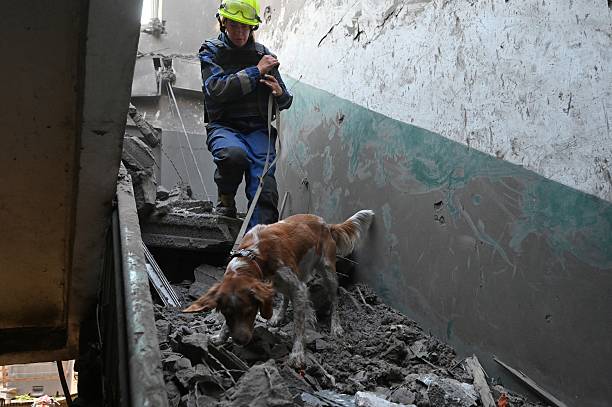
A Ukrainian rescuer works with a disaster-trained search dog among the rubble of a destroyed building following an airstrike in Kharkiv. The attack killed one person and wounded nine others, local authorities said. (Sergey Bobok / AFP via Getty Images)
UKRAINE STRIKES TYUMEN REFINERY, 2,000 KM INSIDE RUSSIA
Ukrainian forces struck the Tyumen Oil Refinery, also known as the Antipinsky Oil Refinery, in Tyumen City in Siberia on June 20 — more than 2,000 kilometers from Ukraine’s international border. Defense Minister Advisor Serhii Sternenko confirmed the strike, reporting that local residents heard at least two explosions after a drone alert was declared in the city and plant staff were urgently evacuating pressure from the facility. Russian opposition outlet Astra reported that at least ten fire trucks arrived at the refinery. Tyumen Oblast Governor Alexander Moor claimed Russian air defenses repelled the attack and no damage occurred; geolocated footage published on June 20 showed a smoke column rising from the site.
The Tyumen refinery is one of Russia’s largest independent oil refineries, with an annual processing capacity of seven to nine million tons of crude oil per year. President Zelensky praised the operation in his evening address: “Our long-range sanctions have reached the Tyumen region in Russia — which is also an oil-refining hub — more than 2,000 kilometers from our national border. Effective.” The strike extends Ukraine’s deep campaign well beyond its previous range, deepening pressure on Russian energy infrastructure that already accounts for a quarter to a third of the federal budget. On the same day, the Ukrainian General Staff published satellite imagery confirming that the June 18 strike on the Moscow Oil Refinery destroyed one RVS-10,000 tank and one RVS-30,000 tank in addition to the primary processing unit already confirmed.
CRIMEA UNDER SUSTAINED DRONE ASSAULT: GAS STATIONS, POWER PLANT, BRIDGES, LOGISTICS
Ukrainian Unmanned Systems Forces Commander Major Robert “Magyar” Brovdi reported on June 20 that Ukrainian forces struck four gas compression stations in occupied Crimea — near Zhuravlivka (approximately 120 km from the frontline), Aromatne (approximately 220 km), Klyichi (approximately 212 km), and Lokhivka (approximately 212 km). Geolocated footage showed a fire at a fuel and gas storage facility belonging to the “TES” gas station company northwest of occupied Bakhchysarai; a local Crimea-based channel reported at least 13 explosions within one hour, noting that TES operates the largest gas station network in occupied Crimea. NASA satellite data confirmed heat anomalies at the Tavriyska Thermal Power Plant east of occupied Simferopol, with local sources reporting a fire and series of explosions there; residents reported additional blasts in Simferopol, Perevalne, Sevastopol, and Krasnoperekopsk.
Ukrainian forces simultaneously struck transport infrastructure: Brovdi reported a strike on a road bridge over the Henichesk Strait (approximately 120 km from the frontline), used by Russian forces to transport military supplies between Crimea and occupied Kherson Oblast. A Ukrainian OSINT project analyzing June 19 satellite imagery confirmed that previous Ukrainian strikes have damaged the Henichesk bridge to a single operational lane prohibiting truck movement, while the nearby Chonhar bridge also retains only one lane for light vehicles with military equipment diverted to pontoon crossings. The same analysis found that Ukrainian strikes critically damaged a road bridge over the North Crimean Canal near Armyansk, forcing Russian authorities to build a new crossing over the drained canal. Ukrainian forces also struck a roadstead tug near Skadovsk, fuel tankers near Chaplynka and Prymorsk, and logistics transport near Armyansk. Russian passenger train operator Grand Service Express announced on June 19 that all trains traveling to and from Crimea would terminate at Kerch due to the temporary closure of an unspecified section of the Crimean railway, consistent with the effects of ongoing Ukrainian strikes on rail infrastructure.
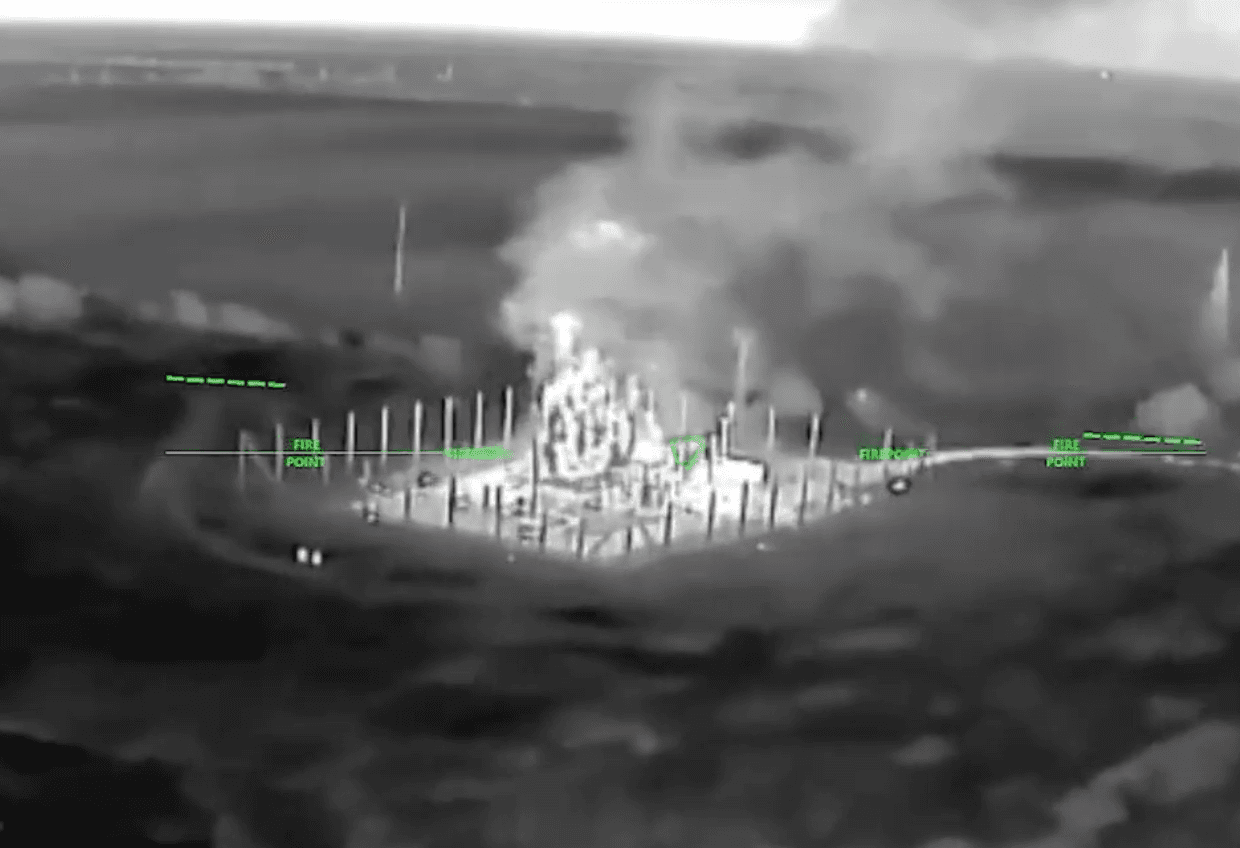
Ukrainian drone targets gas infrastructure in Russia-occupied Crimea. (Robert Brovdi / Telegram)
UKRAINE CHOKES OFF RUSSIA’S SOUTHERN SUPPLY LINES: BRIDGES, LOGISTICS, DRONE ADAPTATION
The bridge and logistics interdiction campaign was the lead story along the entire southern axis on June 20. A Ukrainian artillery battery commander reported that Russian forces are facing increasingly severe logistics difficulties across the entire east bank of occupied Kherson Oblast as Ukrainian forces systematically strike supply routes, hindering Russian ability to accumulate personnel, ammunition, and supplies along the frontline. Russian mobile fire teams are now routinely escorting fuel tankers driving toward Crimea, as confirmed by footage published June 20. Ukraine also struck a Pantsir-S air defense system near Dolynske in Zaporizhzhia Oblast (approximately 70 km from the frontline), a fuel storage site and gas stations west of Berdyansk (approximately 100 km from the frontline), and fuel trucks throughout occupied Donetsk Oblast including on the H-20 Mariupol-Donetsk City highway. Ukrainian Mayoral Advisor Petro Andryushchenko reported that Russian occupation authorities closed the motor and rail crossing at the Uspenka checkpoint between Rostov Oblast and occupied Donetsk Oblast — indicating Ukrainian drones may be interdicting logistics directly on the Russian border.
A Ukrainian commander of an anti-drone battalion disclosed how Russia has been forced to adapt its drone operations since SpaceX terminated Starlink access for Russian users on February 1, 2026. Russian forces had been using Starlink-equipped BM-35 and BM-39 Italmas drones to strike moving targets at operational depth; after losing Starlink, they reduced use of these drones at longer range. As of June 2026, Russian forces are resuming BM-35 use at shorter distances, switching to cheaper fixed-wing reconnaissance drones like the Knyaz Veshchy Oleg, flying surveillance drones at higher altitudes and in silent mode, and using interceptor drones to escort strike drones. Russian forces also redeployed the Svarog Counter-Drone Detachment of the 50th Separate Varyag USF Brigade — 23 teams with counter-drone, radar, and interception capabilities — from frontline support to rear area protection in the Kupyansk-Lyman corridor, and have begun assembling an additional counter-drone detachment drawn from four separate armies, requiring personnel to be pulled from existing units.
FRONTLINE: RUSSIAN MARGINAL ADVANCE NORTH OF POKROVSK; KOSTYANTYNIVKA MAP UPDATED; KUPYANSK INFILTRATION
Geolocated footage published June 20 confirmed a marginal Russian advance west of Rodynske north of Pokrovsk, the day’s only confirmed territorial change. Russian forces also infiltrated into central Radkivka north of Kupyansk and continued infiltration missions in central Lyman and deeper into Kostyantynivka, with ISW updating its control-of-terrain assessment to expand Russian infiltration areas in Kostyantynivka’s northern, northwestern, and western sections. ISW noted the absence of observed evidence of Ukrainian forces maintaining organized defense in the southernmost and easternmost sections of the city, indicating Russian forces have likely consolidated at least some positions there, though Russian infiltration areas remain interspersed with Ukrainian positions. The Ukrainian General Staff struck a Russian drone control point near Soledar northeast of Kostyantynivka on June 19; the Russian MoD struck a purported Ukrainian drone control point in Mykolaipillya west of Kostyantynivka with three FAB-1500 glide bombs.
Russian forces intensified glide bomb use in the Kupyansk direction, striking a purported Ukrainian drone control point in Monachynivka with three FAB-500 bombs and a bridge on the H-20 Kupyansk-Chuhuiv highway west of Hrushivka with four FAB-500 bombs — targeting Ukraine’s ability to defend against Russian ground operations near Kupyansk. A Ukrainian brigade reported that Russian forces are intensifying assaults in the Lyman direction, exploiting thick summer foliage to conceal personnel concentrations from Ukrainian drone surveillance. Recently geolocated footage confirmed Ukrainian forces still operating in eastern Zakitne despite ongoing Russian infiltration; the Shyrova Mountain terrain in the area is complicating Russia’s ability to consolidate. Ukrainian forces struck a Russian pontoon bridge over the Bakhmutka River north of Dronivka in the Lyman direction using a Ukrainian-developed Blyskavka loitering munition. In Belgorod Oblast, Ukrainian forces struck Russian drone control points near Terebreno and a Grad MLRS west of Gogolevka. Luhansk People’s Republic head Pasechnik reported that Ukrainian drones dropped explosives on the M-03 Kyiv-Dvorizhanske highway in occupied Luhansk Oblast, prompting occupation authorities to restrict traffic toward the Dvorizhanke border checkpoint. In Zaporizhzhia City, authorities began installing anti-drone nets along bridges following reports of Russian strikes targeting bridge infrastructure in an effort to cut Ukrainian logistics to the Orikhiv direction and southern Donetsk Oblast.
ZAPORIZHZHIA NUCLEAR PLANT LOSES POWER FOR THE TWENTIETH TIME
The Zaporizhzhia Nuclear Power Plant lost offsite power for the twentieth time in its history — and since the start of Russia’s full-scale invasion — on June 20 when the plant’s only functional powerline, the 330kV Ferosplavna-1 line, failed due to an unspecified fault. The International Atomic Energy Agency reported that repair work on the previously disconnected 750kV Dniprovska line continues under a localized ceasefire arrangement. The IAEA noted that the physical condition of the ZNPP has deteriorated significantly under Russian occupation, which has militarized the plant, threatened and imprisoned its personnel, and pursued conditions to transfer the facility to the Russian power grid.
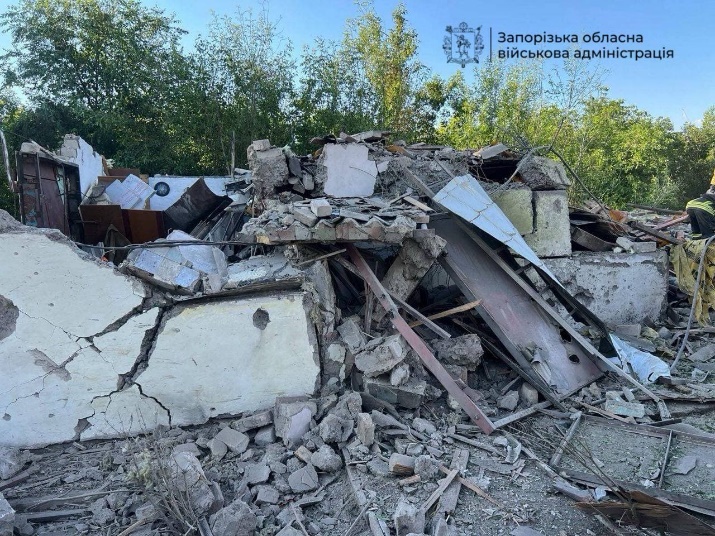
A home lies in ruins after a Russian attack on Zaporizhzhia, Ukraine. (Ivan Fedorov / Telegram)
ZAPORIZHZHIA CITY STRUCK BY NINE GLIDE BOMBS: FIVE KILLED, AT LEAST 19 INJURED
Russian aircraft dropped nine guided aerial bombs on Zaporizhzhia City on June 20, killing at least five people and injuring at least 12 in the initial strike alone, with regional authorities reporting a total of 19 injured across the wider oblast throughout the day. Oblast Governor Ivan Fedorov reported that one woman was pulled from beneath the rubble of a destroyed home; 19 multi-story buildings were damaged, along with residential buildings, civilian infrastructure, and an equestrian sports club. City Council Secretary Regina Kharchenko separately confirmed the damage to 19 high-rise structures. Thick plumes of smoke rose over the city in footage published by regional authorities. Russian forces conducted a total of 24 airstrikes, 642 drone strikes, five multiple-launch rocket system attacks, and 216 artillery strikes against 53 settlements across Zaporizhzhia Oblast throughout the day.
Zelensky offered condolences to the victims’ families in his evening address and renewed his warning to Ukrainians to take shelter: “Tonight and in the coming hours, we must pay particularly close attention to air raid alerts. The Russians have prepared for a new massive strike. Please, stay safe.” He also reiterated his warning to Belarus in the address, specifying that the equipment Russia uses to guide drone strikes against Zhytomyr, Rivne, and Volyn oblasts is installed on communications towers along the Belarusian border.
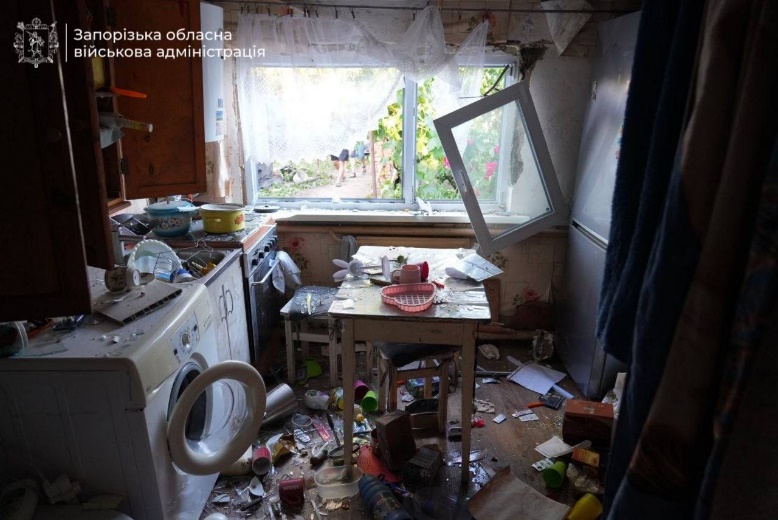
The interior of a home damaged by a Russian attack in Zaporizhzhia. (Ivan Fedorov / Telegram)
OVERNIGHT DRONE ATTACK: 99 LAUNCHED, 92 DOWNED; CASUALTIES IN KHARKIV AND SUMY
Russian forces launched 99 Shahed, Gerbera, and Italmas-type drones and Parodiya decoys overnight on June 19 to 20 from Bryansk, Oryol, and Primorsko-Akhtarsk. Ukrainian air defenses downed 92; seven drones struck three locations, with debris falling at three more. Russian attacks struck residential, commercial, industrial, and civilian infrastructure in Donetsk, Kharkiv, Kirovohrad, Mykolaiv, Kyiv, Odesa, and Zaporizhzhia oblasts. A drone struck a post office in Zaporizhzhia City on June 19, wounding 15 people. A drone struck an enterprise in Trostianets, Sumy Oblast overnight, injuring a 40-year-old man who was hospitalized and causing an acute stress reaction in a 42-year-old woman.
In Kharkiv, Russian guided aerial bombs and drones struck apartment buildings in the Kholodnohirskyi district overnight, killing two people and injuring 10, including a child and a teenager. Four people were reportedly trapped under rubble; search and rescue operations were underway. Russian forces also struck 13 additional settlements across Kharkiv Oblast, injuring three more civilians including two children. In Sumy Oblast, 13 people were injured as Russian forces struck the region with glide bombs and drones. In Kherson Oblast, a woman died in hospital on June 20, a day after being severely wounded by a Russian drone on June 19. Over the past week, Zelensky reported that Russian forces deployed approximately 2,200 attack drones, more than 1,800 guided aerial bombs, and 87 missiles against Ukraine.
ZELENSKY RETURNS POLISH MEDAL BY POST; NAWROCKI DEFENDS REVOCATION
Zelensky returned his Polish Order of the White Eagle to Warsaw on June 20 via Nova Post, Ukraine’s leading postal service, which operates branches across Poland. He thanked the Polish people for their support and solidarity, adding that Ukraine remains open to communication with Poland to prevent “misinterpretations of the complex and painful pages of our peoples’ past.” The return came after Polish President Karol Nawrocki revoked Zelensky’s 2023 award on June 19 amid public outcry over Zelensky’s decision to name a serving Ukrainian military unit after the Ukrainian Insurgent Army (UPA) — a World War II-era nationalist formation that is remembered in Poland for the massacre of Polish civilians in the Volyn region. In his response on June 20, Zelensky noted that the Order of the White Eagle remains with historical recipients including Catherine II, Benito Mussolini, and Gerhard Schröder, who have not been stripped of the honor.

The Order of the White Eagle in a box at Ukrainian Postal Service Nova Post. (President Volodymyr Zelensky / Telegram)
Nawrocki defended the revocation on June 20, telling Polish broadcaster TVN24: “We are a proud Polish nation, and we have a threshold of tolerance regarding matters that affect us and our allies. That threshold has been crossed.” Several Ukrainian officials, including Kyrylo Budanov, the head of the Presidential Office, renounced their own Polish awards in protest. The tensions come one week before the Ukraine Recovery Conference in Gdansk, which Zelensky is due to attend; concerns had been raised in Kyiv about whether Zelensky would participate given the dispute.
HUNGARY LIFTS BAN ON UKRAINIAN MEDIA IMPOSED BY ORBAN
Hungary’s new government under Prime Minister Peter Magyar officially overturned a nine-month ban on 12 Ukrainian media outlets, including Ukrainska Pravda, European Pravda, New Voice, Hromadske, and TSN, which former Prime Minister Viktor Orban’s administration had blocked in September 2025 in retaliation for Ukraine restricting access to Hungarian outlets that promoted Russian narratives. Hungarian Social Relations and Culture Minister Zoltan Tarr announced the reversal on June 19, calling the original ban an attempt to deepen divisions between Kyiv and Budapest and saying the new government is focused on “good-neighborly relations.” Ukraine has not yet announced whether it will lift its reciprocal ban on Hungarian media outlets Origo and Demokrata.
FORMER CULTURE MINISTER CHARGED OVER FAKE MUSICIAN MOBILIZATION FRAUD
Ukraine’s National Police announced on June 20 that former Culture Minister Rostislav Karandeev has been served notice of suspicion in a scheme that allowed fighting-age men to fraudulently leave the country during martial law by posing as musicians on fake charity concert tours. Karandeev, who led the Culture Ministry from 2023 to 2024, signed documents submitted to the State Border Guard permitting the men to cross the border; a place in a fictitious band cost up to $13,000 paid in cryptocurrency, with 28 men already having used the scheme and 16 more planning to do so. Four other members of the scheme who recruited clients and coordinated logistics were also served notices of suspicion. Karandeev denied wrongdoing, saying in comments to Interfax on June 20 that he had acted lawfully and that the ministry struggled to identify fraudulent travel requests from legitimate ones among a high volume of applications. The National Police had announced the investigation in April, noting they were examining former Culture Ministry employees. Under martial law, Ukrainian men aged 23 to 60 are prohibited from leaving the country.
RUSSIA’S HIDDEN ECONOMIC STRAIN: INTELLIGENCE REPORT ON WAGES, LABOR, AND INEQUALITY
Ukraine’s Foreign Intelligence Service published a report on June 20 documenting structural distortions in Russia’s wartime economy that official statistics obscure. Russia’s state statistics service Rosstat reported an average nominal wage of $1,460 in the first quarter of 2026; Sberbank’s transactional monitoring data puts the actual median wage at $900 — a $560 gap the intelligence attributed to extreme income concentration in defense, finance, and raw materials sectors that statistically inflate the average while wages stagnate across the broader economy. Sectors employing the majority of the workforce saw wage increases of only six percent, with apparel manufacturing averaging $791, healthcare $764, and education $737.
The war economy’s labor drain is now visibly affecting civilian industry. Russia’s largest clothing manufacturer Gloria Jeans announced the complete liquidation of its domestic production facilities in early June, transitioning to a pure retail model importing foreign apparel, citing an inability to recruit seamstresses and assemblers as the defense complex outbids civilian employers with state-funded salaries. During the first quarter of 2026, the number of open vacancies in Russia fell by 20 to 25 percent while the number of resumes increased by 34 percent; businesses have largely ceased hiring and are raising salaries faster than productivity, reducing profitability and deterring investment in modernization. Meanwhile, Putin’s approval rating fell to 65.6 percent in April 2026 — its lowest level since before the full-scale invasion — a drop of 4.5 percentage points since late March and more than 12 points below the end of 2025, coinciding with Russia’s first economic contraction since 2023.
5.7 MILLION UKRAINIAN REFUGEES; EU DEBATES TEMPORARY PROTECTION EXTENSION TO 2028
Ukraine’s parliamentary commissioner for human rights Dmytro Lubinets reported on World Refugee Day that more than 5.7 million Ukrainian citizens have fled abroad due to Russia’s full-scale invasion, with the total number of displaced Ukrainians since 2014 reaching 8.5 million. Lubinets outlined two conditions for eventual mass repatriation: safety from aerial and ground threats, and restored functional infrastructure. He also raised concerns about the forced removal of Ukrainian children by municipal authorities in European host countries, citing a recent Italian case and reminding partners that international humanitarian law prohibits adopting children from countries at war.
EU member states are debating extending the temporary protection mechanism for Ukrainian refugees to March 2028; Germany, Poland, and Sweden favor tighter restrictions on military-age men aged 23 to 60, Austria has proposed ending automatic protection for this group as early as March 2027, while Estonia and Luxembourg oppose major revisions. Ukraine’s government has separately asked the EU to consider restricting protection for military-age men, consistent with Kyiv’s mobilization priorities. The European Commission is expected to publish a formal legislative proposal on the extension shortly.
WHO REPORT: OVER 3,000 ATTACKS ON UKRAINE’S HEALTHCARE SYSTEM SINCE 2022
World Health Organization representative Jarno Habicht, marking his eight years heading the WHO Ukraine office, published a detailed account of the war’s impact on Ukraine’s healthcare system. WHO has documented more than 3,000 attacks on healthcare facilities and services since February 24, 2022 — averaging two attacks per day — killing 240 people and injuring more than 1,000 healthcare workers and patients. Every third attack targets primary healthcare services; every fifth targets medical transport including ambulances. WHO has distributed ambulances, trained emergency medical teams, facilitated more than 20,000 medical visits to frontline communities within six to 50 kilometers of active combat zones in 2025 and more than 6,400 already in 2026, and built 46 modular primary healthcare units since 2023.
Habicht reported that 68 percent of Ukrainian adults say their health has deteriorated compared to the pre-war period, more than 70 percent report anxiety, stress, or other mental health symptoms, and 36 percent are delaying seeking healthcare — rising to 43 percent in Kherson. He noted a measurable increase in strokes and heart attacks among younger people, and warned about the post-war burden: veterans requiring long-term rehabilitation, the 36 percent of the population who have postponed care, and the question of whether Ukraine’s healthcare system will be modern enough to attract back the millions of Ukrainians currently living abroad.
EU DISBURSES €34 MILLION TO ARMENIA AS RUSSIA TIGHTENS ECONOMIC PRESSURE
The European Commission disbursed €34 million ($39 million) to Armenia on June 20 to offset the impact of Russia’s trade restrictions on the country’s private sector, following Commission President von der Leyen’s pledge of rapid assistance to Prime Minister Pashinyan. The disbursement is part of a wider package combining direct financial aid with trade facilitation and solidarity measures. Russia has imposed restrictions on Armenian fruit, vegetables, alcohol, mineral water, flowers, and fish imports following Pashinyan’s reelection and Armenia’s continued pivot toward the EU.
By the close of June 20, Ukraine’s drones had reached Siberia, five more civilians were dead in Zaporizhzhia, and Zelensky had sent his Polish medal back through the postal service. The Zaporizhzhia nuclear plant had lost power for the twentieth time. A former culture minister was under suspicion for selling draft dodgers a fake band. And Zelensky warned that another massive Russian strike was being prepared. “Perhaps Putin is becoming weaker,” Zelensky had said the day before. “That is why he may intensify strikes against us.” If that logic holds, June 21 will be worth watching.
A PRAYER FOR UKRAINE
1. For the Five Killed in Zaporizhzhia
Lord, nine guided bombs fell on Zaporizhzhia City on June 20 and five people did not survive them. One woman was pulled from beneath the rubble of her home. Nineteen apartment buildings were damaged in a city of 710,000 people that sits 40 kilometers from the front line and has been struck so many times that its governor now warns of ballistic missiles while sharing photos of the latest fires. We pray for the families of the five who died, for the city that keeps absorbing these blows, and for every rescue worker who goes into the rubble not knowing what they will find. Lord, let this city sleep without sirens, even once.
2. For the Twenty-Eighth Musician Who Paid $13,000 to Escape
Father, a former minister signed documents. Twenty-eight men paid — in cryptocurrency, in desperation, in whatever calculation they made about their own lives weighed against a war without a defined end. We do not know their names or their stories. We only know that the men holding the line in Kostyantynivka, in Kherson, in the Pokrovsk direction, did not pay. We ask for wisdom for a country trying to sustain a war that has cost it so much for so long, and for justice that is neither blind to the real pressures people face nor indifferent to those who shoulder what others buy their way out of.
3. For the Zaporizhzhia Nuclear Plant
God of order, the Zaporizhzhia Nuclear Power Plant lost offsite power for the twentieth time on June 20. Twenty times. The IAEA continues its gentle language of concern. The plant’s physical condition deteriorates under occupation. We pray for the engineers and technicians still working there, for the communities downstream that live with what a catastrophic failure would mean, and for the international community to find the clarity and courage to demand something more than monitoring reports.
4. For Ukraine’s Physicians and Nurses
Lord of healing, more than 3,000 attacks on healthcare facilities since 2022. Two per day, every day, for four years. Two hundred forty people killed. More than one in three Ukrainians delaying care they need. A healthcare system that is somehow still functioning, held together by what the WHO representative called the courage of healthcare workers and the knowledge Ukrainians have developed under fire. We pray for every doctor in a frontline clinic, every paramedic whose ambulance has been targeted, every nurse working a night shift in a building with no certainty it will still be standing by morning. They deserve protection. They deserve rest. They deserve a country at peace.
5. For Poland and Ukraine, Whose History Is Not Simple
God of truth and reconciliation, a medal went back in the mail on June 20 and a history that has not finished becoming the past was briefly at the center of this war’s diplomatic stage. Ukraine and Poland have a genuine and unresolved grief between them, rooted in things done before either country’s current leaders were born. We do not pray for that grief to be erased or for either side to pretend it away. We pray that it can be spoken about honestly, without letting Russia be the only one who benefits from the speaking. One week before a recovery conference in Gdansk that both countries need, let the right conversations find a way to begin.