
Ukraine Daily Briefing | June 19, 2026 | Day 1,577 of the Full-Scale Invasion
Prepared by Dayana Bozhyk
Ukrainian drones struck Moscow for the third consecutive day on June 19, with the capital’s mayor reporting 37 more intercepted drones even as Russia confirmed the Moscow Oil Refinery had suspended operations indefinitely following the previous night’s record attack. Russian Foreign Minister Lavrov published a 2,000-word essay rejecting the Ukraine-Europe peace proposal and reiterated Russia’s maximalist demands. Zelensky gave Belarus one week to dismantle communications equipment Russia uses to guide drone strikes into Ukraine — or warned Ukraine would do it instead. Eleven civilians were killed and 63 injured across Ukraine, including an eight-year-old girl in Dnipropetrovsk. Russia’s Central Bank cut its key interest rate despite acknowledging that Ukraine’s strikes are driving up inflation, while Rosneft’s CEO publicly denied fuel shortages that 53 Russian regions are actively rationing.
THE DAY’S RECKONING
There is something new in the arithmetic of this war. A Russian foreign minister publishes a 2,000-word essay explaining why peace is impossible on any terms but Russia’s own — and by the time it circulates, Moscow is being struck by drones for the third day in a row. The Central Bank of Russia cuts its key interest rate while simultaneously admitting that Ukrainian strikes on refineries are feeding inflation; its chief implies the math no longer adds up but lowers the rate anyway. And Rosneft’s CEO steps before cameras to assure Russians there are no fuel shortages, in a country where 53 regions are rationing gasoline.
June 19, 2026, was a day of contradictions held together by force of habit. Russia’s official position on peace, on fuel, on its own central bank independence — all of them required publicly saying the opposite of what its own records showed. Ukraine, for its part, was doing something simpler: flying drones into Moscow for the third day in a row, launching Ukraine’s TrophyLab database to share captured Russian weapons data with allies, and giving Alexander Lukashenko seven days to remove the equipment helping Russia kill Ukrainian civilians. Eleven more Ukrainians did not survive the day to see what comes next.
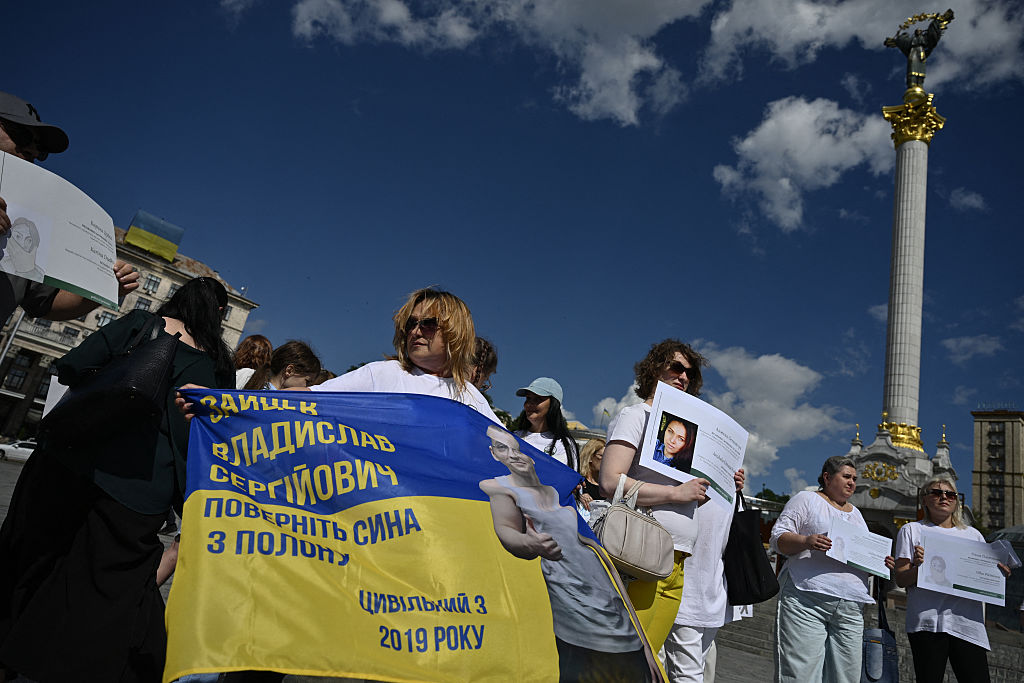
People hold placards as they participate in a meeting marking the International Day for the Elimination of Sexual Violence in Conflict on Independence Square in Kyiv support of Ukrainian civilian women imprisoned by Russian authorities. (Genya Savilov / AFP via Getty Images)
MOSCOW HIT FOR THE THIRD CONSECUTIVE DAY; REFINERY CONFIRMED OFFLINE INDEFINITELY
Ukrainian drones reached Moscow for the third day running on June 19, with Mayor Sergei Sobyanin reporting that Russian air defenses intercepted 37 drones over the capital during a two-hour window between 12:10 p.m. and 2:12 p.m. local time. Footage shared on Russian Telegram channels showed drones in the air above the city; Sobyanin reported no casualties or significant damage from this particular wave, but the mere repetition of attacks on consecutive days represents a new pattern — Russia’s own defense ministry claiming the daily drone count launched against it now reaches the hundreds on a near-daily basis.
The General Staff on June 19 formally confirmed the full extent of damage from the previous night’s record attack: the June 18 strike destroyed the combined oil processing unit, three RVS-10,000 storage tanks, and one RVS-30,000 tank at the Moscow Oil Refinery. The facility — which supplies about 40 percent of Moscow’s fuel market and all four of the capital’s major airports’ aviation fuel — has suspended oil processing operations “for an indefinite period.” Russian opposition outlet Vazhnye Istorii had separately reported that the refinery provides 50 percent of Moscow’s diesel demand. Kremlin spokesman Dmitry Peskov acknowledged the strikes on June 19, claiming Russian air defenses are performing well “despite everything,” while Lavrov and Peskov both indicated that Russia would use the Ukrainian strikes as justification to continue and intensify its own strike packages against Ukraine. Putin, who had attended the Russia-ASEAN summit in Kazan without publicly commenting on the Moscow attacks the previous day, also avoided discussing the strikes in a Security Council meeting on June 19, according to The Moscow Times.
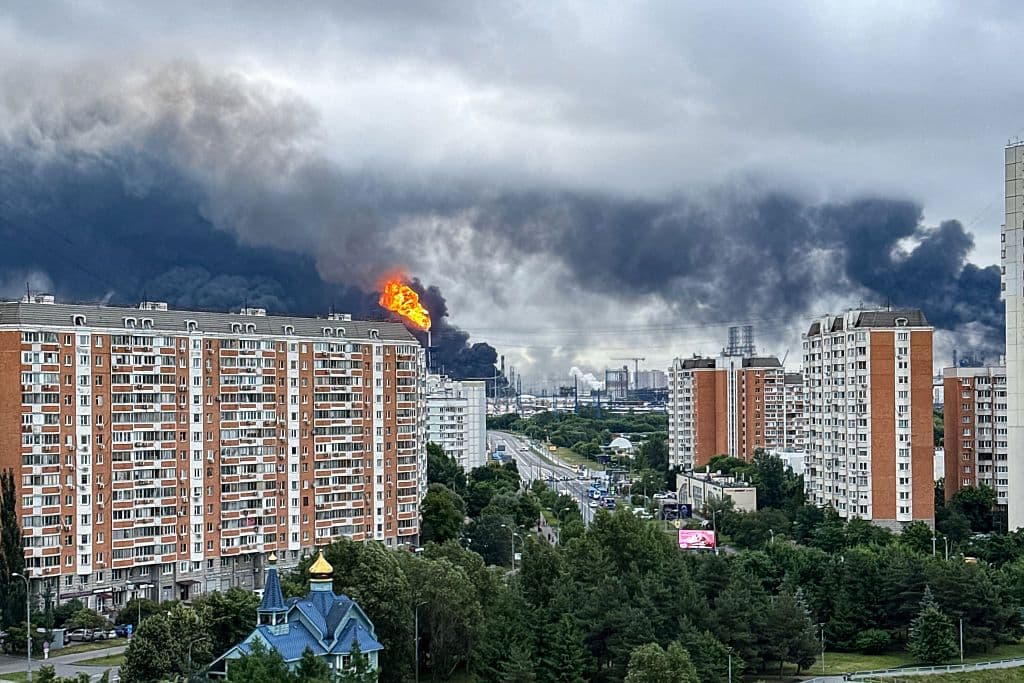
Black smoke rises from the area of the Moscow Oil Refinery on the south-astern outskirts of Moscow. (AFP via Getty Images)
A Ukrainian drone regiment separately struck a Russian fuel-carrying locomotive near Zhudilovo in Bryansk Oblast on June 18, roughly 54 kilometers from the international border, disabling the locomotive and continuing Ukraine’s campaign against Russian logistics. In the overnight period of June 17 to 18 and continuing into June 19, Ukraine’s Unmanned Systems Forces struck the Hlibivske gas condensate field and underground fuel storage facility near Dozorne in occupied Crimea, a locomotive near Rozdolne, and a Repeynik portable radar system near Kamyanske; fires were reported at the Hlibivske site. USF commander Brovdi additionally reported Ukrainian forces struck Russian logistics trucks throughout occupied Zaporizhzhia Oblast and a P-18 radar system near occupied Novovasylivka. The General Staff confirmed strikes on fuel and lubricants warehouses near Novoivanivka and Maliivka in the Oleksandrivka direction, and a fuel depot near Mariupol roughly 115 kilometers from the frontline.
LAVROV PUBLISHES A 2,000-WORD REJECTION OF PEACE — AND CITES A SECRET ALASKA DEAL
Russian Foreign Minister Lavrov published a lengthy essay on June 19 titled “Ukraine, Europe, and Global Security,” formally rejecting the five-point peace framework proposed jointly by Ukraine, France, the UK, and Germany on June 7 — which called for an immediate ceasefire, resumption of negotiations, and freezing of the current frontline as a starting point. Lavrov argued that Europe cannot serve as a “third-party observer” or mediator because of its military support for Ukraine, accusing European leaders of using the premise of negotiations as cover for what he called “geopolitical expansion” and preparation for a future attack against Russia. He declared Russia cannot resume negotiations “through ultimatums.”
Lavrov also reiterated Russia’s maximalist negotiating position: ensuring the security of Russia’s western borders, and European “guarantees” to protect the rights of Russian speakers and the Orthodox faith in Ukraine — demands Ukraine has consistently rejected as conditions for capitulation. In a separate briefing, Lavrov claimed Russia’s negotiating position is anchored to “agreements” allegedly reached at the August 2025 Alaska Summit between Putin and Trump, which he said Russia intends to pursue in upcoming talks with the U.S. delegation. No official documentation of any Alaska Summit agreement has been published by either the U.S. or Russia; Kyiv, which was not party to the talks, has said the summit produced no binding framework. The Kremlin has consistently exploited the absence of a public record from Alaska to imply commitments were made without having to defend them openly.
Peskov separately used his June 19 briefing to claim Russia remains “open to contacts” and “dialogue,” while simultaneously blaming Europe for breaking off engagement and dismissing EU calls for negotiations “from a position of strength” as reflecting European “incompetence, misinformation, or stupidity.” The joint effect of Lavrov’s essay and Peskov’s briefing: Russia is publicly prepared to talk, provided any talks begin from acceptance of Russian demands, exclude European partners, and treat the alleged Alaska agreements as the baseline. Macron’s France TV interview, published on June 19, provided the counterpoint: the French president said Trump had entered office in early 2025 convinced Ukraine would lose, and that European leaders had to travel to Washington to argue against proposals at the Alaska summit that would have required Ukraine to cede territory it had not yet lost.
ZELENSKY GIVES BELARUS ONE WEEK: REMOVE THE STRIKE EQUIPMENT OR UKRAINE WILL
Zelensky issued Ukraine’s most direct public ultimatum to Belarus since the full-scale invasion began, setting a deadline of June 26 for Lukashenko to dismantle communications relay equipment on Belarusian territory that Russia uses to extend the range and accuracy of drone strikes against Ukraine. Speaking at a joint press conference in Kyiv with Honduran President Nasry Asfura, Zelensky described the equipment as relay systems mounted on communications towers in two Belarusian border regions, which allow Russian operators to fly guided drones at extended range and with greater precision against Ukrainian civilian areas rather than active frontline positions.
“There are relay systems on those towers,” Zelensky said. “He can remove them. If he truly does not want to be part of the war, let him remove that equipment and switch it off.” He directly challenged Lukashenko’s repeated claim that Belarus poses no military threat to Ukraine: “When Lukashenko says he does not want to be involved in the war, he should be honest, at least with his own people. It is not only he who could be drawn into the war — his entire country could be dragged into it by Russia.” Zelensky said Russia has used Belarusian territory “from the earliest days” of the invasion and accused Belarus of being “one of the main suppliers to the Russian army” through fuel exports. “If he does not switch it off, we will,” Zelensky said. Belarusian CIS representative Igor Nazaruk said on June 19 that Belarus reserves the right to take action “with regard to Ukraine” to protect the security of Belarusian citizens — framing in line with the ongoing Kremlin effort to use the fabricated Bryansk bus incident to justify future military responses. Russia and Belarus separately signed memoranda on biotechnology cooperation at the Union State Biotechnological Forum in Minsk on June 18.
RUSSIA’S CENTRAL BANK CUTS RATES WHILE ADMITTING UKRAINE’S STRIKES DRIVE INFLATION
The Russian Central Bank lowered its key interest rate on June 19 from 14.5 to 14.25 percent, the lowest level since October 2023, in its third rate reduction since March 2026. The cut came even as Central Bank Chairperson Elvira Nabiullina publicly acknowledged that the recent spike in domestic fuel prices — a direct result of Ukraine’s strike campaign against Russian energy infrastructure — has affected June’s inflation rate and may increase inflation expectations. The Bank’s own statement identified pro-inflationary risks as larger than disinflationary ones in the medium term, and specifically cited the decline in motor fuel production as a driver of those risks.
The contradiction between the Bank’s own inflation warnings and its rate cut reflects a pattern ISW has previously assessed: the Kremlin is exerting rising pressure on Nabiullina to lower the key interest rate to maintain the facade of economic stability and to expand capital availability for the war industry, even as expansionary fiscal policies exacerbate inflation. Nabiullina had stated as recently as April that it would be “naive” to think that higher inflation would lead to lower rates; the Bank cut rates anyway. The Financial Times separately reported, citing French open-source analyst Clement Molin, that verified footage confirms Ukraine has conducted no fewer than 375 drone strikes against Russian trucks and vehicles in occupied Ukraine since May 2026, half of them on the M-14 Rostov Oblast-Crimea highway. Crimean residents are spending hours in line at gas stations; nearly a quarter of Russian gas stations, including 85 Tatneft and 2,200 Rosneft locations, have imposed fuel purchase restrictions. Rosneft CEO Igor Sechin, however, claimed publicly on June 19 that Rosneft has not imposed any restrictions and guarantees stable supply — a claim contradicted by the company’s own operational reports and Russia’s Cabinet of Ministers, which announced the same day that Russia “intends” to ensure stable petroleum supply and prevent “localized market imbalances.”
FRONTLINE: UKRAINIAN ADVANCE NEAR HULYAIPOLE; RUSSIAN COGNITIVE WAR EXPANDS TO SLOVYANSK
Geolocated footage published on June 18 confirmed that Ukrainian forces recently advanced northwest of Solodke northeast of Hulyaipole in Zaporizhzhia Oblast, the day’s single confirmed shift in territorial control. A Kremlin-affiliated milblogger separately acknowledged on June 19 that the Russian forward line of own troops is further west and south of Nesteryanka southeast of Zaporizhzhia City than previously assessed — gains by Ukraine that predate the past 24 hours but constitute a public Russian acknowledgment of Ukrainian territorial holdings in the area. Russian forces repelled a Ukrainian counterattack near Mala Tokmachka but did not advance; a Ukrainian brigade spokesperson confirmed Russian forces do not hold positions within Mala Tokmachka and were stopped 300 meters from the settlement.
The Kremlin’s cognitive warfare campaign — which ISW has documented expanding from Kostyantynivka to Slovyansk over the past week — continued on June 19 with Russian forces conducting infiltration missions in central Lyman, Yurkivka southeast of Slovyansk, and several locations in northeastern and eastern Kostyantynivka. The Russian MoD claimed its 88th Separate Motorized Rifle Brigade seized Yurkivka; ISW assessed this as not indicating a change in terrain control, citing limited infiltrator presence and no evidence of consolidation. Ukrainian 11th Army Corps Spokesperson Lieutenant Colonel Dmytro Zaporozhets denied Russian control of Rai-Oleksandrivka and confirmed Ukrainian forces hold most of the settlement, with only a contested gray zone remaining. Zaporozhets also disclosed the strategic logic behind the Slovyansk axis: Russian forces are attempting a motorized pincer movement to envelop Ukrainian positions on their flanks, using motorcycles, ATVs, and light vehicles rather than armor, while intensifying guided glide bomb strikes against Slovyansk, Mykolaivka, and Oleksandrivka.
Drone interdiction of Russian logistics continued to reshape operations behind the front. The commander of the Russian 20th Combined Arms Army rerouted ground supply lines in the Lyman direction after Ukrainian drone strikes forced logistics routes to extend roughly 140 kilometers from the frontline, requiring three-person armored crews per truck rather than a single driver. A Ukrainian corps operating in Luhansk Oblast reported that Ukrainian drone operators have held full control of the low-altitude airspace over occupied Luhansk Oblast since May 31; USF commander Brovdi confirmed recent strikes on a fuel and lubricants tank near Bryanka, MT-LB armored vehicles near Tarasivka and Smolyanynove, and fuel trucks throughout the oblast. Ukrainian forces counterattacked near Ridkodub, Nove, and Novyi Myr in the Borova direction and northwest of Pokrovsk; Russian forces continued operations in Kupyansk, Borova, Kostyantynivka-Druzhkivka, Dobropillya, Pokrovsk, Novopavlivka, and Oleksandrivka without confirmed advances. In the Kramatorsk direction, a Ukrainian officer reported Russian forces increasing artillery and drone strikes while concealing manpower with thermal cloaks, making thermal imaging drones ineffective; Zaporozhets described Kramatorsk as relatively quiet as Russia prepares logistics.
OVERNIGHT STRIKES: 11 KILLED, 63 INJURED; AN 8-YEAR-OLD GIRL IN DNIPROPETROVSK
Russian forces launched 90 Shahed, Gerbera, Italmas, and Banderol-type drones and Parodiya decoys overnight on June 18 to 19 from Bryansk, Oryol, Primorsko-Akhtarsk, and occupied Hvardiiske. Ukrainian air defenses downed 79; nine drones struck eight locations, with debris falling at eight more. The Ukrainian Energy Ministry reported power outages in Dnipropetrovsk, Zaporizhzhia, Mykolaiv, Sumy, Kharkiv, and Kherson oblasts; DTEK reported Russian forces have been striking power generation facilities in Dnipropetrovsk Oblast for two consecutive days. A Ukrainian defense technology advisor reported that Russian forces are deploying a new Molniya-2 variant called the “Lightning-13” with four engines and a 13-kilogram warhead, making the weapon more destructive per strike. A Russian milblogger claimed Russia is systematically targeting the 100 kV distribution network in Sumy Oblast.
Eleven civilians were killed and 63 injured nationwide over the 24-hour period. In Dnipropetrovsk Oblast, three people were killed — including an eight-year-old girl in Pavlohrad — and 18 others injured as Russian forces struck three districts with artillery, missiles, and drones. In Sumy Oblast, a 78-year-old woman and a 63-year-old man were killed and four others injured across roughly 40 attacks on 23 settlements using mortars, artillery, MLRS, FPV drones, guided bombs, and other weapons. In Donetsk Oblast, two people were killed — in Mykolaivka and Kramatorsk — and four injured, with settlements struck 33 times over the day. In Kharkiv Oblast, one person was killed and 15 injured, including four children, with Russian attacks hitting Kharkiv and 24 other settlements; the Kholodnohirskyi district was struck again by guided aerial bombs, injuring at least five people and potentially trapping four under rubble of a two-story apartment building. In Kherson Oblast, one person was killed and nine others injured in drone strikes on Kherson’s Korabelnyi district, including attacks targeting a bus and pedestrians. In Zaporizhzhia Oblast, four were injured as Russian forces launched around 950 strikes against 53 settlements. Russian forces are using near-2,000-drone mass strike tactics against Kherson City, with a Ukrainian brigade spokesperson reporting that number of drone strikes on the city from June 8 to 14 alone; Russian forces are increasingly using FPV drones to hunt civilian cars, ambulances, and buildings in the Kherson direction.
RUSSIA STRIKES FOREIGN CIVILIAN VESSELS IN THE BLACK SEA, KILLING ONE SAILOR
Russian drones struck two foreign-flagged civilian vessels in the Black Sea on the evening of June 18, killing one crew member and injuring five others. A Panama-flagged vessel was struck with one crew member killed and two injured, one of whom remains in critical condition; a second vessel sailing under the flag of Saint Kitts and Nevis was also hit, with three crew members sustaining minor injuries. Deputy Prime Minister for Reconstruction Oleksiy Kuleba condemned the strikes as an attack on “freedom of navigation, international trade, and global food security.” A separate Russian drone strike on a truck parking area in Odesa Oblast overnight started a fire that engulfed empty fuel and gas tankers, killing one person and injuring four others.
The attacks came on a day when Ukraine’s Navy also clarified that a previous report of a Russian maritime drone attack on Odesa was false — Ukrainian naval personnel had been conducting planned training exercises against potential maritime drone threats, not repelling an actual attack. The clarification came after Ukrainian Telegram channels had circulated reports of an Odesa strike. Russia has a documented recent history of striking civilian shipping: in May, the Vanuatu-flagged cargo ship ANT was struck en route from Odesa to Turkey; on June 6, Russia struck two state-run maritime search and rescue boats on a humanitarian mission.
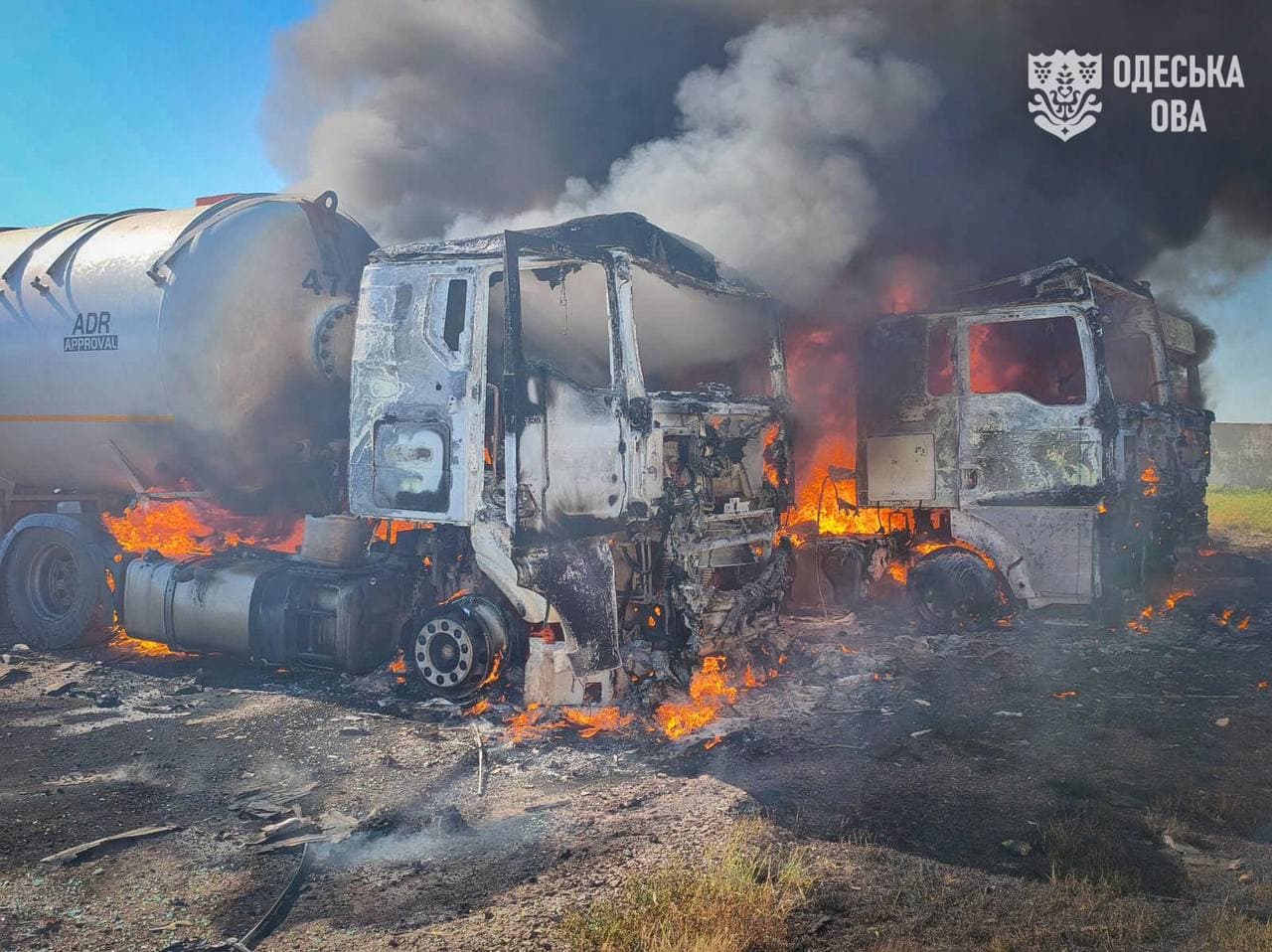
Burned trucks stand at the site of a Russian drone strike in Odesa Oblast. (Odesa Oblast Military Administration/Telegram)
A UKRAINIAN POW ARRESTED FOR TORTURING FELLOW PRISONERS TO DEATH
Ukraine’s Security Service and prosecutors announced on June 19 that they have charged a Ukrainian National Guard senior rifleman — returned in a prisoner swap in March 2025 after being captured in June 2022 — with torturing fellow Ukrainian POWs during his captivity in a Russian-run correctional colony in occupied Horlivka, Donetsk Oblast. According to the SBU, the man was appointed by Russian prison staff as “head of household” of a barrack floor, a role he used to exert psychological pressure, threaten violence, and force other Ukrainian prisoners into heavy physical labor. Prosecutors stated that one captured Ukrainian soldier died as a result of his torture and dozens of others were injured, with evidence recovered from his smartphone corroborating witness accounts. He faces up to eight years in prison if convicted.
TROPHYLAB: UKRAINE OPENS CAPTURED RUSSIAN WEAPONS DATABASE TO ALLIES
Defense Minister Mykhailo Fedorov announced on June 19 the launch of TrophyLab, a secure platform giving allied governments, research laboratories, and defense technology manufacturers access to detailed technical data, analysis reports, and documented vulnerabilities of Russian weapons captured on the battlefield. “Every missile, drone, and vehicle seized on the battlefield is now a source of knowledge for the free world,” Fedorov said, adding that partners can also request physical equipment for testing, substantially accelerating the development cycle for countermeasures against Russian systems. The platform builds on Ukraine’s existing practice of sharing battlefield intelligence on Russian weapons including the Oreshnik missile and various drone types with Western defense firms.
UN SECURITY COUNCIL TO CONVENE ON KYIV-PECHERSK LAVRA; SANCTIONS PIPELINE EXPANDS
Ukraine’s Foreign Minister Andrii Sybiha confirmed on June 19 that the UN Security Council will meet on Monday, June 22, at Ukraine’s request to address Russia’s strikes on cultural and religious sites, including the June 14 to 15 attack on the Kyiv-Pechersk Lavra. “We expect Council members to deliver a clear message,” Sybiha said. “Russia should realize that neither Ukraine nor the international community will compromise on the principles of the UN Charter and international law.” Preserve director Maksym Ostapenko confirmed that fires damaged the Museum of Book Printing, the Museum of Historical Treasures of Ukraine, the Kushchnyk Tower, and the Mystetskyi Arsenal; a separate strike destroyed Ukraine’s largest and oldest costume collection at the Oleksandr Dovzhenko National Film Studio. More than 2,336 cultural valuables have been stolen or destroyed across Ukraine since the full-scale invasion began, including more than 1,233 paintings from the Kherson Art Gallery alone.
On the sanctions front, the EU is preparing a new package targeting four Chinese companies accused of supplying drone components, military chemicals, and assistance to Russia’s shadow fleet, alongside firms in the UAE, Turkey, and Azerbaijan, expected to be considered by EU foreign ministers the following week. Italy’s Defense Minister Guido Crosetto confirmed on June 19 that Italy will not contribute to the PURL initiative, saying “We have said no from the beginning, and it is still a no,” citing the need to prioritize living costs ahead of elections; Italian Prime Minister Giorgia Meloni separately said Italy may also decline the EU’s SAFE loans program. Italy has, however, told NATO it will push defense spending toward five percent of GDP, split between 3.5 percent on weaponry and 1.5 percent on domestic security, with Meloni planning to announce 2.8 percent GDP spending at the NATO Ankara summit in July.
AUSTRALIA JOINS PURL; SABER ACT INTRODUCED IN U.S. SENATE; NATO ANKARA SUMMIT ON HORIZON
Australia committed 100 million AUD ($70 million) over the next 12 months to PURL on June 19, its fourth contribution to the program, bringing Canberra back into active financial engagement after a period in which it had fallen significantly behind other Coalition of the Willing members in total aid. Australian Defense Minister David Marles said: “What happens in Ukraine matters here in the Indo-Pacific, which is why it is so important for Australia to stay the course.” Twenty-five countries, including Australia and New Zealand as non-NATO members, have now joined PURL.
In Washington, a bipartisan group of U.S. senators introduced the Seized Assets for Battlefield Equipment and Readiness (SABER) Act on June 18, which would expand existing authorities under the 2024 REPO Act to allow frozen Russian sovereign assets under U.S. jurisdiction — estimated at $4 to $5 billion — to be used to purchase military equipment for Ukraine. The bill was introduced by Republican senators John Cornyn, Roger Wicker, and Chuck Grassley alongside Democrats Tim Kaine, Chris Coons, and Sheldon Whitehouse, with a companion House bill led by Representative Joe Wilson. NATO leaders are set to meet in Ankara on July 7 to 8; NATO Parliamentary Assembly Secretary General Benedetta Berti told reporters the discussions are “really focused” toward Ankara, with 99 percent of Ukraine’s military assistance coming from NATO allies. Ukraine expects Zelensky to press for progress on the European anti-ballistic missile system and additional Patriot commitments at the summit.
HUNGARIAN PM BLOCKS EU FAST-TRACK LANGUAGE; ZELENSKY APPEALS TO LULA AND BRAZIL
Hungarian Prime Minister Peter Magyar confirmed on June 19 that he had removed language on “accelerating” Ukraine’s EU accession from the European Council summit declaration, after what he described as four hours of intense negotiation, framing the outcome as a compromise that allowed a closing declaration accepted by all 27 member states for the first time in a year and a half. Magyar said he still supports Ukraine’s accession path and wants to meet Zelensky in Berehove in Transcarpathia, though the timing and format remain under discussion. The first accession cluster — covering rule of law and democratic institutions — was formally opened at an intergovernmental conference in Luxembourg on June 15 with unanimous support.
Zelensky separately asked Brazilian President Luiz Inácio Lula da Silva to facilitate direct peace talks, requesting that Lula engage personally with Putin and Xi Jinping to support the peace process; Brazilian officials described the request as reflecting Kyiv’s limited ability to open direct dialogue channels with Moscow. A new survey published on June 19 by the EU Neighbors East program found that 65 percent of Ukrainians support EU accession and 82 percent trust the EU — a record high — while 70 percent identified corruption as the main obstacle to membership. Forty-one percent of Ukrainians expect accession to take five to 15 years, and 19 percent believe it could come within five years.
By the end of June 19, the war’s contradictions had accumulated beyond easy summary. A foreign minister rejected peace in an essay that ran to thousands of words; drones flew over Moscow for a third day; the Central Bank cut rates while admitting that Ukrainian strikes were feeding inflation; and Rosneft’s CEO denied shortages that the Russian Cabinet of Ministers announced it would try to address in the same afternoon. An eight-year-old girl was killed in Dnipropetrovsk. A sailor aboard a civilian cargo vessel died somewhere in the Black Sea. A Ukrainian POW is in custody for torturing his own countrymen. And in a Kyiv press conference, Zelensky told Lukashenko he had one week to choose which side of this war he was truly on.
A PRAYER FOR UKRAINE
1. For the Eight-Year-Old Girl in Pavlohrad
Lord, a child of eight was killed in Pavlohrad on June 19 in a Russian drone strike. Her name has not yet been published as we write this. You know it. She knew her name, and her street, and her family’s faces, and whatever she was looking forward to this summer. We do not have the words for this. We only ask that You receive her, and that those who loved her find something to hold onto that is stronger than the grief that has just broken open their lives. And we ask, in the plainest possible language: let this stop.
2. For the Sailor Who Did Not Come Home from the Black Sea
Father, a crew member aboard a Panama-flagged civilian cargo vessel was killed by a Russian drone in the Black Sea on the evening of June 18. His vessel was a merchant ship, not a warship. He was working, not fighting. His nationality was not disclosed. His family does not yet appear in any news report. We pray for them, wherever they are, learning what happened. We pray for the sailors aboard dozens of civilian vessels still navigating routes that Russia has turned into a combat zone, and we ask that the world not become comfortable with the deaths of people whose only offense was trying to move grain and fuel across a sea.
3. For the POW Who Became a Torturer
God of justice, there is no easy prayer for June 19’s most painful Ukrainian story: a soldier captured by Russia in 2022 who became an instrument of his captors against his own countrymen, who tortured fellow Ukrainians and caused at least one death. We do not pray for his exoneration. We pray for the men who survived what happened in that barrack in Horlivka and now have to live with what was done to them, and what it cost them. We pray for a justice system strong enough to hold this case honestly, and for a country that can face the full truth of what its people have endured and done inside Russia’s prisons, without looking away.
4. For the People of Kherson, Who Are Hunted Every Day
Lord, a Ukrainian brigade reported on June 19 that Russian forces launched nearly 2,000 drones at Kherson City between June 8 and 14 alone — drones hunting civilian cars, ambulances, and pedestrians. This is not a statistic. It is the daily experience of people who cross a street wondering whether this is the moment a drone finds them. We pray for every person in Kherson trying to live an ordinary life inside a city that Russia has turned into a free-fire zone. We pray for the ambulance drivers who go out anyway. We pray for the rescuers who arrive after each strike knowing another may follow. Give them protection, give them courage, and give this city, somehow, a day of silence.
5. For the Truth-Tellers Inside Russia
God of truth, on June 19, Rosneft’s CEO denied shortages that Russian gas stations are rationing, while the Central Bank cut rates even as its own chairwoman said Ukraine’s strikes are feeding inflation. Kremlin state TV did not broadcast footage of the Moscow drone attacks. Russian officials told their people everything is fine. We pray for the journalists, bloggers, and ordinary citizens inside Russia who looked at the smoke above Moscow and wrote what they actually saw, even knowing some of those posts would be deleted and some of those writers could face prosecution. Let truth find ways to persist in a system built to silence it, and let it find ears willing to hear.