
Ukraine Daily Briefing | June 28, 2026 | Day 1,586 of the Full-Scale Invasion
Prepared by Dayana Bozhyk
Putin publicly acknowledged fuel lines and a “certain deficit” at a meeting with Russian energy executives on June 28, the first such admission since Ukraine’s refinery strike campaign began. Ukrainian forces overnight struck the Slavyansk Refinery in Krasnodar Krai and the Yaroslavl Refinery, while confirming damage from a June 26 to 27 strike on a missile components plant in Volgograd. Russia’s Black Spark resistance group claimed it infiltrated the Alabuga Shahed drone factory and sabotaged assembled units. Russia launched two Zircon missiles, six Iskander ballistic missiles, and 142 drones at Ukraine overnight, hitting Kyiv with ballistic weapons, killing two people and wounding 17 in Zaporizhzhia with guided bombs, and injuring 36 across the country. The commander of Ukraine’s 154th Mechanized Brigade was found dead with a gunshot wound. Ukraine ratified a defense cooperation agreement with Kuwait.
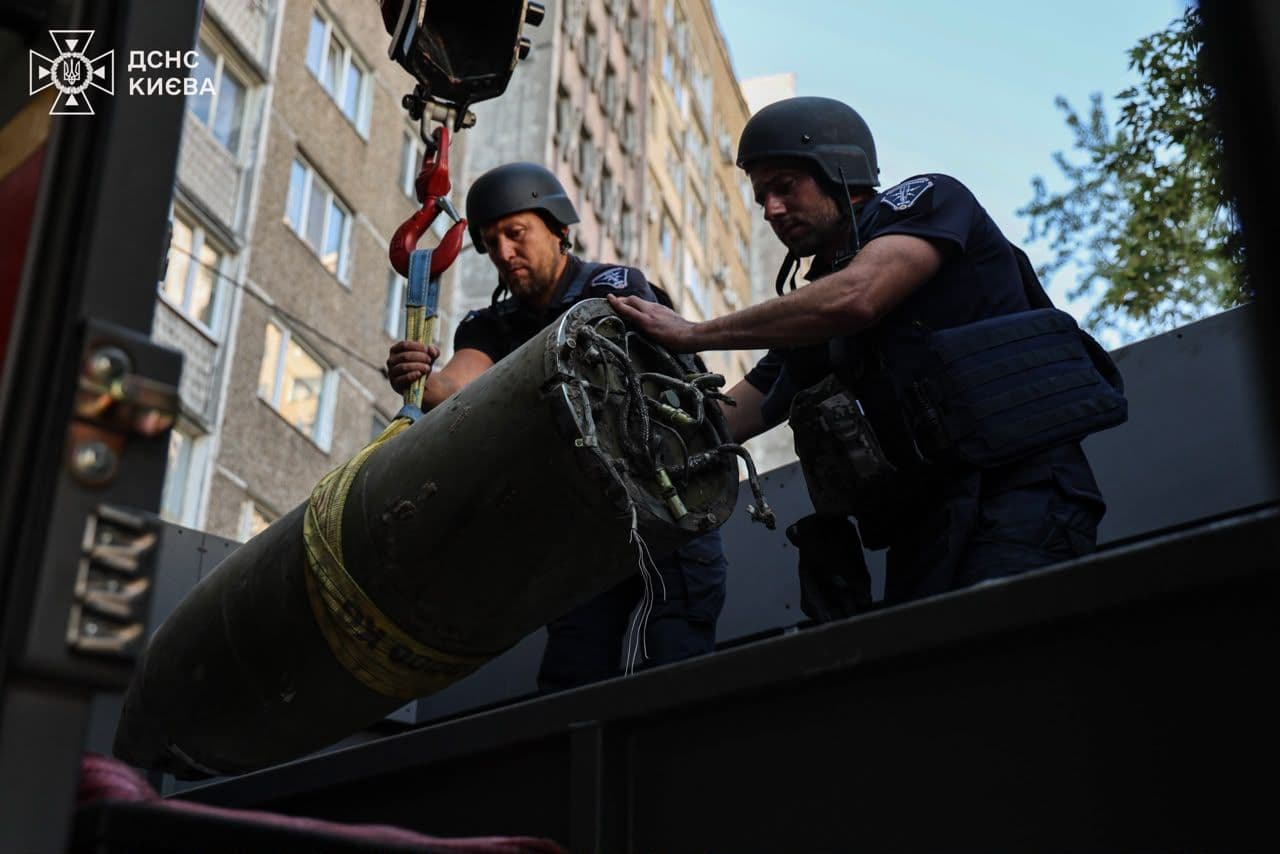
Kyiv emergency services handling fragments of a Russian missile launched at Kyiv, Ukraine, overnight. (State Emergency Service/Telegram)
THE DAY’S RECKONING
Putin had been insisting since March that there were no fuel shortages. On June 28, addressing a meeting with Russian energy executives, he stopped insisting. “Unfortunately, there are still lines at gas stations, and the right grade of gasoline isn’t always available,” he said. “We are now observing a certain deficit, but not critical.” He spoke of tapping fuel reserves, imposing export bans on gasoline and jet fuel, and considering banning diesel exports. He acknowledged that only enough energy remains in Crimea “to last a few more days.” He blamed Ukraine’s strike campaign, described it as an attempt to gain leverage at the negotiating table, and said he would not negotiate as a result.
While Putin admitted the deficit, Ukraine’s 40-day strike campaign struck again overnight: the Slavyansk Refinery in Krasnodar Krai caught fire across 20,000 square meters. The Yaroslavl Refinery, 710 kilometers from the border, was also hit. The Titan-Barrikady missile components plant in Volgograd, struck June 26 to 27, had two of three workshops partially destroyed. Russia’s Black Spark resistance group announced it had infiltrated the Alabuga drone factory in Tatarstan and sabotaged Geran-2 and Geran-3 drones from the inside.
In the night’s other arithmetic: two Zircon missiles, six Iskander ballistic missiles, and 142 drones fired at Ukraine. Kyiv hit by ballistic weapons. Zaporizhzhia struck by guided bombs, killing two and wounding 17 including a five-year-old boy and a 16-year-old girl. A Ukrainian brigade commander found dead with a gunshot wound. And Putin, at a United Russia congress, spoke of “strength and resolve” — and named a commissioner under ICC arrest warrant to lead his party’s Duma election list.
PUTIN ADMITS FUEL LINES, “CERTAIN DEFICIT,” AND CRIMEA RUNNING DRY
Putin publicly acknowledged Russia’s fuel crisis on June 28 at a meeting with Russian energy industry leaders — the first time he has done so explicitly since Ukraine’s deep-strike campaign against Russian refineries began. “Unfortunately, there are still lines at gas stations, and the right grade of gasoline isn’t always available. And, of course, we understand the challenges faced by agricultural producers and farms during the summer,” Putin said. In a separate interview after the meeting, Putin went further: “We are now observing a certain deficit, but not critical, I will say now. There are several issues here that we must address.”
Putin said Russia has tapped its fuel reserves, with amounts already down roughly four percent versus the previous year. He confirmed a complete ban on gasoline and jet fuel exports is in effect and said diesel export restrictions are also under consideration. He added that Russia is working to “minimize the impact” of Ukrainian strikes on energy infrastructure by increasing production and improving the speed of weapons delivery to protect critical facilities. Putin noted that Crimea has only enough energy to last “a few more days” but insisted demand would be met. Russia’s 40-day operational pause in refinery production caused by the June strikes on the Moscow Oil Refinery, NORSI, and now Slavyansk and Yaroslavl represents the most significant disruption to Russian domestic fuel supply since the full-scale invasion began. Putin did not announce any new measures beyond those already disclosed, and did not indicate any willingness to proceed with peace talks despite acknowledging that the strike campaign’s purpose is to strengthen Ukraine’s negotiating position.
OVERNIGHT UKRAINE STRIKES: SLAVYANSK AND YAROSLAVL REFINERIES HIT; VOLGOGRAD PLANT DAMAGE CONFIRMED
Ukrainian forces struck and ignited a fire at the Slavyansk Oil Refinery in Slavyansk-on-Kuban, Krasnodar Krai, overnight on June 27 to 28 — roughly 300 kilometers from the frontline and one of the largest refineries in southern Russia. Ukraine’s Unmanned Systems Forces reported the facility has an annual processing capacity of 5.2 million tons and that the strike started fires near the refinery’s oil tank farm, cargo area, and primary oil processing unit. Geolocated footage and NASA FIRMS satellite data confirmed large-scale heat anomalies at the site. The Slavyansk-on-Kuban emergency dispatch confirmed the fire exceeded 20,000 square meters. Krasnodar Krai’s emergency response headquarters acknowledged drone debris started the fire but attributed it to falling debris from intercepted drones. The SBU linked the strike to Zelensky’s 40-day intermediate- and long-range strike campaign announced June 25.
The General Staff also confirmed a strike on the Yaroslavl Oil Refinery in Yaroslavl City, approximately 710 kilometers from the border and one of Russia’s major refineries with a processing capacity of 15 million tons per year producing automobile gasoline, diesel, and aviation fuel. Geolocated footage showed a smoke plume near Yaroslavl City. Separately, the General Staff confirmed on June 28 that the June 26 to 27 missile strike against the Titan-Barrikady enterprise in Volgograd City caused a fire and partially destroyed two of three struck workshops. Titan-Barrikady manufactures components used in Russian missile systems including the Iskander complex, making it a direct contributor to the ballistic missile strikes on Ukrainian cities.
BLACK SPARK CLAIMS ALABUGA DRONE FACTORY INFILTRATION AND SABOTAGE
Russian resistance group Black Spark stated on June 27 that its members worked inside the Alabuga Special Economic Zone in the Republic of Tatarstan for several months and gathered intelligence on the assembly of Russian Geran-2 and Geran-3 strike drones. The group implied its members installed sabotage components in assembled Geran drones that will cause the drones to malfunction when Russian operators attempt to launch them in the future — without specifying the nature of the sabotage to avoid enabling countermeasures. Black Spark also reported that it separately hacked the Alabuga zone’s website.
Alabuga is one of Russia’s primary sites for assembling Iranian-designed Shahed-type drones, which Russia designates Geran. Production at Alabuga has expanded significantly since the full-scale invasion, with the facility reportedly assembling hundreds of drones per month. If Black Spark’s claims are accurate — ISW was unable to independently verify them — the infiltration would represent a significant intelligence and sabotage operation directly targeting Russia’s drone supply chain from within Russian territory.
OVERNIGHT STRIKE ON UKRAINE: TWO ZIRCON MISSILES, SIX ISKANDERS, 142 DRONES; KYIV AND ZAPORIZHZHIA HIT
Russian forces launched two Zircon/Onyx anti-ship missiles from Kursk Oblast and six Iskander-M/S-400 ballistic missiles from Bryansk Oblast, alongside 142 Shahed-type, Gerbera-type, and Italmas-type strike drones and Parodiya decoys from Kursk, Oryol, Millerovo, Primorsko-Akhtarsk, occupied Donetsk City, and occupied Hvardiiske. Ukrainian air defenses intercepted one of the two Zircon/Onyx missiles, all six Iskander ballistic missiles, and 125 drones. Missiles and 14 drones struck 11 locations; debris fell at 13 more. Russian forces struck gas and civilian infrastructure in Chernihiv and Kharkiv oblasts.
In Kyiv, ballistic missiles targeted the city between 2:00 a.m. and 2:35 a.m. with at least seven explosions across the capital. The primary impact zone was the Darnytskyi district on the left bank, where fires broke out in a residential building courtyard, an auto repair shop, and a non-residential structure. Two people were injured. A pharmaceutical plant belonging to Darnytsia manufacturer was also struck, though no casualties were reported there. In Chernihiv, drone debris struck the grounds of a secondary school, damaging an educational building and shattering windows in an adjacent five-story apartment block, injuring two people. In Dnipropetrovsk Oblast, Russian strikes targeted gas stations in the Dniprovskyi and Samarivskyi districts of Dnipro City, igniting fires and damaging vehicles, injuring two people; Russian forces also bombarded the Nikopol district, striking Nikopol itself and the Chervonohryhorivka, Marhanets, and Pokrovske communities, setting a sports school building on fire.
In Zaporizhzhia, Russian forces separately struck the city with guided aerial bombs on the morning of June 28, striking a residential neighborhood and starting a fire. As of afternoon reporting, two people were killed — including a 53-year-old woman — and 17 injured including a five-year-old boy in serious condition and a 16-year-old girl. Russian forces also struck the village of Shevchenkivske near Zaporizhzhia in a second guided bomb attack, injuring two women aged 94 and 68 and a 68-year-old man. Russian forces also struck gas stations near Zaporizhzhia City. Total casualties nationally from the overnight and daytime strikes reached 36 injured. Zelensky reported that over the preceding week Russia deployed approximately 1,400 attack drones, 1,500 guided aerial bombs, and 19 missiles against 15 Ukrainian regions.
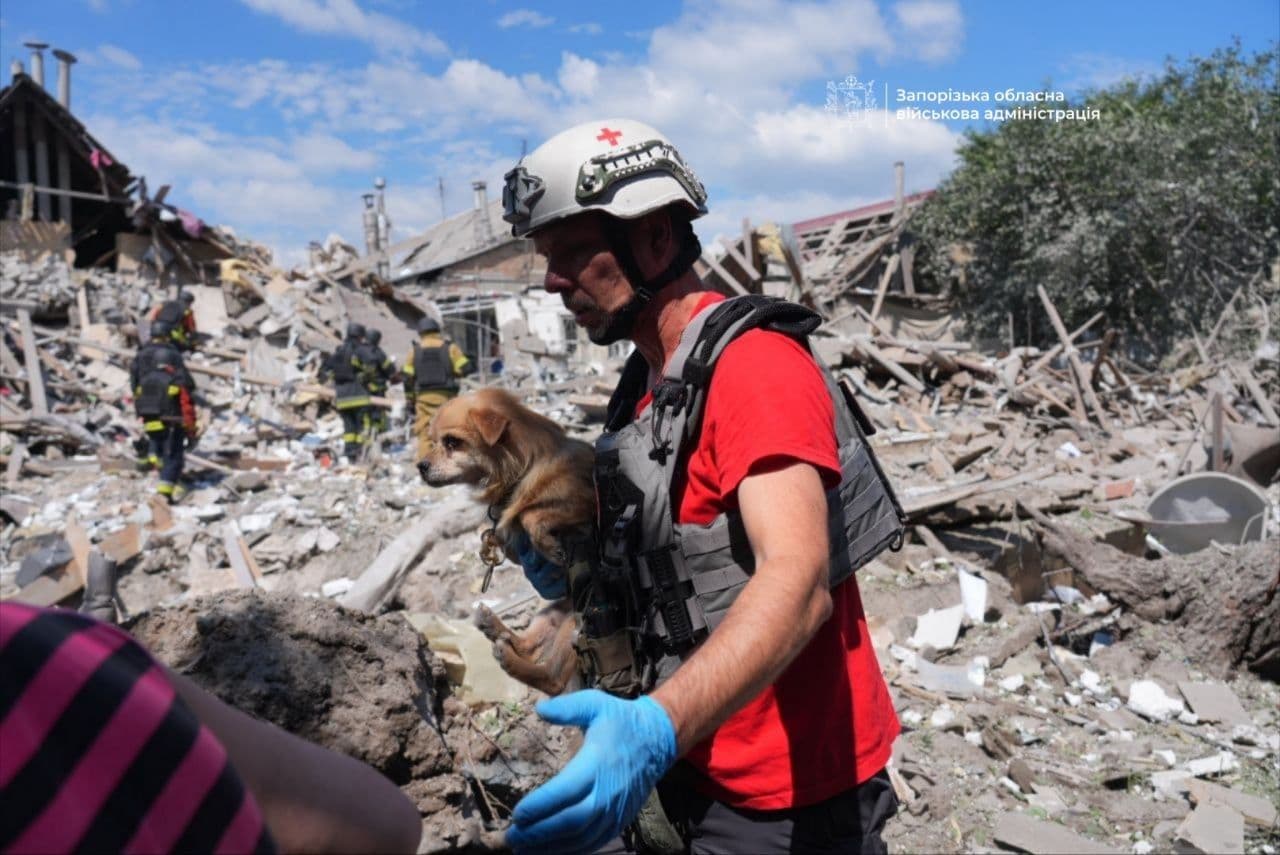
Aftermath of a Russian attack on Zaporizhzhia Oblast. (Local authorities)
COMMANDER OF UKRAINE’S 154TH BRIGADE FOUND DEAD WITH GUNSHOT WOUND
Colonel Volodymyr Kononnikov, commander of Ukraine’s 154th Separate Mechanized Brigade, was found dead on June 28, Ukraine’s Operational Command South and Zaporizhzhia regional police confirmed. The command described him as “an officer devoted to Ukraine and the military, a responsible commander who cared about the personnel and needs of his unit.” Zaporizhzhia regional police reported that a military unit commander had been found dead with a gunshot wound and opened a criminal case under Article 115 of Ukraine’s Criminal Code, which covers intentional homicide. Authorities did not release details on the circumstances surrounding the death. The investigation is being conducted by police under the procedural supervision of the Specialized Prosecutor’s Office for Defense of the Eastern Region.
PUTIN AT UNITED RUSSIA CONGRESS: STRENGTH RHETORIC, DUMA LIST, AND A CANDIDATE UNDER ICC WARRANT
Putin used his speech to the United Russia Party Congress on June 28 to project resolve and frame Russian military victory in Ukraine as inevitable, rejecting diplomatic solutions and claiming Ukrainian forces are “retreating along the entire frontline” — a claim at odds with ISW’s assessment that Russian forces suffered net territorial losses of over 380 square kilometers in April and May combined. Putin claimed the West “cannot strategically defeat Russia,” emphasized that all Russians support the war effort, and described the current moment as “difficult” and “fateful.” He vaguely referenced Ukraine’s “terrorist attacks” on Russian infrastructure without explicitly naming the refinery strikes or the fuel shortages he had acknowledged in a separate meeting earlier the same day. He also alleged without evidence that Western countries are attempting to politically destabilize Russia ahead of the September elections.
For the first time since 2007, United Russia formally declared itself “the president’s party,” publishing a congress poster featuring Putin with the slogans “United Russia is the president’s party” and “Being for Putin is the bare minimum” — with the Latin letter “Z,” Russia’s war symbol, incorporated into the design. Dmitry Medvedev announced United Russia’s top five Duma candidates: Foreign Minister Lavrov, Moscow Mayor Sobyanin, Yunarmia’s Vladislav Golovin, Kremlin-appointed Children’s Rights Commissioner Maria Lvova-Belova, and state-backed milblogger Yevgeny Poddubny. Notably, Lvova-Belova is under an International Criminal Court arrest warrant issued in 2023 alongside Putin himself for their roles in the state-sanctioned abduction of Ukrainian children. Her placement at the top of the Duma candidate list represents the Kremlin’s explicit endorsement of its child deportation program as an electoral platform. ISW assessed that Putin’s speech is intended to shape the information environment ahead of elections that will be neither free nor fair, and to link United Russia’s political success to popular support for the war.
RUSSIA’S DIPLOMATIC POSTURE: HARDLINERS PUSH FOR NUCLEAR ESCALATION; SYBIHA BURIES “SPIRIT OF ANCHORAGE”
Russian nationalist hardliners are increasing pressure on Putin to abandon ongoing diplomatic contacts with the United States and escalate the war dramatically. Pro-war commentators cited by Reuters argue that diplomacy has failed and that Russia should seek Ukraine’s complete military defeat. Nationalist businessman Konstantin Malofeyev publicly questioned why Russia is not using tactical nuclear weapons. Others urged Moscow to emulate Iran’s direct military confrontation with the United States, arguing that Ukrainian strikes would be impossible without Washington’s approval. Three senior Russian officials separately told Reuters that U.S.-Russia contacts have failed to produce meaningful progress, accusing Washington of not following through on proposals from the Alaska summit. Despite the domestic pressure, the Kremlin has not formally abandoned diplomatic channels or endorsed nuclear use.
Ukraine’s Foreign Minister Sybiha responded to the continuing Russian invocation of Alaska on June 28: “The reality makes one thing clear: if the ‘Spirit of Anchorage’ even existed, it is certainly dead now.” Sybiha’s comments came after Secretary of State Rubio confirmed last week that no agreement was reached at the Alaska summit. “For Russia, the lesson of Anchorage is that any peace plan developed without Ukraine is doomed to become a spirit and disappear,” Sybiha said, urging Moscow to stop “believing in spirits” and engage in direct talks or face continued battlefield deterioration. Turkish Foreign Minister Fidan separately announced Ankara’s readiness to host new Ukraine-Russia negotiation rounds, stating: “We strive for the soonest possible conclusion of Russia’s war against Ukraine through dialogue and on the basis of international law.” Turkey previously hosted the May and June 2025 talks that produced a major prisoner exchange. Ahead of the NATO summit in Ankara on July 7 to 8, Zelensky outlined Ukraine’s core priorities: advanced air defense, energy resilience, and sustained pressure on Russia.
FRONTLINE: KUPYANSK ADVANCE CONFIRMED; OLEKSANDRIVKA COMPLEX; CRIMEA EVACUATION PLANS LEAKED
Russian forces recently advanced in the Kupyansk direction. A source reporting on the Russian Western Grouping of Forces claimed on June 28 that Russian forces cleared Petropavlivka east of Kupyansk and Kurylivka southeast of Kupyansk, indicating that Ukrainian forces no longer maintain positions there or in nearby Pishchane. Russian forces also continued using FPV drones to supply troops near the Oskil River, as Ukrainian strikes have made conventional logistics too dangerous — FPV drones carry limited payloads and must make multiple flights to supply even a few infantrymen. Russian forces continued operations in northern Sumy Oblast, northern Kharkiv Oblast, and the Velykyi Burluk and Borova directions without confirmed advances. A source confirmed that Russian forces have not entered Ivolzhanske north of Sumy City, contradicting the Russian MoD’s June 25 claim to have seized it.
In the Donetsk Oblast directions, Russian forces continued infiltration in the Slovyansk direction, with geolocated footage showing Ukrainian forces striking a Russian-occupied building in southwestern Lyman. A Russian source acknowledged that Russian forces are attacking Lyman’s approaches but have not entered the city. In Kostyantynivka, a Ukrainian soldier told Bloomberg that forces kill about 90 percent of Russian infiltrators and a Kremlin-affiliated milblogger acknowledged it is premature to speak of Russian seizure of the city. Russian forces are using glide bombs against Kramatorsk more than artillery, likely to intimidate the population; a foreign medic trainer reported Russian drones have also effectively overrun the city. In the Pokrovsk direction, Russian forces are installing antennas disguised as civilian TV aerials to increase drone capacity and using fiber optic drones; Russian companies are being pushed to exhaustion, with each of six to seven companies per battalion cycling through one month of combat before partial restoration. In the Oleksandrivka direction, military observer Mashovets reported that Ukrainian forces withdrew from Rybne south of Oleksandrivka on a prior date and Russian forces occupied part of Krasnohirske just north of Rybne; Russian infiltrators are operating between Zlahoda and Dobropillya. Ukrainian forces have seized most of Berezove southeast of Oleksandrivka and advanced southeast of the settlement, though small Russian groups hold its southwestern outskirts and northwest. Ukrainian forces maintain positions in southeastern Zaporizke and south of it; small Russian groups are operating in Novomykolaivka, on the northern outskirts of Kalynivske, and near Verbove. Russian forces made small-scale penetrations north and northeast of Novohryhorivka a few hundred meters in depth. The Russian MoD published likely AI-altered flag footage claiming seizure of Pysantsi and Novoskeliuvate — both approximately 15 kilometers from the nearest confirmed Russian presence. Ukrainian forces struck a Russian ammunition depot near occupied Amvrosiivka roughly 97 kilometers from the frontline, and geolocated footage showed a Russian truck burning along the M-30 Donetsk City-Horlivka highway near occupied Yasynuvata after a Ukrainian strike. In Zaporizhzhia Oblast, Russian milbloggers claimed Russian forces seized Novoselivka southwest of Hulyaipole and advanced north of Mali Shcherbaky west of Orikhiv; ISW assessed the Novoselivka footage as likely AI-altered. Russian forces conducted limited operations in Novopavlivka, Dobropillya, and western Zaporizhzhia without confirmed advances.
Ukraine’s strike campaign against Crimean logistics continued on June 28, with the General Staff confirming a strike on a railway bridge near occupied Ichki — roughly 255 kilometers from the frontline — used for troop and supply movement, with fires also reported at a nearby agricultural chemical warehouse. Ukrainian forces also struck a Russian mobile fire group along the M-18 Melitopol-Dzhankoi highway near occupied Danylo-Ivanivka, and continued their campaign against the Luhansk rail network with a strike on a bridge near Sabivka, roughly 86 kilometers from the frontline, with geolocated imagery confirming damage. Russian forces struck a Ukrainian training ground in Prybuzke in Mykolaiv Oblast with self-guided Geran drones targeting personnel assembly points and boat depots. A Russian insider source claimed on June 28 that armed men from a private military company linked to Crimean occupation head Aksyonov began arriving at all Crimean oil depots on June 26 and 27 and forcibly took control of the facilities, citing a classified order about preparing reserves in case of evacuation; the source claimed Crimean authorities have drafted a plan for the partial evacuation of up to 250,000 people, though accommodation arrangements remain unresolved.
ZELENSKY PROPOSES MAZEPA MONUMENT AND PANTHEON OF HEROES ON CONSTITUTION DAY
Zelensky used Ukraine’s Constitution Day on June 28 to announce that he has submitted a bill to create the Pantheon of Heroes, a memorial to historical figures who symbolize Ukraine’s struggle for independence, and proposed erecting a monument to Cossack Hetman Ivan Mazepa on the site in Kyiv where a Lenin statue was toppled during the EuroMaidan Revolution. “I am certain that where Lenin fell, Mazepa will stand firm,” Zelensky said. He presented a bust of Mazepa at the Kyiv-Pechersk Lavra — a monastery Mazepa helped finance and restore in the Ukrainian Baroque style, and the same site partially damaged by a Russian strike on June 15. “For centuries, Russia has smeared his name… This lie has failed. Forever,” Zelensky said. Mazepa, who led the Cossacks in the late 17th and early 18th centuries and sided with Sweden against Peter I in an effort to free the Cossack Hetmanate from Russian rule, was long portrayed as a traitor in Russian imperial and Soviet narratives; Ukraine has increasingly recognized him as a symbol of national independence. The announcement is part of Ukraine’s broader campaign to remove Soviet and Russian imperial monuments and restore Ukrainian historical figures to public spaces.
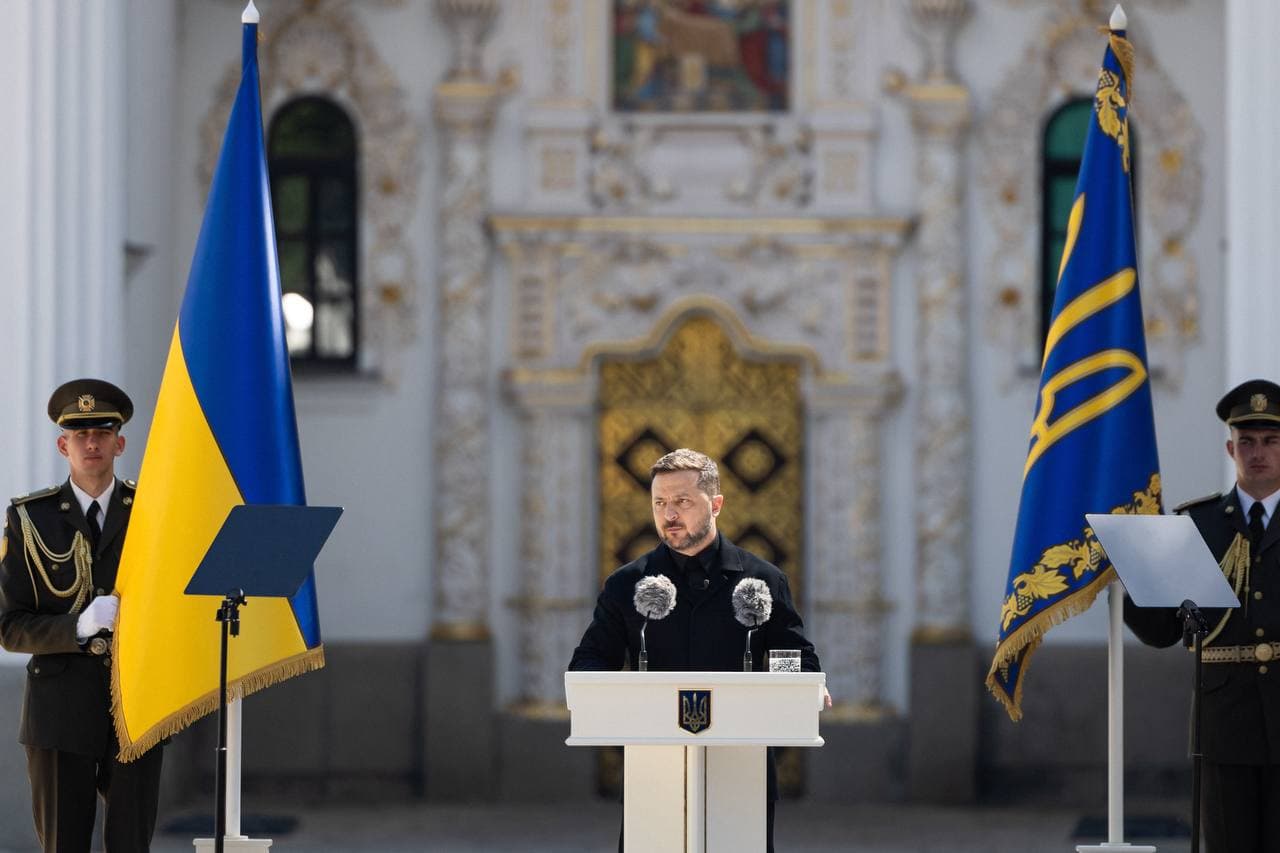
President Volodymyr Zelensky during Constitution Day commemorations. (Volodymyr Zelensky/Telegram)
740 RELIGIOUS SITES STRUCK; SERBIA REINSTATES MILITARY SERVICE; KUWAIT RATIFIES DEFENSE AGREEMENT
Zelensky reported on June 28 that Russian forces have struck 740 religious buildings in Ukraine since the full-scale invasion began, part of a targeted campaign to destroy, desecrate, and loot religious infrastructure in occupied and frontline areas. The figure is separate from cultural sites and includes churches, monasteries, and other religious buildings across the country.
Serbia announced that President Aleksandar Vučić will reinstate mandatory 75-day military service for men under 30, beginning in March 2027 — reversing a post-Cold War demobilization trend and reflecting the broader European shift toward military preparedness in the context of Russia’s war against Ukraine.
Ukraine’s Foreign Minister Sybiha confirmed on June 28 that Kuwait ratified a bilateral agreement on military and defense cooperation, allowing it to enter into force after domestic legal procedures finalized. The agreement, originally signed in 2018, opens the door for joint projects, exchange of experience, and technologies and deepens strategic dialogue. Sybiha specifically linked the agreement to Iranian aerial attacks on Kuwait, noting that Ukraine has expertise in countering the same Iranian drone types Russia uses against Ukrainian cities. Ukraine has now signed defense cooperation agreements with Saudi Arabia, Qatar, the UAE, and Kuwait, with discussions underway with Bahrain and Oman.
June 28, 2026 ended with Putin admitting what his government spent months denying: lines at gas stations, certain deficit, Crimea on its last few days of energy. He called it not critical. The Slavyansk and Yaroslavl refineries burning overnight called it something else. A brigade commander was found dead in Zaporizhzhia Oblast with a gunshot wound. A five-year-old boy is in serious condition from a guided bomb. And Lvova-Belova — under an ICC arrest warrant for helping to abduct Ukrainian children — will lead United Russia’s Duma slate. The performance of strength and the admission of reality have never occupied the same press conference so visibly as they did today.
A PRAYER FOR UKRAINE
1. For the Five-Year-Old Boy in Zaporizhzhia
Lord, a five-year-old boy is in serious condition in a Zaporizhzhia hospital after a Russian guided bomb struck his neighborhood on the morning of June 28. A 16-year-old girl was also injured. A 53-year-old woman was killed. This was a Sunday morning. People were home. The boy was five. We do not have words for a weapon designed to penetrate reinforced structures that finds instead a residential block on a Sunday morning in a city of 710,000 people. We ask for his recovery. We ask for the doctors caring for him. And we ask, in the plainest possible language, for this to stop.
2. For the Family of Colonel Kononnikov
Father, a Ukrainian brigade commander was found dead with a gunshot wound in Zaporizhzhia Oblast on June 28, and a criminal case for intentional homicide has been opened. We do not know the circumstances. We know that Volodymyr Kononnikov was described by his command as devoted to Ukraine, responsible, and careful about his soldiers’ wellbeing. We pray for his family. We pray for the soldiers of the 154th Mechanized Brigade who are absorbing this loss. And we ask that whatever happened be investigated honestly, completely, and without institutional pressure to reach any particular conclusion.
3. For the Workers of Slavyansk-on-Kuban
God of the ordinary, a refinery in Slavyansk-on-Kuban burned across 20,000 square meters overnight, and residents of that Russian city woke to smoke and emergency vehicles and the knowledge that their city has become part of this war’s geography. We do not pray for the refinery’s fuel to flow. We pray for the ordinary workers — shift managers, maintenance crews, operators — who had nothing to do with the decision to invade Ukraine and whose workplace is now a fire scene. We ask that the people of Russia begin to ask, with increasing clarity, who made the decision that brought this war to their doorstep, and why.
4. For the Members of Black Spark
Lord of hidden things, a Russian resistance group called Black Spark says its members spent months working inside the factory that builds the drones Russia sends to kill Ukrainian civilians, and that they sabotaged those drones from the inside. We do not know if this is true. We do not know their names. We know that if it is true, these are people who risked everything — imprisonment, torture, death — to work against a machine of destruction from within. We ask for their safety. We ask that the sabotage works. And we ask that the courage of people inside Russia who act against this war be recognized, however quietly, by the world.
5. For a Country That Has Buried 740 Churches
God who dwells in every holy place, 740 religious buildings in Ukraine have been struck since February 2022 — churches, monasteries, seminaries, chapels. The Kyiv-Pechersk Lavra burned in June. These are not accidents. They are part of a campaign to erase the spiritual geography of a people. We pray for every congregation that lost its sanctuary, every priest who shepherded people through a service in a damaged building, every icon that was evacuated in the dark. Let the faith that survived this war find expression in rebuilt sanctuaries. And let those who ordered the strikes face, in time, the accounting that international law exists to provide.