
Ukraine Daily Briefing — June 27, 2026
Ukraine’s homemade Flamingo FP-5 cruise missiles tore into a Russian ballistic missile plant in Volgograd overnight, while Russian-installed authorities in occupied Crimea declared a state of emergency after weeks of relentless Ukrainian strikes left the peninsula without power and without a railway bridge. Russia answered with its own barrage, hurling 129 drones and a trio of guided bombs at Sumy and Zaporizhzhia, killing at least seven people nationwide and wounding 89 more. Amid the fire, 160 prisoners of war and seven long-held civilians crossed back into Ukrainian hands — proof that even a war with no end in sight still has moments of return.
The Day’s Reckoning
Picture a missile plant in Volgograd, eight hundred kilometers from the nearest Ukrainian soldier, with three of its workshops on fire. Five Flamingo cruise missiles found Russia’s Titan-Barrikady complex overnight — the factory that builds launchers for Iskander-M, Yars, and Topol-M missiles, the very weapons fired back at Ukrainian cities. President Zelensky confirmed the strike himself, and Russian officials, true to form, called it a “high-speed aerial target” and changed the subject.
Eleven hundred kilometers south, in occupied Crimea, the lights are going out for a different reason. A railway bridge that once moved Russian military cargo no longer exists. A thermal power plant burns. Half the peninsula sat in the dark this week, and the Kremlin’s local administrators just declared a state of emergency to manage it.
And in the dark of a Sumy morning, eleven more people were hurt by a single jet-powered drone — proof that for every industrial fire 800 kilometers inside Russia, the war’s daily cost still falls hardest on ordinary apartments.
Flamingo Over Volgograd: Ukraine Hits the Factory That Builds Russia’s Missiles
Three workshops burning. That is what geolocated footage showed at Russia’s Titan-Barrikady plant in Volgograd City after five Ukrainian Flamingo FP-5 cruise missiles found their target overnight on June 26 to 27. President Volodymyr Zelensky confirmed Ukrainian forces had struck the facility, calling it “a major industrial complex” where Russia builds not just missile components but the machinery of an entire war.
The Flamingo is Ukraine’s own creation — a long-range cruise missile built domestically, without waiting on Western approval or delivery schedules. Its target mattered as much as the hit itself. Titan-Barrikady manufactures the self-propelled launchers and transport-loading vehicles for Iskander-M ballistic missiles, the ground equipment for Russia’s Topol-M and Yars intercontinental ballistic missiles, and Msta howitzers. Destroy the launcher factory, and every missile built afterward has nowhere to ride.
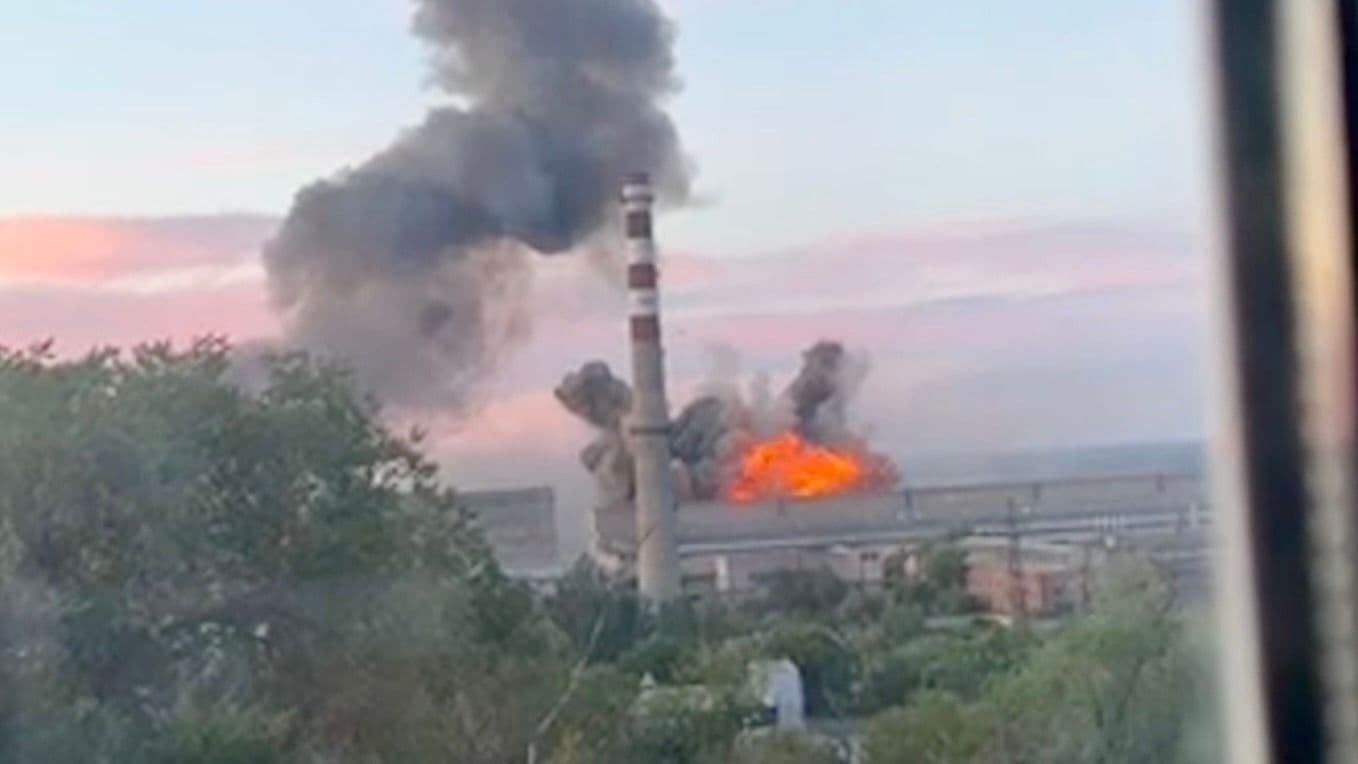
Volgograd Oblast Governor Andrei Bocharov confirmed a “high-speed aerial target” had damaged an “industrial facility” — Kremlin-speak that conspicuously avoided naming Titan-Barrikady or acknowledging what was actually struck. Ten people were injured, he said, though no homes were damaged.
A Russian military blogger offered an unintentionally revealing detail: Flamingo strikes have likely been flying low and over water to dodge radar, and Russia simply doesn’t have enough AWACS surveillance aircraft left to stop them — reportedly fewer than ten operational, with only four or five of the newer variant. Ukraine has been hunting those surveillance planes all war. This was at least the ninth confirmed Flamingo strike since the campaign began, each one chipping further into Russia’s ability to replace what Ukraine destroys.
A Bridge That No Longer Exists: Ukraine Severs Crimea’s Rail Lifeline
“The railway bridge across the North Crimean Canal in Crimea no longer exists.” That is how Ukraine’s Special Operations Forces described the result of a deliberate, two-phase demolition near the settlement of Razdolne. On the night of June 22, SOF drones struck the bridge for the first time, collapsing one of its spans and tearing up the rail line beneath it — a route Russia had used to haul heavy military cargo across the occupied peninsula.
Russia tried to fix it. Repair crews and equipment arrived at the site within days. Ukrainian forces, working alongside local pro-Ukrainian resistance networks who fed them targeting information, waited and struck again on the night of June 23 — hitting both the repair equipment and what remained of the bridge itself. The second strike made the destruction permanent.
The same overnight operation saw Ukrainian medium-range drones, capable of reaching targets 30 to 200 kilometers away, hit more than 60 Russian military targets across occupied Ukrainian territory, according to Unmanned Systems Forces Commander Robert “Madyar” Brovdi.
The bridge was never a famous target like the Kerch crossing, but it was a working one — a route that didn’t make headlines because the cargo always got through. Now it doesn’t. Russia must reroute supplies along roads already strained by months of Ukrainian drone interdiction, while repair crews who showed up to fix one bridge became casualties of trying.
Crimea Goes Dark: State of Emergency Declared as Strikes Disable the Grid
Mikhail Razvozhayev, the Russian-installed head of Sevastopol, framed it as bureaucratic housekeeping: a regional state of emergency, he said on June 26, was needed “to resolve issues of an economic nature.” What he didn’t say plainly is that occupied Crimea’s power grid has been buckling for weeks under sustained Ukrainian strikes, and his administration no longer has a quiet way to manage it.
The numbers tell the real story. On June 23, Russian proxy authorities admitted that roughly half the peninsula had lost electricity. Videos online showed Simferopol dark; photos showed Yalta without power after a strike on a substation. Explosions were heard near the Balaklava Power Plant in Sevastopol. Then, in a single overnight operation, Ukrainian forces hit 38 separate sites across Crimea — the Tavriya Thermal Power Plant in Simferopol, an oil depot in Dzhankoi, two gas compressor stations, two electrical substations, three coastal radar stations, and an anti-aircraft autocannon, according to Brovdi.
Power loss cascaded into water loss. In occupied Yevpatoria, authorities introduced hourly water restrictions after pumping stations lost power and wells went offline. Razvozhayev asked residents for “understanding regarding these temporary difficulties,” promising restoration “as soon as we receive the order.”
Before 2014, Crimea drew over 80 percent of its electricity from mainland Ukraine. Russia spent a decade building thermal plants to replace that lost supply and declare the peninsula energy-independent. Those plants are now exactly what Ukrainian drones are burning down.
The strain has reached even the summer camps. Occupation head Sergey Aksyonov announced on June 22 that children’s camps across the peninsula — including “Artek,” once a celebrated Ukrainian camp seized by Russia after 2014 — would suspend operations until early September, citing security concerns. Some children had already crossed the Kerch Bridge into Crimea, even eaten a meal there, before being turned back. “My children crossed the bridge, had a meal (in Crimea), and then were turned back,” one parent told Russian outlet Ostorozhno Novosti. A summer camp closing over “security concerns” is its own quiet admission: the Kremlin’s own administrators no longer consider the peninsula stable enough to guarantee something as simple as a season of swimming and campfires.
Stolen Wheat, Stolen Children: Mariupol’s Port and the Cost of Occupation
Twelve ships. Eighty-eight thousand eight hundred metric tons of wheat. That is what Russia has shipped out of the occupied port of Mariupol since the start of 2026, according to the city’s council in exile, citing Russia’s own veterinary and customs records. Moscow has worked since seizing the city to rebuild Mariupol into a grain-export gateway — one that could, in theory, move stolen Ukrainian wheat through the Volga-Don Canal to the Caspian Sea and onward to the Atlantic and Indian oceans.
That ambition has run into Ukraine’s missile campaign. A June 10 strike by Ukraine’s National Guard 1st Azov Corps hit the port’s electrical substations, radar systems, repair facilities, control tower, fuel tanks, and a sanctioned vessel tied to Russia’s shadow fleet, the Lady Augusta. The port’s current operational status remains unclear — but Mariupol remains one of Russia’s most important logistics links between occupied Donetsk, Crimea, and the Russian mainland, making it a target Ukraine is unlikely to leave alone.
The same week brought a different kind of return. Ukraine’s NGO partner Save Ukraine confirmed 42 children and teenagers have been brought home from occupied territory in recent weeks. Among them: 13-year-old Sofia, who hid at home every day rather than attend a Russian-run school, while her family endured threats that she would be taken to a boarding institution. And 17-year-old Dmytro, who watched Russian soldiers dress in Ukrainian uniforms to terrify children with mock execution threats — and who, despite a serious heart condition, was forced to register for Russian military service before he was rescued.
Ukraine’s “Children of War” database counts at least 20,000 children abducted since February 2022. Ukraine’s Ombudsman puts the real number as high as 150,000; the Presidential Commissioner for Children’s Rights estimates 200,000 to 300,000. An estimated 1.6 million children remain under occupation today.
Hitting Russia Where It Pumps: The Vtorovo Strike and the 40-Day Campaign
For the second time this month, Ukraine’s Security Service struck the Vtorovo oil pumping station near Penkino in Russia’s Vladimir Oblast, roughly 230 kilometers east of Moscow. Drones from the SBU’s Alpha special forces unit hit technical buildings at the facility, the agency said, triggering a secondary detonation — evidence that fuel or pressurized lines, not just structures, took the hit. NASA satellite fire-monitoring data recorded a heat anomaly roughly 10 kilometers from the station afterward.
Vtorovo is not a minor target. Operated by Transneft, Russia’s state pipeline monopoly, the station pumps diesel toward the Moscow Ring Oil Product Pipeline, feeding depots in Moscow City and onward to the Baltic Sea. It also supplies fuel to Sheremetyevo, Domodedovo, and Vnukovo — the three airports that keep Moscow connected to the world.
The strike is part of a 40-day pressure campaign that President Zelensky approved on June 25, explicitly designed to “compel” Russia toward ending the war through sustained attrition of its energy infrastructure. Ukrainian forces also hit Russian satellite communication nodes this month — including the “Dubna” center in Moscow Oblast and the “Vladimir” center in Gus-Khrustalny — striking at the invisible infrastructure that keeps Russian forces talking to each other, not just the visible infrastructure that keeps them moving.
Behind both campaigns sits a blunt fact: the United States has just let its sanctions waiver on Russian seaborne oil exports expire, re-imposing sanctions on Rosneft and Lukoil. Diplomatic pressure and drone strikes are now squeezing the same artery from two directions at once.
A War of Inches: Frontline Stalemate from Kharkiv to Zaporizhzhia
Across nearly the entire eastern and southern front, June 26 and 27 produced the same verdict, repeated district by district: Russian forces attacked, and did not advance. Northeast of Kharkiv City, Russian troops pushed forward only to be thrown back by Ukrainian counterattacks near Kozacha Lopan and Zamlianyi Yar. In the Kupyansk direction, along the Oskil River, Russian units made no gains while Ukrainian forces quietly advanced east of Podoly. In the Slovyansk, Kostyantynivka-Druzhkivka, Dobropillya, Pokrovsk, Novopavlivka, and Oleksandrivka sectors of Donetsk Oblast — the active core of Russia’s stated war aim to seize the entire region — the story was identical: attack, no advance.
Pokrovsk deserves particular attention, because Russian officials keep claiming they’ve taken it. A spokesperson for Ukraine’s 7th Rapid Reaction Corps said Russian forces continue to claim they’ve seized the city, despite slow progress and a continued, if unspecified, Ukrainian presence in its northern districts. This is not a one-off exaggeration. The Russian Ministry of Defense has begun circulating what analysts assess is likely AI-altered footage of flag-raising ceremonies — most notably in Novoskeliuvate, a village 15 kilometers from any confirmed Russian advance, where soldiers from the 36th Motorized Rifle Brigade posed with a flag despite no Ukrainian forces having ever been confirmed there at all.
In Hulyaipilske, southwest of Hulyaipole, the pattern repeated in miniature: a single Russian soldier was filmed holding a flag in the village, but Ukrainian forces destroyed him within hours and raised their own flag in his place. A Russian blogger insisted there was no Ukrainian presence at all.
What emerges is a battlefield where the war of position has essentially frozen, but the war of narrative has not. Russia’s information operations are racing ahead of its actual territorial gains, manufacturing the appearance of collapse where none exists — a strategy analysts describe as cognitive warfare, aimed less at Ukrainian soldiers than at Western audiences deciding whether continued support is worth the cost.
Crossing the Line: Ukraine Hits Russian Soil Along the Belgorod Border
While Russian troops failed to advance inside Ukraine, Ukrainian forces kept reaching across the border into Russia’s own Belgorod Oblast — the region directly behind Kharkiv’s contested front. The Ukrainian General Staff reported a strike on a Russian command post in Leninskiy, just two kilometers north of the international border, and geolocated footage confirmed a separate hit on a fuel storage warehouse near Rzhevka, seven kilometers inside Russian territory.
A source tracking Russia’s Northern Grouping of Forces identified the units operating in that sector — the 127th Motorized Rifle Regiment and the 128th Separate Motorized Rifle Brigade — and posted images of smoke rising from the burning warehouse. The strikes illustrate a tactic Ukraine has leaned on increasingly as the war grinds into its fifth year: rather than wait for Russian units to cross into Ukraine, hit their staging grounds, fuel, and command structure before they do.
Further south and east, Ukrainian forces struck a command post in occupied Lyman Pershyi, six kilometers behind the front near Kupyansk, and a gas distribution facility near Novokrasnianka in occupied Luhansk Oblast. Eighty-seven kilometers from the front, near Dmytrivka, a Ukrainian strike on a military vehicle severely wounded Lieutenant Colonel Alexander Zolin, who had taken command of Russia’s 36th Motorized Rifle Regiment only days earlier — a reminder that distance from the front line offers Russian officers less protection than it once did.
Burning the Supply Line: Ukraine’s Logistics War Across Zaporizhzhia and Kherson
Ukraine’s strategy in the south has a name now: the “middle strike” campaign, built around short- and mid-range drones designed to choke off the trucks, depots, and transport routes that keep Russian frontline units supplied. The evidence is scattered across highways that, on paper, sit well behind any active fighting. On the M-18 Zaporizhzhia City-Melitopol highway, 84 kilometers from the front, two Russian cargo trucks burned after a drone strike. On the M-14 Melitopol-Mariupol highway, 72 kilometers back, another logistics truck went up in flames; a parked fuel truck in occupied Astrakhanka, 65 kilometers from the front, suffered the same fate.
A bridge along the M-14 Rostov-Crimea highway, struck on June 26 near Volodymyrivka, showed fresh damage in updated battle-damage imagery — holes punched through the span, part of it collapsed, 86 kilometers from the nearest fighting. None of these targets will appear in a headline. That is the point. Brovdi’s forces are not trying to win a single dramatic battle; they are trying to make every supply run a gamble.
Further west, in Kherson Oblast, Ukrainian forces struck a Russian communications node in occupied Chulakivka and a truck near Nadiivka. At sea, the Ukrainian Navy destroyed a Russian boat south of the Tendrivska Spit that had been resupplying the small Russian garrison still clinging to that strip of land — a garrison that, like the one recently driven off the nearby Kinburn Spit, increasingly looks like it is being starved into irrelevance rather than defeated in battle.
Even occupied Crimea’s remaining military infrastructure isn’t safe from the same approach. The Ukrainian General Staff reported a strike on a Pantsir-S1 air defense system near Feodosia, 245 kilometers from the front, while satellite imagery confirmed damage to fuel storage at the Kamysh-Burunskaya Thermal Power Plant and the Kerch Oil Depot, both nearly 290 kilometers deep into occupied territory. Crimea’s energy minister has now warned residents to expect rolling blackouts in the coming days as the grid strains to cope.
A Night of Fire Over Sumy and Zaporizhzhia
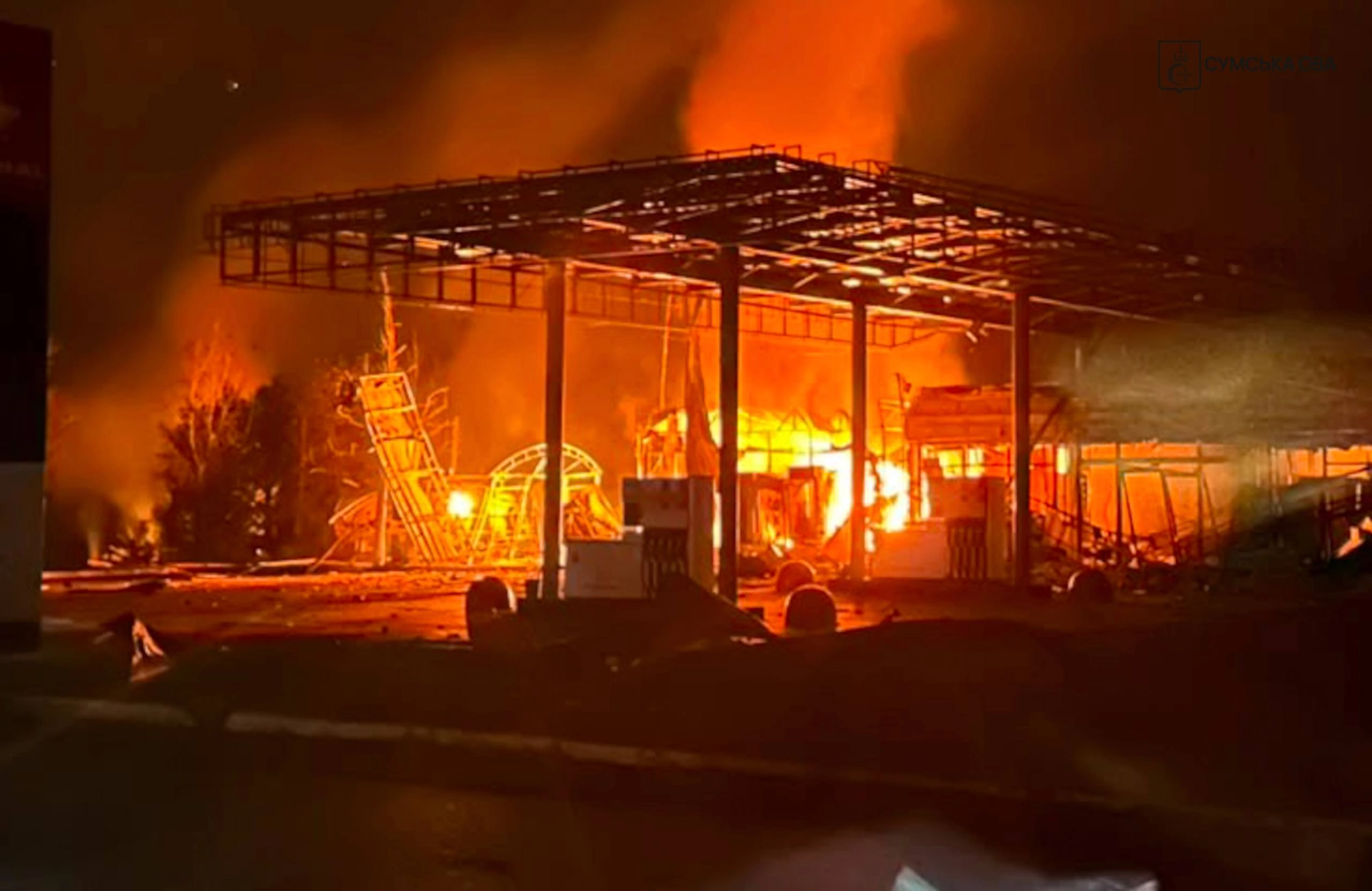
Imagine waking before dawn to the sound of a drone that doesn’t sound like the others — a jet engine instead of a lawnmower whine, fast and low, designed specifically to beat the radar that would normally give you seconds of warning. That is what residents of Sumy heard on Saturday morning, June 27, when a Russian jet-powered drone struck the city’s residential sector directly, injuring 11 people, including two children.
It came on top of an overnight barrage that had already hit the Okhtyrka district and surrounding communities, wounding 10 more, including a 53-year-old woman with severe burns who remains hospitalized in critical condition. Officials said the drones flew deliberately low to slip past radar, damaging homes and gas stations as they went.
The Sumy strikes were a fragment of a far larger wave. The Ukrainian Air Force reported 129 Shahed-type, Gerbera, Italmas, and decoy drones launched overnight from points across southern Russia and occupied territory — Kursk, Bryansk, Oryol, Millerovo, Primorsko-Akhtarsk, occupied Hvardiiske, and occupied Donetsk City. Ukrainian air defenses shot down or suppressed 113 of them; 13 struck seven separate locations, with debris from intercepted drones falling on three more.
In Zaporizhzhia, the attack came by aircraft rather than drone. Russian tactical jets dropped three guided glide bombs on the city late Friday night, tearing into a high-rise apartment building and injuring six people, including a 13-year-old child. It followed a Friday drone attack that had already injured nine. City authorities opened emergency hotlines for residents needing evacuation help — a now-routine response to an attack that has become a near-daily occurrence.
Cluster Warheads and a Damaged Shuttle Bus: Russia Targets Naftogaz and a Mykolaiv Airfield
Russia’s strike campaign against Ukraine’s energy backbone has a specific target this week: Naftogaz, the state oil and gas company that keeps much of the country’s heat, fuel, and power flowing. CEO Serhii Koretsky reported that Russian forces hit Naftogaz production facilities in Poltava and Kharkiv oblasts over the preceding two days using at least four ballistic missiles — some fitted with cluster warheads, designed to scatter submunitions across a wide area rather than concentrate damage on a single point — along with additional drone strikes. A shuttle bus carrying plant workers to one of the sites was damaged in the attack, though no one on board was hurt. Koretsky credited the company’s safety protocols for the absence of casualties, even as assessments of the physical damage continue.
Russia’s Defense Ministry separately claimed responsibility for a drone strike on Ukraine’s Voznesensk airfield in Mykolaiv Oblast, where geolocated footage confirmed a Geran-4 loitering munition — a one-way attack drone that circles until it finds a target, then dives into it — struck a Ukrainian MiG-29 fighter jet and a TZ-22 refueling tanker truck on the ground. Moscow claimed the strike damaged two MiG-29s, a separate fuel tanker, an aircraft starting unit, and caused casualties among ground crew, though Ukraine has not independently confirmed the full extent of those claims.
Together, the two strikes reveal a strategy aimed less at any single battlefield outcome than at the invisible scaffolding that keeps Ukraine’s war effort running: the fuel that flows through Naftogaz pipelines, and the ground equipment that keeps fighter jets flying. Neither strike will shift a frontline. Both make the next mission, the next delivery, the next repair just a little harder than it was the day before.
The Weekly Toll: 1,400 Drones, 1,500 Bombs, and a Demand for Stronger Sanctions
President Zelensky put a number on the week: roughly 1,400 attack drones, nearly 1,500 guided aerial bombs, and 19 missiles, including ballistic missiles, launched against Ukraine over the preceding seven days. Fifteen regions were hit. Kherson, Zaporizhzhia, Kharkiv, and Sumy faced what Zelensky called near-daily bombardment.
The casualty count from just the most recent 24-hour period told its own story. At least seven people were killed and 89 injured nationwide, according to regional authorities reporting on June 27. In Zaporizhzhia Oblast, one person died and 23 were injured, including three children; 102 residents reported damage to their homes. In Sumy Oblast, one person was killed and 14 injured across the day’s attacks. In Kharkiv Oblast, a 79-year-old woman was killed and eight others hurt. In Donetsk Oblast, one person died and seven were injured. In Kherson Oblast, attacks struck nearly 50 settlements, injuring 13. In Chernihiv Oblast, a 57-year-old man was injured and a farm, businesses, trucks, and warehouses were damaged.
“Using various types of weapons, the Russians are striking people, ordinary residential buildings, and our civilian infrastructure,” Zelensky said, calling for expanded air defense — particularly anti-ballistic systems — and a broader international “Drone Deal” framework to help Ukraine intercept the onslaught. “Sanctions against Russia and its partners in this war must be enforced exactly where they will be felt the most,” he said. “Strong and prompt steps are required to force Russia toward ending this war.”
The numbers fit a grim pattern already documented by outside observers. A U.N. Human Rights Monitoring Mission report released June 12 found that May 2026 was Ukraine’s deadliest month since April 2022, with at least 274 civilian deaths and 1,763 injuries verified in 31 days — the highest monthly toll recorded in over four years of full-scale war.
Coming Home: 160 Prisoners of War and Seven Civilians Return
On Friday, Ukraine and Russia carried out one of the largest prisoner exchanges of the year: 160 prisoners of war returned to each side. President Zelensky confirmed the Ukrainians came home from the Armed Forces, the State Special Transport Service, the National Guard, and the State Border Guard Service — defenders who had fought at Mariupol and the Azovstal steel plant, and along front lines stretching from Donetsk to Chernihiv. “We continue bringing Ukrainians home from Russian captivity,” Zelensky said, thanking the units whose battlefield gains “replenish Ukraine’s exchange fund.” Kyrylo Budanov, head of the Presidential Office, called the reunions “real, genuine happiness” for the whole country.
A day later came a second, quieter return: seven Ukrainian civilians, held since 2022, finally crossed home. Commissioner for Human Rights Dmytro Lubinets said the group, aged 35 to 66, had been detained during the occupation of Mariupol and parts of Kyiv, Kharkiv, Zaporizhzhia, and Luhansk oblasts. “After years of unlawful detention by Russia, our people are finally home and can breathe free Ukrainian air,” Lubinets wrote.
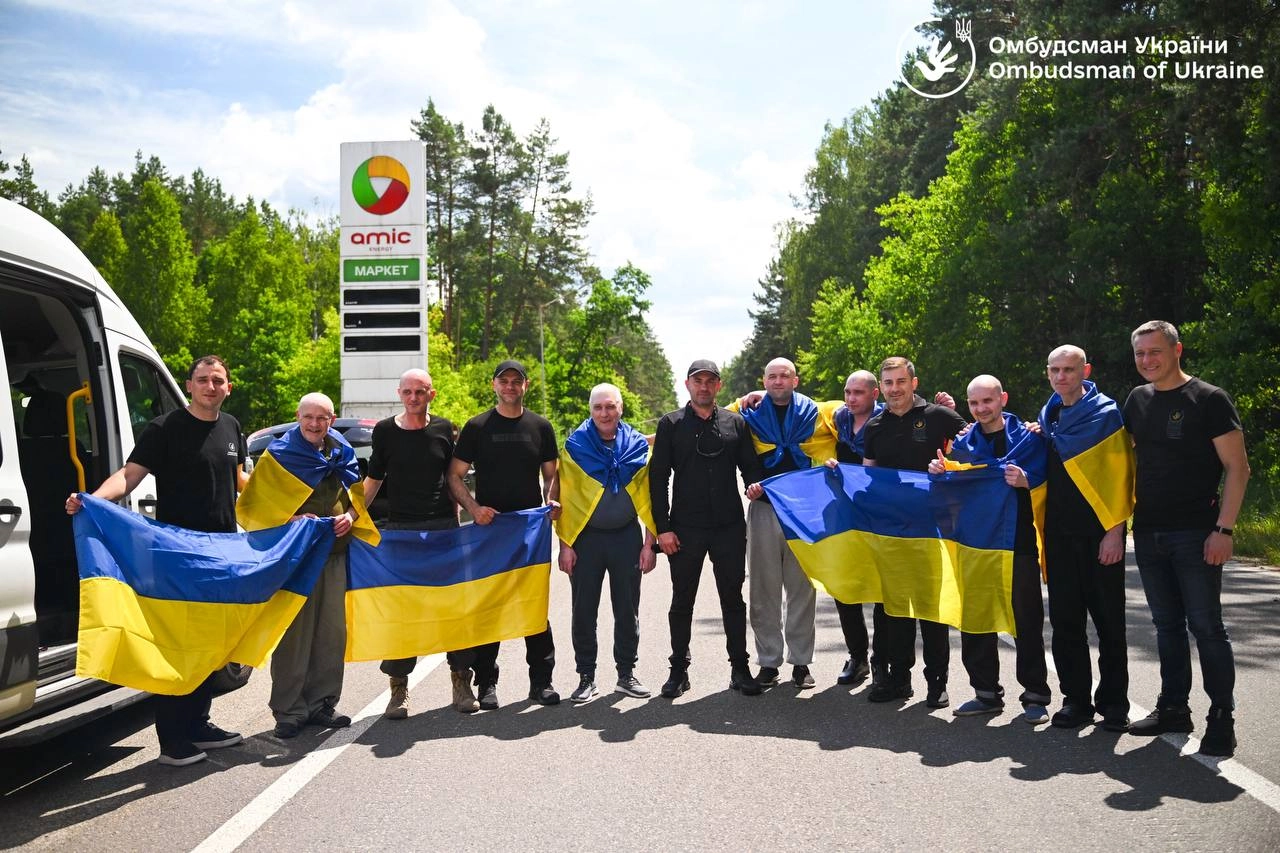
The stories behind the numbers are specific. One man was taken from his home simply because his sons served in Ukraine’s military. Another was seized on his way to work on February 24, 2022 — the first day of the full-scale invasion — and held ever since. A third had joined the volunteer medical unit known as Taira’s Angels in Mariupol and was detained the same day as the unit’s commander, Yuliia Paievska, the paramedic known as “Taira,” who herself was freed back in 2022.
Lubinets credited direct talks with Russia’s new human rights commissioner, Yana Lantratova, who replaced Tatyana Moskalkova in May — talks he says began “from scratch.” Seven Russian civilians, mostly from Kursk Oblast, returned to Russia in the same exchange. It was Russia’s first civilian release since seven Ukrainians came home on February 5. Lubinets vowed the effort continues: “We must bring everyone back — both military personnel and civilians.”
Two Aircraft, Two Stories: A MiG-29 Lost, a Su-24 Investigation Continues
A Ukrainian MiG-29 went down overnight on June 27 during a combat mission over Poltava Oblast after ground controllers lost contact with the aircraft mid-flight. The pilot ejected safely, was located by a search-and-rescue team and was taken to a medical facility for evaluation. The Air Force has opened an inquiry into what caused the loss of communication and the crash itself; officials have not yet disclosed what the mission involved.
The MiG-29 is a Soviet-designed fighter from the 1970s that Ukraine still flies today in upgraded form for both air defense and strike missions — a reminder of how much of Ukraine’s air power still rests on aircraft built before the pilots flying them were born.
The loss follows a more somber inquiry still underway. On the evening of June 16, a Su-24M bomber crashed in the Shepetivka district of Khmelnytskyi Oblast during a scheduled training flight, killing both crew members, aged 55 and 23. Ukraine’s State Bureau of Investigation is working to decode the aircraft’s flight recorder, examining everything from the plane’s technical condition to whether flight preparation protocols were followed. A criminal case has been opened under Article 416 of Ukraine’s Criminal Code, covering violations of flight regulations that cause serious harm.
The Su-24, like the MiG-29, is a holdover from the Soviet era — a variable-sweep-wing bomber that has nonetheless delivered some of Ukraine’s most significant long-range strikes, including attacks on Russia’s Black Sea Fleet infrastructure in occupied Sevastopol. Both losses underscore the same quiet truth: Ukraine’s combat aviation runs on airframes decades older than the war itself, flown to their limits because there has been no other choice.
Belarus Becomes Russia’s Gas Station
As Ukrainian drones keep finding Russian refineries, Russia has found an increasingly obvious workaround: Belarus. Russian outlet RBK reported that Russia imported 5,170 tons of aviation jet fuel from Belarus in May 2026 alone — nearly four times what it imported the same month a year earlier. Russian opposition outlet The Bell reported Russia had already brought in 2,600 tons of Belarusian jet fuel in just the first ten days of June, putting the month on pace to exceed May’s total. Overall, Russia is now importing 26 times more gasoline and three times more diesel from Belarus in June 2026 than during the same period last year.
The dependency is the direct fingerprint of Ukraine’s strike campaign. As Ukrainian long-range strikes degrade Russian refining and processing capacity month after month, Moscow has had to lean harder on its smaller neighbor to keep planes fueled and vehicles running. It is a quiet kind of victory for Ukraine — not a captured town or a downed missile, but a steadily tightening fuel bottleneck that shows up in import statistics rather than headlines.
The dependency comes with political cover at the highest level. Russian President Vladimir Putin and Belarusian President Alexander Lukashenko held closed-door meetings on June 27 at Putin’s residence in Valdai, Novgorod Oblast — talks that, whatever else they covered, take place against the backdrop of Belarus quietly becoming indispensable to keeping the Russian war machine supplied with fuel it can no longer fully produce on its own.
Closing
Three workshops still smolder in Volgograd tonight, eight hundred kilometers from anyone who could have stopped the missile that lit them. A railway bridge in Crimea no longer exists, and the lights are going out across a peninsula whose own administrators just admitted as much. Somewhere in Sumy, eleven people are nursing wounds from a drone that outran the radar meant to catch it — and somewhere else, 160 families are simply glad their soldiers are home. The war does not resolve in a day, or pause to let one side’s good news cancel the other’s. It only adds another layer: fire and homecoming, industrial sabotage and a child’s burned hands, recorded side by side and carried into tomorrow.
A Prayer for Ukraine
1. For the Eleven Wounded in Sumy’s Morning Light
Lord, a jet-powered drone outran the warning systems built to catch it, and eleven people in Sumy paid for that speed with their bodies — two of them children who should have been waking up to nothing more than an ordinary Saturday. Be present in the burn ward where a 53-year-old woman from Kyrykivka fights for her life tonight. Steady the hands of the doctors. Let no name on that casualty list be forgotten by morning.
2. For the Two Twelve-Year-Old Girls of Nikopol
Father, a minibus carried no soldiers, no weapons — only people going about an ordinary day — when a drone found it anyway. Two twelve-year-old girls are now in a hospital bed instead of wherever they were going. Heal what can be healed in their bodies, and protect what is harder to heal in a child who has learned, too young, that an ordinary errand can end in fire. Let them grow up anyway.
3. For Sofia, Who Hid at Home to Stay Herself
God who sees the hidden ones, thirteen-year-old Sofia spent her days in occupied territory hiding inside her own house so that no one would discover she had refused a Russian-run school. She is free now. We ask that freedom be more than a border crossed — that it become safety fully felt, memory slowly softened, and a childhood she still has time to reclaim.
4. For Those Who Carry the Weight of 1,400 Drones a Week
Lord of nations, a president now counts missiles and drones by the thousand each week and still must decide, daily, what to ask allies for and what to absorb alone. Give wisdom to those negotiating sanctions, air defense, and exchanges of prisoners — decisions made under impossible pressure, with no clean option among them. Let their fatigue not become carelessness, nor their urgency become despair.
5. For the 160 Who Came Home, and the Many Who Have Not
God of justice, this week 160 soldiers and seven civilians crossed back into free Ukraine after years that cannot be returned to them — among them a man taken only because his sons served, and a medic detained the same day as her commander. We thank You for every name restored. We do not forget those still waiting, nor the families counting days instead of years. In Your mercy, in Your justice, in Your time — bring this war to its end, and let the ending be worthy of what Ukraine has endured.