
Ukraine Daily Briefing | July 7, 2026 | Day 1,595 of the Full-Scale Invasion
Prepared by Dayana Bozhyk
Ukrainian drones struck eight Russian shadow fleet tankers in the Sea of Azov overnight, part of a campaign that has knocked out 44 electrical facilities in occupied Crimea since July 1 and pushed occupied Kherson Oblast into a full state of emergency. President Volodymyr Zelensky arrived in Ankara for the NATO summit, telling allies “there is no major Russian oil refinery left that has not been struck by Ukraine” and renewing his call for a European anti-ballistic missile shield. Russian attacks nationwide killed at least seven people and injured 88, including a ballistic missile strike on Odesa with cluster warheads and a guided bomb strike on Kherson’s central shopping mall, as Ukraine’s military intelligence confirmed one of its own officers murdered the woman suspected of the June 29 Monaco bombing.
THE DAY’S RECKONING
Picture two scenes from July 7. In Ankara, Volodymyr Zelensky told NATO’s Defense Industries Forum a sentence that would have sounded like fantasy two years ago: there is no major Russian oil refinery left that Ukraine hasn’t hit. In the Sea of Azov, eight Russian tankers loaded with gasoline for Crimea caught fire overnight — one more turn of a blockade that has knocked out 44 electrical facilities on the peninsula in a single week and pushed the entire occupied region into a declared state of emergency.
Back on the ground, the war did what it always does regardless of which summit is happening: a guided bomb hit a shopping mall in central Kherson. A ballistic missile carrying cluster munitions hit Odesa. A man in Sumy, 57 years old, and another, 66, did not live to see the evening. And in a small, strange coda to a story that started in Monaco nine days earlier, Ukraine’s own intelligence service admitted one of its own officers had murdered the woman suspected of trying to kill a Ukrainian businessman there — a reminder that not every casualty of this war dies on a battlefield, and not every dark story belongs entirely to Russia.
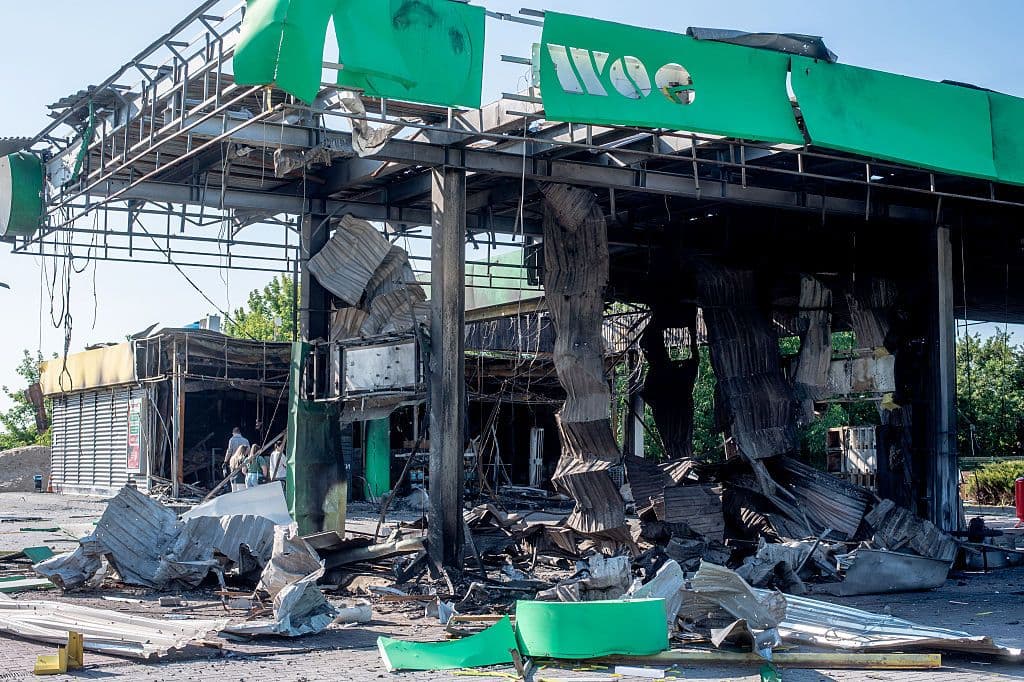
This photograph shows a damaged gas station following a Russian air attack in Kamianske, Dnipropetrovsk region, amid the Russian invasion in Ukraine. (Mykola Synelnykov / AFP via Getty Images)
NATO SUMMIT OPENS IN ANKARA
Zelensky arrived in Ankara for the July 7–8 NATO summit and addressed the Defense Industries Forum, arguing Ukraine’s battlefield experience should make it a “natural” future member of the alliance. “If Ukrainians already know how to fight like this, then it does make sense for these capabilities to become a part of the alliance’s collective defense,” he said, noting Ukraine now intercepts more than 90 percent of Russian Shahed-type drones and eliminates roughly 30,000 Russian troops a month, “nearly 28,000… in June alone,” mostly by drone. He renewed his call for a European “anti-ballistic coalition,” warning the gap “cannot wait until 2030 or beyond” and calling ballistic missiles “Russia’s last major advantage.” NATO Secretary General Mark Rutte praised Ukraine’s strike campaign directly: “You’re hitting deep into Russia when it comes to energy infrastructure or crucial defense industrial capacity,” he said, calling the July 6 barrage on Kyiv a sign of how “desperate Putin is” rather than a sign of strength.
Ukraine signed new Drone Deal cooperation agreements with Estonia, the Netherlands, and Denmark on the summit’s sidelines — its ninth such framework agreement — covering joint drone production, technology sharing, and arms exports; Denmark’s deal builds on the earlier “Danish model” of funding weapons manufacturing directly inside Ukraine. Canada announced more than $900 million in new military aid, including $475 million for ammunition and nearly $400 million for 35 armored vehicles, after Zelensky met Prime Minister Mark Carney; talks continued with Finland’s Alexander Stubb on a similar deal. Nine EU countries co-signed a letter, made public July 7, pressing EU officials Kaja Kallas and Andrius Kubilius to let Ukraine spend its €90 billion support loan on non-European defense products, including US-made PAC-3 interceptors and ATACMS missiles, without waiting for ongoing “mapping exercises.” Allies are expected to pledge €70 billion for Ukraine across 2026 and 2027, though the US is not contributing directly to that figure. CNN reported Trump arrived at the summit in a “bad mood,” having grown skeptical of NATO obligations after allies didn’t back his war against Iran; Trump nonetheless told reporters in Ankara that both Zelensky and Putin “want to make a deal,” describing separate calls with each leader on July 6. Trump and Zelensky are scheduled to meet bilaterally July 8.
CRIMEA’S LOGISTICS COLLAPSE: EIGHT TANKERS SUNK IN A NIGHT
USF commander Robert “Magyar” Brovdi reported Ukrainian forces struck eight Russian shadow fleet tankers — the Venera-3, Sanar-1, Sanar-17, Klimena, Teti, Alexei Savrasov, Ivan Cheremisinov, and Penelopa — along with a dry cargo ship and a ferry transporting gasoline to occupied Crimea through the Sea of Azov overnight. “The shadow fleet is leaving the area,” Brovdi wrote, calling it an “industrial-scale” result. Brovdi separately reported Ukrainian forces struck 44 electrical facilities across Crimea and occupied southern Ukraine between July 1 and 7 alone. Advisor to the Ukrainian presidential office Serhii Sternenko reported fires near the Saky 110 kV and Zakhidno-Krymska 330 kV substations, the Saky railway station, and a known S-400 position. The Ukrainian General Staff reported separate strikes on two railway bridges near occupied Rozdolne and Ichki that Russia uses for military logistics.
Crimean occupation advisor Oleg Kryuchkov confirmed the strikes caused power outages across 18 raions spanning northern, central, western, and eastern Crimea. Kherson Oblast occupation head Vladimir Saldo said the entire occupied oblast is suffering partial or complete power outages and declared a state of emergency July 7; Zaporizhzhia Oblast’s occupation head reported outages there too. Crimean telecom operators introduced emergency roaming July 7 so residents can connect to rival networks if the grid fails completely. Ukraine’s presidential office in Crimea separately released a June summary of the broader campaign: strikes on more than 15 Russian air defense and radar systems, oil terminals in Feodosia, tanks at the Kamysh-Burun heating plant in Kerch, the Hlibiv underground gas storage facility, the Simferopol gas distribution station, and the Crimean Titan chemical plant in Armyansk.
RUSSIA’S OWN PROPAGANDISTS TURN ON THE KREMLIN’S AIR DEFENSE
A prominent Russian milblogger published a lengthy Telegram appeal July 7 calling on the Russian Ministry of Defense to build a unified civil drone-defense command, warning that Russian air defenses are scattered across the military, Rosgvardia, and private businesses with no one actually watching the skies in between. A Kremlin-affiliated commentator separately criticized Moscow for pushing air-defense responsibility onto businesses that lack the capacity to defend themselves, while another called the Russian Aerospace Forces a “fifth wheel” in rear-area defense. One longtime critic of Russia’s failure to adapt put it starkly: “There is no rear in Russia now.” ISW assesses this represents a real reckoning inside Russia’s ultranationalist information space, driven directly by the success of Ukraine’s strike campaign — and that Russia’s recruitment of rear-area air defenders will keep competing with frontline manpower needs it cannot also ignore.
A BRIGADE COMMANDER ARRESTED BY HIS OWN SIDE
A Russian insider source reported the FSB arrested Major General Yuri Zazykin, commander of Russia’s 114th Motorized Rifle Brigade, on corruption charges on July 4, holding him in a pre-trial detention center in occupied Donetsk Oblast; Zazykin had reportedly been about to receive a promotion to deputy commander of the 14th Army Corps. Russian state media previously celebrated Zazykin for leading the campaign that seized Avdiivka in February 2024, and Defense Minister Andrei Belousov awarded him Hero of Russia status in February 2025. ISW notes the Kremlin frequently uses corruption charges to mask the real reasons for purging officials who have fallen out of favor.
DEEP STRIKES CONTINUE: MICROCHIPS, GUNPOWDER, AND A REFINERY THAT STOPPED SELLING FUEL
Ukraine’s General Staff reported striking the Kremniy EL microelectronics plant in Bryansk City — a leading producer of chips for Russian military command, communications, and electronic-warfare systems — and the Bryansk Chemical Plant in Seltso, which manufactures gunpowder, explosives, and rocket fuel components, overnight. Ukrainian forces also hit a fuel depot at Belgorod Airport and the Belgorod Main Gas Pipeline Linear Production Department, causing fires and confirmed power and water outages; acting Belgorod Governor Alexander Shuvaev confirmed the strikes and reported one person killed and three injured in the village of Belovskoe. Footage published July 7 suggested Ukrainian strikes also reached three defense-industrial sites in Moscow Oblast — the Krasnozavodsk Chemical Plant, the Central Scientific Research Institute of Precision Machine Building in Klimovsk, and the Central Scientific Research Institute of Special Machine Building in Khotkovo — prompting Russia’s aviation regulator to restrict flights at Domodedovo, Vnukovo, and Zhukovsky airports overnight.
Reuters reported two industry sources confirming that Ukraine’s July 5–6 strike on the Omsk Oil Refinery halted operations entirely, damaging the CDU-10 unit, responsible for 38 percent of daily output, and shutting down the CDU-11 unit, responsible for another 37 percent; exchange data showed Omsk had stopped selling gasoline and diesel on Russia’s commodities exchange as of July 7. Separately, Ukraine’s Security Service detailed a broader overnight campaign hitting the St. Petersburg Oil Terminal, the Nizhny Novgorod refinery and Starolikeyevo pumping station, the Yaroslavl refinery, the Pervyi Zavod refinery in Kaluga, the Vysotsk terminal in Leningrad Oblast, and the TES-Terminal-1 depot in Kerch — part of a 40-day campaign SBU chief Yevhen Khmara said has already inflicted significant losses on Russian rear-area personnel and logistics.
KOSTYANTYNIVKA: SOLDIERS ON CAMERA CONTRADICT THE KREMLIN
Twenty-one Ukrainian soldiers, mostly unmasked and identified across seven separate units including the 19th Army Corps’ 44th, 100th, and 156th mechanized brigades, the Liyut police special forces regiment, and the 36th Marine Brigade, appeared in video published July 7 confirming they continue holding positions inside Kostyantynivka — recorded, one soldier noted, the day after Putin and Gerasimov publicly claimed the city had fallen. Ukraine’s 28th Mechanized Brigade released combat footage of FPV drones hunting individual Russian infiltrators through the city’s ruins, calling Gerasimov’s capture claim “Fantasy TV.” Ukrainian military research group DeepState assessed active fighting continues throughout the city with Russian forces gaining footholds and infiltrating but Ukrainian defenses still holding overall, while a Ukrainian National Guard spokesperson said Russian troops are increasingly raising flags simply to manufacture seizure claims and using Molniya drones to resupply infiltrators, replicating tactics from Pokrovsk. Even former pro-Russian Donetsk official Pavel Gubarov publicly doubted the Kremlin’s claim, comparing it to Russia’s false assertions about capturing Kupyansk in late 2025 — assertions Zelensky personally disproved by filming himself inside the city. “The analogy with Kupyansk may turn out to be accurate,” Gubarov wrote, “and there will be similar consequences.” ISW’s own mapping shows only the eastern third of the city under confirmed Russian control, with the bulk still contested.
Elsewhere, Russian sources published likely AI-altered flag-raising footage near Ivolzhanske in Sumy Oblast, part of what ISW calls a widening pattern of manufactured advance claims; Russian milbloggers also claimed gains near Bachivsk, Kindrativka, and Andriivka in the same direction, none confirmed. Russian forces continued attritional infiltration attempts in Kupyansk, Velykyi Burluk, Borova, Slovyansk, Dobropillya, Pokrovsk, Novopavlivka, and Hulyaipole without confirmed advances anywhere. A Ukrainian brigade spokesperson denied Russian claims of seizing Losivka near Vovchansk, and a Russian milblogger himself acknowledged Ukrainian forces control half of Mala Tokmachka and that Russia is unlikely to take Orikhiv before autumn. Ukraine’s intermediate-range campaign kept working: strikes on a Buk-M3 system near Hlotivka, supply depots near Volnovakha and Yasynuvata, Hornet drone strikes on trucks near Melitopol, and confirmation that Russian forces have lost their logistics route to the Kinburn Spit entirely.
THE DAY’S TOLL: KHERSON’S SHOPPING MALL, ODESA’S CLUSTER MUNITION
Regional authorities reported at least seven people killed and 88 injured nationwide over the prior 24 hours. Zaporizhzhia Oblast lost three people with 28 injured. Kherson Oblast lost two people with 37 injured, including two children — among them casualties from a Russian aerial bomb attack that hit Kherson’s central shopping mall directly at around 4 p.m. on July 6, causing what the regional governor called serious structural damage. Donetsk Oblast recorded 21 injured with no deaths. Sumy Oblast lost two people, a 57-year-old and a 66-year-old man. In Kharkiv, a Russian guided-bomb and drone strike on the Shevchenkivskyi district killed a 54-year-old man and injured 20 people, including four children, in what Mayor Ihor Terekhov called part of a near-daily pattern of attacks on the city; a separate drone strike on a gas station left one worker with acute stress reaction. In Odesa Oblast, a ballistic missile carrying cluster warheads struck an industrial enterprise, injuring at least nine people, including a 48-year-old man in serious condition; prosecutors opened a war crimes investigation into the strike. Overnight, Russia launched 123 Shahed-type drones and decoys, of which Ukraine downed 108; 12 struck 10 locations and debris fell at five more, damaging infrastructure across Chernihiv, Dnipropetrovsk, Kharkiv, Kherson, Kyiv, Mykolaiv, Poltava, and Zaporizhzhia oblasts. A Russian strike on a repair crew working to restore power in Donetsk Oblast injured 12 utility workers.
BUDANOV: “THERE IS STILL A CHANCE”
Kyrylo Budanov, head of Ukraine’s Presidential Office and former military intelligence chief, said in an interview published July 7 that the active phase of the war could plausibly end in 2026, though another period of escalation likely has to peak first. “There is still a chance, and negotiations were progressing well in the spring. Now we have all entered a phase of escalation,” he told RBC-Ukraine. “To move toward de-escalation, escalation usually has to reach its peak.” He firmly rejected any territorial or constitutional concessions to Moscow — “Do you really think that making Russian a second state language would make them return Crimea?” — and said Ukraine’s Crimea campaign is fundamentally about cutting Russia’s southern logistics rather than an imminent ground offensive to retake the peninsula: “All these hardships serve a greater purpose — bringing Crimea back home,” he said, addressing Ukrainians still living there. On Poland, with the July 11 anniversary of the Volhynia massacres approaching, Budanov said he expects further “escalatory steps” from Warsaw but that Kyiv won’t respond to pressure: “Ukraine will not accept ultimatums from anyone in the world… The last country that tried to issue us an ultimatum was the Russian Federation.” He said Belarus shows no sign of joining the war directly — “A war against Ukraine would end in disaster for Belarus” — but that Russia retains the technical ability to launch another mobilization wave if needed. Separately, Polish Foreign Minister Radosław Sikorski warned Russia is “up to no good” and could stage a false-flag NATO provocation even without intending outright war.
A MURDER CONFESSION CLOSES THE MONACO CASE
Ukraine’s Prosecutor General’s Office and Security Service said July 7 that an active officer of Ukraine’s military intelligence (HUR) confessed to murdering Anastasiia Berezovska, the Ukrainian woman Monaco authorities suspected of carrying out the June 29 bombing that critically injured businessman Vadym Iermolaiev, his wife, and lightly injured their 13-year-old son. Investigators found Berezovska’s body with gunshot wounds after she returned to Ukraine on July 1; both the HUR officer and a former law-enforcement officer accused of acting with him were charged with premeditated murder, and a search of the second suspect’s home reportedly uncovered a basement that appeared to have been used as a torture chamber. The HUR officer said he had acted on his own initiative without informing superiors about his contact with Berezovska or the cryptocurrency and bank transfers investigators traced between them. Military Intelligence Chief Oleh Ivashchenko is personally supporting the investigation. Iermolaiev, a sanctioned former Ukrainian businessman now holding Cypriot citizenship, has denied allegations of collaborating with Russia.
OPERATION AUCHAN: HOW UKRAINE QUIETLY STALLED A RUSSIAN OFFENSIVE FOR SIX MONTHS
Defense Minister Mykhailo Fedorov revealed details of a previously secret operation, codenamed Auchan, that used coordinated bomber-drone strikes and intelligence to systematically disrupt Russian mechanized offensives starting in 2025. In its first phase, Ukrainian bomber drones destroyed more than 800 Russian armored vehicles and artillery pieces over multiple nights, striking more than 50 kilometers behind the front line; a second phase launched in June 2026 shifted focus to Russian artillery, hitting 231 more targets, 171 of them destroyed, bringing the combined total to 1,180 targets struck across both phases. “In just three days, the Defense Forces hit 949 enemy targets,” Fedorov said, crediting the National Guard’s Lasar’s Group and the 412th Separate Brigade of Unmanned Systems NEMESIS. “It is about disrupted enemy plans, fewer opportunities for their offensive, and more chances to save the lives of our soldiers.” Fedorov separately said Ukraine’s ground robotic systems have completed more than 50,000 logistics and evacuation missions since January, and that the number of units using such robots has nearly doubled to 230.
RAIDS, A GAG ORDER, AND RUSSIA’S RETURN TO THE OLYMPICS
Ukraine’s State Bureau of Investigations carried out roughly 70 searches July 7 at the offices, contractor sites, and family homes connected to Vyriy Industries, a leading Ukrainian drone manufacturer, investigating alleged price gouging on government drone contracts worth 7 billion hryvnia ($157 million) and possible use of shell companies to launder funds. CEO Oleksii Babenko denied the allegations at a press conference, noting his firm sells some of the cheapest drones on the market, and said searchers found 40 million hryvnia ($900,000) in cash he insisted was legitimate payroll withdrawals. Industry figures, including Victory Drones co-founder Maria Berlinska, voiced concern the case could signal a broader campaign against Ukraine’s defense-tech sector rather than a genuine investigation.
Separately, a Kyiv judge issued what appears to be an unprecedented pretrial injunction banning the Anti-Corruption Action Center, outlet Slidstvo.info, and journalist Alina Stryzhak from publishing an investigation into 143 properties allegedly owned by the brother of State Investigation Bureau chief Oleksiy Sukhachov. Anti-corruption groups called the ruling a direct violation of press freedom protections and said they would appeal; the judge who issued it, Serhiy Vovk, has a lengthy record of rulings anti-corruption watchdogs consider politically motivated. And the International Olympic Committee lifted its suspension of Russia’s Olympic Committee, reinstating it after Russia’s National Olympic Committee removed sports organizations from occupied Ukrainian territories from its structure — while noting Russian athletes’ participation in specific competitions remains subject to neutral-status rules, and that the IOC “will continue to closely monitor the situation.”
By the end of July 7, Ukraine had spent the day proving two different kinds of strength at once: drones sinking tankers in the dark, and a president in a suit telling the world’s most powerful alliance, in plain language, exactly what Ukraine still needs to survive the next attack. Whether Ankara delivers it before the next Shahed lands is, as always, a question for tomorrow.
A PRAYER FOR UKRAINE
1. For the Two Men Sumy Lost Today
Lord, a 57-year-old man and a 66-year-old man in Sumy did not survive today’s attacks. We do not know their names beyond their ages, but You do. We ask for comfort for whoever mourns them tonight, and for a city that keeps counting its dead in ages because there is no time to learn much more before the next strike.
2. For Everyone Inside Kherson’s Shopping Mall
God of the ordinary places we gather, a guided bomb hit the middle of a city’s shopping center this week, the kind of building where people go for nothing more dangerous than groceries or a birthday gift. We pray for everyone who was there, for the shock that doesn’t leave quickly, and for a country where simple errands keep becoming acts of survival.
3. For the Soldiers Still Holding Kostyantynivka
Father, twenty-one soldiers showed their faces on camera this week just to prove they are still standing in a city the world was told had already fallen. We pray for their safety in the ruins they are defending, for accurate news to reach their families, and for the day this becomes unnecessary — when the truth on the ground and the truth in the headlines are finally the same thing.
4. For a Complicated Grief in the Monaco Case
Lord, this week a Ukrainian intelligence officer confessed to killing a woman suspected of trying to kill a Ukrainian family, and revealed a basement built for torture. We do not fully understand this story, and we do not ask You to make it simple. We ask for justice that is real, not convenient, and for peace for a thirteen-year-old boy who nearly lost both of his parents in an explosion far from any front line.
5. For the Diplomats in Ankara, and Everyone Waiting on Their Words
God of nations, Ukraine’s president stood before NATO today and said, plainly, what his country still needs to survive. We pray that the people with the power to answer him do so quickly, and we ask for Your mercy on every family in Kherson, Sumy, Odesa, and Kostyantynivka who cannot afford to wait for a summit to finish talking.