
Ukraine Daily Briefing | July 6, 2026 | Day 1,594 of the Full-Scale Invasion
Prepared by Dayana Bozhyk
Russia launched its fourth large-scale missile and drone strike against Ukraine since June 1 overnight, firing 419 missiles and drones at Kyiv and killing at least 22 people, including in the nearby town of Vyshneve, where a secondary detonation caused severe damage; Kyiv Mayor Vitali Klitschko declared July 7 a Day of Mourning. Ukraine’s air defense could not intercept a single one of the attack’s ballistic or anti-ship missiles due to a critical shortage of Patriot interceptors. Hours later, Ukrainian drones struck Russia’s Omsk Oil Refinery, its largest, more than 2,500 kilometers from the border — the deepest strike of the war — along with refineries in Yaroslavl and Kaluga and a naval terminal near St. Petersburg, while a separate 48-hour campaign knocked out power across the entirety of occupied Crimea for the first time. Ahead of this week’s NATO summit in Ankara, US Vice President JD Vance said Russia’s capacity for further offensive gains is “vanishingly small,” and Trump confirmed he will meet Zelensky on July 8 to discuss ending the war.
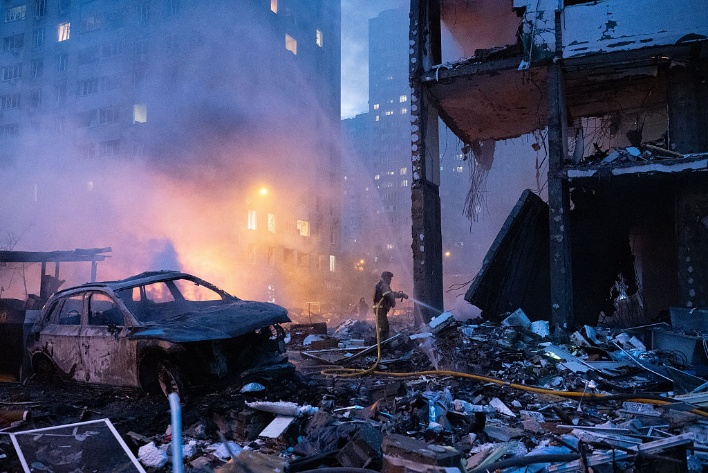
A rescuer extinguishes a fire following a Russian missile and drone attack in Kyiv, Ukraine. (Danylo Antoniuk / Ukrinform / NurPhoto / Getty Images)
THE DAY’S RECKONING
Kyiv had barely finished counting its dead from Thursday’s attack — 31 people, a number the city was still confirming as rescue crews cleared the last of the rubble — when Russia hit it again. Four hundred nineteen missiles and drones, the fourth mass strike in five weeks, and this time not one ballistic missile got stopped, because Ukraine has run out of the interceptors that stop them. A secondary explosion in Vyshneve, just outside the city, tore through a neighborhood that has nothing to do with any front line. Twenty-two people did not survive the night.
Ukraine’s answer landed the same hours, on the other side of a continent: a drone found Russia’s largest oil refinery in Omsk, 2,500 kilometers away, deeper into Russia than any Ukrainian weapon has ever reached. By morning, every one of Russia’s eleven largest gasoline producers had been hit at least once. By the same morning, all 2.5 million people in occupied Crimea had no electricity at all — the first time that has happened in this war. Two facts, one day: a country that still cannot stop a missile from hitting an apartment building, and a country that can now reach almost anywhere the other one has anything left to protect.
RUSSIA’S FOURTH MASS STRIKE SINCE JUNE: KYIV HIT AGAIN
Russia launched 23 Iskander-M/S-400 ballistic missiles, six Zirkon/Onyx anti-ship missiles, 33 Kh-101 cruise missiles, six Kalibr cruise missiles, and 351 Shahed-, Gerbera-, and Italmas-type strike drones overnight — 419 weapons in total, aimed overwhelmingly at Kyiv. Ukrainian air defense downed 326 drones and 37 missiles, including all six Kalibrs and 31 of the Kh-101s, but every ballistic and anti-ship missile got through; 29 ballistic weapons and 18 drones struck 34 locations, with debris falling at 16 more. Zelensky confirmed the strikes killed 22 people and injured nearly 90 across Kyiv and the surrounding region, with the heaviest destruction in the Podilskyi and Darnytskyi districts, where more than 30 residential buildings were hit; officials said the toll climbed steadily through the morning as rescue crews worked through the wreckage. In nearby Vyshneve, a secondary detonation caused catastrophic damage, prompting the evacuation of more than 600 residents and a direct commitment from Prime Minister Yulia Svyrydenko to fund emergency repairs from the state reserve fund; Zelensky demanded a full investigation into what caused the secondary blast. Kyiv Mayor Vitali Klitschko declared July 7 a Day of Mourning for the second time in five days.
Ukrainian Air Force spokesperson Colonel Yuriy Ihnat said ballistic missiles caused the large majority of the night’s destruction and confirmed that only Patriot systems can intercept Russia’s Iskander-M, S-400, Zirkon, and Onyx missiles — systems Ukraine and the rest of the world are producing more slowly than Russia is firing them. Defense Minister Mykhailo Fedorov said Ukraine has already contracted Patriot deliveries with partners, but that they will not begin arriving until 2027. ISW noted that Russia has been steadily reducing the number of ballistic missiles per strike package since June — 41 on June 1–2, 40 on June 14–15, 28 on July 1–2, and 23 overnight — a sign Moscow believes it no longer needs large ballistic barrages to guarantee hits, since Ukraine’s interceptor stocks are already so depleted that even smaller numbers get through untouched. Ukraine’s UN mission requested an emergency Security Council meeting, warning that “every Russian missile launched against Ukraine carries a message far beyond our borders.” UN Secretary-General António Guterres condemned the strike, and UN Humanitarian Coordinator for Ukraine Matthias Schmale, visiting strike sites, called the suffering “unbearable.” Foreign Minister Andrii Sybiha said Putin “will keep aiming missiles at sleeping children” unless Ukraine gets more air defense before the Ankara summit.
UKRAINE’S DEEPEST STRIKE YET: OMSK AND THE REFINERIES RUSSIA CAN NO LONGER HIDE
Ukraine’s General Staff confirmed its forces struck the Omsk Oil Refinery — Russia’s largest, with a capacity of more than 21 million metric tons a year — overnight, more than 2,500 kilometers from the Ukrainian border and the deepest strike of the war. Omsk Oblast Governor Vitaly Khotsenko acknowledged the strike; Ukrainian officials said it was the last of Russia’s eleven largest gasoline producers to be hit since Ukraine’s long-range campaign intensified. Zelensky said Ukraine used upgraded Fire Point drones for the strike: “Siberia is now also within reach of Ukrainian precision,” he said. The same overnight campaign hit the Slavneft-Yanos refinery in Yaroslavl — one of Russia’s largest, with 15 million tons of annual capacity, struck at least nine times so far in 2026 — along with the Novatek Ust-Luga oil terminal and Vysotsk port near St. Petersburg, the First Plant refinery in Kaluga Oblast, and the base of Russia’s 26th Missile Brigade near Luga in Leningrad Oblast. Yaroslavl’s governor claimed Russian air defense downed more than 70 drones approaching the city; debris still injured two people.
Three sources in pro-government Russian media told independent outlet Verstka that the Kremlin has ordered state-controlled outlets to stop publishing footage of Ukrainian strikes inside Russia and focus instead on the consequences of Russian strikes on Ukraine — a directive Telegram channels Mash, Baza, and Shot have largely followed, ignoring recent strikes on the Slavyansk-on-Kuban and Kstovo refineries and a Penza defense plant entirely. Kremlin spokesperson Dmitry Peskov, asked about the strikes, deflected to Russian footage instead, saying only that Putin is briefed “several times a day” on the attacks. The Financial Times reported that US intelligence has helped Ukraine identify flight paths that bypass Russian air defenses, contributing to a record 16 successful refinery strikes in May and at least 194 total strikes on Russian refineries since the start of 2026 — an eleven-fold increase over the same period last year. “Putin has made another fatal strategic error in this war, thinking for some reason that time was only on his side,” Ruslan Pukhov, director of Moscow’s Center for Analysis of Strategies and Technologies, told the FT. “He couldn’t get Ukraine to capitulate, but he gave them enough time to develop mass production of ‘deep strikes.'”
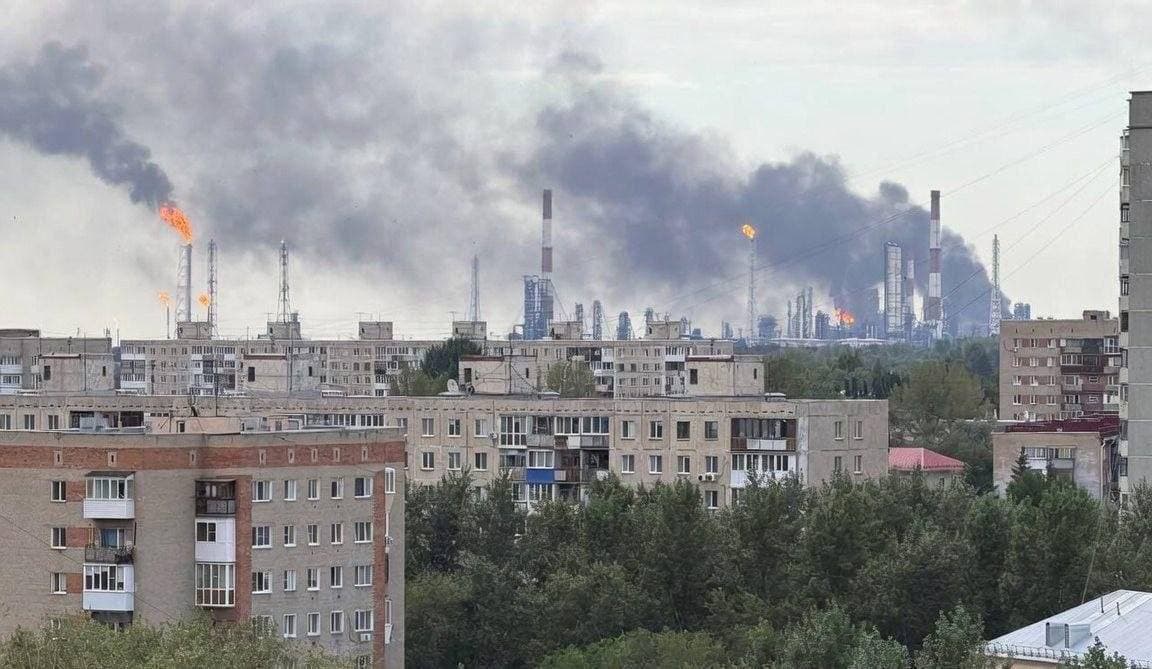
Smoke rises over the Russian city of Omsk following a Ukrainian strike on the Omsk oil refinery overnight. (Andryushchenko Time/Telegram)
CRIMEA GOES COMPLETELY DARK
Ukrainian drones knocked out electricity across the entirety of occupied Crimea overnight — a peninsula of 2.5 million people — in what Kyiv Post called Ukraine’s most ambitious single-night attack on Russian power infrastructure of the war; another 3 to 3.5 million people in occupied Kherson, Zaporizhzhia, and Donetsk oblasts lost power partially. USF commander Robert “Magyar” Brovdi said his forces struck 47 targets in Crimea overnight, including the 330-kilovolt Simferopolska substation near Strohanivka, hit for at least the second time since June 25; two Russian S-400 air defense systems and a Nebo-U radar station in Kerch; and two Russian shadow fleet tankers carrying a combined 7,000 metric tons of fuel to Crimea through the Sea of Azov. “The Crimean power switch is in the ‘off’ mode,” Brovdi wrote. “This isn’t about turning off the electricity, but about dismantling the enemy’s military rear services in Crimea… It’s time for them to pack their bags and head to the train station — to Russia.” Ukraine’s Security Service separately struck three aircraft hangars at the Hvardiiske airfield, a Pantsir-S2 air defense system near Simferopol, and the TES-Terminal-1 oil depot in Kerch, while Ukraine’s Special Operations Forces hit a Volgoneft-class oil tanker in the Sea of Azov and a second target at the Kerch terminal. HUR separately confirmed footage from an earlier strike showing a kamikaze drone destroying a Russian MiG-29 as it was being refueled at Hvardiiske.
Sevastopol’s occupation head, Mikhail Razvozhayev, blamed the outage on “technological disruptions… caused by external influences” and confirmed one resident died; Crimean occupation leader Sergei Aksyonov admitted “some difficulties” and said power would not be fully restored soon. Hotels in the resort towns of Alushta and Yalta reported rolling blackouts. Two drone packages also hit the port of Mariupol, and fires were confirmed near the Russian port of Taganrog, where Ukrainian officials said Russian forces had been storing combat and logistics vehicles. Brovdi said Ukrainian forces have knocked out 37 Crimean energy sites since June 1 alone, with roughly 90 percent of strikes concentrated on the peninsula itself.
NO ADVANCES, BUT UKRAINE KEEPS GAINING GROUND IN THE SOUTH
Neither side made confirmed advances anywhere along the front on July 6, but Ukrainian forces continued pressing an advantage in the Oleksandrivka direction: a Russian milblogger himself acknowledged Ukrainian forces have seized Piddubne and advanced into central Voskresenka and Myrne, confirming Russia holds no part of the latter settlement despite earlier claims. Geolocated footage showed Ukrainian forces still operating in central and northern Kostyantynivka in areas Russian sources previously claimed to have captured, and former pro-Russian separatist leader Pavel Gubarev publicly cast doubt on the Kremlin’s seizure claim, saying none of his Russian military contacts could confirm it and comparing the situation to Russia’s earlier false claims about Kupyansk. Ukraine’s 7th Rapid Reaction Corps reported additional drone strikes on Russian fuel, ammunition, and drone warehouses in southern Pokrovsk and a logistics depot in Novooleksandrivka. Geolocated footage confirmed a Ukrainian strike on a Russian S-400 system 96 kilometers inside Bryansk Oblast, and Ukraine’s General Staff reported hitting a railway overpass, drone depot, and equipment concentration in occupied Luhansk Oblast, along with fuel tankers on the Kalanchak-Armyansk highway in occupied Kherson Oblast. Russian forces intensified small infantry assaults in Kharkiv Oblast and northern Sumy Oblast without being able to mount larger mechanized attacks, Ukrainian officers reported, and ISW identified two Russian units — the Chechen Akhmat Spetsnaz Reconnaissance and Strike Center and the BARS-Bryansk volunteer detachment — operating on the frontline for the first time. In Sumy City, Russian drone strikes killed two people on July 6, regional officials said, part of a week in which Russian forces struck 109 settlements across the wider Kharkiv-Sumy border region, killing 14 and injuring 143, including two children among the dead.
A HELICOPTER CREW LAID TO REST IN BRODY
Ukraine’s 16th Separate Army Aviation Brigade “Brody” confirmed that a four-man Mi-8 helicopter crew — Captain Yuriy Voron, Major Valentyn Mukshynov, Senior Lieutenant Bohdan Khmil, and Junior Sergeant Mykhailo Deriaha — was killed June 30 while flying a combat mission to intercept Russian drones near Starytsivka in Poltava Oblast. A farewell ceremony was scheduled for July 7 at Brody’s Alley of Heroes, followed by services at the Church of the Exaltation of the Holy Cross. “They fulfilled their military duty to the very end, defending Ukrainian skies, covering our infantrymen, supporting combat units, and saving the lives of Ukrainian soldiers,” the Brody City Council said. Voron, a Brody native who flew dozens of combat sorties, held the Orders of Bohdan Khmelnytsky and Danylo Halytsky; Mukshynov had served in a UN peacekeeping mission in the Democratic Republic of Congo before the invasion. All four leave behind parents, wives, and children.
RUSSIA’S FUEL CRISIS BY THE NUMBERS
A detailed ISW review found gasoline and diesel shortages have now spread to 78 of Russia’s 83 federal subjects, with official purchase limits imposed in 48 of them; only five regions, including Chechnya and Kalmykia, have avoided restrictions entirely so far. Russian diesel production fell by a million metric tons in April and another 600,000 tons in May because of continued strikes on petrochemical infrastructure, straining a military that depends on diesel more heavily than gasoline and is increasingly facing its own supply issues in sectors like Lyman and Hulyaipole. Putin has publicly called the shortages “not critical,” while Deputy Prime Minister Alexander Novak called the situation “challenging but manageable” and Peskov blamed global oil price swings rather than Ukrainian strikes. The Kremlin’s countermeasures — tapping strategic reserves, allowing lower-quality fuel, shortening refinery maintenance windows, importing gasoline from Belarus, Kazakhstan, and India — address the symptoms without touching the cause, ISW assessed, since none of it restores the air defense capacity Russia would need to actually stop the strikes.
WASHINGTON’S SIGNALS: TRUMP, VANCE, AND A WAR “GETTING CLOSE”
Trump told reporters July 6 that he believes Putin “feels pressure” over the war and that both leaders want it to end. “We’re in talks and we’ll see if we can get it ended,” he said, adding, “I think we’re getting much closer than people realize.” Trump separately called drones “machines of death,” calling their battlefield role unexpected. In a Times interview published the same weekend, Vice President JD Vance said Russia’s offensive capacity has nearly run out: “The amount that they can get through continued offensive operations is vanishingly small — and getting close to zero,” he said, crediting Ukraine’s shift toward a defensive, drone-heavy strategy under Trump administration encouragement. Officials confirmed Trump and Zelensky will meet July 8 on the sidelines of the NATO summit in Ankara to exchange ideas on ending the war; Trump is expected to present his own vision for a peace framework and plans a follow-up call with Putin afterward. Zelensky is also set to attend a July 7 dinner with NATO leaders, European Council President António Costa, European Commission President Ursula von der Leyen, and South Korean President Lee Jae-myung. A draft declaration seen by Reuters shows NATO allies plan to pledge €70 billion for Ukraine in 2026, with comparable support expected in 2027, though the funding largely repackages existing bilateral and EU commitments rather than adding genuinely new money, and the US is not expected to contribute directly. NATO Secretary General Mark Rutte highlighted a separate $139 billion increase in defense spending by European allies and Canada in 2025, part of the pressure on member states to turn last year’s pledge of 5 percent of GDP on defense by 2035 into concrete national plans.
THE KREMLIN’S INFORMATION WAR: BRITAIN AS REVENGE, CENSORSHIP AT HOME
Russia’s Foreign Intelligence Service claimed in a statement carried by state media that Britain’s support for Ukraine is driven by lingering resentment over the 1853–1856 Crimean War rather than any response to Russia’s 2022 invasion, framing London as the “true architect” of the conflict. The claim echoes decades-old Slavophile rhetoric branding the West morally corrupt, and fits a broader Kremlin pattern — also used to describe Kyiv’s government as Nazi-controlled — of recasting Russian aggression as a defensive reaction to Western scheming. Research cited in the claim found Russian public hostility toward Britain has risen sharply since 1991 and now rivals or exceeds hostility toward the United States, a shift researchers link to warming US-Russia diplomatic contacts under the Trump administration.
PHASE ZERO CONTINUES: A BRITISH CARRIER, POLAND, AND LUKASHENKO’S BALANCING ACT
Britain’s Defense Ministry said a Russian Tu-142 “Bear-F” maritime patrol aircraft repeatedly approached the carrier HMS Prince of Wales at low altitude in the Norwegian Sea on June 2 in an “unsafe and unprofessional” manner before dropping sonobuoys nearby; two British F-35s intercepted and escorted the aircraft away. ISW assesses the incident is consistent with Russia’s broader “Phase Zero” campaign to test NATO’s resolve through risky, deniable provocations. Polish minister Tomasz Siemoniak said Polish authorities have identified suspicious activity near military facilities and Polish-Ukrainian cooperation infrastructure, though with no sign of an imminent specific threat; Polish Foreign Minister Radosław Sikorski called any Russian attempt to test NATO’s resolve “great recklessness and madness.” In Belarus, President Alexander Lukashenko told graduating military academy cadets that Belarusian troops will not fight in Ukraine — “No one will send you into this slaughter,” he said — while simultaneously blaming an international “war party” and EU “militarization” for prolonging the war, a familiar dual message from a leader who has both hosted Russian nuclear weapons and repeatedly resisted direct participation in the invasion.
NEW TECH: A JET-POWERED INTERCEPTOR’S FIRST KILL, AND DRONES HEADED TO AMERICA
Ukrainian-British defense firm Firebolt Engineering said its Griffen interceptor drone achieved its first confirmed kill of a jet-powered Shahed during the overnight barrage, intercepting the target likely over southern Ukraine. The Griffen, a joint venture between Ukraine’s Technary and UK-based Grenadyr, flies faster than 350 kilometers per hour, operates above 7,500 meters, and has a range of up to 120 kilometers — built specifically to catch jet-modified Shaheds that fly at more than twice the speed of older propeller-driven models. Separately, Ukraine’s export control service issued its first-ever permit allowing a finished Ukrainian combat drone — built by F-Drones — to ship to the United States, a milestone for Ukraine’s push to become a defense exporter rather than only a battlefield customer.
By the end of July 6, the war had delivered its usual double ledger: a capital city burying more of its dead while declaring its second Day of Mourning in five days, and a refining region on the other side of a continent watching its last untouched facility catch fire. Neither the missiles nor the drones stopped for a NATO summit two days out — if anything, both sides seemed determined to make sure Ankara had something fresh to discuss.
A PRAYER FOR UKRAINE
1. For Vyshneve, and Everyone Still Not Home
Lord, a town outside Kyiv that has nothing to do with any front line lost its safety overnight to a secondary blast that tore through ordinary streets. Six hundred people fled their homes by morning. We pray for their safe return, for clear answers about what happened, and for everyone still counted among last night’s twenty-two.
2. For a Helicopter Crew Who Did Not Come Home
Father, four men — a captain, a major, a lieutenant, a sergeant — died flying toward Russian drones instead of away from them, protecting soldiers on the ground who will likely never know their names. We pray for the parents, wives, and children they left behind, and for peace as Brody buries them tomorrow.
3. For Every City That Went Dark Last Night
God of light, all of occupied Crimea lost power at once for the first time in this war — two and a half million people, whatever side of this conflict they are on, sitting in the dark tonight because of a war none of them started. We do not know how to weigh military necessity against a peninsula full of homes. We ask only that You watch over everyone in the dark, on every side of every line.
4. For the Diplomats Walking Into Ankara
Lord of nations, this week brings Ukraine’s president and America’s president into the same room again, with a vice president publicly saying Russia is nearly spent and a Kremlin still insisting it can win. We pray for wisdom for everyone at that table, and for a plan that actually holds, not just another headline before the missiles fly again.
5. For Every Family Waiting on News From a Rescue Site
God of comfort, tonight in Kyiv, in Vyshneve, in Podilskyi and Darnytskyi, families are still waiting to hear whether someone they love is among the confirmed or the missing. We ask for strength for the rescue workers still digging, patience for the families still waiting, and, in Your mercy, an end to the nights that make this prayer necessary at all.