
Ukraine Daily Briefing | July 9, 2026 | Day 1,597 of the Full-Scale Invasion
Prepared by Dayana Bozhyk
An anonymous Russian general told journalist Dmitry Kolezev that Putin still believes Russian forces will seize all of Donbas by the end of 2026 and is rejecting negotiations on that basis, even though the general called the required recruitment pace of 55,000 to 60,000 soldiers a month “unrealistic.” Kremlin spokesperson Dmitry Peskov struggled to respond to Trump’s Patriot production announcement, calling it a “misconception,” while Ukrainian forces struck 35 Russian vessels in the Sea of Azov over four nights and hit oil depots in Stavropol and Tver, deep inside Russia. Russian attacks nationwide killed at least 12 people and injured 100 more, and Ukraine’s Security Service formally charged two men, including a military intelligence officer, with murdering the woman suspected of the June 29 Monaco bombing. In Lviv, a confrontation between mobilization officers and residents turned violent, drawing a sharp rebuke from Presidential Office head Kyrylo Budanov.
THE DAY’S RECKONING
An anonymous Russian general said something on July 6 that no Kremlin spokesperson would ever say on the record: that Putin’s plan to take all of Donbas by the end of 2026 would require recruiting 55,000 to 60,000 men a month, a number the general himself called impossible. Putin believes it anyway, according to Reuters sources close to the Kremlin — believes it enough to keep rejecting ceasefire talks, betting that Ukraine and the West will crack before his own math does.
While that story was making its way through Western newsrooms, gasoline tankers kept burning in the Sea of Azov — 35 of them in four nights, the most sustained naval strike campaign of the war. A Russian general’s confession and a burning tanker are the same kind of evidence, really: proof that the war looks nothing like what Moscow keeps telling itself. In Lviv, that gap showed up somewhere else entirely — in a crowd of civilians surrounding a mobilization van, tearing off its bumper, while Kyrylo Budanov warned them from his office that the country they were attacking is the only one standing between them and the army that actually wants to hurt them. Nobody in this war, it turns out, has entirely stopped lying to themselves. Some of the lies just cost more than others.
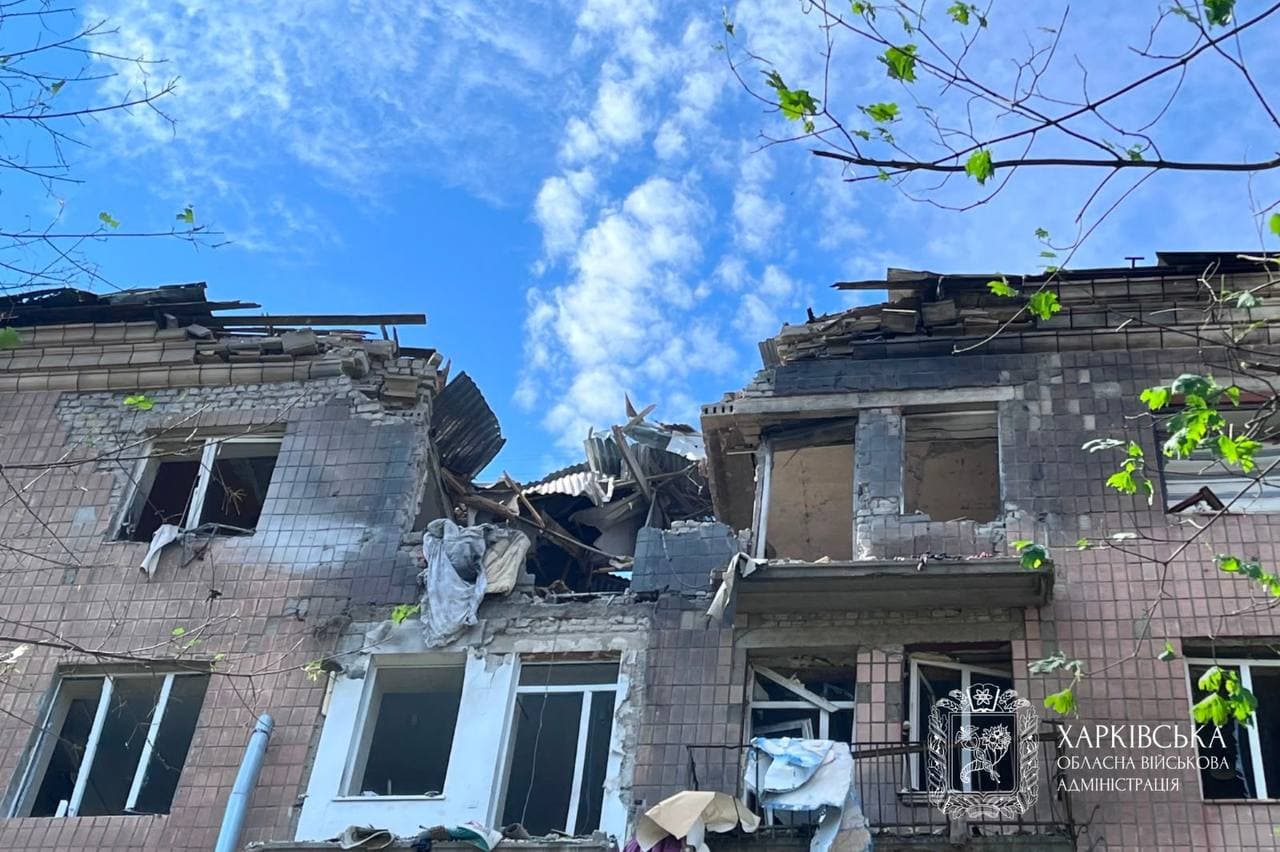
A residential building damaged in a Russian attack on Kharkiv Oblast. (Local authorities/Telegram)
THE KREMLIN CAN’T FIND ITS STORY
Kremlin spokesperson Dmitry Peskov spent July 9 trying to downplay Trump’s July 7 decision to license Ukraine to produce Patriot interceptors, calling it a “misconception” rather than an escalation and claiming, inaccurately, that the US has “always” supplied Ukraine with military aid. Peskov also said Trump did not call Putin on July 8, though Putin “remains open” to talking. Foreign Ministry spokesperson Maria Zakharova repeated a separate line — that Washington remains disinterested in European security while Europe prepares for a “long-term conflict” with Russia. ISW assesses the inconsistency reflects a Kremlin genuinely struggling to respond to a Trump administration that has begun contradicting Russian talking points: Secretary of State Marco Rubio confirmed July 6 there was never a written agreement from the Alaska summit, undermining months of Russian claims that Washington had privately agreed Ukraine should cede Donbas. Trump himself said the Ukrainian refinery strikes were “an escalation that can help lead to an end” to the war, prompting Peskov to warn that Russia would respond to any Western pressure not with concessions but by “creating a larger security zone” — Kremlin shorthand for seizing more Ukrainian territory. Separately, Italy’s foreign minister announced the expulsion of two Russian diplomats accused of espionage, giving them three days to leave the country.
A LEAKED WARNING: PUTIN STILL THINKS DONBAS FALLS THIS YEAR
Russian journalist Dmitry Kolezev published an interview July 6 with an anonymous active-duty Russian general who said Russian military command continues reporting to Putin that Donbas will fall entirely by the end of 2026 — a claim a July 9 Reuters report, citing three Kremlin-adjacent sources, said Putin genuinely believes, and which is driving his continued refusal to negotiate on the current front line. The general said meeting that timeline would require recruiting 55,000 to 60,000 servicemembers a month to offset Russia’s casualty rate, calling the figure “unrealistic” given falling recruitment and manpower shortages. He said Putin remains committed to a theory of victory built on outlasting Ukraine and Western support through sheer attrition, and that the Kremlin is betting Ukraine will suffer a domestic political crisis that forces concessions — with Putin’s public claims about capturing Kostyantynivka and Kupyansk designed specifically to convince Washington and Europe that Russian victory is inevitable and further support is pointless. The general said Peskov’s July 5 comment that Russia’s “special military operation” has become a “real war” is likely condition-setting for eventual mobilization, either declared publicly or carried out covertly under a November 2025 law letting Russia deploy reservists without formally announcing it. ISW notes mobilization remains deeply unpopular in Russia and is ultimately a decision only Putin can make, contingent on his own — by ISW’s continued assessment, badly distorted — read of the battlefield.
UKRAINE’S TANKER CAMPAIGN ENTERS A NEW PHASE
USF commander Robert “Magyar” Brovdi reported Ukrainian forces struck 14 more Russian vessels in the Sea of Azov overnight — 12 gasoline tankers, a tugboat, and a dry cargo ship, including the Chelsea-6, Aura, Sonar-1, Ilya Repin, Galiaskar Kamal, Venera-3, and Penelope — bringing the four-night total to 35 tankers, cargo ships, and support vessels struck since July 6. “The shadow fleet of the worms is thinning,” Brovdi wrote. The same anonymous Russian general told Kolezev that Russia’s General Staff disbanded the Crimean Defense Group in 2024 for lack of naval equipment, leaving Russia with no effective way to protect the seaborne fuel routes it now depends on. Crimea’s occupation power utility, Krymenergo, confirmed complete outages in Dzhankoi, Krasnoperekopsk, and Armiansk districts, with rolling supply elsewhere; one resident described the north of the peninsula as being treated “as an afterthought,” while another wrote that people and livestock alike were going without water or power for days at a time. Putin ordered Russia’s Finance Ministry to issue fuel subsidies to Crimean residents “as quickly as possible,” saying “citizens shouldn’t feel a burden” from the crisis — an order Sevastopol’s occupation head, Mikhail Razvozhayev, tempered by admitting the region receives only a third of its daily fuel needs even with a “colossal effort” underway.
DEEP STRIKES CONTINUE: STAVROPOL, TVER, AND A STEALTH JET THAT COULDN’T SAVE OMSK
Ukrainian forces struck oil depots in Stavropol Krai and Tver Oblast overnight, roughly 585 and 520 kilometers from the front respectively, both confirmed by regional governors and geolocated footage showing fires; Ukraine’s Security Service said the strikes hit the Krasnaya Zvezda facility in Tver and the Stavropolskaya depot, both key gasoline and diesel distribution points. Ukrainian forces also struck the Yug Rusi oil terminal in Bataysk, Rostov Oblast, and two tankers in nearby Taganrog Bay, while Zelensky said a separate strike hit an unspecified fuel storage facility roughly 800 kilometers from the front. New satellite imagery confirmed fuel-tank damage at the Borisoglebsk airbase from the earlier July 7 strike. Separately, Kyiv Post reported that Russia deployed its newest Su-57 stealth fighters to defend the Omsk refinery during Ukraine’s July 5–6 strike — and that the jets managed to shoot down only one of the attacking drones before the refinery was hit anyway. Analysts noted the rare combat sighting followed photos suggesting Russia has begun reconfiguring some Su-57s for anti-drone duty, mounting missiles externally in a way that compromises the aircraft’s stealth profile — a sign, one outlet suggested, of how few other options Russia has left to protect high-value targets from Ukraine’s drones.
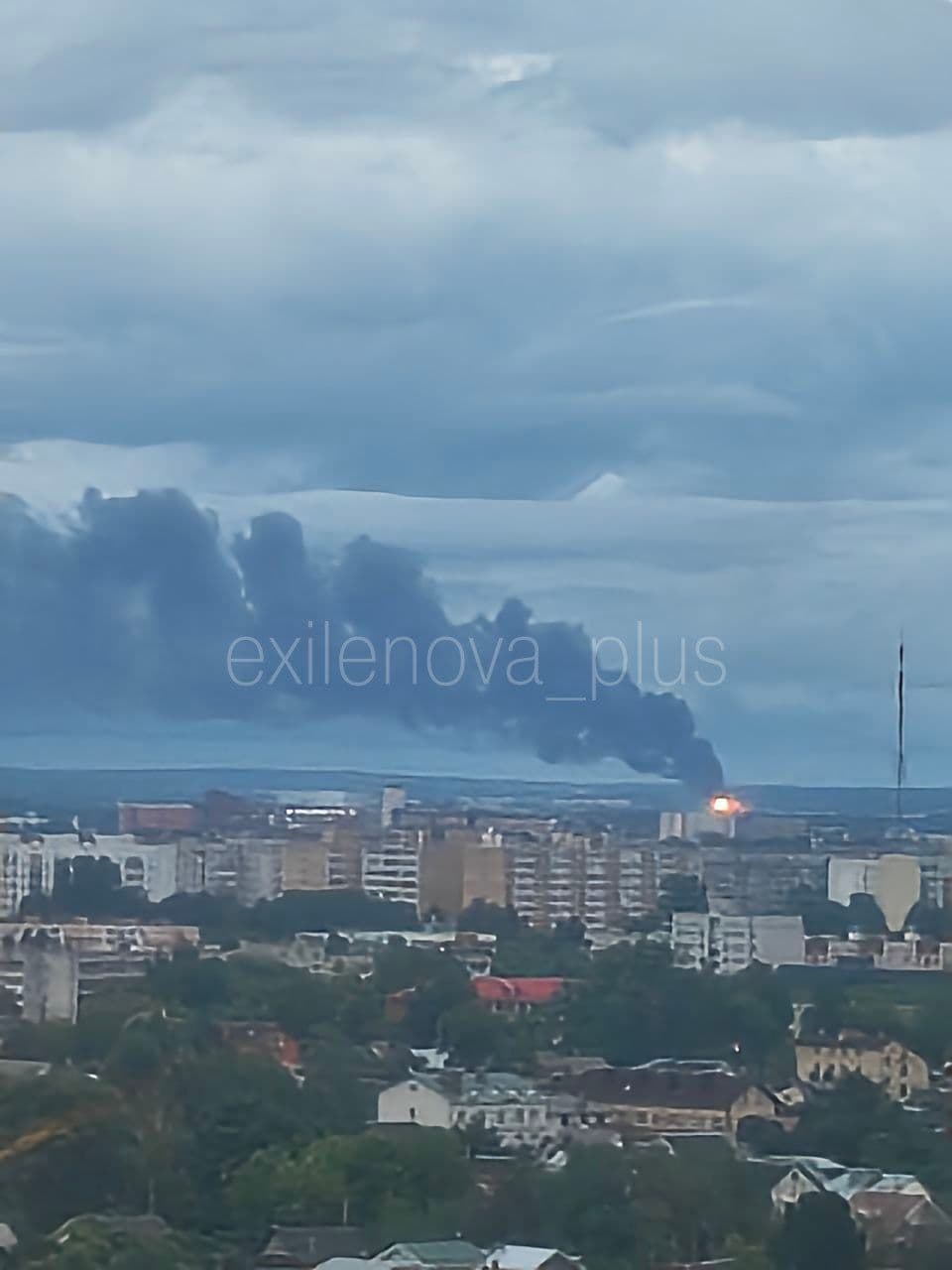
A Russian oil depot purportedly burns in the city of Tver overnight following a Ukrainian attack. (Exilenova_plus/Telegram)
NO ADVANCES, FRONTLINES HOLD
Neither side made confirmed gains anywhere on July 9. In Kherson City, Russian forces struck a minibus, injuring the driver and seven passengers, then conducted a double-tap strike on the first responders who came to help, injuring the driver and two medics — a tactic Ukrainian prosecutors are investigating as a war crime. Ukraine’s intermediate-range campaign continued hitting Russian logistics in Luhansk, Donetsk, Zaporizhzhia, and Kherson oblasts, and USF forces struck 45 targets across occupied Crimea overnight, including the Saky Thermal Power Plant, three oil depots, two vehicle maintenance sites, and a Russian jamming station. Russian forces continued a parallel campaign against Ukrainian civilian fuel infrastructure, striking gas stations in Kharkiv, Zaporizhzhia (killing one person and injuring three), Dnipropetrovsk, and Chernihiv oblasts; one Russian milblogger claimed no gas station remains operational along a 150-kilometer stretch of the Dnipro-Kharkiv highway. Ukraine’s Defense Ministry reported Ukrainian forces intercepted almost 5,300 Russian drones and missiles in June — 90 percent of Shahed-type drones but only 40 percent of ballistic missiles — underscoring where Ukraine’s air defense gap remains most dangerous even as its interception rate against slower threats stays strong.
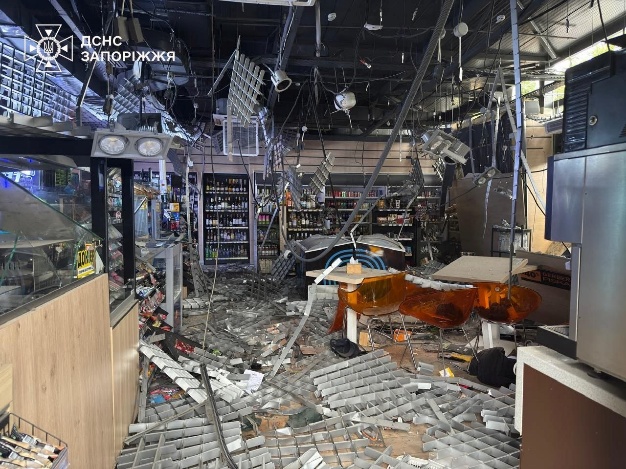
Pictured is the aftermath of a Russian strike on a gas station in Zaporizhzhia. Officials said at least five people were injured in the attack. (Ukraine’s State Emergency Service)
BUILDING THE SHIELD: POLAND’S ROLE IN PATRIOTS, AND A MEETING ON FREYA
Polish Defense Minister Władysław Kosiniak-Kamysz said Patriot interceptor production in Ukraine could begin within weeks, and that Poland — one of only four NATO countries, alongside Germany, Sweden, and the Netherlands, cleared to receive Patriot production and servicing technology — would need to be directly involved in any transfer. “Poland is ready to immediately begin servicing and take further steps,” he said, while acknowledging that even the US faces interceptor shortages amid surging global demand. Separately, Zelensky said Ukraine and eight partner countries in an “anti-ballistic coalition” will soon hold their first joint meeting in France on fast-tracking Ukraine’s own Freya interceptor system, built by Fire Point — maker of the Flamingo cruise missile — and designed as a cheaper, mass-producible alternative to Patriot. “We can do this on our own, but it will take years,” Zelensky said. “But now we can do it very quickly thanks to this anti-ballistic coalition.” Fire Point’s chief designer has said mass production of Freya’s FP-7.X interceptor could begin as early as August, though independent analysts remain skeptical it can match Patriot’s effectiveness anytime soon. Zelensky separately confirmed Ukraine expects additional PAC-3 interceptors from partners, though “there are no dates set yet.”
A RECKONING IN LVIV
A confrontation between Territorial Recruitment Center (TRC) officers and local residents turned violent in Lviv’s Sykhiv district, after officers attempted to detain a man born in 1996 wanted for violating military registration rules. Video showed a crowd surrounding and damaging a TRC vehicle while chanting “shame,” preventing officers from taking a second man into custody. Presidential Office head Kyrylo Budanov condemned the incident sharply: “If today you tear the clothes off and beat servicemen of your own army, think about who will protect you tomorrow from an enemy army that will beat you and tear the clothes off you instead.” Ukraine’s General Staff and Defense Ministry both denounced the attack while simultaneously announcing internal reviews into whether the TRC officers themselves acted lawfully, with the General Staff noting mobilization “requires improvement, and that work is ongoing” even as it remains essential to national defense. Lviv Regional Military Administration head Maksym Kozytskyi called an emergency meeting with law enforcement, saying “there are lines that must not be crossed,” while urging that mobilization “must not lose its human face.”
VYSHNEVE’S MYSTERY RESOLVED
Zelensky revealed July 9 that the secondary explosion that devastated Vyshneve during Russia’s July 6 attack on Kyiv came from an ammunition depot belonging to Ukroboronprom, Ukraine’s state defense conglomerate — not, as initially unclear, a purely civilian target. “Absolutely terrible situation,” Zelensky said. “There was an ammunition depot in Vyshneve. The enemy hit this depot. A large number of people were injured, a large number of losses.” Seven people were killed and 29 injured in Vyshneve specifically; Kyiv’s own toll from the same night’s attack stands at 19 killed and 90 injured, including six children, according to the State Emergency Service, which still had roughly 300 rescue workers operating in Vyshneve around the clock as of July 9. Zelensky said a criminal investigation is underway with the SBU, Interior Ministry, and Prosecutor General’s Office, and that dismissals at Ukroboronprom are coming: “The guilty people will be held criminally liable… there will definitely be dismissals.” He did not say whether the depot’s location or lack of protection reflected negligence, sabotage, or simple bad luck.
BEHIND THE LINES
The United Nations Human Rights Monitoring Mission reported a “desperate situation” in Russian-occupied Oleshky and Hola Prystan, Kherson Oblast, where up to 6,000 civilians, including 180 children, remain trapped by pervasive drone activity and landmines that have cut off food and medical deliveries — the last food delivery to Oleshky came May 26, more than a month before the report. Oleshky’s exiled Ukrainian administration head, Tetyana Hasanenko, said residents are surviving on ground grain, pasta, and expired canned food, unable even to properly bury their dead; a Ukrainian Telegram channel alleged Russian penal-unit soldiers deployed to the area in early July have committed sexual assaults against women and minors, and Russia has not agreed to a Ukrainian proposal for a local ceasefire to allow evacuations. Elsewhere in occupied territory, Russia’s Volgograd Oblast administration ran a supplementary aviation training program bringing teenagers from occupied Luhansk Oblast to meet active-duty pilots and fly training missions, part of a federal “Youth and Children” militarization initiative Putin launched in 2025; separately, Russian drone forces recruiters ran a training session for university students at Vladimir Dahl Luhansk State University, and Russian investigators in occupied Crimea opened a criminal case against a resident accused of “financing extremism” by collecting donations for Jehovah’s Witnesses, a group banned in Russia since 2017.
THE MONACO CASE MOVES TO COURT
A Kyiv court ordered military intelligence officer Vladyslav Reut and former law enforcement officer Vitalii Zhykovych held in pretrial detention without bail for two months, both charged with premeditated murder in the killing of Anastasiia Berezovska, the woman Monaco suspects of bombing businessman Vadym Iermolaiev on June 29. Reut has confessed to being present but told the court Zhykovych ordered him to shoot Berezovska in a wooded area near Bucha and that he refused, claiming Zhykovych fired the fatal shots himself; Zhykovych denies the allegations entirely. Investigators say both men had repeatedly transferred cryptocurrency and bank funds to Berezovska before her death. Both men face life imprisonment if convicted.
SMALL ITEMS
A Russian occupation court in Donetsk Oblast sentenced Ukrainian Colonel Volodymyr Baraniuk — commander of the 36th Separate Marine Brigade and a Hero of Ukraine for defending Mariupol — along with three fellow officers to life imprisonment in absentia, on fabricated charges tied to the 2022 siege that killed an estimated 22,000 Mariupol civilians. And Ukraine’s own Prosecutor General’s Office said it still has found no evidence of Ukrainian state involvement in the Nord Stream pipeline sabotage, a week after Germany filed the first formal charges in the case against Ukrainian veteran Serhii Kuznietsov, currently jailed in Hamburg awaiting trial.
By the end of July 9, the war’s two halves sat side by side as they usually do: a Russian general’s private admission that his own president’s war aims don’t add up, and a Ukrainian suburb still digging through the wreckage of its own side’s ammunition depot. Neither fact will make it into whatever either government tells its own people tomorrow.
A PRAYER FOR UKRAINE
1. For Vyshneve, Grieving Twice Over
Lord, the people of Vyshneve are still learning that the blast that devastated their town came not only from Russian weapons but from an ammunition depot on their own side that should have kept them safer. We pray for the seven who died and the twenty-nine who were hurt, and for a community trying to hold both griefs — the enemy’s attack and the failure that made it so much worse — at the same time.
2. For the Trapped Families of Oleshky
God of the forgotten, up to six thousand people remain trapped in Oleshky and Hola Prystan, eating what little is left of expired food, unable even to bury their dead properly. We ask for the mercy that has not yet come from any ceasefire proposal, and for the safety of every child among the hundred and eighty still there.
3. For a Country Torn Between Fear and Duty in Lviv
Father, this week a crowd in Lviv turned on the very soldiers meant to defend them, out of fear for a neighbor being taken to war. We do not condemn the fear. We ask for wisdom for a country that has to keep asking its sons to fight a war none of them chose, and for healing between a nation and the army that protects it.
4. For the Medics Struck Twice in Kherson
Lord, first responders in Kherson were deliberately struck a second time today while trying to help victims of the first attack. We pray for the medics who keep answering the call anyway, knowing what waits for them, and for a day when helping the wounded stops being dangerous in itself.
5. For an End Not Measured in Someone Else’s Math
God of truth, a Russian general admitted this week that his own president’s plan for victory doesn’t add up, and still the war goes on because one man’s belief matters more than the numbers. We pray that the gap between what is claimed and what is true closes soon, and that real peace, not calculated advantage, is what finally ends this war.