
August 5, 2026
Prepared by Diana Bozhyk
Ukrainian intelligence confirmed that a North Korean missile unit — up to 120 ballistic missiles and six launchers — is taking up positions in Russia’s Voronezh Oblast, the clearest sign yet that Pyongyang’s role in this war has moved from supplying troops to supplying weapons Russia can’t produce fast enough itself. As rescue crews kept working through Wednesday’s ruins, the death toll from Russia’s third mass strike on Kyiv in a week climbed to 17, with new detail revealing that eight of them died waiting for a delayed train at a village station. President Putin reshuffled his top military commanders, moving a general Ukraine holds responsible for Bucha into a desk job rather than out of the war entirely, and a second Russian drone manufacturer survived a car bombing within 48 hours of an attack that may have targeted the country’s own air force chief.
THE DAY’S RECKONING
By Thursday morning, the eight names from Kvitneve station had a story attached to them: a train ran a few minutes late, and the people waiting for it never got another chance to board. That single detail did more to explain Wednesday’s horror than any missile count could — 28 ballistic weapons, not one intercepted, aimed at warehouses that turned out to belong to companies every Ukrainian shops at by name. In Voronezh, a North Korean missile unit was quietly taking up positions, one more country’s weapons flowing into a war that keeps finding new suppliers faster than Ukraine finds new interceptors. In Moscow, Putin moved a general linked to Bucha into a logistics desk rather than out of power entirely, the kind of reshuffle that looks like accountability only if no one asks where the man actually landed. And in a forest near Lyman, a man who had spent 27 years bringing other families their dead didn’t survive the work himself. Some days measure a war in missiles. This one measured it in a missed train, a moved general, and one more name added to a list of people who never made it home.
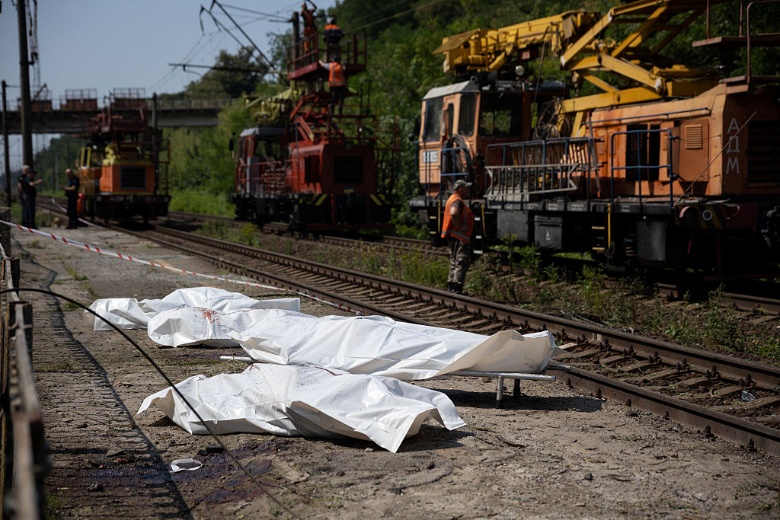
(EDITORS NOTE: Image depicts death.) Bodies of those killed by a Russian missile attack lie in body bags on a railway platform at the site of the strike, while electricians repair a damaged power line nearby in Brovary, Kyiv Oblast, Ukraine. (Oleksandr Magula/Suspilne/Global Images Ukraine via Getty Images)
WEDNESDAY’S TOLL GROWS CLEARER: A MISSED TRAIN AND A CLUSTER MUNITION QUESTION
As search crews kept working through Thursday, the human cost of Wednesday’s overnight barrage on Kyiv and its suburbs came into sharper, harder focus. The death toll rose to 17 — 16 in Kyiv Oblast, one in the capital itself, a 60-year-old woman killed alongside at least 16 others wounded in the city. The single deadliest site turned out to be a train station in the village of Kvitneve, in Brovary district, where eight people died after their train ran late. “The train was slightly delayed last night, and the people did not make their last train,” said Vitalii Bihun, head of the district administration. Three more remained unaccounted for and roughly a dozen were still being treated in hospitals as the search continued.
A new detail added its own weight to the night: Fabian Hoffmann, a missile researcher at the University of Oslo, told the Kyiv Independent that footage from the strike “obviously” showed cluster munitions in use — weapons that scatter smaller explosives across a wide area rather than detonating at a single point, banned under international treaties Russia never signed. A Ukrainian official familiar with the incident offered a more complicated read on why not a single one of the 28 missiles was intercepted: it wasn’t simply the shortage of interceptors, the official said, but the fact that Russia ran drone reconnaissance over the target for hours beforehand, then launched its missiles simultaneously from multiple directions — a barrage that would have overwhelmed Ukraine’s defenses even with more Patriots in reserve. Zelensky didn’t dispute the shortage mattered anyway: “Ballistics interceptors are something that could have saved the lives of those who died today,” he wrote, adding that delays or refusals to transfer them “leads to such terrible victims and destruction.”
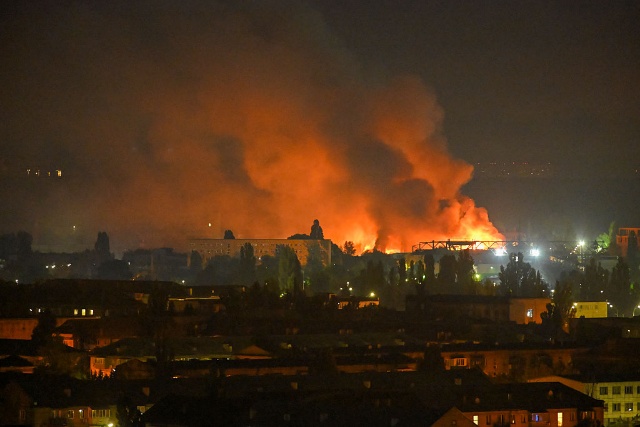
A fire engulfs Kyiv following a massive Russian ballistic missile and drone attack that killed at least 15 and injured 51 others in Ukraine’s capital and in Kyiv Oblast. (Evgen Kotenko / AFP via Getty Images)
THE CORPORATE TOLL: NOVA POSHTA, SILPO, EPICENTR, AND ROZETKA’S TWENTY-FIRST BIRTHDAY
The overnight strike hit Ukraine’s civilian supply chain with unusual precision, destroying or crippling logistics centers belonging to four of the country’s largest retail and delivery companies at once. Nova Poshta’s sorting center in Kyiv’s Obolonskyi district was destroyed, killing two drivers working for a partner carrier and one contractor employee, and wounding eight more; the company said cluster munitions were used and called it a war crime, adding the strike to a growing list that includes hits on its Sumy, Poltava, Vinnytsia, and Pryluky facilities since late July, with losses already topping $7.3 million for the year’s first four months alone. Grocery chain Silpo reported six employees killed across two burning distribution centers; rival chain Novus had its logistics hub struck directly by several missiles but lost no one, since staff had already moved to shelter.
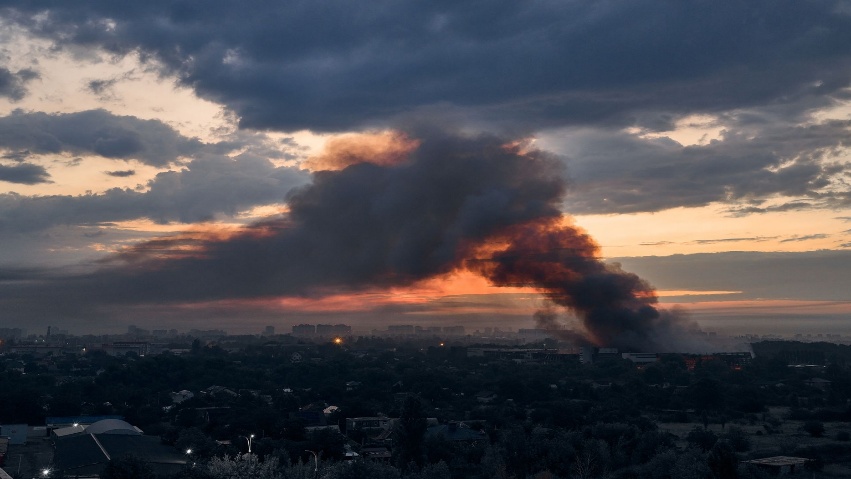
An aerial view shows a massive column of smoke rising above Kyiv from a burning Novus supermarket chain warehouse following a Russian ballistic missile attack in Kyiv, Ukraine. (Kostiantyn Liberov / Libkos / Getty Images)
Hardware retailer Epicentr lost two logistics complexes outright — one burned down entirely on Viskozna Street in Kyiv, the other hit directly in Kalynivka, killing one employee and wounding three — plus its ceramics manufacturing plant, one of Ukraine’s largest tile producers, which stopped production entirely; the company said rebuilding would take up to two years and it would shift some manufacturing abroad in the meantime. Rozetka’s own distribution warehouse in Brovary burned after three ballistic missiles hit it directly. “Today I was supposed to post about Rozetka turning 21 — to thank our customers, partners, and team for this long journey,” CEO Iryna Chechotkina wrote. “Instead, at night I watched as my life’s work burned down.” A Dnipro warehouse belonging to household goods maker Biosphere had already been destroyed the night before; no one was hurt there, since staff had sheltered in time. Prime Minister Serhii Koretskyi ordered ministries to identify alternative warehouse space within three days, calling standard peacetime logistics planning obsolete: “Standard approaches don’t work under wartime conditions — we need fast, unconventional solutions.”
NORTH KOREA’S MISSILE UNIT TAKES SHAPE IN VORONEZH
Ukrainian military intelligence spokesperson Andrii Cherniak told Reuters that a North Korean missile unit — roughly 90 personnel, up to 120 ballistic missiles, and six launchers — is being positioned in Russia’s Voronezh Oblast, likely as part of Russia’s 112th Missile Brigade near the Luhansk Oblast border. Forty of the missiles have reportedly already arrived; the unit’s final size and structure won’t be settled until high-level talks between Moscow and Pyongyang next month. Cherniak confirmed the North Korean-made KN-23 missile Russia used to destroy the Voronov family’s home in Radushne on July 30 came from this same shipment — the first time Russia had used North Korean missiles since August 2025.
North Korea’s KN-23 is roughly comparable to Russia’s own Iskander-M; the KN-24 broadly resembles the American ATACMS. Both follow ballistic trajectories only Patriot systems can intercept, and both carry a reputation, according to Ukrainian officials, for inaccuracy that has translated directly into higher civilian casualties. Since 2023, Pyongyang has supplied Russia with roughly 150 ballistic missiles and thousands of troops, formalizing the relationship through a 2024 strategic partnership treaty and a supplementary defense pact this April that runs through 2031. Adding North Korean missiles to Russia’s stockpile means Moscow can intensify its ballistic campaign against Ukraine without touching its own reserves of S-400 and Zircon missiles — reserves already strained enough that Ukrainian estimates put Russian Zircon expenditure at two-thirds of its entire planned annual output in just the first 19 days of July.
PUTIN’S RESHUFFLE: A BUCHA COMMANDER MOVED, NOT PUNISHED
Putin reorganized several of his top military commands this week, appointing Central Military District Commander Valery Solodchuk as deputy defense minister for logistics, installing Andrei Ivanayev to lead Russia’s Center group of forces in place of Solodchuk, and naming Denis Lyamin — previously the Center group’s chief of staff — to head Russia’s newly formed Unmanned Systems Forces. Putin described the changes as strengthening key areas of the military; independent Russian and Ukrainian sources note the reshuffle also quietly sidesteps accountability. Ukraine holds Solodchuk responsible for the conduct of Russian troops during the 2022 occupation of Bucha, where hundreds of civilians were killed — a transfer to a rear-echelon logistics post, rather than any consequence, for a commander tied to one of the war’s defining atrocities.
The reshuffle comes as Russia’s own battlefield math keeps souring. Ukrainian monitoring group DeepState assessed that Moscow’s goal of occupying all of Donetsk Oblast within 2026 is no longer realistic at the current rate of advance, and unlikely even by 2027 if the pace doesn’t change — in June alone, Russia captured roughly 30 square kilometers at a cost estimated near 39,500 casualties and $19 billion in combined spending and strike losses. Russia is still concentrating heavily on the fortified line of Kostiantynivka, Druzhkivka, Kramatorsk, and Sloviansk, the backbone of Ukraine’s remaining defense in Donetsk Oblast — cities that would require breaking through some of the war’s most hardened positions to take.
CHAYKO’S SON-IN-LAW CONFIRMED DEAD, AND A SECOND DRONE MAKER BOMBED
Russian outlet Agentstvo confirmed, through Russia’s own corporate registry, that Danylo Peredriy — son-in-law of Russian Aerospace Forces Commander Alexander Chayko — died in the August 1 restaurant bombing that a source separately confirmed had targeted Chayko himself during a private birthday celebration. Chayko’s daughter Maria is believed to have been injured in the same blast; Chayko’s own status remains unconfirmed. The bombing killed five people and wounded 21 in total.
Less than 48 hours later, a car bomb in Bolshoy Istok, Sverdlovsk Oblast, critically injured Vladimir Tkachuk, head of drone manufacturer Uraldronzavod and developer of the “Ghoul” FPV attack drone used against Ukrainian troops; the driver of his vehicle was killed outright. Russian investigators opened an attempted murder case without naming a suspect or motive. No connection between the two bombings has been established, but both follow a now-familiar pattern: Russian figures tied directly to the war effort, struck inside Russia’s own borders, by attackers no one has publicly claimed.
FRONTLINE: KRAMATORSK EVACUATES CHILDREN AS SLOVIANSK HOLDS
Donetsk Oblast Governor Vadym Filashkin ordered mandatory evacuation of 525 children from 424 families in Kramatorsk Raion, citing intensified drone, artillery, and glide bomb strikes that have made the area too dangerous for families to remain. Ukrainian forces advanced northeast of Dibrova near Sloviansk and continue holding positions Russia claims to have already seized near Kryva Luka and Rai-Oleksandrivka, according to military observer Kostyantyn Mashovets, even as Russia’s 3rd Combined Arms Army — its combat effectiveness visibly declining — keeps probing with small infiltration groups rather than any larger breakthrough attempt.
Elsewhere, Russian forces made unconfirmed claims of gains near Nova Kruhlyakivka outside Borova and near Zirnytsya southwest of Oleksandrivka — the latter roughly 14 kilometers from Russia’s nearest actual position, a claim so implausible that Russian milbloggers themselves complained about their own command exaggerating advances across the theater. Ukrainian forces continued a steady campaign of their own against occupied infrastructure, striking electrical substations near Mariupol, Melitopol, Berdyansk, and occupied Luhansk Oblast, plus a river crossing near Oleksandrivka that Russian forces use for resupply.
THE FORTY-DAY DEADLINE PASSES
August 4 marked the end of the 40-day operation Zelensky announced in late June to pressure Russia toward a ceasefire through intensified strikes — a deadline that arrived with no ceasefire, but with a tally of its own. Ukraine’s Security Service alone conducted more than 100 strikes on Russian territory during the window, and the broader campaign, including Wildberries warehouses and oil infrastructure, has degraded Russian refining capacity by roughly a third. Whether the pressure changes Moscow’s calculus or simply becomes the new baseline for a longer campaign is a question the deadline’s passing didn’t answer.
ZELENSKY: ALLIED INTERCEPTORS DOWN TWO-THIRDS
Zelensky said after meeting senior military officials that allied deliveries of air defense missiles fell by two-thirds in the first half of 2026 compared with the same period last year — a shortage he tied directly to the US war with Iran diverting resources elsewhere. “Our partners do have the missiles,” he said. “It is important that the necessary political decisions on supplies and the acceleration of production processes are ultimately made — including decisions on localization in Ukraine.” He separately noted that most of the 17 Russian companies producing key ballistic missile components continue exploiting sanctions loopholes, and called for coordinated secondary sanctions on the banks and institutions that keep financing them.
Ukraine’s own path toward self-sufficiency remains years away. Fire Point CEO Iryna Terekh told Reuters the company’s FP7.X interceptor, part of the Freya program backed by 13 European industrial partners, isn’t expected to achieve its first successful intercept until mid-2027 — a full winter away from the country that needs it now.
DEEP STRIKES: UFA AGAIN, AND YAROSLAVL TWICE
Ukrainian drones struck all three refineries of Ufa’s Bashneft cluster for at least the third time in August alone, damaging two secondary processing units and setting off large fires. Farther north, Ukrainian forces hit the Slavneft-Yanos refinery in Yaroslavl Oblast — one of Russia’s five largest, with an annual capacity of 15 million tons — on consecutive nights; Zelensky confirmed the first strike directly, thanking Ukraine’s military and intelligence services “for this manifestation of justice.” A fuel and lubricants plant near Perm also caught fire, cause unconfirmed, roughly 1,500 kilometers from Ukraine’s border.
Wildberries absorbed yet another hit, this time in Aleksin, Tula Oblast, where Governor Dmitry Milyaev confirmed a drone strike ignited the company’s sorting center alongside damage to two apartment buildings and two industrial sites; it’s the eighth of the retailer’s 15 largest logistics hubs to go offline since the strikes began, according to independent outlet Agentstvo, with total losses estimated near $2 billion.
SWEDEN HANDS UKRAINE A STOLEN-GRAIN SHIP
Sweden’s Supreme Court upheld a lower court ruling allowing the seizure and transfer of the Caffa, a sanctioned cargo vessel Ukrainian officials say carried grain stolen from occupied Ukrainian territory, including a shipment out of Russian-held Sevastopol in July 2025. Swedish authorities first intercepted the ship, sailing under a Guinean flag but deemed “stateless” by the coast guard, in the Baltic Sea in March. “This landmark decision sets an important precedent, demonstrating that decisive action by law enforcement and prosecutors, combined with an independent and impartial judiciary, can translate the principle of accountability into tangible results,” Foreign Minister Andrii Sybiha wrote. It’s the first time a foreign court has ordered a Russia-linked vessel handed directly to Kyiv over stolen Ukrainian grain, adding a legal precedent to a broader European campaign that has already seen France, Belgium, and the UK board suspected shadow fleet vessels in their own waters.
BRITAIN’S STREETING COMES TO KYIV
New UK Defense Secretary Wes Streeting made his first visit to Kyiv, meeting Zelensky a day after the strike that killed 17 to discuss expanded sanctions on Russian ballistic missile producers and joint weapons production between the two countries. “The United Kingdom and Ukraine both have strong capabilities, proven in war,” Zelensky said, thanking new Prime Minister Andy Burnham and King Charles III for Britain’s continued support. Streeting told ITV News that demonstrating “unwavering and unequivocal support” early in Burnham’s premiership was a deliberate choice, framing Ukraine’s fight as inseparable from “the very freedom and democracy that we cherish ourselves.”
OLEKSII YUKOV: TWENTY-SEVEN YEARS BRINGING THE DEAD HOME
Oleksii Yukov, the 40-year-old founder of Ukraine’s best-known body recovery unit, Platsdarm, was killed while exhuming remains near Lyman in Donetsk Oblast, after being wounded on the contact line itself. He had spent 27 years doing this work, starting as a teenager excavating World War II battle sites in his hometown of Sloviansk before founding Platsdarm in 2014, the first volunteer team in Ukraine to systematically search for the dead during the Donbas war. He told the Kyiv Independent just three days before his death that he had personally repatriated more than 10,000 bodies — Ukrainian and Russian soldiers alike, and civilians too — often working through minefields with bomb disposal experts before his team could even begin to search.
“Behind every search mission lies someone’s soul, someone’s prayers and hopes — the hope that a loved one will return from hell,” Yukov had written on Facebook less than two weeks before he died. “As long as we fight for them, each of them has a chance to return.” He had already survived one near-fatal injury in 2023, losing an eye when tactical goggles took the force of a mine blast meant for his face, and returned to the field within two weeks. “For much of his life, he gave names back to the dead,” fellow serviceman Serhii Hnezdilov wrote. This time, the work he’d spent almost three decades doing for other families cost him the chance to come home to his own.
WHAT WEDNESDAY KEPT REVEALING
By Thursday, the picture of Russia’s third strike on Kyiv in a week was far grimmer than the first reports suggested — a train station full of people who simply arrived a few minutes too late, warehouses belonging to companies every Ukrainian recognizes by name, cluster munitions in a strike Moscow called precision logistics targeting. North Korea’s missiles kept arriving in Voronezh. A general tied to Bucha got a desk job instead of a reckoning. And a man who spent 27 years bringing other families their dead didn’t get to come home himself. Nothing about any of it paused for the grief. It never does.
A PRAYER FOR UKRAINE
1. For the Eight Who Missed Their Train
Lord, eight people stood waiting at a small station because their train ran a few minutes late, and a missile found them exactly there. There is no way to make sense of timing this cruel, and we do not try to. Hold their families through a grief made sharper by how ordinary and unlucky the moment was, and comfort everyone still searching for the three still unaccounted for.
2. For Every Worker Who Went to a Warehouse and Didn’t Come Home
Father, drivers, sorters, and factory workers across half a dozen companies died doing jobs that exist to keep their neighbors fed and supplied. Hold the families of Nova Poshta’s drivers, Silpo’s employees, and everyone else whose ordinary workday ended in a strike they never saw coming. Let their names outlast the company statements that first announced their loss.
3. For Oleksii Yukov, Who Spent His Life Bringing Others Home
Lord of the fallen, a man who devoted twenty-seven years to returning other families’ loved ones, more than ten thousand of them, did not survive the work himself. Receive him with the same gentleness he showed everyone he carried out of the ground. Comfort his wife, and raise up others willing to continue what he started, however dangerous that work remains.
4. For Two Children Growing Up in a War Neither Side Will Stop
God of the vulnerable, more than five hundred children are being evacuated from Kramatorsk this week, one more upheaval in childhoods already defined by upheaval. Protect these children as they leave behind homes, schools, and friends again. Give their parents strength for a displacement they didn’t choose and can’t yet see the end of.
5. For a War That Keeps Finding New Weapons and New Silence
God of justice, tonight foreign missiles arrive to extend a war that already has enough of its own, while men responsible for real atrocities are quietly reassigned rather than held to account for what happened under their command. Give courage to everyone still working to document the truth, however long justice takes to catch up with it. Let accountability come, even to those who think a new title can outrun what they’ve done.
In Your mercy, in Your justice, in Your time — bring this war to its end, and let the ending be worthy of what Ukraine has endured.