
August 10, 2026
Prepared by Diana Bozhyk
Ukraine launched its largest reported drone attack of the war overnight, sending more than 450 drones into 16 Russian regions and killing 13 people at a petrochemical complex in Tatarstan. Ukrainian military intelligence revealed that Russia has tripled its monthly ballistic missile launches since April and is now exceeding its own production targets by up to 20 percent, exploiting Ukraine’s Patriot shortage with newly manufactured missiles rather than drawing down stockpiles. Russian attacks killed at least four people and wounded 50 across Ukraine during the day, before a further overnight barrage on Kyiv, Zaporizhzhia, and Dnipropetrovsk pushed the toll to nine dead by Tuesday morning. And Russia’s Supreme Court barred Yabloko, the country’s only registered anti-war party, from September’s parliamentary elections.
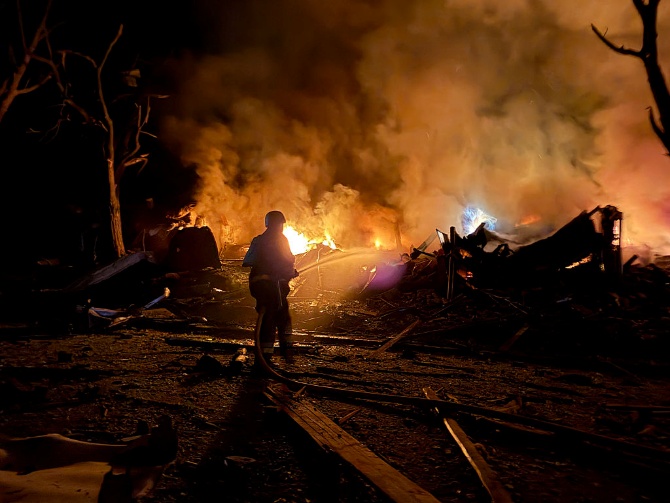
A Ukrainian rescue worker responds at the site of a Russian strike in Zaporizhzhia. (Darya Nazarova / AFP via Getty Images)
THE DAY’S RECKONING
Somewhere over 16 Russian regions Sunday night, Ukraine put more drones in the air at once than it ever had before — more than 450 of them, by Moscow’s own count, headed for targets stretching from Moscow’s outskirts to Tatarstan, nearly 1,000 kilometers away. Thirteen people didn’t survive the strike that found Nizhnekamsk’s petrochemical complex; the regional governor declared a day of mourning before most Russians outside Tatarstan had even heard the city’s name. In Kyiv, Ukraine’s own military intelligence explained, in dry statistical language, exactly why nights like the one Russia would deliver hours later keep getting worse: missile production up, Patriot interceptors down, a arithmetic that favors whoever runs out of patience last. By the time Tuesday’s sun rose, Kyiv, Zaporizhzhia, and Dnipropetrovsk had all been hit again, pushing the day’s toll to nine dead. Somewhere in between, Russia’s Supreme Court quietly closed the last real door for anyone hoping to vote against this war from inside the country still fighting it.
NIZHNEKAMSK: UKRAINE’S LARGEST DRONE STRIKE YET KILLS 13
Ukraine launched what appears to be its largest reported drone attack of the war overnight into Monday, with Russia’s Defense Ministry claiming its air defenses intercepted or destroyed 456 drones across 16 regions, Moscow City, Krasnodar Krai, Tatarstan, and occupied Crimea. The deadliest strike hit Nizhnekamsk, a major industrial hub in Russia’s Republic of Tatarstan, where Tatarstan officials confirmed 13 people killed and 39 wounded; regional head Rustam Minnikhanov declared a day of mourning. Analysis of eyewitness footage by Russian outlet Astra suggested the strike targeted Nizhnekamskneftekhim, one of Russia’s largest petrochemical complexes and a key facility in the Sibur conglomerate’s Volga production cluster — an industrial zone that has now been hit by drones in March, June, and July as well.
Ukraine’s General Staff separately confirmed a strike on the nearby Taneco oil refinery, which produces more than 20 fuel types with an annual capacity of roughly 13 million tons; footage showed smoke rising from the site the following day. Moscow Mayor Sergei Sobyanin said 23 drones were destroyed approaching the capital, while Rostov’s governor claimed more than 70 shot down regionally and Kaluga’s governor reported 16 more, with no casualties there. The scale of the barrage arrived during what Ukrainian officials have called one of the most intense weeks of the entire war — Zelensky said Russia launched 61 missiles, more than 1,560 attack drones, and 1,540 guided bombs against Ukraine in the seven days prior, killing 27 people in Kyiv alone.
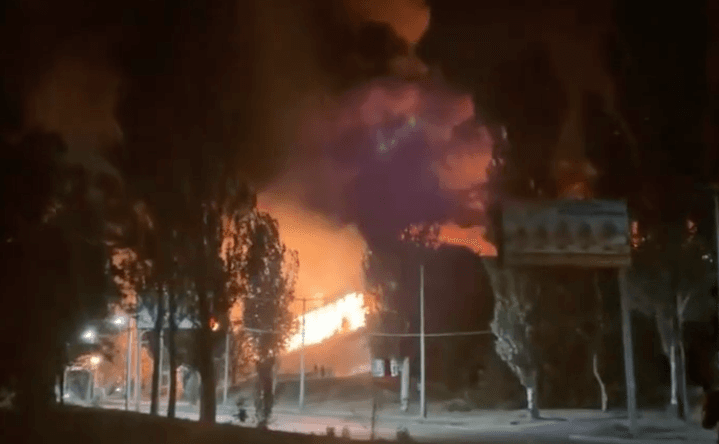
What purports to be a fire at the Halaktyka shopping center in the occupied city of Makiivka, Donetsk Oblast, following a reported Ukrainian strike overnight. (Exilenova Plus/Telegram)
THE DAY’S TOLL AT HOME: SUMY’S BOMBS, AND AN OVERNIGHT ESCALATION
Russian attacks killed at least four people and wounded 50 more across Ukraine during the day Monday. Sumy Oblast took the heaviest toll — two killed, 28 wounded, 13 of them from overnight guided bomb strikes on Sumy City itself, which also damaged homes and civilian infrastructure. Zaporizhzhia Oblast reported one killed and four wounded as Russian forces carried out 867 individual strikes across 47 settlements; Dnipropetrovsk Oblast reported one killed and five wounded across four districts struck nearly 60 times, the worst damage concentrated again in Nikopol district, where a 57-year-old man died and a 15-year-old boy was killed separately in Hrushivka, with two more teenagers wounded. Kherson Oblast reported two wounded, Kharkiv Oblast seven, and Donetsk Oblast four across Dobropillya, Sloviansk, and Kramatorsk.
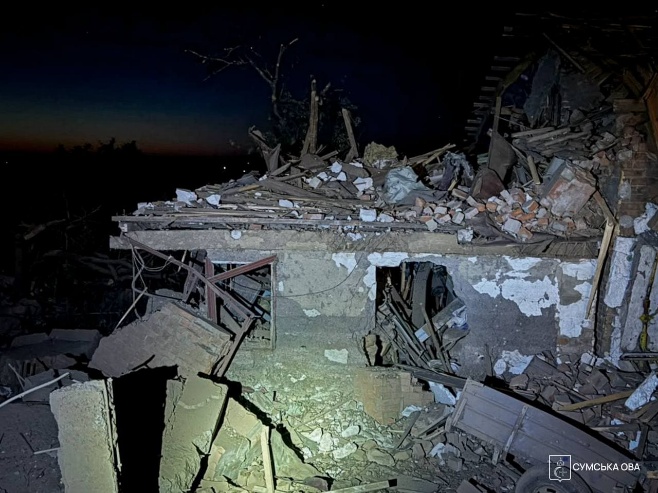
Тhe aftermath of Russian strikes in Sumy Oblast. (Sumy Oblast Military Administration/Telegram)
The day’s violence didn’t end there. Overnight into Tuesday, Russia launched a fresh barrage on Kyiv, Zaporizhzhia, and Dnipropetrovsk using ballistic missiles, guided bombs, drones, and artillery. Zaporizhzhia’s toll climbed sharply as the count updated through the morning: six killed, 19 wounded, Governor Ivan Fedorov said, with residential buildings damaged and parts of the city without power. Mayor Vitali Klitschko confirmed Kyiv itself came under ballistic missile attack after midnight, with a warehouse damaged and one person wounded. By Tuesday morning, the combined overnight toll stood at nine dead. Zelensky tied the campaign to new supply lines: Russia, he said, has received additional ballistic missiles from North Korea and is preparing to host more North Korean troops besides.
Separately, a Ukrainian MiG-29 caught fire during a combat mission over Odesa Oblast Monday evening after a “non-standard situation” during an air-to-air missile launch; the pilot ejected safely, the second Ukrainian fighter lost to an in-flight emergency in as many weeks, following an F-16 crash on July 29. In Poltava Oblast, officials confirmed not a single working gas station remains in the region’s Opishnyanska community after Russian drones struck four filling stations in one night.
SKIBITSKYI’S NUMBERS: RUSSIA’S MISSILE PRODUCTION OUTPACES EVERYONE’S HOPES
Ukrainian military intelligence deputy chief Vadym Skibitskyi laid out, in unusually precise detail, exactly how Russia has restructured its weapons industry around a single insight: Ukraine can’t stop what it can’t intercept. Russia has more than tripled its monthly ballistic missile launches since April, Skibitskyi said, and is now producing key missile types at 110 to 120 percent of planned monthly output — 87 Kh-101 cruise missiles in July against a target of 72, Kalibr production up 11 percent, Kh-35 output at double its plan. Russia had already met its full annual production targets for Zircon and Oniks missiles by August 3, seven months into the year. Crucially, Russia isn’t drawing down stockpiles to sustain this pace — it’s firing newly built missiles, preserving reserves for what Ukrainian intelligence believes will be an even larger strike package later this year.
The shift has a specific mechanism: Russia suspended production of the Kinzhal air-launched ballistic missile and the Kh-32 cruise missile in April, both plagued by accuracy problems — Kinzhal’s average miss distance runs 30 meters or more, Skibitskyi said, against an effective threshold of 5 to 7 meters — and redirected that funding toward more reliable ballistic weapons instead. Commander Robert “Magyar” Brovdi added his own alarming figure the same day: Russia can currently fire a simultaneous salvo of 77 missiles of all types, and is working toward 200. “Even if they only manage half of that, it will all be flying at us,” he said, later clarifying the number spans missiles of every type, not ballistic missiles alone. Russia launched nearly 70 ballistic missiles in the first 10 days of August. Ukraine intercepted one.
On the defensive side of that ledger, the Come Back Alive Foundation’s Dronopad initiative reported its crews have downed more than 53,000 Russian drones since launching two years ago — half in just the past four months — costing Russia an estimated $1.39 billion in destroyed aircraft. More than 90 units now operate along the front and border using Dronopad-supplied gear, funded partly by fuel retailer OKKO, which has contributed nearly $10 million through customer purchases since last year.
FRONTLINE: DOBROPILLYA’S ACCELERATING THREAT
Military analyst Rob Lee reported that Russia’s rate of advance toward Dobropillya and Druzhkivka has picked up in recent weeks, with elements of at least three separate Russian formations — the 177th Naval Infantry Regiment, the 9th Motorized Rifle Brigade, and the 61st Naval Infantry Brigade — converging on the town from the east and northeast, using captured high ground and mine waste heaps as staging points for drone crews and infiltration groups. Russian forces are running five to 10 Geran drone strikes against Dobropillya daily and one to two against nearby Novodonetske and Oleksandrivka, Lee said, alongside sustained glide bomb strikes aimed specifically at forcing Ukrainian drone pilots farther from the front line, degrading their accuracy and reaction time in the process.
Elsewhere, the line held close to its recent shape, with Russian sources themselves increasingly walking back their own claims: a Kremlin-affiliated blogger acknowledged Russia’s position in the Lyman direction is “concerning and developing negatively,” while another conceded Ukrainian forces have reclaimed 26.7 square kilometers near Komar, east of Oleksandrivka. Ukrainian forces cleared Russian infiltrators from parts of western Kostiantynivka, and a Russian fiber-optic drone struck police vehicles in Velykyi Burluk as officers conducted evacuations — a small, specific sign of how far Russian strikes now reach behind the areas still technically under Ukrainian control.
DEEP STRIKES: TOBOLSK, 2,200 KILOMETERS IN
Ukrainian forces struck the Tobolskneftekhim petrochemical plant in Tyumen Oblast, more than 2,200 kilometers from Ukraine’s border — among the deepest strikes of the war — damaging its central gas fractionation unit, which processes 6.6 million tons of feedstock annually into materials Ukraine’s General Staff says feed directly into Russian rocket fuel, aviation fuel, and drone composite production. “This region is now within range of our precision strikes,” Zelensky said, promising more to come “to demonstrate to Russia and the Russians that peace is necessary.” Ukraine’s General Staff also confirmed strikes on a repair unit in occupied Khrustalnyi, Luhansk Oblast, and logistics and artillery depots in Donetsk Oblast, while Ukrainian forces separately struck a Russian S-400 site in Gelendzhik hours after it had fired on Ukrainian territory, destroying four launchers according to satellite imagery reviewed August 9.
YABLOKO BARRED FROM RUSSIA’S ELECTION
Russia’s Supreme Court removed Yabloko — the only registered political party still openly opposing the war and calling for a ceasefire — from September’s State Duma elections, granting a lawsuit filed by the nationalist Rodina party that accused Yabloko of extremism and undisclosed foreign funding. Judge Vyacheslav Kirillov’s ruling came despite Yabloko leader Nikolai Rybakov’s insistence in court that the flagged donations were ordinary contributions from Russian citizens, mislabeled as foreign money. Hundreds of Yabloko supporters gathered outside the courthouse chanting “Shame! Shame!” before police warned them to disperse within two minutes or risk being sent to “military enlistment offices.”
“It’s not even so much about support for Yabloko,” Yulia Navalnaya, widow of the late opposition leader Alexei Navalny, wrote. “It’s about the fact that millions of Russians now have a chance to say what they truly think about Putin and the war.” Yabloko says it will appeal within the five-day window. Separately, a Saratov-based Yabloko candidate, Kirill Rumyantsev, reported receiving death threats over the phone demanding he withdraw his own candidacy — “I’ll break your head,” one message read — which he’s reported to police while declining to withdraw.
RUSSIA’S QUIET RECRUITMENT DRIVE TARGETS THE VULNERABLE
The Financial Times reported that the Kremlin has set regional recruitment quotas totaling 409,000 contract soldiers for the year, with local officials deliberately targeting people with debts, suspended sentences, or recent brushes with the law — precisely the people researchers say are easiest to pressure into signing. “They know who has debts, who is under investigation and who recently lost their driving license, and those are the people they target,” said Janis Kluge of the German Institute for International and Security Affairs. In Russia’s Khabarovsk region, police conducted 2,500 recruitment “conversations” last year and persuaded 32 people to enlist — 28 of them already facing criminal investigations.
Federal enlistment bonuses paid in the first quarter of 2026 hit their lowest level in three years, even as regional signing bonuses climbed into the millions of rubles in some areas. “Putin is clearly postponing another wave of mobilization, so the defense ministry has to put increasing pressure on different groups of people to sign contracts,” said Grigory Sverdlin of the anti-war group Get Lost. At least 28,000 Russian soldiers have been convicted of desertion, according to rights group Peace Plea — a figure Ukrainian analytical group Frontelligence Insight believes may run twice as high based on internal Russian documents.
MOLDOVA RECALLS ITS AMBASSADOR
Moldova recalled its ambassador to Russia for consultations after a drone crashed and exploded in the border village of Crocmaz, roughly 70 kilometers from Odesa, during Sunday’s large-scale Russian attack on the port city. Police recovered debris from what they described as a “missile-type drone,” which sparked a fire and damaged buildings in the Stefan Voda district. “This accident represents a serious violation of the sovereignty and territorial integrity of the Republic of Moldova,” the foreign ministry said. President Maia Sandu called it a direct consequence of Russia’s war: “The risk to human life in our region is real and growing. It must stop.” It’s the first time drone wreckage has actually been identified on Moldovan soil, following earlier, less confirmed incursions — joining a lengthening list of near-misses across Romania and Poland as well.
AUSTRIA’S SANCTIONS-BUSTING NETWORK EXPOSED
Austrian intelligence uncovered a sanctions-evasion network run through a Vienna-registered shell company that exported computer-controlled cutting equipment and specialized metalworking tools to Russian arms manufacturer Rostec, disguising the final destination through forged end-user certificates and intermediary countries including Belarus, Poland, Lithuania, and Turkey. “Using forged end-user certificates, European manufacturers were misled into believing the goods would remain in third countries,” Austria’s Interior Ministry said. The equipment ultimately supported production of the Pantsir air defense system, the Kh-101 cruise missile, and the Iskander ballistic missile — the same weapon type responsible for repeated fatal strikes on Ukrainian cities this month. A Belarusian national who co-owned and managed the shell company was arrested in Austria in May; deliveries to Russian arms manufacturers through the scheme totaled €3.3 million since 2022. Canada separately joined Ukraine, the EU, and Switzerland in sanctioning Streit Group, a UAE-based armored vehicle manufacturer whose products have turned up in Russian National Guard service.
WASHINGTON WEIGHS AN AIR CEASEFIRE, MOSCOW REJECTS “ROOT CAUSES” SHORTCUTS
A US official told the Kyiv Independent that the White House increasingly believes both Moscow and Kyiv may have reasons to consider a limited air ceasefire, even as envoys Steve Witkoff and Jared Kushner prepare new proposals for planned visits to both capitals. Russian Deputy Foreign Minister Mikhail Galuzin rejected the framing outright the same day, telling state media that no “freeze” is possible without addressing what Moscow calls the war’s “root causes” — its original maximalist demands — and accusing Washington of contradiction: “The ongoing deliveries of U.S. weapons, the provision of intelligence, and other forms of assistance speak for themselves — they are incompatible with a commitment to peace.” Kyiv continues to argue that freezing the current front line offers the most realistic path to any ceasefire; Russia continues to demand Ukrainian withdrawal from Donbas territory it doesn’t hold, a demand Ukraine has rejected outright.
Europe’s own drone anxieties kept multiplying. Germany announced it would double its anti-drone unit following last week’s discovery of an explosive-rigged drone beside a Ukrainian cargo plane at Leipzig airport, while separate reporting revealed that cameras on UK Royal Navy K3 Scout drone boats had been found transmitting “heartbeat” signals to an address in China, raising fresh questions about Chinese-made components inside allied military hardware. And across Poland, tens of thousands rallied in 22 cities, including Warsaw, under the banner “Don’t Be Indifferent,” pushing back against a documented rise in anti-Ukrainian hostility that has included street attacks and a wave of online harassment in recent weeks.
RETAILERS COUNT THE COST: INTERTOP’S $10.8 MILLION
Intertop, Ukraine’s largest footwear and fashion retailer, reported roughly $10.8 million in direct inventory losses after Russian strikes destroyed its main logistics warehouse during the August 5 attack on Kyiv Oblast — autumn-winter stock that had arrived just a day before the strike, lost before it ever reached stores. “Some of the new goods arrived literally a day before the attack and were supposed to be distributed among the stores the next day, but unfortunately were lost,” CEO Serhii Badritdinov said, adding the company may face temporary shortages in some categories while it rebuilds. Staff managed to move some inventory out before the strike hit; stores, the website, and mobile app have kept operating from temporary warehouse space. Intertop joins Epicentr, Rozetka, Nova Poshta, Silpo, and Novus on the list of major Ukrainian retailers absorbing serious losses from the same night’s bombardment — the domestic mirror of the campaign Ukraine has been running against Wildberries on the other side of the border.
WINTER PREPARATIONS BEGIN IN EARNEST
Prime Minister Serhii Koretskyi chaired a meeting of Ukraine’s Energy Headquarters, reviewing electricity and gas forecasts with the heads of Naftogaz, Ukrenergo, Energoatom, and other state energy operators ahead of a winter Russia is expected to target more aggressively than the last. “We identified the areas where work needs to be urgently accelerated,” Koretskyi said, emphasizing protection for critical infrastructure and reserve stockpiles for rapid repairs. The meeting comes as officials increasingly expect Russia to shift its winter campaign away from the power grid it has already battered and toward water infrastructure instead — a threat Energy Minister Denys Shmyhal warned about days earlier, noting Ukrainians could survive without electricity longer than without running water and sewage service.
RASSVET RACES AHEAD OF SCHEDULE
Skibitskyi confirmed Russia is deploying its Rassvet satellite internet system — a domestic answer to Starlink, built by Russia’s Bureau 1440 — significantly faster than its own published timeline, having launched an initial 16 satellites in March with a second batch following in July. Moscow plans a 292-satellite constellation by 2027 and 924 by 2035; for now, coverage over Ukrainian territory remains intermittent, active only when a satellite happens to pass overhead. “When the Russians deploy a full constellation of satellites, this system will work like Starlink,” Skibitskyi said, adding that Ukrainian officials are already discussing countermeasures without offering detail. Brovdi called the prospect “a risk for the entire planet”: “Because a dictatorship will gain access to information across the whole globe.”
WHAT MONDAY INTO TUESDAY CONFIRMED
By the time Tuesday’s overnight fires were finally out, Ukraine had launched its largest drone attack of the war and absorbed one of its bloodier weeks in return — 27 dead in Kyiv alone over seven days, nine more overnight as Monday became Tuesday. Russia’s own intelligence picture, laid bare in a single briefing, showed an enemy that has stopped rationing its missiles and started manufacturing its way past Ukraine’s defenses entirely. A political party that dared call for peace lost its place on Russia’s own ballot. Nothing about the war’s fundamental math changed this week. It simply got clearer, on both sides, exactly how that math is being solved.
A PRAYER FOR UKRAINE
1. For the Fifteen-Year-Old of Hrushivka
Lord, a boy not yet old enough to vote was killed in his own village, one more name added to a region that has absorbed near-daily bombardment for four years running. Hold his family, and hold the two teenagers wounded beside him. Let Nikopol’s endurance be met, someday, with something other than another strike to endure.
2. For Thirteen Names in a City Most of the World Just Learned
Father, thirteen people in Nizhnekamsk died in a war they did not start and cannot end, victims of a strike aimed at the industry that supplies it. We hold no satisfaction in any death, on either side of this border. Comfort their families, and let every life lost on every side eventually be counted as fully human by the people making these decisions.
3. For a Party Silenced for Wanting Peace
Lord of justice, the only Russian party still calling openly for this war to end has been barred from even asking its own citizens to vote for that idea. Give courage to Rumyantsev and every candidate facing threats for refusing to stay quiet. Let honest dissent survive somewhere inside Russia, even as the space for it keeps shrinking.
4. For the Men Being Quietly Hunted for Recruitment
God of mercy, men with debts, records, and few options are being deliberately targeted for a war they may not believe in, coerced by circumstance more than conviction. Protect them from choices made under pressure they didn’t create. Give wisdom to their families, and give pause to a system built on exploiting people’s worst moments.
5. For a Winter Ukraine Is Already Bracing For
God of provision, tonight officials plan for a season that hasn’t arrived yet, already certain it will test the country in ways this past year has not, with water and warmth both at risk this time. Give wisdom to everyone preparing shelters, stockpiles, and repair crews for damage that hasn’t happened yet. Provide for this country before the cold makes provision so much harder to find.
In Your mercy, in Your justice, in Your time — bring this war to its end, and let the ending be worthy of what Ukraine has endured.