
August 9, 2026
Prepared by Diana Bozhyk
Russian forces struck a Kharkiv high-rise, then hit a neighboring building with a second strike as rescuers arrived — a deliberate “double-tap” that killed three people and wounded 37, including a 5-year-old boy. Hours earlier, an overnight ballistic barrage on Odesa injured 14 and knocked out power for 300,000 families. Zelensky warned that Russia is preparing a covert mobilization alongside up to 50,000 North Korean troops, even as Ukraine’s own Fire Point announced its first domestically built ballistic missile could see combat by fall — a milestone shadowed by the company’s ongoing ties to Ukraine’s biggest wartime corruption scandal.
THE DAY’S RECKONING
Mayor Ihor Terekhov had just enough time to warn Kharkiv residents that Russia was “deliberately targeting residential buildings” before the second missile confirmed it himself — a strike on a neighboring high-rise, timed for the moment rescue crews reached the first one. Three people died there; 37 more were wounded, among them a boy who hadn’t yet turned six. Odesa had already spent its morning without power, 300,000 households dark after an overnight barrage that also missed 10 of 11 ballistic missiles entirely, Ukraine’s air defenses simply outmatched. In Kyiv, Zelensky used the evening telethon to say plainly what Ukrainian intelligence has been circling for weeks: Putin is preparing a mobilization he won’t call a mobilization, and tens of thousands of North Korean soldiers besides. And in a defense-industry story with an uncomfortable footnote, Ukraine’s own Fire Point confirmed its first homegrown ballistic missile could see combat within months — good news arriving under the shadow of a corruption investigation that has already reached the country’s biggest wartime bribery scandal. Sunday delivered exactly what most Sundays deliver now: proof the war keeps finding new addresses, and proof neither government fighting it is entirely clean about how it gets fought.
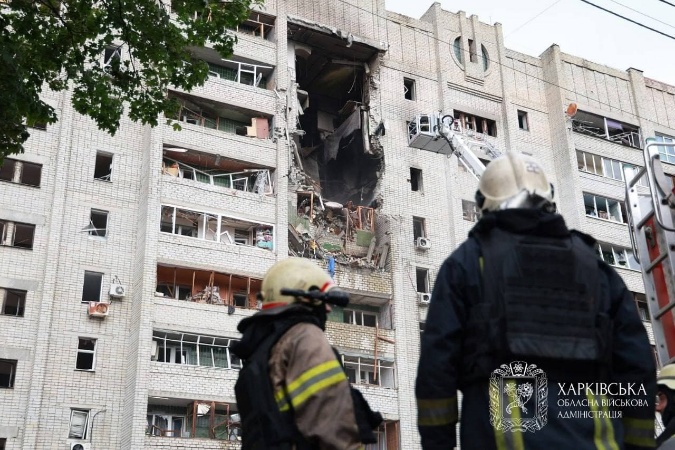
The aftermath of a Russian attack on Kharkiv, Ukraine. (Oleh Syniehubov/Telegram).
KHARKIV’S SALTIVKA DISTRICT: A DOUBLE-TAP ON HIGH-RISES
A Russian strike hit a multi-story residential building in Kharkiv’s Saltivka district Sunday morning, destroying the seventh through tenth floors. As rescue crews arrived, a second strike hit a neighboring high-rise — a deliberate “double-tap,” Mayor Ihor Terekhov said, warning residents the enemy was targeting homes on purpose. Three people died, including men aged 50 and 66; the wounded toll climbed to 37, among them a 5-year-old boy. Eleven people suffered blast injuries, two were treated for carbon monoxide poisoning, and several more were treated for acute stress reactions as rescue crews kept working through the day to free people still trapped in the rubble.
Elsewhere, the day’s toll kept accumulating in smaller, scattered wounds rather than any single dramatic strike. Donetsk Oblast lost three people across Kramatorsk, Druzhkivka, and Dobropillya, with five more wounded; Sumy Oblast lost three, with five wounded, after air raid alerts ran nearly the entire day — 23 hours and 49 minutes straight. Kherson Oblast reported 10 wounded, including two children; Dnipropetrovsk Oblast 11 wounded, including four children; Zhytomyr Oblast three wounded, one with severe burns; Zaporizhzhia Oblast two wounded despite Russia carrying out 974 separate attacks across the region; and Mykolaiv Oblast one wounded from repeated drone strikes.
ODESA UNDER BALLISTIC BARRAGE: 300,000 WITHOUT POWER
Russia launched 11 missiles — most on ballistic trajectories — and up to 100 drones at Odesa Oblast overnight, including six Banderol loitering munitions. Ukrainian air defenses intercepted just one missile and 72 percent of the drones; three more missiles malfunctioned before reaching their targets, but the rest got through, hitting nine locations. Fourteen people were wounded, 11 hospitalized, one seriously. Fires tore through multiple high-rise buildings and homes across two districts, destroying residents’ cars along with them.
The energy grid took the heaviest blow. DTEK, Ukraine’s largest private power company, reported strikes had triggered widespread outages that also cut water service; by morning, 300,000 families sat without electricity, with only a third restored by evening. “The damage is severe, and repairs will take time,” DTEK wrote. Zelensky said the port itself was also damaged, calling it proof that “Russians systematically fight against the world’s food security.” The barrage was part of a broader campaign that struck 67 seaport facilities, 35 vessels in port, and 22 ships at sea across Ukraine’s entire coast in July alone.
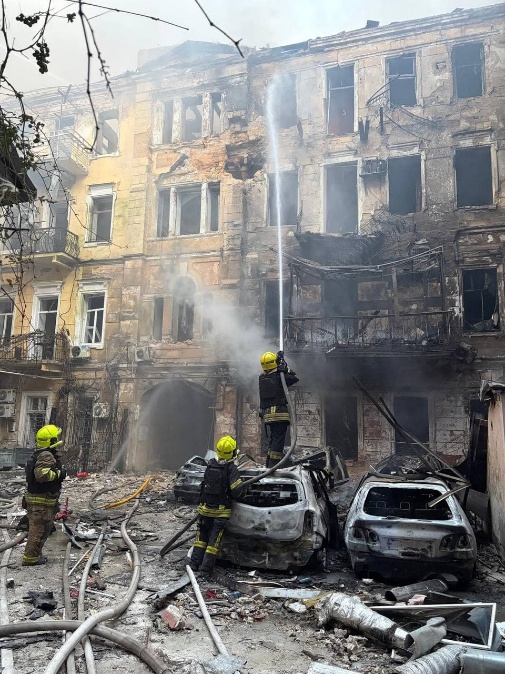
Firefighters extinguish a blaze at a residential building following a Russian missile attack on Odesa overnight. (Serhii Lysak/Telegram)
ZELENSKY WARNS OF COVERT MOBILIZATION AND 50,000 NORTH KOREAN TROOPS
Speaking on Ukraine’s national telethon, Zelensky said Russia is preparing a mobilization it won’t formally announce — Putin, he said, is searching for ways to grow his army without declaring a draft he knows would be politically dangerous. “He is thinking about how to deceive his own people. To carry out mass mobilization without announcing it. To make some shadow contracts, block borders, and so on. We see this,” Zelensky said. He linked the pressure directly to Putin’s need for a sellable victory: with Ukraine refusing any voluntary withdrawal from Donbas, Zelensky warned Putin will instead “twist” the informal terms reportedly discussed with US officials at last year’s Anchorage summit, presenting them to the Russian public as concessions Kyiv never actually made.
He confirmed Russia and North Korea have now agreed to deploy between 30,000 and 50,000 North Korean personnel to Russian territory — a sharp jump from earlier estimates in the low thousands — framing it as Pyongyang trading manpower for battlefield experience and Russian military technology. “North Korea will increase its experience in modern warfare, will receive licenses from Russia, and will receive all military tools from them,” he said, noting Russian forces are already using North Korean-supplied munitions against Ukrainian cities. Ukraine, in response, is deepening its own defense talks with South Korea on air defense cooperation — one democracy quietly courting Pyongyang’s regional rival as the North’s alliance with Moscow deepens.
FIRE POINT’S MISSILE, AND THE CORRUPTION SHADOW BEHIND IT
Zelensky confirmed that Ukraine’s first domestically produced ballistic missile, built by Fire Point, could see combat as early as this fall. “You have to believe it,” he said when asked directly about the company’s timeline. Fire Point CEO Iryna Terekh told Reuters the strike variant, designated FP7, has completed roughly 15 test launches and is in final certification, with a larger FP9 variant capable of reaching Moscow expected by late fall. A faster interceptor version, the FP7.X, is being developed under the pan-European Freyja missile defense program with backing from nine partner countries, aiming for a price under €1 million per unit — a fraction of a Patriot interceptor’s cost — though full deployment isn’t expected before mid-2027.
The milestone carries an uncomfortable footnote. Fire Point, already known for its FP-1 and FP-2 strike drones, has spent the past year tied to Ukraine’s largest wartime corruption scandal, following a Kyiv Independent investigation alleging links between the company and Timur Mindich, a close associate of Zelensky now facing charges in a sprawling corruption case involving state nuclear operator Energoatom. Leaked recordings reportedly show Mindich personally negotiating state contracts on Fire Point’s behalf; both the company and Mindich, who has fled to Israel, deny any connection. Ukraine’s most promising domestic missile program and its most damaging corruption probe currently run through several of the same names.
FRONTLINE: RUSSIA’S NEW ARMOR TRICK FAILS AGAINST DRONES
Russian forces are experimenting with active protection systems — kinetic defenses designed to intercept incoming projectiles — bolted onto tanks in an attempt to survive Ukraine’s drone-saturated “kill zones.” Footage from a failed mechanized assault near Dobropillya in late July showed a Russian tank’s Arena-M system intercepting seven Ukrainian FPV drones before Ukrainian forces still destroyed it, needing 15 to 20 drones in total rather than the usual handful. A Russian military blogger conceded the system’s 12-round magazine simply can’t keep pace with the drone density Ukraine now fields — a technical fix arriving years behind the problem it’s meant to solve.
Elsewhere, the front held close to its recent shape. Ukrainian forces advanced in the Kupyansk and Borova directions, confirmed by geolocated footage and grudging acknowledgment from Russian sources; near Kherson, Ukrainian officials reported Russian forces effectively trapped on the Kinburn Spit, short on food, fuel, and ammunition, and struggling to withdraw through their own minefields. Russian forces continued limited, unconfirmed advances near Kostiantynivka, Dobropillya, and Pokrovsk without any verified breakthroughs, while a Ukrainian brigade near Zaporizhzhia caught Russian troops on camera raising a flag they’d been explicitly ordered to raise for propaganda — a soldier taken prisoner in the act confirmed the staging directly.
DEEP STRIKES: AIR DEFENSES FALL ACROSS KRASNODAR AND ROSTOV
Ukraine’s suppression campaign against Russian air defenses kept widening. Commander Robert “Magyar” Brovdi reported Ukrainian forces destroyed an S-400 system in Gelendzhik hours after it had fired six missiles at Ukrainian territory — “ablaze and sputtering for three hours,” he wrote — along with a Pantsir-S1 in Yeysk, a Tor system in Pudove, and radar stations in Rostov Oblast. Ukraine’s General Staff separately confirmed strikes on a logistics depot in occupied Perekop, Crimea, and Ukrainian forces reportedly struck Belgorod overnight as well, damaging a partially destroyed shopping center and buildings near both an FSB headquarters and the city’s thermal power plant; Russian officials claimed 13 people were injured, though Ukraine’s military hasn’t commented.
At sea, the Molochka shadow-fleet campaign added three more vessels — a tanker and two cargo ships — while Brovdi noted the Kerch Strait has now sat blocked to navigation for 30 straight days. Turkish Foreign Minister Hakan Fidan pressed both Russia and Ukraine to accept a mutual moratorium on strikes against merchant shipping, warning “the conflict has spread to the entire Black Sea,” and Turkey has begun quietly restricting commercial vessel transit through the Dardanelles toward Novorossiysk in response.
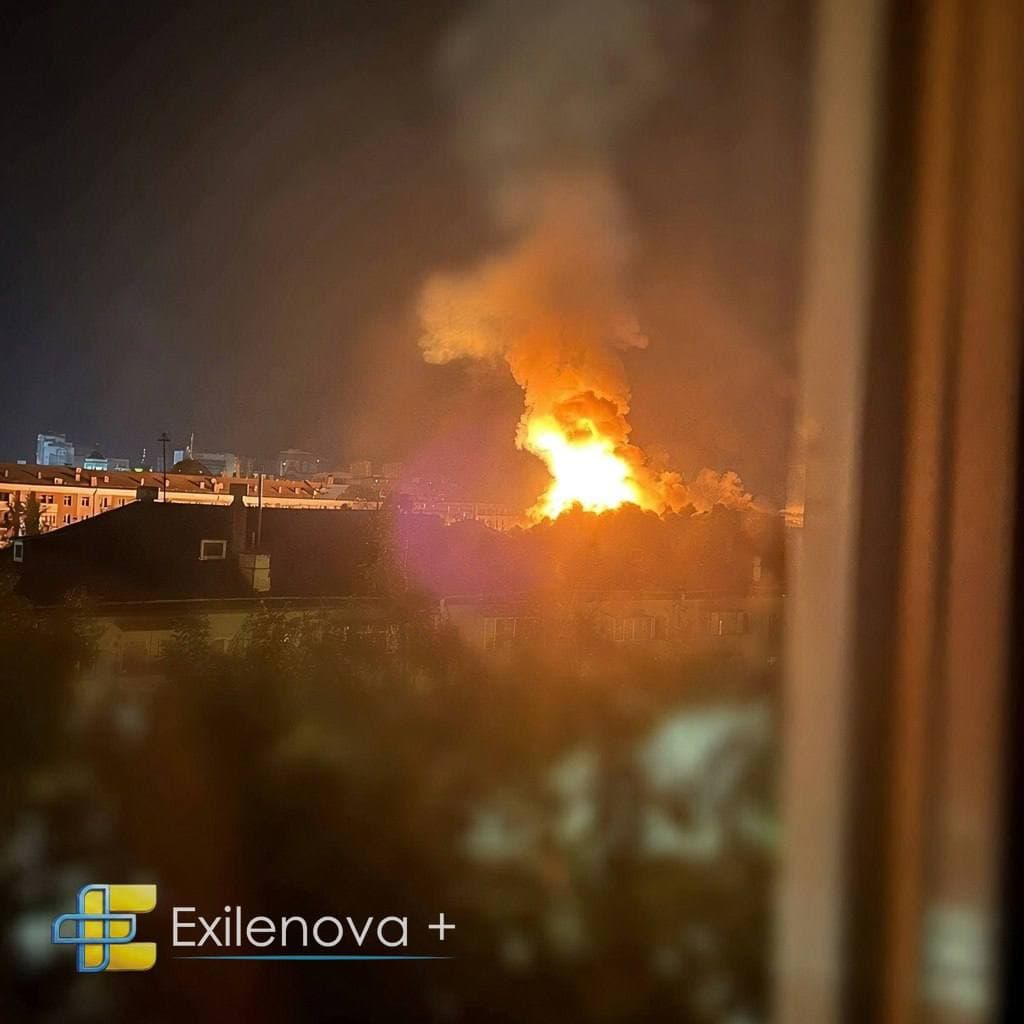
A fire burns in the Russian city of Belgorod overnight following a reported Ukrainian attack on the city. (Exilenova_plus/Telegram)
WHO WAREHOUSE DESTROYED, AND A UNICEF DISPUTE
The World Health Organization confirmed a humanitarian warehouse in Dnipro, holding emergency medical supplies bound for front-line hospitals, was destroyed in a Russian strike, though staff managed to evacuate 130 of roughly 300 pallets beforehand. “Even wars have rules. One of those is that health must be protected,” WHO chief Tedros Adhanom Ghebreyesus said, without naming Russia directly — a pattern of careful neutral language that has increasingly frustrated Ukrainian officials and some European diplomats alike. The WHO has now documented 3,148 attacks on Ukrainian healthcare since the invasion began, resulting in 240 deaths.
That frustration boiled over publicly when Foreign Minister Andrii Sybiha accused UNICEF of false equivalence in a statement the agency issued days earlier, which discussed child casualties without attributing responsibility to Russia’s invasion. Sybiha noted UNICEF’s own figures were wrong: the statement referenced children killed in Russia’s Krasnodar region by what was actually Russian air defense intercepting a Ukrainian drone, while undercounting the Ukrainian side entirely — seven children from a single family, not three, were killed when a missile destroyed their home in Dnipropetrovsk Oblast on July 30. “UNICEF creates a false equivalence between the aggressor and the victim,” Sybiha wrote, adding that another 3-year-old was killed in Kyiv Oblast just the day before.
ZELENSKY AND VUČIĆ, AND A KOSOVO BACKLASH
Zelensky’s three-day visit to Serbia closed with an unexpected diplomatic ripple. During talks with President Aleksandar Vučić, Zelensky reaffirmed that Ukraine does not recognize Kosovo’s independence — a longstanding position, but one that landed badly given Kosovo’s consistent support for Ukraine throughout the war. Pristina’s mayor responded by having a large Ukrainian flag stripped from a city building, declaring “when Kosovo is not respected, Pristina answers.” Kosovo’s foreign minister, Behgjet Pacolli, called the remarks “deeply disappointing,” noting Kosovo’s genuine solidarity made the response feel like a poor return on goodwill.
The larger visit still produced tangible results: Vučić publicly backed Ukraine’s EU accession bid, the two governments signed a food-safety cooperation agreement, and Serbia invited Zelensky back to open a Serbian-Israeli drone factory. Whether one diplomatic misstep with Kosovo outweighs the gains made with Belgrade is the kind of question that will likely depend on which relationship Ukraine needs more in the months ahead.
NAFTOGAZ UNDER RENEWED ASSAULT
Russian drones struck Ukrnafta production facilities and a drilling rig across eastern, western, and central Ukraine, disabling equipment and forcing operations to halt, though security measures kept anyone from being hurt. It follows strikes on seven Ukrnafta filling stations across Dnipropetrovsk, Zaporizhzhia, and Mykolaiv oblasts just two days earlier. “It is obvious that the enemy’s goal is to inflict maximum damage on Ukrainian production and other critical infrastructure to make it impossible to prepare for the heating season,” acting Naftogaz CEO Serhii Fedorenko said. Russia has now destroyed 32 Ukrnafta filling stations and five production facilities run by sister company Ukrgasvydobuvannya in the first seven months of 2026 alone — a campaign running in direct parallel with the intelligence warning that Russia may target Kyiv’s power grid next, ahead of Independence Day.
WHAT SUNDAY CONFIRMED
By the time Sunday’s fires were finally counted, Ukraine had a double-tap in Kharkiv, a quarter-million households dark in Odesa, and a defense minister’s warning that the war’s next chapter may arrive without ever being formally declared. Zelensky’s missile program offered a rare piece of good news, immediately complicated by the same corruption questions that have shadowed much of Ukraine’s wartime procurement. Nothing about the war’s basic shape changed today. It simply kept confirming that both sides are still finding new ways to hurt each other, and new ways to disappoint the people counting on them to do better.
A PRAYER FOR UKRAINE
1. For the Five-Year-Old Boy of Saltivka
Lord, a child not yet six was wounded when a second missile arrived exactly as rescuers reached the first strike, a cruelty built specifically to punish the act of helping. Heal his small body, and heal the fear that comes with surviving something built to kill the people who came to save him. Protect every rescuer who keeps running toward danger anyway.
2. For Three Hundred Thousand Families Without Light in Odesa
Father, an entire quarter of a city’s households woke up in the dark today, water cut along with the power, repair crews working against damage too widespread to fix quickly. Hold every family cooking by candlelight tonight, checking on elderly neighbors, wondering how long the dark will last. Let the lines be restored soon, and let this city’s patience outlast the damage done to it.
3. For Every Family Losing Someone to a War Not Yet Called by Its Name
Lord of truth, tens of thousands more may soon be pulled into this war through mobilization no one will admit is happening, on one side, and foreign troops arriving to gain experience fighting people who never invited them, on the other. Protect the ordinary people caught in decisions made far above them, in Moscow and in Pyongyang alike. Let deception find its limits before more lives are spent extending them.
4. For Honesty Inside the Institutions Meant to Protect Ukraine
God of justice, even the weapons meant to defend this country carry questions about who profited from building them. Give Ukraine’s investigators courage to follow the truth wherever it leads, even into rooms close to power. Let the soldiers who will someday depend on these missiles never have to wonder whether corruption compromised what protects them.
5. For the Medical Supplies That Never Reached the Front
God of healing, a warehouse full of the very medicine meant for frontline hospitals burned before it could reach the people who needed it most, one more link in the chain of care broken by a strike that targeted nothing military at all. Provide another way for that medicine to reach the wounded who are still waiting for it. Protect every warehouse, ambulance, and clinic still standing, and the workers who keep showing up to them anyway.
In Your mercy, in Your justice, in Your time — bring this war to its end, and let the ending be worthy of what Ukraine has endured.