
August 15, 2026
Prepared by Diana Bozhyk
Ukraine struck deep into Russia overnight, hitting a satellite-communications rocket plant in Samara and an air base that launches ballistic missiles at Ukrainian cities, using domestically built Flamingo cruise missiles against both for the first time. As Russia’s oil exports from Novorossiysk ground to a halt and Ukrainian hackers crippled the country’s largest online retailer, three major European powers quietly began building their own peace-talks framework, wary of being sidelined by Washington. Meanwhile, a Russian drone killed a three-month-old boy in Marhanets, and new figures show Russia lost more soldiers in a single month than it has since early last year.
THE DAY’S RECKONING
Picture a missile flying 560 miles into Russia’s interior to hit a factory that builds the rockets carrying Russia’s answer to Starlink into orbit. That’s not science fiction — that’s a Tuesday-night mission using a missile Ukraine builds itself, called Flamingo, striking two targets Russia thought were safely out of reach. One was a satellite plant. The other was an air base that launches the ballistic missiles Russia fires at Ukrainian cities.
Everything else about the day orbited that same theme: reach, and who has it. Russia’s biggest Black Sea oil terminal is so battered it’s stopped accepting new crude. Ukrainian hackers, not just drones, took down a Russian retail giant’s payment systems. Three European capitals, worried Washington might cut a deal without them, started quietly building their own back channel into the peace process. And on the ground, a war that increasingly runs on statistics — kilometers won, drones downed, soldiers lost — added a number no statistic can soften: a three-month-old boy, killed in his own home, the youngest casualty this war has claimed in weeks.
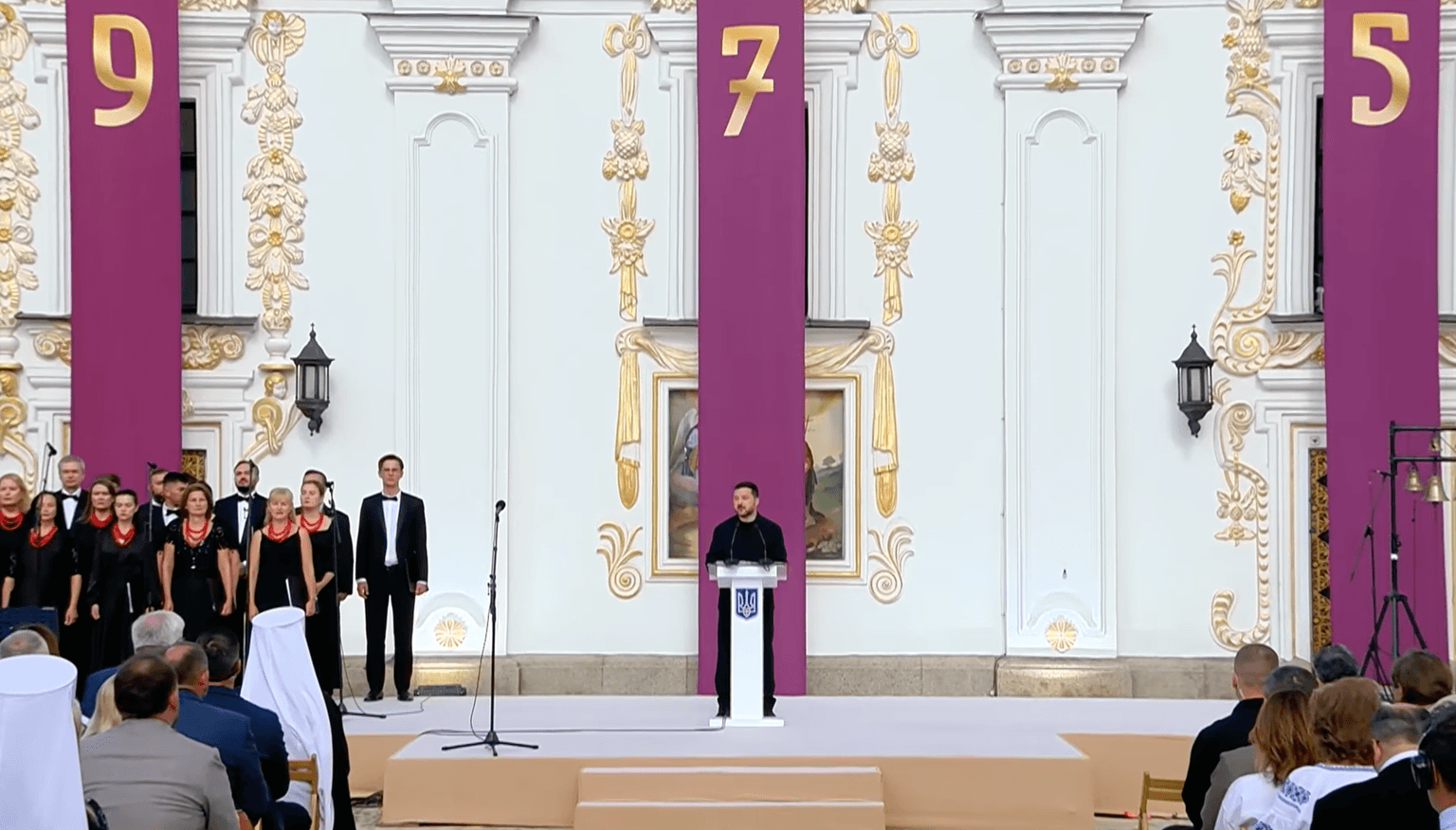
President Volodymyr Zelensky delivers remarks at the Kyiv Pechersk Lavra in Kyiv, Ukraine, the 975th anniversary of the site’s founding. (Screenshot / Presidential Office)
FLAMINGO MISSILES REACH DEEP INTO RUSSIA
For the first time, Ukraine used its domestically built Flamingo cruise missile — a long-range weapon developed entirely in Ukraine, built specifically to hit targets standard NATO-supplied missiles can’t legally reach — to strike two separate, high-value targets deep inside Russia in a single overnight operation.
The first target was the Progress Space Rocket Center in Samara, a facility President Zelensky said sits roughly 560 miles from Ukraine’s border. It’s one of Russia’s core rocket-and-space manufacturing plants, producing the Soyuz-2.1b launch vehicles that carry Russia’s Rassvet satellite constellation into orbit — effectively Russia’s homegrown replacement for Starlink, built after SpaceX cut off Russian access to its terminals earlier this year. Russian forces reportedly already use Rassvet satellites to guide precision drone strikes in Ukraine, which makes the rocket center a legitimate military target rather than a purely civilian one. Ukraine’s Fire Point defense manufacturer confirmed its missiles caused the fire visible in footage published the same day; the regional governor confirmed a strike on an unspecified industrial facility without naming it.
The second target, roughly 425 miles from Ukraine’s border, was the Savasleyka Air Base — home to MiG-31K fighter jets that carry Russia’s Kinzhal aeroballistic missiles, the same weapon type that regularly strikes Kyiv. “The carriers of Russian missiles that strike our cities and villages” is how Zelensky described the base. Of five Flamingo missiles launched at the two targets combined, two reportedly struck the rocket center despite Russia scrambling additional radar aircraft specifically to intercept them — a sign both of the mission’s difficulty and of how seriously Russia now treats the Flamingo threat.
RUSSIA’S OIL EXPORTS QUIETLY GRIND TO A HALT
Four days after Ukraine’s naval strike devastated Novorossiysk, the consequences are still unfolding — and they’re hitting Russia’s export economy, not just its navy.
Russian authorities have suspended crude oil exports from the Sheskharis terminal in Novorossiysk and stopped accepting new oil deliveries into it altogether, according to Reuters, which cited three people familiar with the matter. The reason is almost mundane: the terminal’s storage tanks are full, and with export operations disrupted since the strike, there’s nowhere left to put incoming crude. Separately, Russian Railways confirmed it’s restricting cargo loading at Novorossiysk for a ten-day window, from August 13 through 22 — a rare public acknowledgment that a single Ukrainian strike is still constraining Russian logistics nearly a week later.
Ukraine paired that physical pressure with a digital one. Ukraine’s military intelligence agency confirmed its cyber specialists hit Wildberries — Russia’s dominant online retailer and, increasingly, a target because its warehouses double as logistics nodes tied to the war economy — with a cyberattack that disrupted the company’s main customer-service channel and partially destabilized its payment systems. Wildberries publicly blamed unspecified “technical problems” and quietly extended its payment processing window for sellers from five days to seven, an indirect admission that something was genuinely wrong. Combined with weeks of physical strikes on Wildberries warehouses across Russia, the cyberattack adds a second front to a company that increasingly can’t separate its commercial operations from the war its products help supply.
HOW UKRAINE ACTUALLY WON OLEKSANDRIVKA
Three days after Ukraine announced it had liberated 745 square kilometers in its southeastern counteroffensive, new details are surfacing about how — and just how badly Russia’s own leadership misjudged what was happening beneath it.
Ukrainian brigade commanders involved in the operation described using drones to directly support advancing infantry and, notably, achieving moments of actual mechanized maneuver — tanks and armored vehicles moving together with troops, not just infantry creeping forward alone — a tactic increasingly rare in a war where any vehicle grouping usually draws drone strikes within minutes. Of the 26 settlements Ukraine claims to have retaken, Ukrainian sources say 19 were fully Russian-occupied territory before being outright seized, not merely contested ground changing hands at the edges.
The scale of Russian self-deception adds real weight to the achievement. According to a battlefield analysis reviewed independently, the Ukrainian push forced Russian commanders to divert troops from two entire combined-arms armies to the threatened sector — a diversion that reportedly forced Russia to cancel a separate major offensive planned further north. Meanwhile, on July 3, Russian President Vladimir Putin held a televised meeting where his own chief of the General Staff told him Russian forces had captured over 3,000 square kilometers of Ukrainian territory since January, including rapid gains specifically in the Oleksandrivka and Hulyaipole directions — the exact sector where Ukraine was actively counterattacking at that very moment. Hours later, Russia’s defense ministry publicly announced Oleksandrivka had fallen, while the nearest Russian troops were likely still nine miles away. Independent researchers calculated that over a separate two-week window in July, Russian forces were actually losing territory, not gaining it, at a small but steady daily rate — a pattern researchers say may reflect Russian officers manipulating Putin as much as it reflects deceiving the public.
MEANWHILE, AT THE ACTUAL FRONT — THE NORTH AND EAST
Away from headline strikes, the front line told its usual story: exaggerated Russian claims, contested inches, and slow Ukrainian resistance holding mostly firm.
In Kharkiv Oblast, Russian forces made no confirmed progress despite milblogger claims of a village seizure north of the city. Near Kupyansk, conflicting claims from both sides about who actually controls the town persist, with Ukrainian forces maintaining positions across its central, southern, and southwestern districts regardless of Russian assertions otherwise. Near Borova, Russian sources published what researchers assess is likely AI-altered footage claiming a flag-raising well beyond where any confirmed Russian advance has actually reached — a recurring pattern of digital propaganda substituting for real territorial gain. Ukrainian forces, meanwhile, kept up pressure in occupied Luhansk Oblast, striking a Russian air-defense system near Kreminna and a military supply depot near Lysychansk.
Near Slovyansk, Ukrainian forces made confirmed gains near the village of Ozerne, directly contradicting earlier Russian claims of holding that ground — while Russian forces responded with glide bombs that collapsed a span of a pedestrian bridge in the city itself, part of a deliberate campaign to sever the logistics routes Ukraine’s “Fortress Belt” defensive line depends on. Russian units are increasingly relying on so-called sleeper drones — unmanned systems parked motionless along roadsides and footpaths, silently watching and even listening for Ukrainian vehicle and troop movement before Russian operators strike. Near Kostyantynivka, Russian forces are probing for weak points along the seams between Ukrainian units, testing both flanks of at least one brigade’s defensive line in search of a gap to exploit.
MEANWHILE, AT THE ACTUAL FRONT — THE SOUTH
Further south, the pattern repeated: claimed Russian breakthroughs that don’t hold up, and Ukrainian forces quietly grinding away at Russian logistics instead.
Near Dobropillya, even a Kremlin-aligned military commentator publicly contradicted his own side’s claim of having entered the town, stating plainly that Russian forces haven’t actually established positions there. Near Pokrovsk, Ukrainian forces appear to have maintained or slightly advanced positions even as Russian infiltration attempts continued — geolocated footage showed Ukrainian troops holding ground in an area Russian sources had previously claimed to control. Near Oleksandrivka itself, Russian forces kept attacking without making any confirmed gains, continuing to test the same defensive line Ukraine spent eight months clearing.
Ukraine, for its part, kept striking Russian military infrastructure well behind the contact line: a drone storage depot in occupied Vuhledar and a control point in occupied Selydove, both roughly 15 to 30 miles from active fighting. Near Hulyaipole and Orikhiv in Zaporizhzhia Oblast, Russian forces continued attacking without any confirmed breakthrough, despite a fresh wave of Russian propaganda claiming otherwise. Ukrainian strikes, meanwhile, hit a Russian control point near occupied Mykhailivka and appear to have further damaged a railway bridge near Svitlodolynske that Ukraine first struck earlier in the month — a bridge Russia has apparently been unable to fully repair since. In occupied Crimea, footage confirmed a Ukrainian drone strike on a Russian rocket and artillery depot, and local sources reported explosions and a fire at the Balaklava Thermal Power Plant overnight — a facility local authorities reportedly stopped operating entirely after the strike.
A FAKE FLAG-RAISING CAMPAIGN, AND THE REAL PICTURE UNDERNEATH IT
Behind the individual skirmishes lies a coordinated Russian information effort worth naming directly: in the days since Ukraine announced its Oleksandrivka gains, Russia’s defense ministry and allied military bloggers have flooded social media with footage of Russian soldiers waving flags across more than twenty different villages in the area — footage researchers assess is, in significant part, either AI-generated, digitally altered, or old footage falsely relabeled as new.
The pattern is consistent with what analysts describe as a deliberate cognitive-warfare campaign: fabricate the appearance of sweeping Russian advances in exactly the sector where Ukraine just embarrassed Russian command, in order to muddy public perception of who’s actually winning there. Russia’s defense minister personally inspected the relevant military grouping and claimed it had seized 19 additional settlements as part of a broader summer campaign — claims that independent researchers and even some Kremlin-aligned commentators have separately disputed or been unable to verify. It’s a strange dynamic: Russia’s own military bloggers, usually reliable amplifiers of official claims, are increasingly the ones publicly correcting the record when Moscow’s numbers don’t match what troops on the ground are actually seeing.
The tactic matters beyond simple bragging rights. A flood of flag-raising videos, real or fabricated, shapes how ordinary Russians and foreign observers alike perceive momentum in the war, independent of what’s actually happening on contested ground. For a Kremlin trying to keep its domestic public supportive of a costly war ahead of September’s parliamentary elections, the appearance of victory can matter just as much as victory itself — which is precisely why researchers say this kind of digital fabrication has become a routine instrument of Russian wartime messaging rather than an occasional exception.
152 DRONES AND A THREE-MONTH-OLD IN MARHANETS
Overnight, Russia launched 152 Shahed-type and Gerbera-type strike drones, along with Banderol loitering munitions and Parodiya-type decoys, at Ukraine from five separate launch points. Ukrainian forces intercepted 124 of them; the rest struck 16 locations, with debris landing at one more.
The deadliest strike hit a multi-story residential building in Marhanets, in Dnipropetrovsk Oblast, killing a three-month-old boy and injuring 11 others, seven critically, including a five-year-old boy and a 12-year-old girl. In the city of Zaporizhzhia, a separate drone strike damaged an industrial enterprise and set fire to a shopping center; emergency crews needed 23 rescue workers and seven vehicles to fully extinguish both blazes. Daytime strikes added to the toll: a strike on Pavlohrad injured two men in their late forties and early fifties, while a Russian FPV drone deliberately targeted a combine harvester working a field in Zaporizhzhia district, wounding two farm workers in their early thirties mid-harvest.
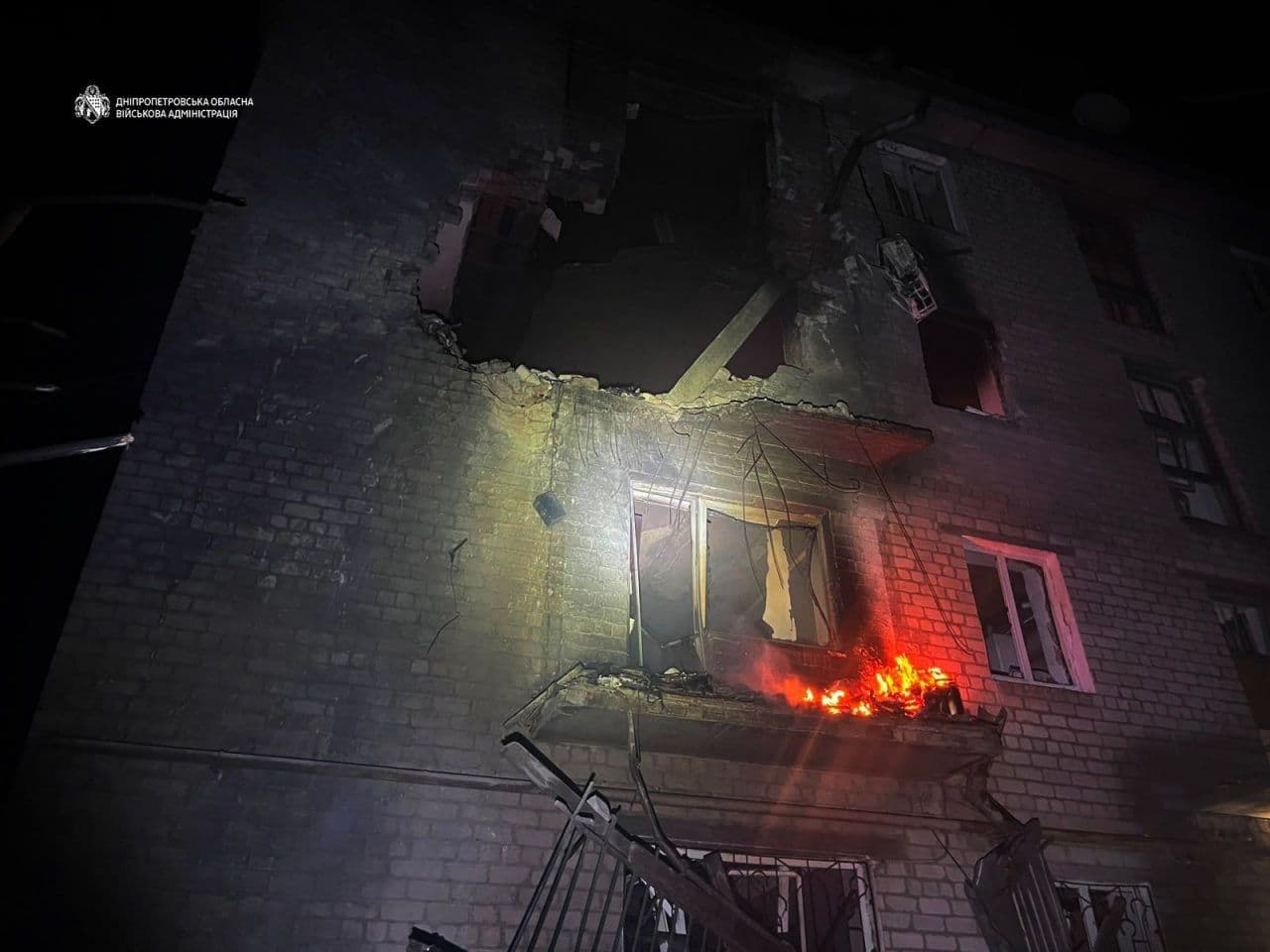
A residential building damaged in a Russian attack on Dnipropetrovsk Oblast overnight. (Dnipropetrovsk Oblast Military Administration/Telegram)
Russia is also quietly upgrading the drones behind these barrages. A Ukrainian presidential defense advisor confirmed Russian forces have begun fitting jet engines onto their cheaper Italmas-type strike drones — previously slower, propeller-driven weapons — specifically to outrun Ukrainian interceptor drones. Combined with Russia’s continued prioritization of jet-powered Geran-4 and Geran-5 production, it’s part of a broader pattern: Ukraine currently lacks enough fast interceptors to reliably catch these upgraded drones, and Russia knows it. By day’s end, Russian strikes had killed at least one person and injured 49 more nationwide.
EUROPE BUILDS ITS OWN SEAT AT THE TABLE
While Washington leads the diplomatic conversation about ending the war, France, Germany, and the United Kingdom have quietly started building a peace-talks framework of their own — driven by growing anxiety that the Trump administration could cut a deal with Moscow that sidelines European interests entirely.
According to European officials, Paris and Berlin are leading the effort to craft a unified European negotiating position, while London is participating more cautiously, mindful of its close relationship with Washington. The officials argue the war’s resolution and Europe’s future relationship with Russia are existential security questions for the continent — not matters Europe can simply outsource to an American administration officials increasingly view as unpredictable. European leaders acknowledge any real negotiation with Moscow will still run through Washington, but they want a guarantee that no final agreement gets signed without their direct involvement.
That European anxiety runs parallel to a separate, more mundane problem in Kyiv: Ukraine still doesn’t have an ambassador to Washington. President Zelensky reportedly offered the post to Yulia Svyrydenko, Ukraine’s prime minister until mid-July, who turned it down. Other experienced candidates are reportedly hesitant too, with one opposition lawmaker suggesting they fear they lack enough of Zelensky’s personal trust to operate effectively in Washington’s current political environment. The vacancy comes at a genuinely bad moment — Zelensky says air-defense missile deliveries from allies have dropped by two-thirds compared to last year — and one opposition figure has floated the theory that Zelensky may deliberately wait until after November’s US midterm elections before naming anyone at all.
UKRAINE ANSWERS RUSSIA’S ATTEMPT TO ERASE THE BORDER
Ukraine’s foreign ministry issued a formal rebuttal to Russia’s plan, revealed this week, to eliminate border-control zones between Russian regions and the Ukrainian territory Moscow claims to have annexed — dismissing the move as legally meaningless despite its symbolic weight.
The ministry’s statement was unusually direct: Russia, it said, is trying to manufacture the illusion that occupied Ukrainian land has become an ordinary part of Russia, rather than performing any legitimate administrative change. “The Russian agency can move control points, rewrite its own documents, and redraw maps as much as it wants,” the ministry said. “This does not make occupied Ukrainian land Russian, and the internationally recognized state border of Ukraine does not shift by a single meter.” Ukrainian officials noted the broader pattern this fits: Russia recognized the “independence” of Moscow-backed proxy territories in Donetsk and Luhansk just three days before launching its full-scale invasion, meaning the legal groundwork for today’s annexation claims was being laid before the first shots were even fired.
Ukrainian officials framed the border move as part of a longer, methodical campaign rather than an isolated bureaucratic footnote — one that also includes simplified, effectively permanent paths to Russian citizenship for residents of occupied territory and laws letting occupation authorities seize Ukrainian-owned homes by declaring them abandoned. Each step individually looks like paperwork. Collected together, Ukrainian diplomats argue, they describe a state trying to make an illegal occupation indistinguishable from ordinary Russian territory through sheer administrative repetition — which is exactly why Kyiv felt the need to respond publicly and immediately, rather than let the claim stand unanswered even for a single news cycle.
ARMING UKRAINE FROM THREE DIRECTIONS
Three separate threads of foreign military support advanced quietly, each drawing a different reaction from Moscow.
Russia’s Foreign Ministry publicly complained to officials in both Washington and Ankara over Turkey’s reported plan to re-export a package of American-made weapons to Ukraine, including 70 long-range ATACMS missiles — precision weapons capable of striking far behind Russian lines. A Russian spokesperson warned the transfer would cause “serious damage” to Russia’s relations with both countries and accused Turkey of undermining its own credibility as a potential mediator in the war. Separately, Lithuania signed an agreement with a Ukrainian defense manufacturer to build a new NATO-standard ammunition plant on Lithuanian soil, with construction starting this fall and production expected by the end of 2027 — output that will initially supply Ukraine directly before eventually expanding to other allied militaries.
Perhaps the most quietly significant revelation came from British reporting: Ukraine has spent the past six months using British-made drones, including a jet-powered model built by a major UK defense contractor and tested by Britain’s own navy, to strike deep inside Russian territory — hitting oil refineries near Moscow and in at least two other Russian regions. Most of Ukraine’s deep-strike missions still rely on domestically built drones, but the British hardware’s involvement marks a quiet escalation in how directly UK-made weapons are now reaching Russian soil, and unnamed British defense sources say they expect Moscow to respond with intensified hybrid attacks against the UK in retaliation.
RUSSIA’S BLOODIEST MONTH IN A YEAR AND A HALF
New Ukrainian military estimates suggest July was catastrophic for Russia’s army — a scale of losses Kyiv says Moscow hasn’t suffered since January of last year.
Ukraine’s Defense Ministry, drawing largely on geolocated drone footage, estimated Russian forces suffered 42,860 troops killed or seriously wounded in a single month, pushing Russia’s total confirmed personnel losses since the invasion began past 1.46 million. Russia also lost nearly 14,000 vehicles — cars, trucks, and motorcycles combined — the highest monthly total of the entire war, according to the same estimates. Independent verification of Ukraine’s figures remains difficult, but military analysts who track the war closely have separately documented intense Ukrainian drone activity specifically targeting Russian logistics and supply convoys moving through occupied southern Ukraine — activity consistent with the kind of sustained attrition these numbers describe.
A Ukrainian drone campaign launched earlier this summer, specifically against Russian road logistics, reportedly destroyed or disabled at least 400 supply trucks carrying fuel and ammunition, using small, cheap drones built from styrofoam and carbon fiber but carrying enough explosive to disable a tank. The losses reportedly left some frontline Russian units short of both supplies and reinforcements for stretches of weeks at a time — a slower, less visible form of pressure than a single dramatic strike, but one that may be doing more cumulative damage to Russia’s ability to sustain offensive operations than any individual headline-grabbing attack this year.
A NEW COMMANDER FOR THE FORTRESS BELT
Ukraine appears set to hand command of one of its most critical defensive sectors to an officer with a track record of putting his soldiers’ lives ahead of orders from above.
According to multiple sources within Ukraine’s defense establishment, Colonel Emil Ishkulov is expected to take command of the 11th Army Corps, responsible for defending the Sloviansk and Kramatorsk sectors — the northern anchor of Ukraine’s “Fortress Belt” defensive line in Donetsk Oblast. Ishkulov previously commanded the 80th Air Assault Brigade, where he became known for refusing an order he judged to exceed his unit’s actual capabilities, and separately for declining to lead his brigade into Russia’s Kursk region ahead of Ukraine’s 2024 incursion there — a decision that put him at odds with Ukraine’s commander-in-chief at the time but earned him a reputation among his own soldiers as a commander who prioritized their survival over headline-grabbing operations.
The reported move fits a broader pattern under new Commander-in-Chief Mykhailo Drapatyi, who ordered a sweeping audit of Ukraine’s military personnel structure in late July aimed at ensuring troops and experienced leadership are distributed fairly and effectively across understaffed units. If confirmed, Ishkulov would replace a commander whose leadership style sources described as increasingly out of step with the demands of the current fight — part of what looks like a broader generational shift in who Ukraine trusts to hold its most contested ground.
POLAND FLEXES A GROWING ARMY
Poland marked its Army Day with a full display of just how fast the country has rebuilt its military since Russia’s 2022 invasion — a visible, deliberate signal to Moscow sitting just across NATO’s eastern border.
Warsaw hosted a large-scale military parade featuring roughly 300 armored vehicles and 2,000 soldiers, alongside a separate naval parade in the port city of Gdynia. Poland’s defense minister confirmed the country’s active-duty force now numbers 220,000 soldiers, already the third-largest military in NATO behind only the United States and Turkey, with an official goal of reaching 300,000 active personnel plus 200,000 reservists in the coming years. That’s more than double the roughly 100,000 troops Poland fielded just over a decade ago, before Russia’s war made rapid rearmament a matter of national urgency rather than long-term planning. Poland observes Army Day annually on the anniversary of its 1920 victory over the invading Red Army — a piece of history that gives this year’s display of force an unmistakable resonance.
The timing carries extra weight given recent strain in Polish-Ukrainian relations, fueled in part by rising hate crimes against Ukrainians living in Poland and by political factions questioning continued support for Kyiv. Poland’s leadership used the occasion to reaffirm, publicly and unambiguously, that Russia remains the country’s central security concern — a message aimed as much at domestic skeptics as at Moscow itself. The buildup also reflects lessons learned directly from the war next door: Poland became the first NATO country to shoot down Russian drones during a mass strike on Ukraine last September, and a Russian cruise missile crashed onto Polish soil just weeks ago, on July 30, underscoring how directly this war already touches Polish territory regardless of formal neutrality.
ZELENSKY MOVES TO PROTECT UKRAINE’S NATIONAL SHRINES
On the same day Ukraine marked 975 years since the founding of the Kyiv Pechersk Lavra — one of the country’s oldest and most sacred religious sites, heavily damaged by a Russian missile strike this past June for the first time since World War II — President Zelensky signed a decree ordering the government to draft formal legislation protecting Ukraine’s most significant cultural and historical landmarks.
The decree instructs Ukraine’s cabinet to produce a draft law by August 24, Ukraine’s Independence Day, establishing clear criteria for designating a site as a national shrine and creating specific new legal measures to shield such places from further Russian attacks. It also directs Ukraine’s foreign ministry to formally document Russian strikes on cultural heritage sites for the international community and to push for more Ukrainian landmarks to be added to UNESCO’s World Heritage list. Zelensky made the announcement at the Lavra itself, standing alongside UNESCO’s Director-General, who was making his first visit to Ukraine since taking the role. “You feel that you are part of something much greater and longer-lasting than your personal story,” Zelensky said of the monastery complex, a solemn note struck deliberately against the backdrop of a war that has already damaged Kyiv’s National Art Museum, its opera theater, and a Chornobyl memorial museum that lost more than 40 percent of its collection in a single strike in May.
GERMANY WARNS OF STRIKES BEFORE INDEPENDENCE DAY
Germany’s embassy in Kyiv issued an updated security advisory urging German citizens to avoid rail travel in Ukraine in the days leading up to August 24 — Ukraine’s Independence Day — citing intelligence suggesting Russia may significantly escalate strikes on energy infrastructure and transport hubs during that window.
“Ukrainian railway infrastructure, as well as the railway operators themselves, continue to remain the target of Russian airstrikes,” the embassy said, a warning that follows directly from this week’s fatal drone strike on a passenger train’s locomotive in Odesa Oblast, which killed the driver and his assistant before they could fully evacuate 340 passengers. Separately, Ukraine’s Center for Strategic Communications said US intelligence indicates Russia is preparing a large-scale strike campaign specifically targeting Kyiv’s energy infrastructure timed around the same holiday — a deliberate echo of Russia’s pattern in prior years of intensifying attacks around dates with symbolic weight for Ukrainian statehood.
Neither Germany nor Ukraine described the exact nature of the expected strikes, but the timing and specificity of the warning suggest officials consider the threat credible enough to act on now, well before the anniversary itself arrives. It’s a familiar rhythm by this point in the war: national holidays and symbolic dates have repeatedly drawn some of Russia’s heaviest bombardments, treated less as occasions for restraint than as opportunities to inflict maximum psychological impact. For ordinary Ukrainians, that means a holiday meant to celebrate independence now doubles, every year, as an unofficial period of heightened vigilance — one more way the war has reshaped even the calendar itself.
A ROCKET PLANT, A BORDER DENIED, A CHILD LOST
By nightfall, the day had reached in every direction at once: deep into Russia’s rocket industry, deep into Europe’s anxiety about being sidelined, deep into the question of who actually controls a strip of embattled Ukrainian villages. None of it resolved anything. All of it mattered anyway.
A missile factory in Samara is burning because of a weapon built entirely in Ukraine. A three-month-old boy in Marhanets will never see his first birthday. Three European capitals are quietly hedging against being left out of their own continent’s future. And Poland marched two thousand soldiers past cheering crowds to make a point Moscow has heard many times before and shown no sign of absorbing: this alliance isn’t going anywhere, no matter how long the war grinds on.
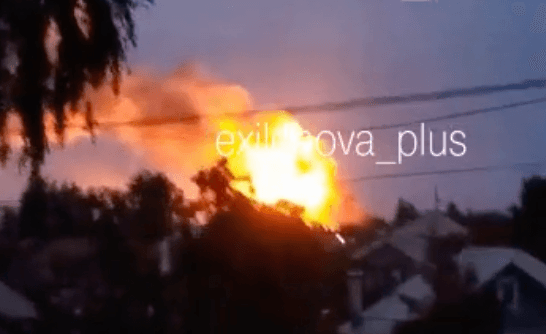
What purports to be the aftermath of a Ukrainian strike on the Russian city of Samara overnigh. (Exilenova Plus/Telegram)
A PRAYER FOR UKRAINE
1. For the Three-Month-Old Boy in Marhanets
Lord, an infant is dead tonight in Marhanets, a life that had barely begun, ended by a drone strike he could never have understood or escaped. We have no words adequate to this kind of loss. Hold his parents close in a grief that has no shortcuts and no timeline. Let his short life be more than a statistic in tomorrow’s casualty count, and let the world remember that this war kills children who never had the chance to be anything but innocent.
2. For the Farm Workers and Ordinary People Caught Mid-Task
Father, we lift up the men injured today simply doing their jobs — harvesting a field, working a shift in Pavlohrad, living an ordinary Saturday interrupted by violence they didn’t choose. Protect the people whose daily labor keeps this country running even under fire. Give them healing, and give their families patience as recovery unfolds slower than any of them would like.
3. For the Soldiers Given a New Commander’s Trust
Lord of the brave, we pray for the troops defending Sloviansk and Kramatorsk, and for the leadership now shifting above them. Give any new commander the wisdom to value his soldiers’ lives as much as the ground he’s ordered to hold. Protect this fragile line, and let those entrusted with defending it feel, for once, genuinely looked after by the decisions made far above them.
4. For a Nation Still Searching for Its Voice in Washington
God of open doors, we pray for a country struggling to find someone willing to represent it in the halls where its future is being decided. Give Ukraine’s leaders wisdom in this search, and give whoever ultimately accepts the courage the role demands. Let Ukraine’s voice be heard clearly in every room where decisions about its survival are made, whether or not a single ambassador sits in the chair.
5. For the Slow, Uncertain Path Toward an Ending
God of patience, we pray for every quiet diplomatic effort happening far from the front — in European capitals, in ambassadors’ offices, in rooms where the shape of peace is slowly being drawn. Give negotiators clarity instead of ego, and give Ukraine’s allies courage to move at the speed this war requires, not the speed that’s merely comfortable.
In Your mercy, in Your justice, in Your time — bring this war to its end, and let the ending be worthy of what Ukraine has endured.