
August 14, 2026
Prepared by Diana Bozhyk
Russia’s foreign minister flatly rejected any ceasefire, threatening “harsher” strikes as Moscow dismissed Turkish and Ukrainian proposals for a Black Sea truce. The same day, a missile tore into one of Odesa’s last working ports as Ukraine’s agricultural exports collapsed to just 30 percent of target, and a Russian glide bomb killed one and wounded twenty-two people in Kramatorsk. Meanwhile, Ukrainian drones reached two more Russian refineries overnight, and Warsaw revealed the identity of the man a Russian-linked assassin had been sent to kill: a Ukrainian-American rapper accused by Moscow of smuggling drones.
THE DAY’S RECKONING
Two days ago, Kyiv did something rare: it offered Moscow a deal. Stop hitting each other’s ships in the Black Sea, at least, while the war grinds on everywhere else. Today Russia answered, and the answer was no — delivered not once but twice, by two separate officials, in case anyone missed the point the first time.
That refusal set the tone for everything else. A missile hit one of the few Ukrainian ports still functioning, deepening an export collapse that’s already cutting into a war-battered economy. A single glide bomb turned an ordinary residential building in Kramatorsk into a crime scene with twenty-three casualties. Ukrainian drones kept reaching deep into Russia regardless, hitting two more refineries overnight. And in Poland, authorities finally named the man Russia allegedly tried to have killed — not a general, not a diplomat, but a rapper who’d annoyed the Kremlin online. Different fronts, same war: one side offering off-ramps nobody’s taking, the other side taking casualties nobody’s counting closely enough.
RUSSIA REJECTS EVERY OFF-RAMP, TWICE IN ONE DAY
When Ukraine offered a Black Sea truce this week, it was a rare bid at de-escalation in a war that’s had almost none. Russia spent the day making sure nobody mistook that offer for progress.
Russian Foreign Minister Sergei Lavrov gave the harder of the two rejections, telling state television that Russia won’t accept any ceasefire that simply freezes the current front line — calling that scenario unacceptable because, in his framing, it would undercut the legacy of the Soviet victory in World War II. He went further, threatening to make Russia’s approach “harsher” and vowing to destroy what he called everything feeding Ukraine’s military machine from the West. “We are already doing this, and they are already starting to moan,” he said, offering no specifics on what new targets that might mean.
Foreign Ministry spokesperson Maria Zakharova handled the narrower rejection, dismissing Turkey’s and Ukraine’s separate proposals for a moratorium on Black Sea maritime strikes. She claimed Russia never received an official request from Turkey and argued there’s no basis for what she called a “half measure” — a pointed reference to the 2022-2023 Black Sea Grain Initiative, the UN-brokered deal that let grain ships sail safely before Russia let it collapse. Zakharova also accused Ukraine of “maritime terrorism.”
It’s worth noting Russian Security Council Deputy Chairman Dmitry Medvedev had already previewed this posture days earlier, telling a ruling-party audience that Russia would end the war “exclusively” on its own terms. Taken together, the message from Moscow is consistent: no partial deals, no temporary pauses, nothing short of what Russia calls a “long-term, reliable, and sustainable” settlement — which in practice means a settlement written entirely by the side that started the war.
A MISSILE HITS ODESA’S LAST WORKING PORT
While Russian officials were busy rejecting a Black Sea truce, Russian missiles gave the more concrete answer: a strike damaged at least one warehouse at the TIS terminal inside Ukraine’s Pivdennyi port complex near Odesa, according to an agriculture-sector executive with direct knowledge of the damage. The terminal’s operator declined to comment.
The timing matters more than the damage itself. TIS is co-owned by a Ukrainian businessman who also runs a specialist clinic for war veterans, and just months ago the world’s largest container shipping company took a majority stake in part of the same port complex — a rare vote of confidence from foreign investors in Ukraine’s ability to keep trading through the war. That container terminal wasn’t hit this time. But the message to any company weighing similar investment is unmistakable: nowhere on Ukraine’s coast is fully safe.
The bigger story is the slow strangulation of Ukraine’s export economy. Roughly 90 percent of the country’s agricultural exports move through the Black Sea, a trade that accounted for a fifth of Ukraine’s entire economy before the war. Russia struck vessels in port waters 35 times and in open Black Sea waters 22 more times last month alone, and ships are increasingly avoiding Ukrainian ports altogether rather than risk it. The result: Ukraine’s agricultural exports hit just 30 percent of their target in the first two weeks of August, and the agriculture ministry now projects the country could lose $12.5 billion in blocked exports by November if the pattern holds. That’s not a statistic about ships. It’s a statistic about farmers who grew crops they now can’t sell.
THE NIGHT UST-LUGA BURNED AGAIN
Ukraine’s deep-strike campaign didn’t take a night off. Overnight, Ukrainian forces struck the Novatek oil refinery at Ust-Luga on Russia’s Baltic coast — the same port hit just a day earlier — this time damaging two separate processing units and sparking a fire, according to Ukraine’s General Staff. The regional governor confirmed the blaze. It’s a sign that Ukraine isn’t just hitting a port once for headlines; it’s returning to grind down a facility until it stops functioning.
The same overnight package reached further inland, damaging a wall of a Wildberries warehouse in Tver Oblast — hundreds of miles from the nearest front line and further evidence that Russia’s dominant online retailer, whose warehouses increasingly double as logistics nodes for the war economy, remains squarely in Ukraine’s sights.
Separately, a Ukrainian open-source intelligence channel published an updated damage assessment for an earlier strike on the Syzran refinery in Samara Oblast, hit back on August 7 and 8. The new assessment is more detailed than what was known at the time: Ukrainian strikes damaged the refinery’s two primary processing units, its fluid catalytic cracking unit, and three separate units used to produce high-octane gasoline components — essentially disabling several of the refinery’s core production lines at once, not just denting a single piece of equipment. Separately, an unverified Ukrainian military source claimed intelligence operatives used explosives to destroy a Trans-Siberian Railway shipment of North Korean ballistic missiles bound for the front, though the source later walked the claim back as unconfirmed, and it remains unverified.
KRAMATORSK: ONE BOMB, TWENTY-TWO WOUNDED
Some strikes are measured in strategic terms — refineries, tonnage, kilometers of range. This one is measured in an apartment building.
President Zelensky reported that Russian forces struck a residential building in Kramatorsk with a guided glide bomb, killing one person and injuring at least twenty-two others. Glide bombs are large, unguided-turned-guided munitions dropped from aircraft flying well outside the range of most Ukrainian air defenses, then steered toward their target using fins and satellite guidance — cheap compared to a missile, brutally effective against anything without reinforced overhead cover, and nearly impossible for a city like Kramatorsk to defend against. Zelensky used the strike to make a broader point: Russia now launches at least 220 glide bombs against Ukrainian frontline areas every single day. Twenty-two wounded in one building isn’t an outlier. It’s Tuesday, multiplied by hundreds of bombs, in city after city along hundreds of miles of front.
Kramatorsk has absorbed this kind of violence for years now, close enough to the front that residents live with the sound of outgoing and incoming fire as background noise, far enough from any Ukrainian counterattack that Russian bombers can operate with something close to impunity overhead. The strike adds one more entry to a war where the ordinary act of being home, in your own building, in a city under Ukrainian control, remains one of the most dangerous things a person can do.
MEANWHILE, AT THE ACTUAL FRONT
Away from headline strikes, the front line itself barely moved — which, after four and a half years, has become its own kind of story.
In Kharkiv Oblast, Russian forces made no confirmed progress, though a Russian milblogger claimed Russian units are now fielding a new type of jamming-resistant carrier drone to strike deeper into Ukraine’s rear — one more entry in a technological arms race that’s been escalating on both sides for two years. Near Kupyansk, Ukrainian forces kept striking infiltrating Russian units and even a Russian ground robot, while a Kremlin-linked commentator publicly criticized his own side’s habit of mapping isolated drone strikes as if they represented real territorial control — a rare admission from within Russia’s own information ecosystem that the exaggeration problem cuts against accuracy, not just against Ukraine. Ukrainian forces also kept up pressure on occupied Luhansk Oblast, striking four electrical substations and, in one single operation roughly 60 miles behind the front, destroying nine armored vehicles and killing seven Russian soldiers.
Near Lyman, in Donetsk Oblast, Russian forces are reportedly rushing in specialized drone units to regain the technological edge Ukraine has held in that sector. Near Kostyantynivka, Russian sources claimed a small territorial gain that remains unconfirmed, while Ukrainian forces struck a Russian drone control point nearby and, separately, absorbed a strike on their own medical workers — a war crime under the Geneva Conventions if deliberately targeted. Further south, near Oleksandrivka, Russian forces launched counterattacks trying to claw back territory Ukraine liberated over the past eight months; Ukrainian troops held their ground, and even a Kremlin-aligned commentator acknowledged Russia’s position there had genuinely deteriorated. Ukraine, meanwhile, kept striking energy infrastructure deep in occupied Donetsk Oblast, hitting substations and a gas distribution station as far as 70 miles behind Russian lines.
RUSSIA’S RARE ADVANCE, AND A BRIDGE THAT DISAPPEARED IN FOUR HITS
Most of the front line held in place. One sector didn’t.
Near Hulyaipole in Zaporizhzhia Oblast, Russian forces launched a platoon-sized mechanized assault — dozens of armored vehicles pushing forward together, a comparatively large and risky maneuver in a war where single vehicles usually draw drone strikes within minutes. It worked, at least partially: Ukrainian forces destroyed one vehicle and struck three more over several hours of fighting, but Russian troops appear to have seized two settlements northwest of the town in the process — one of the only confirmed Russian advances anywhere along the front this week.
Ukraine answered with its own long-range pressure across the region. Ukrainian drone units reported eight separate hits on electrical substations in occupied Berdyansk alone, plus additional strikes on substations scattered across occupied Zaporizhzhia Oblast — infrastructure targets chosen specifically to complicate Russian military logistics rather than to punish civilians directly. The most striking single result came at a railway bridge near occupied Tokmak: Ukrainian operators tested a new type of munition against the bridge and rendered it completely unusable with just four hits — a remarkably efficient trade of a handful of drones for the permanent loss of a piece of infrastructure Russia had relied on to move supplies toward the front.
CRIMEA’S CRUMBLING BRIDGES
Two land bridges connect occupied Crimea to the rest of occupied Ukraine, and both are now visibly falling apart under sustained Ukrainian pressure.
Satellite imagery collected this week confirmed damage to the Syvash bridge between occupied Kherson Oblast and Crimea, corroborating an earlier Ukrainian military claim of a successful strike there. A separate set of images, circulated by a Crimea-based Telegram channel, appears to show that much of the nearby Chonhar railway bridge — once one of the main routes Russia used to resupply Crimea by rail — has now collapsed following repeated Ukrainian strikes. Neither bridge is fully gone, but both are increasingly unreliable for the kind of heavy, sustained logistics traffic an occupying military needs.
Ukraine kept adding pressure elsewhere on the peninsula and along its supply routes: strikes hit a drone control point and two ground relay stations for Russia’s long-range strike drones near occupied Zalizny Port in Kherson Oblast, an electrical substation deeper in the same region, and the Balaklava Thermal Power Plant near occupied Sevastopol. In response, Russian forces have started running more mobile anti-air units along the M-14 highway — the main road connecting Russia to Crimea — specifically to protect convoys, since single Ukrainian drone strikes along that route are no longer landing cleanly. Ukrainian operators have adapted in turn, now targeting the escort vehicles first to stop a convoy in its tracks before picking off the remaining trucks one at a time. It’s a small, granular arms race playing out on a single highway — a preview of how much harder both sides are having to work for results that used to come easily.
112 DRONES AND A CITY WITHOUT POWER
Overnight, Russia launched 112 Shahed-type, Gerbera-type, and jet-powered Banderol drones at Ukraine, alongside a wave of decoys designed purely to exhaust air-defense crews before the real weapons arrive. Ukrainian forces shot down 90; the rest struck 11 locations outright, with debris landing at six more. Strikes hit commercial, logistics, and residential targets across six oblasts, and in Kherson City, Russian strikes knocked out power to several neighborhoods entirely.
One trend is quietly reshaping how hard these nightly barrages are to stop. Ukraine’s air force says Russia used five times more jet-powered drones in July than in June — faster, harder-to-intercept aircraft that increasingly make up as much as two-thirds of a given night’s strike package. Overnight’s package alone included at least 30 of them. Unlike the slower, propeller-driven Shaheds that Ukraine’s air defenses have had years to learn to counter, these faster models compress the intercept window dramatically, forcing defenders to make split-second decisions with far less margin for error.
The human toll spread across the map in familiar fashion. Kherson Oblast absorbed strikes on 31 settlements, injuring 14. Sumy Oblast lost three people, with nine more hurt. Donetsk Oblast lost one person and counted 23 injured — an unusually high injury count for a single region in a single day. Zaporizhzhia, Kharkiv, Odesa, Chernihiv, and Dnipropetrovsk oblasts each reported smaller numbers of wounded. By day’s end: at least four dead, 60 injured, and one more Ukrainian city partly in the dark.
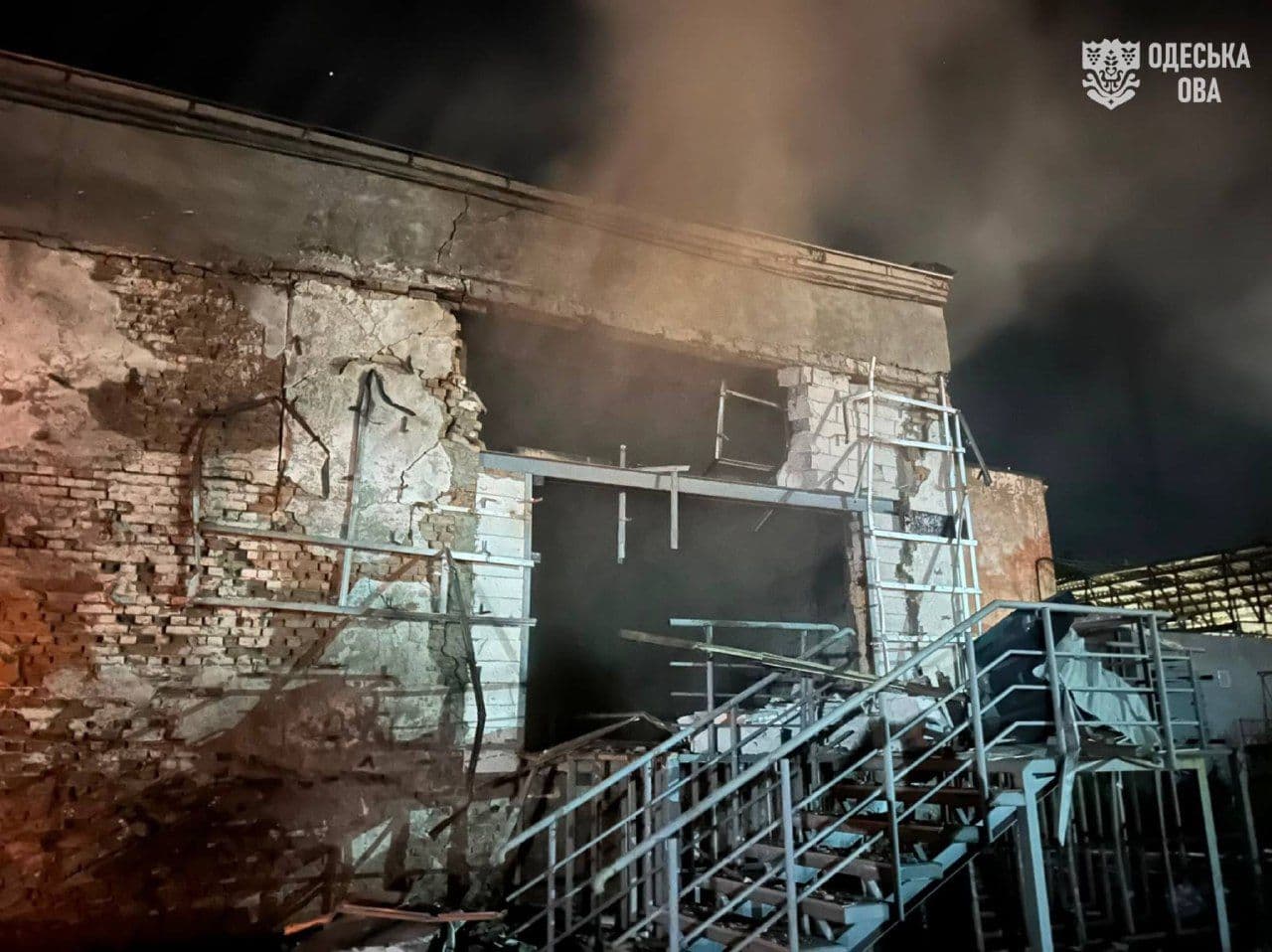
The scene of a Russian attack on Odesa Oblast overnight. (Telegram)
THE UN’S OWN COUNT: JULY IN SHARPER DETAIL
Earlier this week brought grim monthly civilian casualty figures from a Russian-monitoring research group. Now the United Nations has published its own independent count for July, and the added detail makes the picture worse, not better.
The UN’s human rights monitoring mission recorded at least 437 civilians killed and 2,610 injured in Ukraine in July — a 30 percent jump from June, which had itself set the previous record for the deadliest month since the war’s opening weeks in March 2022. Compared with July of last year, casualties are up 70 percent. Child casualties climbed to their highest level in the same window, with 17 children killed and 166 injured. “Every month this year the number of killed and injured civilians has increased,” the mission’s head said. “That trend accelerated sharply in July.”
The new report adds texture that earlier tallies lacked. Kyiv alone accounted for at least 54 deaths and 202 injuries in July — a single city absorbing roughly an eighth of the month’s entire civilian toll. The single deadliest day came on July 2, when Russia struck Kyiv with more than 70 ballistic missiles and nearly 500 drones in one coordinated assault, killing at least 30 people and injuring over 100 more. Russia launched over twice as many missiles at Ukraine in July as in June — at least 429 in total — while Ukraine’s depleted Patriot interceptor stockpile meant only 29 of the 195 ballistic missiles fired that month were actually intercepted. Casualties from aerial attacks specifically rose 143 percent compared to June, with glide bombs like the one that hit Kramatorsk this week ranking as the second-leading cause of civilian deaths and injuries, just behind long-range missiles and drones.
THE RAPPER RUSSIA WANTED DEAD
Yesterday, Poland revealed it had stopped a Russian-linked assassination plot against a US-Ukrainian dual citizen in Warsaw. Today, the target got a name.
Slevin Dadyan — real name Albert Vasilyev, better known by his stage name Kyivstoner — is a Ukrainian-American rapper and video blogger whom Russia’s FSB has publicly accused of orchestrating a plot to smuggle 35 first-person-view drones into Russia to attack a defense facility near Moscow. Polish authorities arrested a 29-year-old man from Ukraine’s partly occupied Donbas region near a Warsaw street on August 7, working alongside Poland’s internal security service to disrupt the plot before it could be carried out. Vasilyev denied any involvement in the alleged smuggling scheme in an Instagram post, writing simply that he was “chilling and playing Dota.”
His biography reads like a case study in how personal and political this war has become. Vasilyev lived in Russia before relocating briefly to Kyiv just before the 2022 invasion, then left for the United States, citing his American citizenship. He’s publicly condemned Russia’s war and reportedly provides financial support to Ukraine’s armed forces — while also drawing criticism from some Ukrainians for past comments dismissing the idea that Ukraine could realistically restore its 1991 borders. None of that ambiguity matters to the people who allegedly tried to have him killed; what matters, evidently, is that he embarrassed the FSB. Polish Prime Minister Donald Tusk called it the first known case of Russia targeting an American citizen for assassination on the soil of another NATO country — a warning, he said, that Warsaw is now treating as a template for what may come next.
TWELVE YEARS, TWO NEW SANCTIONS LISTS
Accountability moved on three separate tracks.
A Russian serviceman — a 50-year-old former convict who’d spent 32 years in prison for robbery before signing a military contract from behind bars — was sentenced to 12 years for systematically raping a 57-year-old woman over two months in an occupied village in Donetsk Oblast, after his infantry unit trapped her in a basement following a civilian’s killing during the same incursion. It’s the maximum sentence Ukrainian law allows under the relevant war-crimes statute, delivered in absentia, since Ukrainian forces captured the soldier during a separate combat operation months after the assault began.
Separately, President Zelensky signed a decree sanctioning 13 cargo vessels, 11 Russian nationals, and 28 companies involved in exporting grain looted from occupied Ukrainian territory — ships flying Russian, Panamanian, Belizean, and other flags, alongside their owners, captains, and the companies that moved the stolen cargo. “The illegal export of Ukrainian grain from temporarily occupied territories must have consequences for everyone involved,” Ukraine’s sanctions commissioner said, adding that Kyiv expects international partners to keep the grain out of their markets entirely.
And Ukraine’s international damages registry, based in The Hague, opened two new categories of claims against Russia: one covering humanitarian spending on displaced and affected civilians, another covering the cost of demining Ukrainian land — a bill Ukrainian officials estimate will ultimately span at least a decade and cost more than $1,400 per acre cleared, given that nearly a quarter of the country’s territory remains contaminated. “We must document not only what Russia has destroyed, but how much it costs Ukraine to overcome the consequences,” a deputy head of the presidential office said. Ukraine’s military intelligence chief put it more bluntly: Russia will pay for every hryvnia spent.
KYIV’S PROTESTERS HAVEN’T GONE HOME
For the fourth consecutive week, several hundred people gathered in central Kyiv demanding that Zelensky reinstate Mykhailo Fedorov as defense minister — a noticeably smaller crowd than the thousands who marched in late July, but a sign the underlying grievance hasn’t been resolved by anything the president has done since.
Fedorov, one of the most popular officials in Zelensky’s government for his role driving Ukraine’s military tech reforms, was abruptly removed during a chaotic reshuffle this summer. Zelensky has never fully explained the decision beyond alluding to friction between Fedorov and then-Commander-in-Chief Oleksandr Syrskyi. When Zelensky later dismissed Syrskyi too — replacing him with the widely respected General Mykhailo Drapatyi — many assumed the controversy would fade. It didn’t. Zelensky has reportedly offered Fedorov an alternative senior post, either a deputy prime minister role focused on military innovation or leadership of Ukraine’s state defense conglomerate; Fedorov has turned both down, saying only reinstatement as defense minister will do.
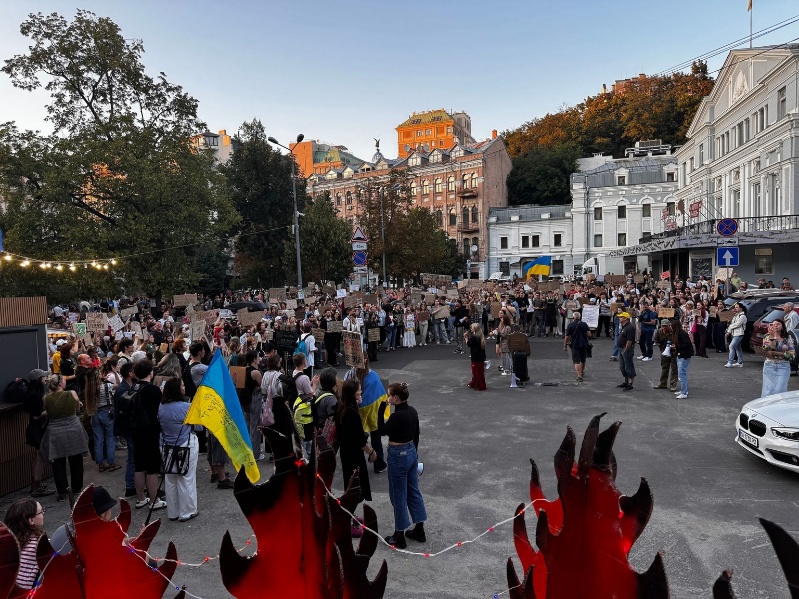
Ukrainians rally in Kyiv, as protests demanding that President Volodymyr Zelensky reinstate former Defense Minister Mykhailo Fedorov continue. (Tim Zadorozhnyy/The Kyiv Independent)
“The president has maximally disappointed me with his silence,” one protest organizer and war veteran said, framing Zelensky’s continued refusal to engage publicly as the real fuel behind the demonstrations, more than the original dismissal itself. The standoff now has a clock attached to it: Ukraine’s parliament returns from summer recess on August 18, when lawmakers may finally vote on whether to formally confirm acting Defense Minister Yevhen Khmara — a vote some insiders believe Zelensky may try to delay rather than risk reigniting public anger either way it goes. Organizers are calling for another march on August 16.
ERASING THE BORDER
A quiet administrative change, leaked through internal documents, may say more about Russia’s long-term intentions than any battlefield report this week.
According to internal Russian security service documents obtained by an independent Russian outlet, Moscow plans to eliminate the formal border zones separating Russia proper from the Ukrainian territory it claims to have annexed — specifically the zones between Rostov and Voronezh oblasts and occupied parts of Luhansk and Donetsk, and separately between Crimea and occupied Kherson Oblast. The stated justification is blunt: the “completion of the annexation” of these territories, treating a border that exists only in Moscow’s own legal fiction as though it were now permanent and unremarkable.
It’s not yet clear whether this means physical checkpoints will disappear or whether it’s a paperwork change dressed up as policy. But the symbolism lines up with a broader pattern Russia has pursued since 2022: simplified, effectively permanent access to Russian citizenship for residents of occupied territory, laws allowing occupation authorities to seize Ukrainian-owned homes by declaring them “ownerless,” and mounting documentation from human rights groups of Ukrainians facing an impossible choice between accepting a Russian passport or losing access to their own property. Each individual step looks bureaucratic. Together, they describe a state working methodically to make an illegal occupation indistinguishable, on paper, from ordinary Russian territory — one border erased, one passport issued, one property seized at a time.
A DRONE OVER LATVIA, A FIGHT OVER POLAND’S PATRIOTS
NATO’s eastern flank had its own quiet reminder of how close this war sits to alliance territory. Fighter jets flying NATO’s Baltic Air Policing mission shot down a drone that crossed into Latvian airspace, with Latvia’s military attributing the intrusion to Russian electronic warfare — language suggesting the drone was likely a Ukrainian strike weapon knocked off course by Russian jamming rather than a deliberate Russian incursion. It’s a pattern that’s recurred before, in Finland in May and elsewhere along NATO’s border with Russia, and one Ukraine’s foreign ministry has previously acknowledged, even offering to send anti-drone specialists to help affected countries defend against it.
Inside Poland, a related but separate fight played out over politics rather than airspace. Poland’s deputy defense minister dismissed opposition criticism that transferring Patriot missile batteries to Ukraine would weaken Poland’s own air defenses, calling the argument something “only a madman” would make and arguing that intercepting Russian missiles over Ukrainian territory is actually the more effective way to protect Polish skies. No formal transfer decision has been made. In the same interview, the minister revealed Poland has, for the first time, formally asked Ukraine to share battlefield technology and tactical expertise developed over four years of war — and confirmed that long-stalled talks over trading Poland’s aging Soviet-era MiG-29 jets for Ukrainian drone technology have picked up fresh momentum, partly because Bulgaria’s interest in buying the same jets has added new urgency to reaching a deal with Kyiv first.
TEXTBOOKS, TEACHERS, AND FOURTEEN YEARS FOR TWENTY-NINE DOLLARS
In occupied Ukraine, the war isn’t just being fought with weapons. It’s being fought in classrooms, courtrooms, and voter rolls.
Russia’s education ministry has finalized a new list of approved textbooks for the coming school year, including a series titled “History of Our Region: Donbas and Novorossiya” for grades five through seven — books a Russian opposition outlet reviewed and found villainize Ukrainian history and culture while justifying the occupation outright. Occupation authorities are moving fast to distribute them: Krasnodar Krai alone is buying more than 40,000 new textbooks for schools in occupied Kherson Oblast, with thousands of the new history books due to arrive before the school year starts. Russia is simultaneously importing teachers through its “Zemsky Teacher” program, which pays Russian educators roughly $24,000 to relocate to small occupied towns and reinforce Russian-language, Russian-curriculum instruction. In occupied Kherson Oblast, children are now enrolled in a government-sponsored summer program teaching them to operate drones, starting on simulators before moving to real aircraft — part of a broader pattern of occupation officials cultivating young operators for Russia’s growing Unmanned Systems Forces.
Russia is also formalizing the machinery of controlled elections across occupied territory ahead of September’s State Duma vote, creating new voting districts inside occupied Donetsk, Luhansk, Kherson, and Zaporizhzhia oblasts for the first time and emphasizing early, at-home voting — a method Ukrainian officials warn is really a tool for coercion, letting election workers pressure residents into voting under watch. And Russian occupation courts continue handing down years-long prison sentences for token acts of resistance: one woman in occupied Berdyansk got 14 years for an alleged $687 donation to Ukrainian forces; another in Tokmak got 12 years for sending just $29.
THE DRONE ARMS RACE JUST GOT ONE STEP FASTER
Behind the daily count of drones launched and intercepted sits a quieter, more technical war: a constant back-and-forth over which side’s drones can survive the other’s jamming. This week, Russia edged ahead.
A Ukrainian drone warfare expert and former service member reported that Ukrainian forces recently destroyed a Russian first-person-view drone equipped with frequency-hopping technology — a system that lets the drone’s radio signal jump rapidly between channels, making it far harder for Ukrainian electronic-warfare jammers to lock onto and disrupt. The upgrade let that drone fly up to 25 miles behind the front line before Ukrainian forces caught it, well beyond where most FPV drones can normally operate without losing their signal to jamming.
The stakes go beyond one downed drone. Military analysts describe a “kill zone” along the front — currently stretching roughly 9 to 15 miles back from the line of contact — where drone saturation on both sides makes movement by soldiers or vehicles extremely dangerous, regardless of which army technically controls the ground. Any technology that lets drones fly farther into that zone without losing their signal effectively pushes the danger zone deeper into what used to be considered safer rear territory. It’s the same pattern that played out in late 2024, when Russia began wiring drones to fiber-optic cable specifically to defeat jamming, forcing Ukraine to invest heavily in interceptor drones capable of hunting other drones out of the sky. Expect the same cycle now: Ukraine adapting its jamming and interceptor tactics within weeks, Russia searching for the next workaround soon after. Neither side stays ahead for long.
A TRUCE OFFERED, A CITY BOMBED, A NAME REVEALED
By nightfall, the day had drawn its own conclusion, even without anyone stating it outright: Russia doesn’t want this war to slow down, and it isn’t pretending otherwise anymore.
A ceasefire proposal died quietly in a spokesperson’s press briefing. A port that Ukraine needs to feed its economy took another hit. A residential building in Kramatorsk became, for one family, the last place their relative ever lived. And a rapper who once joked online about his own government’s draft system learned, definitively, just how seriously a foreign intelligence service had taken his social media presence. None of it moved the front line more than a few hundred meters in either direction. All of it moved the war exactly nowhere closer to ending.
A PRAYER FOR UKRAINE
1. For the Dead and Wounded of Kramatorsk
Lord, one person is dead and twenty-two more are wounded tonight in Kramatorsk, hurt by a single bomb dropped on an ordinary building where people were simply living their lives. We cannot make sense of a war where home itself is a target. Comfort those now grieving, and heal those whose bodies and nerves carry this night forward. Let this building be rebuilt, and let those who mourn find people willing to sit with them in the wreckage.
2. For the Woman Assaulted in Donetsk Oblast
Father, we lift up the woman who endured two months of captivity and abuse in her own occupied village, trapped by the very soldiers meant to prove Russia’s claim over her home. Justice has been done in a courtroom, but justice cannot undo what was taken from her. Grant her real safety now, real peace in her body, and people around her who believe her fully and stay.
3. For a Nation Still Waiting on Answers
Lord of patience, we pray for the veterans and citizens still gathering in Kyiv’s squares, asking simply to be heard by their own government. Give their leaders the humility to explain decisions rather than outlast frustration through silence. Protect the unity this country still needs to survive the war, even amid real and valid disagreement. Let dialogue, not distance, be how this dispute finally ends.
4. For a Man Marked for Death Over a Joke Gone Serious
God of the targeted, we pray for the artist in Warsaw who learned today just how far a foreign government would go to silence him, and for everyone else living under a similar quiet threat simply for being visible and inconvenient. Give him real protection, not just headlines. Give the same to the diplomats, dissidents, and ordinary critics scattered across Europe who now wonder if they’re next.
5. For an End That Doesn’t Come Through Silence
God of justice, we pray against a peace built only on one side’s total capitulation, and against the slow annexation of land, memory, and childhood happening in classrooms and courtrooms far from any front line. Give Ukraine’s negotiators wisdom neither side has offered freely. Let every rejected ceasefire still, somehow, plant a seed for the one that finally holds.
In Your mercy, in Your justice, in Your time — bring this war to its end, and let the ending be worthy of what Ukraine has endured.
Pingback: Януш Ковин-Микке: Украина проигрывает России на море и в пиаре - О чем говорит Молдова