
September 1, 2026
Prepared by Diana Bozhyk
Germany officially attributed the August drone attack at Leipzig Airport to Russia and announced it will close Russia’s Bonn consulate and Berlin cultural center, hours after Vladimir Putin dismissed reports of a new mobilization wave as “absolute nonsense” and ordered his military to prepare “massive strikes” on Ukraine’s energy grid. Russian missiles and drones killed at least 12 people and injured dozens more overnight, striking a Kyiv railway depot that killed seven rail workers and hitting Odesa with a guided aerial bomb for the first time, as drones also crossed into Estonian and Romanian airspace. Zelensky warned airlines and insurers that Russian skies are now “de facto closed” due to Ukraine’s own deep-strike campaign, even as new intelligence showed Russia’s August territorial gains fell to a fraction of last year’s pace despite record monthly casualties.
THE DAY’S RECKONING
Seven railway workers died in Kyiv last night doing a job that has nothing to do with fighting a war — showing up to keep trains running. A guided bomb hit Odesa for the first time anyone can document. Drones drifted into Estonian and Romanian skies, testing borders that aren’t Ukraine’s to defend. That’s the human cost side of today’s ledger.
The strategic side told a different story. New intelligence confirmed what’s been suspected for weeks: Russia’s summer offensive is grinding to a near-halt, gaining barely a fifth of what it captured at the same point last year, while losing over 40,000 soldiers in a single month for the second month running. Germany finally said out loud what everyone already assumed about a drone found near a Ukrainian cargo plane — Russia built it — and announced it’s closing a consulate and a cultural center in response. Putin, cornered on two fronts at once, did what cornered leaders do: he denied the mobilization everyone expects and promised to bomb Ukraine’s power grid instead. Nobody blinked today. Everybody kept doing exactly what today required.
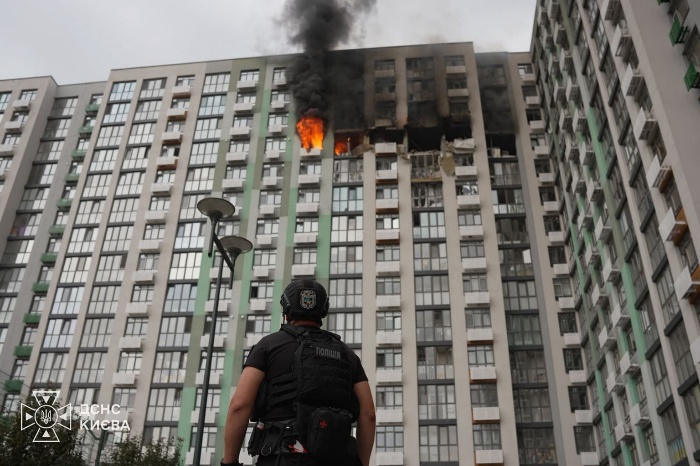
A residential building caught fire following a Russian drone attack on Kyiv, Ukraine. (State Emergency Service/Telegram)
RUSSIA’S SLOWEST AUGUST YET
New battlefield data released today confirms just how badly Russia’s spring-summer offensive has stalled. Russian forces seized or infiltrated roughly 123.53 square kilometers of Ukrainian territory in August — a fraction of the 505.55 square kilometers Russia captured during the same month last year, even counting every contested infiltration alongside confirmed advances. Russia’s main gains came in Donetsk Oblast’s Fortress Belt, yet even there Russian forces still haven’t fully seized Kostyantynivka after months of urban fighting, holding a presence in just over 72 percent of the settlement.
The cost of that limited progress keeps climbing. Ukraine’s General Staff reported Russian forces suffered 42,020 casualties in August — the second consecutive month above 40,000, averaging 340 casualties for every square kilometer seized or infiltrated. Russia’s volunteer-based recruitment system continues struggling to replace those losses fast enough, a gap that helps explain why Kremlin officials keep quietly setting the administrative groundwork for mobilization while publicly denying any such plan exists. Meanwhile, Ukrainian forces continued counteroffensive operations in the Lyman and Oleksandrivka directions, liberating at least 129.81 square kilometers in August — a figure analysts believe likely understates the true extent of Ukrainian gains, since satellite-based assessment methods tend to lag well behind what’s actually happening on contested ground.
GERMANY BLAMES RUSSIA FOR LEIPZIG, CLOSES ITS CONSULATE AND CULTURAL CENTER
Germany’s government formally accused Russian intelligence services today of orchestrating the early-August drone attack at Leipzig-Halle Airport, marking the first time Berlin has directly named Moscow as responsible for an incident that had circulated for weeks as an unconfirmed suspicion. “We have clear indications from our intelligence services and partner agencies, as well as from investigations in Germany and in our European partner countries, of Russian involvement,” Interior Minister Alexander Dobrindt said, noting the drone’s configuration, explosives, and fuel matched patterns from other Russian hybrid operations.
Foreign Minister Johann Wadephul announced Germany will respond by closing Russia’s consulate in Bonn and the Russian House of Culture in Berlin, while pushing for tougher EU sanctions, stricter entry rules for Russian citizens, and increased pressure on Russia’s shadow fleet. “We will not allow Russia’s attacks to divide us or intimidate us,” he said. NATO Secretary General Mark Rutte posted that the alliance “stands in full solidarity with Germany,” while European Commission President Ursula von der Leyen and the leaders of Sweden, Estonia, and Hungary quickly echoed support; Poland’s foreign minister praised Germany “for following Poland’s example,” a pointed reference to Warsaw’s own earlier confrontations with Russian hybrid operations. Ukraine’s foreign minister called for a broader “decisive strategy” against Russia across Europe, framing Leipzig as one piece of a deliberate campaign rather than an isolated incident.
A SIXTH NIGHT OF ATTACKS: KYIV’S RAILWAY WORKERS, ODESA’S FIRST GUIDED BOMB
Russian missiles and drones killed at least 12 people and injured 54 more nationwide overnight, with Kyiv and Odesa oblasts absorbing the worst of a barrage that marked the capital’s sixth consecutive day under fire. A ballistic missile struck a railway depot in Kyiv, killing seven Ukrzaliznytsia employees and destroying a workshop — the deadliest single strike of the night. “Russia always plans its strikes in a way designed to cause maximum destruction to people’s lives,” Zelensky said, noting nearly 350 rescuers responded across the capital and surrounding oblast. A residential building in Boryspil was damaged, forcing 50 evacuations.
Odesa absorbed what local reports describe as the first confirmed guided aerial bomb strike on the city itself, part of a combined attack using Shahed drones, Banderol munitions, and the KAB — a weapon Russia typically reserves for targets closer to the front, given its need for aircraft to fly within launch range. The strike knocked out power to thousands of households and damaged the Orlivka ferry crossing into Romania along with export infrastructure. In Kherson, a first-person-view drone killed one person by striking their car directly. In Zaporizhzhia Oblast, a Russian drone struck emergency workers responding to an earlier fire in Kushuhum, injuring four of them alongside two people killed elsewhere in the region. Donetsk Oblast lost one person with nine injured; Dnipropetrovsk and Sumy oblasts reported six and five injured respectively; Zhytomyr and Chernihiv oblasts saw fires but no casualties.
DRONES CROSS INTO ESTONIA AND ROMANIA OVERNIGHT
As Ukraine launched its own large-scale strikes into western Russia overnight, at least a dozen drones appeared near Estonia’s border around 2 a.m., prompting Tallinn to scramble ground-based air defenses and activate NATO’s rotational air-policing jets. One drone turned toward the border city of Narva before reversing course; a second crossed briefly into southeastern Estonian airspace roughly 30 minutes later before also turning back. Neither drone crashed inside Estonia, and the alert lifted without incident by 5:30 a.m., but the episode came as Ukrainian strikes were simultaneously damaging Russia’s Ust-Luga port in neighboring Leningrad Oblast, with Russian air defenses claiming to intercept 38 drones in the area.
Hours later, a Romanian resident discovered a downed drone containing explosives in a field roughly 18 miles from the Moldovan border; intelligence specialists carried out a controlled detonation, with no casualties reported and the drone’s origin still unconfirmed. Romania borders Odesa Oblast, one of the night’s primary targets, and has recorded repeated drone and debris incidents since 2023. Both incidents add to a now-familiar pattern along NATO’s eastern edge — Poland and Estonia have each seen drones shot down over their territory in the past year, and Romania destroyed a suspected Russian naval drone near a Black Sea gas platform just last month.
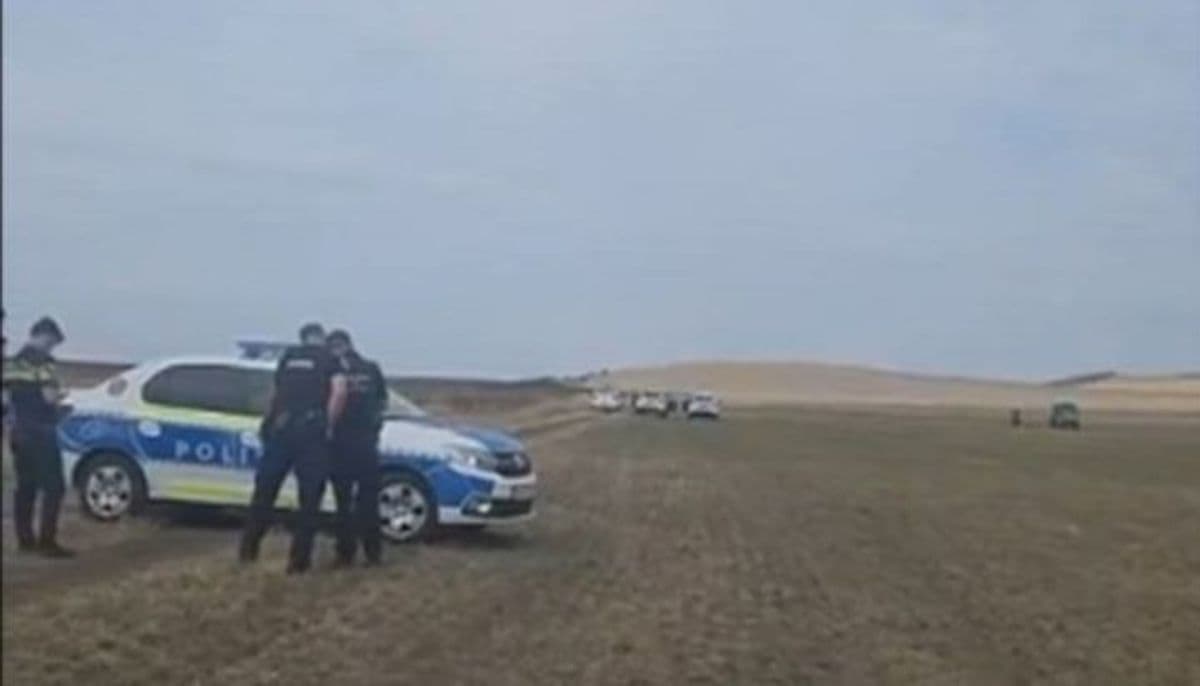
A screenshot from a video shows a Romanian police inspect the site where a damaged drone was found near Viisoara, Vaslui County, Romania. (Digi24)
PUTIN CALLS MOBILIZATION “NONSENSE” AND ORDERS MASSIVE STRIKES ON UKRAINE’S GRID
Speaking at a press conference following the Shanghai Cooperation Organization summit, Vladimir Putin dismissed reports of an impending mobilization wave as “absolute nonsense” and “an information attack on Russia,” cutting off a journalist’s question before it finished. The denial directly contradicts recent warnings from Zelensky, who has said Russian intelligence indicates Moscow plans to recruit roughly 300,000 troops in 2026 and another 300,000 in 2027 without a formal declaration.
In the same appearance, Putin confirmed he’s ordered Russia’s military to “prepare and launch massive strikes” against Ukraine’s energy infrastructure, framing the escalation explicitly as retaliation for Ukrainian drone strikes targeting oil refineries near Moscow and St. Petersburg. “They are hitting ours, they will get a response,” he said, claiming he’d been briefed the same day about a large-scale Ukrainian attempt to breach air defenses around both cities and strike three separate refineries.
The threat continues a pattern Russia has followed every autumn and winter since 2022 — intensifying strikes on Ukraine’s power grid specifically to compound the misery of the coldest months — but the explicit retaliatory framing this time underscores just how directly Ukraine’s own deep-strike campaign is now shaping Russian military messaging, forcing Moscow to publicly justify an already-planned seasonal escalation as a reaction rather than routine cruelty.
ZELENSKY WARNS RUSSIAN AIRSPACE IS “DE FACTO CLOSED”
President Zelensky issued a pointed warning today to airlines, insurers, and foreign governments still operating flights into Russia: Ukrainian drone strikes have made Russian skies unsafe enough that continuing to fly there now carries real risk. “Today we want to warn every airline that uses Russian airspace, every insurer, everyone who still uses key Russian airports — Russian skies are becoming completely dangerous,” Zelensky said, adding that Russian authorities simply aren’t reporting the danger honestly. “Although the Russian authorities do not report this as it should, the Russian sky will de facto be closed.”
Putin responded at his own press conference by accusing Ukraine of “state terrorism,” insisting Moscow cannot negotiate with terrorists — a claim Zelensky rejected outright, noting Russia has kept Ukrainian airspace closed to civilian aviation since 2022 through its own invasion. Presidential chief of staff Kyrylo Budanov welcomed Zelensky’s warning, promising “a firm and proportionate response” to continued Russian attacks. Zelensky said Ukraine remains willing to pause strikes temporarily for diplomatic reasons, as it did during CIA Director John Ratcliffe’s late-August visit to Moscow, framing the offer as evidence Ukraine supports genuine steps toward peace even while insisting Russia bears full responsibility for making its own skies dangerous in the first place.
MODI TELLS PUTIN TO END HIS “ENDLESS WAR”
Indian Prime Minister Narendra Modi delivered an unusually direct public appeal to Vladimir Putin at the Shanghai Cooperation Organization summit, urging Russia to move “from endless war to an end to the war, to a cessation of hostilities.” “Every day that the war continues, humanity is, in effect, set back a step, whilst every step towards peace gives all of humanity real hope for peace,” Modi told Putin during their first in-person meeting this year, according to India’s prime ministerial office.
The appeal carries real weight given India’s position: it remains Russia’s second-largest fossil fuel customer behind only China, with purchases from both countries helping sustain Moscow’s wartime budget since 2022. Despite the public call for peace, Modi still referred to Putin as “my friend” and praised the two countries’ deepening economic ties, confirming plans to host Putin in India for a BRICS summit later this month.
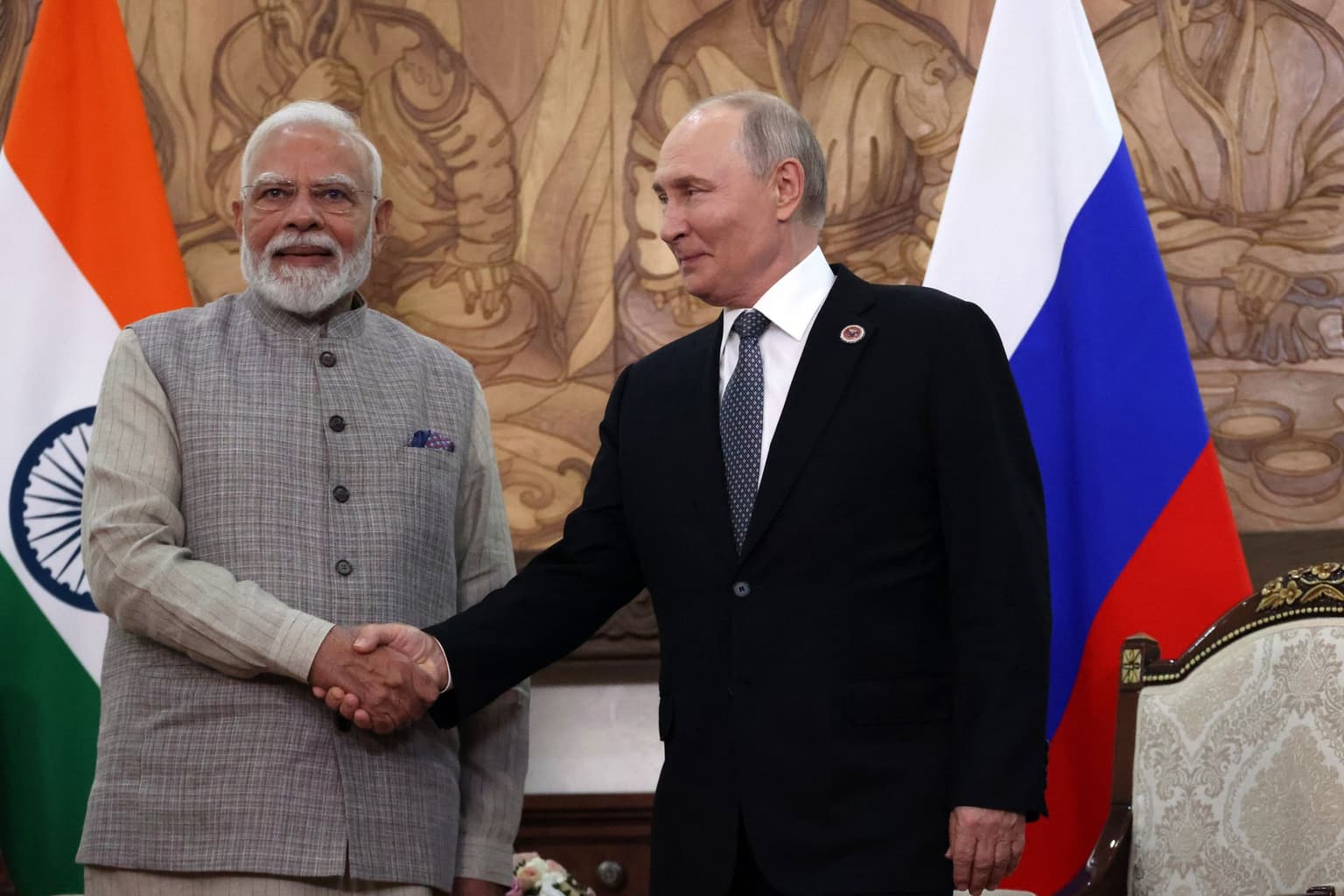
Russian President Vladimir Putin (C) shakes hands with Indian Prime Minister Narendra Modi (L), in Bishkek, Kyrgyzstan. (Contributor/Getty Images)
The remark echoes a similar appeal Kazakhstan’s president made in July, suggesting even some of Russia’s closest partners are growing publicly uneasy with a war that shows no sign of ending on any timeline convenient to them — a quiet but notable shift among countries that have otherwise avoided direct public criticism of Moscow throughout the war.
MEANWHILE, AT THE FRONT: SLOVYANSK NOW WITHIN ARTILLERY RANGE
Slovyansk’s military administration head confirmed today that Russian forces have advanced to within seven to 10 kilometers of the city and are now shelling it with tube artillery — a shift from previous reliance on rocket systems that suggests Russian commanders are actively preparing for renewed offensive operations rather than simply holding position. An officer with Ukraine’s 11th Army Corps said Russia has redeployed additional troops from near Siversk specifically to reinforce the push toward Slovyansk.
Elsewhere, Ukrainian forces continued counterattacking effectively: sources on both sides acknowledged Ukrainian troops pushing both north and south of Lyman, while Russian sources conceded Ukrainian counterattacks near Borova achieved tactically significant gains despite ongoing Russian infiltration attempts there. Near Kostyantynivka, Russian forces began shelling approaches to Oleksiyevo-Druzhkivka with artillery for the first time, aiming to cut Ukrainian supply lines into Druzhkivka.
In western Zaporizhzhia Oblast, Russia’s defense ministry claimed a partial encirclement of Orikhiv using what researchers assess as likely AI-altered flag-raising footage — claims analysts say don’t match the actual, far more limited pattern of fighting observed on the ground, where Ukrainian forces retain firm control over the settlement and its immediate flanks despite scattered Russian infiltration attempts nearby. In occupied Crimea, Ukrainian strikes destroyed a Pantsir-S1 air-defense system that had guarded the Kerch Strait Bridge since 2024.
UKRAINE’S DEEP STRIKES AND A NEW COMMAND STRUCTURE FOR DONETSK
Ukraine’s Main Military Intelligence Directorate confirmed a strike on Novatek’s Ust-Luga oil export terminal in Leningrad Oblast overnight, nearly 540 miles from the border, with published imagery showing smoke rising above the facility. Ukrainian forces also struck a fuel and lubricants warehouse in Belgorod Oblast and confirmed an earlier strike destroyed a drone launcher and storage site at the Tsimbulov Drone Port in Oryol Oblast.
New details emerged today about Commander-in-Chief Mykhailo Drapatyi’s restructured command for Donetsk Oblast, first announced August 26. Brigadier General Andriy Biletsky’s new formation will cover the area from the Lyman direction through the Kramatorsk-Kostyantynivka Fortress Belt, while Brigadier General Denys Prokopenko’s command will oversee the Dobropillya sector to the south. Drapatyi also appointed Colonel Emil Ishkulov to command the 11th Army Corps and Brigadier General Valeriy Skred to lead the 19th Army Corps, both reporting to Biletsky and both responsible for the increasingly pressured Slovyansk-Kramatorsk area.
A General Staff source described the new formations’ central priority in blunt terms: stopping Russia’s advance, not merely managing it — a distinction that signals a shift toward more aggressive, better-coordinated defense rather than the reactive, sector-by-sector holding pattern that’s defined much of the fighting in Donetsk Oblast throughout the summer.
PUTIN RESHUFFLES SECURITY SERVICES AND EXPANDS HIS OWN PROTECTION
Putin signed a decree expanding Russia’s Federal Protective Service — the agency responsible for physically guarding senior officials — from 785 to 812 personnel, the fourth such increase since 2022, following a spring surge in Ukrainian strikes and a string of assassination attempts against Russian military figures, including an August 1 bombing that targeted Aerospace Forces Commander Alexander Chayko.
Separately, Russian insider sources reported Putin dismissed 13 officials and appointed 15 others across law enforcement agencies on August 31, notably including personnel overseeing Kursk and Penza oblasts — two regions where Russian authorities have run aggressive, coercive recruitment campaigns since June. Analysts assess the reshuffle likely represents quiet preparation for a possible mobilization wave following September’s elections, positioning loyal officials in regions viewed as most vulnerable to unrest if involuntary call-ups eventually proceed.
Whether or not Putin ultimately activates that option remains, as it has throughout the year, a decision analysts say depends entirely on his own read of battlefield conditions and regime stability, not on any fixed timeline. Taken together, the security expansion and the law-enforcement reshuffle paint a portrait of a leader simultaneously hardening his own personal protection and quietly repositioning the officials who’d need to manage any domestic backlash his next major decision might provoke.
RUSSIA’S JET-POWERED DRONE MATH
Ukrainian Air Force spokesperson Yurii Ihnat laid out the scale of Russia’s tactical shift today: Russia launched five times more jet-powered drones in July than in June, and more than 2,800 of them throughout August alone. The math matters because Ukraine’s interception rate tells two very different stories depending on the drone type — 90 to 95 percent against older, propeller-driven models, but only around 60 percent against the newer jet-powered variants now making up roughly 56 percent of Russia’s total strike packages.
Notably, Russia achieved that shift while actually reducing its overall drone volume, from 6,583 long-range drones in April down to 4,943 in August, as manufacturing capacity increasingly prioritizes the faster Geran-4 and Geran-5 models over older Shahed types — fewer drones overall, but a meaningfully higher share that Ukraine simply cannot catch as reliably.
Russian forces have also begun launching jet-powered drones continuously throughout the day rather than concentrating strikes overnight, a tactic in place against Kyiv specifically since August 27 that’s designed less to maximize any single night’s destruction than to keep Ukrainian air defenses perpetually engaged, exhausting both equipment and personnel over a sustained, multi-day stretch rather than a single dramatic barrage. Ukrainian officials say the shift is forcing a rethink of how interceptor resources get allocated day to day, since the old assumption that the heaviest threat arrives after dark no longer reliably holds.
UKRAINE’S MONEY PROBLEMS
Prime Minister Serhii Koretskyi told parliament today that Ukraine is implementing strict austerity on any budget spending not earmarked for defense, having identified roughly $1.75 billion in savings to redirect toward the military as the country grapples with a $27 billion defense funding gap. He asked lawmakers to approve 44 outstanding decisions by November 1 — including 26 draft laws — to help unlock international funding tied to reform benchmarks Ukraine has fallen behind on.
The fiscal strain isn’t Ukraine’s alone to solve. In Washington, a Russia sanctions bill that passed the Senate 86-11 has stalled in the House, with Republican leaders declining to schedule a vote and Democrats raising concerns about handing Trump additional tariff authority. Separately, US Army Secretary Dan Driscoll — a key figure in Washington’s peace-negotiation efforts and a rare Ukraine-sympathetic voice inside the administration — resigned amid reported friction with Defense Secretary Pete Hegseth over military modernization priorities.
EU foreign policy chief Kaja Kallas, meanwhile, urged member states holding air-defense interceptors nearing their expiration dates to simply hand them to Ukraine rather than let them go to waste, calling interceptor shortages “the main issue” facing Kyiv’s defense heading into autumn. She said the EU is separately pushing to unlock roughly $7.5 billion through the European Peace Facility, with several member states already committing to redirect any returned funds straight back to Ukraine’s air-defense needs.
A MOBILIZATION CORRUPTION SCHEME: $70,000 TO CROSS THE BORDER
Ukraine’s Parliamentary Ombudsman Dmytro Lubinets revealed today that corruption within the country’s mobilization system has reached what he called a dangerous, near-irreversible level, describing a newly identified “turnkey” smuggling service that allows men to pay $50,000 to $70,000 to be taken directly across the border from inside a military recruitment van.
Lubinets said escaping a recruitment center outright can cost roughly $10,000, while securing release from inside one runs closer to $15,000, with the problem concentrated heavily in Ukraine’s western Zakarpattia region rather than frontline areas like Zaporizhzhia or Kharkiv, where he said such corruption is far less common. He attributed the surge directly to monthly mobilization quotas of roughly 30,000 people, which he said pushed recruitment centers toward detaining people regardless of health or legal eligibility just to hit the number.
“We have not yet passed the point of no return, but we are very close to it,” Lubinets said, citing cases including a person held 55 days inside a recruitment center, a Bakhmut veteran allegedly told to fight again or pay, and roughly 1,500 men removed from military registration in a single day. “This is me publicly demonstrating 1% of what we find,” he added, warning that continued abuse risks provoking growing resistance from Ukrainian society at large.
FEDOROV LAUNCHES A DEFENSE TECH COMPANY WITH PALANTIR’S BACKING
Former defense minister Mykhailo Fedorov announced plans today for a new Ukrainian defense technology company, with Palantir CEO Alex Karp confirmed as its first major investor following a meeting at Palantir’s Washington office. “Ukraine will be the priority for me,” Fedorov said, describing the venture as a way to apply lessons from his time running the ministry toward battlefield robotics, low-cost AI-guided missiles, and jet-powered interceptor drones — the same technology areas he’s pitched to US officials as part of a broader push to trade Ukrainian expertise for Patriot interceptors.
Karp offered enthusiastic public backing: “I have been absolutely inspired by what you and the Ukrainians have pulled off, and very and super delighted that we could play a part,” he said, calling the venture potentially “defining for the world.” Further details, including the company’s name and structure, will come later, Fedorov’s team said. The announcement adds another concrete step to Fedorov’s rapidly expanding post-government career, which now spans an unpaid advisory role with Italy’s defense ministry, ongoing talks with Elon Musk over Starlink access, and now a formal venture with one of the most prominent names in American defense technology — all while his political future in Ukraine itself remains deliberately unresolved.
GERMANY’S SNUB, A PUBLISHER’S COMEBACK
German Vice-Chancellor Lars Klingbeil confronted Russian Finance Minister Anton Siluanov directly at yesterday’s G20 finance ministers’ meeting, telling him bluntly that Russia’s government must end the war, and helped lead a successful push to exclude Siluanov from the group’s traditional photo. “The signal to welcome the Russian finance minister here I perceive as irritating,” Klingbeil said, noting it marked Russia’s first G20 finance appearance since the invasion began. EU Economy Commissioner Valdis Dombrovskis echoed the discomfort: “I personally had and have problems with discussing topics like global imbalances with a representative of an aggressor country carrying out brutal daily attacks against civilians.”
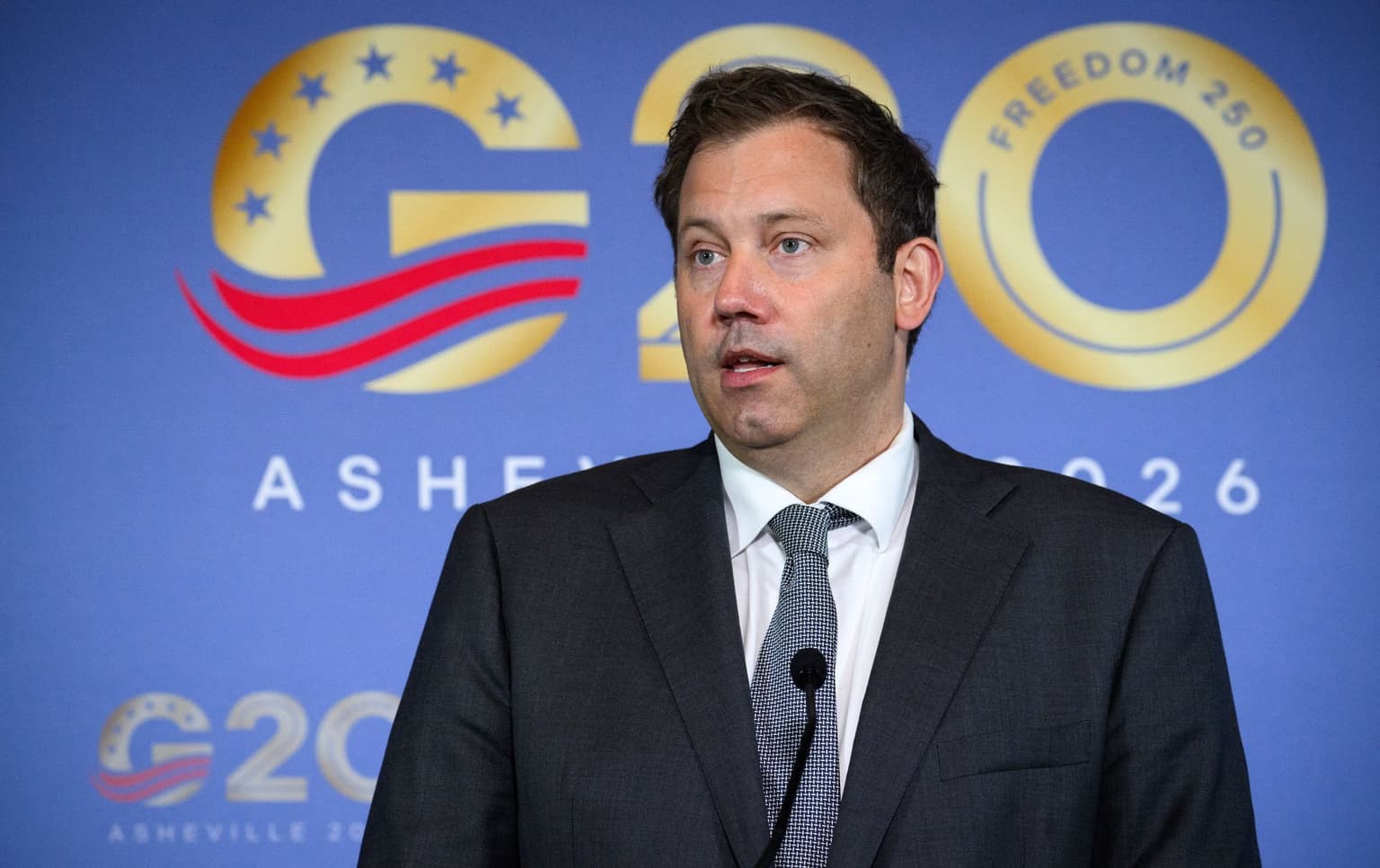
German Vice-Chancellor and Finance Minister Lars Klingbeil speaks to the press at the G20 meeting of finance ministers in Asheville, U.S. (Bernd von Jutrczenka/picture alliance via Getty Images)
On a smaller but genuinely hopeful note, Ababahalamaha — Ukraine’s leading children’s book publisher, known for its Ukrainian-language editions of Harry Potter and major national poets — announced it has secured a new warehouse and expects to resume shipping orders within the week, following the Russian strike that destroyed its previous facility in late August. “In the near future, there will be delays in shipping orders. Many of our beautiful books burned, resulting in huge financial losses,” the publisher wrote, thanking readers for their continued support. It’s a small counterpoint to an otherwise grim day: proof that even after Russia’s strikes on Ukraine’s cultural and economic life, some part of what was destroyed keeps finding its way back to work.
RAILS BURNING, SKIES CLOSING, A WAR SLOWING DOWN
By nightfall, the day’s numbers told two competing stories. One: Russia’s summer offensive has all but stalled, buying barely a fifth of last year’s ground at a cost of 40,000 casualties a month. The other: seven railway workers are dead in Kyiv, a bomb reached Odesa for the first time, and Putin has ordered his military to bomb Ukraine’s power grid before winter even arrives.
Both stories are true at once, which is precisely what makes this war so hard to end. Germany closed a consulate today. Modi asked a friend to stop fighting. A children’s book publisher found a new warehouse. None of it moved the war meaningfully closer to its conclusion. All of it added one more day to a ledger that keeps growing longer regardless of which side is technically winning.
A PRAYER FOR UKRAINE
1. For the Seven Railway Workers
Lord, seven people died last night simply going to work, keeping trains running in a country that depends on them more than most ever notice. We grieve lives ended in the middle of an ordinary shift. Receive each of them by name, comfort their families and colleagues, and let their deaths be remembered as more than a footnote in a night that took so many others too.
2. For Odesa, Struck in a New Way
Father, a guided bomb reached Odesa for the first time today, a city that had absorbed drones and missiles but not this particular weapon before. We grieve every new escalation this war invents. Protect the people of Odesa as they adjust to a danger they hadn’t yet had to fear, and give them the same resilience that’s carried this city through every other attack before this one.
3. For Every Family Paying to Escape a Broken System
Lord of justice, we lift up the families caught between a war that demands soldiers and a corrupt system that lets the wealthy simply buy their way out. Give Ukraine’s leaders the courage to fix what’s broken rather than let it fester, and give investigators like Lubinets the backing they need to keep exposing it. And give those who cannot afford $70,000 the same dignity and fair treatment as those who can.
4. For Wisdom as Winter Approaches
God of provision, we pray for Ukraine as it braces for deliberate strikes on its power grid, promised openly by the very leader ordering them. Give engineers, officials, and families the resources this season will demand, and give them warning enough to prepare rather than only react. Let every quiet preparation already made hold firm against whatever comes, and let this winter test Ukraine’s resolve without breaking it.
5. For Every Voice Still Calling for an End
God of peace, we give thanks for every leader, however imperfectly positioned, still willing to tell Vladimir Putin plainly that this war must end. Give those voices increasing weight, and give Russia’s own leadership ears willing to hear them. Let persistence in calling for peace never be mistaken for its absence, and let this war’s end come sooner than its current trajectory suggests.
In Your mercy, in Your justice, in Your time — bring this war to its end, and let the ending be worthy of what Ukraine has endured.