
September 20, 2026
Prepared by Diana Bozhyk
Ukrainian forces launched the largest combined missile and drone strike package of the war against Moscow Oblast overnight, hitting the Gazpromneft-Moscow oil refinery and a major logistics warehouse on the final day of Russia’s State Duma elections, with Moscow’s own mayor claiming more than 1,600 drones were shot down since the attack began. A Russian strike on Kyiv Oblast killed a child whose mother had been wounded alongside them a day earlier, part of a nationwide barrage that killed at least eight people and injured 30 more, while a Russian FPV drone killed a 71-year-old priest at a Kherson monastery. Ukraine’s 3rd Army Corps announced the second phase of Operation Vivaldi, liberating 50 more square kilometers northwest of Lyman and killing roughly 800 Russian personnel, as Russia’s predetermined election results showed United Russia winning a smaller-than-expected margin amid widespread reports of ballot stuffing and observer intimidation.
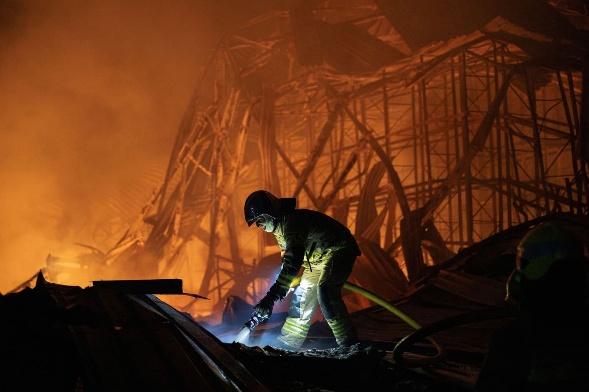
Ukrainian firefighters extinguish a fire at a warehouse following a Russian drone strike in Kyiv region, amid the Russian invasion of Ukraine. (Photo by Genya SAVILOV / AFP via Getty Images)
THE DAY’S RECKONING
Russia spent three days staging an election it had already decided the outcome of. Ukraine spent the final night of that election sending the largest strike package of the entire war straight at Moscow itself. A major oil refinery caught fire. A logistics warehouse burned. Moscow’s own mayor claimed 1,600 drones downed, and Russian officials, apparently more worried about voter turnout than public safety, didn’t even bother sounding the sirens.
Everywhere else, the war kept its usual, brutal accounting. A child in Kyiv Oblast died from wounds a day after the strike that caused them, the mother beside them still recovering. A 71-year-old priest died when a drone found a monastery in Kherson. Ukraine’s own counteroffensive north of Lyman kept expanding, fifty more square kilometers and roughly eight hundred Russian soldiers gone in a single push. Germany’s far right won another regional election. Zelensky confirmed he’ll finally sit down with Trump in New York. Nothing today resolved simply. Everything today measured how much distance still separates a rigged vote from the war it was staged to justify.
UKRAINE’S LARGEST STRIKE OF THE WAR HITS MOSCOW ON ELECTION DAY
Ukrainian forces launched their largest combined missile and drone strike package of the war against strategic targets in Moscow Oblast overnight, timed to land on the final day of Russia’s State Duma elections. Moscow Mayor Sergei Sobyanin claimed Russian air defenses downed more than 1,600 Ukrainian drones since the attack began, including 450 on the approaches to Moscow City alone. Ukraine’s General Staff confirmed forces struck the Gazpromneft-Moscow Oil Refinery in Kapotnya, roughly 450 kilometers from the border — one of Russia’s largest refineries, with annual processing capacity of 12 million tons — sparking a large fire and damaging its primary AVT-6 processing unit along with a second complex processing unit and an isomerization unit.
Ukrainian manufacturer Fire Point said its FP-1 drones also struck the refinery and a warehouse complex belonging to Modern Warehouse Technologies near Sofyino, forcing the refinery entirely offline and pushing Russia’s total idled refining capacity from 10 to 14 percent nationwide. Zelensky said the strike package combined FP-1, RZ-100, Mich-2000, Palianytsia, Vendetta, Lyutyi, Bars, and Sichen long-range drones with Flamingo cruise missiles and a new “Pelican” strike vehicle, though its exact nature remains disputed between Ukrainian and Russian sources. Russian officials acknowledged strikes across 17 Moscow municipalities, while Moscow Oblast authorities notably declined to sound air-raid sirens or send emergency alerts — a departure from standard protocol that drew open criticism even from Kremlin-aligned military bloggers, who said the silence was prioritizing a smooth election over public safety.
A CHILD DIES, EIGHT KILLED NATIONWIDE
Russian attacks killed at least eight people and injured 30 more across Ukraine over the past day, regional officials reported. A child wounded in a Russian strike on Kyiv Oblast the previous day died in the hospital this morning; Governor Tymur Tkachenko had reported that morning that both the child and their mother were hospitalized after the attack. Kherson Oblast lost three people with 11 injured, including a child, two of them wounded by drones that struck the city this morning, Governor Oleksandr Prokudin said. Sumy Oblast lost four people — two men aged 45 and 58 and two women aged 56 and 76 — with five more injured.
Zaporizhzhia Oblast lost one person with three injured, Governor Ivan Fedorov said. Donetsk Oblast reported seven injured, and Kharkiv Oblast reported three injured, including a 19-year-old man, a 32-year-old woman, and a 50-year-old man. Chernihiv Oblast reported one person wounded by an FPV drone in a border village. Zelensky said Russia launched more than 2,000 strike drones, 1,700 guided aerial bombs, and 19 missiles against Ukraine over the preceding week alone, with the vast majority of drones being fast, jet-powered variants specifically engineered to evade mobile air-defense fire. August alone saw at least 372 civilians killed and 2,349 injured nationwide, according to the UN’s Human Rights Monitoring Mission — the second-highest monthly toll of 2026, after July’s 448 killed and 2,675 injured.
A PRIEST KILLED AS A DRONE STRIKES A KHERSON MONASTERY
A Russian FPV drone struck a monastery in Kherson Oblast today, killing a 71-year-old priest and wounding four others, part of the broader nationwide barrage of drone strikes hitting civilian and religious sites across the country. The strike adds a monastery to the list of clearly non-military targets Russian forces have hit this year, part of a pattern researchers describe as deliberately expanding beyond legitimate military objectives into spaces that serve no strategic purpose beyond their presence in a contested region.
Separately, Russian forces struck a mobile Ukrposhta postal branch in Sumy Oblast on Saturday, wounding postal workers who were transporting pensions, medicine, mail, and food supplies to residents in frontline border communities, according to Ukrposhta CEO Ihor Smilyanskyi. “The enemy continues to hunt our mobile Ukrposhta branches that bring pensions, medicine, parcels, and food to Ukrainians,” Smilyanskyi said, adding that doctors in Sumy and Trostyanets worked through the night to treat workers who sustained severe trauma in the blast, offering a “cautiously positive prognosis” despite the severity of their wounds. It’s the latest in a documented pattern of strikes specifically targeting the mobile postal service that keeps frontline and border communities connected to basic supplies. Ukrposhta has continued operating these routes despite repeated attacks, citing the essential nature of the service for elderly and isolated residents who have no other reliable way to receive pensions or medication.
OPERATION VIVALDI PHASE TWO: 50 MORE SQUARE KILOMETERS, 800 RUSSIAN DEAD
Ukraine’s 3rd Army Corps disclosed details today on the second phase of Operation Vivaldi, its counteroffensive north of Lyman, confirming the liberation of Shandryholove, Derylove, and Drobysheve, all northwest of the city. Commander Brigadier General Andrii Biletskyi said Ukrainian forces liberated a total of 50 square kilometers in this phase and eliminated roughly 800 Russian personnel. Biletskyi said the corps prepared for the ground assault by landing a wave of drones and unmanned ground vehicles more than 10 kilometers behind Russian lines specifically to harass the tactical rear and disrupt Russian coordination ahead of the actual advance.
The operation demonstrates something Ukraine has struggled to achieve consistently throughout the war: a genuine, if limited, break from the static positional warfare that’s defined most of the front since 2022, reintroducing elements of coordinated mechanized maneuver at the tactical level. Analysts credit the unmanned ground vehicles specifically with enabling this shift, since they let Ukrainian forces establish disruptive presence deep behind Russian positions without exposing personnel to the kind of direct contact that’s made any forward movement so costly elsewhere along the front for both sides throughout the war. Biletskyi said the corps intends to continue applying the same combined drone-and-infantry approach to further sectors along the Lyman axis in the weeks ahead.
RUSSIA’S PREDETERMINED ELECTION RESULTS MEET REAL DISCONTENT
Russia’s Central Election Commission reported initial results today showing United Russia winning 57.54 percent of counted ballots, with the Communist Party at 13.67 percent and the Liberal Democratic Party at 9.27 percent, based on the first 13.88 percent of ballots processed. Full preliminary results are expected tomorrow, with final results due September 25. The margin represents only a modest increase over United Russia’s 49.82 percent in 2021 — far short of the sweeping mandate the Kremlin had hoped to project, likely reflecting genuine difficulty balancing the appearance of unity against acknowledging real societal discontent over the war’s costs.
Foreign Minister Sergei Lavrov and Security Council Deputy Chairman Dmitry Medvedev both framed the results as confirmation of Russian society’s commitment to Putin’s war aims, continuing months of Kremlin messaging positioning United Russia as the country’s “victory party” and the election itself as a referendum on the invasion. The comparatively conservative margin, however, suggests the Kremlin’s own calculated moderation — deliberately avoiding results implausible enough to draw skepticism even from a captive domestic audience, while still claiming enough of a mandate to justify whatever sacrifices, including potential mobilization, Putin decides to demand next. Election commission head Ella Pamfilova said full preliminary results would be published Monday, with final certified results following September 25.
BALLOT STUFFING AND CONSCRIPTION NOTICES AT POLLING STATIONS
Multiple sources, including domestic Russian election observers, reported large-scale violations and vote manipulation throughout the three-day voting period. Russian authorities reportedly engaged in ballot stuffing, detained or disqualified several hundred Communist Party and Yabloko observers — after already barring Yabloko candidates from the ballot entirely — and threatened to dismiss public-sector employees who didn’t vote. In Novosibirsk, individuals wearing Russian military uniforms reportedly stopped voters at polling stations to issue conscription notices or pressure them into signing Defense Ministry contracts, using the voting process itself as cover for recruitment activity that would otherwise draw far more scrutiny.
Russia separately claimed cyberattacks targeted its parliamentary election’s online voting systems, though officials offered limited detail on the scale or origin of the alleged intrusions. The combination of documented ballot manipulation, coercive recruitment tactics deployed at polling stations, and unverified cyberattack claims paints a picture of an electoral process the Kremlin controlled far more actively than its own public messaging about broad democratic participation would suggest — a contradiction that’s become increasingly difficult for even sympathetic domestic commentators to fully paper over. Independent monitors said the scale of documented irregularities this cycle exceeded what they’d observed in the 2021 vote, despite tighter Kremlin control over both media coverage and opposition participation this time around.
POLAND ORDERS SHELTER AS STRIKES HIT A UKRAINIAN GAS STATION
Polish authorities issued an unusually direct shelter-in-place alert today after Russian strikes hit a Ukrainian gas station near the border, using notably stronger language than most recent alerts, which had typically only advised residents to monitor the situation rather than take shelter. The escalation in alert language reflects growing Polish concern over how close Russian strikes keep landing to its own territory, following a string of incidents in recent weeks including strikes on trains and border crossings near the Polish frontier.
Separately, Ukraine’s General Staff confirmed a sustained campaign against Russian tactical drone infrastructure continuing since September 18, striking command nodes near Volodymyrivka, Verbove, Dobropillya, and Rivnopillya in Zaporizhzhia Oblast, along with drone control installations near Novoprokopivka and a Russian training range near occupied Novopetrivka. In Donetsk Oblast, Ukrainian forces hit UAV command posts near Luhanske and Pokrovsk, a supply warehouse in Rybynske, and an ammunition depot near Amvrosiivka, while confirming an earlier September 17 strike damaged a Russian surveillance radar station in Russia’s Smolensk region. Officials described the sustained campaign as deliberately targeting the connective tissue of Russian drone operations — control nodes and supply depots — rather than waiting to intercept finished strikes after launch. Local officials near the Ukrainian gas station said the shelter order likely prevented casualties, since most residents complied quickly given the unusually direct wording of the warning.
ZELENSKY CONFIRMS A TRUMP MEETING IN NEW YORK
President Zelensky confirmed today he’ll meet President Trump in New York during the UN General Assembly, describing a prior phone conversation as significant: “It was an important conversation, and we managed to discuss many things. This meeting could change a lot. There is diplomatic momentum.” Zelensky renewed his appeal for tougher international pressure on Russia alongside the meeting announcement: “It is important that our partners also seek and find ways to make Russia feel the consequences of its war. Now is the right time to take new sanctions against the aggressor and to push for peace through strength.”
The announcement follows the US State Department’s confirmation on September 18 of a possible $2.7 billion sale of air-defense systems and related equipment to Ukraine, including S-300 Clone and GAM-67 missiles, counter-drone radar systems, range-extended laser-guided air-defense systems, and mobile launcher modification kits — all equipment Kyiv had specifically requested. Zelensky separately confirmed he’d approved new long-range operations in response to continued Russian strikes on September 19, though he declined to specify what those operations would entail, following Ukraine’s earlier confirmation that its strike capability now extends more than 3,000 kilometers into Russian territory. Zelensky said Ukraine remains willing to pursue a mutual halt to strikes on energy infrastructure specifically, an offer Russia has yet to formally accept despite Trump’s own public calls for exactly that arrangement.
GERMANY’S FAR RIGHT WINS ANOTHER REGIONAL ELECTION
Germany’s far-right, Kremlin-friendly Alternative for Germany party was projected to finish first in regional elections in Mecklenburg-Western Pomerania today, earning an estimated 38.2 percent of the vote against 35.4 percent for the center-left Social Democrats, according to German broadcaster Tagesschau — a stinging defeat for Chancellor Friedrich Merz’s center-right coalition. The result marks the second consecutive regional election this year in which the AfD has finished first, following a similar outcome in Saxony-Anhalt earlier this month.
The pattern carries direct implications for Ukraine, given the AfD’s platform explicitly calling for cutting military and financial assistance to Kyiv and resuming economic cooperation with Moscow. Each additional regional victory strengthens the party’s national standing ahead of future elections while complicating Merz’s ability to maintain the kind of sustained, high-level support for Ukraine that’s defined Germany’s policy since 2022 — a dynamic increasingly mirrored across several European countries where far-right, Russia-sympathetic parties continue gaining ground on platforms partly built around war fatigue. Merz’s own coalition partners have signaled growing concern that repeated regional losses could eventually translate into weakened federal support for Ukraine, even without any formal change in Germany’s national governing coalition. Opposition leaders within Merz’s own party have begun openly debating whether a harder line on migration and energy costs could blunt the AfD’s continued momentum ahead of further regional votes later this year.
MEANWHILE, AT THE FRONT
Russian forces continued offensive operations across Sumy, Kharkiv, and Kupyansk without confirmed advances, as Ukrainian forces counterattacked near Hoptivka and east of Zapadne. Ukrainian Joint Forces Group Spokesperson Colonel Viktor Trehubov said Russian forces have shifted tactics in several sectors, increasingly attacking with individual soldiers rather than in coordinated groups — a change Ukrainian officials attribute to mounting personnel losses that have made larger, more traditional assault formations too costly to sustain in heavily contested sectors. Russian sources disputed claims of advances near Doroshivka, north of Kupyansk, with a source tracking Russia’s Western Grouping of Forces explicitly refuting reports that Russian troops had entered the settlement.
Separately, Russia’s FSB published an order closing the Russian side of its border opposite Narva, Estonia, from September 16 through 26, prohibiting small-vessel traffic, hunting, and nighttime access within a defined zone near the international border. Estonia’s Interior Ministry said the situation along its eastern border remains calm despite the restriction, which officials haven’t yet linked to any specific security concern rather than routine administrative measures Russia periodically imposes along contested border stretches. NATO allies in the region continue monitoring the restriction for any sign it reflects preparation for broader military activity rather than the kind of periodic administrative tightening Russia has imposed along this same border before.
A MOSCOW REFINERY BURNING, A CHILD LOST, A VOTE ALREADY DECIDED
By nightfall, today’s furthest edges pulled toward the same uneasy pattern this war keeps sustaining: Ukraine reaching further into Russia than ever before, while Russia’s own political theater carried on as if none of it mattered. A refinery outside Moscow burned through an election Russia had already decided the outcome of before a single vote was counted.
A child in Kyiv Oblast didn’t survive wounds from a strike that happened the day before. A priest in Kherson died at his own monastery. And somewhere north of Lyman, Ukrainian soldiers pushed fifty more square kilometers forward, proving that even after three and a half years, this war still has room left to genuinely surprise both sides. Nothing today ended. Everything today measured how much further both the war and the lies sustaining it still have to travel.
A PRAYER FOR UKRAINE
1. For the Child Lost in Kyiv Oblast
Lord, a child died today from wounds inflicted the day before, their mother still recovering beside an empty space where they should be. We cannot make peace with a loss this specific, this preventable. Receive this child gently, comfort their mother through grief compounded by her own injuries, and hold this family as they face a loss no parent should ever have to carry.
2. For the Priest Killed at His Own Monastery
Father, a 71-year-old priest died today in the place he’d devoted his life to serving, struck by a drone that found sacred ground indistinguishable from any other target. We grieve violence that spares nothing, not even the spaces meant for prayer. Comfort the four wounded alongside him, and protect every person of faith still gathering in places this war keeps proving unsafe.
3. For Postal Workers Delivering Pensions Through Danger
Lord of provision, we lift up the Ukrposhta workers wounded today simply for delivering pensions, medicine, and food to people who depend on them. Give them full recovery, and give Ukraine’s postal service continued courage to keep reaching communities this war has made increasingly difficult to serve. Protect every worker still driving those routes tomorrow, and let the pensions and medicine they carry keep reaching the people who depend entirely on their willingness to make that drive.
4. For Truth to Outlast a Vote Built on Deception
God of justice, we pray for the Russians denied any real voice in this week’s election — watched at polling stations, pressured into contracts, counted by a system rigged before the first ballot was cast. Let truth eventually reach a country whose own government fears an honest count, and give those who resisted the manipulation, however quietly, courage that outlasts this single election.
5. For Every Soldier Advancing Through Genuinely Contested Ground
God of the brave, we give thanks for real progress north of Lyman today, and we pray for every soldier who fought for those fifty square kilometers. Protect them as Operation Vivaldi continues, give their commanders continued wisdom, and let this hard-won advance hold through whatever Russia attempts next to reverse it.
In Your mercy, in Your justice, in Your time — bring this war to its end, and let the ending be worthy of what Ukraine has endured.