
September 19, 2026
Prepared by Diana Bozhyk
Poland joined a new European coalition aimed at building shared ballistic-missile defense capability, as the UK confirmed its military sites have been targeted by suspicious drones more than 300 times over the past two years. ProPublica reported that Donald Trump Jr. received payments tied to his 2022 wedding from Umar Kremlev, a sanctioned Russian oligarch close to the Kremlin, prompting a congressional investigation into potential national security concerns. Russian strikes killed at least five people and injured more than 30 across six oblasts overnight, including a 40-year-old man killed when a regional train was struck in Kharkiv Oblast. Kremlin economic envoy Kirill Dmitriev is reportedly preparing to meet Germany’s far-right AfD leadership to discuss resuming Russian gas supplies to Europe, while French President Emmanuel Macron called an emergency G7 meeting over spiking energy prices tied to Russian hybrid attacks.
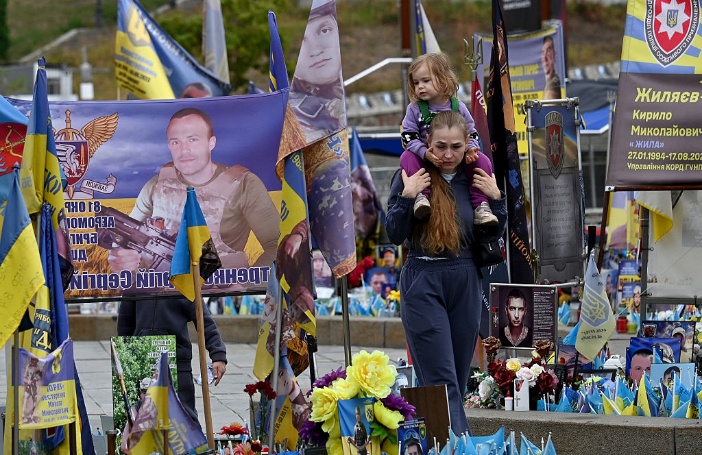
A woman carries her daughter on her shoulders as she walks to a makeshift memorial to fallen Ukrainian and foreign soldiers on Independence Square in Kyiv. (Sergiy Supinsky / AFP via Getty Images)
THE DAY’S RECKONING
A drone crossing into British airspace near a military site used to feel like a headline. Now it’s a pattern with a number attached: 300 times in two years, confirmed today by the UK’s own government. Poland spent the day doing something about exactly that kind of threat, formally joining a European coalition built to give the continent shared ballistic-missile defense rather than each country improvising alone.
Everywhere else, the war’s money kept finding uncomfortable places to surface. A sanctioned Russian oligarch turns out to have paid for part of Donald Trump Jr.’s wedding, a detail serious enough that Congress opened an investigation the same day it became public. Germany’s largest opposition party is reportedly preparing to sit down with a Kremlin economic envoy to talk about reopening the gas taps. Five people died overnight in strikes spread across six Ukrainian regions, including a man on a regional train that had nothing to do with any front line. Nothing today resolved simply. Everything today measured how far this war’s money, drones, and diplomacy now reach into places that have nothing to do with the battlefield itself.
A DEADLY NIGHT SPREAD ACROSS SIX REGIONS
Russian strikes killed at least five people and injured more than 30 overnight and into today, spread across Kherson, Kharkiv, Donetsk, Sumy, Kyiv, Dnipropetrovsk, and Odesa oblasts. In Kharkiv Oblast, a regional train was struck directly, killing a 40-year-old man and injuring seven more, according to Governor Oleh Syniehubov — the latest in a sustained Russian campaign against Ukraine’s railway network that’s continued despite mounting international condemnation following last week’s strike on a train carrying Western officials. Kherson Oblast lost one person with nine injured as daily Russian attacks on the region continued, Governor Oleksandr Prokudin said.
Donetsk Oblast lost one person with six more injured as Sloviansk and Kramatorsk came under fire, Governor Vadym Filashkin reported. In Sumy Oblast, a 17-year-old boy was killed after stepping on unidentified explosive ordnance, Governor Oleh Hryhorov said — a death caused not by a direct strike but by the deadly debris this war keeps scattering across communities long after any single attack ends. Five people, including three children, were injured in a drone strike near Fastiv, Kyiv Oblast. Dnipropetrovsk Oblast reported two civilians injured in Dnipro, and Odesa Oblast reported three injured in strikes on civilian infrastructure overnight. The scattered nature of the night’s violence, touching six separate regions without a single dominant strike, reflects the same daily pattern that’s defined much of the war’s fifth year: no single dramatic headline, but a cumulative toll that adds up regardless of whether any one attack draws international attention.
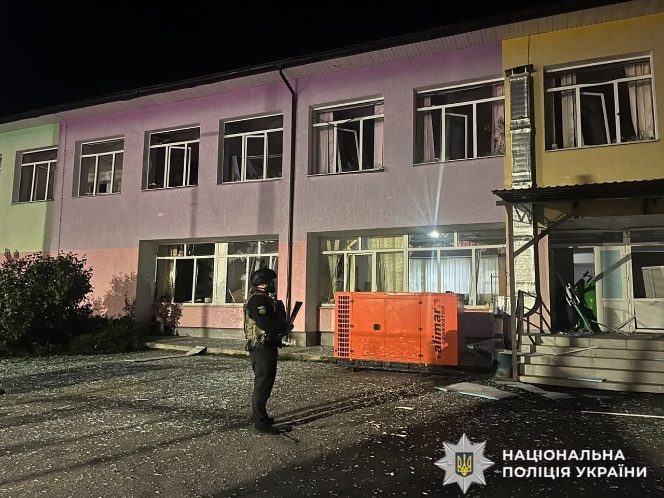
The aftermath of a Russian drone strike in Hlevakha in the Fastiv district of Kyiv Oblast. (Ukrainian National Police/Telegram)
POLAND JOINS A EUROPEAN BALLISTIC MISSILE DEFENSE COALITION
Poland formally joined a new European coalition today aimed at building shared ballistic-missile defense capability across the continent, part of a broader push among NATO’s eastern members to reduce dependence on any single country’s air-defense stockpiles as Russian missile and drone activity keeps testing the alliance’s collective posture. The move comes as Poland has already shifted its own air-defense operations to a more preventive footing, with military aviation “preventively” active in Polish airspace during recent Russian strikes on central Ukraine specifically to protect the country’s eastern regions.
The coalition reflects a broader European recognition that individual national stockpiles of interceptors and radar systems can’t realistically keep pace with the volume and speed of Russia’s evolving strike capability, particularly its faster jet-powered Geran-type drones, which have sharply reduced the warning time available to neighboring states. Poland’s own defense ministry has separately confirmed plans to expand its F-16 and helicopter coverage in response to a string of drone incursions in recent weeks, part of a broader regional pattern of countries choosing to sortie aircraft more frequently even at real financial and maintenance cost, rather than risk being caught unprepared by an incursion. Officials involved in the new coalition say pooling resources across member states could meaningfully reduce the cost burden any single country would otherwise bear alone, while also closing gaps that a patchwork of independent national systems inevitably leaves exposed.
UK MILITARY SITES TARGETED BY DRONES OVER 300 TIMES
The UK government confirmed today that suspicious drones have been detected near British military installations more than 300 times over the past two years, underscoring how routinely hybrid aerial threats have come to test even countries geographically distant from the war itself. Officials didn’t attribute every incident definitively to Russia, but the sheer frequency reflects a pattern British defense officials increasingly describe as sustained probing rather than isolated coincidence.
The disclosure adds Britain to a growing list of countries — Poland, Germany, Lithuania, the Netherlands, and Denmark among them — that have documented significant numbers of drone incursions near military or critical infrastructure sites this year alone. Taken together, the pattern reinforces what Polish Prime Minister Donald Tusk warned last week: that Russia is deliberately testing how much ambiguous, deniable pressure NATO members will absorb before treating an incursion as an actual attack, systematically probing the practical limits of Article 5’s collective-defense guarantee without ever crossing a line clear enough to trigger it outright. British officials say identifying the specific operators behind each incident remains difficult, since many drones are small, commercially available models that leave little forensic evidence once recovered. The government said it is reviewing counter-drone technology procurement specifically in response to the scale of incidents documented, following similar reviews already underway in Germany and Poland.
TRUMP JR.’S WEDDING PAYMENTS TRACED TO A SANCTIONED OLIGARCH
ProPublica reported today that Donald Trump Jr. received payments connected to his 2022 wedding from Umar Kremlev, a sanctioned Russian oligarch with close Kremlin ties, prompting Representative Robert Garcia, the top Democrat on the House Oversight Committee, to open a formal investigation into the relationship. Garcia requested records related to the payments, citing both national security and public corruption concerns. Following the report’s publication, Trump told reporters at the White House he had “no idea who Umar is” and had “never heard of him.”
The revelation lands amid heightened scrutiny of financial and personal ties between the Trump family and Russian-linked figures more broadly, at a moment when the administration’s own envoys are simultaneously engaged in active peace negotiations with Moscow. Kremlev, previously flagged in Western reporting for his role in international sporting federations with documented Kremlin connections, adds one more thread to a web of relationships Congress is now examining more closely — questions that carry particular weight given how directly US policy toward Russia’s invasion currently sits with the Trump administration’s own negotiating team. Garcia’s committee is expected to request additional financial disclosures in the coming weeks as the investigation proceeds, and Democratic lawmakers have signaled they intend to press for public hearings if the administration doesn’t cooperate voluntarily with the inquiry’s initial document requests.
AFD AND THE KREMLIN PREPARE TO DISCUSS REVIVING GAS SUPPLIES
Kremlin economic envoy Kirill Dmitriev and leaders of Germany’s far-right Alternative for Germany party are preparing to meet as early as next spring to discuss a possible resumption of Russian gas supplies to Germany, Reuters reported today, citing two undisclosed sources. The AfD has emerged as Germany’s largest party in recent polling while running on a platform explicitly calling for cutting assistance to Ukraine and resuming economic cooperation with Russia. Dmitriev, who heads the Russian Direct Investment Fund and has played a central role mediating US-Russian diplomatic contacts, would reportedly meet AfD co-leaders Alice Weidel and Tino Chrupalla.
Given the AfD’s current position outside Germany’s governing coalition, the meeting would carry little immediate policy effect, but it signals how directly Russia is now courting political forces across Europe that favor reduced support for Ukraine — a strategy that’s become increasingly visible as far-right parties gain ground in Germany, France, and elsewhere on platforms that overlap, to varying degrees, with Moscow’s own stated interests in weakening Western unity behind Kyiv. German officials have not commented publicly on the reported plans, and it remains unclear whether any such meeting would produce concrete outcomes beyond symbolic engagement. Ukrainian officials, when asked about the report, called any discussion of resuming Russian gas supplies premature and potentially damaging to European unity while the war remains unresolved.
SENATOR SHAHEEN: “WE WON’T LET PUTIN WAIT US OUT”
Democratic Senator Jeanne Shaheen outlined a sweeping sanctions push today aimed at closing remaining loopholes in Western pressure on Russia, arguing the war has become as much a test of allied patience as of battlefield endurance. “We won’t let Putin wait us out,” Shaheen said, framing continued economic pressure as essential to preventing Russia from simply outlasting Western political will rather than being forced into genuine concessions at the negotiating table.
The comments come as the Graham Sanctioning Russia and Iran Act — named for the late Senator Lindsey Graham, who died in July after championing the bill for more than a year — heads toward Trump’s desk following its passage in both chambers. Shaheen’s remarks reflect continued bipartisan concern in Congress that existing sanctions, however extensive, still leave meaningful gaps in enforcement against countries and entities helping Russia evade the pressure meant to constrain its war effort. She specifically pointed to third-country intermediaries and shadow-fleet shipping networks as areas where enforcement has lagged behind the legislation’s original intent, calling for closer coordination between Treasury enforcement and allied customs authorities. Shaheen said she plans to introduce additional legislation targeting these specific gaps once the current sanctions bill is signed into law.
UKRAINE EXPANDS BUSINESS SUPPORT WITH WAR-RISK INSURANCE
Ukraine’s government announced an expanded package of business support today, including subsidized loans and a new war-risk insurance mechanism designed to help companies continue operating despite the ongoing threat of Russian strikes on commercial and industrial facilities. The initiative responds directly to a pattern that’s intensified sharply since August: repeated strikes on shopping centers, food-processing plants, and retail warehouses that have left companies like Bunge, Epicentr, and Metinvest absorbing repeated losses with no reliable way to insure against future attacks through conventional means.
The war-risk insurance mechanism specifically aims to close a gap that’s become increasingly costly for Ukrainian businesses: standard commercial insurance policies typically exclude war-related damage entirely, leaving companies to absorb catastrophic losses out of pocket or simply cease operating in higher-risk regions. By offering state-backed coverage, officials hope to keep more businesses operating even in areas Russia has targeted repeatedly, preserving jobs and tax revenue that Ukraine’s wartime economy continues to depend on heavily. Officials said eligibility details and coverage caps would be finalized in coming weeks, with priority given to companies in frontline and near-frontline regions facing the highest documented strike risk. Business groups welcomed the announcement while urging the government to move quickly, noting several major employers have already scaled back operations rather than absorb further uninsured losses.
UKRAINE LAUNCHES A CENTRALIZED FOREIGN RECRUITMENT CENTER
Ukraine’s National Guard launched a centralized recruitment center yesterday aimed at boosting foreign enlistment and supporting volunteers throughout their entire service pathway, Prime Minister Serhii Koretskyi announced. “The Center will coordinate the recruitment of foreign volunteers for contract service and will accompany them at all stages: from interviews and checks to training,” Koretskyi said, adding that streamlining the process matters directly for battlefield readiness: “The candidate’s path to service should be as fast as possible. Combat units should receive the necessary reinforcements more quickly.”
The centralized approach addresses a recruitment pipeline that’s historically varied significantly in speed and consistency depending on which unit or branch a foreign volunteer approached directly. With Ukraine’s own domestic mobilization system under mounting strain and foreign volunteers representing a comparatively small but strategically valuable source of additional manpower, a faster, more standardized onboarding process could meaningfully affect how quickly units facing personnel shortages actually receive reinforcements. The National Guard said it would also provide clearer guidance on legal status, pay, and benefits for foreign volunteers, addressing complaints that inconsistent information had previously discouraged some prospective recruits from completing the enlistment process. Officials said the new center would operate multilingual support staff to help candidates navigate paperwork that has historically posed a significant barrier for non-Ukrainian speakers.
MACRON CALLS AN EMERGENCY G7 MEETING OVER ENERGY PRICES
French President Emmanuel Macron called for an emergency G7 meeting today to address spiking energy prices, which he linked directly to both Russia’s continued hybrid attacks and the broader disruption Ukraine’s own strikes on Russian refineries have caused to global fuel markets. The move reflects growing political pressure across G7 economies as fuel costs climb, a dynamic Trump has separately cited in his own public calls for Ukraine to scale back its refinery campaign specifically.
Macron’s framing differs meaningfully from Trump’s: rather than pressuring Ukraine to halt its strikes, the French president’s call for coordinated G7 action treats rising energy prices as a shared consequence of Russian aggression that allied economies need to manage collectively, rather than a problem Ukraine alone should be expected to solve by curtailing its own defensive economic-pressure campaign against the country that invaded it. French officials said the proposed meeting would also address longer-term strategies for reducing G7 economies’ exposure to future Russian-linked supply shocks. The Elysee Palace said Macron intends to raise the issue directly with fellow G7 leaders before the group’s next scheduled summit, framing energy security as inseparable from the alliance’s broader Ukraine strategy. Analysts noted the proposal reflects growing recognition among European leaders that isolated national responses to Russian hybrid pressure have proven less effective than coordinated action, a lesson increasingly applied across defense, energy, and diplomatic domains simultaneously.
MEANWHILE, AT THE FRONT
Neither Russian nor Ukrainian forces made confirmed advances anywhere along the front today, continuing the static pattern that’s defined most of the line since Operation Vivaldi disrupted Russia’s northern encirclement effort near Lyman. Ukrainian forces continued consolidating gains from the counteroffensive, while Russian forces regrouped and redeployed units toward Dobropillya in what Ukrainian intelligence expects to culminate in renewed mechanized assaults by October. Russian forces continued unsuccessful offensive operations across Sumy, Kharkiv, and Donetsk oblasts without confirmed territorial change, while Ukrainian forces maintained pressure through intermediate-range strikes against Russian logistics and command infrastructure well behind the front line itself.
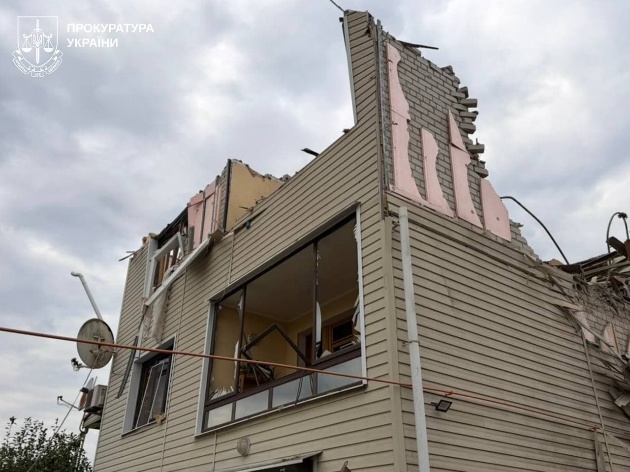
The aftermath of a Russian drone attack on the city of Balakliia in Kharkiv Oblast, Ukraine. (Prosecutor General’s Office)
Poland’s shift toward more preventive air-defense sortieing, detailed earlier this week, continued today as well, with Polish aircraft again active during the latest wave of Russian strikes on central Ukraine — a now-routine precaution reflecting just how little warning time faster Russian drones leave for neighboring states to react once a launch is detected. Ukrainian officials say the relative quiet along the ground front line reflects both sides regrouping after Operation Vivaldi’s disruption of Russia’s original campaign design, rather than any genuine lull in the war’s broader intensity. Analysts expect renewed fighting to intensify around Dobropillya and the Fortress Belt as Russian forces complete the redeployment already underway toward that sector.
A MISSILE SHIELD, A WEDDING PAYMENT, A TRAIN STRUCK
By nightfall, today’s furthest edges pulled toward the same uneasy pattern this war keeps sustaining: security cooperation deepening in one direction while uncomfortable money keeps surfacing in another. Poland joined a missile shield. The UK counted 300 drone incursions it can’t fully explain. A sanctioned oligarch’s money turned up somewhere nobody in Washington wanted to find it.
Five people across six regions won’t see tomorrow, including a man on a train that had nowhere near a front line to justify targeting it. And somewhere in Berlin, a party gaining ground in the polls is reportedly getting ready to talk with Moscow about turning the gas back on. A teenager in Sumy Oblast died from ordnance this war left behind without even needing to strike again. Nothing today ended. Everything today measured how many different currencies — money, drones, diplomacy, and simple bad luck — this war still trades in, far beyond the battlefield itself.
A PRAYER FOR UKRAINE
1. For the Man Killed on a Regional Train in Kharkiv
Lord, a man died today on a train doing nothing more than traveling home or to work, caught by a strike that served no military purpose. We grieve a death this ordinary made cruel by its randomness. Receive him, comfort the seven injured alongside him, and protect every passenger still boarding trains where even routine travel carries real risk. Railway officials say the sustained targeting has forced repeated rerouting and delays even on lines far from active combat, a quiet but constant drag on ordinary movement across the country.
2. For the Teenager Lost to Buried Ordnance
Father, we lift up the seventeen-year-old boy killed today by explosive debris this war left scattered behind, long after whatever attack first deployed it had ended. Comfort his family, and protect every child and teenager still living in landscapes quietly seeded with danger that doesn’t announce itself until it’s already too late. Give the deminers working through decades of backlog patience and safety in work that will outlast this war itself, and let no other family lose a child to a threat that lingers long after the fighting that caused it ends. Ukrainian Railways has separately documented more than 1,500 strikes on its own infrastructure this year alone, a toll that keeps climbing even as trains remain the country’s primary transportation given closed civilian airspace nationwide.
3. For Truth to Surface, However Uncomfortable
Lord of justice, we pray for honesty in every corner of this war’s financial and political entanglements, however far from Ukraine’s own borders those threads eventually lead. Give investigators courage to follow evidence regardless of whose name it touches, and give leaders everywhere the integrity to answer honestly when uncomfortable questions arrive. Let truth surface regardless of how inconvenient its timing, and let accountability reach as high as the evidence actually leads.
4. For Every Nation Building Defenses It Never Wanted to Need
God of protection, we pray for Poland, Britain, and every country now investing in defenses against threats that didn’t exist for them just a few years ago. Give their leaders wisdom in preparation, and give their people patience with costs and disruptions that come from simply taking a real danger seriously. Let this vigilance protect without provoking, and let it never be needed in the way these nations now quietly prepare for.
5. For Businesses and Workers Trying to Keep Going
God of provision, we pray for every Ukrainian business and worker trying to operate despite the constant threat of the next strike. Give Ukraine’s new insurance and support systems real effectiveness, and give companies the confidence to keep employing people and paying into an economy this country still desperately needs functioning.
In Your mercy, in Your justice, in Your time — bring this war to its end, and let the ending be worthy of what Ukraine has endured.