
September 24, 2026
Prepared by Diana Bozhyk
Russian ballistic missiles struck Kyiv in three waves overnight, part of a nationwide barrage that killed at least 18 people and injured more than 70 across eight regions, hitting a maternity hospital in the capital and killing five people in a single strike on Oleksandrivka, Donetsk Oblast. President Zelensky revealed that the Trump administration has proposed three immediate steps to de-escalate the war — a ceasefire on long-range energy strikes, reopening the Black Sea grain corridor, and a trilateral US-Ukraine-Russia meeting possibly in Abu Dhabi — even as Russian Gerbera-type drones crashed in both Moldova and Romania and Polish officials confirmed sabotage caused a fire at a Starlink ground station. Russia’s Defense Ministry repeated a baseless claim that it has encircled Dobropillya, and a Ukrainian national fatally stabbed a priest and injured four others at a Polish abbey near the border.
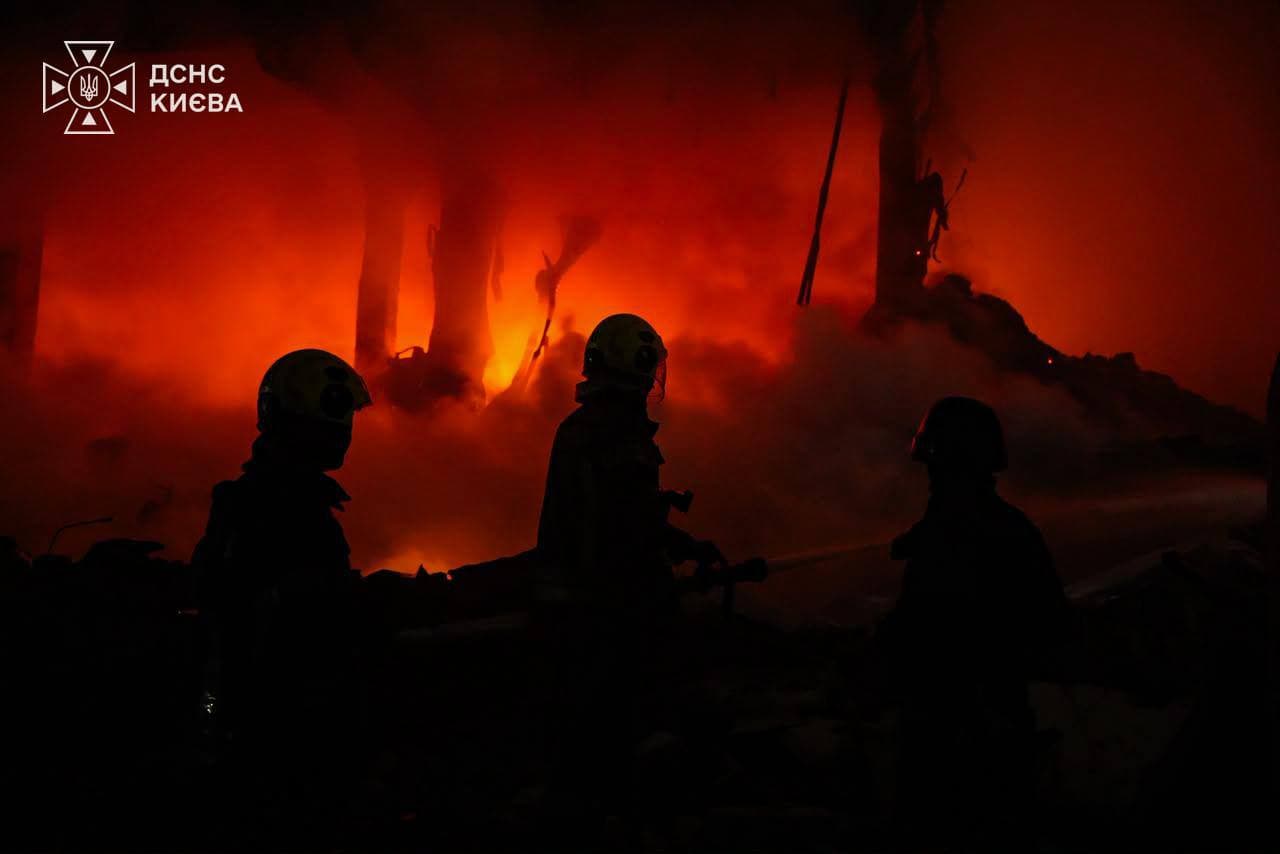
Firefighters work at the site of a fire following a Russian attack on Kyiv overnight. (State Emergency Service of Ukraine in Kyiv/Telegram)
THE DAY’S RECKONING
Three waves of ballistic missiles hit Kyiv overnight, one of them finding a maternity hospital. Five people died in a single strike on a Donetsk village most of the world will never hear named. By the time the counting finished, eighteen people across eight regions wouldn’t see tomorrow. Zelensky said it plainly: this keeps happening because the pressure on Russia still isn’t total enough to stop it.
Even as the missiles fell, diplomacy kept moving on its own separate track. Trump’s team floated three concrete steps toward de-escalation — an energy ceasefire, reopened grain shipping, a trilateral meeting that might actually happen. Russian drones crashed in Moldova and Romania on the same day, testing borders that have nothing to do with any front line. A Starlink station burned in Poland. Berlin’s airport went dark for hours over a single drone. And in a quiet Polish town near the border, a Ukrainian man killed a priest with a knife, a tragedy with no connection to any battlefield at all, but one that will shape how two neighboring countries see each other regardless. Nothing today resolved simply. Everything today measured how many different kinds of violence this war has learned to produce at once.
A MASSIVE BALLISTIC BARRAGE KILLS 18 NATIONWIDE
Russian ballistic missiles struck Kyiv in three separate waves overnight, damaging residential buildings, a maternity hospital, and energy and logistics infrastructure, President Zelensky said. Two people were killed and eight injured in the capital. “Every such attack happens because pressure on the aggressor has still not become total, and Russia believes it can continue relying on ballistic terror,” Zelensky said, renewing his appeal for ballistic missile interceptors. Russia launched 282 drones overnight, including jet-powered variants, alongside Zircon anti-ship missiles and Iskander-M, S-400, and KN-23 ballistic missiles; Ukrainian forces intercepted 227 targets, including 219 drones, four Zircons, three ballistic missiles, and one Banderol munition.
Donetsk Oblast bore the heaviest toll: eight people killed and 19 injured, with five dead in a single strike on Oleksandrivka, two more in Kramatorsk, and one in Sloviansk. Kharkiv Oblast lost six people with 12 injured, including 12 wounded in a single strike on an agricultural enterprise in Stara Hnylytsia. Sumy Oblast reported nine injured as Russian forces carried out nearly 60 separate attacks against 22 settlements. Odesa Oblast reported two injured as strikes damaged a hospital, school, residential buildings, and a shopping center. Kherson Oblast reported two injured, with two apartment buildings, a house, and gas pipelines damaged. Zaporizhzhia Oblast reported six injured as Russian forces carried out 690 strikes against 55 settlements region-wide, and Dnipropetrovsk Oblast reported one person injured as Russian forces struck three districts more than 10 times with drones and artillery.
ZELENSKY REVEALS TRUMP’S THREE-STEP DE-ESCALATION PLAN
President Zelensky said today the Trump administration is proposing three immediate steps to de-escalate the war and resume diplomacy: a Russian-Ukrainian ceasefire on long-range strikes against energy infrastructure, reopening the Black Sea grain corridor, and a trilateral meeting between the United States, Ukraine, and Russia — possibly in Abu Dhabi. Zelensky said Secretary of State Marco Rubio’s invitation for Russia to attend December’s G20 summit in Miami could also provide a venue for that trilateral meeting, adding he sees the Miami summit as potentially his best remaining chance to finally sit down directly with Putin.
Kremlin spokesperson Dmitry Peskov called it premature to discuss whether Putin would actually travel to the G20 or meet Trump there, offering no firm commitment either way. The Kremlin separately signaled openness to a different trilateral format — a Putin-Trump-Xi meeting at November’s APEC summit in China — though neither format has been formally confirmed by Moscow. Putin has so far refused to meet Zelensky directly in any third country, continuing to insist any bilateral meeting between the two leaders would have to take place in Moscow itself, a precondition Kyiv has consistently rejected. Trump has previously said he believes Putin’s reluctance stems partly from personal antipathy toward Zelensky, an assessment that, whatever its accuracy, does little to resolve the practical standoff over where any face-to-face meeting might actually occur.
RUSSIA’S DRONE CAMPAIGN SPREADS TO MOLDOVA AND ROMANIA
A Russian Gerbera-type drone crashed in Cernita, Moldova, today, according to geolocated footage and Moldovan police statements, while Romania’s Ministry of National Defense reported a separate unidentified aerial vehicle entered Romanian airspace for roughly four minutes before crashing near Solca — geolocated footage confirmed it was also a Russian Gerbera-type drone. Chernivtsi Oblast Military Administration Head Ruslan Osypenko said four Russian drones flew over Ukraine’s Bukovyna region targeting border crossings with Moldova and Romania; Ukrainian forces shot down three of them, while the fourth continued toward Suceava County, Romania.
Polish Prime Minister Donald Tusk confirmed Polish authorities evacuated the Zosin and Dorohusk border crossings for 30 minutes as a precautionary measure during the same overnight Russian strikes on Ukraine, part of the same preventive security posture Poland adopted after previous strikes near its border crossings. Researchers assess the intentional and accidental drone incursions into NATO and Moldovan airspace are likely part of a deliberate Kremlin strategy to normalize airspace violations by simply increasing their frequency, gradually eroding the threshold at which member states treat an incursion as a genuine attack requiring formal response. Today’s incidents mark the second time in roughly two weeks that Russian drones have crossed into both Moldovan and Romanian territory within the same 24-hour window, a clustering pattern that’s become increasingly difficult to dismiss as purely accidental given how consistently it recurs.
SABOTAGE HITS A STARLINK STATION IN POLAND, A DRONE SHUTS BERLIN’S AIRPORT
A fire broke out at a Starlink satellite communications ground station in Wola Krobowska, Poland, last night, which Polish Deputy Prime Minister Krzysztof Gawkowski confirmed today was the result of deliberate sabotage aimed at disrupting internet services. Gawkowski said Polish authorities haven’t yet established who’s responsible, but that many signs point toward Russia’s evolving pattern of hybrid attacks. Separately, German authorities temporarily suspended operations at Berlin-Brandenburg Airport last night after air traffic control detected an unidentified drone in the area; German officials haven’t yet linked the incident to Russia either.
Both incidents fit a broader pattern of suspected Russian sabotage against European defense and logistical infrastructure that’s continued throughout the year without always producing definitive attribution. Western intelligence sources continue warning about further such attacks: a Lithuanian defense ministry source said Russia could launch Gerbera-type drones from a shipping container in the Mediterranean against Spain, France, or Italy, while Danish intelligence assessed Russia will likely intensify its hybrid war against the West in coming months through cyber and sabotage attacks, even while judging a limited direct military strike on a NATO border state unlikely. The CIA reportedly separately warned Poland that Russia may target undersea telecommunications infrastructure specifically to disrupt the Polish banking system.
RUSSIA FALSELY CLAIMS IT ENCIRCLED DOBROPILLYA AGAIN
Russia’s Defense Ministry published a map today purporting to show its Central Grouping of Forces encircling Ukrainian troops in Dobropillya, an apparent attempt to substantiate a nearly identical claim it first made on September 22. The map shows Russian advances that don’t correspond to any observed Russian presence in the area, particularly north of the town. Independent researchers have found no evidence supporting any encirclement, assessing the nearest confirmed Russian-held territory sits 10.2 kilometers from Dobropillya’s southeastern outskirts.
Ukrainian officials directly refuted the claim: a Ukrainian artillery reconnaissance battalion’s chief of staff said Russian forces haven’t made major advances toward Dobropillya, while military observer Kostyantyn Mashovets confirmed Ukrainian forces still hold positions south and northeast of the town. Even a Russian milblogger described the alleged encirclement as merely establishing fire control over Ukrainian supply roads rather than any continuous infantry presence. Analysts assess the repeated fabrication is partly designed to distract from Ukraine’s genuine elimination of Russia’s salient north of Lyman in recent months, which forced Russian commanders to abandon their original plan for a wider encirclement of the Fortress Belt through both Lyman and Dobropillya combined. Russia’s own culture of dishonest battlefield reporting — the “beautiful reports” Russian milbloggers themselves have criticized for months — increasingly appears to be distorting not just public perception, but the Kremlin’s own internal understanding of where its forces actually stand.
A UKRAINIAN NATIONAL KILLS A PRIEST IN POLAND
A Ukrainian man attacked five people with a knife at the Benedictine Sisters’ Abbey in Jaroslaw, Poland, roughly 35 kilometers from the Ukrainian border, today, killing one victim and injuring four others in what President Zelensky called “a horrific crime.” The attacker stabbed four men and one woman, three of them clergy members, before police arrived; one victim, a Catholic priest, died at the hospital from his injuries, while two others remain in serious condition, according to District Prosecutor Bozena Harasz-Woloszyn.
Polish Prime Minister Donald Tusk confirmed the assailant, a 31-year-old Ukrainian national, is now in police custody. “The perpetrator is a Ukrainian citizen. He will be punished to the full extent of Polish law. My heart goes out to the loved ones of the victims of this brutal attack,” Tusk wrote. Authorities haven’t yet established a motive. The incident, while unconnected to the war itself, arrives at a politically sensitive moment given ongoing tension over Ukrainian refugee integration in Poland and follows a summer already marked by rising documented hostility toward Ukrainians in several host countries — a dynamic this tragedy risks inflaming regardless of the attacker’s actual motivations. Polish officials moved quickly to frame the attack as an isolated criminal act rather than evidence of any broader pattern, a distinction that will likely prove difficult to maintain in public discourse regardless of how the investigation ultimately concludes.
TRUMP AND XI MEET AS CHINA’S SECRET TRAINING OF RUSSIAN SOLDIERS COMES TO LIGHT
President Trump and Chinese President Xi Jinping met today and agreed to “support each other” in hosting December’s G20 summit in Miami and November’s APEC summit in China, according to Beijing’s official statement, which offered no detail on what, if anything, the two leaders discussed regarding Ukraine specifically. Xi did tell Trump that China “hopes the U.S. side will adhere to the correct position of opposing ‘Taiwan independence'” and handle the issue “with prudence” — Beijing’s own priority clearly taking precedence in its public readout of the meeting.
The meeting comes as Reuters reported that China secretly trained more than 200 Russian military personnel in 2025, personnel later sent to fight in Ukraine — a disclosure that directly undercuts China’s repeated public claims of neutrality in the war. China remains the world’s largest buyer of Russian oil, a position that now exposes it to potentially steep tariffs under the newly signed US sanctions bill targeting the largest purchasers of Russian energy. Putin and Xi separately signed cooperation agreements during Putin’s May visit to Beijing, deepening a strategic partnership that continues expanding even as Beijing publicly maintains it isn’t taking sides in Russia’s invasion. China has previously denied allegations that it supplies weapons or defense-industry components to Russia, denials that grow harder to square with each new report documenting direct Chinese involvement in training or supplying Russian forces.
SHADOW FLEET CRACKDOWN CUTS FALSE-FLAG SHIPS IN HALF
A report from the Center for Research on Energy and Clean Air think tank found that Western detentions have cut the number of Russian shadow-fleet ships flying false flags by more than half between last October and June 2026. The crackdown has forced 107 vessels to switch to the Russian flag registry since January 2025, leaving them with few remaining alternatives as open ship registries worldwide tighten their own oversight of vessels with suspicious ownership histories.
The shadow fleet consists of aging, poorly insured tankers Russia uses to ship oil in violation of international sanctions, which Western governments have also accused Moscow of using to support broader hybrid operations against Europe. European countries have grown increasingly assertive in enforcing sanctions against the fleet this year, with France, Sweden, and Belgium each detaining or boarding shadow-fleet vessels in recent months — part of a coordinated push that’s meaningfully complicated Russia’s ability to keep exporting oil through vessels designed specifically to obscure their true ownership and origin. The CREA report credits increasingly aggressive port inspections and insurance-verification requirements across multiple European jurisdictions with forcing much of the shift, rather than any single dramatic enforcement action. Analysts caution the flag switch to Russia’s own registry doesn’t eliminate the underlying safety and environmental risks these aging vessels pose, since Russian oversight of its own registry remains considerably lighter than the international standards these ships were originally built to meet decades ago.
UKRAINE OPENS A SECOND EU ACCESSION CLUSTER
Ukraine formally opened its second EU accession negotiating cluster today, covering internal market issues, as reform delivery continues shaping the pace of the country’s broader membership bid. The milestone comes as EU officials continue pressing Kyiv on rule-of-law progress specifically, following last week’s tense meeting between Ukrainian and EU representatives over both accession reforms and the bloc’s own internal fight over sanctions delistings.
Ukraine’s overall accession process remains slow by design, requiring unanimous approval from all 27 member states at each stage, with Hungary in particular continuing to use its veto power to delay Ukraine’s broader integration timeline. Today’s cluster opening nonetheless represents tangible forward movement Ukrainian officials have worked to secure amid broader uncertainty over the bloc’s financial commitments, offering a rare piece of good news on the EU relationship after a week largely dominated by disputes over sanctions and rule-of-law benchmarks. Ukrainian officials framed the milestone as proof that reform work continues advancing even while broader political disputes over funding and sanctions play out separately in Brussels. Ukraine has now opened two of the six total negotiating clusters required for full EU membership, with officials expressing hope that continued visible progress could help build momentum toward opening the remaining clusters before the war’s diplomatic timeline shifts attention elsewhere entirely.
NEARLY 60 COUNTRIES UNITE AGAINST RUSSIA’S CHILD ABDUCTIONS
Nearly 60 countries joined a summit today specifically addressing Russia’s ongoing abduction and deportation of Ukrainian children from occupied territory, coordinating efforts to track, identify, and eventually return the thousands of children Russia has taken since 2022. The summit comes as Ukraine’s own tracking organization dedicated to documenting these abductions confirmed it has just two weeks of funding left before being forced to shut down entirely, according to reporting on the group’s financial situation.
Separately, a Kyiv Independent investigation found Russia is “increasingly obstructing” the return of Ukrainian children from occupied territory, making the process considerably harder than it was even a year ago as Moscow tightens bureaucratic and physical barriers to reunification. The funding crisis facing Ukraine’s own tracking effort threatens to undermine exactly the kind of documentation work that’s made international pressure on Russia over this issue possible in the first place, even as today’s 60-country summit demonstrates genuine, broad international concern about a practice the International Criminal Court has already cited in issuing arrest warrants for Putin himself. Ukrainian officials estimate the true number of deported children reaches well into the hundreds of thousands, a figure Russia has never formally acknowledged or provided a comprehensive accounting for despite years of mounting international pressure.
DEEP STRIKES CONTINUE: REFINERIES HIT IN UFA AND BASHKORTOSTAN
Russian officials reported Ukrainian long-range strikes against energy and industrial infrastructure in Rostov Oblast and Krasnodar Krai overnight. Rostov Oblast Governor Yuri Slyusar said Ukrainian drone debris damaged an oil depot in Kagalnitsky Raion, roughly 111 kilometers from the border, without sparking a fire, while Krasnodar Krai’s regional headquarters reported drone debris caused a fire at an industrial facility in Dinsky Raion, roughly 220 kilometers from the border — serious enough that Krasnodar Krai Governor Veniamin Kondratyev declared a regional state of emergency.
Separately, explosions and smoke were reported near an oil refinery in Ufa, Bashkortostan, adding to the string of refineries Ukraine has struck across Russia throughout September. Ukraine’s General Staff also confirmed damage to Russian radar systems and a drone launch site in a separate strike, part of the same sustained campaign against Russian air-defense and drone infrastructure that’s continued alongside the refinery strikes. The consistent pattern of strikes reaching hundreds of kilometers into Russian territory, triggering regional emergency declarations and confirmed fires, underscores how routinely Ukraine’s deep-strike campaign now operates across multiple Russian regions simultaneously. Regional officials across all three affected areas offered only limited public detail on the actual scale of damage, consistent with Russia’s broader pattern of minimizing public disclosure about the cumulative toll these strikes continue inflicting on its own energy infrastructure.
MEANWHILE, AT THE FRONT
Neither Russian nor Ukrainian forces made confirmed advances anywhere along the front today. Russian forces continued offensive operations across multiple sectors without meaningful territorial change, while Ukrainian forces maintained positions gained during Operation Vivaldi and continued intermediate-range strikes against Russian logistics well behind the front line. The relative battlefield stalemate stood in sharp contrast to the day’s dramatic civilian toll, underscoring how disconnected Russia’s continued strikes on population centers have become from any actual military objective along the static front itself.
Russian forces conducted glide-bomb and drone strikes against multiple frontline settlements throughout the day, part of the now-routine pattern of area bombardment that’s defined Russian tactics for months without producing corresponding territorial gains. Ukrainian officials continued documenting and refuting inflated Russian claims across several sectors, a now-familiar rhythm that’s repeated almost daily as Moscow’s propaganda apparatus works to manufacture an impression of battlefield momentum that independent tracking consistently fails to confirm.
KALLAS ACCUSES PUTIN DIRECTLY OF ORDERING MURDERS ON US SOIL
EU foreign policy chief Kaja Kallas delivered an unusually pointed accusation today, saying Trump’s invitation for Putin to attend December’s G20 summit in Miami was “very hard to hear” given that Russian intelligence officers have recently been charged with murders committed on American soil. “So, my question is, do these intelligence officers operate, you know, alone, or do they get orders from Vladimir Putin? And I can tell you, they get orders from President Putin,” Kallas said, directly tying the Russian president personally to intelligence operations targeting people inside the United States.
Separately, the European Commission confirmed it will use the Miami summit to condemn Russia’s invasion of Ukraine regardless of whether Putin actually attends, continuing a practice it’s maintained at every G20 gathering since 2022. “The G20 is a key forum for addressing existing and emerging global challenges, some of which have been created precisely by Russia’s war against Ukraine,” Commission deputy chief spokesperson Olof Gill said, adding that July and August were the deadliest months for Ukrainian civilians since the war began. Separately, Zelensky told the UN General Assembly that Ukraine will intensify its own refinery-strike campaign if Russia launches another major winter assault on Ukrainian energy infrastructure, warning that “General Winter” — the harsh conditions that have historically favored Russian strategy — “may no longer fight exclusively for Russia.”
AUSTRALIA SIGNS A BILATERAL SECURITY AGREEMENT WITH UKRAINE
Australia and Ukraine signed a formal bilateral security agreement today following a meeting between President Zelensky and Australian Prime Minister Anthony Albanese, committing Canberra to ongoing support across naval capacity building, critical energy infrastructure protection, and sharing best practices for democratic reform. “Australia have always stood with Ukraine. Thank you for your real and concrete support,” Zelensky said. The agreement repeatedly draws an explicit link between the Indo-Pacific and Euro-Atlantic regions, citing North Korea’s direct troop deployment to fight alongside Russia as evidence the war threatens global security well beyond Europe.
“This Bilateral Security Agreement underscores Australia’s ongoing commitment and enduring support for Ukraine as it defends itself against Russia’s aggression,” Albanese said. Canberra separately announced a 60 million Australian dollar — roughly $42.2 million — support package for Ukraine, with 75 percent consisting of Australian Defense Force equipment and the remainder split across other assistance categories. The agreement adds Australia to a growing list of countries outside Europe and North America formalizing long-term security commitments to Ukraine, reflecting a broader recognition among Indo-Pacific democracies that Russia’s war carries strategic implications extending well beyond its immediate European theater.
Zelensky thanked Albanese specifically for what he called consistent political and geopolitical solidarity throughout the war, a relationship that’s spanned multiple Australian sanctions packages against Russia and earlier military assistance dating back to 2022. Today’s formal agreement moves that relationship from ad hoc support toward a codified, longer-term commitment, giving Ukraine one more documented partnership it can point to as evidence the war’s stakes remain a genuinely global concern rather than a narrowly regional one.
A BALLISTIC BARRAGE, A THREE-STEP PLAN, A KNIFE IN A QUIET TOWN
By nightfall, today’s threads pulled toward the same uneasy pattern this war keeps sustaining: real diplomatic movement running alongside violence that shows no sign of actually slowing down. Eighteen people across eight regions won’t see tomorrow. A maternity hospital in Kyiv took a hit meant to terrorize, not to achieve anything resembling a military objective.
Trump’s team floated a plan with real, specific steps attached. Russian drones tested two more borders that have nothing to do with any front line. And in a quiet Polish town, a knife took a priest’s life in a tragedy this war didn’t cause but will inevitably shape how it’s remembered anyway. Nothing today resolved. Everything today measured how many different forms of harm this war has learned to produce, on how many different fronts, all at once.
A PRAYER FOR UKRAINE
1. For the Five Lost in Oleksandrivka
Lord, five people died today in a single strike on a village most of the world will never hear named. We grieve a loss this concentrated, this complete for one small community. Receive them, comfort their families and the eight more killed across Kramatorsk and Sloviansk, and hold Donetsk Oblast as it counts, once again, what a single day’s violence actually cost.
2. For Every Patient in a Struck Maternity Hospital
Father, we lift up the mothers and newborns caught in a strike on a Kyiv maternity hospital, a place meant only for bringing life into the world. We grieve violence that spares nothing, not even the beginning of a life. Protect every patient and newborn still there tonight, and give the staff strength to keep providing care despite the danger surrounding them.
3. For a Priest and Every Victim of a Senseless Attack
Lord of mercy, we grieve the death of a priest today, killed not by this war’s weapons but by a knife in a place meant for prayer. Comfort his community, and heal the four others wounded alongside him. Give Poland and Ukraine grace toward each other in a moment that could easily deepen division, and let this tragedy be met with justice rather than blame cast too widely.
4. For Children Still Waiting to Come Home
God of the lost, we pray for every Ukrainian child still separated from family in occupied territory, and for the organizations working to bring them back even as their own funding runs out. Provide for this work to continue, and give the nearly sixty countries gathered today the resolve to turn today’s summit into lasting, funded action rather than a single day’s attention.
5. For Diplomacy to Finally Match Its Own Promises
God of peace, we pray for the three steps proposed today — a ceasefire, reopened grain shipping, a meeting that might actually happen. Give these proposals the follow-through this war desperately needs, and give leaders on every side the courage to turn promising words into verified action. Let today’s plan become tomorrow’s reality, not simply another proposal left unfulfilled.
In Your mercy, in Your justice, in Your time — bring this war to its end, and let the ending be worthy of what Ukraine has endured.