
September 29, 2026
Prepared by Diana Bozhyk
Russian forces struck a residential area and a school building in central Sumy with four guided bombs during class hours, killing two people and wounding six, including three children. President Zelensky said Russian mobilization has quietly begun despite Kremlin denials, as Vladimir Putin’s government prepared a record 17.1 trillion ruble defense budget for 2027 even while researchers estimated Russia has now suffered more than 405,000 combat deaths since the invasion began. Ukraine’s 3rd Army Corps said its counteroffensive near Lyman has captured more than 250 Russian prisoners, while a Khartiia Corps video showed Russian troops forcing Ukrainian children, elderly residents, and a man on crutches through a gas pipeline as human shields during a retreat near Kupiansk.
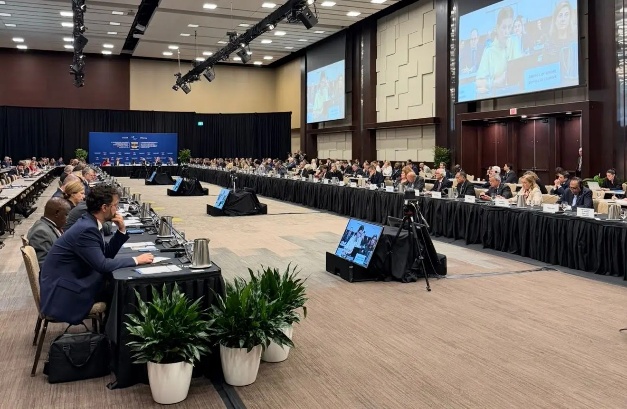
Dignitaries meet at the Second International Conference on Returning Ukrainian Children, Detained Civilians, and Prisoners of War in Toronto, Canada. Fifty countries and four organizations signed a pledge at the conclusion of the summit calling for the return of Ukrainian prisoners of war, unlawfully detained civilians, and children abducted by Russia. (Volodymyr Ivanyshyn/The Kyiv Independent)
THE DAY’S RECKONING
Four guided bombs fell on Sumy today while children sat in class, and only a fast decision by their own teachers to move everyone into the shelter kept the day from becoming a tragedy far worse than the two lives it still cost. In Kharkiv, rescue crews spent more than 24 hours digging through what was left of an apartment block in Saltivka, pulling 32 people out alive one at a time. Zelensky’s message to Ukraine’s allies was blunt: stop reacting with statements and start reacting with consequences, because Russia only escalates when it senses room to.
Russia, for its part, spent the day proving his point in numbers. A record defense budget. A fourth troop-ceiling increase this year. Quiet confirmation that mobilization, denied in public for months, has already begun in practice. And on a stretch of pipeline near Kupiansk, soldiers who couldn’t outrun a Ukrainian advance solved their problem by marching children and a man on crutches ahead of them into a tunnel, filming it as they went. Nothing today resolved cleanly. Everything today measured how much cruelty this war can still manufacture out of pure operational convenience.
TWO KILLED IN A SUMY SCHOOL STRIKE AS ZELENSKY DEMANDS ACTION BEYOND WORDS
Russian forces launched four guided aerial bombs at central Sumy on Tuesday, striking a residential area and hitting a school building while classes were in session. Two people were killed and six wounded, including three children, President Zelensky said, adding it remained unclear at the time of his statement whether the deaths occurred at the school or in the surrounding residential area. “Thanks to the teachers and school administration, the children and staff were in the shelter; in total, 100 people were evacuated in time,” Zelensky said, crediting staff for limiting the toll. The attack came less than a month after Ukraine reopened at least 25,000 schools nationwide on September 1 under new wartime safety protocols meant to preserve some version of ordinary childhood.
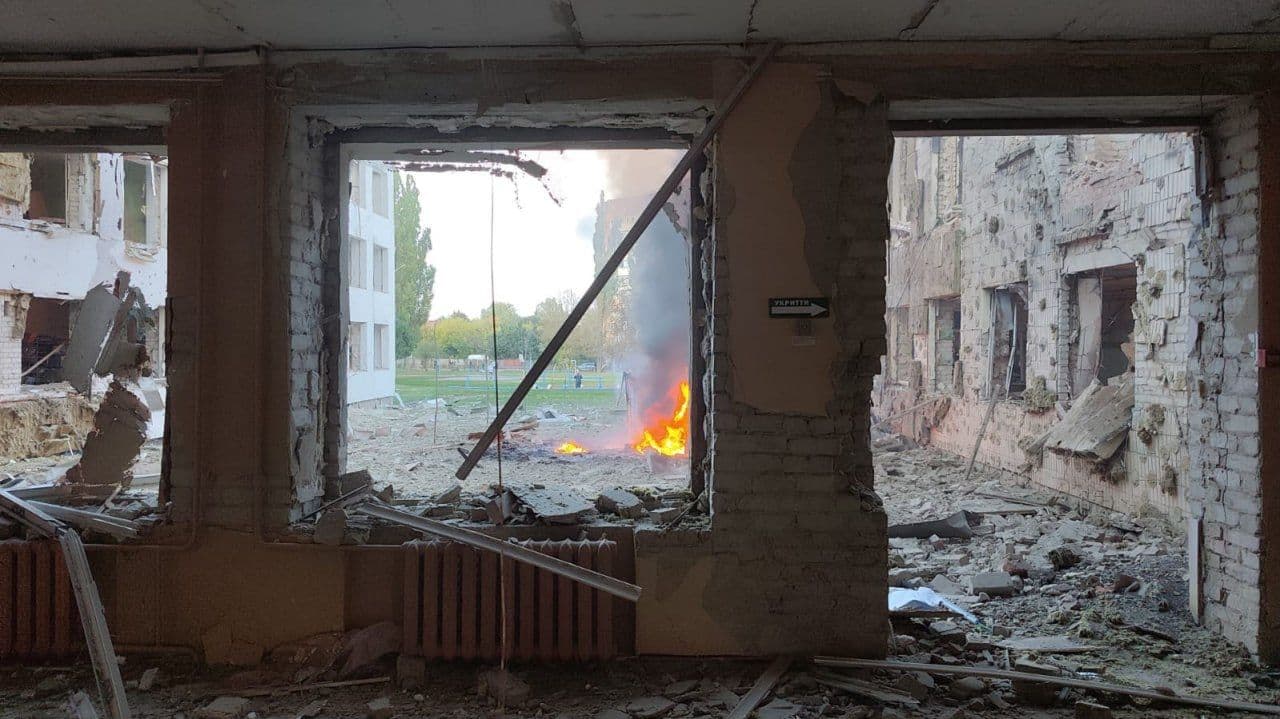
Damage to a school in Sumy after a deadly Russian glide bomb strike. (Volodymyr Zelensky / Telegram)
Zelensky used the statement to press Ukraine’s Western partners for a firmer response, noting that Russian strikes on civilian areas have intensified markedly since senior US envoys Steve Witkoff and Jared Kushner left Kyiv on September 6 without a diplomatic breakthrough. “America, Europe, and all our partners must not forget that Russia will not stop this madness without real pressure,” he said. “We expect that the response steps to these strikes will come and will not be limited to words only.” Ukrainian officials have repeatedly observed that Russia tends to intensify strikes precisely when diplomatic momentum revives, treating renewed talks as an opportunity to demonstrate it isn’t actually interested in stopping.
KHARKIV’S SALTIVKA: 48 WOUNDED, A DAY-LONG RESCUE
Russian forces struck Kharkiv’s Saltivka residential neighborhood with glide bombs on the morning of September 28, wounding 48 people, including 12 children. Rescue operations continued for more than 24 hours, concluding only this afternoon, with 32 people ultimately pulled from the rubble, Ukraine’s State Emergency Service said. Saltivka, a dense residential district on Kharkiv’s northeastern edge, has absorbed repeated Russian strikes throughout the war given its position closest to the Russian border of any major Ukrainian residential area. Local officials said the extended rescue window reflected both the density of the damaged apartment blocks and the sheer number of residents crews needed to account for before declaring the operation complete.
As in other frontline regional capitals like Zaporizhzhia and Kharkiv itself, the inaccurate but destructive glide bomb has become Russia’s weapon of choice against dense urban areas — cheap, difficult to intercept, and capable of leveling multiple floors of an apartment block in a single strike. The extended rescue timeline in Saltivka, spanning more than a full day of continuous work, illustrates both the scale of the damage and the discipline of emergency crews working under the constant threat that a follow-up strike could target the rescue operation itself, a tactic Russian forces have used elsewhere against first responders throughout the year.
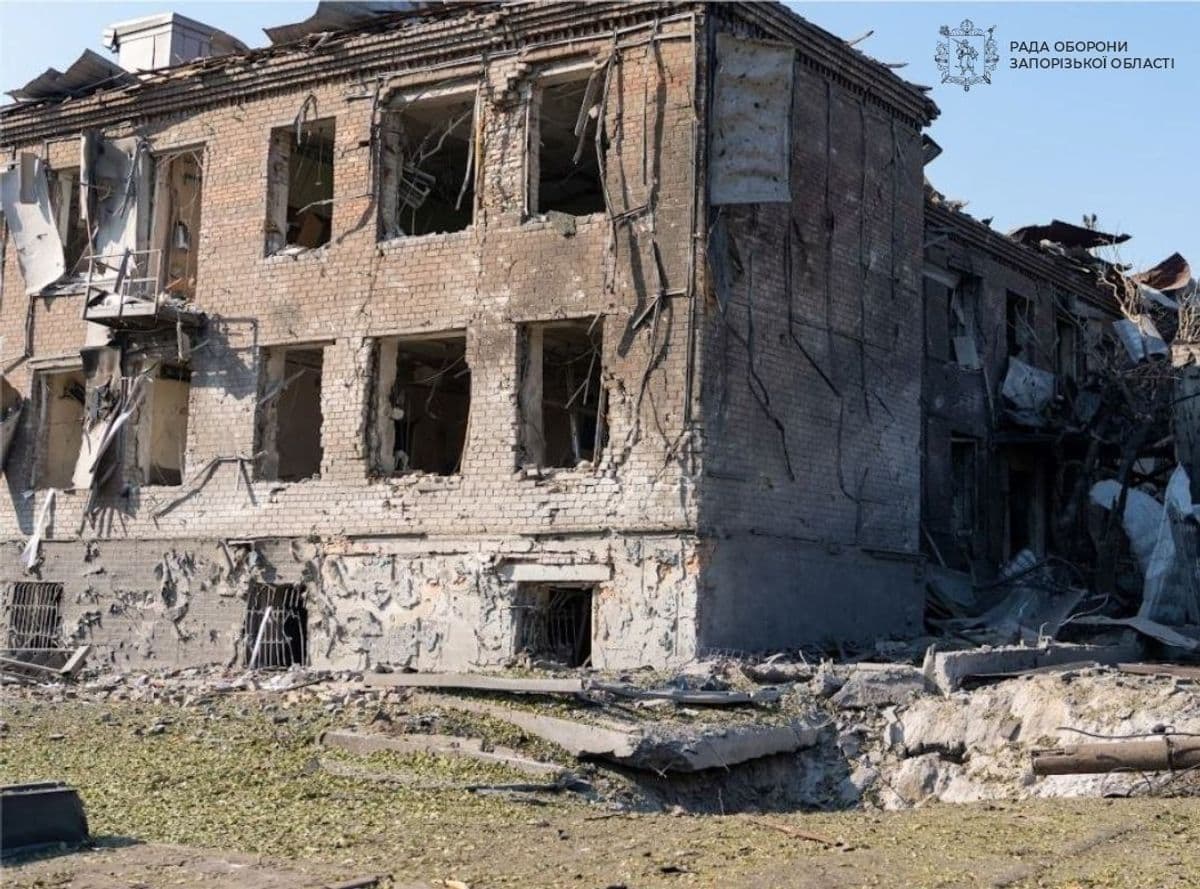
A photo capturing the aftermath of a Russian attack in southeastern Zaporizhzhia Oblast, published. (Co-head of the regional Defense Council Ivan Fedorov / Telegram)
NATIONAL TOLL: 1 KILLED, 56 INJURED ACROSS SEVEN REGIONS
Russian attacks killed at least one person and injured 56 others across Ukraine over the past day, local authorities reported Tuesday, as Russia launched yet another overnight attack on Kyiv that damaged an educational institution and multiple apartment buildings, injuring one person. Ukraine’s Air Force said Russia struck overnight with an Onyx and a Zircon anti-ship missile, two Iskander-M/S-400 ballistic missiles, and 152 attack drones, 82 of them jet-powered; Ukrainian forces downed all three missiles and 106 of the drones.
In Donetsk Oblast, one person was killed and six injured, Governor Vadym Filashkin said. Kharkiv Oblast reported two men, aged 28 and 44, injured. In Zaporizhzhia City and its surroundings, 34 people were wounded, 33 of them in a single Russian strike on an industrial facility on September 28, according to co-head of the regional Defense Council Ivan Fedorov. Kherson Oblast reported two people injured. In Odesa, a September 28 strike on a high-rise residential building injured six people, two of them hospitalized. Sumy Oblast, beyond the school strike, reported five more wounded in separate drone attacks — three men aged 23, 46, and 52, and two women aged 37 and 49. Taken together with the day’s headline strikes in Sumy and Kharkiv, the scattered nationwide toll underscores how routinely Russian violence now spreads across multiple fronts simultaneously, rarely concentrated enough in one place to dominate a single day’s news cycle on its own.
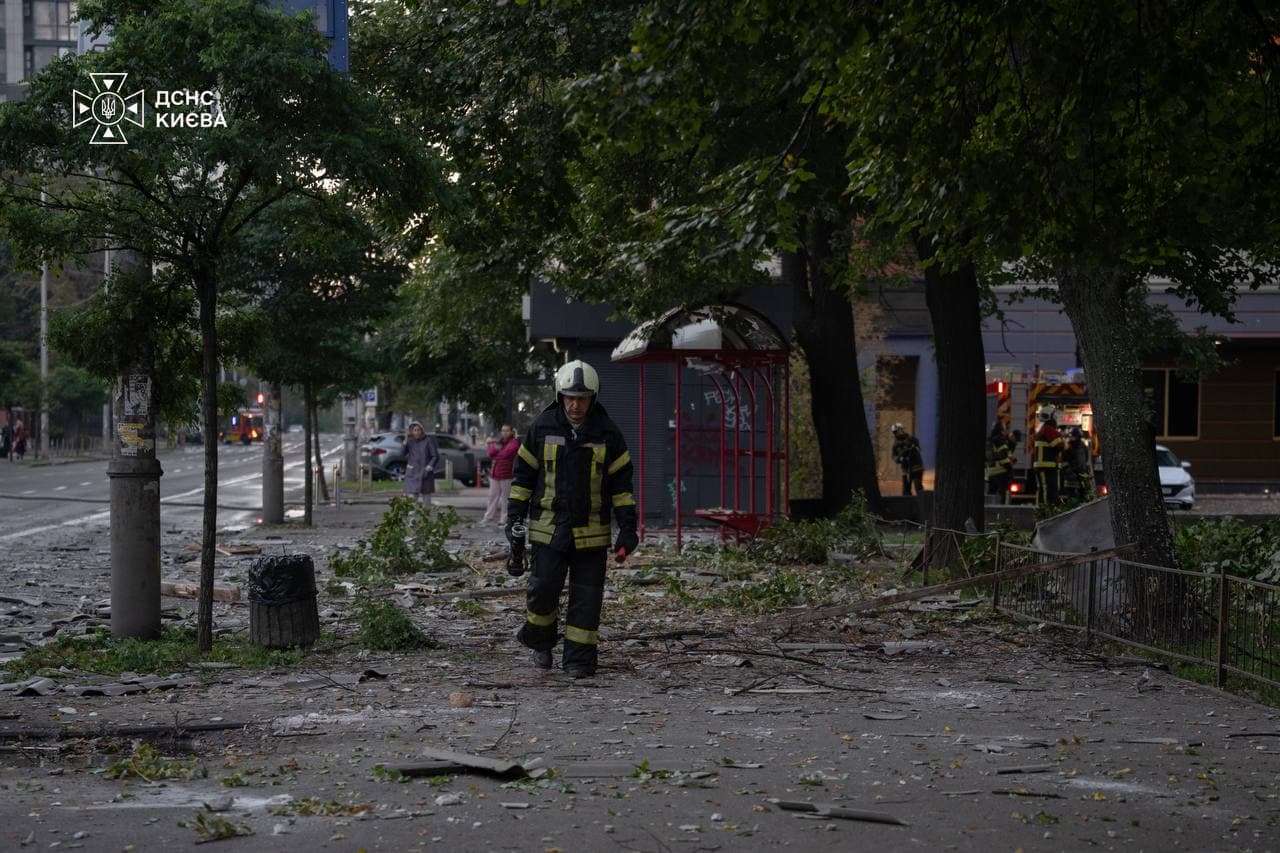
A Ukrainian rescue worker walks down a street following Russia’s overnight attack on Kyiv. (Ukraine’s State Emergency Service)
RUSSIAN SOLDIERS USE CIVILIANS AS HUMAN SHIELDS IN A KUPIANSK PIPELINE
Ukraine’s National Guard 2nd Khartiia Corps released drone footage Tuesday showing Russian troops leading Ukrainian children, elderly residents, and a person on crutches through the Ostrogozhsk-Shebelinka gas pipeline near contested Holubivka village, close to Kupiansk, walking alongside draft-age men in civilian clothes the corps believes are Russian soldiers. The group would have to travel more than 10 kilometers through the pipeline before emerging in a forest, where they’d likely be transferred to Russian-occupied territory; Russian forces reportedly filmed the group throughout. “The occupiers use this gas pipeline to secretly smuggle their assault troops into Kupiansk. Now they are using that same pipeline to abduct civilians,” Khartiia Corps said, adding Ukrainian forces didn’t attack because doing so would have endangered the civilians.
A senior Khartiia officer told the Kyiv Independent the tactic operates on “several layers” — using civilians as cover while crossing open ground without drone protection, abducting children and the elderly outright, and generating propaganda footage — and that Russia has used the same pipeline-smuggling method in Avdiivka and Sumy before Kupiansk. Foreign Minister Andrii Sybiha called for the “grave violations of international humanitarian law” to be documented and prosecuted: “Russia is once again using Ukrainian civilians as instruments of war.” Using civilians as cover in combat and forcibly transferring them are both prohibited under the Geneva Conventions; a Donetsk Oblast Prosecutor’s Office report from November 2025 similarly found a Russian commander had ordered troops in Pokrovsk to use civilians as human shields over radio.
PUTIN’S ARMY CAN’T OUTPACE ITS OWN LOSSES
Icelandic researcher Ragnar Gudmundsson’s tracking data published Tuesday showed Russia suffered some of its highest single-day losses of the entire war this month — 2,090 men on September 28 and 1,960 on September 17 — with total Russian combat deaths since February 2022 probably exceeding 405,000, and total casualties on pace to pass 1.6 million by mid-November. An ISW analysis from September 18 concluded flatly that “the Kremlin will have to change its recruitment practices and likely conduct some form of involuntary reserve call-up in order to sustain its war effort in Ukraine… Russia’s current casualty rate exceeds its recruitment rate by thousands per month.”
Petro Andriushchenko, director of Ukraine’s Center for the Study of Occupation, reported Monday that Russia has “factually begun” shadow mobilization, with recruiters contacting former servicemen in the central Sverdlovsk region to “volunteer” for drone-defense units protecting energy and industrial infrastructure around Yekaterinburg. Recruits need only nine years of schooling, fall between ages 52 and 62 depending on rank, and meet a reduced fitness standard permitting moderate impairments. “Russian authorities specifically emphasize that this is not a military service contract and that reservists will supposedly not be sent to the war against Ukraine,” Andriushchenko’s report noted — before adding that reservists taken in during 2022-2023 under identical assurances were routinely transferred to frontline units anyway.
RUSSIA PLANS A RECORD 17.1 TRILLION RUBLE DEFENSE BUDGET
Russia plans to spend a record 17.1 trillion rubles — roughly $202.6 billion — on defense in 2027, about 27 percent above the previously projected 13.5 trillion rubles and 32 percent above 2026’s allocation, according to government documents reviewed by Reuters and figures cited by the Moscow Times. Defense spending is set to consume around 35 percent of Russia’s total federal budget next year, a post-Soviet record; combined with “National Security” spending covering the Interior Ministry, National Guard, and security services, the total security apparatus will consume 21.4 trillion rubles, or 43.9 percent of all spending. The draft three-year budget allocates 16.6 trillion rubles for 2028 and 16.3 trillion for 2029, showing no sign Moscow expects to scale back after 2027.
The surge comes as Russia’s own fiscal position deteriorates: the 2026 budget deficit is now projected at 3.2 percent of GDP, double the 1.6 percent estimated earlier this year, while the Finance Ministry has cut its 2026 oil-and-gas revenue forecast from 8.9 trillion to 7.6 trillion rubles. To cover the gap, Moscow plans to raise net borrowing 26 percent in 2026 to 5 trillion rubles and 43 percent further in 2027 to 7.7 trillion, pushing state debt to 21.7 percent of GDP — above the 20 percent threshold Russian authorities have previously treated as a safe ceiling. The government is also preparing a windfall tax on mining, metals, and gold companies expected to raise 600 billion rubles over three years, alongside higher taxes on passive income and foreign online purchases. Economist Janis Kluge estimates Russia has already spent roughly $676 billion on the war since 2022 — about 28 percent of current GDP — a total on pace to approach $876 billion by 2027, more than Russia’s entire gold and currency reserves.
OPERATION VIVALDI TAKES 250 PRISONERS AS RUSSIA’S OWN MAPS LIE
Ukraine’s 3rd Army Corps said Monday its counteroffensive near Lyman, underway since August, has captured more than 250 Russian prisoners of war, publishing images of dozens of disarmed Russian personnel under guard in a northern Donetsk Oblast forest. Ukrainian media and Russian military bloggers alike corroborated the corps’ broader claim of 2,500 to 3,000 Russian soldiers killed or seriously wounded in the operation, which capitalized partly on unusually low Russian troop density in the area it targeted. Russian official sources have largely ignored the defeat, continuing to insist Kremlin forces are advancing regardless.
Separately, French researcher Clément Molin’s analysis comparing Russia’s claimed territorial gains against independently verified control found that for much of 2026, Russia “barely advanced in Ukraine but continued to update their official maps and claims,” producing a gap exceeding 5,000 square kilometers between Russian propaganda and actual battlefield reality — an area roughly the size of England’s Northumberland county or France’s Bouches-du-Rhône department. Separately, Ukrainian troops carried out the world’s first known logistics mission using a domestically developed amphibious unmanned ground vehicle, traveling more than 40 kilometers across both land and water to resupply frontline positions, while the 3rd Army Corps also deployed strike UGVs armed with grenade launchers directly against Russian shelters for the first time during the Vivaldi operation.
ESTONIA BLAMES RUSSIA FOR SABOTAGE, RUTTE URGES CALM
Estonian Foreign Minister Margus Tsahkna accused Russia’s special services of ordering an August arson attack on defense firm Milrem Robotics in Tallinn, writing that investigators “can conclude with certainty” the attack was state-sponsored sabotage; the Kremlin dismissed the accusation as “baseless” and lacking “any form of reasoning.” Tsahkna said the perpetrators had been apprehended and no longer posed a threat, and that Estonia had summoned the Russian ambassador. Lithuania’s foreign minister said “Russia’s fingerprints are all over” the attack, while Latvia’s president called for more support for Ukraine and Sweden’s prime minister called the attribution “directed against Europe as a whole.”
NATO Secretary General Mark Rutte, addressing the incident and a broader pattern of European sabotage, urged member states toward “calm, carry on and support Ukraine” rather than alarm. “Russia continues its reckless campaign of hostile actions against NATO allies… But Russia is failing. It is failing on the battlefield in Ukraine and it is failing to undermine our unity,” he said, while acknowledging the sabotage campaign “can have an impact — and sometimes they have an impact, clearly.” Lithuania’s prime minister, speaking alongside Rutte, said intelligence services had no proof Russia was imminently preparing anything larger, describing the risk level as elevated but not currently fluctuating.
KRYVYI RIH’S STEEL PLANTS GO SILENT
Zelensky’s hometown of Kryvyi Rih is cutting its municipal budget and postponing development projects after repeated Russian strikes idled the city’s major industrial employers, defense council head Oleksandr Vilkul said. ArcelorMittal’s Kryvyi Rih operations, along with the Inhulets and Southern mining plants and the Kryvyi Rih Iron Ore Plant, are all currently idle, with other major businesses producing at no more than a quarter of prewar levels. ArcelorMittal confirmed last week it cannot safely restart operations after its facilities were hit four times in five weeks, most recently September 21, killing five employees and injuring 17 with extensive damage to production infrastructure.
Vilkul said industrial taxes fund public-sector wages, infrastructure maintenance, and social services, calling next year’s budget outlook poor, though he declined to specify planned cuts. “This isn’t about development. It’s about survival. Right now, we have to survive,” he said, prioritizing schools, hospitals, water supply, and heating over other spending. The city’s water and heating utilities currently have roughly 1,000 combined vacancies as displaced industrial workers seek new employment, with municipal companies now tasked with helping place them. Kryvyi Rih’s struggles mirror a broader pattern spreading across Ukraine’s industrial heartland, where repeated targeting of large employers ripples outward into municipal budgets never designed to absorb this scale of simultaneous economic and physical destruction.
RUSSIA REJECTS A BLACK SEA GRAIN TRUCE AS EXPORTS HIT HISTORIC LOWS
Countries attempting to mediate between Kyiv and Moscow told Ukraine that Russia has rejected every option discussed for a new Black Sea grain arrangement, Agriculture Minister Taras Vysotskyi told Bloomberg. “All possible rounds of negotiations have been tried, but without success,” he said, adding no truce appears likely in the coming months and that Ukraine must “prepare for the situation to remain as critical as it is now.” Ukrainian agricultural exports fell to just 1.13 million tons in August, down from 2.6 million tons a year earlier — the lowest figure since April 2022, when Russian naval forces had the Black Sea fully blockaded. Roughly 30 million tons of Ukrainian agricultural products are expected to go unexported this season, Vysotskyi said, since alternative routes can handle only about half of traditional volumes.
Russia faces its own export collapse: combined Russian and Ukrainian wheat exports have fallen to roughly 2.7 million tons, 60 percent below last year and the lowest since 2010-11, as Ukrainian strikes on Azov and Black Sea ports — through which 80 percent of Russian grain exports pass — have damaged terminals and more than 100 vessels since July. Russian grain exports specifically fell to a 16-year low in August and September, prompting Putin to order state purchases of 1 to 3 million tons of grain to support struggling farmers ahead of the next planting season, after Communist Party leader Gennady Zyuganov warned of risk to the harvest without intervention.
EU PRESSES UKRAINE ON REFORMS AHEAD OF OCTOBER SUMMIT
An early draft of conclusions for the EU’s October 15-16 summit calls on all parties, “notably Ukraine,” to accelerate reforms needed to unlock the remaining €30 billion of this year’s €45 billion Ukraine Support Loan allocation, of which only €14.9 billion has been disbursed so far, according to a draft reviewed by Rapporteur. The document cites Ukrainian parliament’s failure to adopt anti-corruption and tax measures Brussels has requested. A European Commission spokesperson said Monday that financing and reform must advance together to support Ukraine’s resilience and EU accession path.
The pressure lands as Ukraine confronts a $27 billion funding gap and has separately asked the EU to front-load loan disbursements so Kyiv can place drone orders this autumn. Finance Minister Serhiy Marchenko, speaking at a European Policy Centre event, questioned whether Ukrainians should face higher taxes now, citing the strain Russian strikes and disrupted trade have already placed on households and businesses. Among the reforms Brussels considers at risk are a proposed 20 percent VAT on cross-border e-commerce parcels under €150, expected to raise roughly $224 million annually; lawmakers initially rejected the measure September 1 before passing it in first reading nearly two weeks later, alongside simplified insolvency procedures for small and medium enterprises. It still needs a second reading and Zelensky’s signature.
TATAROV’S ASSOCIATES TIED TO $1 MILLION IN KYIV APARTMENTS
Investigative outlet Bihus.info reported Monday that two alleged associates of Oleh Tatarov, deputy head of Ukraine’s Presidential Office responsible for law enforcement, have acquired 11 apartments worth over $1 million in two troubled Kyiv developments allegedly involving fraud schemes. The apartments, registered to business partners of Italian businessman Nicola Mirto — himself an associate of Tatarov and former client of his law firm — sit in the Perlyna Nyvok and Akvamaryn complexes, both of which went through bankruptcy, stalled construction, and alleged fraudulent resale schemes; both developments had also promised apartments to state bodies including the SBU and National Bank that were never fully delivered.
Tatarov, one of Ukraine’s most controversial officials, was charged with bribery in 2020 over the separate Aristocrat development project, a case investigators say was effectively buried when the Prosecutor General’s office transferred it from the more independent NABU to the more pliable SBU before it was closed in 2022. Former Ukrbud CEO Oleh Maiboroda alleged in a 2023 Reuters interview that Tatarov served as an intermediary in bribing state officials between 2014 and 2019; Maiboroda has since fled Ukraine to escape his own prosecution. Tatarov has denied wrongdoing and hasn’t yet responded to the Kyiv Independent’s request for comment on the newest findings.
A CHILDREN’S PLEDGE, IRAN SANCTIONS, AND A NORD STREAM ASYLUM BID
Fifty countries and four international organizations, including Austria, Denmark, Hungary, Japan, and the UK, signed the Toronto Pledge Tuesday calling for the return of Ukrainian prisoners of war, unlawfully detained civilians, and abducted children, explicitly condemning Russia’s “militarization” of Ukrainian children in occupied territory. Norwegian State Secretary Eivind Vad Petersson called Russia’s treatment of Ukrainians “a systemic challenge” rather than coincidence, while Canadian Foreign Minister Anita Anand said new technology, including AI, and cooperation with third countries remain necessary to close persistent gaps in the effort to bring people home.
Separately, the US Treasury sanctioned 13 individuals and entities in Russia, Hong Kong, China, and Pakistan under “Operation Economic Outcast,” targeting Russian firms including MG-Flot LLC, which transports weapons for Russia’s Defense Ministry, and aircraft manufacturer JSC Yakovlev Design Bureau, over their role helping Iran procure weapons amid its ongoing war with the US. And a Ukrainian suspect in Germany’s Nord Stream sabotage investigation, diver Volodymyr Zhuravliov, requested political asylum in Croatia after a Croatian court authorized his extradition to Germany on September 18; his lawyer argued he “would not receive a fair trial” there. A Polish court had previously refused to extradite Zhuravliov in 2025, ruling the sabotage could be considered justifiable given Ukraine’s defense against Russia.
MEANWHILE, AT THE FRONT
Belgium confirmed it will transfer three F-16 fighter jets to Ukraine by the end of the year, with Zelensky thanking Prime Minister Bart de Wever and noting Ukraine has already received urgent F-16 ammunition deliveries from both Belgium and Spain. The pledge adds to Ukraine’s growing but still limited fleet of Western fighters as jet-powered Russian drone volumes continue climbing. Separately, Belarusian dictator Alexander Lukashenko proposed the US join a nitrogen fertilizer plant venture with Russian state gas giant Gazprom, telling a Russian regional governor in Minsk “we should make an offer to the Americans… if not, we will build it with Gazprom and the Russians and sell the finished product.” The pitch follows Trump’s September 21 comments about a “massive deal” for Belarusian potash, hopes Lukashenko dampened the next day by saying Belarus simply lacks the volumes Trump wants.
Along the front itself, Russian forces continued probing multiple sectors without confirmed major advances, while Ukrainian forces maintained pressure through Operation Vivaldi and sustained intermediate-range strikes against Russian logistics. The Kremlin’s own battlefield claims kept diverging sharply from what independent tracking could confirm, continuing a pattern that’s defined most of the war’s fifth year: Russian maps updated regardless of what troops on the ground actually control. Ukrainian officials say documenting that gap consistently, strike by strike and claim by claim, remains essential to countering a Kremlin propaganda apparatus that depends on outside observers simply accepting its version of events without independent verification.
A SCHOOL STRUCK, AN ARMY OUTPACING ITSELF, A PIPELINE FULL OF HOSTAGES
By nightfall, today’s threads pulled toward the same uneasy pattern this war keeps sustaining: violence calibrated for maximum reach, met by a Kremlin still pouring resources into a war machine that’s consuming itself faster than it can be rebuilt. A school in Sumy absorbed four guided bombs during class hours. Saltivka’s rescue crews worked more than a day to pull thirty-two people from rubble.
Russia signed off on its largest defense budget on record while its own researchers’ data shows the army bleeding out faster than recruiters can replace it. Ukrainian soldiers took 250 prisoners near Lyman while Russian maps kept claiming ground nobody actually holds. And near Kupiansk, a man on crutches walked through a pipeline tonight because Russian soldiers needed cover and had no better idea than to use him as some. Nothing today ended. Everything today measured how much further this war can still stretch before either side’s capacity to sustain it runs out.
A PRAYER FOR UKRAINE
1. For the Two Lost in Sumy’s School Strike
Lord, two people died today near a school where children were in class when the bombs fell. We give thanks that quick teachers kept the toll from being far worse, and we grieve the two lives still lost. Comfort the six injured, including three children now carrying this day in ways no classroom lesson prepared them for, and protect every school still holding class within reach of the front.
2. For Saltivka’s Wounded and the Crews Who Dug for a Day
Father, forty-eight people were hurt in Kharkiv’s Saltivka district, and rescue crews spent more than a full day pulling thirty-two of them from rubble. We grieve a neighborhood that keeps absorbing this same violence, and we give thanks for every rescuer who kept digging past exhaustion. Heal the wounded fully, and give this district some measure of the peace it keeps being denied.
3. For Every Civilian Forced to Walk Through Danger
Lord of the vulnerable, we lift up the children, elders, and disabled residents marched through a pipeline today as cover for a retreating army. We grieve dignity stolen for pure military convenience. Protect them on whatever road comes next, and give the world clarity to call this exactly what it is: a war crime committed against people who had no say in any of it.
4. For Kryvyi Rih and Every City Losing Its Livelihood
God of provision, we pray for Zelensky’s hometown and every city watching its factories go silent under sustained attack. Give displaced workers new paths forward, and give local leaders wisdom to protect what matters most — schools, hospitals, water, and heat — when almost everything else must wait its turn. Let survival hold until rebuilding becomes genuinely possible again, for every family counting on it.
5. For an End Before Either Side’s Capacity Runs Out
God of peace, we pray that this war ends through justice rather than simple exhaustion, before either side’s capacity to sustain it collapses into something even more desperate. Give Ukraine’s allies the resolve to match pressure with real consequences, not just statements, and give Russia’s own leadership a conscience that arrives before the cost, on every side, grows even higher.
In Your mercy, in Your justice, in Your time — bring this war to its end, and let the ending be worthy of what Ukraine has endured.