
October 8, 2026
Prepared by Diana Bozhyk
A Russian guided bomb struck two passenger buses in Kramatorsk this morning, killing at least 33 people, while drones circling overhead repeatedly forced rescuers to take cover. A strike on an energy facility serving Kyiv cut power across most of the capital, halted the metro, and disrupted water supply, as Ukrainian drones hit refineries in Salavat and Omsk and set a Yandex data center ablaze. Zelensky toured the ruins of Pryluky with British Foreign Secretary Ed Miliband, who pledged £54 million for winter, and announced talks with Trump’s envoys in the United States after Marco Rubio called a negotiated end to the war unattainable.
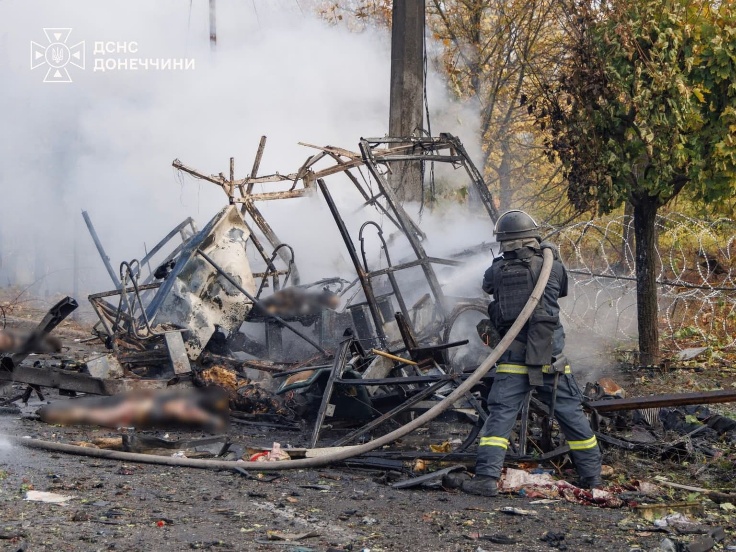
An emergency service worker extinguishes a fire on the remains of a bus following a Russian glide bomb attack on Kramatorsk in Ukraine. (Telegram/DSNS)
THE DAY’S RECKONING
The bomb fell on Yuvileina Street in Kramatorsk at about 10 a.m., where two buses were carrying passengers through the city. Within hours the toll stood at 30, then 33, and some of the dead could not be identified. Authorities stopped all public transport in Kramatorsk and Sloviansk. In Kyiv, a morning of drone strikes killed four people and an attack on the grid left most neighborhoods without electricity, the metro still, and taps on the right bank running dry.
Zelensky spent part of the day in Pryluky, where rescuers had finished recovering the dead from the day before. He said Russian attacks had killed 78 people and wounded 215 in recent days. Ukraine answered with strikes on two refineries more than 1,300 kilometers from the border. In Washington, the secretary of state said peace talks could not succeed while Russia demands all of Donetsk Oblast; Zelensky replied that Ukraine was not at an impasse and sent his negotiators to the United States.
KRAMATORSK: A GUIDED BOMB ON TWO PASSENGER BUSES
A Russian guided aerial bomb hit two passenger buses on Yuvileina Street in Kramatorsk at around 10 a.m. Donetsk Oblast Governor Vadym Filashkin first reported 30 killed and 18 wounded. The State Emergency Service (DSNS) later put the death toll at 33, and Filashkin raised the number of injured to 22; Kyiv Post’s later reporting cited 33 dead and 18 wounded. Fires broke out in at least two buses.
Zelensky said doctors were still fighting for the lives of some of the wounded and that the toll could rise. Two of the dead could not yet be identified because of the severity of their injuries. “This strike will not go without our response. Russia is trying to destroy all life in Donbas, and the world needs to react to this,” he said. The DSNS said Russian drones constantly circled over the site, repeatedly interrupting rescuers and forcing them to take cover, ISW reported.
“The Russians are deliberately targeting civilians. For them, a bus full of passengers is an attractive target precisely because a single strike can kill as many people as possible,” Filashkin wrote. He ordered the Kramatorsk and Sloviansk city military administrations to suspend all public transport, saying authorities had no right to risk the lives of passengers and drivers.
It was not the first attack on public transport in the city. On Oct. 2, a Russian FPV drone hit a passenger bus in Kramatorsk, injuring two people, and on Sept. 13 a strike on a vehicle in the city center killed two and injured four. ISW said Russia has intensified glide bomb strikes on Kramatorsk and other Fortress Belt cities and assessed that strikes causing mass casualties may also be meant to push civilians to leave ahead of planned Russian attacks.
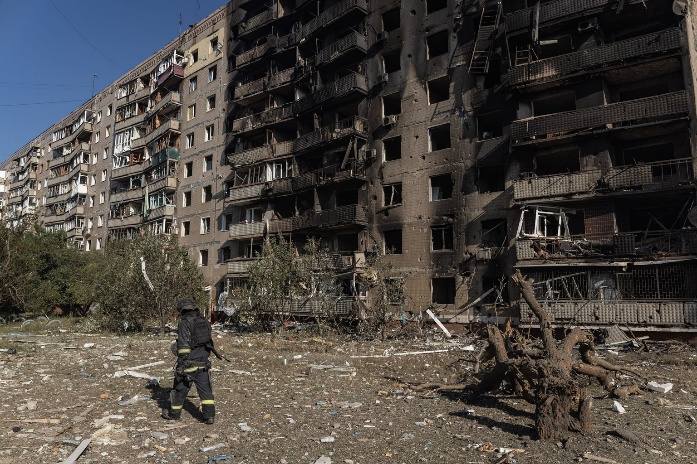
A Ukrainian firefighter walks past a burnt-out and damaged building following several Russian attacks on a residential area, in Kramatorsk, Donetsk Oblast, Ukraine. (Diego Herrera Carcedo / Anadolu via Getty Images)
ACROSS UKRAINE: 142 DRONES AND A GUARD KILLED IN IVANO-FRANKIVSK
Russia launched 142 drones overnight, including 82 jet-powered Shahed-type models, alongside Gerbera strike drones and Parodiya decoys, from the directions of Oryol, Kursk, Shatalovo, occupied Donetsk, and occupied Hvardiiske in Crimea, the Air Force said. Air defenses downed or suppressed 126. Drones struck seven locations, and debris fell at four.
Before the Kramatorsk strike, Russian attacks in Donetsk Oblast had killed four people and injured six over the previous day, Filashkin said. Two died in Zelene, one in Sloviansk, where three were also injured and a high-rise, a shop, a gas station, and a bus were damaged, and one in Veselia Hora. One person was injured in Zoloti Prudy and one in Druzhkivka. Russian forces shelled the oblast 31 times, and 256 people, including 32 children, were evacuated from the front line.
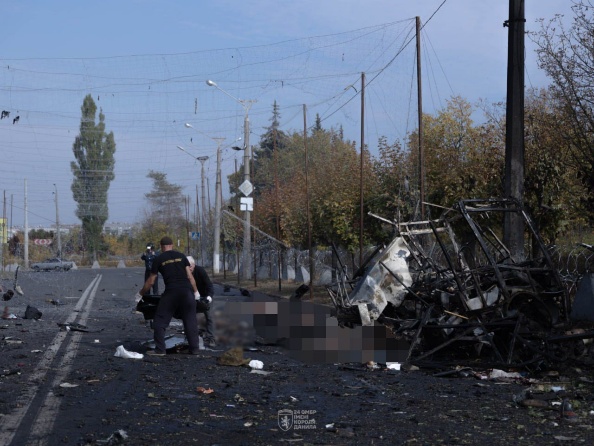
Emergency service workers work at the site of a Russian strike in Kramatorsk, Donetsk Oblast, Ukraine. (Kostiantyn Melnykov / 24th Separate Mechanized Brigade)
In Sumy Oblast, Russian drones injured four people: a 46-year-old woman and men aged 69 and 49 in Sumy, and a 62-year-old man in the Velykopysarivska community. In Kharkiv Oblast, three people were injured: a 67-year-old woman in Kharkiv, a 62-year-old man in Derhachi, and a 70-year-old woman in Dobrenka. In Kherson Oblast, attacks injured five people and damaged a high-rise, four houses, and cars, Governor Oleksandr Prokudin said. In Zaporizhzhia Oblast, three people were injured and authorities received 84 reports of damage. In Odesa Oblast, an attack damaged a parking lot and an animal shelter, killing one animal, Governor Oleh Kiper said. Damage was also reported in Dnipropetrovsk and Rivne oblasts.
Late in the evening, a Russian Shahed attacked Ivano-Frankivsk in western Ukraine. Fragments struck an outbuilding and started a fire, killing a civilian security guard born in 1959, Mayor Ruslan Martsinkiv and regional administration head Svitlana Onyshchuk said. “There is no safe city in Ukraine,” Martsinkiv said.
KYIV: FOUR KILLED IN A MORNING OF DRONE STRIKES
Russian drone strikes killed four people and injured at least 19 in Kyiv, Mayor Vitali Klitschko said. Morning attacks on the capital first killed one person and injured 11. A drone then struck a four-story commercial building in the Solomianskyi district, killing two people, injuring two, and starting a fire, while wreckage from another drone fell in Holosiivskyi. A fourth person died of injuries in hospital, the Kyiv City Military Administration said in the afternoon. By evening, Klitschko put the number injured at 19, of whom 13 were hospitalized. A further strike was reported in the Shevchenkivskyi district, and emergency services were sent to the scene.
In Kyiv Oblast, the DSNS said a drone strike set fire to a logistics facility in Bucha district. In Sviatopetrivske, a school-kindergarten and a playground in a residential complex were damaged, and in another settlement in the district a woman was injured and hospitalized, Governor Tymur Tkachenko said. Overnight, three people were injured across the oblast, two in Bucha district and one in Brovary district, and three warehouses, an infrastructure facility, a private house, and four vehicles were damaged.
The capital has been under repeated drone attack for days, and the strikes came as Russia targeted the energy system around the city. The Kyiv Oblast Military Administration said Russia has significantly intensified attacks on energy infrastructure in recent weeks, hitting power lines and transformers and disrupting electricity transmission to consumers. Energy workers are operating around the clock to repair damaged equipment, the administration said.
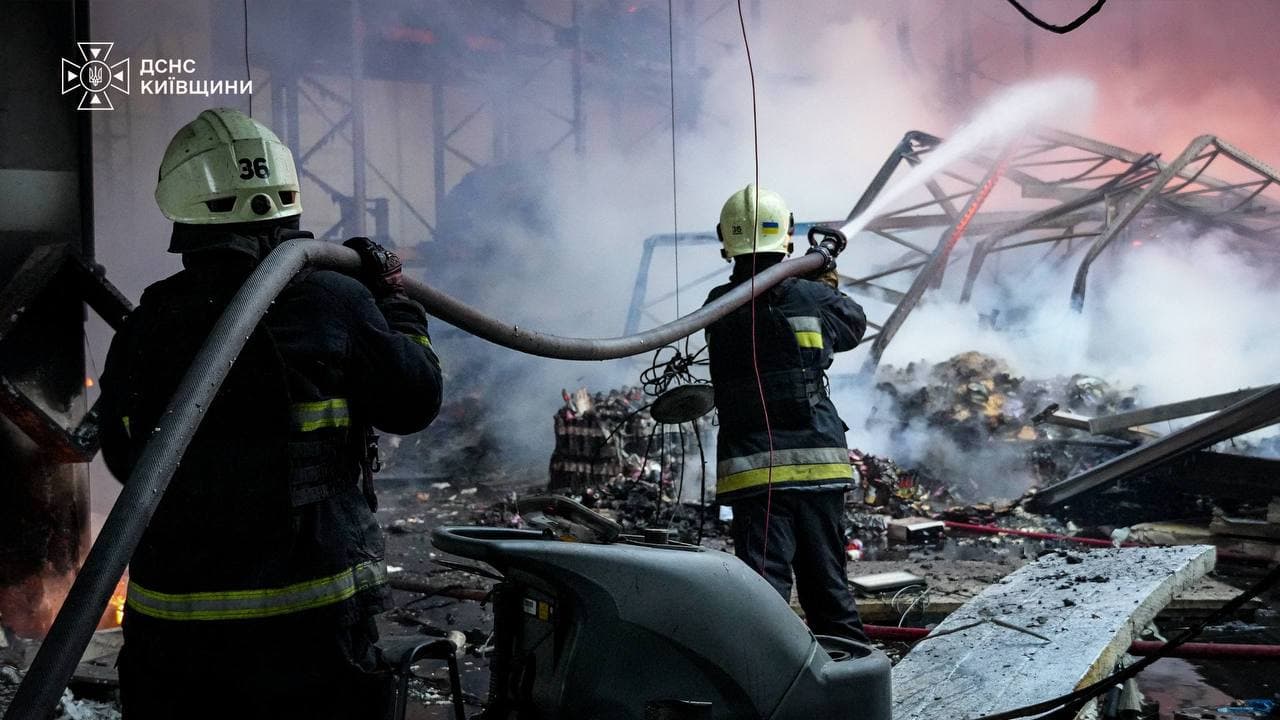
Emergency services fight a fire at a logistics facility in the Buchanskyi district in Kyiv Oblast after a Russian attack. (Telegram/DSNS Kyiv)
KYIV GOES DARK: METRO HALTED, WATER PRESSURE FALLS
“There was an attack on one of the energy facilities important for the city of Kyiv,” Energy Minister Denys Shmyhal said. “Energy workers are doing everything possible to restore electricity as quickly as possible.” Through the day, most neighborhoods lost power. Kyiv Independent reporters saw outages in Podil, Pechersk, Solomianskyi, and on the left bank, and the sound of generators returned as businesses tried to keep operating.
The drop in voltage halted Kyiv Metro trains and escalators, the city administration said, and other public transport was affected. The administration warned that lower voltage had reduced pressure in the water network on the right bank, particularly in the Holosiivskyi, Sviatoshynskyi, Solomianskyi, and Shevchenkivskyi districts. Pumping equipment was reactivated by 9 p.m., but officials said it would take “some time” to restore normal pressure.
DTEK announced emergency outages in the Brovary, Bucha, Vyshhorod, and Boryspil districts of Kyiv Oblast, and Kyiv Post reported that the day’s power schedules lasted up to 12 hours. As of 12:30 a.m. Friday, areas on the left bank were still without power, while electricity had returned to parts of the right bank. Ukrenergo said consumption limits would apply in some regions the next day, and DTEK introduced emergency cuts on the right bank and in Bucha and Vyshhorod districts on Ukrenergo’s orders.
Speaking at the Moldova Security Forum in Chisinau, Prime Minister Serhii Koretsky said Ukraine is better prepared for winter than last year but warned that Russia has strengthened its capabilities by stockpiling jet-powered drones and missiles. At the same forum, Moldovan President Maia Sandu said her country is ready to take in more Ukrainian refugees. “If this winter in Ukraine is as difficult as the whole world expects, we are ready to receive as many people as need safety,” she said.
ZELENSKY AND MILIBAND IN PRYLUKY
Zelensky visited Pryluky with British Foreign Secretary Ed Miliband and Foreign Minister Andrii Sybiha, meeting survivors and emergency workers at the site of Wednesday’s missile strike. He said the rescue operation at the destroyed five-story building had ended: 22 people were killed, including five children, and 54 injured. Seventeen people remained in hospital, including a five-year-old girl. More than 100 residential buildings were damaged across the city, along with schools, kindergartens, shops, and businesses.
“We must support our people,” Zelensky said, pointing to a veteran who had lived in the destroyed building. “When partners are literally standing alongside Ukrainians, it truly matters.” Residents told him about shortages of shelters and housing. He ordered the head of the Chernihiv Regional Military Administration to quickly help those with nowhere to live, saying temporary help must be followed by permanent solutions: “It is also important that the victims ultimately receive new housing.” He put the head of the State Emergency Service in charge of letting residents back into their apartments once it is safe.
After the health minister briefed him on building shelters at medical facilities, Zelensky ordered the work accelerated and additional funding found. The hospital’s own shelter is to be repaired as a priority while a new, modern one is built, and the interior minister was tasked with inspecting every shelter in the city.
Zelensky said Russian attacks on Pryluky, Kramatorsk, Kyiv, and other cities had killed 78 people and injured 215 in recent days, calling it “terror directed against people and life.” He thanked partners who condemned the attacks but said statements must be followed by defense packages, naming weapons to intercept ballistic missiles, ammunition for combat aircraft, and investment in drone interceptors as immediate needs.
LONDON PLEDGES £54 MILLION AND 38 NEW SANCTIONS
Miliband, on his first visit to Ukraine as foreign secretary, announced £54 million in winter energy and humanitarian assistance. Of that, £20 million will fund emergency repairs to the power grid, backup generators, and solar power, and £34 million will go to heating and water systems, including direct cash assistance, delivered with partners such as UNICEF, the UN Refugee Agency, and the Ukrainian Red Cross. Britain pledged a further £6 million for the pursuit of justice for Russian war crimes. “Five winters on, the people of Ukraine are still living under constant threat of Russian strikes, energy blackouts and death,” Miliband said. “My message to Putin is clear – You cannot wait us out. Until you choose the path of peace, the U.K. will not relent in its support for Ukraine, our values, or our national security. You will remain a pariah.”
Britain also published 38 new sanctions listings, which Kyiv Post put at around 40, targeting Russia’s financial, oil, energy, technology, and cryptocurrency sectors. They include three cryptocurrency exchanges and two payment platforms linked to the “A7” network at the heart of Moscow’s efforts to evade financial sanctions, the oil companies Zarubezhneft and INK Capital, and 12 more shadow-fleet tankers. “The message is simple: if you help Russia fund or equip this war, you will face the consequences,” the government said. Britain has now sanctioned 645 ships and 3,537 targets in total, and says more than 90 percent of Russia’s oil production capacity is covered.
Sybiha said the meeting coincided with the sixth anniversary of the Ukraine-UK Agreement on Political Cooperation, Free Trade and Strategic Partnership. The two sides launched the second meeting of the Political Pillar of their Strategic Partnership Dialogue. He put total British support at £25 billion, including £16 billion in military aid.
NEGOTIATORS HEAD TO THE U.S. AS RUBIO CALLS PEACE UNATTAINABLE
Ending the war through negotiations is currently unattainable, Secretary of State Marco Rubio told Greek newspaper Kathimerini, because Russia insists on gaining full control of Donetsk Oblast without fighting, a demand Kyiv rejects. A day earlier, Russian Deputy Foreign Minister Sergey Ryabkov said there were no plans for U.S.-mediated talks.
Zelensky pushed back. “You can’t, on the one hand, negotiate with Russia about future economic projects, and on the other, talk about a diplomatic impasse,” he said. “We are not in a diplomatic impasse. Shut down (Russia’s) entire economy. Silence Russia. Don’t feed them with your sales; impose sanctions on their weapons.” He said Trump “can and should” do more to push Putin toward talks.
Zelensky said a Ukrainian delegation will meet U.S. envoys Steve Witkoff and Jared Kushner in the United States on Friday and Saturday to discuss proposals for an energy and Black Sea ceasefire. “Meetings are expected to take place over two days, and we are counting on a European team to join our negotiating group and the American negotiating group,” he said. Head of the Presidential Office Kyrylo Budanov said he was on his way. “Peace is not achieved through loud statements – it requires hard work together,” he said. Ukrainska Pravda and RBC-Ukraine reported that Rustem Umerov, Davyd Arakhamia, and First Deputy Foreign Minister Serhiy Kyslytsya would also attend; an unnamed source told RBC-Ukraine that talks could prepare a trilateral meeting in the second half of October, which has not been confirmed.
Zelensky also spoke with European Council President António Costa, thanking him for the €1.2 billion defense tranche, and discussed the timeline for opening new accession clusters, and a winter energy package ahead of the Oct. 15-16 summit. They agreed to meet in a trilateral format with Commission President Ursula von der Leyen.
REUTERS: KUSHNER AND DMITRIEV DISCUSSED NORD STREAM
U.S. and Russian officials have discussed bringing an American investor into the Nord Stream gas pipelines, Reuters reported, citing five people familiar with the matter, including a White House official. The talks involved Kushner and Kirill Dmitriev, head of the Russian Direct Investment Fund and a close adviser to Putin. Kushner reportedly sees business deals as key to securing a settlement; a deal would let American investors profit from gas flowing to Europe once an unconditional ceasefire is reached.
“Any deals will have to be negotiated by Russia with DFC and Treasury and must benefit United States taxpayers and companies,” a White House official told Reuters, adding that there had been “no Nord Stream discussions recently.” Two sources said the issue was still on the table, and it was unclear how much of the meetings focused on the pipelines. One U.S. official said a deal was unlikely in the medium term. Dmitriev’s representative declined to comment.
Both pipelines are under U.S. and EU sanctions, which would make any deal practically illegal; Trump can waive U.S. sanctions, but that could become harder if Democrats win Congress in November. A spokeswoman for Germany’s Economy and Energy Ministry told Reuters that Berlin has found other suppliers and that reopening the pipelines would require German government approval, which it has no wish to give. Germany once relied on the pipelines for more than half of its gas imports. Dmitriev, who met U.S. Energy and Treasury officials last month to explore energy projects, has long lobbied for Russian gas sales to Germany to resume.
Asked what economic deals Washington and Moscow were discussing, Zelensky said Ukraine knows a lot. “We know a lot… about various dialogues, but I am simply not ready to talk about them publicly and in detail,” he said, according to Ukrinform.
DRONES HIT REFINERIES IN SALAVAT AND OMSK
Ukrainian forces struck two Russian oil refineries with a combined processing capacity of 31 million tons a year, the General Staff said. The Gazprom Neftekhim Salavat refinery in Bashkortostan, roughly 1,300 kilometers from the border, caught fire after an overnight strike, with images showing thick smoke over the plant. The General Staff described it as one of Russia’s largest refining and petrochemical complexes, processing up to 10 million tons of feedstock a year and producing gasoline, diesel, fuel oil, bitumen, and polyethylene.
The General Staff also confirmed a strike on the Omsk refinery, Russia’s largest, which processes more than 21 million tons of crude a year and lies roughly 2,450 kilometers from the border. Drone maker Fire Point said the refinery was hit with its FP-1 long-range drones, and videos from local residents showed explosions and smoke. Omsk Oblast Governor Vitaly Khotsenko confirmed a drone attack on the region. Ukraine previously struck the Omsk refinery on July 6, damaging a primary processing unit. “The destruction of such facilities is the exercise by Ukraine of its inalienable right to self-defense in accordance with Article 51 of the UN Charter,” the General Staff said.
The General Staff further reported that Ukrainian forces struck a Russian mesh network repeater in the Black Sea. ISW said such repeaters extend the range at which Russian operators can control strike drones and allow more accurate attacks on Odesa Oblast, Ukraine’s border crossings with Moldova and Romania, and shipping in the western Black Sea. In the Kherson direction, the State Border Service said Ukrainian forces struck a Russian heavy equipment storage area, destroying a T-72 tank, a Tigr armored vehicle, a fuel tanker, and two D-30 howitzers.
A YANDEX DATA CENTER BURNS; ZELENSKY: “WE RESPONDED”
Geolocated footage showed a fire at the Yandex data center in Sasovo, Ryazan Oblast, roughly 530 kilometers from the border, and satellite imagery showed fire damage to the part of the building that houses it, ISW reported. Yandex said a Ukrainian drone strike caused the fire, suspending operations and causing outages in its services, according to ISW. The Kyiv Independent reported disruptions for several banking services, Google, RuTube, and the Russian Railways website, and Russian business outlet RBK reported temporary outages for users of several major media outlets.
The data center shares a building with the Sasta machine-tool plant, which is under U.K. sanctions for its role in Russia’s defense industry, Militarnyi reported. A Ukrainian OSINT channel said the facility has a capacity of up to 12 megawatts and houses tens of thousands of servers, and Yandex reported in 2021 that two of the supercomputers Russia uses to train neural networks with Western processors were located there. ISW said Western export controls may prevent Yandex from quickly replacing damaged advanced chips.
Asked about the attack, Zelensky told reporters: “We responded to them. I cannot share all the details.” He said Ukraine would keep retaliating for Russian strikes on its data centers. “We certainly are capable. We always respond in kind. Regarding data centers, as you all know, they have been and still are striking our data centers.” Russian strikes on Ukrainian data centers and internet providers in late September disrupted service for around 100,000 households, officials said.
Zelensky added that Ukraine’s response would not mirror Russia’s attacks on civilians. “Let me tell you frankly: Ukraine certainly, most certainly, does not retaliate against children,” he said. “It does not. And it never will. But certain adults will soon receive a response.”
SOCHI REOPENS BEACHES AS IRKUTSK LIFTS ITS QUARANTINE
Authorities in Sochi said the oil tanker set ablaze by Ukrainian drones on Tuesday poses no threat, and beaches closed as a precaution were reopened. Dmitry Plishkin, head of the Sirius region, said local waters and beaches had received a clean bill of environmental health. A day earlier, Sochi Mayor Andrey Proshunin said the fire on the tanker had been put out, no oil pollution had been recorded, and the vessel was drifting along the coast.
Kyiv Post identified the ship as the Liberia-flagged Aframax Rio, a 246-meter, 107,113-ton tanker built in 2004 and sanctioned by Ukraine as part of Russia’s shadow fleet; earlier reports had named it the Aframax Rea. It was hit about 15 nautical miles off Sochi, and NASA fire data showed fires near the ship for more than 24 hours. Local outlet Sochi Radar said it was fully loaded and that burning oil on the water kept firefighters away. Its declared operator, Singapore-based Executive Ships Management, said all 23 crew members were safe ashore. Zelensky said in his Wednesday address that Ukrainian forces had badly damaged a tanker in the Black Sea, without naming it.
In Siberia, the quarantine in Irkutsk Oblast was lifted, Russian state media reported, after the death on Oct. 2 of Darya Shipilova, a 28-year-old technician at the Anti-Plague Institute of Eastern Siberia and the Far East. Governor Igor Kobzev said “the patient” had been vaccinated against the infections she worked with, that safety controls had been confirmed, and that “nearly 5,000 laboratory tests” found no dangerous pathogens. Russian authorities have described the illness as “pneumonia of unknown etiology.” Independent outlets earlier reported that FSB officers escorted ambulances carrying her contacts and that more than 60 staff were confined to the institute; the Kyiv Independent could not verify those reports.
A LEAKED RUSSIAN PLAN FOR UKRAINE’S WINTER, AND A NIGHT OF WAREHOUSE STRIKES
An alleged Russian document calculates that about 1,000 weapons would be needed to disable roughly 60 critical Ukrainian energy and utility targets, RFE/RL’s investigative project Schemes reported after obtaining a copy from sources in Ukraine’s Defense Forces. The file, titled “Analytical Brief: Analysis of Ukraine’s Energy Generation and Utilities” and dated August 2026, lists up to 770 drones and drone-missiles, 170 guided bombs, and 75 Kinzhal and Iskander-M missiles. It estimates three Kinzhals for each combined heat and power plant, 20 Geran or Dan-T/Banderol weapons for each boiler house, and two Iskanders to disconnect each of Ukraine’s three operating nuclear plants from the grid.
The document names Kyiv, Kharkiv, and Odesa as the main target cities and claims that disabling 12 key substations could cut up to 90 percent of their electricity. Its authors acknowledge that boiler houses are close to homes. Experts told Schemes it is an analytical estimate rather than a combat order. “This is not a combat directive,” said Oleksandr Kharchenko of the Energy Research Center. Ukraine’s intelligence services have not formally authenticated it. At least three facilities hit on Sept. 30 appear in the file.
Kyiv Post also reported damage to civilian businesses from the Oct. 6-7 barrage. A missile hit a new warehouse of publisher Knygolove, restocked after a July attack destroyed nearly 250,000 copies; the company said tens of thousands of books were lost. The central warehouse of the ATL auto parts chain was destroyed, an Auchan food warehouse was hit, and the Kyiv Cardboard and Paper Mill halted production after its third attack this year. Auchan and the paper mill said no employees were injured.
SEOUL RECALLS ITS AMBASSADOR; A UKRAINIAN JOURNALIST DETAINED IN VIENNA
South Korea decided to recall its ambassador to Ukraine, Park Hee-chang, its Foreign Ministry announced, deepening the dispute over Zelensky’s disclosure at the UN General Assembly on Sept. 23 of the transfer of two North Korean prisoners of war to South Korea. Seoul says the disclosure broke a confidentiality agreement; Zelensky’s office has said no such agreement existed. “The government looks forward to the smooth resolution of all pending issues between the two countries and will continue consultations with the Ukrainian side to this end,” the ministry said.
Foreign Ministry spokesperson Heorhii Tykhyi said Ukraine had invited South Korea’s ambassador to the ministry to “seek constructive solutions.” “We are convinced that diplomacy should prevail over emotions. Despite Seoul’s decision to recall the ambassador, Ukraine remains open to resuming constructive dialogue — even if it takes time,” he said. Tykhyi clarified that Sybiha had merely expressed regret over the escalation, after South Korean Foreign Minister Cho Hyun said on Tuesday that he had received an apology that fell short of Seoul’s expectations.
In Austria, Mykhailo Tkach, head of Ukrainska Pravda’s investigations team, is being detained, the outlet announced. He was reportedly in Vienna on assignment to locate fugitive former Prosecutor General Ruslan Kravchenko. The whereabouts of his colleague Yaroslav Bondarenko are unknown; Tkach has been in touch with his lawyer. “The editorial office considers this detention illegal and demands his immediate release and an official explanation for the actions of the Austrian law enforcement officers,” Editor-in-Chief Sevgil Musayeva wrote. Tykhyi said Ukraine’s embassy had asked Austria to explain the circumstances and that the consul had requested access. Tkach received a Free Media Award in Oslo on Sept. 29 and has exposed corruption in Zelensky’s inner circle.
LITHUANIA TARGETS RUSSIAN GRAIN; KYIV REJECTS PERMANENT FARM LIMITS
Lithuanian Prime Minister Mindaugas Sinkevičius renewed calls for EU sanctions on Russian grain. “Lithuania will propose not only banning such transit (of Russian grain through the EU), but also adding individual oligarchs from the Russian agricultural sector who are supporting the war to the list of sanctioned persons,” he wrote on Facebook, pointing to Russia’s use of European ports, including in the Baltic states, to export grain while it strikes ships carrying Ukrainian cargo. He said he had ordered stricter controls on grain origin so that grain stolen from Ukraine does not pass through Lithuania. “We will not allow the Russian war machine to profit by using our infrastructure as a gateway to global markets,” he said. EU sanctions envoy David O’Sullivan told the Kyiv Independent that the bloc has not targeted agricultural goods “because it doesn’t really affect the war machine.”
On Wednesday, Agriculture Minister Taras Vysotskyi rejected permanent EU limits on Ukrainian farm exports after accession, responding to a Commission communication that said the EU may need “targeted arrangements to significantly limit financial support and market access for sensitive agricultural products.” “Ukraine cannot agree to such an approach,” Vysotskyi said, adding: “Transitional periods are a normal part of EU enlargement, and Ukraine is ready for them.” The Ukrainian Agribusiness Club said transition should not become “a mechanism for permanently excluding Ukrainian agriculture from the internal market.”
The same day, French far-right leader Marine Le Pen spoke against Ukraine’s EU membership in a video. “If Ukraine were to enter the European Union, we would be the first to suffer,” she said, citing competition and the sharing of Common Agricultural Policy subsidies. Enlargement Commissioner Marta Kos said on Tuesday that Ukraine “will and can become a member of the CAP,” with conditions to be discussed.
A SAILOR IN COURT, A CLOSED POLISH PROBE, AND RUSSIA’S HIRED SABOTEURS
A Royal Navy sailor charged with trying to pass military secrets to Russia appeared in court in London. Teddy Young, 24, a junior intelligence specialist, faces two charges under the National Security Act 2023 for allegedly trying to pass protected information to a foreign power between November 2024 and May 2025, using his security clearance aboard a warship and the dark web, according to the Associated Press. He is the first member of the British armed forces charged under the act. “These are very serious charges against a serving member of the armed forces,” said Commander Helen Flanagan, head of London’s Counter Terrorism Policing.
In Poland, military prosecutors found Polish SIM cards in some of the Russian drones downed during the mass incursion of Sept. 9-10, 2025, broadcaster RMF24 reported. Prosecutors discontinued the investigation without identifying those responsible. “The investigation was discontinued because the perpetrator of the crime of violating Polish airspace and thus posing a threat to public safety was not identified,” said Marcin Kozak, spokesperson for the Lublin District Prosecutor’s Office. More than 30 Gerbera-type drones breached Polish airspace that night.
Further details emerged of the Danish intelligence warning reported earlier in the week. Speaking at a homeland security conference in Copenhagen, PET analyst Josefine Christensen said Russia is increasingly relying on untrained proxies recruited through Telegram and other platforms, including homeless people and drug users. “It could be anyone just looking for quick money,” she said. “If the first person isn’t successful, they’ll throw another one at the problem until they succeed.” ISW noted the warning comes against a backdrop of recent Russian arson and sabotage attacks on defense companies in Estonia and Germany, and described Russia’s shift toward weapons production as a significant escalation.
MEANWHILE, AT THE FRONT
Russian milbloggers acknowledged Ukrainian advances east of Slovyansk and Kramatorsk, ISW reported. They said Ukrainian forces liberated Ozerne, drove Russian troops from Pyskunivka, and are counterattacking toward Kryva Luka, a dominant height south of the Siverskyi Donets River, including from across the river, and that Ukrainian forces liberated Malynivka and advanced near Minkivka and Fedorivka east and southeast of Kramatorsk. One milblogger said a Russian offensive from Siversk toward Slovyansk may be “doomed” if Russian forces fail to retake forests south of Lyman. ISW said positions likely remain intermixed and that the gains may build on months of shaping efforts like those that preceded Operation Vivaldi.
The Russian Defense Ministry claimed the capture of Hannopillya in Kharkiv Oblast, about 20 kilometers beyond the furthest assessed Russian advance; ISW called the claim baseless. Joint Forces Group spokesperson Col. Viktor Trehubov said official Russian maps show near-total control of a 15-kilometer border strip and encircled Ukrainian units, reflecting what he called a pervasive culture of lying in the Russian military, and that Sumy Oblast remains relatively stable. He said Russian forces are building up in the Velykyi Burluk direction, though it remains one of the least active areas. A source reporting on Russia’s Western Grouping of Forces claimed Moscow plans to send fresh regiments north of Lyman before winter to let two regiments of its 144th Motorized Rifle Division recuperate, and footage showed a Russian infiltration into central Kupyansk-Vuzlovyi.
Near Dobropillya, military observer Kostyantyn Mashovets said Russian forces control only southern Sofiivka and Toretske and have infiltrated the town’s southwestern outskirts. Russian forces advanced in northwestern Kostyantynivka and near Andriivka west of Orikhiv, while Ukrainian forces advanced east of Oleksandrivka and repelled a mechanized assault near Staroukrainka. Actor Serhii Strelnikov announced he had enlisted in the 9th Separate Unmanned Systems Brigade.
THE CITY THAT STOPPED ITS BUSES
By evening, Kramatorsk and Sloviansk had no public transport, and Kyiv’s metro stood still for hours as the capital’s grid buckled. In Pryluky, the rescue was over and the work of rehousing had begun.
The day’s diplomacy pulled in two directions: Rubio said peace was out of reach, Zelensky said it was not, and Ukrainian negotiators boarded flights to meet Trump’s envoys. Behind them, Kramatorsk was still trying to identify its dead.
A PRAYER FOR UKRAINE
1. For the Passengers of Kramatorsk
Lord, thirty-three people boarded buses in Kramatorsk this morning to go about their lives, and did not reach the end of the route. Receive every one of them, including those whose names are not yet known. Comfort the families who will search for them, strengthen the doctors still fighting for the wounded, and protect the rescuers who kept working while drones circled above them.
2. For Kyiv in the Dark
Father, we pray for the four killed in Kyiv today and for the nineteen wounded, for those in the commercial building in Solomianskyi and for every home that lost power and water. Watch over the elderly climbing stopped escalators, the parents without heat for their children, and the energy workers repairing the grid around the clock. Let light and warmth return before the winter comes.
3. For the Grieving of Pryluky
God of mercy, the search in Pryluky is over, and twenty-two are gone, among them five children. Be near to the seventeen still in hospital and to the five-year-old girl among them. Give homes to those left with nowhere to live, safe shelters to every family in the city, and comfort to the neighbors who will pass the empty building each day.
4. For the Guard in Ivano-Frankivsk and the Wounded Everywhere
Lord, we pray for the security guard killed in Ivano-Frankivsk while protecting a building, and for the wounded in Sumy, Kharkiv, Kherson, Zaporizhzhia, Donetsk, and Kyiv regions. Heal the elderly and the young alike, and give strength to the medics who care for them. Protect the 256 people, among them 32 children, evacuated from the front line, and grant them a safe place to rest.
5. For Those Who Seek Peace
God of justice, guide the Ukrainian negotiators traveling far from home, and give them wisdom, courage, and clear sight. Let no deal be made at the expense of the people who have suffered most. Protect the journalists who seek the truth, and soften the hearts of those who can still choose to stop this war and spare the lives still in its path.
In Your mercy, in Your justice, in Your time — bring this war to its end, and let the ending be worthy of what Ukraine has endured.