
October 7, 2026
Prepared by Diana Bozhyk
A Russian cruise missile brought down part of a five-story apartment building in Pryluky today, killing 22 people, including three one-year-old boys, as a nationwide barrage of 48 cruise missiles, ballistic missiles, and 130 drones killed at least 30 people across Ukraine on Vladimir Putin’s 74th birthday. Ballistic missiles struck Kyiv before dawn, drones kept hitting apartment blocks into the night, and Zelensky said Ukraine searches every day for Patriot interceptors. In Brussels, EU ambassadors approved the bloc’s largest-ever list of Russia sanctions and cleared the way for Ukraine and Moldova to open two new accession clusters next week.
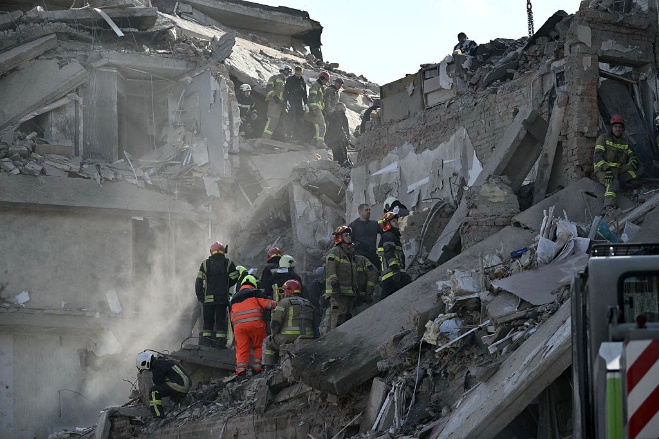
Rescuers conduct search and rescue operations at the site of a Russian aerial strike at a multi-floor residential building in Pryluky. (Genya SAVILOV/AFP via Getty Images)
THE DAY’S RECKONING
The deadliest strike came in Pryluky, about 150 kilometers east of Kyiv, where a Kh-101 cruise missile brought down sections of a five-story residential building. By Thursday morning, rescuers had recovered 22 bodies, five of them children. Three of the children were one year old. In Kyiv, ballistic missiles fell in two waves before dawn, and a drone set a 12-story building ablaze late at night, where two more bodies were later found. Kremenchuk, Oleksandriya, Dnipro, and Zaporizhzhia counted their own dead and wounded.
Interior Minister Ivan Vyhivskyi put the national toll at 28 by evening; by the next morning, Kyiv Post counted 32. The General Staff answered with a birthday tally of Russian losses, and Sybiha called for a dock in The Hague. In Brussels, diplomats approved nearly 1,600 new sanctions designations and moved Ukraine’s EU bid forward, while Kyiv listed five ceasefire tracks and said Russia must agree.
PRYLUKY: FIVE CHILDREN AMONG 22 DEAD
A Russian Kh-101 cruise missile struck a five-story apartment building in Pryluky, Chernihiv Oblast, overnight, causing sections of the structure to collapse while families were inside. The State Emergency Service (DSNS) first reported four or five dead; the toll rose through the day to 14, then 19, and by Thursday morning to 22, including five children. Around 55 people were injured, seven of them children. Rescuers pulled 15 people out alive, including one child, using ladders to reach the upper floors.
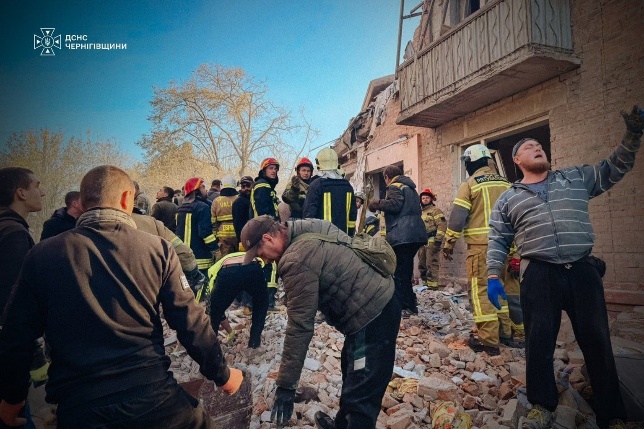
Rescuers search through the rubble of a destroyed residential building in Pryluky, Chernihiv Oblast, after a mass Russian strike overnight. (Ukraine’s State Emergency Service)
Zelensky named three of the dead as one-year-old boys Oleksandr, Kyrylo, and Serhii, and an eight-year-old named Maksym; another child’s body was recovered in the evening. “Today, as a ‘birthday gift’ to Putin, the Russian army destroyed a residential building in Pryluky,” he said. “It was an ordinary five-story apartment block. There may still be people under the rubble.”
Vyhivskyi described the rescue of a five-year-old girl and her mother, thrown from their apartment by the blast; DSNS squad commander Pavlo Levchenko helped pull them from the wreckage and carried the child to safety. The strike also damaged a gas pipeline, temporarily leaving more than 18,000 residents without gas. “There’s a lot of destruction, especially in the town centre,” Deputy Mayor Danylo Savenko told Reuters.
Resident Halyna Osovyk, 55, told the Kyiv Independent that two entrances of the building across the road were destroyed. She said one family lost a mother, a grandmother, and a child, while another child was rescued. “It was just sheer horror. And the sound of the missiles — you simply cannot put it into words,” she said. Chernihiv Oblast Governor Viacheslav Chaus said he hoped Putin “ends up in custody in The Hague or in hell.”
KYIV: BALLISTIC MISSILES BEFORE DAWN, DRONES UNTIL MIDNIGHT
The first explosions shook Kyiv at about 3:15 a.m., after the Air Force warned of ballistic missiles. “The missiles are falling one after another. At least 10-12 explosions from what I can count,” the Kyiv Independent’s Tim Zadorozhnyy reported. A second wave followed around 5:15 a.m. Strikes hit a non-residential area in Obolonskyi, warehouses in Podilskyi, and non-residential sites in Shevchenkivskyi. In Darnytskyi, a 200-square-meter fire broke out at a garage cooperative, where firefighters found two bodies and rescued two people. An unexploded Russian ballistic missile was left among homes in the same district, police images showed.
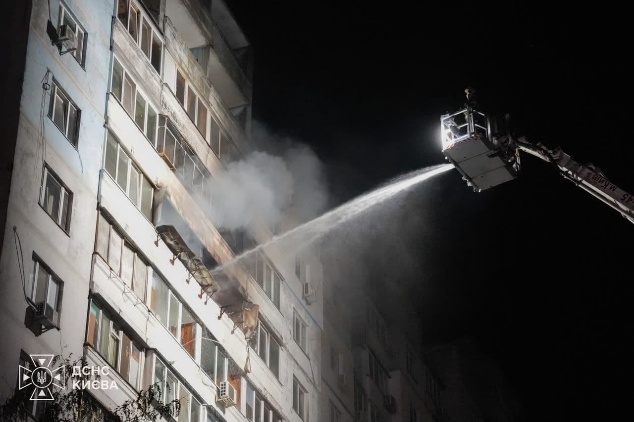
Firefighters extinguish a blaze on the 10th floor of a 12-story building in Kyiv’s Darnytskyi district late in the evening, after a Russian drone attack. (Ukraine’s State Emergency Service / Telegram)
Drones kept coming through the day. In Solomianskyi, a drone set the first three floors of a five-story residential building on fire; firefighters rescued 12 people from the upper floors. Mayor Vitali Klitschko said at least 13 people were injured in Obolonskyi and Solomianskyi, including six medical workers, one of them a woman in serious condition. A woman’s body was found at the site of an attack in Obolonskyi, where falling debris set a car on fire, and the city administration reported a man killed without naming the district.
At 10:23 p.m., a drone hit the 10th floor of a 12-story building, sparking a fire and partially destroying the structure. Four people were injured, including two children, and rescuers evacuated 22 residents, eight of them children. Klitschko placed the building in Darnytskyi; Kyiv Post, citing the DSNS, put it in Desnianskyi. Early Thursday, rescuers found two bodies inside, bringing the capital’s toll to four, Kyiv Post reported.
Power outages knocked out some water pumping stations, cutting the water supply on the city’s western bank, Klitschko said.
48 CRUISE MISSILES, 130 DRONES, 18 LOCATIONS HIT
The Air Force said Russia used ballistic missiles, cruise missiles, anti-ship missiles, and drones in the overnight attack. Of 48 Kh-101, Iskander-K, or Kalibr cruise missiles, 39 were shot down or suppressed as of 10 a.m. Five ballistic missiles out of an unspecified number were downed or suppressed by electronic warfare. Of 130 attack and decoy drones, including 46 jet-powered models, 117 were shot down or suppressed. Hits were recorded at 18 locations. Zelensky said Russia launched 70 missiles, including a significant number of ballistic missiles, without giving a breakdown or saying how many were intercepted. Earlier, the Air Force had warned of Tu-95 bombers approaching the border.
“This was one of the most treacherous strikes,” Zelensky said. “The Russians wanted to strike painfully and demonstratively.” Energy infrastructure was one of the main targets, Kyiv Post reported, and Russia struck Kyiv and 12 regions.
ISW counted at least 128 civilian casualties, including at least five children, in its first tally of the night, and said several Russian milbloggers observed that Russia now sends multiple high-volume waves of drones and missiles at a small number of targets instead of spreading missiles across a wide area. One milblogger claimed 30 cruise missiles were aimed at Kremenchuk, Oleksandriya, and Svitlovodsk alone. ISW assessed that jet-powered Geran drones, which penetrate air defenses more reliably, make this concentration possible without significantly increasing missile use, and that Russia will likely apply the pattern to Ukraine’s energy system during the winter.
The think tank said the strikes are meant to overwhelm air defenses, damage energy, transport, and logistics infrastructure ahead of winter, and make civilian life untenable, adding that such tactics have not worked in the past. It stressed the importance of Western air-defense help, especially U.S.-made Patriot systems capable of countering ballistic missiles.
KREMENCHUK, OLEKSANDRIYA, ZAPORIZHZHIA AND TWO BOYS IN KONOTOP
Ballistic and cruise missiles struck Kremenchuk in Poltava Oblast, hitting four high-rise buildings and a city community center. The Poltava Regional Prosecutor’s Office said a 72-year-old woman and a 40-year-old man were killed. Vitalii Diakivnych, head of the Poltava Oblast Military Administration, said 47 people were injured; ISW, citing officials, reported 41, and the Kyiv Independent’s regional roundup put the figure at 40.
In Oleksandriya, Kirovohrad Oblast, two people were killed and three injured, and one man remained missing, Governor Andrii Raykovich said. In Dnipro, five apartment buildings were damaged, Zelensky said. In Zaporizhzhia, transport infrastructure and an apartment building were damaged; regional authorities said one man was killed and six people injured in the city and surrounding district.
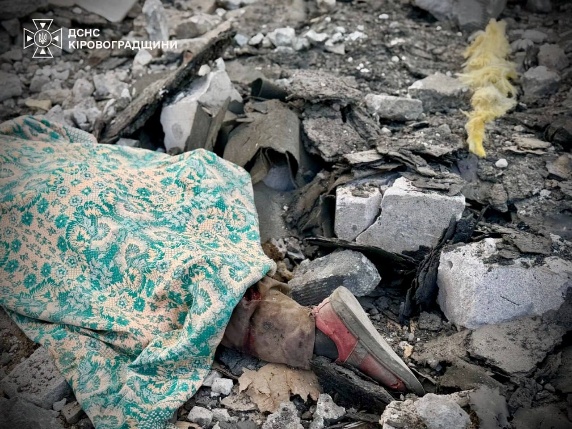
The aftermath of a Russian strike on Oleksandriya, Kirovohrad Oblast. (Andrii Raykovich / Telegram)
The Kyiv Independent’s roundup of the past day counted at least 30 dead and at least 138 injured nationwide. In Dnipropetrovsk Oblast, regional authorities reported seven people injured in a Russian attack on a medical facility in Kryvyi Rih and two more in the Nikopol area. In Donetsk Oblast, 12 people were injured. In Kharkiv Oblast, two people were injured. In Kherson Oblast, Russian attacks killed one person and injured 11, including a child. In Sumy Oblast, two people were killed and 12 injured.
In Konotop district, two 14-year-old boys found an explosive device in a field, Sumy Oblast Governor Oleh Hryhorov said. It detonated, and both died at the scene from severe injuries. “In addition to constant enemy attacks, there is a serious danger of encountering explosive devices,” Hryhorov warned, urging residents not to approach, touch, or move suspicious objects. He did not specify the type of device. Konotop lies about 65 kilometers from the Russian border.
ZELENSKY: “PUTIN DOES NOT FEEL” THE PRESSURE
In his evening address, Zelensky urged world leaders not to remain silent and said Russia intends to keep escalating. “Such a ‘gift’ Putin gave himself for his birthday. The killing of children, the killing of people,” he said. “It is in his interest to wage war. War is his nature, his ideology.” He added: “This is exactly what Moscow chooses despite all our efforts with our partners to bring peace closer.”
Zelensky called ballistic missiles Ukraine’s greatest current air-defense challenge. “Air defense packages are now a vital necessity for us,” he said. “That is why we search every day for missiles for the Patriots, which can and must genuinely protect people’s lives here, in Ukrainian skies.” Kyiv Post noted that Ukraine relies mainly on U.S.-made Patriot systems against ballistic missiles and has repeatedly warned that it lacks enough launchers and interceptors.
He also criticized discussions about easing sanctions on Russian oligarchs, saying Russia’s continued ability to export oil and carry out international financial transactions shows that pressure remains insufficient. “Putin still does not feel that this is creating real problems for him,” he said. “And this is not only Ukraine’s problem, not only our problem, and not only the problem of our people and our children. It is a problem for everyone in Europe and the Western world.” He called for stronger economic and military pressure on the Kremlin.
Zelensky offered condolences to the families of those killed. In Pryluky, he said, first responders were working nonstop “doing everything possible to find every person.”
A BIRTHDAY TALLY FROM THE GENERAL STAFF, AND A MESSAGE FROM PYONGYANG
Ukraine’s General Staff published an interim tally of Russian losses to mark Putin’s birthday, estimating total personnel losses at 1,545,950, including 1,690 over the past day. The tally lists 12,396 tanks, 25,498 armored combat vehicles, 50,836 artillery systems, 2,192 multiple-launch rocket systems, 1,690 air-defense systems, 443 aircraft, 356 helicopters, 35 ships and boats, two submarines, 551,876 operational-tactical drones, and 5,126 cruise missiles. The figures do not separate killed from wounded and have not been independently verified. “Having unleashed the largest war on the continent since World War II, the Russian dictator drives his country closer to the abyss – and himself toward the dustbin of history – with each passing year,” the statement said.
Foreign Minister Andrii Sybiha wrote on X: “On Putin’s birthday, Russian generals brought him his favorite present: war crimes.” He said Russia had lost 1.6 million troops killed and injured without achieving a single strategic goal, and urged partners to give Putin “real presents”: stronger sanctions on Russia’s military-industrial complex, including ballistic missile producers and the Rassvet satellite system, plus more air defense and energy aid before winter. The “ultimate present,” he said, would be a dock in The Hague. “We are preparing the Special Tribunal for the Crime of Aggression Against Ukraine for practical launch already next year.”
North Korean leader Kim Jong Un congratulated Putin, pledging Pyongyang’s “invariable support” and calling Russia’s war against Ukraine a “sacred war of justice.” North Korea has supplied weapons and deployed thousands of troops to Russia, including forces that fought in Kursk Oblast.
KYIV OUTLINES FIVE CEASEFIRE TRACKS; ERDOGAN CALLS PUTIN
Ukraine is working with partners on five possible ceasefire formats, Foreign Ministry spokesperson Heorhii Tykhyi said at a briefing, according to RBC-Ukraine. They are a full and unconditional ceasefire, which Ukraine accepted in March 2025 and for which it awaits a reciprocal Russian decision; Black Sea navigation security, worked on with Turkey and Egypt; protection of food exports through the Black Sea, with India; an India-led track to halt attacks on energy infrastructure; and a separate energy ceasefire under discussion with the United States.
“These are initiatives developed with the involvement of Ukrainian diplomacy. They are realistic and mutually beneficial,” Tykhyi said. “It takes two to tango.” He called claims that Ukraine is to blame for the lack of a ceasefire an attempt to exploit public fatigue with the war: “An attempt to shift the blame for the continuation of the war from Moscow to Kyiv is manipulation.” Tykhyi also said Ukraine is talking with neighboring countries about restructuring border operations to improve security as drone incursions increase.
Moscow has repeatedly rejected such proposals. At the Valdai Discussion Club on Oct. 1, Putin called an offer to stop attacks on Ukrainian ships in exchange for a halt to strikes on Russian refineries “absurd,” and answered “No” when asked whether he would agree.
Turkish President Recep Tayyip Erdogan called Putin, his office said, telling him Turkey is ready to contribute to direct talks between Russia and Ukraine and stressing the importance of safe navigation in the Black Sea. Erdogan also congratulated Putin on his birthday and on his party’s result in the recent parliamentary elections. The call followed drone strikes on merchant ships off Romania and Bulgaria earlier in the week.
3,500 JET DRONES IN SEPTEMBER; TURRETS ONLY A “SITE-LEVEL” DEFENSE
Russia launched almost 3,500 jet-powered drones against Ukraine in September, Air Force spokesperson Yurii Ihnat said on television, according to Ukrinform. That is a tenfold rise from 350 in June, after 1,500 in July and 2,850 in August. Ihnat said fewer jet drones have been launched in October so far, around 50 a night and 30 during the day. He said the newer models, capable of 800-900 kilometers per hour, are comparable to ordinary cruise missiles and complicate interception, and that Ukraine is working on countermeasures with partners. “Innovative solutions from our military-industrial complex, our military leadership, and political leadership, in conjunction with our partners, will help us solve this problem,” he said.
Ihnat said the AI-assisted machine-gun turrets deployed along Kyiv’s bridges have already downed jet-powered drones, which surprised him. But presidential adviser Serhiy “Flash” Beskrestnov cautioned that the turrets offer only limited protection. “It is important to understand that a machine gun turret is not a ‘city-level’ defense, but a ‘site-level’ defense. For example, a warehouse, a production facility, a bridge, an electrical substation,” he wrote on Facebook. “The turret does not replace the main means of air defense; the turret is the last level of defense when the drone has overcome all others.” The range of protection, he said, depends mainly on the machine guns themselves.
According to Ukrinform, about 12 turrets are deployed around Kyiv, with eight more planned, citing earlier comments by Zelensky. Kyiv Post reported that F-16s have taken on a bigger role in intercepting jet drones in recent weeks, with Kyiv seeking more 20mm cannon rounds, and that Zelensky has pledged to scale up production of small air-defense missiles, about which little is known.
UKRAINE HITS SESHCHA, SAMARA, AND A YANDEX DATA CENTER
Ukrainian forces struck the Seshcha air base in Bryansk Oblast, an electronic warfare station near Hrynove, and a radar station near Yelionka, the General Staff said, with damage still being assessed. In occupied Donetsk, they hit a site used to store, prepare, and launch attack drones, and struck drone command posts near Bilotserkivka and Kamianka in occupied Zaporizhzhia Oblast and command-and-observation posts near Hirnyk, Ukrainsk, and Kurakhivka. In occupied Luhansk Oblast, a supply warehouse near Krynychne and a fuel depot near Kondriuche were targeted.
Zelensky said Ukrainian forces hit two oil facilities and a military training ground in Perm Krai and Samara and Astrakhan oblasts, without naming them. “There is also a response in the Black Sea,” he added, giving no details. Russian authorities claimed Ukrainian naval drones struck a Liberian-flagged tanker off the coast, ISW reported.
Footage and NASA fire-detection satellite data showed large fires at the oil pipeline and storage facility near Prosvet in Samara Oblast. The cause has not been officially stated. The General Staff separately confirmed that its Oct. 2 strike on the site damaged 11 RVS-20000 tanks, three RVS-50000 tanks, pipeline sections, and a loading station, and that an Oct. 4 strike on the Astrakhan Gas Processing Plant damaged two gas purification units and a secondary distillation unit.
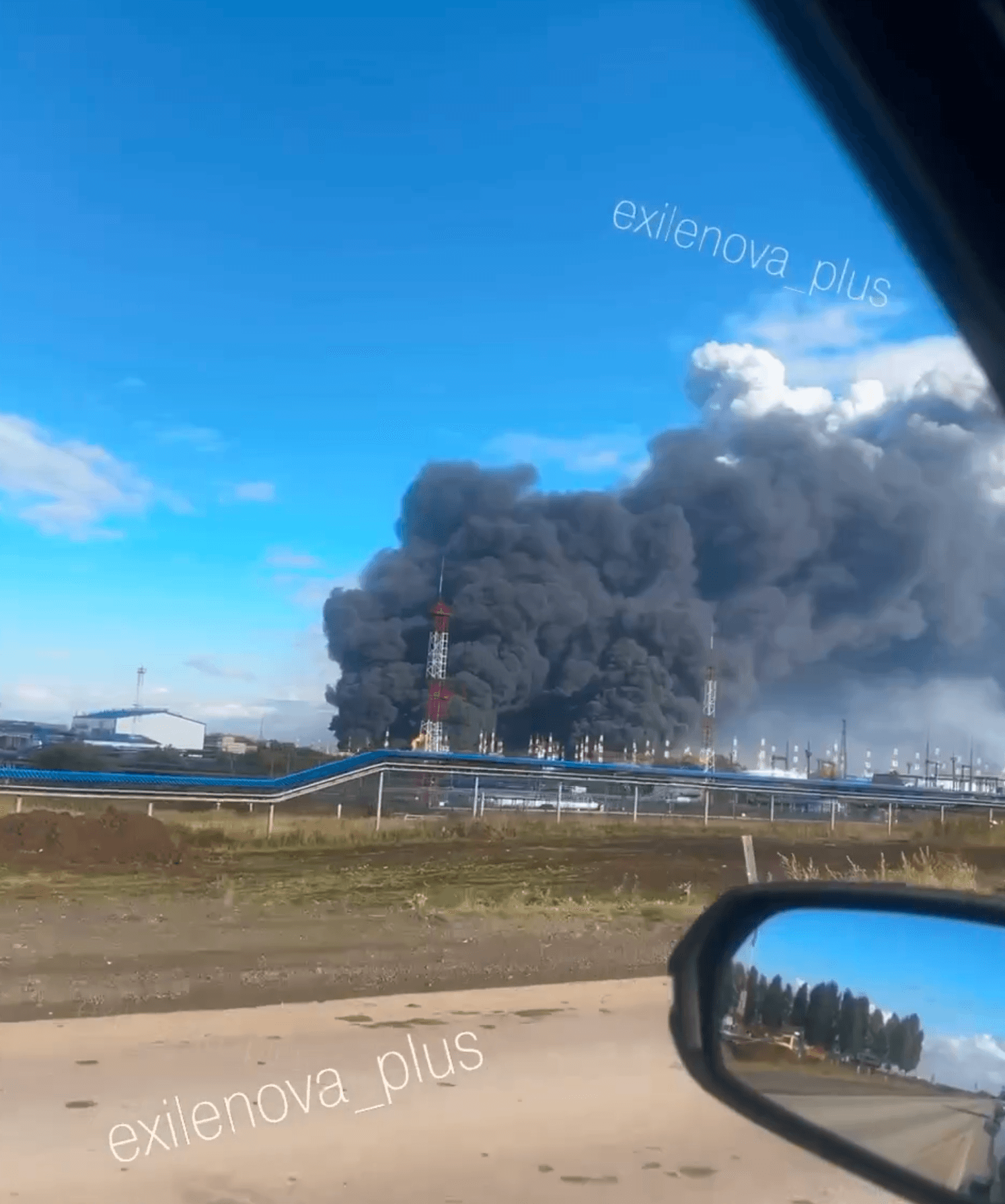
A screenshot of a video showing a huge blaze at a Russian oil pipeline and storage facility in Samara Oblast. (Exilenova-Plus / Telegram)
In Ryazan Oblast, Yandex’s largest data center, in Sasovo, was reportedly damaged in an overnight drone attack, according to OSINT groups Exilenova+ and ASTRA. Yandex Cloud acknowledged an “incident” and power problems in one availability zone from about 1:31 a.m. without linking it to an attack. The data center sits on the grounds of the Sasta machine-tool plant, under U.K. sanctions since 2024 for its role in Russia’s defense sector. It is unclear which was targeted, and neither Ukraine nor regional authorities confirmed the strike.
EU ENVOYS APPROVE A RECORD LIST; U.S. SENATORS PRESS TRUMP
EU ambassadors unanimously approved sanctions against about 1,650 individuals and entities, according to Kyiv Post, or nearly 1,600 by the Kyiv Independent’s count, the largest single set of designations since the full-scale invasion, paving the way for formal adoption by foreign ministers in Luxembourg on Oct. 12. According to RFE/RL’s Rikard Jozwiak, the list targets 743 individuals and 826 entities tied to Russia’s defense industry, from shipyards and aviation firms to electronics makers and armored vehicle repair plants. More than half of the defense listings are linked to missile production, Reuters reported. The ambassadors also approved listings against 77 people purportedly elected to Russia’s State Duma from occupied Ukrainian territories in the Sept. 18-20 vote, and extended the EU’s chemical weapons sanctions framework, which covers 31 individuals and six entities. The EU currently sanctions about 3,000 individuals and entities over the war and plans to move to smaller, rolling lists after this one.
In Washington, Senators Jeanne Shaheen and Roger Wicker urged the Trump administration not to wait for the Oct. 18 start of most provisions of the Lindsey O. Graham Sanctioning Russia and Iran Act, which Trump signed on Sept. 18. In a letter shared with the Kyiv Independent, they cited Russia’s intensified strikes on civilians and energy infrastructure and new North Korean troop deployments. They urged Washington to match the more than 600 shadow-fleet vessels designated by the EU and U.K., compared with 216 by the United States, to target sanctions-evasion intermediaries in the UAE and Hong Kong, and to impose secondary sanctions on suppliers in China, the UAE, and Türkiye. They also called for sanctions on companies behind the Rassvet satellite network, including Bureau 1440, 5C Group, and Eltex.
€1.24 BILLION FROM BRUSSELS, 85 BILLION KRONER FROM OSLO
The European Commission disbursed €1.24 billion in defense support to Ukraine from the bloc’s €90 billion loan. “Today’s disbursement will help strengthen Ukraine’s defense industry. And Ukraine’s ability to defend itself. To protect people and infrastructure,” said Commission President Ursula von der Leyen. The money will go to drones, drone interceptors, drone ammunition, and missiles made by Ukrainian companies. Of €28.3 billion earmarked for defense in 2026, €15.4 billion remains to be paid, pending Kyiv’s receipts; an EU official told the Kyiv Independent that Ukraine has yet to submit receipts for Patriot PAC-3 interceptors. The Commission said Ukraine still has €32.5 billion available for the rest of 2026, including €17.1 billion in budget support tied to reforms.
Prime Minister Serhii Koretsky said the tranche brings defense financing under the program to almost €13 billion and, together with €2.9 billion received from the Ukraine Facility on Oct. 2, to €4.1 billion in two payments. “Given the difficult financial situation, these funds are critically important for the resilience of the state,” he said. Further payments depend on reform bills that have stalled in parliament since November 2025. Finance Minister Serhii Marchenko said seven related bills have passed first reading and that Ukraine will need $52.6 billion in external budget support in 2027, of which about $20 billion is committed, leaving a gap of about $32.6 billion. Bloomberg reported that the EU declined to speed up its loan schedule.
Norway’s proposed 2027 defense budget earmarks 85 billion kroner, about $8.89 billion, for Ukraine through the Nansen Support Program, raising its total to 344 billion kroner. Ukraine faces a 1.66 trillion hryvnia budget shortfall for 2027, the Kyiv Independent reported. According to the Kiel Institute, Norway is the ninth-largest donor to Ukraine by total allocations.
EU ENVOYS CLEAR THE WAY FOR TWO NEW CLUSTERS
EU ambassadors took the next step toward opening two more accession clusters with Ukraine and Moldova, covering the internal market and competitiveness, the two largest, which address broad parts of the economy. The decision applies to both countries because the EU has politically linked their bids. If everything goes as planned, the clusters should be opened at an Intergovernmental Conference in Luxembourg on Oct. 13.
The step became possible after Ukraine submitted a bill on education for national minorities to parliament on Oct. 2, as Hungary had demanded under a political deal reached in early summer. That deal allowed the first two clusters, on the rule of law and external relations, to open in June and July. Much remains to be done: Ukraine must submit a written negotiating position, which is understood to be ready, and a technical working group of the 27 member states must agree on the EU’s common position, to be adopted by ambassadors and ministers. If the Verkhovna Rada fails to pass the minorities law on Oct. 12, the formal meeting the next day will not take place.
The volume of procedure has prompted the Commission to propose cutting some of it. “Based on the treaties, we need two unanimity decisions, giving candidate status, and finishing,” Enlargement Commissioner Marta Kos told members of the European Parliament. “But now, in between, we have 150 steps also for sending a letter to a candidate country.”
Opening the clusters could help Ukraine benefit from the Commission’s new “gradual integration” approach, presented on Tuesday, under which candidates begin to receive some EU benefits as they complete reforms. A senior EU official told the Kyiv Independent that progress on the internal market cluster is critical because it covers “economic security and critical infrastructure.”
LITHUANIA WANTS TROOPS ON THE KALININGRAD BORDER; MOLDOVA BUILDS SHELTERS
Lithuanian Interior Minister Martynas Katelynas asked Defense Minister Robertas Kaunas to deploy army units to help border guards protect the frontier with Russia’s Kaliningrad exclave. “I have appealed to the Defense Minister, Robertas Kaunas, to have Lithuanian Armed Forces units deployed to help border guards protect the border with the Kaliningrad region,” he wrote. He called it a preventive measure in response to signals that Russia may announce mobilization, and to Tuesday’s incidents on the Latvian-Belarusian border, where armed escorts pushed migrants toward Latvia and masked people crossed to steal equipment. “Deploying soldiers is a preventive decision, so that we are prepared and can stop similar incidents,” he said, adding that the situation at the border is calm.
The request came a day after Lithuania’s parliament took a first step toward lifting the constitutional ban on nuclear weapons. In September, Russia said it was ready to use its entire arsenal, including nuclear weapons, if NATO tried to isolate Kaliningrad, and on Oct. 1 Putin said no one could be sure nuclear weapons would never be used.
Moldova plans to build protective shelters at border crossings with Ukraine where border guards and nearby residents can take cover during drone incursions, Interior Minister Daniella Misail-Nichitin told NewsMaker. Some Moldovan border guards stationed on the Ukrainian side, at the Kryva and Palanca posts, will be moved to the Moldovan side, she said. The decision follows a rise in drone incursions, including Monday’s strike at the Palanca-Mayaky-Udobne crossing that lightly injured a Moldovan border guard and Saturday’s incident in which five Russian weapons exploded on Moldovan territory.
NATO’S MILITARY COMMITTEE IN KYIV; DANISH INTELLIGENCE WARNS OF SABOTAGE
NATO’s Military Committee, led by its chair, Admiral Giuseppe Cavo Dragone, and including the military representatives of all 32 member states, visited Kyiv on Tuesday, the alliance reported. It was the full committee’s first visit to Ukraine since April 2018. Dragone said the trip fulfilled a promise to Commander-in-Chief Mykhailo Drapaty, whom he called “a good friend.” “We are here in full strength, sending a clear message: the bond between NATO and Ukraine is strong and unbreakable,” he said.
The delegation sought to understand Ukraine’s military priorities, receive an up-to-date battlefield assessment, and learn lessons from the war. It was shown examples of Ukrainian air defense, drone warfare, and unmanned ground systems, and paid respects at the Wall of Remembrance at St. Michael’s Golden-Domed Monastery. Addressing Russia’s hybrid campaign, Dragone said: “Those who think that by perpetrating an act of sabotage, cyberattack, and violation of the airspace in national NATO territory, they will undermine our support and our resolve. I will respond. You are failing.” Ukraine’s ambassador to NATO, Alyona Hetmanchuk, said it was the first Ukraine-NATO Council meeting at Military Committee level on Ukrainian soil.
In Copenhagen, Josefine Christensen, an analyst at Denmark’s security and intelligence service PET, told Reuters that Russia has stepped up efforts to disrupt Danish companies supplying weapons to Ukraine. Russia planned many operations in the spring but carried out “very little,” she said, before carrying out “a lot more” from early summer, now aiming at targets with a direct impact on the front line, such as weapons production. Russia relies on people recruited online, some first tasked with photographing targets, and European drone makers have drawn particular attention, she said. The Russian embassy in Copenhagen denied the claims.
ROSATOM TAKES OVER DELO; KAZAKHSTAN SEEKS ITS CITIZENS’ RETURN
Russia’s state atomic corporation Rosatom announced that it has acquired the remaining 51 percent of Delo Group, the country’s largest logistics and transportation operator, giving it full ownership. Rosatom said it will merge its logistics assets, including Delo’s, into Russia’s largest national logistics company, with 50 percent of the country’s container handling market and 44 percent of rail container shipping. Delo’s assets include seven marine container terminals, a grain terminal, 46 railway container terminals, about 40,000 container flatcars, and 11 vessels, with port infrastructure in the Baltic and Black Sea basins and the Far East. ISW noted that Ukrainian strikes have significantly disrupted Delo’s operations in ports such as Novorossiysk and assessed that the Kremlin is consolidating strategic logistics under state control.
Kazakhstan’s Foreign Ministry said on Tuesday that it is negotiating with Russia to return citizens serving with Russian forces. Its hotline keeps receiving appeals, and once each case is verified, a list will be sent to Moscow. “Negotiations are underway regarding their return to their homeland,” the ministry said, without saying how many people are involved or whether Moscow had agreed. Relatives of several young men say they went to Russia for civilian jobs but were pressured into signing military contracts; geolocation data indicated some were in northern occupied Luhansk Oblast. The mother of Miras Tasharganov told RFE/RL’s Kazakh service that he went to work in Kursk before being taken to an enlistment office. The accounts have not been independently verified, and Russia has not commented. Ukraine’s “I Want to Live” project claims at least 2,420 Kazakh citizens have signed contracts with Russia’s Defense Ministry, a figure that cannot be confirmed.
UN EXTENDS ITS RUSSIA RAPPORTEUR; 56 UKRAINIANS STILL MISSING IN NEPAL
The UN Human Rights Council voted 21 to 5 on Tuesday to extend for a year the mandate of its special rapporteur on human rights in Russia, Mariana Katzarova of Bulgaria, citing the “continued significant deterioration” of rights there. Ireland presented the resolution on behalf of the EU. “Extrajudicial killings of government critics, erosion of political pluralism, systematic crackdowns on civil society, independent media, journalists, indigenous peoples and minorities in Russia are met with impunity,” Irish Ambassador Laurence Simms said.
The resolution voiced deep concern at the “mass arbitrary arrest, detention and harassment” of people speaking out against the war in Ukraine and urged Moscow to give Katzarova “full, free and unhindered access.” Britain, Chile, France, Italy, Japan, and South Korea were among its supporters; Burundi, China, Cuba, Ethiopia, and Vietnam voted against, and 21 countries, including Brazil, India, Mexico, and South Africa, abstained. Spain’s ambassador, Marcos Gomez Martinez, addressed Russian human rights defenders in Russian: “We have not forgotten you; you are not alone.” Russia did not speak in the debate.
Ukraine’s Foreign Ministry said on Tuesday that 56 Ukrainians remain missing after Nepal ended its search-and-rescue operation following the August floods caused by a glacier collapse in the Himalayas, which killed at least 1,455 people. Forty-six of the missing were traveling together in a tour group. “Despite weeks of efforts by diplomats, consuls, and rescuers, (the missing Ukrainians) have still not been found among either the dead or the injured,” the ministry said. Nepalese officials are considering legal steps to declare the missing dead, and Ukraine’s National Police is finalizing a DNA database to share with Nepalese authorities.
MEANWHILE, AT THE FRONT
Ukrainian forces recently advanced east of Oleksandrivka, ISW reported, citing geolocated footage of Russian strikes on Ukrainian troops north of Komar; Russian milbloggers had previously acknowledged that Ukrainian forces liberated nearby Perebudova. Near Lyman, a Kremlin-affiliated milblogger said Ukrainian counterattacks continue along the Zherebets River and that Ukrainian manpower and drone superiority are preventing Russian forces from consolidating positions around the city. A source reporting on Russia’s Western Grouping of Forces claimed Ukrainian forces control Novoplatonivka, Hrekivka, and Druzhelyubivka near Borova, contrary to Russian claims.
A Ukrainian battalion commander said Russia is transferring additional forces, including unmanned systems and Spetsnaz elements, from quieter sectors to the Slovyansk-Kramatorsk direction to try to seize the agglomeration before winter. ISW said the current Russian rate of advance makes that goal unachievable. Russian forces conducted an infiltration mission into western Malynivka, east of Kramatorsk, and the Russian Defense Ministry claimed a FAB-500 glide bomb strike near Molocharka, north of Kostyantynivka.
In Dobropillya, the Russian Defense Ministry claimed its forces captured a park area, a community center, and two production facilities at the mine. ISW said it has seen no evidence of Russian advances into the town beyond limited infiltration, and a Ukrainian regiment reported clearing dozens of Russian positions near Hruzke and Novomykolaivka. In the Kupyansk direction, a Ukrainian brigade commander said Russian forces are now using reconnaissance drones, including Orlan-10s, at scale, operated by navigator-pilot pairs and spotter groups rather than mainly by FSB units. In northern Sumy Oblast, Russian attacks made no confirmed advances as Ukrainian forces counterattacked.
THE DAY THE BIRTHDAY CAME
By nightfall, Pryluky’s rescuers were still working with ladders and excavators, and in Kyiv firefighters had evacuated 22 people, eight of them children, from a burning 12-story building. The numbers changed through the night: 14, then 19, then 22 in one city; 28, then 32 across the country.
In Brussels, envoys approved the sanctions and the clusters. In Kyiv, the General Staff and the Foreign Ministry sent their own birthday messages. In Pryluky, families were still waiting for news of relatives missing under the rubble.
A PRAYER FOR UKRAINE
1. For the Children of Pryluky
Lord, receive Oleksandr, Kyrylo, and Serhii, who had lived only one year, and eight-year-old Maksym, and the fifth child taken from the rubble. Hold them in Your arms where no missile can reach. Comfort the parents and grandparents who survived them, and the families who lost mother, grandmother, and child in one moment. Heal the seven wounded children, and let the five-year-old girl carried out by a rescuer grow up in peace.
2. For All Who Died in the Night
Father, we lift up the twenty-two dead of Pryluky, the four killed in Kyiv, the woman and man of Kremenchuk, the two lost in Oleksandriya, and every soul taken across Ukraine today. Comfort the families searching hospital lists and rubble for names. Be near to the man still missing in Oleksandriya and to those who wait for him. Let none of these lives be forgotten.
3. For the Two Boys of Konotop
God of mercy, two fourteen-year-old boys went into a field in Konotop district and did not come home. We pray for their parents, for their friends and teachers, and for every child who walks across land the war has poisoned with explosives. Guard their steps, open the eyes of those who clear the mines, and let the fields of Ukraine one day be safe again for children.
4. For the Rescuers and the Wounded
Lord, strengthen the rescuers who climbed ladders in Pryluky, carried children from burning floors in Kyiv, and searched collapsed rooms through the night. Heal the wounded in Kremenchuk, Kyiv, Zaporizhzhia, and every city struck today, including the medical workers hurt while caring for others. Give doctors steady hands and sufficient strength, and let every family left without gas, water, or power find warmth.
5. For Those Who Guard the Sky
God of justice, protect the air defenders, pilots, and gunners who stood against missiles and drones through the night. Give them the interceptors they need, and move the hearts of those who can provide them. Grant wisdom to the leaders deciding on sanctions and aid, so that pressure falls on those who wage this war and protection reaches those who suffer from it.
In Your mercy, in Your justice, in Your time — bring this war to its end, and let the ending be worthy of what Ukraine has endured.