
The Ukraine Daily Briefing · Friday, October 16, 2026
At a Russian command post, Vladimir Putin’s generals told him the war was being won. In a Kharkiv market, two traders were killed before the morning was out, and Ukraine answered with a drone strike 2,340 kilometers from its border.
The Day’s Reckoning
Kharkiv’s market traders are at their stalls early. On Friday morning, a Russian drone came down among them. A 71-year-old woman and a 58-year-old man, both traders, were killed. Medics brought back a man wounded near the heart. Eleven ambulance crews worked the scene, most of their patients torn by shrapnel.
That same day, far from any market, Vladimir Putin visited a command post and listened to his generals describe a war that does not exist: whole regions taken, Ukrainian troops encircled, Russian columns at the gates of cities they have never reached.
That was the thread running through Friday. Moscow told stories. Elon Musk and Donald Trump each pointed away from himself over who slowed Ukraine’s satellites. The Kremlin told the Pope that Ukraine was to blame for the starving town Russia occupies.
And on the ground, Ukrainians kept telling the truth the hard way: by holding the line, by striking back, and by burying their dead.
The General’s Map
Valery Gerasimov, chief of Russia’s General Staff, gave Putin his report on Friday in a briefing the Kremlin made public. Russia, he said, had taken more than 1,800 square kilometers of Ukraine since September 1. Putin went further, claiming about 6,500 square kilometers since January and Russian troops “confidently advancing” along the entire front.
The Institute for the Study of War, which tracks the front line through geolocated video and satellite imagery, sees a different war. By its count, Russia has not gained ground since September 1 at all. It has suffered a net loss of 122 square kilometers, and the evidence shows Russian forces still losing ground so far in October.
The claims got bolder the closer they came to Ukraine’s cities. Gerasimov said his troops had reached the outskirts of Kramatorsk and were five kilometers from Zaporizhzhia. The evidence puts them at least 21 kilometers from Zaporizhzhia, and that is counting only the small groups that slip through the lines. Putin said Ukraine holds just over 10 percent of the Donetsk region. Ukraine holds about 20 percent of it, according to the Institute.
Why exaggerate to your own commander-in-chief in public? Because the audience isn’t Putin. The Institute assesses that these monthly performances are meant for Kyiv and its allies: if Russia looks unstoppable, perhaps Ukraine will give up what Russia cannot take by force, above all the Fortress Belt, the chain of fortified cities in Donetsk that Russian troops have been unable to capture.
Putin made the price plain. The “security zone” his troops are trying to carve out of northern Ukraine, he said, will not even be on the table in any peace talks. Russia demands Ukrainian land and offers none of its own.
Gerasimov also confirmed something Ukrainians already knew. Russia is now deliberately striking strategic bridges, railways and data centers. Kyiv’s South and North bridges have been hit again and again since October 1. Putin ordered the strikes to continue.
On the real map, Ukraine held. In the Dobropillya direction, Ukraine’s General Staff counted 60 Russian assaults in a single day, and a Russian blogger reported a Ukrainian counterattack near Zolotyi Kolodyaz. North of Kharkiv, Ukrainians counterattacked near Starytsya while Russia’s Defense Ministry claimed to have closed an “encirclement” that no independent evidence shows exists. East of Slovyansk, video showed Ukrainian positions in an area Russia had claimed as its own. In western Zaporizhzhia, they pushed forward near Stepnohirsk.
In Kupyansk, Ukrainian drones hunted Russian infiltration teams, small groups that sneak into a town without holding it. Near Lyman, Ukrainian drones struck a Russian infiltration team in Yampil. Southeast of Borova and around Hulyaipole, Russian assaults gained nothing. In the Dnipro River delta, Ukraine’s naval infantry turned back two Russian boats trying to land on an island.
A Russian military blogger declared Kostyantynivka fully captured. Ukrainian troops were filmed in the western part of the city as recently as October 10.
Morning in Kharkiv, Night Across Ukraine
The drone that killed the two traders was only the start of Kharkiv’s day. Officials counted 19 people hurt, 10 of them in the hospital and two in serious condition. Drones struck four districts of Ukraine’s second-largest city. At 11:57 a.m., another hit the roof of a business in the Nemyshlianskyi district and wounded two more. A strike on the power grid cut electricity to 280,000 customers.
One woman, covered in shrapnel wounds, refused to go to the hospital. The medics kept trying to talk her into it.
Across the Kharkiv region, a 105-year-old woman was among those wounded over the past day.
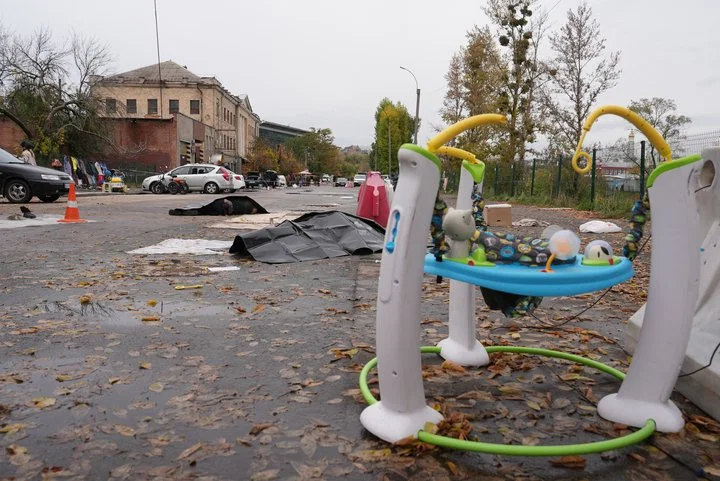
Lives stolen in an instant. Families left grieving. Futures that will never be lived. The bodies of people killed in a Russian strike lay on the streets of Kharkiv’s Shevchenkivskyi district. These were not just casualties of war. They were people with names, families, hopes, and dreams. Someone’s child. Someone’s parent. Someone’s beloved friend. Their lives mattered, and their deaths are another heartbreaking reminder of the terrible human cost of Russia’s war against Ukraine. (Photo: Suspilne Kharkiv)
The night had been long everywhere. Russia launched 149 attack drones overnight, most of them the fast jet-powered kind, and then 330 more drones and loitering munitions during the day. Ukraine’s air defenders brought down more than three-quarters of them. In Uman, a drone fell onto an apartment building and set it on fire; five people were hurt, and rescuers pulled a man from the rubble of a damaged building nearby. Across Ukraine, at least three people were killed and 52 injured over the past day, regional officials said.
The target, again, was the light. Power went out in Kyiv, Volyn, Odesa, Zaporizhzhia, Dnipropetrovsk, Kharkiv, Sumy and Chernihiv regions. The whole city of Lutsk lost electricity, and its utilities ran on backup power.
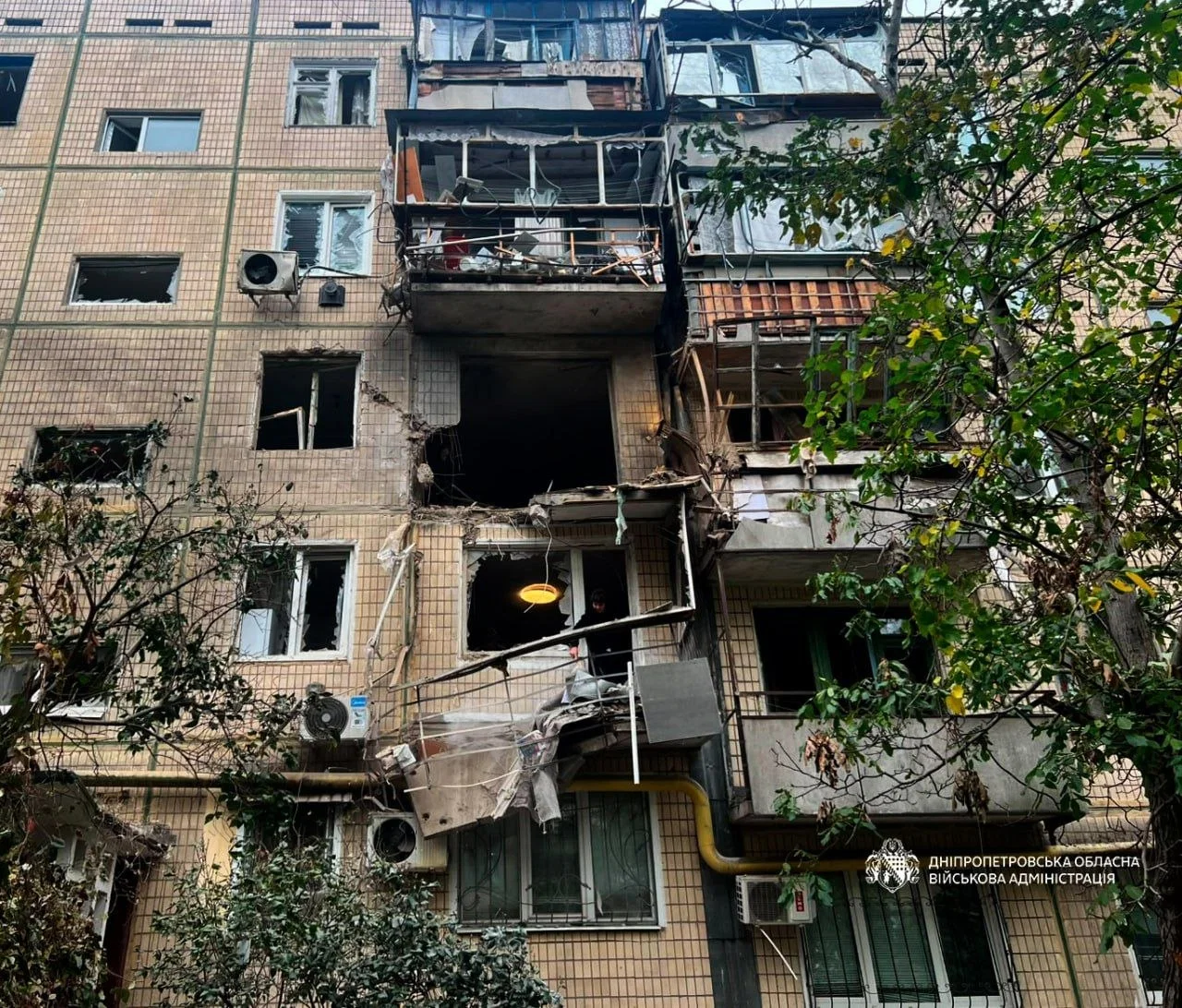
Another night of terror. Another Ukrainian community waking up to destruction. Another reminder that nowhere feels completely safe when war can come crashing through your walls. A Russian attack left a building damaged in Ukraine’s Dnipropetrovsk region. What was once part of the ordinary fabric of daily life now bears the scars of war. For Ukrainians, these are not simply photographs of damaged buildings. They represent shattered security, disrupted lives, and the constant uncertainty of whether their homes will still be standing tomorrow. (Photo: Oleksandr Hanzha, Head of the Dnipropetrovsk Regional Military Administration / Telegram)
In Kyiv, emergency blackouts replaced the schedules residents use to plan their days. And Mayor Vitali Klitschko switched on the city’s central heating, starting with schools, hospitals and kindergartens. He said bombardment had created “extreme conditions.” Two districts on the left bank, Dniprovskyi and Darnytskyi, will have to wait: a damaged power facility there is still under repair.
This year, heating season begins as a race against the next strike.
A Pope’s Call From a Hospital Bed
Pope Leo XIV is recovering in Rome’s Gemelli Hospital from surgery on Tuesday to remove a cancerous tumor from his lung. On Friday he picked up the phone and called Vladimir Putin.
He asked about one town: Oleshky, on the Russian-held bank of the Dnipro River in the Kherson region, a few kilometers from Ukrainian Kherson. The Pope called for a ceasefire there so food and medicine could get in and civilians could leave safely.
Oleshky has been under Russian occupation since the first days of the invasion. The last food delivery reached the town on May 26, its exiled Ukrainian administrator said. Its only hospital has run out of medicine, and a stroke there now has no treatment. When a supply convoy tried to get through in early September, drones destroyed it. Ukraine’s human rights commissioner, Dmytro Lubinets, called the town “a death trap.” His office has verified at least 358 people who urgently need help to leave. Some don’t wait. They walk out through minefields.
The Kremlin said Putin backed the Vatican’s idea and would cooperate. Then it said he had given the Pope a “detailed explanation” of Kyiv’s responsibility for the suffering. Lubinets says Ukraine had an evacuation ready, with the International Committee of the Red Cross prepared to take part and Ukrainian troops ready to hold their fire. Russia never confirmed it would go ahead.
Ukraine’s security service warned on October 7 that Russian troops had been ordered to film Oleshky residents blaming Ukraine’s army for the blockade. On Friday, the UN’s human rights chief, Volker Türk, called the situation “desperate” and urged Russia to let people go.
A sick man in a hospital bed used his strength to plead for a town most of the world has never heard of. Moscow used the call to shift the blame.
(Note: Three of the internally displaced families living in our Velykyi Lazy IDP Center escaped Oleshky recently. The story of these families escaping is here.
The Speed Limit Nobody Will Own
Since Wednesday, the question has been who slowed down Ukraine’s battlefield satellites. On Friday, Britain’s Telegraph newspaper offered an answer that pleased no one in power.
Elon Musk, it reported, citing four sources, went to Donald Trump with the idea of capping the speed of Starshield, the military version of his Starlink network. One source said Trump “agreed.” After the chaos that followed, a senior source said, Musk worried about a backlash from customers in Europe, so he posted that the U.S. government was responsible. “The reality is that they were both in it,” the source said. The Telegraph said two Ukrainian sources and a senior European official confirmed the account.
Musk had written that the limits were set “by the U.S. military and ultimately” the president. Trump said Friday that he did not think either he or Musk was responsible. The Pentagon has said nothing.
In Brussels, Zelensky explained what the slowdown actually did. Ukraine’s interceptor drones, the ones that chase Russia’s jet-powered attack drones, fly fast. Some systems were throttled to about 70 kilometers per hour. “When the speed was reduced, we were unable to intercept some of the jet-powered Shaheds,” he said. “We were unable to use a tool to protect civilians.”
The cap also cut off drone deliveries of food and water to soldiers who live for weeks under Russian surveillance. Speeds are recovering, Zelensky said, but are not back to normal.
Europe heard the warning. “In the short-term Europe can’t replace this capability,” said Kaja Kallas, the EU’s top diplomat. Germany, which pays for some of Ukraine’s terminals, was blunter. “These restrictions must be lifted,” said Foreign Minister Johann Wadephul. “We insist that it works if we are paying for it.”
Fire 2,340 Kilometers Away
The city of Surgut, in Russia’s Khanty-Mansi region, lies about 2,340 kilometers from the Ukrainian border. Until Friday, the war had never reached that region.
A drone set fire to Gazprom’s condensate stabilization plant there, which turns gas condensate into motor and aviation fuel. The regional governor, Ruslan Kukharuk, confirmed a fire at an industrial site after a drone attack. Ukrainian officials have not claimed it. Serhii Sternenko, a Ukrainian activist and former defense adviser, named the plant and said it can process 12 million tons of raw material a year.
The same night, more than 59 drones reached Moscow, the city’s mayor said, and flights stopped at four of the capital’s airports. Monitoring channels said a Yandex data center in the Vladimir region was targeted again, five days after an earlier strike shut it down. Zelensky has promised to answer Russia’s strikes on Ukrainian internet infrastructure in kind; that same Friday, Gerasimov boasted to Putin about Russia’s campaign against Ukrainian data centers. In the Rostov region, a drone attack started a fire at production and storage sites in Aksay.
Ukraine also went after Russia’s eyes. In Krasnodar Krai, it hit a Nebo-U long-range radar, a system that spots aircraft and missiles and that Ukraine’s General Staff values at about $100 million. In the Bryansk region, it struck two more radar stations and an electronic warfare system.
Satellite photos confirmed what Ukraine had said about its Neptune missile strike on the Borisoglebsk airfield: four Su-34 bombers destroyed.
Also Today
Fire in the west. Russian drones set an oil depot ablaze in the Shepetivka district of the Khmelnytsky region and struck Chortkiv in the Ternopil region twice; no casualties were immediately reported.
Cherkasy. A drone fell on the grounds of a private business in the regional capital and started a fire that crews quickly put out.
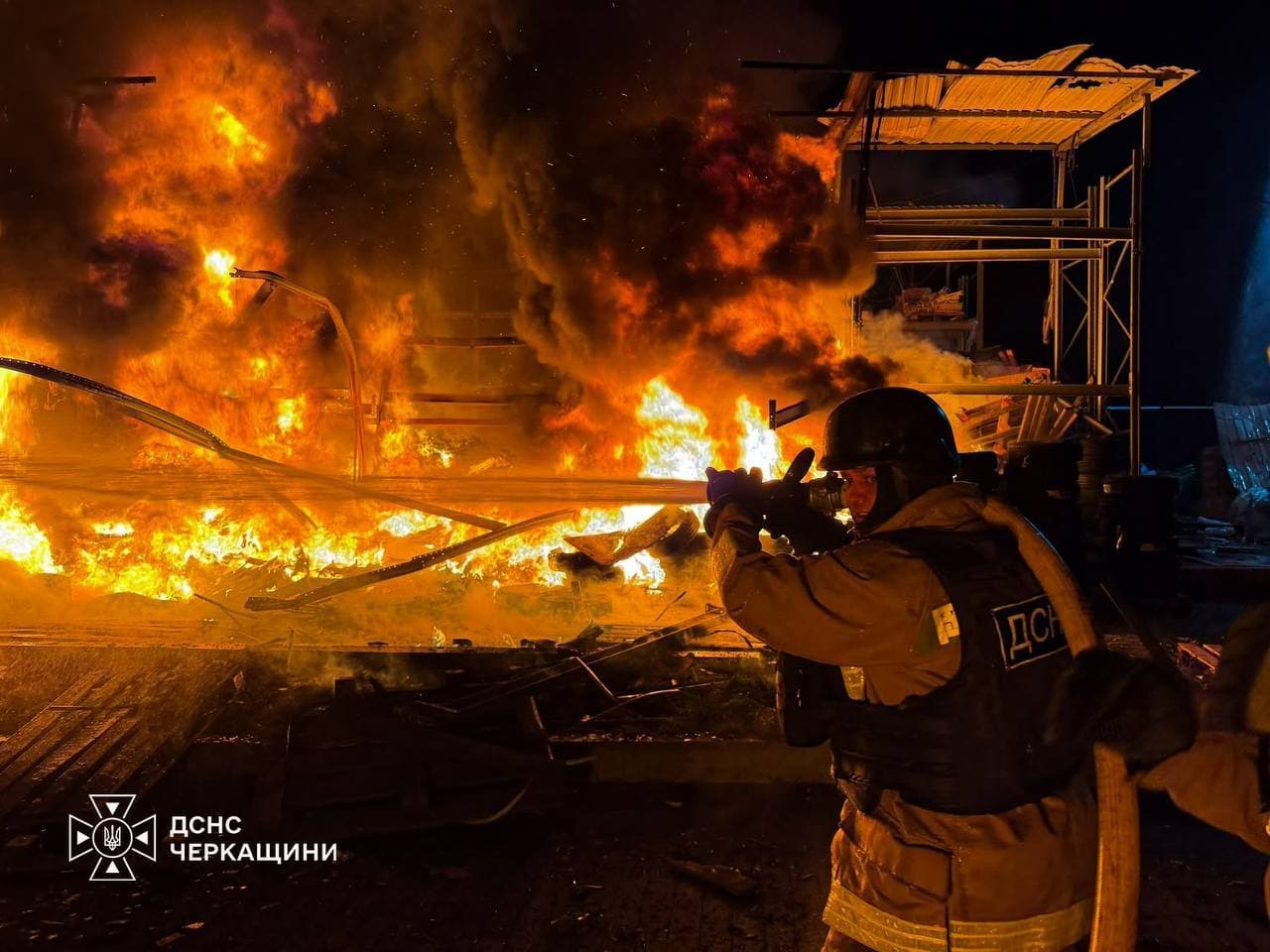
In the darkness of the night, Russian attacks shattered the peace of another Ukrainian community. In Uman, firefighters rushed into the destruction of a damaged residential building, where families should have been sleeping safely in their homes. Behind every shattered window and broken wall are ordinary people whose lives have once again been turned upside down by war. (Photo: State Emergency Service of Ukraine / Anadolu / Getty Images)
Dnipropetrovsk region. Russia struck the region more than 30 times with drones, artillery and glide bombs, killing two people; bomb experts plucked an unexploded warhead from a Geran-4 drone that had lodged on a power line some 60 meters off the ground.
Kherson. A 66-year-old man stepped on a Russian mine in the Korabelnyi district late Friday and was badly hurt; Russian mines have killed or injured 1,739 civilians since 2022, including 178 children.
Sumy. A drone hit a shopping center in central Sumy and wounded three; across the region, Russian troops attacked 38 settlements in a single day.
The rest of the toll. One person was killed in Kramatorsk, two in the Kherson region, and people were wounded in the Odesa, Rivne and Volyn regions as Russia targeted homes and power.
Planes from Belgium. Prime Minister Bart De Wever said Belgium will deliver ten F-16 fighter jets to Ukraine this year, now that its own F-35s are arriving, because Ukraine needs jets that can shoot down Russia’s jet drones.
“You are not alone.” Polish Prime Minister Donald Tusk told Zelensky in Brussels that anything that helps Putin is unacceptable to Europe; Zelensky said Polish ammunition had helped defend Kyiv, and Ukraine expects to buy another €125 million in Polish weapons on a Polish loan by year’s end.
Zelensky’s warning. Putin “truly believes that we are not a country, not a nation,” Zelensky told reporters in Brussels, and he asked why, if Moscow wanted only the east, it went for Kyiv first. He warned Europe that the drones crossing into its skies will one day be joined by missiles.
The diesel precedent. Zelensky warned that the U.S. deal letting Russian diesel back onto world markets, now authorized through April 7, 2027, could lead to gas deals and sanctions relief for Russia’s banks.
Lukashenko weighs in. Belarus’s leader said Trump should not dictate who leads Ukraine but urged Zelensky to keep a promise to serve one term; Zelensky says Ukrainians alone choose their president and that constant attacks make an election nearly impossible.
Moldova. At least four unidentified drones crossed into Moldova overnight, and one crashed and exploded in a field about 30 kilometers inside the country.
Europe’s shadow. Marine Le Pen came to Brussels on the eve of the summit to vow cuts to France’s support for Ukraine, and diplomats said the far-right frontrunner was already “in the room” as Emmanuel Macron worked through his final months in office.
Seized businesses. Putin signed a decree placing the Russian assets of five European companies, including France’s Tarkett and Belgium’s Ontex, under “temporary management,” pressure that may be aimed at forcing Europe to unfreeze Russian money.
Grain at risk. Ukraine asked Turkey to help restore safe Black Sea shipping, warning that some 32 million tons of farm products worth about $10 billion are at risk; Turkey has been discussing a partial ceasefire at sea to protect merchant ships.
Tanks near Finland. Satellite imagery shows Russia restocking tanks and howitzers at storage bases, some less than 200 kilometers from Finland; the Institute for the Study of War sees no sign of an imminent attack on NATO but urges vigilance.
Lifesaving drones. Ukraine’s government approved a pilot project to fly blood, medicine and donor organs between hospitals, starting at the Heart Institute, whose drones can fly up to 700 kilometers.
Europe’s backup plan. The EU is negotiating to bring Ukraine into GOVSATCOM, its pooled secure satellite network, but its own constellation of more than 300 satellites won’t be fully running until 2029; meanwhile, Russia is building its own Starlink rival, Rassvet.
Belarus drills. Troops from Russia, Belarus, Kazakhstan, Kyrgyzstan and Tajikistan wrapped up the active phase of two alliance exercises in Belarus.
The Closing
Maps can be drawn in any color a general likes. Graves cannot be redrawn. On Friday, Russia’s commanders handed Putin a war of their imagining, while in Kharkiv two traders who had come to sell their goods did not go home. The truth of this war is not on a screen in a Russian command post. It is in the market, in the hospital ward, and in the soldiers who were still standing where Gerasimov said they were gone.
A Prayer for Ukraine
1. For Those Who Hold the Real Line
Lord, Russia’s generals claimed cities they have never touched, and Your servants stood where the maps said they had fallen. Strengthen the defenders near Dobropillya, who faced 60 assaults in a single day. Guard the soldiers at Starytsya, Stepnohirsk and Kupyansk, and the naval infantry who turned back the boats in the Dnipro delta. Feed those who wait in the trenches for drones bringing food and water. Let no lie move them from their ground.
2. For the Traders of Kharkiv
Father, a woman of 71 and a man of 58 went to the market in Kharkiv to earn their bread, and they did not come home. Receive them into Your rest and comfort the families who wait in vain. Heal the man whose heart was restarted, the woman who refused the hospital, and the 105-year-old who has now been wounded by war. Bind up the wounded of Uman, Sumy and Kherson, and bring justice for every life taken.
3. For Those Who Hold Power
God of truth, men in high places are passing blame back and forth while Ukraine’s skies stay open to the drones. Bring hidden things into the light. Give Volodymyr Zelensky clear words in Brussels and give Europe’s leaders the courage to keep their promises. Bless Pope Leo as he heals and honor his plea for Oleshky. Turn the hearts of those who decide whether a defender’s drone can fly.
4. For the Lights and the Warmth
Lord of light, Kharkiv, Lutsk and Kyiv went dark again, and the radiators of Kyiv’s schools and hospitals are only now warming. Protect the repair crews in Dniprovskyi and Darnytskyi and the bomb experts who climb toward live warheads. Open a road into Oleshky, so that bread, water and medicine reach its people and the trapped may leave without crossing minefields. Keep the children of Ukraine warm this winter.
5. For a People Who Keep Standing
Righteous God, Ukraine was struck in its markets and in its power lines, and still it reached 2,340 kilometers into Russia. Its air defenders brought down hundreds of drones in a day, and its neighbors said, “You are not alone.” Sustain this people, whose courage is real though their strength is not endless. Let truth outlast every lie told about them.
In Your mercy, in Your justice, in Your time — bring this war to its end and let the ending be worthy of what Ukraine has endured.