
The Ukraine Daily Briefing · Thursday, October 15, 2026
Ukraine held its fire on Russia’s oil refineries for three days and got nothing back but more drones, so Volodymyr Zelensky ended the pause: “The block is out. We’re done.” Overnight, Ukrainian Neptune missiles caught Russian bombers on their airfield, Russia answered with 580 drones, and a news report traced the order to slow Ukraine’s battlefield satellites to the White House.
The Day’s Reckoning
The warning came in time, and that was the only lucky part. In a five-story building in Kyiv’s Pechersk district, the children heard that a drone attack was on its way and ran out into the corridor. The oldest carried the others out of their room. Then the windows blew in, and he threw the little one to the floor and covered them. Ruslan, who lives there, raced home from work when his wife called. The children were only slightly hurt.
On Thursday, a whole country did what that boy did. Ukraine stopped waiting for someone else to shield it.
The satellites that guide Ukraine’s drones came back on, but still capped, and a news report said the order to slow them had come from inside the White House. For three days, Ukraine had spared Russia’s refineries because Washington asked, and Russia kept bombing. So Zelensky lifted the ban. His missiles had already wrecked four Russian bombers on the ground.
Russia answered by filling the sky: 580 drones in a single night, and by Thursday night parts of Kyiv were dark.
A Switch Inside the White House
You’re a drone pilot behind the southern front. Your drone is fast because it has to be: its job is to catch the Russian supply trucks carrying the shells that will be fired at your friends. You push the throttle, and the video feed, your only eyes, freezes. The drone is still flying. Nobody is steering it.
That happened all along the front on Oct. 14, after Starshield, the military version of SpaceX’s Starlink satellite internet, began cutting out above 100 miles per hour. Ukraine flies its drones by live video over these satellites. The fast ones it uses to hunt Russian trucks and to chase Russia’s jet-powered attack drones before they reach Ukrainian cities were suddenly crippled.
Nearly 48 hours later, nobody in Washington or at SpaceX would own the decision. Elon Musk said limits are set “by the U.S. military and ultimately (the president).” On Thursday, Reuters reported that Pentagon officials had been told from inside the White House that the service needed to be slowed. Two U.S. officials and a Western official said so, but none named who gave the order. A senior U.S. official denied it came from Trump, and the White House denied any role.
By Thursday the glitches were fixed. The cap was not. “160 km/h is not enough, and it limits how we can defend ourselves against the Russians,” said Junior Sgt. Dimko Zhluktenko of the 413th Unmanned Systems Regiment. He estimated the restriction had already cost Ukraine tens of millions of dollars.
Zelensky put the cost in a different currency. “It’s a big mistake,” he said. “People will die.”
Even Washington was angry. Republican Sen. Thom Tillis said he would ask the Defense Department’s inspector general to investigate. “At best, this was an unacceptable error or lapse, and at worst a conscious decision to clear the field for a Russian attack,” he said.
And there is no spare tire. Europe has no satellite system Ukrainian soldiers could bolt onto a drone tomorrow; switching would mean replacing thousands of terminals. “You can’t rely solely on one solution that can be switched off,” said Bohdan Sas of the Ukrainian defense company Buntar Aerospace. The dependence runs deeper still. Ukraine relies on American satellites for early warning of ballistic missiles too, and for two nights this week Kyiv’s warnings came only as the missiles were already arriving. Zelensky called that a deliberate decision. Washington blamed technical problems.
“We’re Done”: Ukraine Takes Off the Handcuffs
On Oct. 11, Donald Trump announced an “energy ceasefire” that Kyiv says it never saw coming and demanded that Ukraine stop striking Russian oil refineries. Ukraine stopped. Russia didn’t. On Oct. 14 alone, its missiles and drones went after 26 Ukrainian power facilities.
On Thursday, Zelensky ended the experiment. “The block is out. We’re done,” he told the Financial Times.
Why refineries? Because oil pays for the war. “We should squeeze Russia, not Ukraine, to surrender,” said Kaja Kallas, the European Union’s top diplomat, backing him. Zelensky named his price for ever stopping again: more American Patriot interceptors, the missiles that knock down ballistic missiles. Without leverage, he warned, Washington and Moscow will just strike their next deal. “Maybe it will be gas. Definitely it will be gas.”
He said U.S. officials had warned his generals that intelligence sharing would stop if the strikes went on. “They said this to my generals, not to me.” Trump insisted, “We are helping them, and we are sharing intel,” then called Zelensky “not a good guy” for the U.S. to deal with.
Asked by Piers Morgan about Trump’s wish for a new Ukrainian president, Zelensky said that choice is “a decision for our people, not Trump, not Musk, not anyone else.” Resign? “No, of course not. This is my responsibility.” And he said what hurt most: “This is our country, our body, our home, our children. That’s why it’s painful when Trump chooses one side.”
Moscow, meanwhile, dropped any pretense. Asked about concessions for peace, Foreign Minister Sergei Lavrov said: “There will be no ceasefire.”
Ukraine had already shown what the end of restraint looks like. Overnight, its navy fired Neptune cruise missiles, a homemade weapon that sank Russia’s Black Sea flagship in 2022, at Borisoglebsk airfield in Russia’s Voronezh region, about 230 miles from the front. The targets were Su-34 bombers, the planes that drop winged, guided bombs on Ukrainian towns from beyond their reach. Zelensky said four were destroyed and two damaged. “These aircraft were ready for new strikes on Ukraine and were equipped with aerial bombs,” he said. “Our long-range operations will continue.”
One Russian military blogger wrote that Russia’s only way to protect its warplanes now is to pull them back about 250 miles from Ukraine’s border. Every mile farther is more warning time for a Ukrainian family.
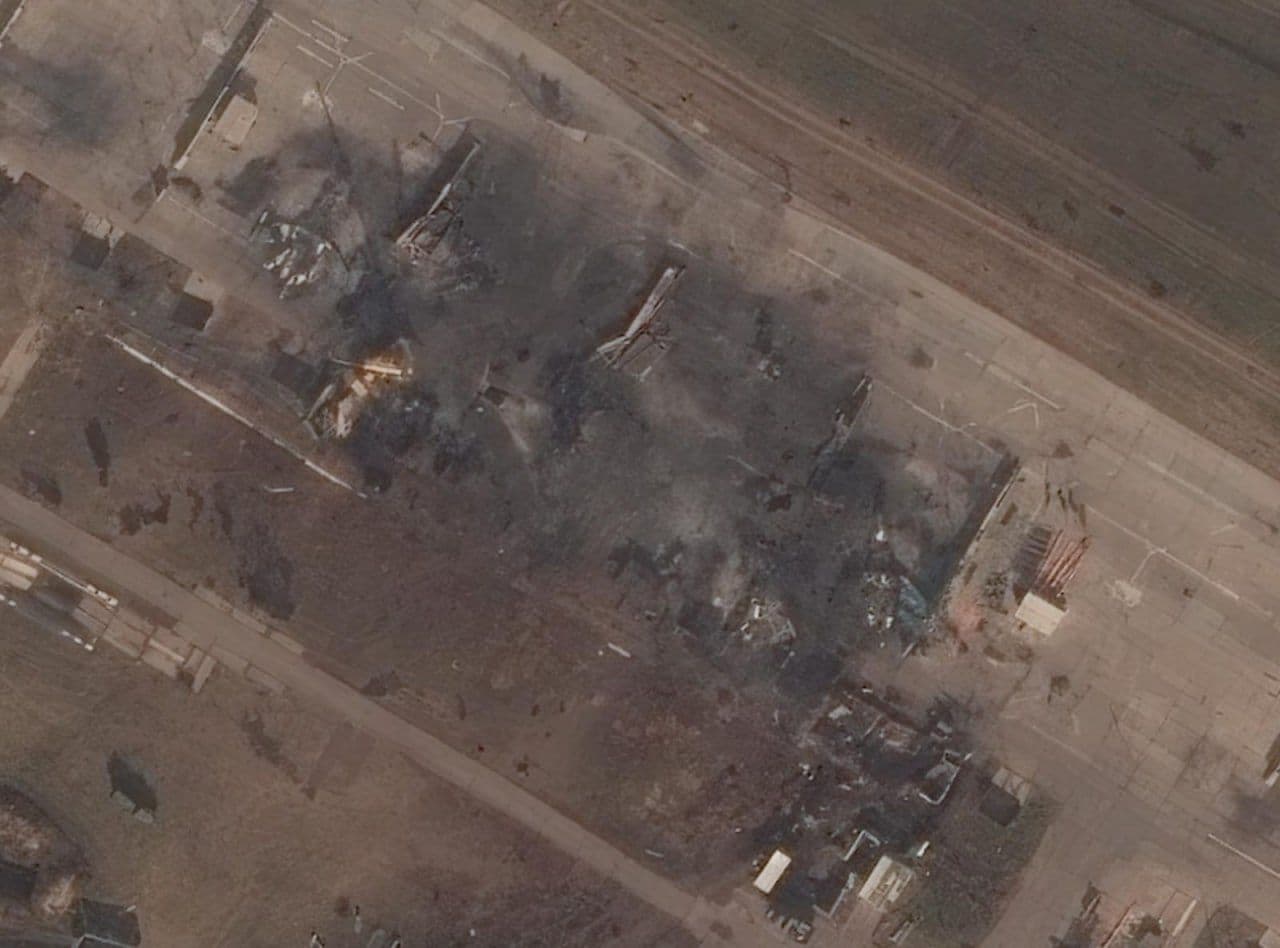
Satellite imagery of the damaged Su-34M bombers on the Borisoglebsk military airfield in Voronezh region, Russia, on Oct. 15, 2026 (President Zelensky/Telegram)
The Sky Was Never Clear
“There were constant waves, and our sky was not clear of them for a single hour,” Zelensky said. Since Wednesday morning, Russia had sent 850 attack drones.
Overnight alone came 580, plus two cruise missiles. Ukraine’s air defenders shot down 536. They won almost every duel. It wasn’t enough. The Kirovohrad region in central Ukraine took the biggest attack of its entire war, some 360 drones, and three people were killed in the city of Kropyvnytskyi. Nationwide, at least 10 people died in a single day, among them a man killed in the Kharkiv region village of Spodobivka, where a 15-year-old boy was wounded beside him. Zelensky said Russia escalated because it had been handed “a relaxation of sanctions.”
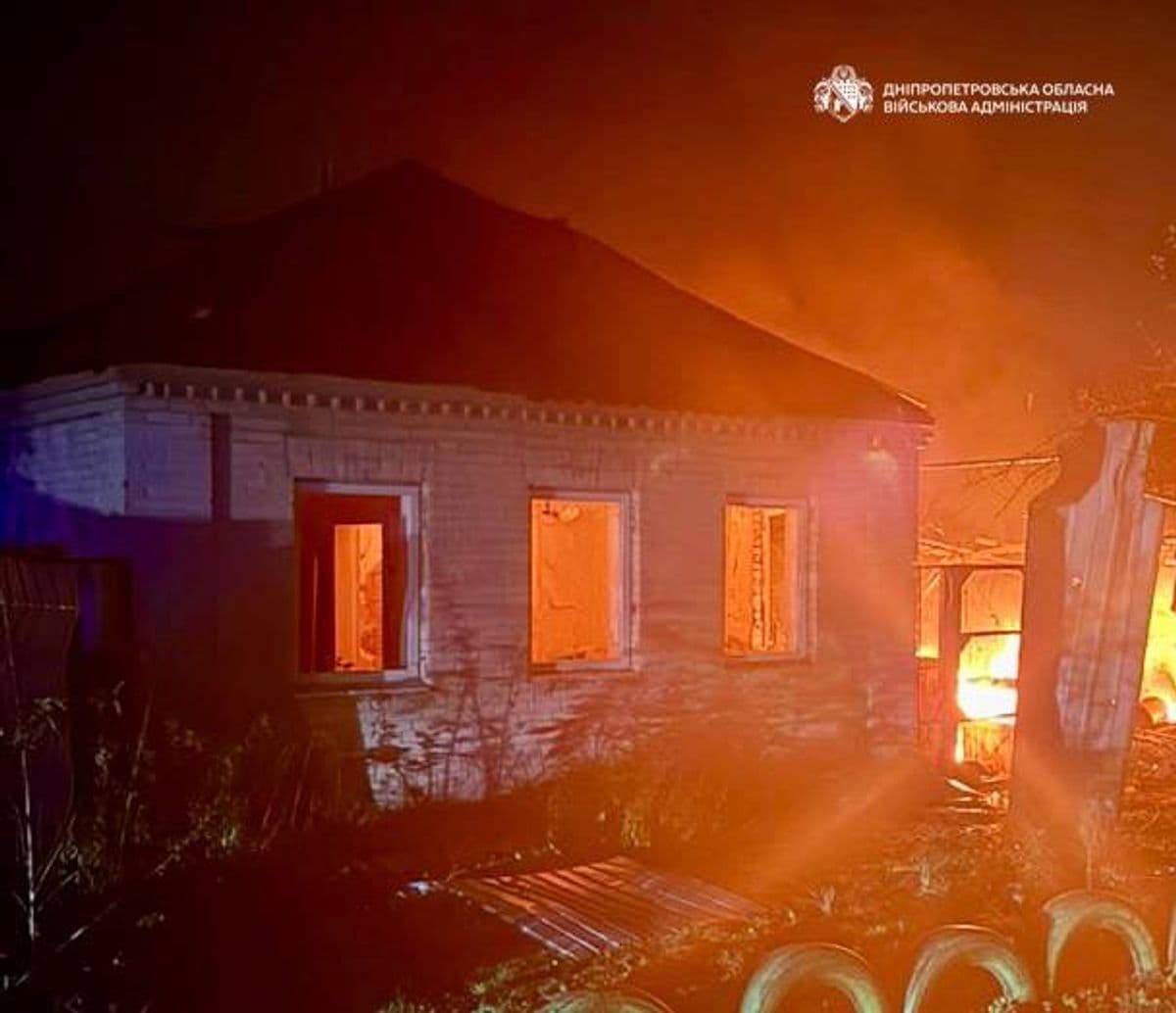
Fire in a home hit by a Russian attack on Dnipropetrovsk Oblast. (Dnipropetrovsk Regional State Administration/Telegram)
In Kyiv, Inna Kozub was in her kitchen when a drone came down near a five-story building in Pechersk. “The blast wave blew the kitchen door off its hinges, and glass rained down,” she said. “I started shaking all over, and tears began to flow.” Seven people were hurt. Ruslan, whose children were home when the windows blew out, said what many in the city are thinking: “They say that this is a matter of the Americans stopping helping us.”
Then, late Thursday night, came the blow Kyiv dreads most. After bursts of air-defense fire over the city, the lights went out across parts of the capital and the region around it. With pumping stations short of power, water pressure dropped on the right bank. Lutsk, far to the west, went dark too.
This is Russia’s fifth winter campaign against Ukraine’s grid, and the weapons are worse than last year’s. Jet-powered drones are faster and harder to shoot down, and Russia has nearly finished a new launch base for them near Millerovo, built in six weeks on what was an empty field. Worse, a person familiar with the matter told CNN that Ukraine has run out of Patriot interceptors, its main defense against ballistic missiles.
Last winter, Kyiv families sat without heat at minus 25 Celsius. This winter has not even begun.
“One Does Not Negotiate With Tyrants”
Former Ukrainian President Viktor Yushchenko wrote an open letter to Donald Trump, “from one human being to another, and from one president to another.”
“Freedom is in our blood,” he wrote. He reminded Trump of a promise. When the Soviet Union collapsed, Ukraine held one of the largest nuclear arsenals on Earth and gave it up. In 1994, in the Budapest Memorandum, the United States and its partners pledged to respect Ukraine’s security and borders. “Ukraine kept its word. Russia broke its word.”
He reminded him of shared blood, too: Sgt. Michael Strank, one of the six Marines who raised the flag at Iwo Jima, whose family came from Lemkivshchyna.
“Do not mistake the Ukrainian desire for peace for a willingness to surrender,” he wrote. “We were here, we are here, and we will always be here.” And twice, the line he wanted Trump to remember: “One does not negotiate with tyrants — one stops them.”
Also Today
Fire on the Black Sea. Drones struck four civilian ships on Oct. 14 and 15, two of them inside the waters of NATO member Romania. Seven sailors from the burning tanker Wine Trader are still missing. A NATO official said the drones were “of Russian origin,” and Romania’s foreign minister said, “Russia bears full responsibility.”
Russia’s imaginary maps. A Ukrainian brigade spokesman said Russian commanders still claim villages Ukraine liberated in its Operation Vivaldi offensive near Lyman, because their own maps don’t match the front.
Pressure near Dobropillya. Russia stepped up assaults to dig into the city’s outskirts before winter; one brigade said it destroyed about two Russian infantry platoons in a day. Ukraine advanced north of Kupyansk and confirmed it holds Novoandriivka and Lidyne.
Hitting the drone schools. Ukrainian military intelligence said its forces destroyed a training center for Russian drone operators, and their instructors’ quarters, in occupied Khorly.
A refinery fire in Ryazan. Russia’s Defense Ministry, which rarely admits such things, said Ukraine “attempted” a strike on a Ryazan refinery and that drone debris started a fire there.
Britain’s missiles. Bloomberg reported that Britain will send Ukraine more Storm Shadow cruise missiles, which can hit targets up to 155 miles inside Russia.
Mending Chornobyl. Britain pledged £17 million and the G7 €260 million to repair the shelter over Chornobyl’s ruined reactor, holed by a Russian drone in February 2025. Full repairs will cost about €500 million.
Europe counts the cost. At a Brussels summit, German Chancellor Friedrich Merz said the EU must find more money to carry Ukraine through next year; Zelensky joins the talks on Friday. Estonia’s prime minister said the faster Russia’s refineries are “blown to smithereens the better,” while France’s Marine Le Pen said France “cannot keep financing Ukraine.”
Life behind the line. In occupied Oleshky, more than 6,000 people, about 200 of them children, are running out of food with no evacuation route. “They understand that the summer has passed and no evacuation has been organized,” said the town’s exiled administrator.
Russia’s network in Belarus. A Belarusian outlet reported that Russia is building a secure military communications network along its border with Belarus, reaching toward Ukraine and NATO countries.
A Swede in custody. Russia’s FSB said it arrested an unnamed Swedish man near the Lithuanian border, accusing him of fighting for Ukraine and plotting sabotage.
The Closing
Tonight, parts of Kyiv are dark again, and families are filling bottles before the water pressure drops. Off the Romanian coast, rescuers are still searching for seven sailors. On a Russian airfield, four bombers that were loaded for Ukraine sit burned and useless. Ukraine spent three days holding its fire, and it is done waiting for someone else to stand in front of it.
A Prayer for Ukraine
1. For the Children of Pechersk
Lord, a boy in Kyiv heard the warning and gathered the little ones into the corridor. When the windows burst, he threw the little one to the floor and covered them. Thank You that they lived. Bless his courage and heal the fear that will follow these children into every siren. Comfort Inna Kozub, who stood shaking in a kitchen full of glass, and the seven wounded of her street.
2. For the Dead of Kropyvnytskyi and the Sailors in the Sea
Father, three people died in Kropyvnytskyi in the worst night their region has known. A man died in Spodobivka while a 15-year-old boy was wounded beside him, and at least ten across Ukraine were killed in a single day. Receive them and hold their families close. Watch over the seven sailors missing off Romania, strangers to this war, and bring them home to those who wait.
3. For Those Who Hold the Switch
God of wisdom, a quiet order slowed the satellites that guide Ukraine’s defenders, and no one will claim it. Expose what is hidden and turn the hearts of those in Washington toward justice. Give Volodymyr Zelensky courage and clarity as he travels to Brussels. Give Europe’s leaders the will to find what Ukraine needs for the winter. Raise up allies who keep their word.
4. For the Lights of Kyiv and the Shelter at Chornobyl
Lord of light, parts of Kyiv went dark tonight, and water is failing on the right bank. Strengthen the repair crews who climb toward broken lines while the alerts still sound. Guard the nuclear plants that keep Ukraine’s lights on and shield the wounded shelter at Chornobyl. Bless the hands that will mend it. Let the people of occupied Oleshky have bread, water and a way out.
5. For the Defenders Who Will Not Yield
Righteous God, Ukraine’s sailors struck the bombers that terrorized its towns. Its soldiers held near Dobropillya and stood again in Novoandriivka and Lidyne. Its air defenders brought down 536 drones in a single night. Sustain them, for their strength is not endless. Let the world remember that a people who gave up their weapons for a promise are owed that promise still.
In Your mercy, in Your justice, in Your time — bring this war to its end and let the ending be worthy of what Ukraine has endured.