
The Ukraine Daily Briefing · Sunday, October 18, 2026
Prepared by Diana Bozhyk
A week after Washington announced a truce on energy, Russia had hit Ukraine’s power and gas system 76 times, and on Sunday it hit it again. Ukraine answered with its largest strike on St. Petersburg of the war. Between those two fires stood an ally that restored one lifeline, kept another throttled, and told Ukraine’s president to “be careful.”
The Day’s Reckoning
The roof is burning. It’s Sunday morning in Odesa, smoke is pouring from the top of a high-rise in a crowded neighborhood, and somewhere below, a teenage girl is being treated by medics. Out in the countryside to the south, more than 24,000 homes have just gone dark.
That is the plot of this Sunday. Exactly one week ago, President Donald Trump announced an “energy ceasefire” between Russia and Ukraine. Russia never committed to it. Ukraine paused its strikes on Russian refineries for several days and then stopped waiting. On Sunday, President Volodymyr Zelensky gave the count: 76 Russian strikes on Ukraine’s energy and oil-and-gas sites since the truce was announced.
Ukraine answered in kind, sending drones 850 kilometers north to set fire to St. Petersburg’s oil terminal and hit a data center of Russia’s largest social network. And all day, Kyiv fought a second battle — for the American help it depends on. Some came back. Some did not.
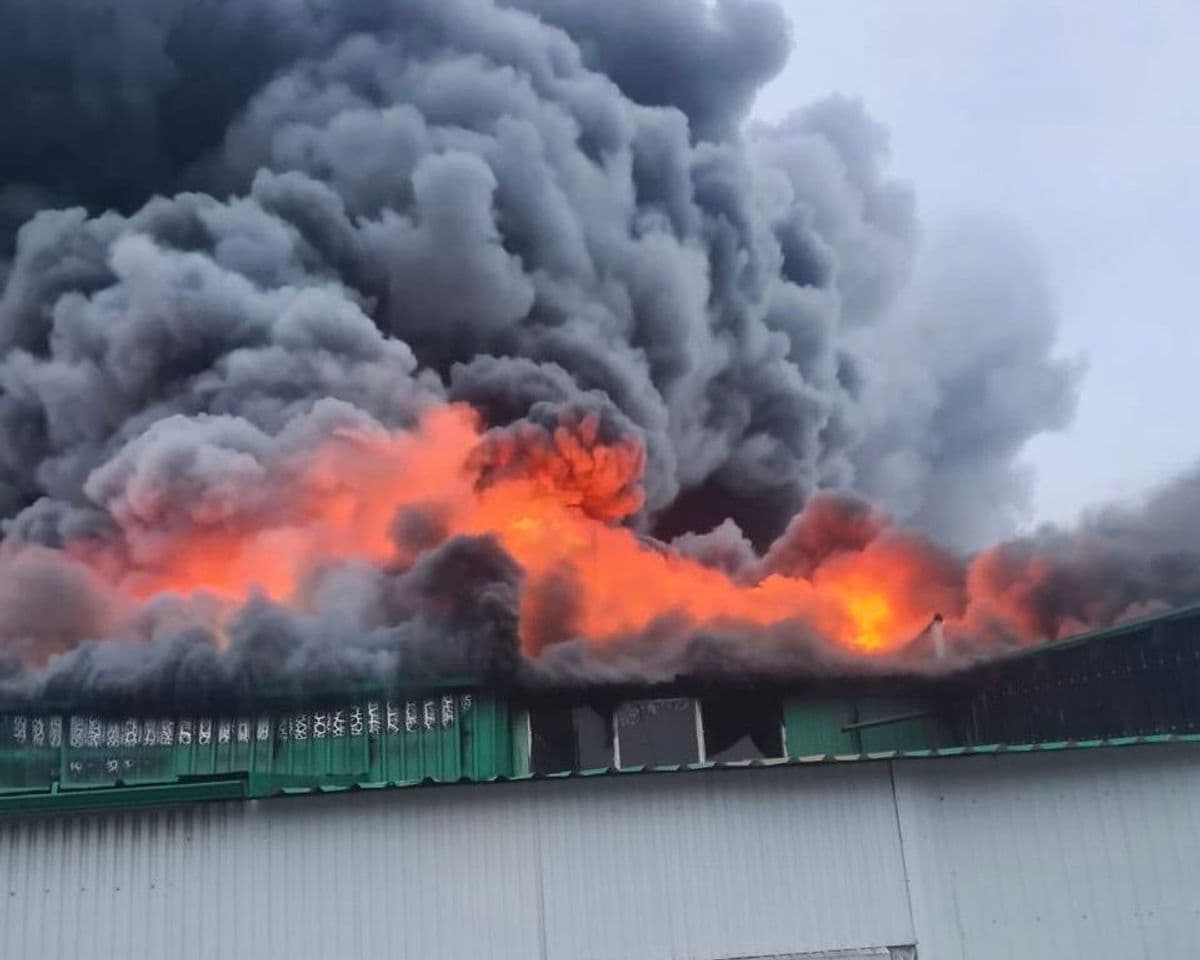
A large fire engulfs an industrial facility in Manevychi, Volyn Oblast, following a Russian drone attack on the morning. (Roman Romaniuk / Telegram)
Seventy-Six
You live in the Izmail district, in Ukraine’s far south, where the Danube meets the Black Sea. On Sunday, your lights go out, and they stay out.
Russian strikes on the Odesa region left 24,100 households without electricity across the Bilhorod-Dnistrovskyi, Izmail and Bolhrad districts. Dispatchers cut power on purpose to keep the damaged grid from collapsing entirely. The private energy company DTEK did not soften the news. “The destruction is extensive,” it said. “Restoring damaged equipment will require time.”
In the city of Odesa itself, Russian fire hit a high-rise in a densely populated district, setting its roof ablaze and wrecking upper-floor apartments. Two people were hurt, among them a teenage girl, said the regional governor, Oleh Kiper. Emergency crews set up a headquarters on the spot to help families who could no longer stay in their homes.
Odesa was only one stop on Russia’s map that night. Overnight, it launched one Iskander-M ballistic missile and 180 attack drones, including 26 jet-powered ones, plus decoys meant to soak up Ukraine’s air defenses. Ukraine brought down 152. The rest struck 20 locations. Electrical substations were hit in the Vinnytsia, Zhytomyr, Khmelnytskyi and Odesa regions. In the Ternopil region, drones hit an energy site near the village of Staryi Vyshnivets. In Rivne, fires broke out across the city.
In Manevychi, a small town in the Volyn region, drones set warehouses and production buildings ablaze at an industrial site. It was the town’s second industrial strike in three days. On Friday, an attack on the Agrofrukt plant there killed one person and wounded eight.
“Tens of thousands of families remain without power,” Zelensky said. “Power engineers and repair crews are working virtually around the clock on restoration.”
Then he gave the week’s full bill. Nearly 2,700 attack drones. About 1,700 guided aerial bombs, known in Ukraine as KABs. And 66 missiles, most of them ballistic. “The main targets of these strikes are specifically energy,” he said. “The Russians are trying to create a blackout.”
The human cost kept coming. Across Ukraine, Russian attacks killed at least 10 civilians and wounded 73 over the past day, regional officials said. The Donetsk region took the worst of it, with seven killed and 14 wounded, most of them in Sloviansk. In the Sumy region, two people died. In Zaporizhzhia, where Russia fired 10 missiles at the city, one person was killed. In the Chernihiv region, a drone struck a family’s yard.
Zelensky aimed his last words at Washington. “America must see that Russia is not making reciprocal steps in response to the lifting of sanctions or agreements,” he said. “On the contrary, they perceive every signal of an opportunity to earn revenue as proof that their bet on war is working.”
Foreign Minister Andrii Sybiha put it in a single line: “Reducing the cost of its aggression while it continues attacking Ukraine will not bring peace. It can only make further aggression easier to finance.”
Fire in the Northern Capital
At 2:50 a.m., the sky over St. Petersburg began to flash.
Russia’s second city, home to 5.6 million people and 850 kilometers north of Ukraine’s border, woke to explosions as Russian air defenses fired into the dark. Residents filmed drones crossing overhead. By morning, the St. Petersburg Oil Terminal — one of Russia’s largest fuel storage and export hubs, handling a reported 12.5 million tons a year — was engulfed in flames. Ukrainian drone maker Fire Point said its FP-1 long-range drone did it.
The terminal was not alone. The city’s governor, Alexander Beglov, reported fires at the Ruchyi oil depot and at industrial warehouses in the Kolpinsky district. Ozon, one of Russia’s biggest online retailers, said a drone hit one of its logistics centers. “We evacuated all employees, and no one was injured,” the company wrote, warning that some orders might be canceled.
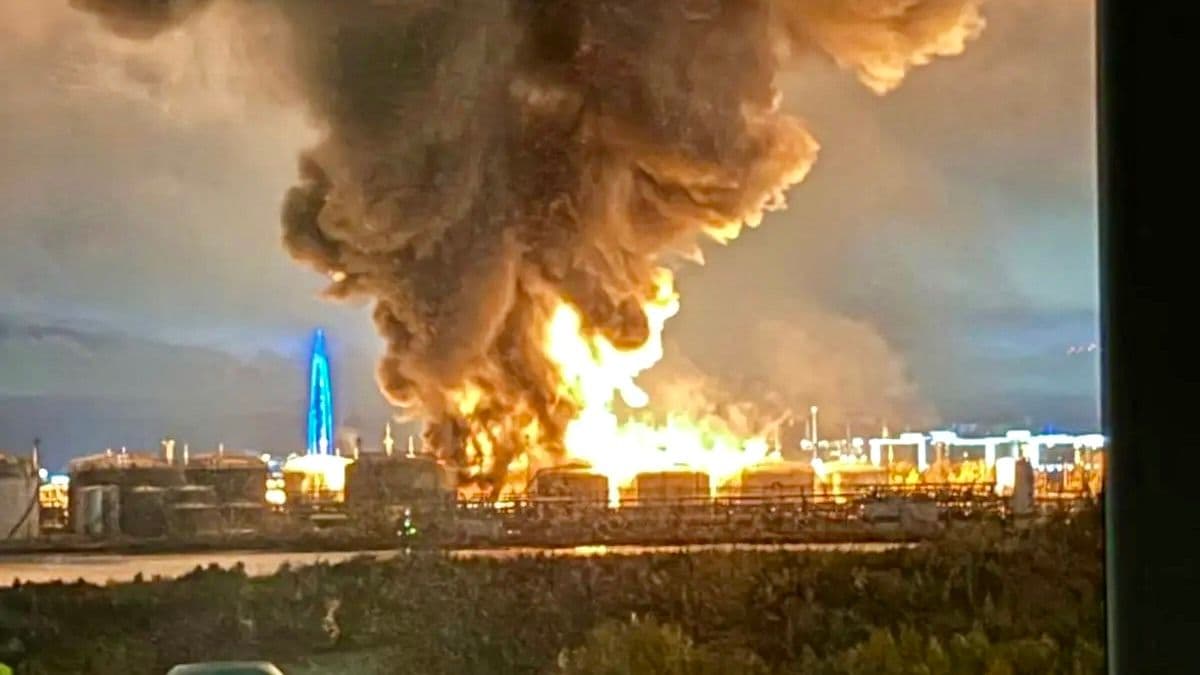
A fire burns in St. Petersburg amid a Ukrainian attack. (Exilenova_plus / Telegram)
And then there was VK, Russia’s largest social network. Ukrainian drones struck and heavily damaged a VK data center near the city. VK insisted its services stayed online. Its users disagreed, flooding outage trackers with complaints. Next door, a 330-kilovolt substation was hit, and about 20,000 people lost power.
It is the latest in a string of Ukrainian strikes on Russia’s internet backbone, after repeated hits on data centers of the Russian tech company Yandex. Zelensky had promised to “respond in kind” to Russian attacks on Ukrainian data centers.
Beglov said one person was killed and five injured; Russian state media later put the injured at 10. Russian officials said 12 apartment buildings and two houses were damaged. Russia’s Defense Ministry claimed it shot down 1,015 Ukrainian drones across Russia, Crimea and the Black Sea overnight, a figure that cannot be checked.
The Institute for the Study of War, a Washington think tank that tracks the fighting daily, called it Ukraine’s largest strike on St. Petersburg’s digital, energy and logistics infrastructure since 2022.
In Moscow, Kremlin spokesman Dmitry Peskov shrugged it off, saying Ukrainian strikes cannot “change the course of events.”
The Ally on the Other End of the Line
You are the officer in Kyiv whose job is to warn a city that a ballistic missile is coming.
For three days this week, that job got much harder. Only the United States, Zelensky said, has the intelligence to tell Ukraine when Russia launches a ballistic missile — and for three days, the warnings stopped. On Sunday, Zelensky said they were back. “We didn’t receive it during ballistic attacks for three days,” he told NBC’s “Meet the Press.” “We are very thankful for this. Now it works.”
That was the good news. The rest of the day went the other way.
First, the missiles. Patriot interceptors are Ukraine’s best defense against ballistic missiles, and NATO allies have paid for American Patriots through a program called PURL, the Prioritized Ukraine Requirements List. Zelensky told Bloomberg that Washington had approved delivery of only some of them. “And this is not a technical issue,” he said. He put the current flow at 12 Patriot interceptors a month, about a quarter of what Ukraine received under President Joe Biden — and now Ukraine has to pay for them. His offer to Washington had been simple: “We don’t target Russian diesel, you give us missiles for Patriot systems to protect our facilities. But they just want us to stop attacking diesel.” The U.S. government has not confirmed his figures.
Second, the satellites. Since Wednesday, Ukraine’s Starlink connections have been capped at 161 kilometers an hour, too slow to steer interceptor drones onto Russia’s jet-powered drones. The cap also covers Starshield, SpaceX’s more secure military version. Asked whether Trump or SpaceX founder Elon Musk ordered it, Zelensky answered: “both,” and said Ukrainian intelligence shows “it was a message from the American government to limit this feed, and technically SpaceX did it.” Secretary of State Marco Rubio said Ukraine has no Starshield access for strikes deep into Russia and that it is “under discussion.”
Treasury Secretary Scott Bessent pushed back hard on NBC. “President Zelensky should be very careful about making statements like this that aren’t true,” he said, adding that Trump and Rubio “categorically” denied ordering the cap. On sanctions, he said “no sanctions have been lifted” — and it is true that the new penalties under the Graham sanctions law were waived on Friday before they ever took effect. Rubio called the waiver a 60-day pause to study the economic fallout, and White House spokeswoman Taylor Rogers said enforcing the sanctions now would get in the way of peace talks.
Trump explained himself on Truth Social. “I am in the process of negotiating Peace in the war between Russia and Ukraine, and don’t want to do anything that will drive, foolishly, Russia away from the bargaining table,” he wrote. He blamed Ukraine’s refinery strikes for hurting world diesel markets and turned on Zelensky: “His country is in shambles, a large portion of his land is lost, his oceans and seas are gone, and his male population is low, wounded, and/or dead. I WANT THIS WAR END!”
Zelensky kept the door open. He spoke by phone with Trump’s envoys, Steve Witkoff and Jared Kushner, about the Miami talks and about Patriots, and said a new round could come as soon as October 20 or 21. “A great deal depends on America’s position here,” he said. On elections, which Moscow and Trump have pressed him to hold, he repeated his condition — a full 60-day ceasefire first — and said he would run again. “If you think that I don’t want elections, it’s not true, and it’s not fair.”
But he also named the fear underneath it all. If the United States and Russia stand together, he said, “we will not prevail, and we will not be able to stand.”
Spillover
On Sunday, a drone crossed into Lithuania, a NATO member, and blew up near the village of Juodzionys in the north. It damaged a passing car and sent residents to shelters. No one was hurt.
NATO fighter jets scrambled but could not identify the object through the clouds, President Gitanas Nauseda said. “Russia’s war of aggression against Ukraine is spilling over onto the eastern flank of NATO and EU,” he wrote. Lithuania’s defense minister said it came from Poland; Poland’s Defense Ministry said its radar saw no such crossing. Ukraine’s Foreign Ministry offered a possible explanation and an apology: Russian electronic warfare may have diverted Ukrainian drones from their targets. Ukraine was striking St. Petersburg that same night. “We apologize for any disruption, risks, and concern this may have caused,” spokesman Heorhii Tykhyi said.
The same night, someone tried to burn down a Lithuanian company that stores Starlink equipment. The attackers went for satellite antennas and a control unit, leaving behind containers of incendiary liquid. The company had been warned and had added guards, and the attempt failed. Prime Minister Mindaugas Sinkevicius pointed at Moscow: “It is likely that it is already clear who commissioned it — the Russian side.” It resembles a September arson at a Starlink station in Poland and incidents in Bulgaria.
Across the Black Sea, Romania’s acting defense minister, Radu Miruta, said the two drones Romanian jets shot down near Sulina on Saturday may have been Russian Geran-4s, judging by their speed of 450 kilometers an hour.
The Map Moscow Drew
You hold a position in Malokaterynivka, just south of Zaporizhzhia. On Friday, Russia’s top general told Putin his troops were five kilometers from the city.
On Sunday, your commanders answered him. Southern Forces spokesman Maksym Kravchuk said Ukrainian troops still control Malokaterynivka. Zelensky put the front about 20 kilometers from Zaporizhzhia. ISW, which checks claims against geolocated video, found Russian forces at their closest about 24 kilometers away.
“We are seeing results on the front,” Zelensky said in his evening address. “Since the start of fall, our warriors have liberated more territory than the Russians have managed to capture.”
Much of that came from Operation Vivaldi, Ukraine’s counteroffensive in the Lyman direction. Its commander, Brig. Gen. Andrii Biletskyi of the Third Army Corps, said it has freed 16 settlements and 277 square kilometers. An officer from one of its drone battalions described how: drones flew above the infantry like close air support — the role attack aircraft usually play over troops in contact — and armored units encircled the village of Kolodyazi northeast of Lyman and freed it without street fighting.
Moscow’s paper victories kept unraveling. A source reporting on Russia’s own Western Group of Forces said General Valery Gerasimov’s claims to have taken Kovalivka and Palamarivka near Kupyansk were unconfirmed. A Ukrainian brigade denied Russia had seized Kolodyazne near Velykyi Burluk. In Dobropillia, a Russian soldier raised a flag in the southeast of the town after slipping in with a small team; ISW has seen no sign Russia holds ground there.
The fighting is still real. Russian troops crept into the eastern edge of Lyman and north of Kupyansk-Vuzlovyi, where Ukrainian drones hit them. Near Sumy, Ukrainian forces advanced or held near Myropillia, in an area Russian sources had claimed; a source close to Russia’s Northern Group of Forces said Russian troops there are focused on Myropillia and on Novodmytrivka, southeast of the city. South of Orikhiv, Ukrainian drones caught a Russian all-terrain vehicle carrying an infiltration team in Novodanylivka. Around Kharkiv, Sloviansk, Kostiantynivka, Hulyaipole and Novopavlivka, Russian attacks gained no confirmed ground, though Russian military bloggers claimed small advances near Kurtivka, southeast of Sloviansk, and north of Raiske, near Kostiantynivka. Near Hulyaipole, Ukrainian forces counterattacked, ISW reported.
Also Today
Oleshky, starving. Foreign Minister Sybiha said Russia has turned occupied Oleshky, across the Dnipro from Kherson, into a “death trap” for about 1,700 people, with the only road out mined, the hospital out of medicine and bodies left unburied. “People cannot survive on statements of concern,” he said, appealing to the UN and the Red Cross. On Friday, Pope Leo XIV urged Putin by phone to allow aid and evacuation; the Kremlin said Putin blamed Ukraine.
A door opens in Budapest. Hungarian Prime Minister Peter Magyar said Ukrainian grain can transit Hungary to Western Europe, after Zelensky asked neighbors to reopen land routes because Black Sea shipping is blocked by Russian attacks. Magyar called Kyiv’s new minority-education law “a first step towards rebuilding mutual trust.”
Poltava’s Saturday. A Russian bombardment of the Poltava community on Saturday killed a 59-year-old man and wounded four, police said.
Hunting the Smerch. A Ukrainian drone unit said it destroyed a Russian BM-30 Smerch heavy rocket launcher and its reload vehicle about 60 kilometers behind the front, a launcher it said had been firing on the Kherson and Mykolaiv regions.
Firebombs on drones. A Ukrainian source said Russia has begun fitting its Gerbera-2 strike drones with incendiary warheads on top of their standard 10-kilogram explosive charge.
A new Russian division. ISW found more evidence that Russia has reorganized its 4th Motorized Rifle Brigade into the larger 84th Motorized Rifle Division in eastern Ukraine.
The Russian who chose Ukraine. Anastasia Vistorobska, 41, left a career embroidering for Chanel and Givenchy in Paris to serve as a combat medic with the Freedom of Russia Legion, Russians fighting for Ukraine, Lord Ashcroft reported. “I have seen 42 comrades go on a mission but only 38 came back,” she said.
Music through the sirens. The National Symphony Orchestra of Ukraine and the Dumka choir recorded Gounod’s “Romeo and Juliet” for a Danish opera film despite blackouts and alerts. Composer Alla Zagaykevych was named Maestra Honoris Causa by the Royal Conservatoire in The Hague, and conductor Oleksandra Korobka won Best Female Conductor at a competition in Romania.
Permission to rest. Kyiv psychologist Oleksandra Hurovych told Kyiv Post that growing tired of donating, volunteering and following the news is “absolutely normal.” “You get tired, too, even of doing good things,” she said.
The Closing
Tonight, somewhere in the Izmail district, a family is waiting for the lights to come back, and somewhere in St. Petersburg, an oil terminal is still burning. That is what a truce looks like when only one side keeps it. Ukraine asked for missiles and was told to be careful what it says. It is still standing, and it is still asking. The question for the rest of us is whether we are still listening.
A Prayer for Ukraine
1. For Those Who Defend
Lord of hosts, cover the soldiers in Malokaterynivka, Dobropillia and Lyman, who hold ground that Russia’s generals have already claimed on paper. Steady the drone pilots and the F-16 crews who chase jet drones across the night sky, and the crews of Operation Vivaldi who freed Kolodyazi without a street battle. Give the officers who sound the alarms over Ukraine’s cities clear warning and quick hands.
2. For the Wounded and the Grieving
God of all comfort, receive the seven killed in Donetsk region, most of them in Sloviansk, the two lost in Sumy region, and the man of 59 killed in Poltava. Heal the teenage girl hurt in Odesa and every child wounded this week. Remember the people of Oleshky, hungry and trapped, and the dead their neighbors are forbidden to bury. Let their suffering be seen, and let justice not sleep.
3. For Those Who Lead
King of kings, give President Zelensky patience and courage as he pleads for his people with allies who hesitate. Grant President Trump, his envoys and the Congress the wisdom to see clearly who keeps a truce and who breaks it. Bless Hungary’s new openness, and give every leader in Europe and Washington the resolve to protect the innocent rather than reward the aggressor.
4. For the Grid and the Towns
Faithful God, strengthen the repair crews working around the clock in Odesa, Vinnytsia, Zhytomyr, Khmelnytskyi, Ternopil and Rivne regions. Bring light back to the 24,100 homes of Bilhorod-Dnistrovskyi, Izmail and Bolhrad. Protect the workers of Manevychi, struck twice in three days, and shelter every family whose home was damaged before the cold arrives. Give the engineers rest between the strikes, and let what Russia breaks by night be mended by day.
5. For a People Who Keep Standing
Father, Ukraine kept its word for days while its power plants burned, and still it asks, and still it hopes. Sustain the medics, the musicians, the volunteers and the weary who give long past their strength. Let them rest without shame and rise again. Be near to every family waiting tonight in the dark for the lights to return. In Your mercy, in Your justice, in Your time — bring this war to its end, and let the ending be worthy of what Ukraine has endured.