
The Ukraine Daily Briefing · Saturday, November 14, 2026 · Day 1,725 of the Full-Scale War
Prepared by Diana Bozhyk
The Day’s Reckoning
For the first time, Washington has asked Kyiv the question everyone had avoided: would Ukraine give up the rest of Donbas in exchange for NATO membership? President Volodymyr Zelensky disclosed the idea, said any concrete offer would go to a public vote, and announced a prisoner exchange that would be the largest of the war. At the same time, a Russian position paper reported by The New York Times showed Moscow asking for more than it did in 2021, from a NATO pullback to limits on French and British nuclear weapons, while the Kremlin refused an energy ceasefire. Ukraine marked a sixth day of Starshield speed restrictions over occupied land, and US senators demanded SpaceX’s records. Russia hit Zaporizhzhia again on Saturday, wounding more than 20 people and closing the dam crossing, and drones struck Kharkiv and Sumy oblasts. Ukraine hit an air base in Lipetsk and a key oil hub in Samara Oblast. At the front, Ukrainian troops pushed east of Oleksandrivka as Russia pressed hardest toward Dobropillia.
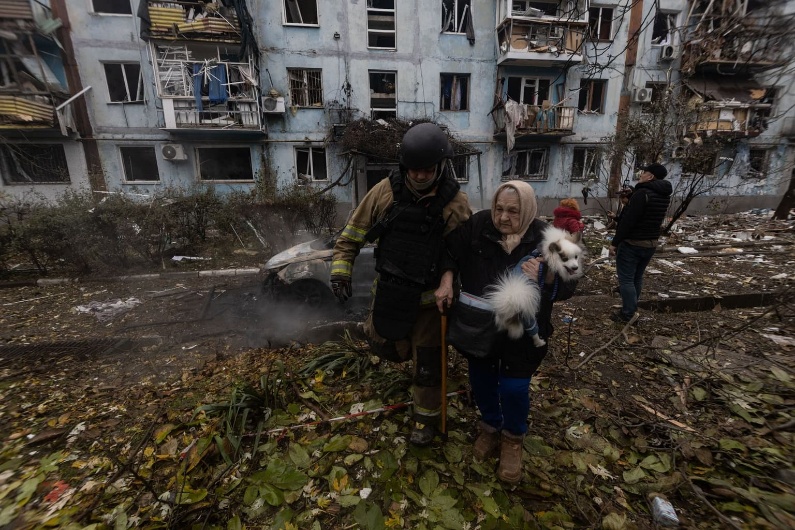
A firefighter helps a resident carry her pet in a devastated residential area following a Russian airstrike in Zaporizhzhia, Ukraine. (Francisco Richart/Anadolu via Getty Images)
The Question From Washington
“The Americans raised the question: ‘What if Ukraine joins NATO? Would Ukraine withdraw from Donbas?'” Zelensky told journalists on Friday evening, describing the US-brokered talks in Abu Dhabi. “This was the first time this issue had been raised.”
He set out what Kyiv would need before even considering it: guarantees from NATO and the EU, an army of adequate size with weapons and funding for a fixed period, and a recovery plan with clearly identified money. “If the American side confirms precisely this to us, together with other NATO partners, then I will ask our Ukrainian society what it thinks,” he said. “I have no right to make that decision on my own.” Any deal, he added, would come “without any recognition of the occupied territories as Russian.” Zelensky said he had asked for guarantees modeled on NATO’s Article 5, the alliance’s mutual-defense clause, “as an absolute minimum”; US officials now speak of something similar to Articles 4 and 5, along the lines of Washington’s bilateral commitments to Israel. Asked whether American soldiers would deploy to Ukraine, the US side answered “No.”
The same briefing brought firmer news on prisoners. Kyiv had pushed for an “all-for-all” exchange in Abu Dhabi; after US envoys Steve Witkoff and Jared Kushner saw Vladimir Putin in Moscow, the sides agreed to swap 1,200 to 1,300 people each. “The main signal was to conduct the largest exchange of the entire war,” Zelensky said. White House deputy press secretary Anna Kelly said the envoys have begun preparing it.
Europe, Zelensky said, will no longer sit “in the next room” but at the main table. He asked Europeans to finalize their delegation by the end of November, expected it to number three to five officials, and noted that Kyiv has the final say on its makeup. A senior European official told TVP World that Björn Seibert, chief of staff to Commission President Ursula von der Leyen, will represent the Commission alongside the E5 national security advisers. Zelensky warned against letting the talks start with a redesign of Europe’s security order. “First, this war must be ended,” he said. “There are no security guarantees in Europe and for Europe without Ukraine.”
On Saturday, Kushner wrote on X that Washington’s focus is now “facilitating direct engagement between Moscow and European partners” and preparing the agenda for the next trilateral round. “Several new ideas emerged from these discussions and are now being explored,” he wrote, calling NATO a “critical pillar” of European security.
Moscow’s Paper
The document is unsigned, a “non-paper” in diplomatic terms, but The New York Times, which obtained a copy, said two sources involved in the talks described it as Russia’s opening position. It repeats Moscow’s December 2021 ultimatums almost word for word: NATO forces out of every country that joined after 1997, no further enlargement, no Western weapons for Ukraine and no “military activity” in Ukraine, Eastern Europe, the South Caucasus or Central Asia. It then goes further. It asks NATO to end nuclear-sharing arrangements, bars France and the United Kingdom from using their nuclear deterrents to protect European allies, and would accept Ukraine in the EU only if it is excluded from the bloc’s common defense policy. Russian negotiators, the sources said, held up the Cold War division between NATO and the Warsaw Pact as a model for Europe. Witkoff and Kushner replied that circumstances have changed since 2021.
The Institute for the Study of War (ISW), a Washington think tank, said the American question about NATO membership amounts to an implicit rejection of Moscow’s core demand. Ukrainian lawmaker Mykola Kniazhytskyi told Politico that Putin is stalling to win a war of attrition. Vladimir Medinsky, who led Russia’s delegation, has kept to the same line: non-bloc status for Ukraine, caps on the size and weapons of its army and recognition of Russian rule over Crimea and four regions.
Zelensky also said Putin personally turned down a proposal for a mutual halt to strikes on energy infrastructure. In Abu Dhabi, Russia’s delegation claimed it had no mandate; after the envoys took the question to Moscow, the answer came back. “A ceasefire is not supported personally by Putin,” Zelensky said.
He dismissed Putin’s offer of a “humanitarian mission” in Kostyantynivka as “an absolutely primitive move, because otherwise he cannot take this city.” Kyiv, he said, gave the Americans a list of seven or eight blockaded settlements where civilians, including children, remain, among them villages near Oleshky; Russia proposed none of them. “Why? Because after Kostiantynivka come Kramatorsk and Sloviansk.” Citing satellite imagery, he said Russian forces used the recent Oleshky truce to bring up weapons and fortify positions, and presidential adviser Dmytro Lytvyn said troops were rotated in under its cover. When he explained this to the US negotiators, Zelensky said, “they said: ‘Yes, we understand.'”
The Dam Is Closed
A 45-year-old man was riding his scooter along the main road of Kushuhum, just outside Zaporizhzhia, on Saturday when a Russian FPV drone — a small first-person-view attack drone — hit him. He died on the spot. In the city itself, strikes across three districts wounded 22 people, among them a six-month-old boy, a two-year-old girl and a 12-year-old. In the Voznesenivskyi district alone, 17 people were hurt as an apartment block and a school were damaged; in Khortytskyi, two women and the infant were wounded; earlier, a strike on an infrastructure site in Zavodskyi set a fire and injured a 32-year-old man. Authorities closed traffic across the DniproHES dam in both directions and sent drivers to the city’s other bridges.
Officials also updated Friday’s toll. A man trapped under rubble at an industrial site in the Kosmichnyi district had been killed alongside the 17-year-old boy, and a woman wounded in Thursday’s attack on public transport died in hospital, bringing the region’s two-day death toll to four. Governor Ivan Fedorov reported that one Russian salvo of 10 missiles hit an apartment building, injuring 29 people and leaving two buildings uninhabitable.
In Hlukhiv, Sumy Oblast, a drone hit a house, wounding a woman and her nine-year-old grandson, who was taken to intensive care with blast and shrapnel wounds. As police arrived, a second drone struck the same spot and wounded an officer. In Derhachi, near Kharkiv, drones injured three adults and damaged six homes; four children, aged four to 13, were treated for acute stress. Across Ukraine, authorities counted at least seven people killed and 80 injured over the day: two dead in Kherson Oblast, one each in Donetsk and Kharkiv oblasts, with further injuries in Dnipropetrovsk and Chernihiv oblasts and some 50,000 Odesa Oblast customers left without power. In Sumy Oblast, Russia carried out more than 40 attacks, injuring seven people. The Air Force said Russia launched 96 drones overnight, including Gerbera and Parodiya decoys; 81 were downed or jammed, and eight locations were hit. On Saturday morning, an explosion was heard in central Kyiv as several drones remained in the air.
Russia is also sharpening its aim. The Telegraph reported that Iskander ballistic missiles now carry optical and radar seekers that correct their course in the final seconds, and presidential adviser Serhii Beskrestnov confirmed they were used against Kyiv’s bridges; four hit the North Bridge in a single night last weekend. A Kremlin-linked blogger said the bridge strikes are meant to cut the capital’s grid in two along the Dnipro. Russian bloggers also showed a new ground-launched version of the Dan-T loitering munition, normally fired from drones or helicopters, which may be harder to detect at launch.
At sea, drones of unknown origin struck three merchant ships off Romania’s coast on Friday and Saturday: the Ukraine-bound Larissa 1, whose crane was damaged, and the tanker Evia Petrol V and bulk carrier Marsol near Sulina, both of which caught fire. No one was hurt. Defense Minister Ștefan-Radu Oprea said an investigation is under way. Romania scrambled two F-16s after detecting an aerial target east of Snake Island.
Starshield, Day Six
“If you impose restrictions there, you are already partially recognizing the temporarily occupied territories as not ours,” Zelensky said of the 161-kilometer-per-hour (100 mph) speed cap on Starshield, the military version of SpaceX’s Starlink, over Russian-held land. Ukraine has never had Starshield over Russia itself; extending a similar limit to occupied Ukraine, he warned, “already sounds political.”
The practical cost is in the sky. Russian jet-powered drones are usually intercepted over occupied territory, before they reach government-held areas. Ukrainian interceptors such as the Bars drone rely on Starshield and can no longer catch them there. “We have to shoot them down at other lines of defense, and this gives the Russians more opportunities to attack,” Zelensky said. The Defense Ministry spoke to SpaceX, which said it was “not imposing any restrictions” and called it a technical issue. “We do not believe that is the case,” Zelensky said; Ukraine tests the links in different directions daily and “every day, we get the same confirmation.” He added that Secretary of State Marco Rubio had earlier told him Starshield was “more under the control of the U.S. government than of SpaceX,” which does not square with what his team now sees. ISW noted that Russia launches many of these drones from sites in occupied Donetsk and Hvardiiske in Crimea, so the cap shortens the window to catch them.
In Washington, Senators Jeanne Shaheen and Chris Coons sent Elon Musk a four-page letter demanding SpaceX preserve all logs, software changes and correspondence with the White House, the Pentagon and Russian officials since September 1, with a November 30 deadline. “The October and November restrictions now raise the disturbing possibility that these vulnerabilities persist even within systems on which the US government relies,” they wrote. Representatives Gregory Meeks and Adam Smith, the senior Democrats on the House foreign affairs and armed services committees, said earlier restrictions had contributed to civilian casualties in Ukraine.
The Line
The commander of a Ukrainian regiment near Dobropillia said on Saturday that his troops destroyed seven vehicles and three all-terrain vehicles and killed or wounded about 30 Russian soldiers while repelling a recent mechanized assault, likely the armored push toward Hruzke on Friday. The numbers show where Moscow is concentrating: the General Staff counted 47 Russian attacks in the Dobropillia direction over two days, the most since November 1, and 11 near Kostyantynivka. ISW calculated that these two sectors account for 80 percent of all Russian attacks on Ukraine’s Fortress Belt, the chain of fortified cities in Donetsk Oblast, since early October. Footage from November 11 showed a separate Russian mechanized assault toward Druzhkivka, with several infantry fighting vehicles and light vehicles, and Ukrainian drones destroying several of those vehicles near Nova Poltavka, about 10 kilometers behind Russian lines, before they could reach the front. ISW said Russian forces have failed to consolidate their infiltrated positions inside Kostyantynivka, despite claiming the city since July, and have not taken Dobropillia, though Moscow’s Defense Ministry once said it had encircled and seized the town. A local truce around Kostyantynivka, the think tank warned, would let Russia move heavy equipment up to the front without fear of Ukrainian drones.
The clearest Ukrainian gains came farther south. Military observer Kostyantyn Mashovets said Ukrainian forces have built a bridgehead along the east bank of the Mokri Yaly River, cleared Perebudova, Komar and Fedorivka, and reached within a kilometer of Vesele, east of Oleksandrivka; a Russian blogger confirmed that Komar had been cleared. By his count, Russia now holds only two settlements in Dnipropetrovsk Oblast, Dachne and Novomykolaivka. South of Novopavlivka, a Ukrainian regiment reported finishing a three-week clearing operation in and around Filiia, and Mashovets said Russian infiltrators moving west from Novoserhiivka along both banks of the Solena River reached the area of Novomykolaivka and Muravka before being stopped near Biliakivka, so Russia does not hold it or Marivka as claimed.
Russia did gain ground in two places, according to geolocated footage of Ukrainian artillery hitting newly taken Russian positions: near Zarichne, northeast of Lyman, and north of Rai-Oleksandrivka, east of Slovyansk. Its Defense Ministry claimed Tersianka, northwest of Hulyaipole, a village about 21 kilometers beyond the farthest confirmed Russian advance; Russian bloggers credited the 36th Motorized Rifle Brigade. Neither side reported ground fighting in the Kherson direction. Ukrainian forces counterattacked northeast of Kharkiv and southeast of Orikhiv, while Russian attacks in northern Sumy Oblast, near Kupyansk and Borova and inside Kostyantynivka made no confirmed progress.
Deep Strikes
Ukraine’s General Staff confirmed a strike on the Samara oil pumping and dispatch station near Prosvet, about 950 kilometers from the front, where several storage tanks caught fire. The station blends crude from Tatarstan and western Siberia into Urals, the grade behind about half of Russia’s oil exports. The General Staff also said a hangar for aircraft maintenance equipment, a fuel tank and the central command post were hit at Lipetsk-2 air base, home to Su-34, Su-35 and MiG-31 jets. An open-source analyst updated the damage at the Volgograd refinery hit on Thursday night: four primary processing units, hydrotreating and coking plants and six storage tanks, with a fire covering some 3,500 square meters.
Also Today
Denmark and Britain. Back in Kyiv, Zelensky announced a €645 million defense package and €20 million for energy from Denmark, plus new British sanctions on Russia’s oil sector. On his trip he also met the prime ministers of Ireland, Poland, Italy and the Czech Republic and Lithuania’s president. He said Ukraine aims to close its last two EU accession negotiating clusters by the end of 2026.
Bulgaria and Poland step back. Bulgarian Prime Minister Rumen Radev said in Dublin that Sofia has no money for Ukraine and will no longer supply weapons from its stocks, though it will not block other members’ aid. Radev said any EU funds Bulgaria guarantees should go only to humanitarian needs, power and medicine, with part set aside for the ethnic Bulgarian community in Odesa Oblast. Polish Prime Minister Donald Tusk told NATO’s Mark Rutte that Warsaw will not pay into PURL, the scheme through which Europeans buy American weapons for Ukraine, citing its own defense spending; Zelensky said PURL needs fresh money before winter.
Anti-corruption. Zelensky said anti-corruption officials told him Health Minister Viktor Liashko, Security Council Secretary Ihor Klymenko and lawmaker David Arakhamia have no links to the Khimprom drug network whose members discussed bribing officials. He said the network has spread into Poland and is trying to enter Germany, and asked partners, “above all, the Americans,” to help stop it.
Online and in sport. YouTube blocked 16 Russian channels for viewers in Ukraine, including pro-war bloggers and foreign-language versions of Masha and the Bear. After Elina Svitolina beat Aryna Sabalenka at the WTA Finals, Belarusian opposition figure Pavel Latushka condemned Sabalenka over footage allegedly showing her insulting her Ukrainian opponent and called for her ban.
Hungary’s buried cash. Prime Minister Péter Magyar said investigators seized more than $18 million in cash, some buried in forests, in a probe into Miklós Seszták, a minister under Viktor Orbán; Tusk noted that Orbán’s brother Áron was detained days earlier in a people-smuggling case.
Air defense. Zelensky said Ukraine’s domestic anti-ballistic missile under the FREYJA program is ready, with Denmark completing the radar component.
The Closing
In Zaporizhzhia, emergency crews walked the impact sites on Saturday morning, counting shattered windows and seven damaged cars, and told reporters the casualty figures were still being clarified. Across the river, the dam road stood empty, closed in both directions. Drivers turned toward the Arch Bridge, the Cable-Stayed Bridge and the Preobrazhenskyi Bridge.
A Prayer for Ukraine
1. For Those Who Defend
Lord, stand with the soldiers near Dobropillia who stopped armor before it reached their lines, and with those who cleared Komar, Perebudova and Fedorivka field by field. Steady the crews whose interceptors can no longer reach the sky they once guarded. Give rest to the weary, healing to the wounded, and bring home soon every one of the prisoners now promised in the largest exchange of this war.
2. For the Wounded and the Grieving
Merciful God, receive the man struck down on his scooter in Kushuhum, the man buried under rubble in Kosmichnyi and the woman who died of Thursday’s wounds. Hold the six-month-old boy, the two-year-old girl and the nine-year-old in Hlukhiv’s intensive care. Protect the police officer hurt while helping others, and comfort the children of Derhachi who still shake after the explosions.
3. For Those Who Lead and Negotiate
Lord of truth, give Ukraine’s leaders wisdom as hard questions are placed before them, and let no choice about land and people be made without the people themselves. Give Europe’s negotiators firmness and unity, and grant American envoys clear sight about the papers placed on the table. Turn hearts in Moscow from conquest, and let any peace rest on truth rather than fear.
4. For Cities, Bridges and Light
God of light, guard the bridges of Kyiv and the dam of Zaporizhzhia, and the people who cross them every day. Strengthen repair crews restoring power to Odesa’s villages and the homes of Derhachi. Protect sailors on the Black Sea and the engineers who guard the grid, and let warmth and light hold through the coming winter in every city on both banks of the Dnipro.
5. For a People Who Keep Standing
Faithful Lord, on the one thousand seven hundred twenty-fifth day, sustain a people who keep driving to work by another bridge when one is closed. Renew courage in those who wait for sons and daughters in captivity, and hope in the towns that live beneath the drones. Let Ukraine walk toward the day when roads open and no one fears the sky.
In Your mercy, in Your justice, in Your time — bring this war to its end, and let the ending be worthy of what Ukraine has endured.